This year marked the 76th anniversary of the first NIWBT
The Illini women’s basketball team finished third in the 2025 NIWBT (Photo by Craig Pessman)
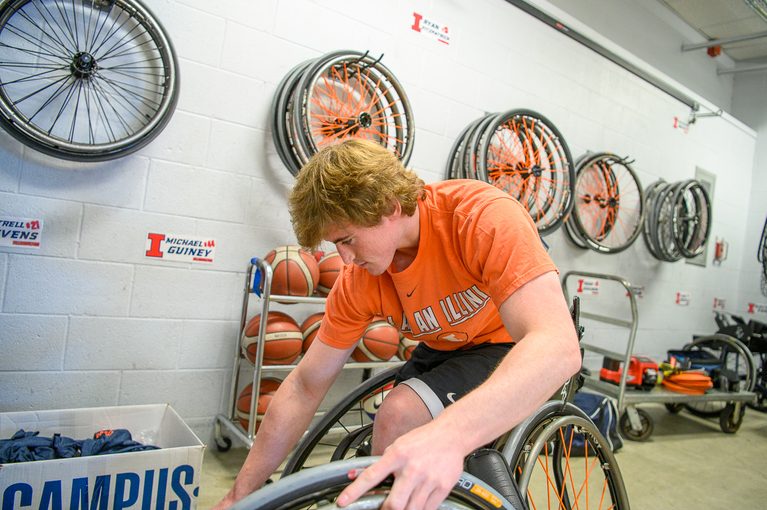
The University of Illinois and Illinois Wheelchair Athletics played host last week to the 47th Annual National Intercollegiate Wheelchair Basketball Tournament and even though neither Illini team took home a title, the event at the State Farm Center was still an opportunity to showcase Illinois as a trailblazer for disability resources and adaptive sports.
This year marked the 76th anniversary of the first NIWBT, which was hosted in 1949 at a University of Illinois satellite campus in Galesburg, Illinois. The tournament was organized by Dr. Tim Nugent, the first director of Disability Resources and Educational Services, also known as DRES. In honor of the man known as the “father of accessibility,” the tournament winner is awarded the coveted Timothy J. Nugent Championship Trophy.
This season’s NIWBT featured 11 men’s teams and 6 women’s teams competing in 21 total games across four days, from March 26-29.
In terms of results, the Illini women’s team reached the semifinals after beating City University of New York 72-19, but lost to Texas-Arlington 59-40. The Illini women did defeat Arizona, 62-37, for a third-place finish.
Women’s coach Stephanie Wheeler praised the fans for making their voices heard.
“You could hear their screams, you could hear their I-L-Ls, you could hear them say the names of the players,” Wheeler said. “It’s that kind of energy that translates on court.”
The Illinois men beat Eastern Washington 79-39 in their first-round game, but were defeated by Alabama 65-47 in their second game. The Illini men did cap their play by beating Missouri 51-34 in a consolation game.
In the men’s bracket, top-seed Arizona beat Texas-Arlington 75-65 to win the Nugent trophy. For the women, top-seeded Alabama beat UTA 67-52 to secure the title, its fifth straight title since 2019 (the 2020 tournament was canceled because of the COVID-19 pandemic).
The Illinois men last won an NIWBT title in 2010, while the Illini women have yet to capture the Nugent trophy since women’s play began in 2011. Despite the teams’ current droughts, both programs hold 29 championships between them.
Three members of the men’s team—Ryan Fitzpatrick, Sebastian Milan and Martrell Stevens—left Champaign-Urbana shortly after the tournament to play for Team USA in the IWBF Men’s U23 Americas Championship from April 2-6 in Bogota, Colombia. That tournament features Brazil, Canada, Colombia and Team USA, competing for two qualification spots at the 2025 IWBF Men’s U23 World Championship, taking place in São Paulo, Brazil in June.
Next year’s NIWBT will be played at the University of Arizona.
AHS Get to Know: Laura Mattie, associate professor in the Department of Speech and Hearing Science
Laura Mattie joined the College of Applied Health Sciences in 2015. She leads the Development in Neurogenetic Disabilities Lab, or “DND” Lab.
How would you describe your primary research interests?
My primary research interest is learning how young children with neurodevelopmental disabilities develop early social and communication skills to inform parent-implemented early language interventions.
Why did you decide to apply to work at Illinois?
I applied to Illinois because it was one of the only job postings that targeted expertise in children with disabilities and family well-being, which signified that my work was already valued.
What are you working on right now?
I have 4 main projects right now:
The Power of the Point Project focuses on the predictors of early language development in toddlers with Down syndrome and fragile X syndrome.
ASD Screening Tools in Down Syndrome is a large-scale survey of caregivers of individuals 6-18 years old that aims to determine how to best use autism screening tools for this population.
The Speech Accessibility Project aims to make voice recognition technology useful for individuals who may have diverse speech patterns and disabilities, including people with Down syndrome.
A Foundational Study of Adaptive Behaviors in Individuals with Down Syndrome is a survey of caregivers to learn about the practical, conceptual, and social skills used in everyday life by their children with Down syndrome who are between birth to 22 years old.
What’s a fun fact you’d like to share about yourself?
I am a twin mom to 15-month-old girls, so much of my free time is chasing after them! When I do have some down time, I enjoy rewatching TV shows like “The Office” and “Parks & Recreation,” reading, and snuggling with our dogs.
In today’s rapidly evolving media landscape, the spread of misinformation and disinformation regarding scientific topics such as natural disasters, vaccines and climate change can pose a risk to public health.
Camille Hobby
Director of Digital Content Development, University of California Press, profiled in Against the Grain
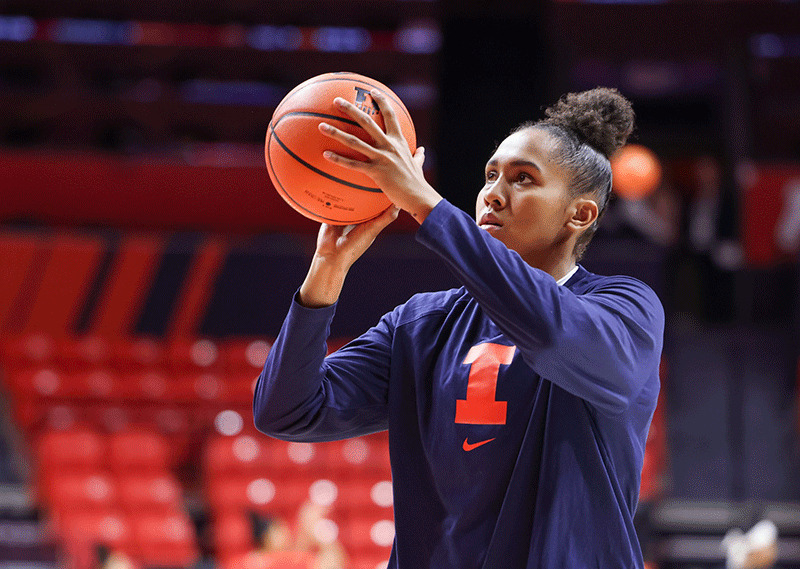
Camille Hobby’s life has always revolved around sports. She grew up moving from city to city as her father, Marion—currently the defensive line coach for the NFL’s Cincinnati Bengals—coached at various colleges and in the NFL, but her personal passion was always for basketball. Now, at 23, graduating with two degrees, three ACC tournament wins and a Women’s Basketball Invitation Tournament championship under her belt, the 6-foot-3-inch center is ready to start a new chapter in her basketball career.
“I think it was kind of just a natural progression,” Hobby said. “I’ve been around sports my whole entire life. I definitely want to stay in sports—college athletics, professional, whatever the case is, so in the future I want to be a coach. I want to get into coaching, and I thought it was the best idea for me to go into (the Department of Recreation, Sport and Tourism).”
I think it was kind of just a natural progression,” Hobby said. “I’ve been around sports my whole entire life. I definitely want to stay in sports—college athletics, professional, whatever the case is, so in the future I want to be a coach. I want to get into coaching, and I thought it was the best idea for me to go into (the Department of Recreation, Sport and Tourism).
Camille Hobby
Director of Digital Content Development, University of California Press, profiled in Against the Grain
Hobby graduated from the University of Illinois Urbana-Champaign with a master’s degree in recreation, sport and tourism in May 2024 after spending her fifth year of eligibility with the Fighting Illini women’s basketball team. Hobby earned a bachelor’s degree in sport management from North Carolina State University, where she would have played all four years, had COVID-19 not taken a season away.
“I had one year [of eligibility] due to COVID, so I transferred primarily because of basketball, because of having that extra year. But then I wanted to continue that sports management realm of study, so that’s how I ventured my way to the RST department.”
“I had one year [of eligibility] due to COVID, so I transferred primarily because of basketball, because of having that extra year. But then I wanted to continue that sports management realm of study, so that’s how I ventured my way to the RST department.”
In deciding where to spend her last year of eligibility, a few key aspects drew Hobby to choose Illinois. She said the school’s reputation was one factor in her decision, giving a nod to the iconic “Block I” impact on a resume.
“Everyone sees the I. Everyone knows the logo, you know, and that’s extremely important, especially when you’re going into jobs and looking for future places of work.”
She also highlighted the university’s emphasis on community and academics that impacted her decision.
“It’s a tight-knit community—definitely a college town. So, that played a huge role into that [decision], especially playing basketball in an environment that supports the needs of the team, and having great academics was important to me.”
After college, Hobby wants to play professionally in Europe before moving on to coach basketball, putting both her degree and lifetime of experience playing basketball to use. She said coaching would allow her to have a positive impact on the lives of other young athletes, something she has not only experienced from an athlete’s perspective but also witnessed through her father’s own career.
“He played a huge part in that,” Hobby said. “I’ve seen the incredible players that he’s coached in the past and he’s been influential in their lives and that’s something that I want to do, is to make an impact on young people’s lives and get them to be the best versions of themselves.”
Hobby also reflected on how her experience earning a degree in RST aided her service-oriented view of coaching, saying “I’ve always been a person that wants to help people and be of service to others and make them better, and I feel like that’s kind of what the RST department is; it is in the service business of helping others and showing them things and that’s kind of where my heart lies. That’s where I know my dad’s heart lies as well, helping those around us, and the best way, I feel, to do that, is through coaching.”
The program not only helped Hobby prepare for coaching as a public service, but it also emphasized to her the importance of diversity and inclusion in coaching.
“I feel like the biggest part of being a coach is the diversity and equity part of it—universal design and making sure that there’s a space for everyone. I feel like that’s so important, especially as a coach. You want to make sure that your players feel like they are important, feel like they are accepted, whoever they are, what makes them different and unique.”
One specific experience in the program stuck with Hobby: watching wheelchair basketball club teams compete. She recalled how it made her re-think diversity in sports, saying, “that was completely eye-opening for me. I think a lot of the time we hear about having that inclusion, having diversity, but a lot of the time there’s not much action behind it. To see them and see how competitive they are was really inspiring, and it just allowed me to get into that—finding equity and inclusion for everyone. Not just in terms of race or gender, but for someone who has challenges that limit them from playing traditional sports.”
Hobby intends to follow in the footsteps of the people she has looked up to: her father and her own coaches, who she said inspired her on and off the court.
“Having people who advocate for you, people who are just good people who want to see you succeed, that’s important. To see them, it makes me want to be like that in the future: always encouraging my players, believing in them, and wanting the best for them.”