Alumni Spotlight—Steve Staples


Q: Why did you pick AHS?

A: I wanted to pursue a career in sports management and AHS (then known as Leisure Studies) was just starting to offer a M.S. in Sport degree at the time (early 1990s).

Q: Which professors had the most impact on you?

A: Bill McKinney had the most impact on me, academically and professionally. The vast majority of students in the program at that time were planning to pursue careers in parks and recreation. As the chair of the department at that time, Bill made sure that the handful of us interested in sports management, were not overlooked. While working on my master’s degree, I became interested in pursuing a Ph.D., as well. Bill was very supportive and became a terrific advocate and friend throughout the process. I feel very fortunate that I had the opportunity to thank Bill in person in Arizona before he passed away earlier this year.

Q: What course did you most enjoy?

A: I can’t remember the specific course, but I recall really enjoying Dr. (Joseph) Bannon’s class. He emphasized the importance of theoretical concepts in practical settings. His insight had a significant impact on my career and he was an excellent role model.

Q: Did you enter AHS knowing your career path, or did AHS help you decide?

A: I did enter AHS knowing that I wanted a career in sports. What I didn’t know is how much I would like working in athletic administration. After volunteering at (Division of Intercollegiate Athletics), I became a graduate assistant for the athletic department and spent 12 years of my career working in intercollegiate athletics.

Q: Did your AHS experience lead to your current job?

A: I feel that my experience as a master’s and especially a Ph.D. student prepared me well for my current role at Princeton. Writing a thesis and dissertation helped improve my writing skills and critical thinking. Being able to write articulately helps me every day in my job as a major gifts fundraiser.

Q: What was your favorite on-campus experience?

A: My favorite on-campus experiences were Illinois athletic events. Whether it was football at Memorial Stadium, basketball at the Assembly Hall or volleyball in Huff Hall, I attended a lot of games during my three years on campus and I loved every minute of it.

Q: What does AHS mean to you?

A: It means a great deal to me. It was a transformative experience for me. I help to support the study tour that Dr. (Michael) Raycraft leads each year because in my mind, it is the perfect blend of academic and experiential learning. I had a similar experience through my academic training and work at DIA. To understand the theoretical and practical sides of any industry is incredibly important. I am a proud alum of RST, AHS and the university as a whole!

Editor’s note:

To reach Vince Lara-Cinisomo, email vinlara@illinois.edu

Related news

Alumni Spotlight—Ariana Mazza Bensyl


Q: Why did you pick AHS?

A: Being active in sports growing up fostered my interest in exercise and how the body works. I knew going into college that I wanted to be a Physical Therapist. When I was looking into colleges, I was looking for one that provided me the opportunity to get a great education and prepare me for PT school. The College of Applied Health Sciences offered Kinesiology as a program of study, which fit my PT path. I was confident the curriculum would prepare me for getting into PT school, as well as the academic demands of PT school.

Q: Which professors had the most impact on you?

A: One person that most impacted me was my academic advisor, Amy O’Neill. She encouraged me to challenge myself and work hard to attain my goals throughout my time at the University of Illinois. Amy also brought the idea of completing the Physical Education Teacher Licensure program to my attention. I completed the Pedagogy track within Kinesiology and I really enjoyed it. Dr. Amy Woods was one of my professors who saw a lot of potential in me and pushed me to be a better teacher. Another professor that had an impact on me was Mary Carlton. She had such passion and excitement for what she was teaching that it made learning exciting!

Q: What course did you most enjoy?

A: I really enjoyed my Injuries in Sport class. Learning about injuries, how to tape an ankle, preventative care and emergency care was cool! Especially for a kid who had her ankles taped throughout her high school sports career. I also really enjoyed Psychophysiology in Exercise & Sport.

Q: Did you enter AHS knowing your career path, or did AHS help you decide?

A: I did enter AHS knowing my career path. I knew I wanted to go to PT school, but I thought I wanted to work in the sports world of physical therapy. When I was doing my student teaching, I learned that physical therapists could also work in the school environment. This opened my eyes to a different path within physical therapy that was interesting to me and has actually taken me to my current job.

Q: Did your AHS experience lead to your current job?

A: Yes, it did lead me to my current job. My time in AHS prepared me to get into and be successful in PT school. I have received my doctorate of Physical Therapy from Northwestern University (’14) and am currently a PT in Northbrook School District 28. I have been able to combine the love of education and teaching that I learned from my time in AHS with my passion for physical therapy.

Q: What was your favorite on-campus experience?

A: I was part of the Alpha Chi Omega sorority during my time on campus. Creating so many memories and lifelong friendships with my sorority sisters really made for many favorite on-campus experiences. Not necessarily an on-campus experience, but an experience related to my time in AHS, was meeting my husband. A colleague I met while doing my student teaching introduced me to him. He is a fellow AHS ’11 graduate! We have talked about how we were probably in some of the same intro KIN classes our freshmen year but didn’t know it!

Q: What does AHS mean to you?

A: The University of Illinois is such a big university and being part of AHS made it feel smaller. The professors and academic advisors in AHS really created an environment where I felt they wanted me to succeed. AHS means being part of a community that truly cares about their students.

Editor’s note:

To reach Vince Lara-Cinisomo, email vinlara@illinois.edu.
 

Related news

KCH researchers get grant to help Community Health Workers


For Department of Kinesiology and Community Health researchers Andiara Schwingel and Susan Aguiñaga, the concept of helping place Community Health Workers has a personal meaning.

Schwingel, a KCH associate professor, and Aguiñaga, an assistant professor in KCH, recently received a grant of $100,000 for their project entitled, “Online Certificate Programs for Community Health Workers: From Overlooked and Under‑Researched Employees to Well‑equipped Frontline Agents in the Fight to Reduce Health Disparities in Communities of Color. Drs. Schwingel and Aguiñaga plan to establish a coalition that includes Community Health Workers (CHWs) and other stakeholders to develop, evaluate, and disseminate online learning strategies through certificate programs that will train CHWs to address community health needs.

CHWs are full- or part-time employees of health systems. With at least a high school diploma, CHWs receive on-the-job training and work in multidisciplinary teams focused on primary health care, prevention, and health promotion, the researchers said. Although the CHW model is widely utilized across the globe, the U.S. and Illinois have only recently begun to recognize its importance and develop the infrastructure that supports these grassroots health workers. No online training is currently available in Illinois, a gap that Schwingel and Aguiñaga said they want to fill. Illinois is currently developing recommendations for training and certification programs, and, the researchers said, significant progress has been made in Illinois where House Bill HB5412 passed in February 2021, building momentum for CHWs training and this project.

The researchers sought the grant because they believe CHWs are ideal members of collaborative healthcare and prevention teams working with vulnerable populations and underserved communities as they complement the work of formally trained healthcare professionals.

“As I have lived in many different countries, I am very familiar with universal health care systems that adopt the CHW model,” Schwingel said. “I have seen firsthand the important role they play at community settings as frontline workers visiting homes, being a resource and serving as the go-to people for the community. They also carry the voices and opinions of community members to local healthcare teams. I have seen how effective CHWs are in bringing people to clinics for immunization programs and health promotion events.”

Schwingel said she was motivated to address healthcare systems when she moved to the United States about 12 years ago.

“I found that through my research I could contribute to addressing disparities in health by testing the feasibility of using the CHW model with Hispanic communities in this country.”

Schwingel said her goal is to greatly increase the number of CHWs locally.

“That way, when my research funding ends, the community is left with important human resources to continue the endeavors. Over the years, I have experienced a number of challenges working with volunteer CHWs due to the lack of a state/national reimbursement system for these workers. Nonetheless, my interest has only grown, and I have seen increasing interest in this space by grass roots organizations, healthcare employers, and even state and national agencies.”

One of the vital parts of building a CHW pipeline in Illinois is that the CHWs know well and have easy access to hard-to-reach groups such as historically underrepresented populations of African Americans and Hispanics (which includes undocumented individuals), the researchers said, adding that CHWs are members of the communities that they serve, they share culture, language, income, and life experiences. The CHWs can serve as liaisons between health and social services, especially as the percentage of the underrepresented population rises; in fact, by 2050, that population projects to represent 43 percent of the state and national population by 2050.

The researchers said they will work with partners such as the University of Illinois Extension, the Illinois Community Health Workers Association, a group of CHWs that serve African American and Hispanic communities, and a group of CHW employer organizations.

Schwingel and Aguiñaga also plan to use what they call a “culturally and linguistically sensitive approach.” For two women of color, that is especially important, Schwingel said, calling it a “transformational” process.

“It makes use of a patient’s language and culture as tools to improve outcomes for that individual. By tailoring services to an individual’s culture and language preference, health professionals can help bring about positive health outcomes for diverse populations,” she said.

Editor’s note:

To reach Andiara Schwingel, email andiara@illinois.edu.
To reach Susan Aguiñaga, email saguina2@illinois.edu.

Share on social

Related news

Alumni Spotlight—Paige Schober


Q: Why did you pick AHS?

A: I chose AHS because the areas I was interested in studying all fell in the cross section between science and research fields and the health and human study fields.

Q: Why did you pick KCH?

A: I knew I wanted to study Kinesiology because I was passionate about the growing field and all the areas one can take a degree into such as human performance and athletics.

Q: Which professors had the most impact on you?

A: I had so much respect and appreciation for Tina (Matilla) Greenlee, who taught and served as the teaching assistant for several of my courses in KCH. She was so helpful to me and supportive of my growth in the classroom and on the dance team as she was an alumni herself. Amy O’Neill also made a tremendous impact on me in how well she helped me map out my path with such care and consideration.

Q: What course did you most enjoy?

A: I enjoyed KIN 355, Biomechanics of Human Movement with Dr. (Ian) Rice. It was the first time I experienced a crossover between physics and physiology. I was very interested in the quantifiable aspects of movement and the technologies that accompany that tracking.

Q: Did you enter AHS knowing your career path, or did AHS help you decide?

A: I did not know my career path specifically, just that I wanted a career in movement. I started on the Physical Therapy track because it seemed like that was what most people did. It was Amy O’Neill that helped me explore all my options and ultimately discover the world of strength and conditioning through a summer internship.

Q: Did your AHS experience lead to your current job?

A: My experience in AHS absolutely laid the foundation for the rest of my career. I went on to earn a M.S. in Exercise Science from the University of Montana and now I work as an athletic performance coach at UCLA.

Q: What was your favorite on-campus experience?

A: I was a member of the Illinettes Dance Team, so my favorite experience was performing at football games in Memorial Stadium.

Q: What does AHS mean to you?

A: I’m so grateful for my experience in AHS because it truly laid the foundation for the rest of my career. I was exposed to literature, research, and technology at such a high level and it opened my eyes to the world of kinesiology. I learned tools and techniques that I carried with me into graduate school and into my career in exercise science and athletic performance.

Editor’s note:

To reach Vince Lara-Cinisomo, email vinlara@illinois.edu.

 

Related news

Alumni Spotlight—Edward Harvey


Q: Why did you pick RST?

A: I actually entered the University in the College of Commerce (now Gies College of Business). I had been working for the Urbana Park District on a seasonal and part-time basis, doing park maintenance and working in sports and recreation programs. I really enjoyed the work but didn’t realize it was a career. When Robin Hall started at the Urbana Park District, he had a profound influence on me taking another look at my career plans. He arranged for me to talk to Chuck Pezoldt, who was on the faculty at that time. Chuck’s genuine enthusiasm for and boots-on-the-ground experience in the parks and recreation profession proved too persuasive to resist, and I transferred into the then-Department of Recreation and Park Administration.

Q: Which professors had the most impact on you?

A: As mentioned, Chuck Pezoldt’s background in Illinois Parks and Recreation on a local level fit right in with what I was interested in doing when I graduated. Jim Brademas was the Director of (Office of Recreation and Park Resources) ORPR at that time. He also had a wealth of practicable experience as a parks and recreation administrator and also as a consultant. Bob Espeseth didn’t come to the university until I was in graduate school but his background in Wisconsin State Parks and other park systems was very valuable to my education. Bob and I have continued a great relationship for nearly fifty years.

Q: What course did you most enjoy?

A: Chuck Pezoldt taught the undergraduate course in parks and recreation administration, which I found extremely interesting as well as directly related to my background. He gave a quiz on the Illinois Park District Code every class. Great way to learn the code!

Q: Did you enter AHS knowing your career path, or did AHS help you decide?

A: I had already tried two years in the College of Business taking accounting, economics and finance courses. I liked it a learned a lot but part of what I learned was that I probably didn’t want to do it for a profession. Once I learned that parks and recreation was a career choice, it sounded perfect for me.

Q: Did your AHS experience lead to your current job?

A: I’m retired now but yes, it did lead to a career of 38 years in three park districts: Urbana, Champaign and Northbrook. In retirement, one of my favorite activities is bicycle riding. I often ride through the local Champaign and Urbana Parks and see how the trees I planted 50 years ago are doing. It’s more than a career when you do it for a lifetime.

Q: What was your favorite on-campus experience?

A: I played in the Marching Illini for three seasons, carrying a sousaphone. I also played tuba in the Concert Band under Mark Hindsley for three years and under Harry Begian for one year. Those experiences provided a lifetime of memories.

Q: What does AHS mean to you?

A: I have always felt the college and department provided me with what I needed to have a successful career. At the time I was in school, I vowed that if I ever had the opportunity, I would try to help future students get the same opportunity. For that reason, my wife and myself have established a scholarship fund for undergraduate Recreation, Sport and Tourism students named for my late parents. It makes me feel good that I have been able to provided a small level of assistance for these future leaders in our profession.

Editor’s note:

To reach Vince Lara-Cinisomo, email vinlara@illinois.edu.
 

Related news

Stodolska, Shinew get grant to combat systemic racism in access to nature


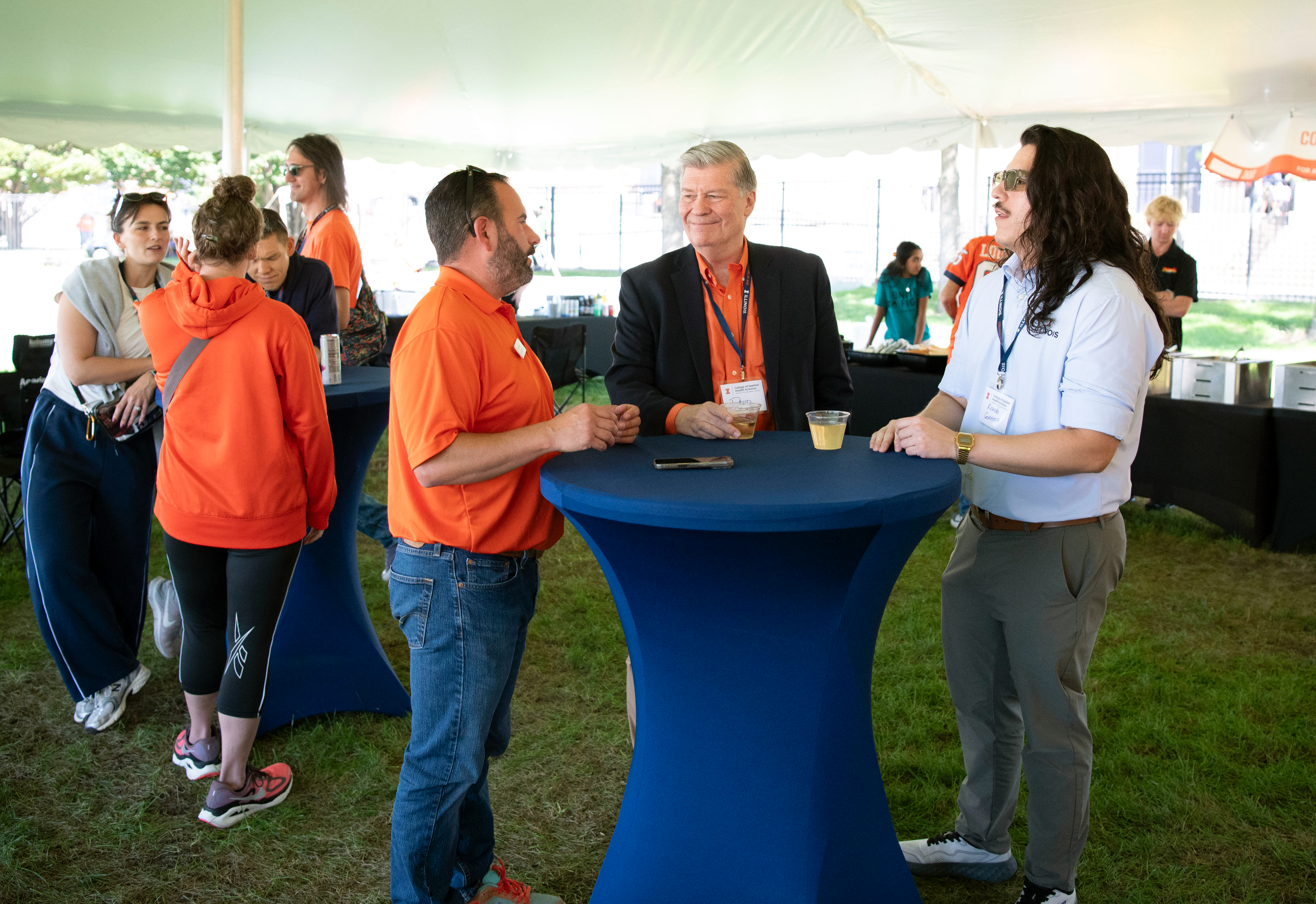
Undergraduate and graduate students Fredy Quevedo, Lateshia Dove, Jared Gleason, and Kristel Ong are actively involved in the study.

Two researchers from the Department of Recreation, Sport and Tourism in the College of Applied Health Sciences are among the recipients for this first year of Call to Action funding from the Office of the Chancellor.

RST Professors Monika Stodolksa and Kim Shinew received a grant of $93,428 for their project entitled, “Combating Systemic Racism in Access to Nature, Open Spaces, and Parks and Recreation.” Drs. Stodolska and Shinew plan to give a formal evaluation of continuing efforts by the Urbana Park District (UPD) to increase access to nature and recreation opportunities among diverse residents, as well as create a blueprint that can be shared nationwide on how to dismantle systemic racism and increase access to nature and recreation among people of color.

Parks and recreation services play critical roles in making neighborhoods and cities livable, the researchers said, helping to improve mental and psychological health, increase physical activity, decrease obesity and hypertension, and increase community pride. The critical roles of nature and recreation in people’s health and wellbeing have been underscored by the COVID pandemic, Drs. Stodolska and Shinew said.

Data collection is underway and undergraduate and graduate students Fredy Quevedo, Lateshia Dove, Jared Gleason, and Kristel Ong are actively involved in the study.

Drs. Stodolska and Shinew said the study builds on the research project their team conducted in 2016-2017 that evaluated the needs, interests, benefits, and constraints regarding the utilization of Urbana Park Districts’ programs among underserved residents. This area of research is important, they said, due to historical and contemporary systemic racism and exclusionary practices that have caused people of color to have fewer opportunities to access recreation services and natural environments at the community and national levels, making them less likely to obtain the physical and mental health benefits these types of experiences provide.

The previous study, Drs. Stodolska and Shinew said, showed that constraints such as fees, transportation, racial tensions, lack of knowledge of opportunities, safety, and language barriers negatively affected minority residents’ ability to access parks and recreation programs.

Thanks to the results of the researchers’ previous study, the UPD has, over the past four years, implemented a number of steps to improve the provision of their services to underserved residents that included the establishment of the new Outreach and Wellness Division, staff diversity trainings, development of a new action plan, translation services, multi-language signage, restoration of local parks, changes in marketing campaigns, new programs delivered on-site in low-income underserved neighborhoods, targeted outreach efforts, and a new “You Belong Here” campaign.

The UPD also was able to leverage resources from local grants to provide on-site scholarships to reduce the cost of recreation programs for low-income residents, the researchers said. The UPD staff estimated that the new outreach efforts resulted in more than 2,000 “new” users—mostly African American and Latinx children—being able to access play opportunities, recreation programs, and nature in Champaign County.

“Such efforts undertaken by the UPD are pioneering and, thus, have the potential to serve as a model for recreation agencies across the U.S. on how to dismantle obstacles to accessing nature and recreation opportunities that have roots in the historical systems of oppression,” Drs. Stodolska and Shinew said.

Editor’s note:

To reach Vince Lara-Cinisomo, email vinlara@illinois.edu.
 

Share on social

Related news

College of Applied Health Sciences
110 Huff Hall
1206 South 4th Street
Champaign, IL 61820
(217) 333-2131