From a small tent to powerful connections fueling opportunity
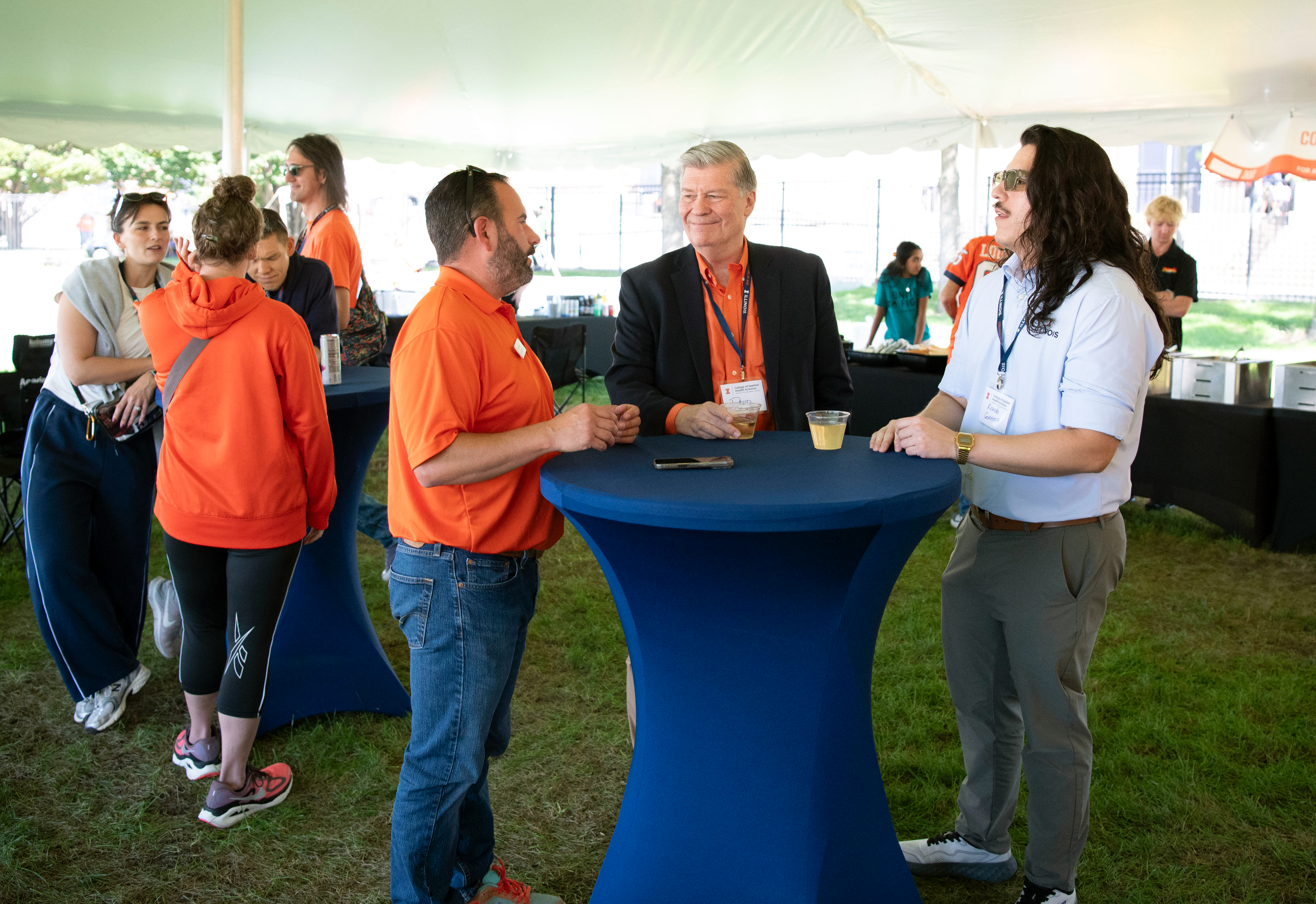
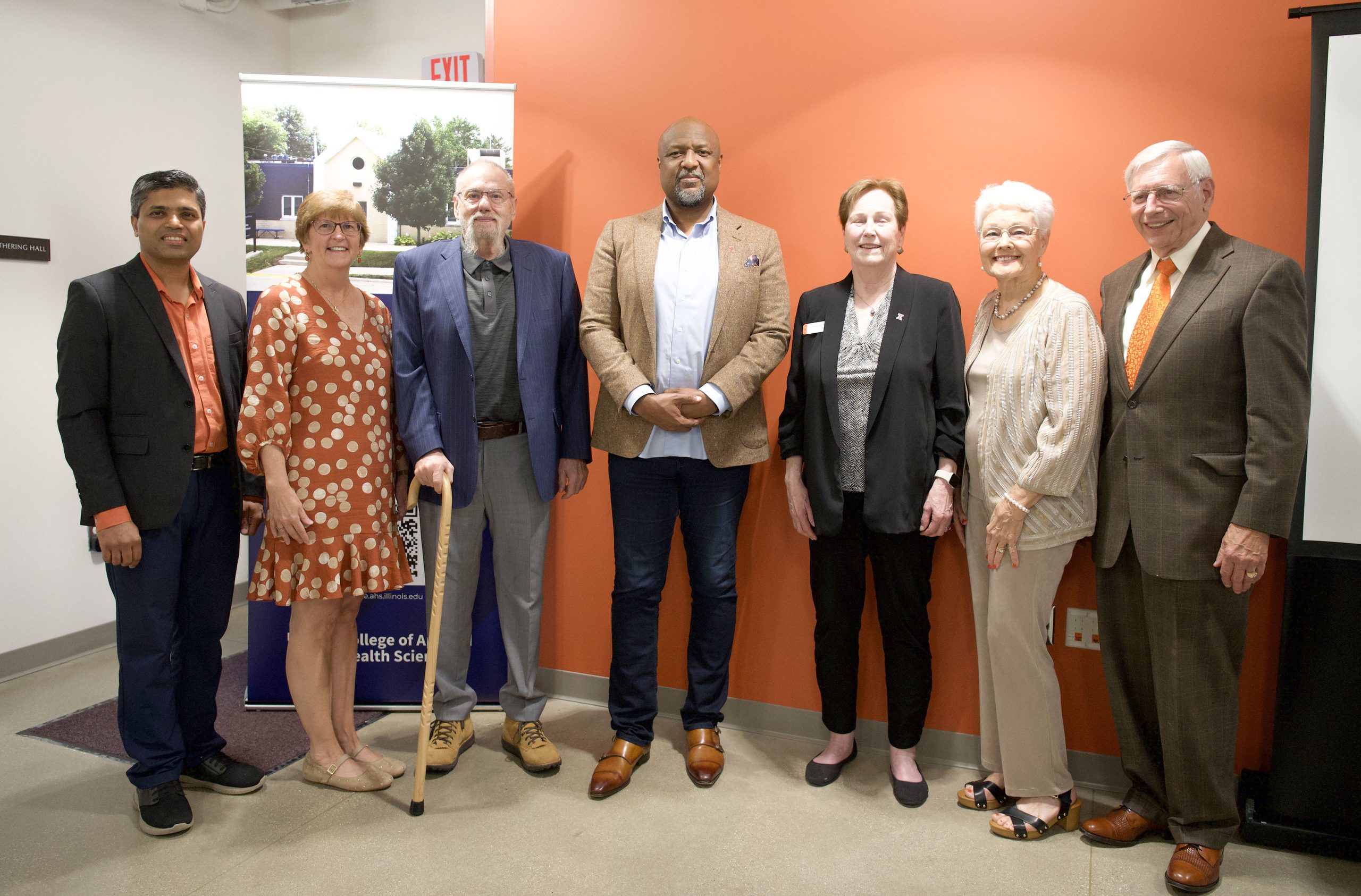
David Shockey, center, with Senior Director of Advancement Matt Smith, left, and Health and Kinesiology Assistant Professor Shaon Lahiri (Photo by Bridget Lee-Calfas)
By Vince Lara-Cinisomo
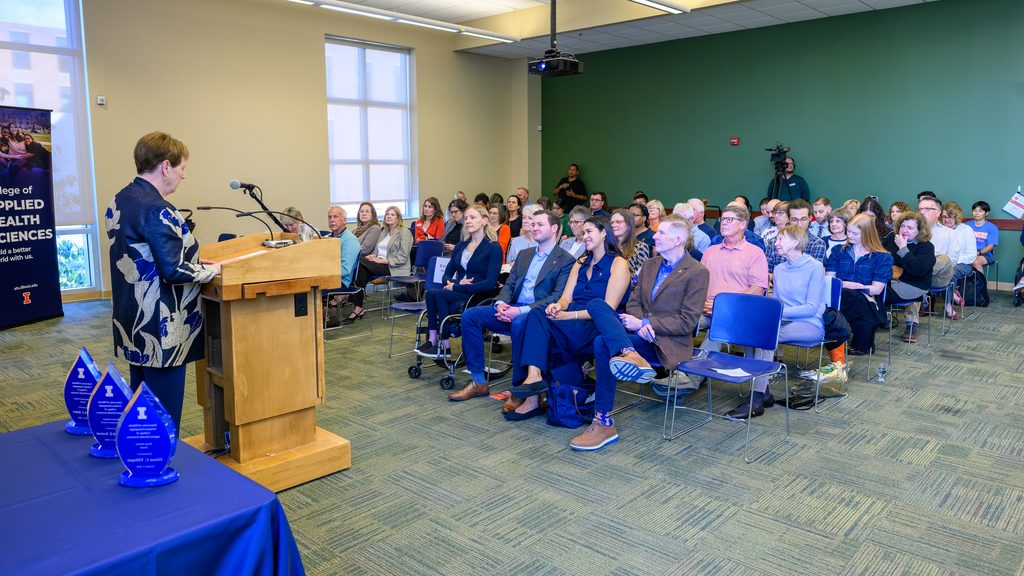
Sara Kelly once had to make a case for a small tent and a gathering of perhaps 75 people. On Saturday, Oct. 3, 2026, she saw how far that idea had come.
The former Assistant Dean for Advancement for the College of Applied Health Sciences recalled an early tailgate around 2005, tucked away on the other side of what was then Assembly Hall.
At the college’s 2026 tailgate in Grange Grove in front of Gies Memorial Stadium, Kelly saw just how much the gathering has evolved.
“For me to see this today is amazing,” Kelly said.
The event brought together alumni, faculty, staff and donors, giving supporters a place to renew friendships and connect with the people behind the college’s work. For donors, those connections linked the pleasure of returning to campus with the reasons they give: opportunities for Veterans, health equity, community wellness, vital research and a commitment to students.
The gathering gave donors a chance to discuss those shared values and investments with the college community while participating in a beloved annual campus tradition.
Peter Korst, chair of the college’s Board of Visitors, described attending as one way he demonstrates his enduring affinity for Applied Health Sciences.
“I want to show up to support the college in any way,” Korst said.
Korst earned his undergraduate degree in civil engineering at Illinois and a master’s degree in what was then Leisure Studies and is now the Department of Recreation, Sport and Tourism. Both colleges equipped him with valuable skills, he said, but Applied Health Sciences contributed more directly to what became his vocation.
His involvement began on an advisory board for RST before he joined the Board of Visitors. The tailgate gives him another way to maintain those ties, with familiar faces making each return more anticipated than the last.
“It seems like every year it gets more and more comfortable because I see more people that I know,” he said.
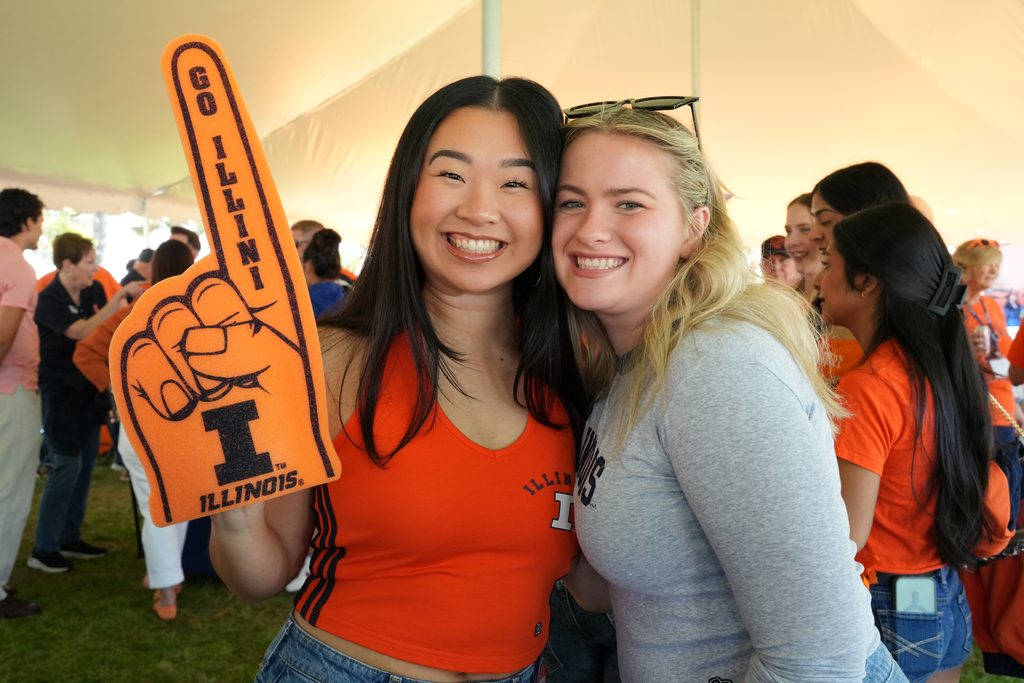
Students as well as faculty, staff and alumni packed the tailgate tent in Grange Grove (Photo by Bridget Lee-Calfas)
That sense of connection also informs his goals for the board. Korst said members want opportunities beyond hearing reports about the college. He is helping identify ways they can engage more directly with students and faculty.
For Denis Lougeay, who runs the San Diego Illini Club, the gathering connected a distant alumni community with people it supports in Urbana-Champaign.
Lougeay said he had returned for homecoming perhaps 30 times or more but first attended the college’s tailgate last year. Valued relationships with people associated with the college help draw him back.
“It’s really great to be here and see all these people,” Lougeay said.
His club sponsors a scholarship for Veterans at the Chez Veterans Center, and he also contributes individually.
“We sponsor a Veteran, essentially, every year,” he said.
Neither Lougeay nor his wife Denruth is a Veteran, he said. But San Diego’s many Navy Veterans and Veterans serving on the club’s board helped make the connection meaningful.
A tour when the Chez Veterans Center opened introduced Lougeay to its facilities and staff, strengthening his confidence in its mission.
“We got a tour right when the Chez Center opened, and it is just an amazing facility,” he said.
For David Shockey, a generous donation to the Rural Health Initiative grew from both personal experience and relationships with people working to extend the university’s reach.
Shockey, a lawyer and two-time University of Illinois graduate from Freeport, Illinois, has a sister with a hearing impairment. He’s also a longtime supporter of University of Illinois Extension and wanted to connect campus expertise with people in Stephenson County who seldom make the trip to Illinois.
He described the developing project as an experiment that would bring together university talent with local enthusiasm and commitment.
“It’s a trial (and) we’re going to see how it goes,” Shockey said.
The proposed approach would use dedicated technology to connect people remotely with campus staff and graduate students for additional evaluation of hearing and speech concerns, he said. Shockey characterized it as a way to seek a second opinion.
The project is not yet underway, he said, but the enthusiasm of Extension contact Margaret Larson encouraged him. Larson is the County Extension director for Jo Daviess, Stephenson and Winnebago counties.
“I’ve never seen her more driven,” Shockey said, who added that AHS Senior Director of Advancement Matt Smith was instrumental in getting him on board.
Shockey’s gift illustrates how the relationships renewed at a tailgate can connect to work far beyond campus. For Lougeay, that work means supporting Veterans. For Korst, it includes finding new ways to serve students and faculty.
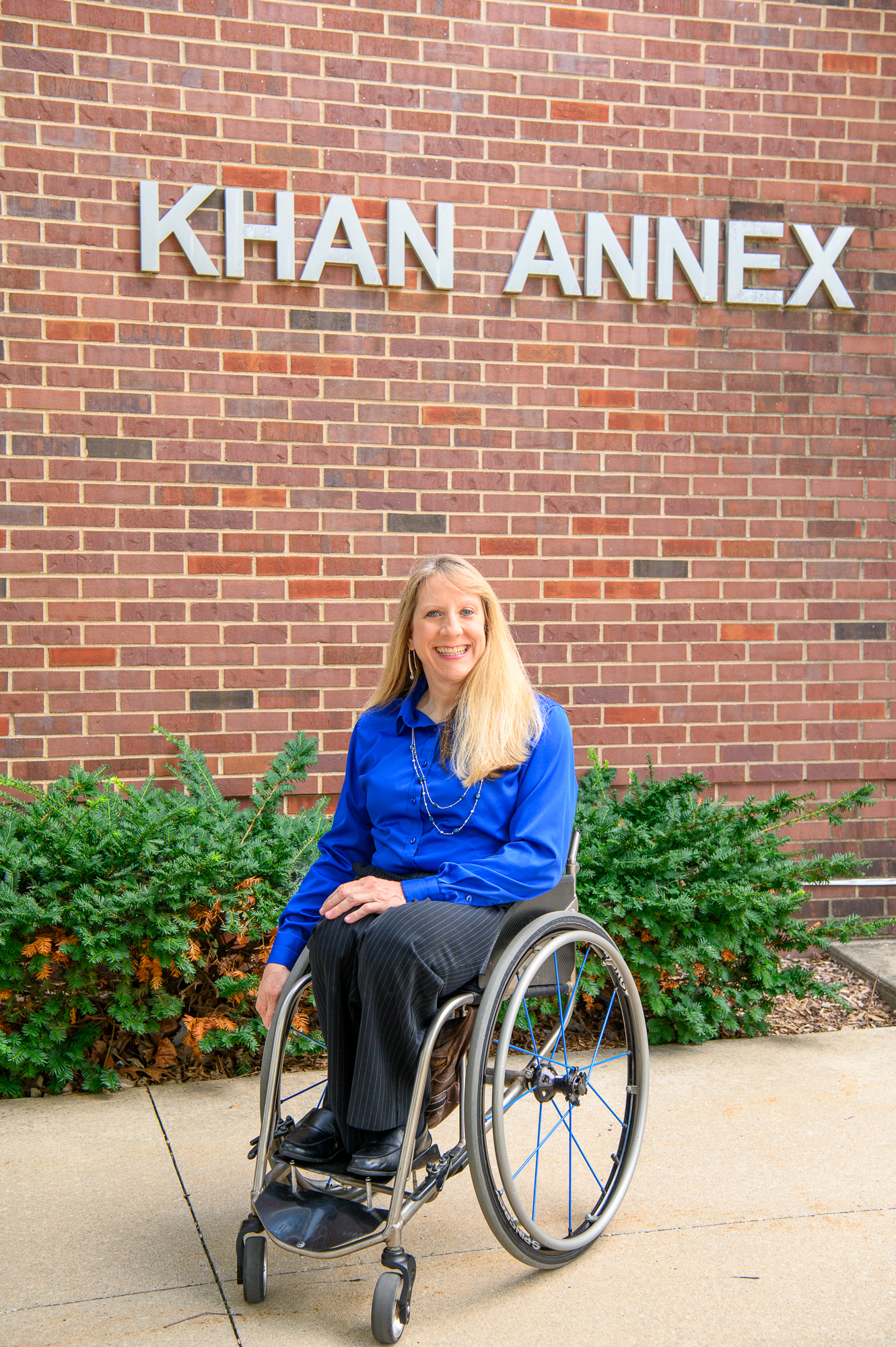
Kelly, who helped establish the gathering, also recalled hiring former Assistant Dean of Advancement Jean Driscoll—who recently retired from the university—for her passion for the college’s mission and her experience as an alumna.
“She exemplified what we’re really all about—giving people opportunities to excel,” Kelly said.
In Grange Grove, the people who help make those opportunities possible had a place to come together—and reasons to keep returning.
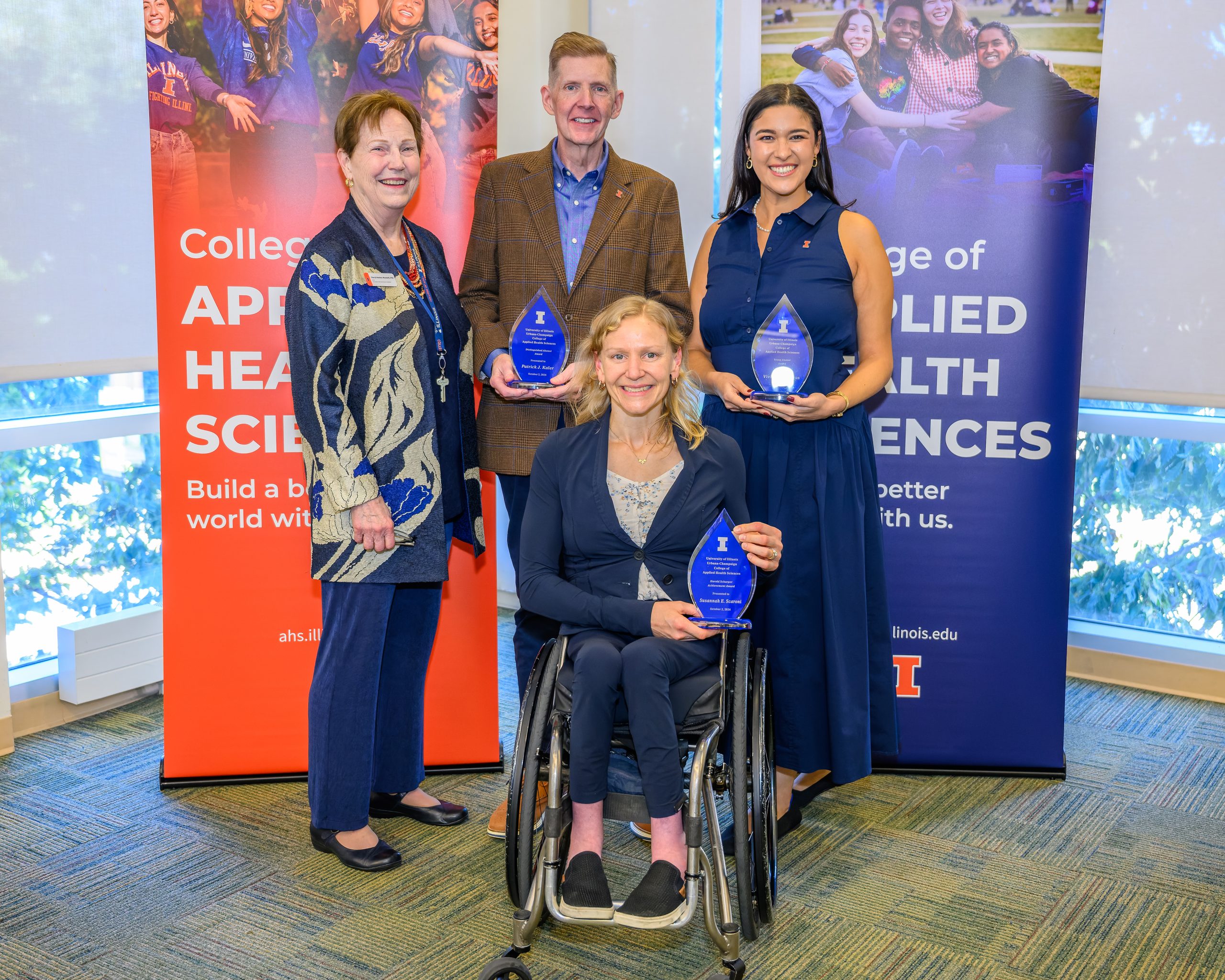
Patrick Kaler, Vivian Villegas and Susannah Scaroni were honored as the 2026 AHS Alumni Award winners
From left to right, Dean Cheryl Hanley-Maxwell, Patrick Kaler, Susannah Scaroni and Vivian Villegas. (Photo by Craig Pessman)
Walking between Huff and Freer halls during her first semester at the University of Illinois Urbana-Champaign, Vivian Villegas encountered something that surprised the friend beside her: an academic advisor who knew her name and remembered her first big test.
Health and Kinesiology advisor Amy O’Neill stopped to ask how it had gone. For Villegas, a freshman from Dixon, Illinois, that small exchange helped make a large university feel manageable.
Years later, the pediatric occupational therapist returned to accept the College of Applied Health Sciences’ 2026 Young Alumni Award, recognizing work that helps children find their own ways to participate and belong.
Villegas joined tourism executive Patrick Kaler and Paralympic wheelchair champion Susannah Scaroni as the college’s 2026 alumni awards recipients. Their careers reach from classrooms to international competition to the communities that welcome travelers, connected by an Illinois education and a commitment to expanding opportunities.
“Although their paths are very different, each has used an Illinois education to open doors for others and strengthen communities,” Dean Cheryl Hanley-Maxwell said.
For Villegas, the recognition brought back another campus memory: watching the same awards ceremony as a student in 2016.
“This really is a full-circle moment and one that I will cherish forever,” she said.
She arrived at Illinois planning to become an occupational therapist and chose kinesiology as her major. Within the college, she found opportunities to work as a research assistant and serve as student council president her senior year.
After earning her bachelor’s degree at Urbana-Champaign, she completed master’s and doctoral degrees in occupational therapy at the University of Illinois Chicago.
Her work now focuses on children, including nonspeaking autistic students, in school and community settings. She helps students who use augmentative and alternative communication and has helped develop an early literacy curriculum for children in kindergarten through second grade.
Her work also extends to research at the Children’s Participation and Environment Research Lab, teaching occupational therapy students an Illinois-Chicago and serving on the Board of Managers at GiGi’s Playhouse Chicago, which supports people with Down syndrome and their families.
Accepting the award, Villegas emphasized the significance of recognition for clinicians whose daily contributions may draw little attention. She described herself as representing alumni “engaging in the meaningful everyday work that often goes unrecognized.”
For Kaler, recipient of the Distinguished Alumni Award, the road back to Illinois began with a decision to step away from an established career.
About a decade into the tourism industry, he returned to school with plans to earn a master’s degree and eventually become a professor. Research papers, seminars and discussions of theory made the transition demanding.
“I won’t pretend that was an easy decision,” he said.
His advisor, former Recreation, Sport and Tourism Department Head Carla Santos, helped him navigate the move from professional life to academia. But graduate school also clarified what Kaler missed.
“I missed the people,” he said. “I missed the problem-solving and creating experiences that can truly change lives.”
After earning his master’s degree in tourism in 2005, he took a job in Lake Tahoe, California, instead of continuing toward a doctorate. For someone who grew up in Rantoul, Illinois, the move stretched his expectations.
“The thought of going to Lake Tahoe was never on my bingo card,” he said.
Kaler’s career subsequently took him to Los Angeles, Northern Virginia and Buffalo, New York. Since 2014, he has led Visit Buffalo Niagara as president and CEO, with responsibilities that also include the Buffalo Convention Center and Buffalo Sports Commission.
Hanley-Maxwell’s remarks placed that work in the context of community development, describing destination leadership as a way to support local businesses and create opportunities throughout a region.
Kaler credited graduate study with strengthening his research and strategic thinking. He also credited colleagues, staff members, industry partners and family for helping make his career possible.
Alongside his industry work, Kaler has shared his experience through teaching, lectures and appearances at national tourism conferences.
Thank you for making this campus my favorite place to come home to.
Vivian Villegas
2026 Young Alumni Award winner
His advice to students left room for uncertainty.
“The field will surprise you,” he said. “It might bring you back to school years later than you planned. It might take you far from where you thought you’d ever end up. Trust it anyway.”
For Scaroni, opportunity is inseparable from access.
The recipient of the Disability Resources and Educational Services’ Harold Scharper Achievement Award came to Illinois from tiny Tekoa, Washington, to study and train with its wheelchair racing program and renowned coach Adam Bleakney. She earned a bachelor’s degree in dietetics and a master’s degree in nutritional sciences and became a registered dietitian.
Her athletic achievements include six medals across four Paralympic Games, with gold in the T54 5,000 meters at the Tokyo Games and four medals at the 2024 Paris Games. She also has won the Boston, Chicago and New York City marathons.
A serious training accident in 2021 interrupted that career. Her return to elite competition added another chapter to a record that Hanley-Maxwell described as extending well beyond results, through mentorship, disability advocacy and work promoting wellness.
In accepting her award, Scaroni focused on the people who helped make an accessible education possible. She credited Scharper and DRES founder Tim Nugent with demonstrating that everyone deserves the freedom education offers.
“As many of us—and I would argue that those of us with disabilities, especially—know, freedom can feel like the absence of a barrier,” Scaroni said.
Dean Cheryl Hanley-Maxwell opened the ceremony with remarks about the winners. (Photo by Craig Pessman)
That freedom, she said, allowed her to pursue goals in athletics, academics and her profession.
“For me, a physical disability has never been a barrier to any of my physical, academic, or professional dreams,” she said.
Together, the honorees offered different measures of achievement: destinations strengthened, students supported and barriers removed. Their remarks also returned repeatedly to the people and experiences that helped them reach those milestones.
For Villegas, that connection still feels personal whenever she returns to campus, whether to watch basketball, walk the Quad or share the university with loved ones.
She closed by thanking the college for the award and, “more importantly, for making this campus my favorite place to come home to.”
Sally Peterson-Falzone during a mission to China in 2013 (Photo provided)
It is with great sadness that I share the passing of Dr. Sally Peterson Falzone, a distinguished SHS alumna, scholar, clinician, and leader whose contributions to the field of speech-language pathology, particularly in craniofacial disorders and cleft palate, have left an enduring impact on many children and families.
Dr. Falzone earned both her bachelor’s and master’s degrees from the University of Illinois before completing her PhD at the University of Iowa. She was widely respected for her expertise in craniofacial disorders, and her prominent leadership/involvement in several organizations.
Among her many accomplishments, Dr. Falzone served as President of the American Cleft Palate-Craniofacial Association and was deeply involved in the Society for Ear, Nose and Throat Advancements in Children (SENTAC) and numerous other professional organizations. Her influence extended far beyond her clinical and scholarly contributions. She was a dedicated mentor, a trusted colleague, and a passionate advocate whose work helped shape the field and inspired many clinicians.
As Judy Le Duc, who had the privilege of working alongside Sally for many years at the University of Illinois Medical Center, reflected, Sally was “a scholar, academician, and clinician” who devoted herself entirely to serving children with craniofacial conditions. Those who knew her personally speak not only of her professional accomplishments but also of her generosity, compassion, and commitment to others.
Dr. Falzone was also a longtime friend and supporter of our Department and the College of Applied Health Sciences. We are deeply grateful for her many contributions to our profession.
On behalf of the Department of Speech and Hearing Science, I extend our heartfelt condolences to Sally’s family, friends, former colleagues, and all those whose lives she touched.
Her legacy will continue to live on through the many clinicians she mentored, and the countless children and families who benefited from her care and advocacy.
With sympathy and gratitude,
Georgia Malandraki
Shahid and Ann Carlson Khan Professor of Applied Health Sciences Department Head Department of Speech and Hearing Science
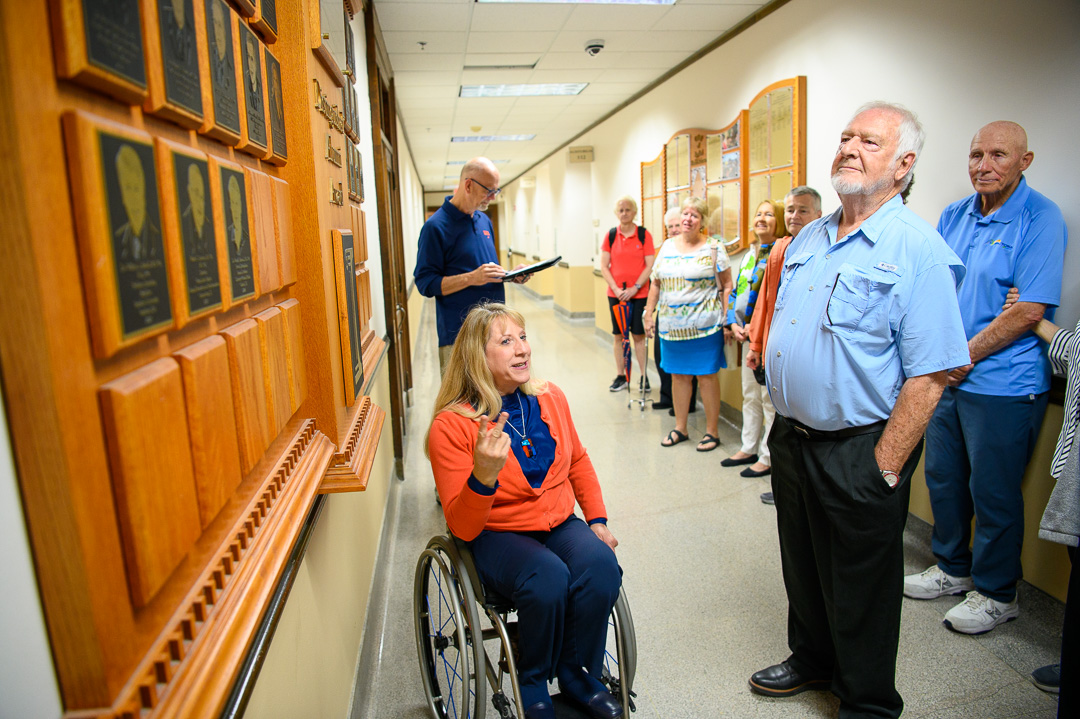
Jean Driscoll outside of Huff Hall on August 4, 2026. Driscoll is retiring from the University of Illinois for a new fundraising role in St. Louis. (Photo by Ethan Simmons)
Jean Driscoll wants you on her team.
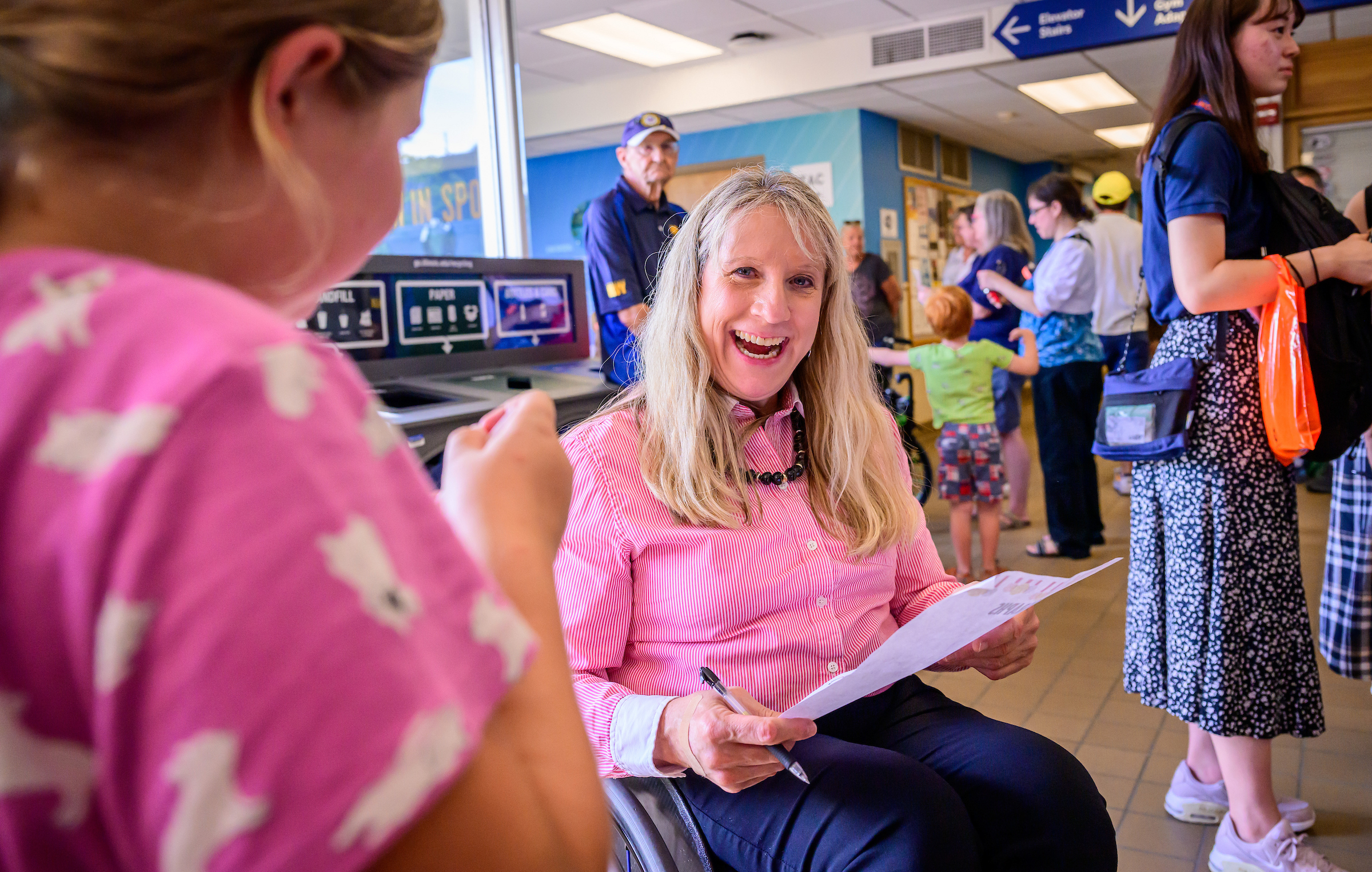
Whether you’re a colleague, friend, donor or stranger, sharing a nice dinner or a quick chat inside Huff Hall, Driscoll invites you into her world, mainly to learn more about yours.
After roughly two-and-a-half decades working and learning at the University of Illinois Urbana-Champaign—including two brief exits and returns—Driscoll is retiring from her post as assistant dean for advancement for the College of Applied Health Sciences, a role she’s held since 2020 after coming back a second time.
A new challenge is fast approaching: she’ll be fundraising for the Foundation for Barnes-Jewish Hospital in St. Louis, but colleagues can rest assured that she will be working until the end of her appointment at Illinois on Aug. 31.
Driscoll’s people-first personality has helped secure some of the finest gifts in the College of Applied Health Sciences’ history and woven enduring relationships with alumni who care deeply about the college’s mission.
It’s easy to forget now, but at every phase of her life, Driscoll’s success was anything but guaranteed. The shy younger sister from Milwaukee born with spina bifida, a young athlete with budding talents, a college fundraiser who was “green as green could be.”
“‘Team’ is a theme from my youth onward, where I was the last kid picked on the playground, to now, where I get to choose people for my team,” Driscoll said. “I’m carrying that torch and passing it along—as I transition away from the University of Illinois, I feel like I’m passing it toward each of the staff members here, a little bit to our alumni, donors and friends, and to my closest colleagues.”
What has radiated from Driscoll on the last days of her U. of I. appointment is an appreciation for her place in history, a full respect for the layers of accessibility on this campus that were fought for by trailblazers before her, on the Illinois campus and beyond.
“I try to live in this space of gratitude and try to remember that there are people, my predecessors both professionally and personally, who have laid a foundation so that I can be where I am,” she said.
A reluctant advocate
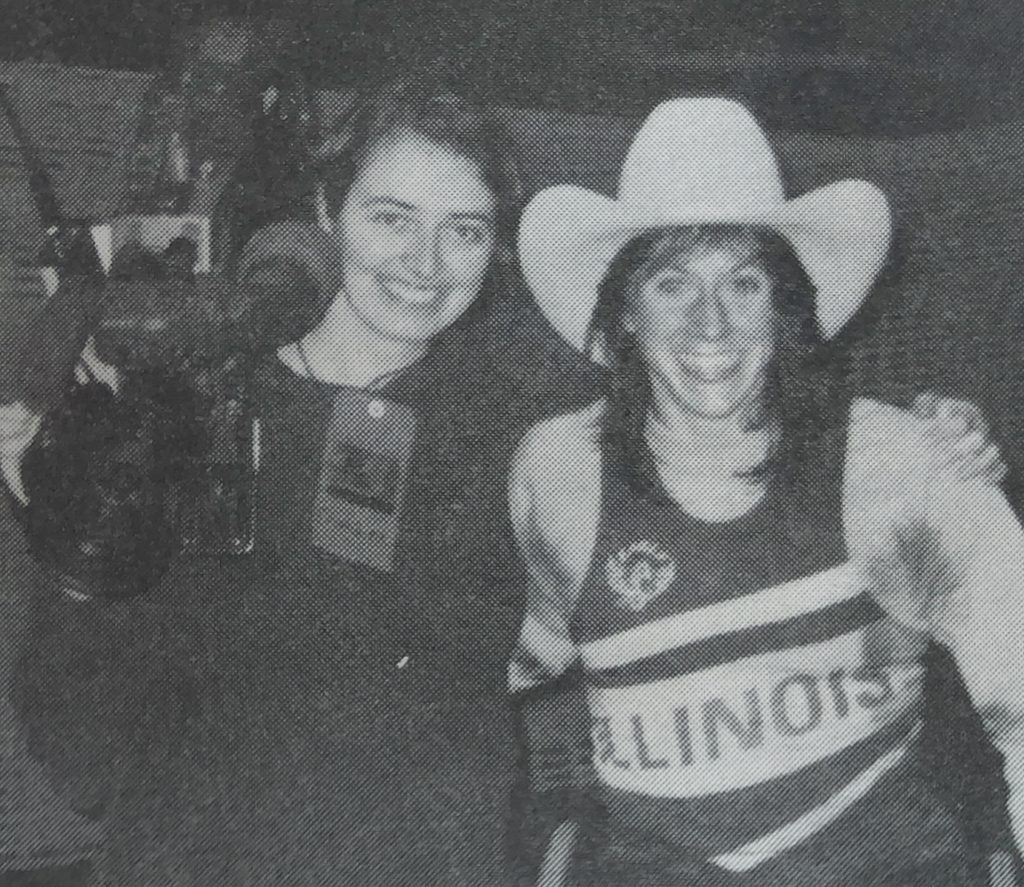
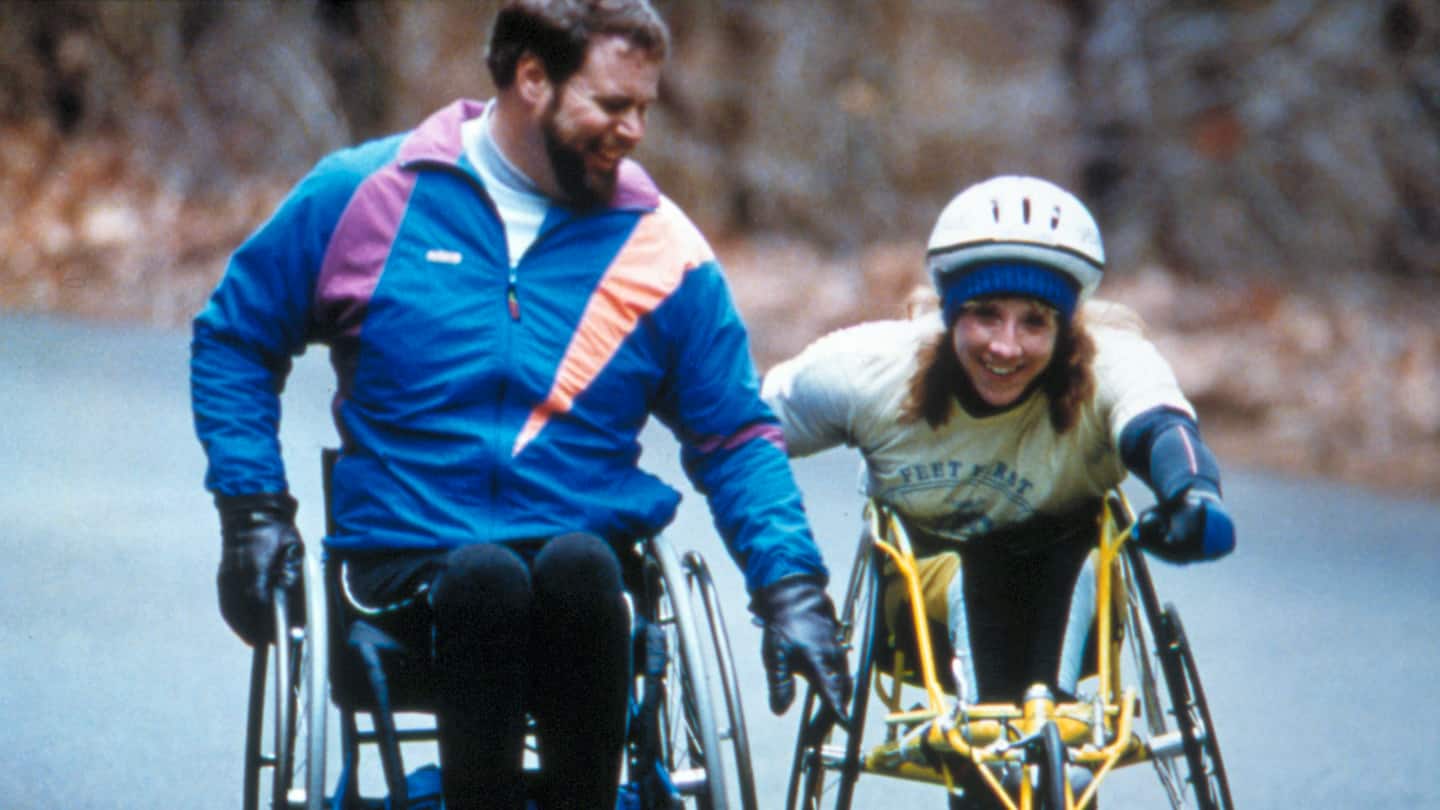
It took two years for Coach Marty Morse to persuade Jean Driscoll—who had become a world-class short-distance wheelchair racer with only a few years of training—to compete in the Boston Marathon. In 1990, she finally caved, “just to get him off my back.”
“I’m sitting on the starting line, not believing I belonged in that race. How did I let Marty talk me into it?”
Then, 26.2 miles later, Driscoll not only won, but broke the wheelchair marathon world record by almost seven minutes, clocking in at 1 hour, 43 minutes, 17 seconds. She thought it was a fluke: her Illinois teammate Ann Cody was supposed to win, she had been “killing” Driscoll in all the workouts.
Imposter syndrome be damned; her life had changed forever.
“All of a sudden, everybody wanted to hear what I had to say,” Driscoll said. “The spotlight was … it felt like a burden to bear in those first few years, because I was so shy.”
She broke her own world record in the 1991 Boston Marathon on her way to seven straight wins in wheelchair marathoners’ most hallowed race. The spotlight intensified, and slowly, Driscoll’s understanding of her reach and voice began to shift.
“I realized what an opportunity there was to help people understand what disability is and isn’t. It’s a characteristic, like hair color and eye color. It’s not a defining principle.”
She has repeatedly returned to a form of that message, bringing her story back to the universal. Driscoll signs her autographs “Dream BIG and Work Hard!” That same phrase became the title of a children’s book based on her life story.
By the time she retired from racing after the 2000 Sydney Games, she was caught on the opposite end, wondering whether there were enough spokespeople to “carry the message” for the disability community she had been preaching for the last decade. (“That was kind of selfish and self-centered, quite honestly—there have been plenty of people to carry this on,” she said.)
Her retirement from racing allowed her to step into the role of global advocate. In the early 2000s, she traveled back and forth to Ghana several times to host wheelchair racing camps and help develop their para-athletics programs. In 2004, wheelchair racers Raphael Nkegbe and Ajara Busanga became the first Paralympians to represent Ghana in their country’s history, with Driscoll as a key mentor.
Alison Davis got to see Driscoll’s athletic talents and personable nature while filming “Against the Wind,” a documentary on Driscoll’s return to competition. (Provided)
“There are so many places around the world where, if you have a disability, you are considered to have no value, no rights, no education,” Driscoll said. “We have alumni who have done these big things, and every generation has students and alumni and faculty who are making a difference in our country and in the world.”
The subject of Illinois journalism instructor Alison Davis’ first long-form documentary was Driscoll’s return to competition in 1996 after she broke her leg the prior year. Media attention was at its zenith, and Driscoll’s schedule was packed, but she still allowed Davis and her collaborator Tim Hartin to follow along with the camera.
When they first traveled over to Disability Resources and Educational Services (DRES) to pitch the documentary, “I was in awe of her and nervous she would say no,” Davis said. “But we quickly recognized we had the same goal for this project and that was to make a sports documentary. We wanted it to focus on the grit and challenges of training at an elite level and not make it an ‘inspirational story’ of someone who happens to race in a wheelchair.”
Their footage and interviews became “Against the Wind,” an award-winning documentary of what ended up being Driscoll’s seventh consecutive win of the Boston Marathon.
“Jean is a person who truly cares about her community and making others feel seen … She is successful because of her hard work, but also because she is an incredible human, and people admire her for all that she is beyond the athletic achievements,” Davis said.
Prepared for everything
To understand today’s Jean Driscoll, you’ll weave through several storied mentors, generally winding up with two brainy coaches that shaped her years at Illinois: former head of DRES Brad Hedrick, and longtime wheelchair track and field coach Marty Morse, both of whom are “forever on a pedestal.”
“I don’t even want to imagine what life would be like had I not met those men and had they not invested so much of their time and talent and skill in me,” Driscoll said.
Hedrick recruited her in the spring of 1986 after seeing her play wheelchair soccer in Wisconsin, having traveled up to Milwaukee for a wheelchair sports clinic.
Coach Marty Morse trained Jean Driscoll for years of dominance in wheelchair marathons. (Photo by Curt Beamer).
Initially, Driscoll couldn’t be bothered to join the women’s wheelchair basketball team, especially not at regional rival University of Illinois. But Hedrick kept sending letters and kept calling, and Jean joined the team. (Driscoll thinks she has a “weakness” for persistent people.)
Athletically, she was thrown into the fire, facing off against Sharon Hedrick, a star on the basketball court and the track who practically no one beat in a wheelchair race from 1975 until she retired in 1990.
“There was no freshman adjustment year for Jean—she got right to work,” Morse said. “She’s always been meticulous, completely prepared for everything.”
Despite Driscoll’s shyness, once she arrived on campus, Morse saw an absorbent, talented young adult, bent on understanding how everything worked.
This trait reared its head in several wheelchair athletics workshops that Morse hosted through the years, bringing in guest speakers from across the country. As an undergraduate, Driscoll stepped up as Morse’s administrative assistant, running workshops with more than 100 people while competing at the same time, Morse said.
And all the while, she was forming connections across the university. She naturally became acquainted with a wide roster of figures in Illinois athletics and academics: basketball head coaches Kathy Lindsay and Theresa Grentz; pioneering athletics administrator Karol Kahrs; Jayne DeLuce, today’s CEO of Experience Champaign-Urbana who managed the aquatics venues during the 1996 Atlanta Olympics, and countless others.
“Instead of just being friends with somebody, she wanted to know how their job went,” Morse said. “Jean is so well-versed, and she was this way as an undergrad. If she took an interest in something on this campus, it was all in.”
After Morse developed a syrinx—a cyst inside his spinal cord—he underwent four major surgeries from 1997 to 2000, which resulted in a loss of function. Morse and his wife Karen Iehl-Morse, a longtime Illinois athletics trainer and instructor in the program, were taking care of their son, 4-year-old Steven, with another child on the way.
“We were having a lot of problems,” Morse said. “And Jean, who was always one of our go-to babysitters, she [basically] just moved in the house. She was there for us during that really traumatic time. Jean is family to us.”
When Driscoll first left Urbana-Champaign in 2004, Morse was upset. He was losing a great friend, but he also felt the university had “dropped the ball” by not keeping her here.
“Because it was like, boy, this woman, her entire career has been nothing but promotion of Illinois,” Morse said. To see her finally return to the University of Illinois in her development and alumni relations role at the College of Applied Health Sciences in 2006 “was no surprise.”
And her return led to countless more friendships and memories. Longtime U. of I. communications officer Robin Kaler first met her at a local 5K, where she “fan-girled” and asked Driscoll to pose with her baby for a picture.
They became fast friends. Over the years, she “has always been there to build the Illinois brand,” Kaler said, thinking of a half-time commercial where Driscoll sang the Alma Mater song with other famous Illinois alums.
One Halloween, Driscoll and Kaler dressed up as the campus statues Alma Mater and Learning, then went to a restaurant near campus, with plenty of onlookers.
“We laughed the entire time as the other diners stared at us,” Kaler said. “Even though she’s retiring, she will be a pillar of our university community forever.”
Tricks of her trade
After 20 years of working in advancement and development, Driscoll knows that lots of people want to make gifts for higher education. Oftentimes, “they just don’t know what they want to do, or how they want to do it,” Driscoll said.
As she describes it, there’s a creative process of matching the donor’s interests with a college’s needs. A scholarship fund? A named space? A new building?
In any case, the process begins with careful listening. One of her favorite donation stories started with a retraction—a donor had withdrawn their support for a five-figure gift to the college. This donor had a list of grievances about how they were communicated with during the process and how their gift was handled.
Driscoll speaks to former sports psychology faculty from the University of Illinois. (Photo by Ethan Simmons)
So, Driscoll decided to reopen the relationship, working to address each point “one by one,” she said. By the time they were finished, the donor came back with a seven-figure estate gift for the college. The key was leaning into the “crucial conversation,” where a resolution needed to be reached.
“The younger Jean would be surprised, and dare I say impressed, with how I’ve grown into leadership and management,” Driscoll said.
Driscoll’s last month with her advancement team has involved plenty of hand-offs, introducing her staff to key figures and longstanding relationships. And news of her retirement led to some unexpected gray areas, too, like colleagues being unsure of how or when to communicate with her.
What’s never left is Driscoll’s genuine care, and her “unmatched attention to detail, which has consistently elevated the quality of everything our team produces,” said Angela Tammen, director of external engagement for the advancement team. “In every meeting, she brings the conversation back to the people behind our work. She wants us to understand who they are, what matters to them, and why their story is important.”
Driscoll hired Kathy Saathoff in 2013 to support the Applied Health Sciences advancement office. Saathoff’s first impression was how “strong and confident” Driscoll was in her own skin, and her supportive, empathy-driven leadership style.
“I always appreciated her letting us do our jobs, but when we needed support, she was right there to lend it,” Saathoff said.
Advancement officers Matt Smith and Josh Joines have been flying across the country to fill in the web of connections that Driscoll is entrusting with them.
“I want it to be a smooth transition for our alumni and our friends and donors. Because advancement work can be transient, people come and go,” Driscoll said. “I don’t want to start something we can’t finish.”
Another journey
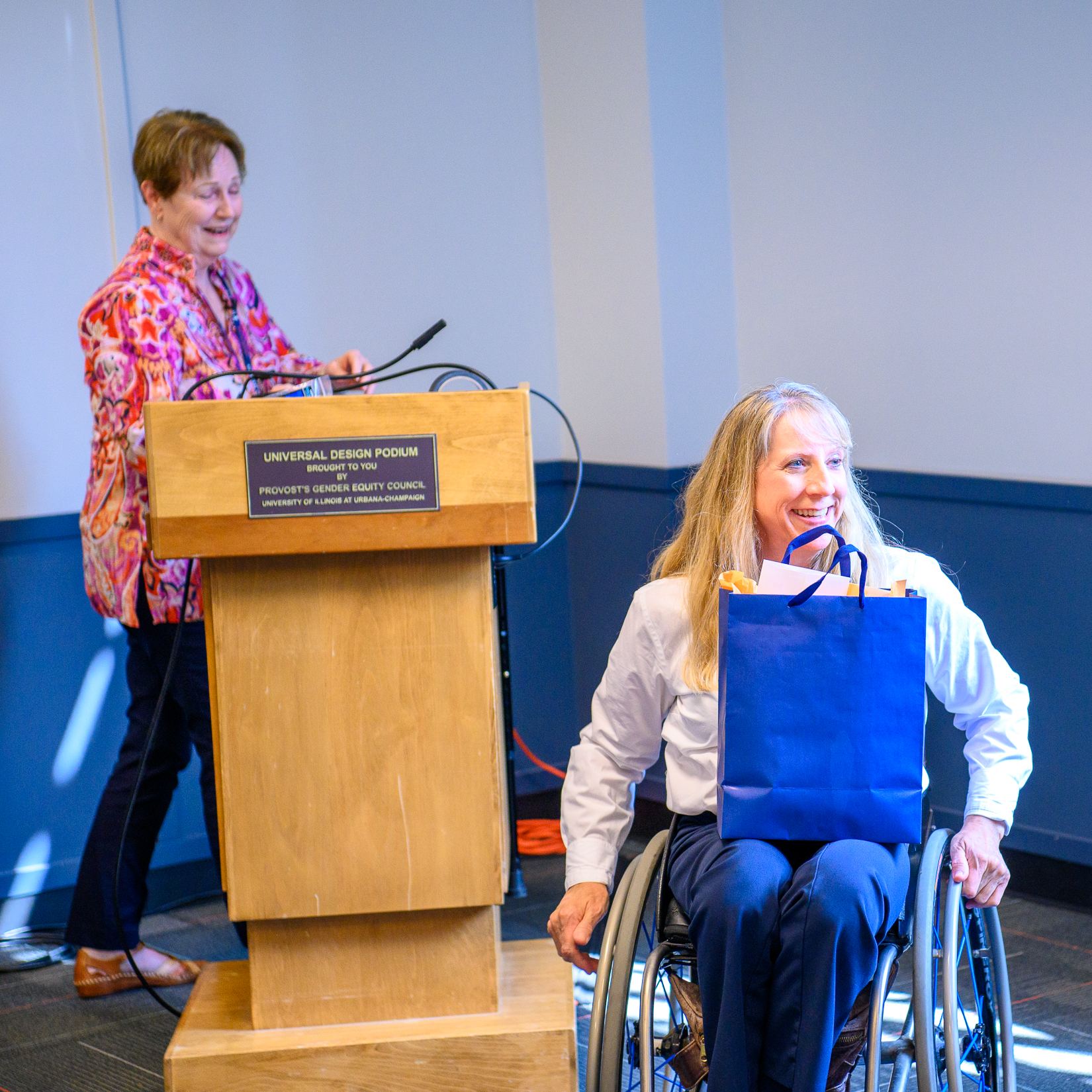
Jean Driscoll accepts a gift from the College of Applied Health Sciences a week before her retirement, at a ceremony held Aug. 25, 2026.
Dean Cheryl Hanley-Maxwell took note of Driscoll making effortless connections at an Illinois event, where she circulated the room and introduced Hanley-Maxwell to influential figures at the college with her genuine curiosity.
“Jean is the ultimate people person,” said Hanley-Maxwell, who became dean of the College of Applied Health Sciences in 2016. “I have watched her build meaningful connections in a matter of minutes, leaving people with the sense that they have known her for years rather than moments.”
That’s part of why, when Driscoll sat down with the dean this spring to let her know she was accepting a new opportunity, she said, “I’m so happy for you.”
“I thought I would have to explain myself, but I didn’t have to,” Driscoll said. “It’s a mark of good leadership.”
At the Foundation for Barnes-Jewish Hospital, she’ll be working as the fundraiser with a fellow Illini: former Assistant Vice Chancellor for Advancement David Bruns, with a new mission at top of mind.
“For years and years, I have wondered what healthcare fundraising might look like—I have relied on healthcare my entire life, from the minute I was born,” Driscoll said. “I will have to prove myself all over again. When you’re outside your comfort zone, that’s where you grow.”
(Photo by Fred Zwicky / University of Illinois Urbana-Champaign)
What motivated her in her early years was a prove-them-wrong mentality. It kept her “punching the wheels” of her racing chairs for 14 years. These days, her drive revolves around showing up for the people she cares about.
Along with her new professional journey, she’ll be spending as much time as she can doing her “favorite thing in the world,” kayaking with her extended family in Wisconsin. She still gets butterflies every time she visits.
For all her Illini faithful, this could be a goodbye, but also a “see you next time.”
“I can’t help but have empathy and appreciate where people have come from and where they are now and where they’re going, because there are experiences that truly shape us,” Driscoll said.
If you can learn anything from Driscoll, “it’s sincerity and honesty,” Morse said. “As long as you are the same with her, you’ll be very glad you met Jean Driscoll.”
Graduates reconnect through a trip visiting the country’s landmarks
For 28 University of Illinois alumni, eight days on the road offered more than a chance to visit famous stadiums, museums and monuments. It became a traveling classroom—one built around shared history, new friendships and plenty of Illini pride.
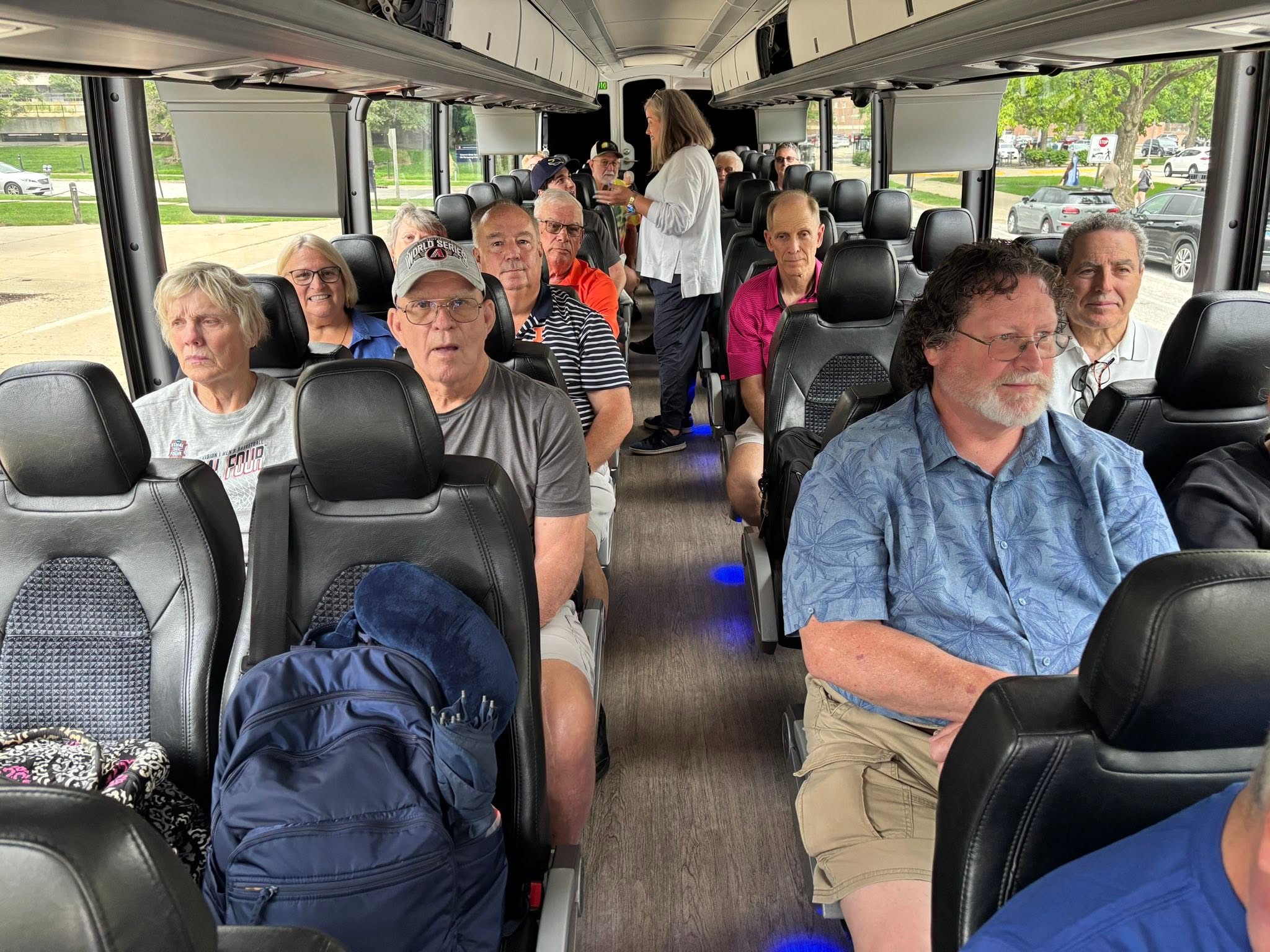
Led by Recreation, Sport and Tourism Clinical Associate Professor Michael Raycraft, the Illini Alumni Roadtrippers embarked on a journey through some of the nation’s most historic sports and cultural institutions. The experience drew inspiration from Raycraft’s RST 180 Hall of Fame Tour, an RST course that brings the history and cultural influence of sports to life beyond the classroom.
The Illini Alumni Roadtrippers set off on a journey to some of America’s most historic cultural institutions (Photo provided)
The alumni version gave travelers an organized way to explore that history together, with transportation, lodging, admissions, meals and expert guidance incorporated into the itinerary.
Scott Williams said he registered for the experience through the University of Illinois Alumni Association, with travel organized by Sports and Entertainment Travel LLC. Every destination offered something worthwhile, he said, but one stop stood apart.
“I was most surprised and intrigued by Saratoga Springs and the extensive culture and history surrounding horse racing,” Williams said.
The itinerary took the group through a broad stretch of American history. Stops included the National Baseball Hall of Fame in Cooperstown, New York; Saratoga Springs and Niagara Falls in New York; the Pro Football Hall of Fame in Canton, Ohio; the NCAA Hall of Champions in Indianapolis, Indiana; and Indianapolis Motor Speedway.
Two other popular spots for these travelers were the National Comedy Center and the Lucille Ball Desi Arnaz Museum in Jamestown, New York.
“For that group, it was pretty meaningful,” Raycraft said, noting that the students he takes on RST 180 likely are not familiar with the legendary TV show “I Love Lucy.”
The Ball Arnaz museum features a full-scale replica of Ricky Ricardo’s famous Manhattan nightclub, known as the Tropicana Room.
“We had dinner at the Tropicana,” Raycraft said. “(The Roadtrippers) really loved it; they really could connect with it.”
The mix was intentional. Rather than treating sports as a collection of scores and trophies, the journey placed athletic history alongside stories about communities, entertainment, nature and national identity.
For Mike Waldbusser, the chance to experience unfamiliar destinations without having to coordinate the details made the trip especially appealing.
“I am a sports fan and had never been to any of these places, so it was a great opportunity to see them on an organized, planned trip—especially with fellow alums,” Waldbusser said.
He had previously participated in senior alumni day trips organized by Lou Liay, the retired executive director of the University of Illinois Alumni Association. Liay helped develop the Roadtrippers concept with Raycraft but was unable to join the eight-day tour because of health concerns. His daughter, Alicia, traveled in his place and brought along a Lou Liay bobblehead.
She photographed “Little Lou” at the tour’s destinations and sent the pictures to her father, giving him a playful presence throughout the journey.
“So ‘Little Lou’ did actually make the trip,” Waldbusser said.
For Waldbusser, choosing a favorite destination proved difficult because each offered a different experience. Niagara Falls, however, had the biggest impact.
“The sheer power, magnitude and beauty of Mother Nature left an impression,” he said.
Waldbusser advised future travelers to bring dry socks and shoes and to “double bag” their belongings before entering the Cave of the Winds.
Saratoga Springs delivered another unexpected highlight. The group explored the city’s horse racing tradition, toured the Oklahoma Training Track and visited natural springs in Saratoga Spa State Park.
Waldbusser said he had not closely followed horse racing before the tour but came away with a new interest in the sport. After returning home, he found himself watching “Racing From the Spa” on television.
The group also encountered reminders of Illinois’ contributions to American sports history. At Cooperstown, travelers found former Illini baseball star Lou Boudreau. In Canton, they encountered connections to George Halas, Red Grange, Dick Butkus, Ray Nitschke, Bobby Mitchell and George “Papa Bear” Halas-era football history. At the NCAA Hall of Champions, they found former Illini basketball player Mannie L. Jackson, a donor to the College of Applied Health Sciences and the man who endowed the Illinois Academic Enrichment and Leadership Program, or I-LEAP.
Those discoveries connected nationally recognized institutions with the travelers’ own experiences at Illinois.
“Traveling with fellow alums and exchanging stories and experiences” created new friendships, Waldbusser said.
Raycraft added context at each stop, using questions and stories to encourage the group to look beyond exhibits. One discussion explored why the Baseball Hall of Fame was placed in Cooperstown and asked travelers to compare that community with Canton, home of the Pro Football Hall of Fame.
“I appreciated all of Mike’s insights and stories to enhance our trip,” Waldbusser said.
RST Clinical Associate Professor Mike Raycraft modeled this trip on his RST 180 trip, in which he takes students to some of the same historic spots. (Photo provided)
The Roadtrippers experience grew from conversations involving Raycraft, Liay and David Bambrey, president of the University of Illinois Alumni Association, according to Kristina Oncken-Cortez, associate director of alumni experiences for the association’s Explorers travel program.
Oncken-Cortez said she had not known about RST 180 until Raycraft explained the course to her. The alumni tour translated elements of the student experience for a different generation of Illini, retaining the emphasis on learning through firsthand encounters.
It also became part of a much larger alumni travel program. Oncken-Cortez said the association offers more than 50 Explorers tours each year.
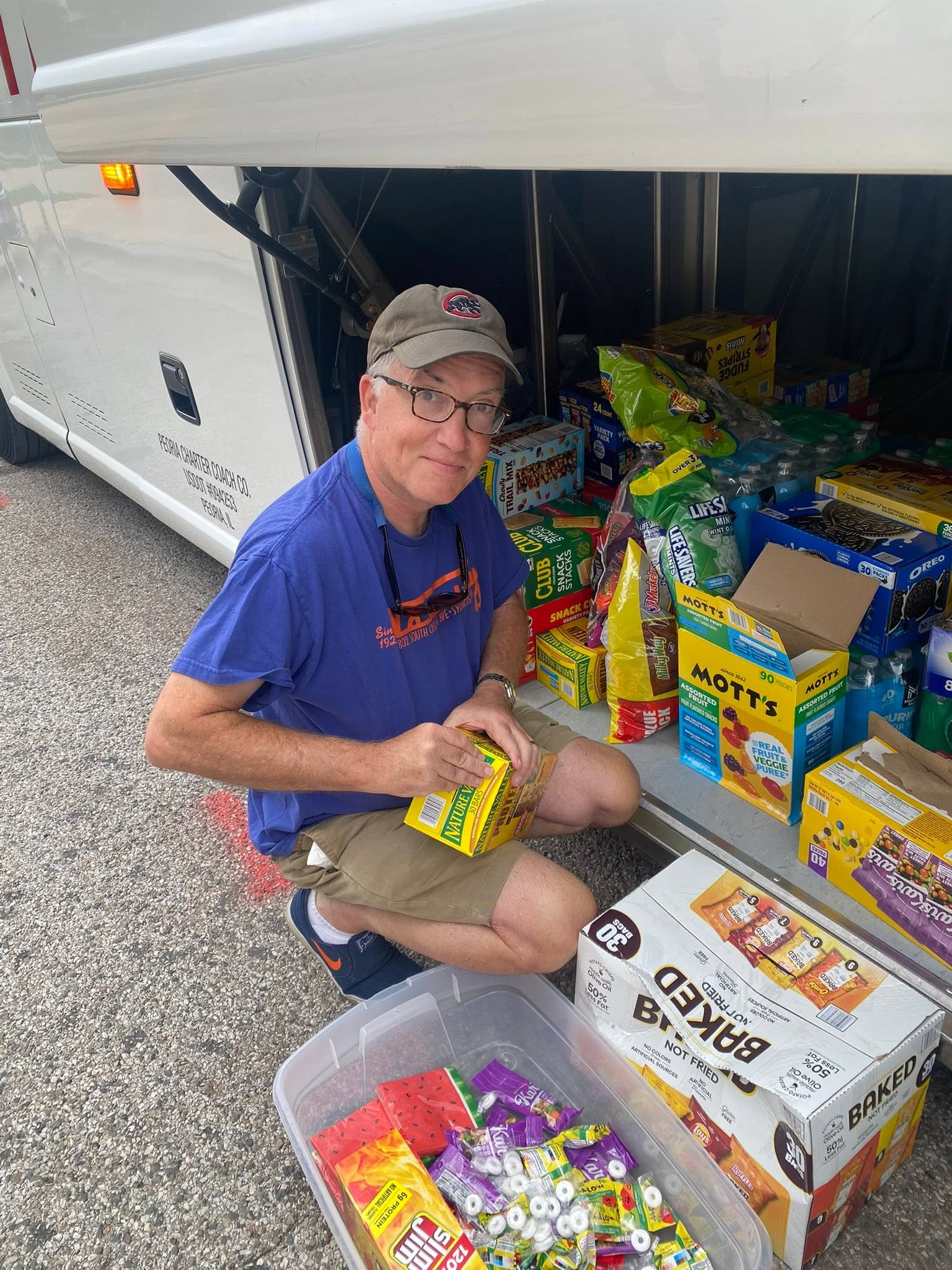
Life aboard the bus supplied its own memories. The travelers shared refreshments, meals, advice and jokes as the miles accumulated. Gary Earls, the group’s driver, kept the trip moving smoothly and offered one memorable recommendation: avoid the bus restroom while the vehicle was bouncing down the road.
Williams also said the combination of destinations and companionship made the experience easy to recommend.
“I’d encourage any Illinois alumni to experience this diverse collection of unique experiences in the effortless company of friendly fellow explorers,” he said.
Asked what he would tell another Illinois graduate considering a Roadtrippers journey, Waldbusser’s answer was direct.
“Go! Sign me up,” he said. “Everything is arranged—hotels, admissions, bus refreshments and most meals. Just get on the bus and leave the driving to Gary.”
After eight days, the lasting images were not limited to plaques, exhibits or celebrated landmarks. Waldbusser also remembered the sight of travelers enjoying one another’s company.
It was, he said, a “great, easy way to see all these venues,” guided by an experienced and knowledgeable leader and shared with “a great group of Illini.”
And that knowledgeable leader would love to do it again.
“I’m optimistic,” Raycraft said of a July 2027 trip. If alumni are interested in going on the trip, Raycraft encouraged them to email him at mraycraf@illinois.edu.
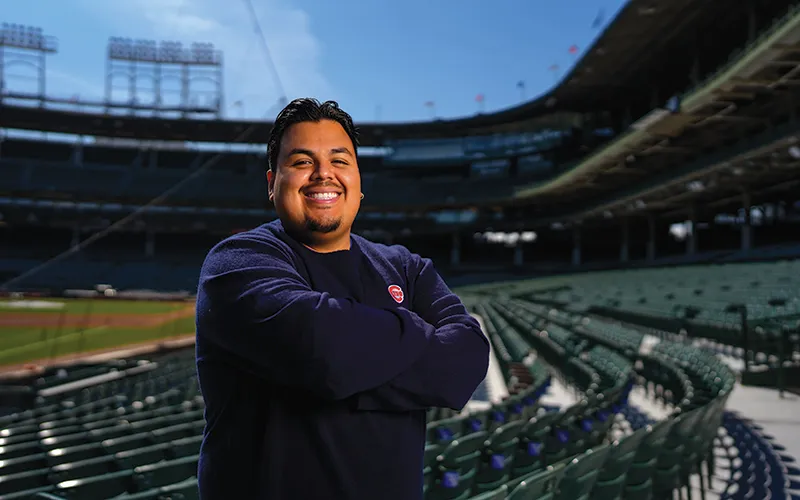
RST alum Fredy Quevedo Jr. enjoying the friendly confines of Wrigley Field. (Photo provided)
As the Spanish-language interpreter for the Chicago Cubs, Fredy Quevedo Jr. steps in front of cameras and reporters, knowing his role is far more than translating words. He’s translating trust. Culture. Confidence. As a media relations specialist, Quevedo helps players share their stories authentically, ensuring language is never a barrier to being heard.
It’s a role that feels tailor-made, even if the path there was anything but linear.
Born and raised in Elgin, Quevedo grew up deeply connected to his community. Long before he enrolled at Elgin Community College (ECC), he was already familiar with the campus through the Youth Leadership Academy program, attending sessions as early as middle school. “I came here all the time, so I already knew the buildings and the campus.”
After high school, Quevedo’s journey took a few turns. He attended college, took time away to work a variety of jobs, and even headed to Minnesota to briefly pursue college football. But by 2019, he found himself back home — and back at ECC, ready to reset and rebuild his confidence.
“I was everywhere, and then I came back home, which is ironic, but it’s the thing I’m most grateful for. You never know where the journey might take you, but you always come back home.”
At ECC, Quevedo completed his Associate in Arts in just one year, graduating in 2020. His time at ECC had a profound impact, as he found support through TRIO and worked closely with mentors who helped him map out clear, achievable next steps. “Being here helped me get right mentally for when I would transfer,” he said, adding that he initially pursued political science out of high school. “I [now] knew what I wanted to go after.”
That sense of care and support mattered. As a first-generation college student and the son of immigrants from Mexico, Quevedo had spent much of his life navigating systems that weren’t built with language access in mind. Growing up, he often translated for his mother at appointments, in offices, and in everyday moments. At the time, it was simply what needed to be done. In hindsight, it was the foundation of a future career.
After ECC, Quevedo transferred to the University of Illinois, Urbana-Champaign, where he earned a bachelor’s degree in recreation, sport and tourism with a concentration in sport management. It was there that his vision sharpened: he wanted to work in sports and use his language and culture as strengths — not side notes.
“I grew up watching sports and playing sports, and I didn’t even know jobs like this existed,” he said.
That clarity led him to take a leap and start applying for roles even when he felt underqualified. His first break came with the San Francisco 49ers, where he worked in marketing while finishing his final semester at U of I. When that role ended, he explored his options in the Bay Area. Then came the call from the Cubs in May of 2023, followed by a second move back home.
Today, Quevedo is one of just 30 Spanish interpreters across Major League Baseball — one per team — helping Spanish-speaking players navigate interviews, media obligations, and public life. But to him, the job is about more than words.
“My goal is to help players find their voices so their stories are told, they are heard, and they feel comfortable being themselves,” he said.
That responsibility feels personal. Quevedo knows how powerful it is to see someone who looks like you, sounds like you, thriving in a visible space. He carries that awareness into every interview and every interaction, hoping young people, especially ECC students, see possibility reflected back at them.
“Don’t ever be afraid to pursue an opportunity. Always be yourself and trust yourself.”
Looking back, Quevedo credits ECC with helping him build that willingness, along with humility, gratitude, and confidence. “ECC showed me the importance of community,” he said. “Of asking for help … of believing that where you start doesn’t limit where you can go.”
From Elgin classrooms to one of baseball’s most iconic ballparks, his journey has come full circle. He’s grounded in home, fueled by purpose, and driven by a belief that language access isn’t just a service. It’s a bridge that breaks down barriers and creates broader connections.
And thanks to Fredy Quevedo Jr., more voices are crossing it every day.
Editor’s Note: Reprinted from Elgin Community College’s website.
Nearly 500 graduates obtained a bachelor’s degree from the College of Applied Health Sciences
The University of Illinois Urbana-Champaign named the student recipients of its highest academic honors for the spring 2026 semester.
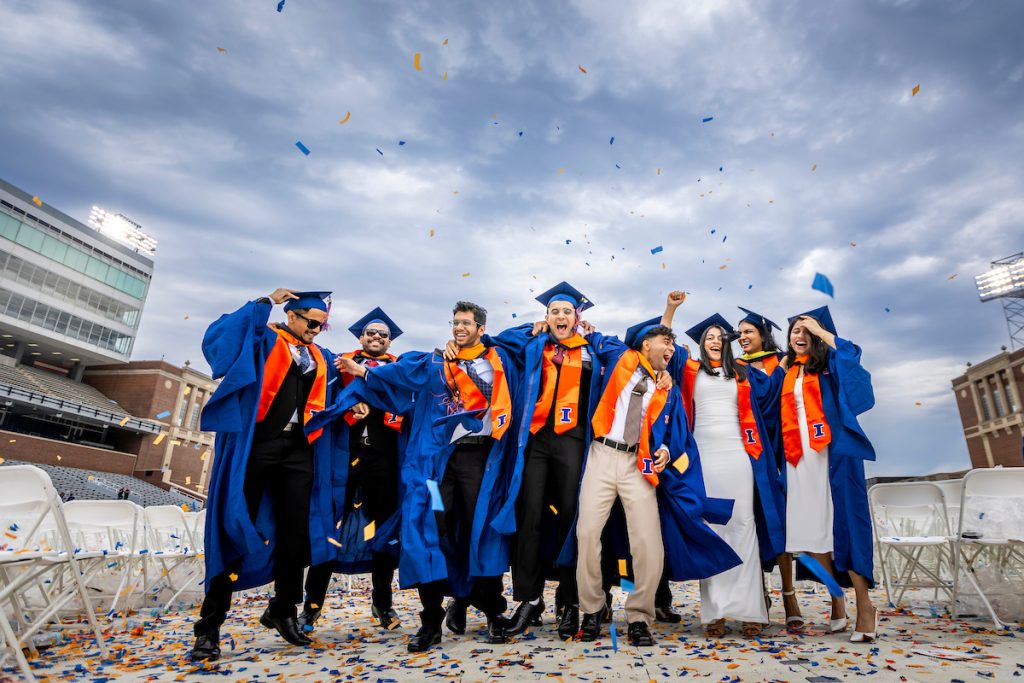
2026 Commencement (Photo by Michelle Hassell)
At the College of Applied Health Sciences at Illinois, 509 students made the Dean’s List, a semesterly honor for students who reach the top 20% grade-point average in their college class or curriculum, with at least 12 academic hours taken for a letter grade.
This year, 17 AHS graduates were recognized as Bronze Tablet honorees. This is the university’s highest honor for graduates, reserved for the top 3% of academic achievers from each college’s graduating class.
Here are the AHS representatives—from all five of our undergraduate degree programs—whose names will be displayed on a bronze tablet in the university’s Main Library:
Audrey Arlis, speech and hearing science
Christopher Atadero, interdisciplinary health sciences
Brian Becker, recreation, sport and tourism
Sarah Blyskal, community health
Lydia Burger,kinesiology
Nicole Dudek, recreation, sport and tourism
Collin Janusz, kinesiology
Estelle Jones, speech and hearing science
Brielle Mapanao, kinesiology
Katherine Naveja, kinesiology
Dorothy Nguyen, recreation, sport and tourism
Stacy Pontikes, speech and hearing scinece
Forrest Benjamin Reyes, recreation, sport and tourism
Karla Rodriguez, speech and hearing science
Farris Sweid, interdisciplinary health sciences
Nicole Zagone, community health
Ella Zick, interdisciplinary health sciences
Last academic year, 490 graduates obtained a bachelor’s degree from the College of Applied Health Sciences.
In all, Illinois recognized 9,005 Dean’s List students and 387 Bronze Tablet honorees for the spring 2026 semester, and awarded more than 12,174 degrees and certificates. Databases for each honor are available online.
A “theater kid through and through,” Haupert (RST ‘21) helps realize the artistic dreams of her community as Palatine Park District’s first-ever cultural arts manager.
In her new role at the Palatine Park District, Laney Haupert carries administrative work to keep her local arts scene running .
From an early age, Laney Haupert dreamed of working in the theater—not acting on stage, but managing her favorite productions behind the scenes.
But life took her in an unexpected direction: as Palatine Park District’s cultural arts manager, Haupert carries administrative work to keep her local arts scene running from her position in parks and recreation.
“I had this lightbulb moment: I can work in cultural arts, do theater, put up shows, serve my community, and have all the benefits of working in the public sector,” Haupert said. “Taking this job was my Hannah Montana, ‘Best of Both Worlds’ moment.”
After a stint in the creative arts and a taste of park district life, Haupert went back to school, obtaining master’s degree online from the Department of Recreation, Sport and Tourism at the University of Illinois Urbana-Champaign in 2021. It gave her the tools to steer her career toward a new path.
“A master’s degree is something I always wanted to complete,” Haupert said. “Having found this program and hearing more about it, it was a great fit for where my career was at and where I saw my life going.”
Haupert is from Bartlett, Illinois, a village of 41,000 in the Chicago metro area. She grew up in community theater, starring in her local production of “The Velveteen Rabbit” when she was 8 years old. As she got older, she found more roles backstage: hanging curtains, doing makeup and building sets for local plays.
Haupert’s mother, Carrie Fullerton, always thought Haupert had the “personality for parks and recreation.” Fullerton is a two-time graduate of the RST program at Illinois and has served as executive director of the Arlington Heights Park District since 2020.
Haupert had different plans, at least at first. She obtained her Bachelor of Fine Arts in Theatre Administration from Millikin University in 2018, working as director of development for the school’s student-run studio theater. But after graduating, the job prospects were dry, so she found an administrative assistant role at the Glenview Park District—and found out she loved it.
“Sometimes it takes someone who is not your parent to realize how cool this thing is, that your parent has been spoon-feeding you,” she said. “I thought parks and recreation was something I really wanted to explore further.”
You have to remember the ‘why’ of what we’re doing, and who it’s for. It’s for the little version of you who really needed this at a certain point in life.
Laney Haupert
Cultural Arts Manager, RST ’21
In February 2020, she landed a role with the Bolingbrook Park District, managing both its gymnastics and theater programs. A month in, the COVID-19 pandemic hit, all in-person events were canceled and she had a “whole lot of nothing to do.”
Haupert’s graduation cap after obtaining her online master’s degree in RST reads “Don’t forget to play.” Today, she is the Palatine Park District’s first-ever cultural arts manager. (Photo provided)
But Haupert had a clearer idea of where she wanted to take her career. She wanted more knowledge—and a degree that connected to her new industry.
The flexibility of the RST online master’s program appealed to her: “Maybe you’re a sports person and love athletics, want to be around it doing recreation management. For me, my love has always been theater and live performance,” Haupert said.
The online format made it easier for her to balance coursework and her job, completing her master’s in a year and a half. RST’s online degree gave her “structure” that she sorely needed, especially early in the pandemic. The master’s program also helped her ace the test for her Certified Parks and Recreation Professional Certification, an industry qualification.
Haupert stayed with Bolingbrook until January 2022, when she began with the Deerfield Park District as its cultural arts and special events supervisor. That experience brought her to Palatine in 2024, where she’s continued to support young artists as the park district’s first ever cultural arts manager.
She supports all manner of performances year-round: multiple choirs, a community band, theater programs and dance recitals. Her big task is to cultivate a school-of-art brand for the park district, while getting “more and more people to do cool stuff with us,” she said.
With a fresh perspective on her role, Haupert is helping to realize the artistic dreams of kids growing up in the same lane she once did.
“The most important thing that’s been a throughline for me: if you’re having fun, you never work a day in your life,” Haupert said. “You have to remember the ‘why’ of what we’re doing, and who it’s for. It’s for the little version of you who really needed this at a certain point in life.”
These three RST graduates “always knew” they’d be working together again someday
Three Recreation, Sport and Tourism alums, Eva Schmidt, Chelcia Abajian and Christine Stromberg work together through the U.S. Tennis Association. “It’s incredible to see the three of us together again.” (Photo provided)
More than a decade after their time together at the University of Illinois Urbana-Champaign, three alumni from the Department of Recreation, Sport and Tourism have found themselves reunited in a place far removed from campus, yet deeply connected to their shared past.
Today, Chelcie Abajian, Eva Schmidt and Christine Stromberg work together through roles connected to the U.S. Tennis Association, contributing to the operations and hospitality surrounding one of the sport’s most prestigious events: the U.S. Open in New York. Their professional reunion, however, is only part of the story. At its core lies a friendship that began during their graduate school days at Illinois and endured long before their careers converged again.
Seeing one another again in the same professional space has been both surreal and deeply meaningful.
“It’s incredible to see the three of us together again,” said Abajian, who is senior manager, conferences and events at the USTA. “Even during the years we weren’t working side-by-side, our bond never wavered.”
Some of their most vivid memories from Illinois weren’t formed in classrooms or lecture halls, but in moments of spontaneity that helped cement their friendship. All three got both their undergraduate and graduate degrees in RST.
“My favorite memory from our Illinois days is more on a personal level,” Abajian said. “Just three months after we met, we took a spontaneous trip to New York City, which was Eva’s first time ever visiting. Looking back, that was the moment we knew this friendship was for the long haul. It’s pretty remarkable that the city where we first bonded as friends is now the same place where we’re making our mark together during the U.S. Open.”
Another favorite memory comes from the final days of their time at Illinois.
“My favorite memory together at Illinois was taking our graduation pictures at Memorial Stadium,” said Schmidt, now director of premium hospitality, office of the president with the USTA. “With the help of a colleague, we were able to take pictures in the Colonnades and it was a fun way to reflect on the last two years. Today, 12 years later, it’s surreal to be working together again, but I love the camaraderie!”
Their journey from classmates to colleagues was never guaranteed, but perhaps it wasn’t entirely surprising either.
“In a way, I think we always knew,” Abajian said. “Christine and I have been a team since 2008, first as student-athletes and now as colleagues who share a love for event operations and tennis.”
That long-standing partnership eventually played a role in bringing the trio back together professionally. When Abajian joined the USTA in 2022, she quickly realized the potential of reconnecting with familiar talent.
“When I landed at the USTA in 2022—due to Christine referring me—one of my first major events was managing the president’s suite,” she said. “I called Eva because her hospitality background was the missing piece of the puzzle for our staff. Watching her move into a full-time role afterward was the ‘full-circle’ moment we’d been building toward since college.”
Another member of the group shared a similar perspective about their eventual reunion.
“Similar to Chelcie’s answer, I always knew we’d be working together again in some capacity,” Schmidt said. “Our paths were always parallel and it was only a matter of time before they intersected.”
Even so, the exact setting was a surprise.
“When we were at Illinois, if I could have predicted where we would end up, at least for me and Eva, I thought it would be in Chicago somewhere, not all living in new places,” said Stromberg, who is director of U.S. Open Player Services. “The years after graduation, following each other’s careers and supporting each other in what we were pursuing is one of the things that kept us all together.”
Their individual career paths since college have been anything but identical.
Abajian remained closely tied to athletics after completing her master’s degree, eventually transitioning into her current role with the USTA.
“I stayed in college athletics until I shifted to the USTA in 2022,” she said. “I’m not surprised by my journey. I have a love for tennis and event management and this role marries the two together.”
Schmidt said her trajectory was far less predictable.
“My career journey since college has been completely nonlinear,” she said. “Every time I thought I had a pathway, I’d pivot and go the polar opposite direction. Working at the USTA has felt the most stable so far.”
Unexpected turns ultimately became a rewarding part of the journey.
“I never thought I’d end up outside of the state of Illinois but that’s my favorite part of my career path,” she said. “I never expected any of this and I continue to surprise myself. Who knows what’s next!”
For Stromberg, tennis itself became the unexpected thread tying everything together.
“Even though I grew up as a tennis player, my original goal was not to work in tennis,” she said. “I started taking opportunities as they arose and walked through some doors that were open and found the career path that I was ultimately looking for; I just didn’t know it’s what I was looking for.”
Many of the skills they rely on today trace directly back to their student-athlete experiences and time at Illinois.
“My skills go back to being a student-athlete,” Abajian said. “Most importantly: time management. I can juggle multiple tasks, prioritize what needs to get done and work my daily life around a schedule.”
Schmidt credited her early experiences working within Illinois athletics as formative.
“I was fortunate enough to have an internship in the Division of Intercollegiate Athletics as an undergrad that took me into my graduate assistantship at Illinois,” she said. “Those years were so formative and have influenced everything I’ve done.”
Accountability, Stromberg added, remains central to how she approaches leadership today.
“Similar to Chelcie, my skills go back to being a student-athlete,” she said. “In addition to what she mentioned, accountability is one of the most important things I learned and it drives how I make decisions and lead today.”
Their friendship has only strengthened as their relationship has shifted from classmates to colleagues.
“It has only grown,” Abajian said.
Working together professionally has also given them new perspectives on each other.
“It’s certainly grown and also allows us to approach things from a different perspective,” Schmidt added.
“It continues to grow every day,” Stromberg said.
One moment in particular made their shared journey feel complete.
During one U.S. Open, the three unexpectedly found themselves together in the player walk-on tunnel at Louis Armstrong Stadium during the retirement ceremony for American tennis player John Isner.
“In my first year full time with the USTA, the three of us found ourselves in the player walk-on tunnel at Louis Armstrong Stadium for John Isner’s retirement ceremony,” Schmidt said. “Each of us were there for different reasons and we had yet to organically bump into each other at the Open. We all paused and acknowledged the greatness of the moment and even took a selfie.”
Their long history together also shapes how they work.
“Having been friends since 2012, our professional partnership at the USTA is built on a decade-plus of mutual trust,” Abajian said. “This shared history allows us to solve problems with total confidence and zero hesitation. We are each other’s most reliable sounding board and always the first phone call when it’s time to get to work.”
Honesty is part of that dynamic as well.
“We aren’t afraid to tell each other the hard things,” Stromberg added. “That’s really where growth comes from.”
Looking back, each of them has advice for the younger versions of themselves who were navigating graduate school in Champaign-Urbana.
“Work hard, but work does not define you,” Abajian said. “Chill out on the perfectionism; mistakes are just proof that you’re actually out there trying things. Your worth doesn’t go up or down based on your productivity, so don’t forget to clock out and find some sun.”
Schmidt emphasized patience.
“Take a breath,” she said. “Don’t feel like you have to have your whole life figured out by 25.”
And while their professional futures may take them in different directions, one thing is certain: their friendship will remain constant.
“Our friendship comes first in our circle,” Abajian said. “We are fortunate to have each other to lean on for work and personal advice. We hope to keep growing and learning together in this organization.”
As Stromberg summed up, the next step might be uncertain, but the foundation they share is not.
“We don’t know where the professional path will take each of us,” she said. “But we know where our friendship will.”
This summertime enrichment program for local youth run by Health and Kinesiology at Illinois is back in Champaign
A day in the iPALS program provides academic enrichment, playtime, social-emotional learning and nutritious snacks. (Photo provided)
A group of Illinois physical education alumni are supporting one of the College of Applied Health Sciences’ longest-running youth programs as it returns to Champaign.
Three graduates of the former Department of Physical Education for Women at Illinois—Carolyn Bechly, Jean Snuggs and Lyndell Wilken—have pooled their resources into an endowment to help fund the Illinois Physical Activity and Life Skills program, also known as iPALS. The summer wellness program for local children is also a steppingstone for Illinois student educators to develop their skills.
“We’re hoping iPALS can be part of their practical experience, building on what they’ve learned in a classroom,” said Wilken, who graduated in 1972 and became a coach, physical educator and athletics administrator.
The eight-week iPALS program run by the Department of Health and Kinesiology in Applied Health Sciences brings in local schoolchildren every summer for a full day-camp experience, with structured playtime, academic enrichment, social-emotional learning and nutritious snacks available each day.
Beyond a summer opportunity for at-risk youth—every child participant qualifies for SNAP benefits or free-and-reduced lunch—the program doubles as a research study, funded by the U.S. Department of Agriculture.
The premise of the study: to see if regular physical activity, summertime enrichment and specialized nutrition can curb “learning loss,” the regular backsliding of academic achievement that occurs over summer break. Enrollment in iPALS is completely free.
The University of Illinois has a long history of youth summer programs. iPALS was originally the “Sport Fitness” program, where physical activity was the focus. With community input from partnering local school districts, faculty leaders have developed a more balanced approach over the years, between academic and social enrichment, exercise and nutrition.
Many of the daily snacks served to iPALS kids contain lutein, a carotenoid common in leafy green vegetables that settles in our eyes and brain, supporting our eyesight and cognitive health. The iPALS participants, ages 6 to 11 years old, take fitness, academic and cognition assessments at the beginning and end of the program to measure its direct impacts.
“Given that physical activity participation is among the most robust behavioral approaches to support both physical and cognitive health, we anticipate that the iPALS program has the potential to have a meaningful impact on children in our community,” said principal investigator Naiman Khan, associate professor in the Department of Health and Kinesiology.
During iPALS days, the kids move from station to station, with each stop run by Illinois graduate students. The researchers purposely use students with diverse backgrounds: nutrition majors running the snack station, education majors running academic enrichment, and physical educators structuring the playtime.
“For me, the most important aspect is that we provide a safe space for eight hours a day where kids are guaranteed meals and snacks, surrounded by adults who care about them, and they’re able to build relationships with peers experiencing similar realities,” said HK Associate Professor Kevin Richards, who researches the teaching of physical education. “That impact is difficult to capture with data, but it is the most meaningful part of the program.”
Interested families can visit the iPALS website and complete the eligibility survey to see if their child qualifies for the program. This year’s iPALS will take place at Booker T. Washington STEM Academy in Champaign on weekdays from June 3 to July 17.
Booker T. Washington STEM Academy in Champaign will be the hosting venue for this year’s iPALS program. (Champaign Unit 4)
A Motivated Donation
Illinois alumnae Carolyn Bechly, Lyndell Wilken and Jean Snuggs on a trip to Alaska. The three graduated from Illinois Department of Physical Education for Women just as Title IX took effect. (Photo provided)
The teaching experience available in the iPALS program mirrors the student teaching opportunities that were available to prior generations of Illinois physical education majors. Months after the passage of landmark Title IX legislation in 1972, the Illinois departments of Physical Education for men and women were fused, just as Bechly, Wilken and Snuggs happened to embark on their careers.
Under Title IX, every education program that received federal funding had to ensure equal access for students regardless of sex. Schools nationwide had an imperative to start girls’ sports teams, and a dire need for coaches. Some states, including Illinois, mandated that coaching slots be filled by women.
Suddenly, these new Illinois physical education graduates had their work cut out for them.
“It was an amazing time, and busy,” Wilken said. “The opportunities were huge, also the workload you sustained, because you were a full-time teacher and you weren’t given anything extra for coaching—just the love of sport and wanting girls to have opportunities that drove most of us to essentially do it for free.”
The three women quickly discovered the lessons from the Illinois’ physical education program were useful in the field. They had learned under department legends such as professors Phyllis Hill and Beulah Drom, who instilled foundations in childhood motor skills and structuring class-time for physical education. The pedagogy of P.E. was scientific and practical: to help students understand the joy of movement, you’ll have to get them to line up single file as well.
“The science of it was really fascinating … you learned how to learn things, which carried over into how to teach,” Snuggs said. “In retrospect, it was always incredibly teaching-oriented.”
Wilken, Snuggs, Bechly and their cohort have retired, mostly, from long careers in physical education and coaching, spanning secondary schools, colleges and universities. They owe much of their lasting bond with their classmates to the passage of Title IX, and the whirlwind of entering the field together, giving student-athletes—particularly young women—opportunities that didn’t exist for themselves.
“We graduated, Title IX happened, and we fell into wonderland,” Bechly said. “Us starting as brand-new teachers, to be able to coach and experience stuff we didn’t really experience to that level, it was just fabulous.”
Naturally, shared professional experiences led the cohort to stay in touch and collaborate. Wilken made a spirited call to Snuggs back in 1979: Wilken was leaving her post at the American River College in Sacramento after founding its women’s track and field team. The school would need a new athletics administrator, and a new coach.
Inspired by how iPALS mirrors their own student-teaching experiences at Illinois, these physical education alums set up a fund to support the program indefinitely. (Photo provided)
“I had never run a track race in my life, but Lyndell said, ‘Hey, you might like this, why don’t you apply?’” Snuggs said. Snuggs got the job and stayed at American River College for more than 30 years, retiring as its dean of physical education in 2012. Wilken went to work at Lane Community College in Oregon, coaching its cross country and track teams to four conference championships.
Today, more than 53 years after the passage of Title IX, these alums have reconnected with their alma mater. After dialogues with the current faculty of Health and Kinesiology, the iPALS program seemed a good target for their financial support, mirroring their own student-teaching experiences at Illinois.
Their Supervised Teaching of Physical Activity/Nutrition Fund will support iPALS indefinitely. The founders have put out an open call for alums, including fellow physical educators, to donate.
“We’d like the students working there in the summer to be future physical educators, and that they continue being mentored and teaching,” Bechly said.
Families can register their kids for this summer session of iPALS now. In the meantime, the PEW alums hope more supporters help sustain the program.
“Physical education is a wonderful opportunity for kids to make decisions at whatever level, in terms of how they deal with others, how they deal with winning and losing. It’s heavy-duty stuff they can use for the rest of their lives,” Snuggs said.
Editor’s note:
To learn more about iPALS or sign up your child, visit the program’s webpage.
Want to contribute to the Supervised Teaching of Physical Activity/Nutrition Fund (Fund #778014)? Donate or email our AHS Office of Advancement at advancement@ahs.illinois.edu.