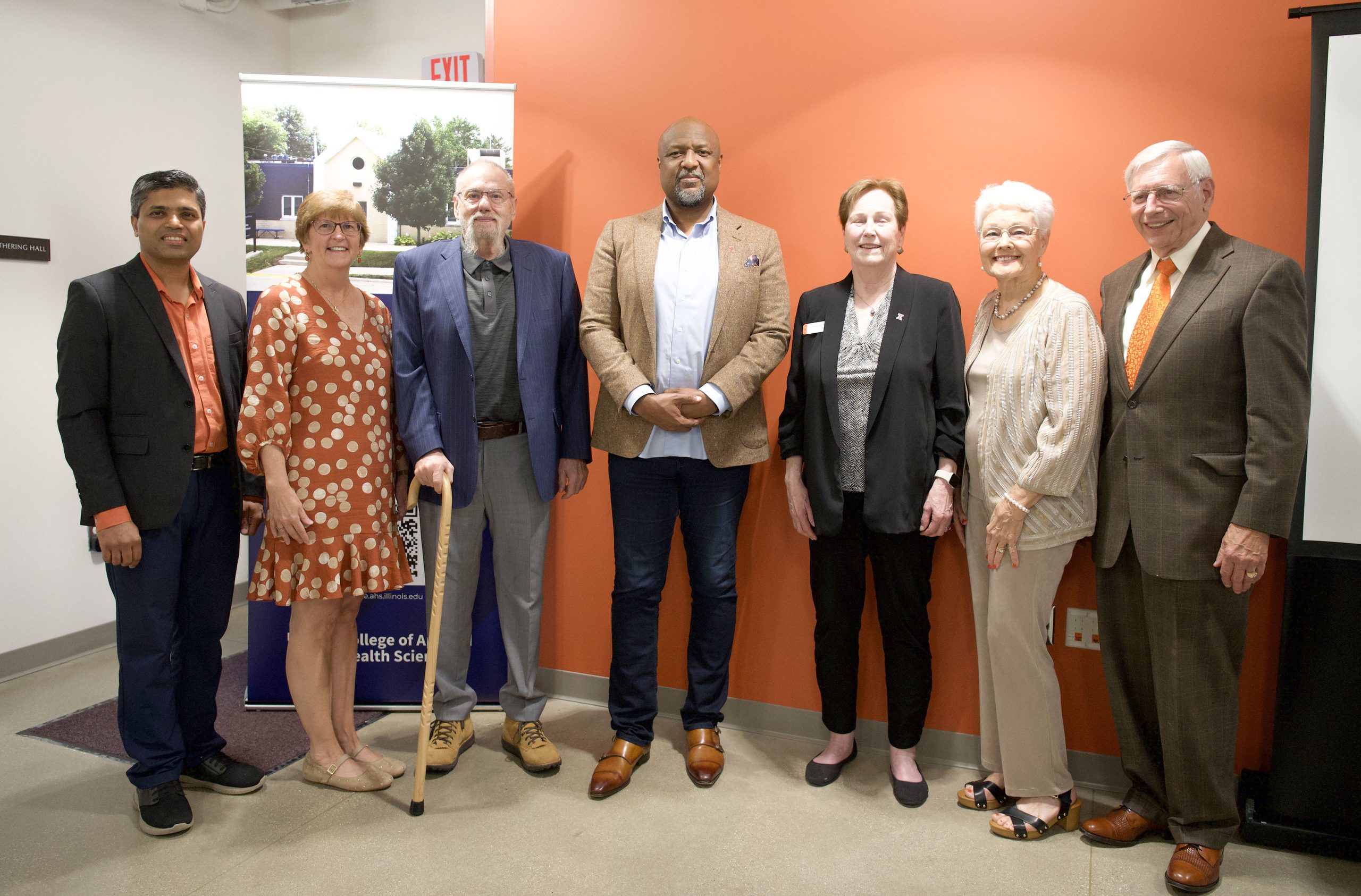
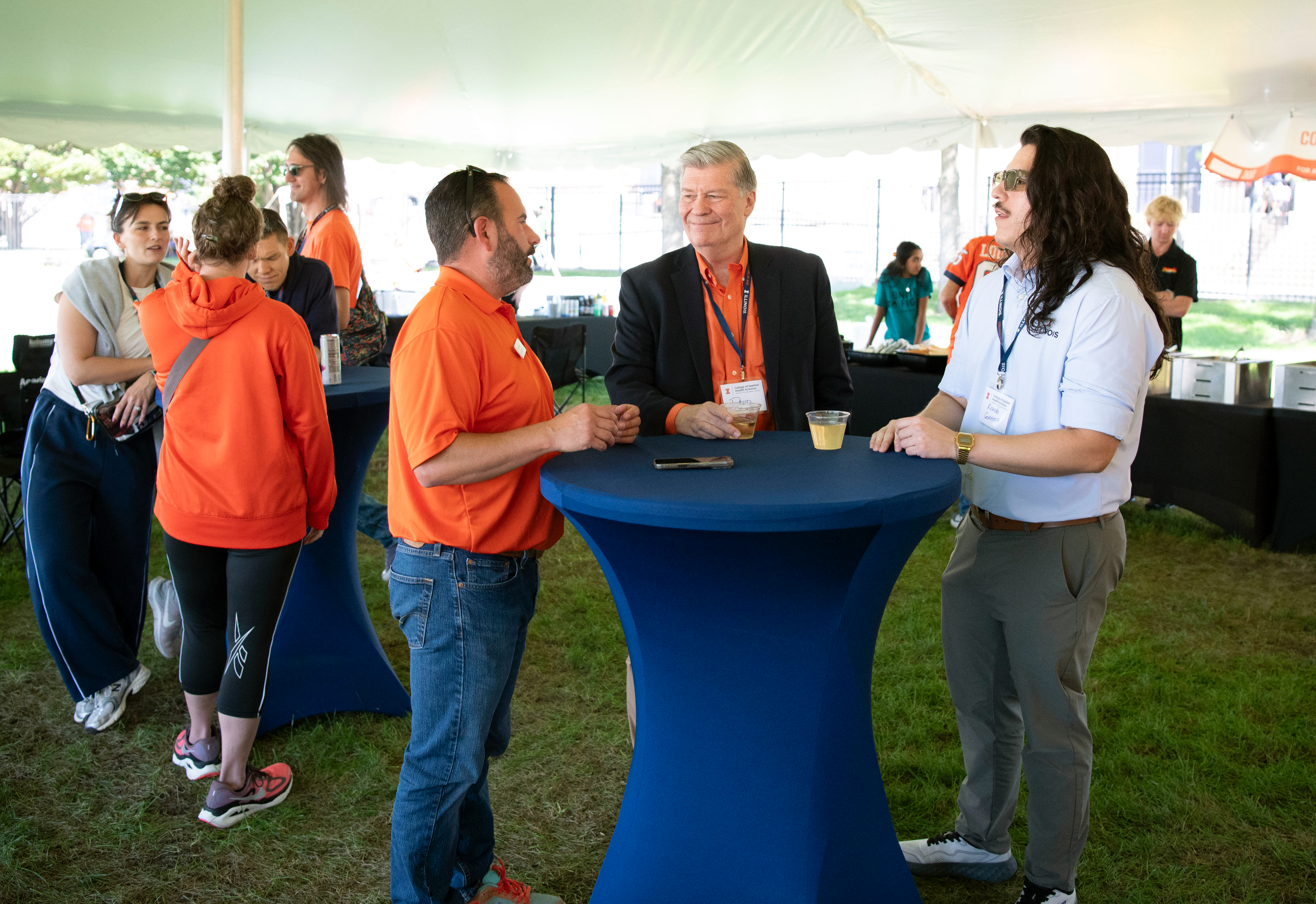
The theme of the 2026 Sapora Symposium was ‘the power of community.’ (Photo by Ethan Simmons)
The 2026 Sapora Symposium once again brought the RST community together in a powerful way—connecting students, alumni and industry leaders through meaningful engagement and shared learning.
Centered on this year’s theme, the power of community, the Symposium explored how civic engagement, marketing, and social and digital innovation shape professional pathways across recreation, sport, and tourism.
The series kicked off on January 29 in Chicago with keynote remarks by Michael Strautmanis of the Barack Obama Presidential Center, whose insights on leadership and community development set the tone for the weeks ahead.
The main event, held March 6 at the Illini Union, welcomed more than 130 undergraduate and graduate students and over 35 speakers and table hosts—most of them RST alumni. Throughout the day, students engaged directly with professionals, turning conversations into mentorship and networking into lasting connections.
We are deeply grateful to TSMGI for their continued partnership and to the outstanding group of speakers and guests who generously shared their time and expertise:
2026 Participating Speakers & Guests
Jordan Bressler – TSMGI
Reese Bressler – TSMGI
Jamie Bronska – Chicago White Sox
Glenn Eden – Chicago Civic Leader / Choose Chicago
Carly Eilian – TSMGI
Christian Evans – Indianapolis Pacers
Brian Floriani – Bernie’s Book Bank
Abri Forrest – TSMGI
Melissa Garritano – Special Olympics Illinois
Megan Gaseor – Chicago Cubs
Parker Gray – DIA Marketing Street Team
Joe Kennedy – Obama Presidential Center
Chris Marciani – TMRW Sports
Andrew McCarthy – TSMGI
Alexis McCay – KemperSports
Nick McDuffee – Village of Savoy Parks and Recreation
Brendon McGuire – DIA Football Video
Lauren Mroz – National Basketball Association
Alex Munoz – NASCAR
Tristan Nelson – Oklahoma City Thunder
Joe Ronovsky – Village of Bedford Park / Wintrust Sports Complex
Carmen Rossi – 8 Hospitality
Alex Roux – Big Ten Network
Rebecca Seldin – TSMGI
Liam Sise – La Grange Park District
Joey Spathis – TSMGI
Mark Steinberg – Excel Sports Management
Christine Stromberg – United States Tennis Association
Angela Tzortis – Chicago Cubs
Rachel Wright – TSMGI
Your collective engagement—spanning sport organizations, tourism and destination marketing, recreation and park systems, community development, nonprofit leadership, and agency work—created an exceptional experience for our students and reflected the full breadth of the RST field.
Norrito is preparing students to see sport not just as an industry, but as a powerful force for social good.
RST postdoc Alessio Norrito will primarily work with Professor Yuhei Inoue, while collaborating across the department.
The Department of Recreation, Sport and Tourism at the University of Illinois Urbana-Champaign is pleased to welcome Alessio Norrito as a postdoctoral research associate. Norrito brings with him an international perspective, interdisciplinary expertise and a deep belief in the power of sport to improve lives and communities. He will primarily work with RST Professor Yuhei Inoue, while developing collaborations with other RST faculty members.
“Alessio is an excellent addition to the department, as his research can effectively bridge sport management, recreation and tourism, advancing our understanding of how these interrelated fields can work together to address some of the grand challenges facing today’s society,” Inoue said. “In addition, given his international background and experience, Alessio can share valuable global perspectives with RST faculty and students, strengthening an important dimension of our department.”
Norrito earned his Ph.D. in sport sociology and management from Loughborough University, one of the world’s leading institutions for sport research. Before joining Illinois, he served as a senior lecturer at Manchester Metropolitan University. His academic path, however, is rooted in a broader professional journey that spans continents and industries. Prior to entering higher ed, Norrito worked in marketing and e-commerce within the food and beverage sector, with professional experiences in Shanghai, China and Turin, Italy. Those early roles, he notes, shaped his understanding of organizations, markets and people—insights that continue to inform his research and teaching today.
Norrito has contributed to international research projects supported by organizations such as the International Olympic Committee, UNESCO and UEFA. His work has been recognized by the European Association for the Sociology of Sport, which awarded him the Young Researcher Award for his contributions to the field. Across these projects, his research consistently examines how sport and leisure can enhance well-being and strengthen communities, with particular attention to how organizations pursue social purpose at the intersection of global contexts and local realities.
That interdisciplinary focus made the U. of I. a natural next step.
“I think the University of Illinois has a unique take on the way that sport management should be, which strongly aligns with my ideas,” Norrito said. “I position my work in between sociology and management, firmly believing that the two disciplines should be in constant dialogue for solving pressing global issues, creatively and innovatively finding alternatives that benefit people globally.” He added that he found “matching values in the RST department,” allowing him to contribute meaningfully through sport management while being “strongly supported in the development and realization of this work.”
At the heart of Norrito’s research is a simple idea: sport helps people connect. “At its simplest, sport helps us talk to each other and know each other better,” he said. “These interactions make us feel emotions that either unite or divide us.” His work emphasizes that when organizations learn to harness the positive side of sport, it can generate feelings of being “loved, hopeful and ambitious.” What is often overlooked, he notes, is how everyday experiences—like playing or watching sports—can help individuals and communities imagine a shared future. “Sometimes the simple pleasures of life, like sport, can give us a direction of where we want to go in the future, either [individually] or collectively,” he said. “According to my research, this pursuit can generate diverse forms of happiness.”
Norrito’s international research collaborations have also reshaped his understanding of how global sport organizations operate. “I was surprised the most [by] just how valuable research is for global sport organizations,” he said. “My belief prior to these experiences was that research was something ‘for academics.’”
For students interested in working in sport at a global level, Norrito’s advice is clear: engage deeply with organizations’ strategic plans and think proactively about how to fit within them. “Your time in [U. of I.] is key to developing your future self, and taking the right courses can be key to becoming the person that you need to be to land that dream job,” he said.
This semester, Norrito is teaching RST 210: Management in RST, where he introduces students to management and leadership across recreation, sport and tourism contexts. His approach to leadership resists simple formulas.
“I strongly do not believe in a one-size-fits-all approach,” he said. “Instead I encourage RST students to engage in reflexivity. Reflecting on yourself is a key practice to understand what skills you need to develop to be the leader you want to be in the future.”
That philosophy is closely tied to how he brings his research into the classroom.
“My research leads me to believe that behind every social problem there is always an opportunity to solve it,” Norrito said. “And when this social problem is solved, it benefits those who have solved it, those who were affected by it and society as a whole.” He regularly draws on examples from his own work to show students how social impact, business and management are deeply connected—and how future professionals can align purpose with practice.
Norrito’s passion for sport as a subject of serious academic inquiry has personal roots. He recalled a formative moment from his high school years in Palermo, Italy.
“When I was in high school, in my hometown of Palermo, the science surrounding sport was not very popular,” he said. After submitting an assignment about soccer, he was told by a teacher that sport did not belong in the classroom—and he failed the assignment.
“The fact that my job now involves talking about sport inside a classroom is quite ironic,” he said, “but also tells the lesson that we should protect our beliefs and challenge assumptions that seem wrong to us.”
Now at Illinois, Norrito is doing exactly that—challenging assumptions, connecting disciplines and preparing the next generation of RST leaders to see sport not just as an industry, but as a powerful force for social good.
These Recreation, Sport and Tourism undergraduates landed summer internships abroad. Here’s what they learned
Every year, students studying Recreation, Sport and Tourism at the University of Illinois Urbana-Champaign venture across the United States for professional internships. Some even find work outside of the country.
The College of Applied Health Sciences spoke with two RST students set to graduate this May, David Shan and Juan Manrique, who spent last summer working abroad in China and Guatemala, respectively.
Their interviews have been lightly edited for length and clarity.
***
David Shan
RST student David Shan spent his early life in Californiabut went to middle and high school in Beijing, China. He was always into sports, participating in volleyball and badminton. He even founded a huge badminton tournament at his high school. Shan followed his passion to RST at Illinois, where he’s set to graduate early—and he’s already interned for some of the biggest gaming companies in the world.
What company did you intern for last summer?
I interned for Electronic Soul, a game studio and public-traded company in Hangzhou, China.
How did you get the job?
There are apps like LinkedIn and Handshake in Chinese markets for job applications. I scrolled through offers and applied for this role.
They asked, “How can you link your experience to the gaming industry?” I explained that games are part of sports, and that a lot of the classes I was taking at RST could prepare me for the job. Marketing, finance, event planning. I also talked about the badminton tournament I had been running. Those things all helped me get the job.
What was your day-to-day like?
At Electronic Soul, we’d have shows for some of the icons inside the games. We ran tournaments for the game they designed and helped prepare all the promotional materials. I was in the office for five days a week, from 9 a.m. to 6 p.m.
We had a big comic show for characters in the games. It was held in place for a week; we spent a bunch of time preparing for it. We set up the stage for the actors dressed as the characters.
I was also involved in the designing stage of one of the games they were launching, while they were still designing the characters. So I helped do some background research on how the characters could act in the game and what would make them appealing.
Any special takeaways?
Before I went to this company, I didn’t play games that often. The whole process of game design and launch, it was a whole new thing for me.
There are a bunch of different fields in RST, but any industry that’s more popular, I felt like I could grow a lot and it may be easier to get in.
Any advice for students searching for internships abroad?
One is, be more open. There are a lot of industries that we could go to, even though it’s not linked with our own major. People might think, how are games related to your major?
There are a lot of opportunities outside of the [U.S.]. Other countries are still developing, they have huge market opportunities for games and other industries as well. Don’t be shy or afraid.
I got another internship at Tencent, the biggest gaming company in the world, because they had a career fair. I flew there over the weekend and talked to the staff and got the job. Just be more active and try out everything.
What’s your experience been like here at RST?
The RST internship coordinator Hayley Hardin and advisor Jason Schroeder, they all taught us how to reach out to people, how to email and be active. Giving everything a shot. That mindset helped me prepare for my career and get job opportunities.
I’m passionate about entrepreneurship; that’s my long term goal. But in the short-term, I may go to other gaming companies. I’m interning at Tencent right now. After I graduate, I may use that experience to apply for a full-time role.
There are a lot of opportunities outside of the [U.S.]. Other countries are still developing, they have huge market opportunities (…) Don’t be shy or afraid.
David Shan
RST undergraduate
Juan Manrique at the Xelajú MC soccer field.
Juan Manrique, a senior in RST, got his Associate Degree in Computer Science from Harold Washington College in his home city of Chicago. A lifelong sports enthusiast and soccer player, he decided to come to Illinois for its sport management program.
At first, Manrique wanted to find a D1 soccer program to play for. But in his first summer internship outside of the states, he helped the program run behind the scenes.
What company did you intern for last summer?
The professional soccer club Xelajú MC in Quetzaltenango, Guatemala. They won the league championship back in 2012, when I was 10 years old. It was crazy seeing that on TV.
How did you get the job?
It’s a funny story, my grandfather was actually the president of Xelajú MC back in 1999–2000. But I didn’t use him as a resource at all. Instead, I sent the current president of the club a friend request on Facebook.
I basically told him, “I want to shadow you and help wherever I can.” I mentioned my granddad, and that both my dad and mom are from Guatemala. He accepted my friend request, and he had won the election to continue for a second term. At that club, it works like our presidential election, where they get elected to serve on new terms.
What was your day-to-day like?
When I arrived it was the offseason for the men’s team. The women’s team made the finals but unfortunately lost. I spent a lot of time learning different systems in the institution.
I was moving around the office and helping with whatever I could. I worked with the marketing and communications group, the media group of the team, even helped the utility group as well, making sure the players had their boots and their jerseys. It was pretty cool. That’s what made it interesting, was that every day was different.
Any special takeaways?
It’s a different culture, and a different way things are managed. Any resource we have here in the United States, it’s accessible. You have to work with limited resources, we didn’t have the best equipment, but we had to work with what we had.
The professor told me I was probably the first intern in the history of University of Illinois to do their summer internship in Guatemala. I told that to the soccer club over there; they had never had an intern in their existence. It was pretty cool.
Manrique sits at the club’s media table. He was told he’s “probably” the first student from the University of Illinois to land a summer internship in Guatemala.
Any advice for students searching for internships abroad?
It’s a great opportunity for people that want to take on a new challenge, learn about a different heritage and culture and see how things are managed. Businesses are managed differently in every country; every country has different standards, methods and techniques of how they should do things as an administration.
To do an internship abroad, you need to be familiarized and acquainted with what you’re gonna do. I had the luck that this is my favorite soccer team, and my family’s from there.
What’s your experience been like here at RST?
Doing the internship has opened my doors to working internationally, with them or another team, it has opened that path for me. I see RST is a community that’s growing; recreation, sport and tourism keeps exploding day by day. [The U.S.] is going to be co-hosting the World Cup. That’ll be huge. There’s a lot of opportunities out there, even remotely.
In this capstone course, recreation, sport and tourism undergrads plan events from start to finish. The class has created several community highlights
Visitors to this year’s “Yappy Hour” event brought their pups to Riggs Beer Co. for drinks and fun. Recreation, Sport and Tourism students organized this event and several others this spring. (Photo by Ethan Simmons)
Tournaments for pickleball, spike ball and wheelchair basketball, a “yappy” hour at a local brewery with dogs invited, a fairy tale ball at a local library: Each spring, students in Recreation, Sport and Tourism help organize some of the semester’s most memorable events on and off campus.
And it all comes back to one class: Event Implementation in RST, which is required coursework for undergraduates in the RST major, and Sarah Agate’s “favorite class to teach.”
“In recreation, sport and tourism, regardless of what your job is, you’ll probably be involved in helping plan and facilitate events,” said Agate, teaching associate professor in the Department of RST in the College of Applied Health Sciences at the University of Illinois Urbana-Champaign. “I get emails from students even a few months later who have graduated and are working in their grown-up job, saying, ‘I hadn’t planned on doing events, but now that’s part of my job, and I feel so prepared and ready because of what we did.’”
Technically, Agate teaches two events courses—RST 460: Event Management in Recreation, Sport and Tourism and RST 465: Event Implementation in RST take place across the fall and spring semesters. The two-course sequence was an appealing feature for Agate before she was hired at the University of Illinois; it offered a more rewarding experience than the one-semester event classes she had taught at previous stops.
In fall, students group together, decide the event they want to support, then spend the next few months partnering with local agencies, finding sponsors and sharpening their event plans, including emergency and risk management.
Spring is all about promotion, execution and evaluation. This year, RST students in her class helped put on 11 events, starting with the Illinois Wheelchair Basketball Tournament on Feb. 13–14 and ending with a kids’ football camp on April 26.
After facilitating the events, the final project is the evaluation report. Students gather survey data from attendees and compile suggestions for their partnering agency of what went well and how the event could run even better next time.
Sarah Agate, teaching associate professor in RST.
The event planning process can feel “overwhelming” to undergraduates who are partnering to host big local events with lots of moving pieces. Agate planned a phase of her course to answer the question: how can we be ready if something goes wrong?
This year, Agate expanded the risk management section. She took students to a local crisis management training, including first aid demonstration and an active threat training with campus police officers.
Students are assigned a “venue risk assessment” for each event, where they check for first aid kits and defibrillator locations, whether exits were clearly marked and determine sheltering plans spots if severe weather were to come around.
“The saying that I have heard numerous times is something along the lines of, ‘Hopefully we don’t have any problems, but in the case that we do, we will be prepared for them,’” said RST senior Drew Erickson, who organized a “Yappy Hour” at the Riggs Beer Co. with seven of his classmates.
The group planned a rain date just in case of April showers. Of course, the event went smoothly on a sunny Urbana spring day, bringing together townies, their pups and local vendors over brews.
RST students Nina Bollman, Tariq Cotton, Kaden Feagin, Brandon Henderson, James Kruetz, TJ McMillen, Mac Resetich and Xavier Scott, hosted the ICON for Illini Kids Football Camp held April 26, 2026, at the Irwin Indoor Practice Facility.(Photo provided)
Many of the events have become community mainstays, like the annual Fairy Tale Ball at the Urbana Free Library, or the Illini Get Pickled pickleball tournament, now three years running.
RST junior Michael Evans has helped run the tournament since its inception, an event in Huff Gym first created by RST students Carson Bounds and Gavin Christopherson. The past two years, it raised more than $11,000 for Cunningham Children’s Home, a child welfare agency based in Urbana.
This year’s event had a recreational bracket with lots of student and faculty sign-ups and a second tourney with a new spin: a Greek house bracket for fraternity and sorority members to duke it out on the pickleball courts. This year, more than 50 teams signed on.
Though Evans had experienced behind-the-scenes event organizing through his work at Illinois Athletics, Agate’s courses gave Evans the “why” behind every step of the process.
“Compared to an Illini football game, our event is a blip on a map,” Evans said. “To see how much it takes for just this small pickleball tournament and the number of people from so many different places who have their hands in it—whether it be, ‘Oh hey, I know this person,’ or the people we talked to rent Huff Gym out, the sponsors … there’s a ton of people who just want to see this go well, and they want to support Cunningham.”
The events courses are designed as a capstone experience for students in the recreation, sport and tourism program, and Agate gets an extended front-row seat, as a rare instructor to see the same students for two semesters.
“I feel like I really get to know them,” Agate said. “It’s fun to see their skills develop over those eight months we have together, where they’re nervous at the beginning, then they get into the process with their professional. By spring, they’re event facilitators … it’s fun to watch their confidence grow.”
A sponsored partnership serves as an experiential learning opportunity for Recreation, Sport and Tourism students
Students from RST 441 and faculty from the department have developed a model for emergency preparedness at the Wintrust Sports Complex at the Village of Bedford Park. (Photo provided)
On any given weekend, the parking lots around the Wintrust Sports Complex fill with minivans and team buses, their passengers streaming through the doors with duffel bags and folding chairs in tow. Inside, basketballs thud against hardwood, volleyballs whistle across nets and tournament brackets inch toward championships. Over the course of a busy stretch, as many as 2,000 athletes, coaches and family members can pass through the facility.
What most of them never see is the intricate choreography required to keep that many people safe, and the multiyear partnership quietly reshaping how that work gets done.
Over the past three years, the Village of Bedford Park, Wintrust and students and faculty from the Department of Recreation, Sport and Tourism in the College of Applied Health Sciences at the University of Illinois Urbana-Champaign have built a model for emergency preparedness that doubles as a proving ground for experiential learning. What began as a consulting-style project in faculty member Mike Raycraft’s course has evolved into a collaborative, partner-supported initiative central to the department’s engaged scholarship.
At its core, the collaboration reflects RST’s broader strategy: strengthening its national leadership in experiential education through a growing network of community, industry and governmental partnerships that give students high-impact, hands-on training opportunities while addressing real-world challenges.
One prominent example is the funded contract with Bedford Park and the Wintrust Sports Complex led by co-principal investigators Carla Santos—RST’s department head—and RST faculty members Mike Raycraft and Toni Liechty. Through that work, faculty and students are not only developing applied learning opportunities, but also assisting their sponsor in tackling pressing issues tied to community development and facility and operational readiness.
“Our sponsored partnership with Bedford Park and the Wintrust Sports Complex enables us to translate research into practice while providing students with direct, hands-on experience in the field,” Santos said. “Through engagement with practitioners and meaningful service to communities, our students develop the professional competencies, leadership skills and applied judgment that employers increasingly demand. This investment in experiential learning strengthens course relevance, deepens community impact and reinforces RST’s national reputation for preparing career-ready graduates.”
The practical engine behind much of that work is RST 441, a course led by Adjunct Instructor Robyn Deterding. In the class, graduate students function less like traditional students and more like consultants embedded in a working sports venue.
When the partnership began, Deterding said, the first task was to assess the complex’s existing safety infrastructure.
“Wintrust didn’t have much in the way of plans and emergency practices when we started,” she said. “So first we had to find out what they had, what they did and when they did it.”
Students evaluated routine facility checks, reviewed staff training frequency and examined equipment inspection practices. They presented recommendations to venue leadership, who were responsible for implementation. In the second year, the focus sharpened on evacuation planning—a critical need for a multicourt complex hosting youth tournaments, adult leagues, corporate events and special competitions, often simultaneously.
“You know you can’t prevent accidents and incidents from occurring,” Deterding said. “But you can plan and train for them. If they don’t happen, excellent. If they do, you have a plan to work from.”
The partnership has since expanded to include coordination with the Chicago Office of Emergency Management, Homeland Security and other public safety agencies. This year, students in RST 441 are partnering with the complex, the village and Chicago emergency officials to plan and deliver the Safe Chicago training program, an initiative designed to train up to 100 community and agency participants in CPR/AED, Narcan administration and Stop the Bleed techniques.
The Safe Chicago program represents the next phase of the “living lab” concept: moving beyond internal planning to outward-facing community resilience. By training coaches, staff, volunteers and local collaborators, the effort extends preparedness beyond the building’s walls.
For Bedford Park officials, the collaboration has provided both practical benefits and a long-term talent base.
“Our goal is to be able to develop a pipeline to give students an experience and give them an internship where they’re actually going to learn something and be in charge of the task with a project as opposed to going to an already established relationship,” said Joe Ronovsky, the village’s chief business officer. “We view this as like the lab in the Chicagoland area.”
That lab connects students with a broader ecosystem of sports and corporate partners, including the Chicago Sky, the Chicago White Sox, Wintrust Financial and Special Olympics Illinois.
“We really wanted to create kind of this lab that gave them real-life experience as opposed to just an internship where you’re cold calling or doing mailing,” Ronovsky said. “A real-life lab.”
For students, the difference is tangible. Rather than drafting hypothetical plans for a classroom grade, they are producing emergency guides, training protocols and communication strategies that can be adopted and implemented immediately.
“Any students working on these projects with us can actually go into a job interview and talk about things that have actually been done and implemented versus a hypothetical project that they did in grad school,” Ronovsky said.
The arrangement also acts as an external audit for the village and complex.
“The return on it for us is that we get third-party validation of changes or things that we need to implement,” Ronovsky said. “They’re the brightest minds, and one day all those students are going to be in leadership positions. The best thing you can do is just open up the opinions of the room and let all the brighter people talk and contribute to what we want to do. The return for us is just to be able to create this incubator.”
The inside of the Wintrust Sports Complex. (Photo provided)
Co-investigator Raycraft said the “leadership of Dave Brady and Chief Business Officer Joe Ronovsky has been transformative for the Village of Bedford Park.
“Their forward-thinking vision has accelerated economic development, strengthened tourism and elevated the village’s profile as a hub for sport, business and community engagement. Importantly, this collaborative environment has created a unique living laboratory for our students and faculty and provided opportunities to explore innovative ideas, conduct impactful research and contribute meaningfully to community-based service initiatives.”
Deterding emphasizes that emergency planning hinges on the principle of reasonable care, the obligation to take appropriate precautions to protect patrons. In a venue that can host thousands of visitors in a weekend, many of them minors, the stakes are high.
“Making sure everyone is receiving the same information and coordinating the work each is doing is difficult,” she said. “There are a lot of moving parts, but that’s what we do, and we do it well.”
Risk management can easily fade from attention in the absence of crisis, she acknowledged. Part of her role is ensuring that safety remains integrated into daily operations rather than relegated to a binder on a shelf.
The broader lesson, Santos said, is that experiential learning is most powerful when it serves both students and communities. The Bedford Park partnership complements a wider array of industry-engaged projects across RST, each designed to blur the line between classroom and field.
As whistles blow and crowds cheer inside the Wintrust Sports Complex, much of that work remains invisible. Yet embedded in updated evacuation guides, coordinated agency protocols and community-wide trainings is a model for how universities and municipalities can collaborate—strengthening public safety while preparing graduates ready to lead from day one.
In Bedford Park, the game plan now extends well beyond the court.
The Office of Recreation and Park Resources is making tangible impacts for communities and nonprofits
The ORPR team has worked with more than 20 community and nonprofit organizations on facility planning, capacity building and more methods of improving residents health and quality of life, writes Director Laura Payne. (Photo provided)
On any given day, a graduate student at the University of Illinois Urbana-Champaign might be found leading a focus group in a small Illinois town, presenting data to local officials or helping design the future of a community park. It’s not a simulation—it’s real work with real impact, made possible by the Office of Recreation and Park Resources.
Since its founding in the mid-1960s by Joseph Bannon, Ph.D., ORPR—which is affiliated with the Department of Recreation, Sport and Tourism in the College of Applied Health Sciences at Illinois—has been guided by a simple but powerful vision: connect research to real-world practice while strengthening communities through parks and recreation. Decades later, that vision is not only alive: it’s expanding to enhance ORPR’s reach and impacts.
In recent years, ORPR has worked with more than 20 community and nonprofit organizations, helping them tackle challenges ranging from facility planning to capacity building toward helping communities enhance their health and quality of life for their residents. At the heart of this work is a commitment to service, education and collaboration.
“We take our lead from the communities, as they are experts of their own communities and we partner with them on their projects,” said Laura Payne, director of ORPR. “Students gain hands-on experience while helping organizations make meaningful, data-informed decisions.”
That hands-on experience is transformative. Students don’t just learn theory; they conduct focus groups, analyze survey data and present recommendations to real clients. For many, it becomes a defining part of their professional journey.
“The experience I gained with ORPR helped my application stand out,” said Aaron Hoyle-Katz, a recent master’s graduate who secured a park planner position with the Champaign County Forest Preserve District. “I wasn’t just learning about planning—I was doing it.”
ORPR’s impact extends far beyond the classroom. In Naperville, a needs assessment conducted by ORPR revealed strong demand for a multipurpose recreation facility—insight that guided efforts to secure funding for a new community activity center and to acquire additional land to preserve, restore and maintain parks and extend multiuse trails. In the village of Brookfield, feasibility studies are shaping the future of local multipurpose community recreation spaces.
A rendering of the Naperville park district’s multipurpose facility, born of a needs assessment by ORPR. (Photo provided)
Perhaps one of the most compelling examples comes from the village of Crete. There, ORPR partnered with multiple municipal agencies to conduct a comprehensive community needs assessment. Through shared planning workshop sessions, the Park District, Library District, Village and Township aligned around common goals.
The results were tangible. Community feedback highlighted priorities such as expanded bike infrastructure, more youth and adult programming and the need for a central gathering space. Since the project concluded, Crete has already acted, purchasing and transforming a building into a community center.
For students, projects such as these often evolve into deeper research opportunities. Hoyle-Katz, for example, conducted his thesis research on trail development in Crete, uncovering both community concerns and opportunities for collaboration. Another graduate student, Ryan McGrath, partnered with the Illinois Park and Recreation Association to study how agencies responded to the COVID-19 pandemic—work that now helps guide future resilience planning.
ORPR’s reach also extends into the classroom. Through partnerships with courses such as the Community and Open Space Design Studio in the Department of Landscape Architecture, students collaborate directly with municipalities such as Rock Island, helping reimagine parks such as Mel McKay Park while gaining invaluable design and planning experience.
Looking ahead, ORPR continues to push the boundaries of research and practice. In collaboration with the Rails-to-Trails Conservancy, the team is assessing research on the economic, social and health outcomes of trails to assist in developing an impact calculator that will help communities demonstrate the return on investment in multiuse trails. They are also working on initiatives to position parks and trails as solutions to social isolation and loneliness.
At its core, ORPR is more than a program—it’s a bridge. Between students, educators and professionals. Between research, education and real-world application. And between communities and the resources they need to thrive.
When students leave here, they’re not just prepared—they’re experienced. And the organizations they serve professionally and communities we work with are stronger because of it.
One embarrassing moment produced viral fame and lifelong lessons for this Recreation, Sport and Tourism alum.
In Derek Dye’s 2012 internship with the Daytona Cubs, he sold concessions, cleaned the bleachers, worked the soundboard, even dressed as the mascot. (Provided)
At their best, college internships are valuable learning experiences. Derek Dye didn’t expect his to involve getting tossed out of a baseball game.
That was the viral story for this University of Illinois alum’s first big-time summer job with Minor League Baseball, working as a stadium operations intern in August 2012. Back then, Dye was a rising senior in the Recreation, Sport and Tourism program at Illinois, eager to break into the sports industry.
“I would’ve done anything to work in sports,” Dye said. “The minor league was the main target for me, a lot of people wanted to get their foot in the door.”
Growing up in Moline, Illinois, sports were truly his life: Dye ran a backyard football club in high school and developed a passion for sports data of the major leagues. His dream was to become the general manager for the Chicago Cubs.
When college neared, he applied to relevant programs across the state that could help him reach his goals. He eventually broke through the waitlist for the University of Illinois’ Recreation, Sport and Tourism program in the spring of 2009.
“The RST major was the first thing I was looking at, I thought it was the perfect fit,” Dye said.
It’s customary for RST students to work an internship in the field before they graduate. Baseball’s minor league was his main target, including the Quad City River Bandits in his hometown.
The summer before his senior year at Illinois, he landed a seemingly perfect role: an internship with the Daytona Cubs, the Minor League Baseball team in Daytona Beach, Florida, and affiliate of the Chicago Cubs.
He ended up taking out a $1,700 loan from his grandma to live in a Daytona Beach apartment. When the summer of 2012 began, Dye began a do-everything internship for the Cubs: serving stadium food and beverage, cleaning the bleachers, selling tickets and running the soundboard, all for a $50-a-week stipend.
“You’re gone!”
A picture of the Daytona Cubs soundboard’s options for “bad call.” (Provided).
August 1, 2012. The Fort Myers Miracle faced off against the Daytona Cubs.
At the top of the eighth inning, a Fort Myers batter hit a ground ball to short. The Cubs threw it first, and the umpire called it safe. But Dye, sitting up in the press box, thought it was an out. Earlier that week, Daytona had added an array of audio snippets on the soundboard to play for a “bad call.”
One of them was an organist’s rendition of “Three Blind Mice.” Dye clicked on it.
Umpire Mario Seneca’s head perked up, then he turned and pointed to the press box. “You’re gone!”
The crowd was puzzled, and Seneca continued to gesture up to the soundboard, where Dye was at the helm. “Turn the sound off the rest of the night.”
Fear washed over him.
“As you can imagine, being 21 years old and 1,200 miles away from home, my first reaction is ‘what just happened? I’m gonna get fired,” Dye said. “I can’t believe this is actually happening.”
Ejected from his post, the press box was silent: no batter walkups, no anything. The fans started to announce the game themselves, standing from the stands and shouting out the players’ names who were up to bat.
After the game, Dye resumed his usual grunt work, leaf-blowing peanuts from the stands. Then his phone started ringing off the hook: calls came in from reporters at CBS, ESPN, Major League Baseball.
News of his ejection was trending on Twitter. Everyone wanted to know about the soundboard guy—an intern—who was thrown out of the game for playing Three Blind Mice.
“I tried to talk to as many people as I could,” Dye said. He took calls until 2 a.m.
After waking, WGN called him. Unbeknownst to him, it was live on air. He answered questions from his closet so he wouldn’t wake up his roommates.
Dye’s ejection contended for the Minor League Baseball “Moment of the Year.”
He went to the ballpark the next day, and 45 more publications were there to talk to him.
The fallout from the league arrived immediately. Florida State League Commissioner called the incident a “mockery of the game” and fined the team $525.
Dye was banned from the press box for the remainder of his internship. But the team’s general manager, Brady Ballard, covered the fee for his barely paid intern.
“It showed me he saw the big picture,” Dye said. “I was a 21-year-old intern doing my work to engage the crowd and cut my teeth in sports. He didn’t shy away from it, and his support also helped the story grow legs.”
And the Daytona Cubs sold out their stadium the very next game.
“I think the legend behind it had more sticking power than it would nowadays,” Dye said. “Every year it comes up in August for the anniversary.”
‘Your rep is your personal brand in the industry’
When Dye returned for his senior year at Recreation, Sport and Tourism, advisor and instructor Ryan Gower—now chancellor of Illinois Eastern Community Colleges—asked one of his classes: “Anyone have any funny stories from their internships?”
Everyone looked back at Dye and laughed. He had gotten texts from classmates about his ejection for the whole month.
After working in the sports world, Dye is now the director of marketing for Chicagoland’s Affy Tapple.
“Instead of putting my head down, I was able to turn what could’ve been a really negative thing into a really fun story,” Dye said.
He took classes from RST’s many memorable professors, including Clinical Associate Professor Michael Raycraft and Adjunct Instructor Kyle Emkes, and experienced the breadth of the leisure and tourism side of the major in classes with Professor Carla Santos and Professor Emeritus Kim Shinew.
He also took on new roles in his budding sports career, working 40-hour weeks while interning for Illinois Division of Intercollegiate Athletics. He helped the kids club and worked with spring sports teams, such as softball and tennis.
Words from instructor and former Illinois volleyball coach Don Hardin lingered with him: if you want to work in sports, you’ll have to handle the tough stuff.
“There’s going to be grunt work, not everything is going to be a glamorous stop,” Dye said, paraphrasing Hardin’s advice. “You’re going to have to be on the front lines, and your rep is your personal brand in the industry.”
After graduating in 2013, Dye interned with Tampa Bay Rays and later managed eCommerce for Sports Collectibles, a sports memorabilia seller. Today, he’s the marketing director for Affy Tapple, a caramel apple producer in Chicagoland.
His degree at RST continually comes in handy at his newest role, where he’s had to manage people and organize big events. Dye hasn’t become a Major League general manager, but the moment he feared would stain his reputation ended up shaping how he shows up for others.
“Being on the ground level, you see everything and learn how to make the best of tough situations,” Dye said. “I’ll never be hard on someone for trying their best.”
A new essay from a Recreation, Sport and Tourism professor shows these runners “shaping their own destinies” on a premier stage of the sport.
Ted Corbitt (center) crosses the Boston Marathon finish line in 1956. Thanks in part to his stellar finishes in the Boston Marathon, Corbitt became the first Black American to run the Olympic Marathon in 1952. (Courtesy of Gary Corbitt)
The Boston Marathon’s first known Black finishers. The first Black American to run the marathon in the Olympics. A charismatic road race organizer who ran the Boston Marathon more than 15 times—without a single recorded time.
Jacob Fredericks, teaching assistant professor in the Department of Recreation, Sport and Tourism at the University of Illinois Urbana-Champaign, researches the history of race and long-distance running. His newest written project covers many of the overlooked accomplishments of Black runners in one of the premiere stages of the sport: the Boston Marathon.
Fredericks’ essay, “The Colorful Boston Marathon: A History of Race and Long-Distance Running in Boston” will appear as a chapter in “Black Identity and Sport in Boston: New Essays on Racialized Space and Performance,” a book edited by Rob Cvornyek and Doug Stark and expected for release by the University of Tennessee Press later this year.
Fredericks ties together the accomplishments of a handful of Black long-distance runners who left their mark on the Boston Marathon, visibly and invisibly, alongside the modern-day efforts to organize a more inclusive long-distance competition in the city.
“Black Americans in this sport are really shaping their own destinies. They have a lot of agency in creating clubs, establishing their own races. And it’s not separate,” Fredericks said. “The things that they’re doing affect the Boston Marathon—they’re still running alongside white runners and international runners. It’s not as segregated as it seems on paper.”
To uncover the history, he leaned heavily on newspaper clippings from publications in Boston’s Black press, like the Boston Guardianand Boston Chronicle. In the early –to –mid 20th century, the marathon got scant coverage in the mainstream press like the Boston Globe, rarely going deeper than the winners or the size of the crowd. “[What] really comes through in the Black press: these runners having this agency at a time when most of America was heavily segregated—if not structurally, then informally. Even in Boston, those issues still remain.”
Early contenders
The first figures he uncovered—Aaron Morris and Clifton Mitchell—were club teammates from New York. In 1919, a full 22 years after the marathon’s founding, Morris became the first known Black American to cross the Boston Marathon finish line, with his sixth place finish of 2 hours and 37 minutes.
“[Morris] is in the Black press, they’re celebrating him: ‘We have a breakthrough,’” Fredericks said. “And he disappears. Maybe he has an injury, and there’s this hope among sportswriters of ‘He’ll be back,’ but we never see him again in the results.”
Teaching Assistant Professor Jacob Fredericks.
The very next year, their hopes were renewed with Clifton Mitchell, a fellow member of the New York St. Christopher Club for runners. Mitchell finished eighth in the 1920 Boston Marathon. Almost immediately, writers in the Boston and New York Black press rallied around him as a candidate to represent the U.S. in the summer Olympic marathon.
Despite their fervent support, he wasn’t selected.
“In this chapter, I think of the Boston Marathon as a stage where you can display your athletic abilities—it’s very visible, and people are watching you, and it’s being recorded. There are Black people among white people in the 1920s, running together.”
Nearly 30 years later, another New Yorker—Louis “Lou” White—broke through in the race and the Boston press. He finished third in the 1949 Boston Marathon, seizing the highest placing for an African American runner in the first year the race was televised.
He soon became a Boston transplant, joining the Boston Athletic Association and putting up several great performances: “Lou White, a Black man—is Boston’s man in the marathon, a symbol of the city on the world stage,” Fredericks said.
White had a protege of sorts: Ted Corbitt, who in 1952 became the first African American to run the marathon in the Olympic Games. One of the most prolific marathoners in history, he finished the Boston Marathon 22 times.
“He is a big proponent of running for health, but also integration, and trying to challenge the status quo and build these new structures,” Fredericks said.
A fixture and “father figure” in the long-distance running community, and a committed member of the integrated track-and-field New York Pioneer Club, Corbitt later helped found the New York City Marathon.
An invisible organizer and the ‘true’ Boston Marathon
Perhaps the most unique figure in Fredericks’ chapter is O’Neil Shannon, a professional boxer and Bostonian. Shannon ran the Boston Marathon at least 16 times without ever receiving a runner’s bib.
“His name comes up again and again as this guy who’s training for the Boston Marathon and running the Boston Marathon. And I’m looking at the results, and I just never see his name,” Fredericks said. “I finally found from his own interview that officials told him the first time he stepped up to the line, ‘We know you. You’re that boxer who was at the Garden last night. You can’t run here officially.’”
So Shannon joined the Boston Marathon’s long tradition of race “bandits,” runners who participate in the 26.2-mile race without registering. At the time, race officials mostly tolerated these bandits, who ran alongside official runners on public roads.
Though he remained invisible in the record books, Shannon continued to build an athletic legacy in Boston. He founded the Blockbuster Athletic Club, where boxers came to both spar and train to run long-distance.
Reverend O’Neil Shannon (left) shakes the hand of Boston Mayor John F. Collins in August 1965. Though he never recorded an official time, boxer and road race organizer Shannon ran the Boston Marathon at least 16 times. (City of Boston).
Shannon began organizing his own road races, all weaving through Boston proper, and fielded serious competitors—including Ted Corbitt. In the mid-1950s, Carter Playground on the Northeastern University campus became a common site where he’d start and finish his own races.
It’s the same playground where, a decade later, Rev. Martin Luther King Jr. organized a march downtown to advocate for desegregation and equal access to schools and transportation.
“Shannon becomes this cornerstone of the Boston Black community, where he’s a leader of his own club,” Fredericks said. “He’s hidden in the marathon results. We never see him, but he’s present. You can feel his impact on the sport and the city.”
Over the decades, qualifying for the Boston Marathon has become increasingly competitive. Just this year, the time requirement to qualify was upped by 5 minutes.
The race path itself has begun in Hopkinton since 1924, a town 25 miles west of Boston. Local runners have responded by founding a new, unsanctioned marathon, called 26.TRUE, meant to highlight the city’s neighborhoods and celebrate its cultural and ethnic diversity.
“The Boston Marathon’s earned its prestige over one hundred years; it’s a great course. But the question is: is it really Boston?” Fredericks said. “What kind of Boston is this presenting? And so that’s the 26.TRUE: they organized a marathon, but held it entirely within the city limits, in front of Boston people and to inspire people who live in Boston.”
To Fredericks, the existence of 26.TRUE reminds him of the resolve Black American runners showed to compete and organize in the face of formal and informal barriers
“They’re choosing to run the Boston Marathon because they want to, and they’re part of these clubs, these networks, because they want to push themselves,” Fredericks said. “They find a lot of meaning. And they brought a lot of pride to the Black community through their participation.”
Editor’s note
Teaching Assistant Professor Jacob Fredericks teaches management and contemporary issues in Recreation, Sport and Tourism. To reach Fredericks, email jfred@illinois.edu
“Black Identity and Sport in Boston: New Essays on Racialized Space and Performance,” is expected for release by the University of Tennessee Press later this year.