Tailgate strengthens ties between Applied Health Sciences and its supporters 


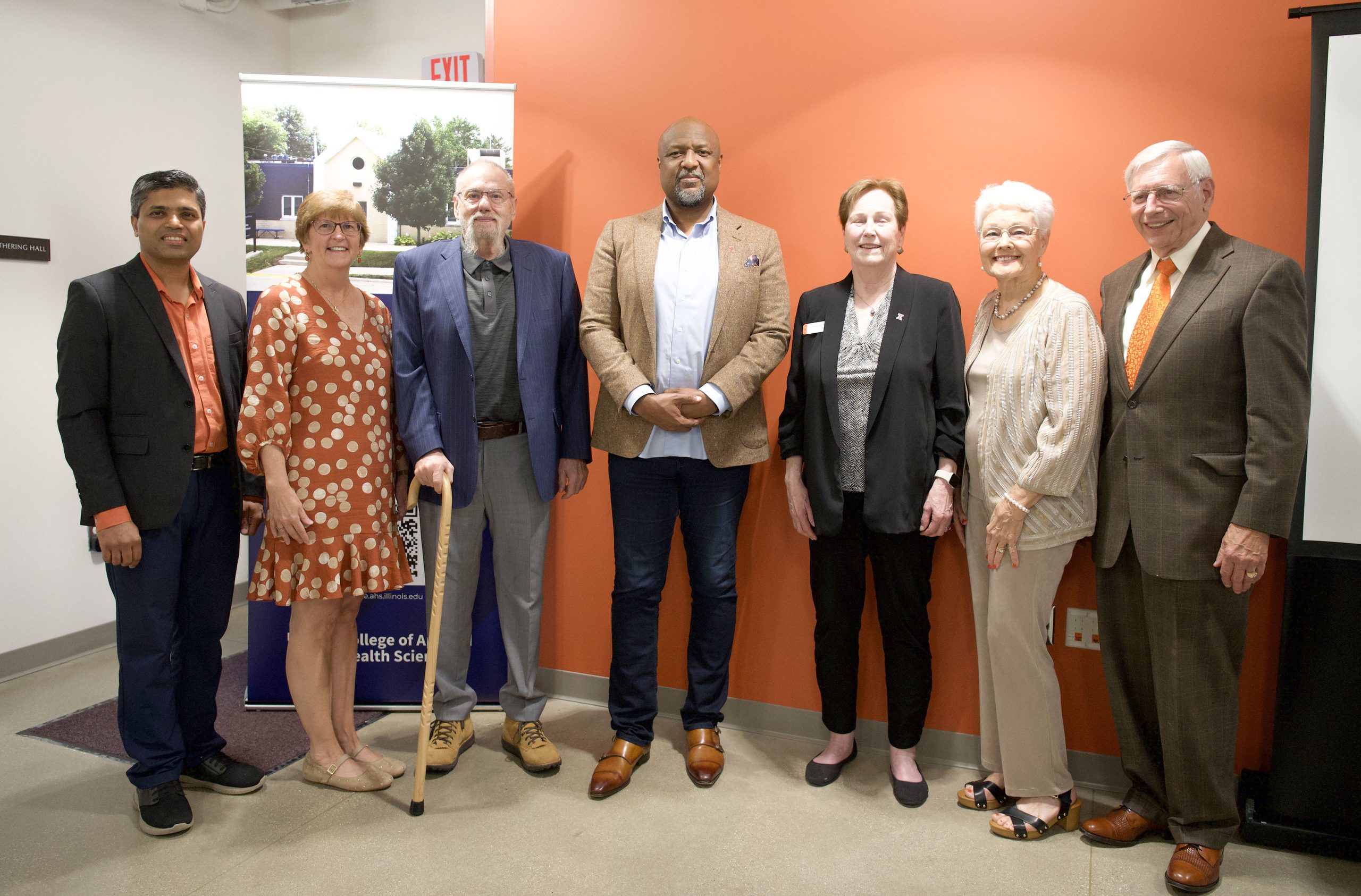
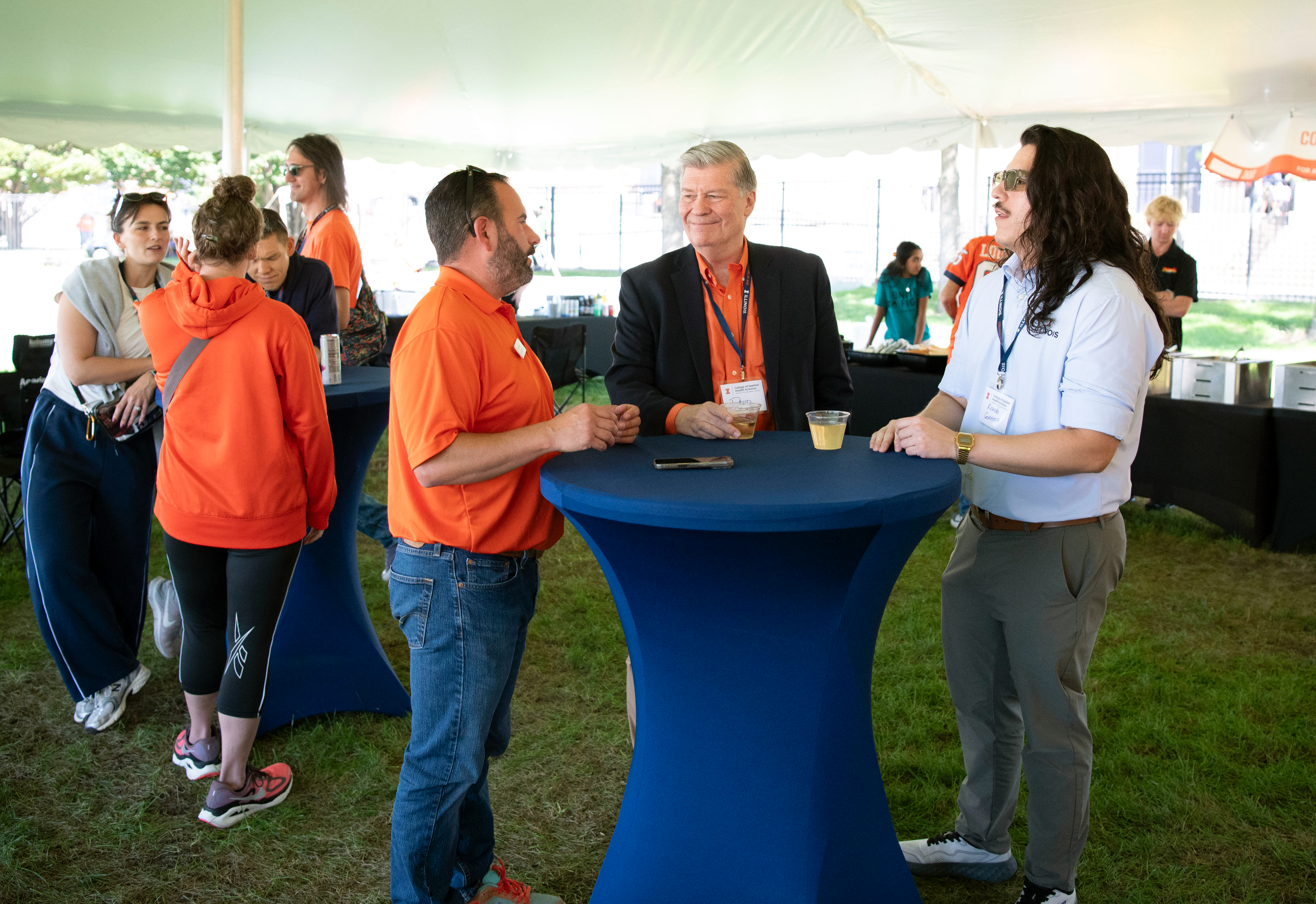
David Shockey, center, with Senior Director of Advancement Matt Smith, left, and Health and Kinesiology Assistant Professor Shaon Lahiri (Photo by Bridget Lee-Calfas)

By Vince Lara-Cinisomo 

Sara Kelly once had to make a case for a small tent and a gathering of perhaps 75 people. On Saturday, Oct. 3, 2026, she saw how far that idea had come. 

The former Assistant Dean for Advancement for the College of Applied Health Sciences recalled an early tailgate around 2005, tucked away on the other side of what was then Assembly Hall.

At the college’s 2026 tailgate in Grange Grove in front of Gies Memorial Stadium, Kelly saw just how much the gathering has evolved. 

“For me to see this today is amazing,” Kelly said. 

The event brought together alumni, faculty, staff and donors, giving supporters a place to renew friendships and connect with the people behind the college’s work. For donors, those connections linked the pleasure of returning to campus with the reasons they give: opportunities for Veterans, health equity, community wellness, vital research and a commitment to students. 

The gathering gave donors a chance to discuss those shared values and investments with the college community while participating in a beloved annual campus tradition. 

Peter Korst, chair of the college’s Board of Visitors, described attending as one way he demonstrates his enduring affinity for Applied Health Sciences. 

“I want to show up to support the college in any way,” Korst said. 

Korst earned his undergraduate degree in civil engineering at Illinois and a master’s degree in what was then Leisure Studies and is now the Department of Recreation, Sport and Tourism. Both colleges equipped him with valuable skills, he said, but Applied Health Sciences contributed more directly to what became his vocation. 

His involvement began on an advisory board for RST before he joined the Board of Visitors. The tailgate gives him another way to maintain those ties, with familiar faces making each return more anticipated than the last. 

“It seems like every year it gets more and more comfortable because I see more people that I know,” he said. 

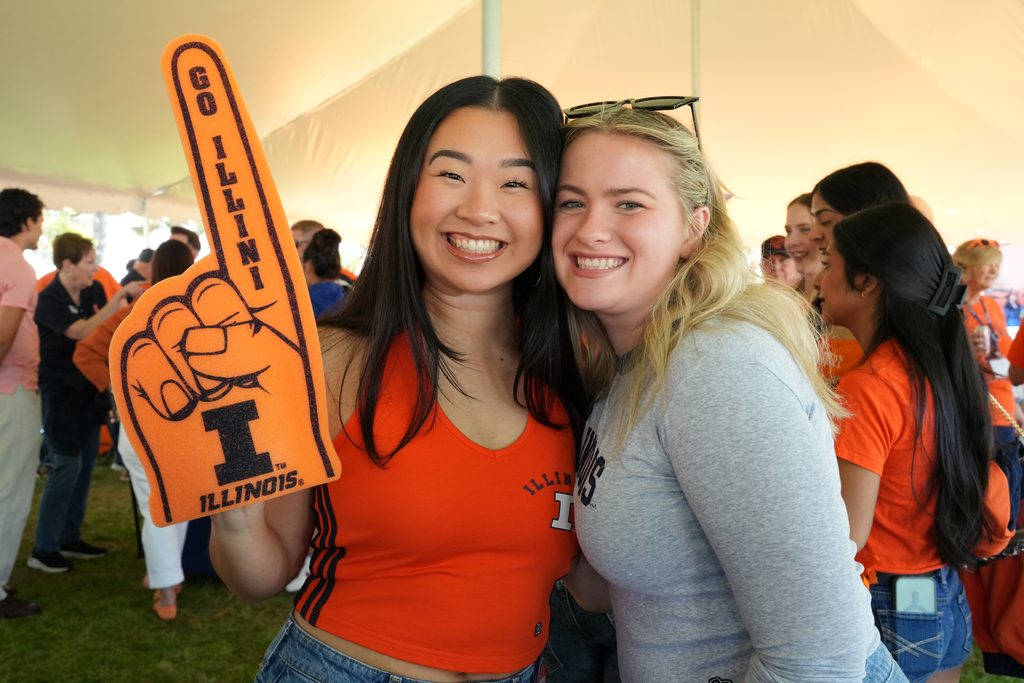
Students as well as faculty, staff and alumni packed the tailgate tent in Grange Grove (Photo by Bridget Lee-Calfas)

That sense of connection also informs his goals for the board. Korst said members want opportunities beyond hearing reports about the college. He is helping identify ways they can engage more directly with students and faculty. 

For Denis Lougeay, who runs the San Diego Illini Club, the gathering connected a distant alumni community with people it supports in Urbana-Champaign. 

Lougeay said he had returned for homecoming perhaps 30 times or more but first attended the college’s tailgate last year. Valued relationships with people associated with the college help draw him back.  

“It’s really great to be here and see all these people,” Lougeay said. 

His club sponsors a scholarship for Veterans at the Chez Veterans Center, and he also contributes individually. 

“We sponsor a Veteran, essentially, every year,” he said. 

Neither Lougeay nor his wife Denruth is a Veteran, he said. But San Diego’s many Navy Veterans and Veterans serving on the club’s board helped make the connection meaningful. 

A tour when the Chez Veterans Center opened introduced Lougeay to its facilities and staff, strengthening his confidence in its mission. 

“We got a tour right when the Chez Center opened, and it is just an amazing facility,” he said. 

For David Shockey, a generous donation to the Rural Health Initiative grew from both personal experience and relationships with people working to extend the university’s reach. 

Shockey, a lawyer and two-time University of Illinois graduate from Freeport, Illinois, has a sister with a hearing impairment. He’s also a longtime supporter of University of Illinois Extension and wanted to connect campus expertise with people in Stephenson County who seldom make the trip to Illinois. 

He described the developing project as an experiment that would bring together university talent with local enthusiasm and commitment. 

“It’s a trial (and) we’re going to see how it goes,” Shockey said. 

The proposed approach would use dedicated technology to connect people remotely with campus staff and graduate students for additional evaluation of hearing and speech concerns, he said. Shockey characterized it as a way to seek a second opinion. 

The project is not yet underway, he said, but the enthusiasm of Extension contact Margaret Larson encouraged him. Larson is the County Extension director for Jo Daviess, Stephenson and Winnebago counties. 

“I’ve never seen her more driven,” Shockey said, who added that AHS Senior Director of Advancement Matt Smith was instrumental in getting him on board. 

Shockey’s gift illustrates how the relationships renewed at a tailgate can connect to work far beyond campus. For Lougeay, that work means supporting Veterans. For Korst, it includes finding new ways to serve students and faculty. 

Kelly, who helped establish the gathering, also recalled hiring former Assistant Dean of Advancement Jean Driscoll—who recently retired from the university—for her passion for the college’s mission and her experience as an alumna. 

“She exemplified what we’re really all about—giving people opportunities to excel,” Kelly said. 

In Grange Grove, the people who help make those opportunities possible had a place to come together—and reasons to keep returning. 

Editor’s note:

To reach Vince Lara-Cinisomo, email vinlara@illinois.edu.
 

Share on social

Related news

McKenna receives $1.87M grant to connect writing and reading instruction 


Meaghan McKenna is an assistant professor in the Department of Speech and Hearing Science (Photo by Ethan Simmons)

Meaghan McKenna, an assistant professor in the Department of Speech and Hearing Science at the University of Illinois Urbana-Champaign, has received a five-year, $1.87 million grant to develop and evaluate a technology-based program designed to strengthen writing and reading outcomes for young children. 

The U.S. Department of Education’s Office of Special Education Programs awarded the grant for “Writing for Reading: A Technology-Based Approach to Literacy Growth.” The project will evaluate an innovative expansion of an early elementary writing program (WriteStart) into the Electronic Data Management and Expert Decision Making System ( EDM2).  

The work responds to an Office of Special Education Programs Stepping Up for Technology Implementation grant opportunity supporting evidence-based technology tools and approaches that improve reading outcomes for children with disabilities or those at risk for disabilities. McKenna said the funding opportunity was a strong match for WriteStart because writing can contribute to broader literacy growth but often receives less classroom attention than reading. 

“Reading often receives greater attention than writing in classrooms, leaving writing underprioritized despite its important role in children’s communication, literacy development and learning across all subjects,” McKenna said. “By giving writing greater attention in the early elementary grades, we have an opportunity to strengthen children’s broader literacy skills while helping them become successful writers.” 

WriteStart will help kindergarten and first grade teachers assess student writing, monitor progress and use the results to make instructional decisions. Its resources will include professional learning modules, assessments, instructional recommendations and intervention materials. The system also will guide teachers in providing additional support when students need it, including children receiving special education services and those vulnerable for later academic difficulties. 

McKenna said the project will be developed in close collaboration with educators so the materials are understandable, practical and feasible in classrooms. During the first year, educators will review WriteStart’s resources and provide feedback. In years two through four, participating educators will test the program as the research team studies how it supports instruction and whether students improve in writing and reading. In the fifth year, the team plans to make WriteStart available to educators nationwide. Surveys and virtual meetings will document what works, what obstacles educators face and what additional support they need. The researchers will use that feedback to study how the program can be sustained across different schools and classrooms. 

“By partnering with educators throughout development, testing and scale-up, our goal is to create a sustainable approach that helps young children become confident and successful writers who see writing as a meaningful and enjoyable way to express their ideas,” McKenna said. 

Reading often receives greater attention than writing in classrooms, leaving writing underprioritized despite its important role in children’s communication, literacy development and learning across all subjects.

Meaghan McKenna

SHS assistant professor

WriteStart builds on EDM2, a system in development since 2017 by Howard Goldstein (professor, University of South Florida), Jack Drobisz (assistant research professor and assistant director of the Research & Data Center, University of South Florida) and colleagues with funding from the U.S. Department of Education’s Institute of Education Sciences. The existing system supports preschool literacy through professional learning and data-based decision-making for teachers. 

McKenna participated in the initial design of  EDM2 and reviewed early prototypes. She also heard from preschool teachers using the system that it changed how they delivered tiered instruction, improved student outcomes and made their work more efficient. Those experiences helped shape the plan to add writing assessment and instruction for kindergarten and first grade. 

Rather than offering a single set of lessons for every child, WriteStart is also intended to help teachers interpret each student’s writing and select instruction or intervention in response. The approach connects professional learning, assessment and classroom materials in one system, allowing the research team to study both how educators use the technology and how children respond to the resulting instruction. 

McKenna leads a research team that includes Drobisz; Hope Gerde, a professor at Texas A&M University; and SHS Associate Professor Pasquale Bottalico. Drobisz has led EDM2‘s development since 2017. Gerde has experience developing iWRITE, a web-based professional development program in early writing funded by the Institute of Education Sciences. Bottalico will contribute expertise in statistical analysis and educational program evaluation. Goldstein will serve as a member of the advisory board alongside individuals in university and school district positions with expertise in technology integration, writing and special education. 

McKenna said that this project builds on kindergarten and first grade writing assessment and intervention materials that have already undergone iterative development thanks to Institute of Education Sciences postdoctoral and early career funding, positioning it for scale-up and long-term sustainability. McKenna said the project’s long-term goal is to give teachers the support needed to deliver high-quality writing instruction to every child in their classroom. The team will examine both classroom implementation and student learning as WriteStart moves from educator review to field testing and, ultimately, national availability. 

The researchers will begin with schools and districts where they already have collaborative relationships, while seeking connections with additional schools and districts that may be interested in learning more about the project as it grows.

Editor’s note:

Educators, schools and districts interested in the work may contact McKenna at meaghanm@illinois.edu to learn more.

More information about WriteStart is also available at writestart.org.  

Share on social

Related news

Illinois alumni award winners turn opportunity into service


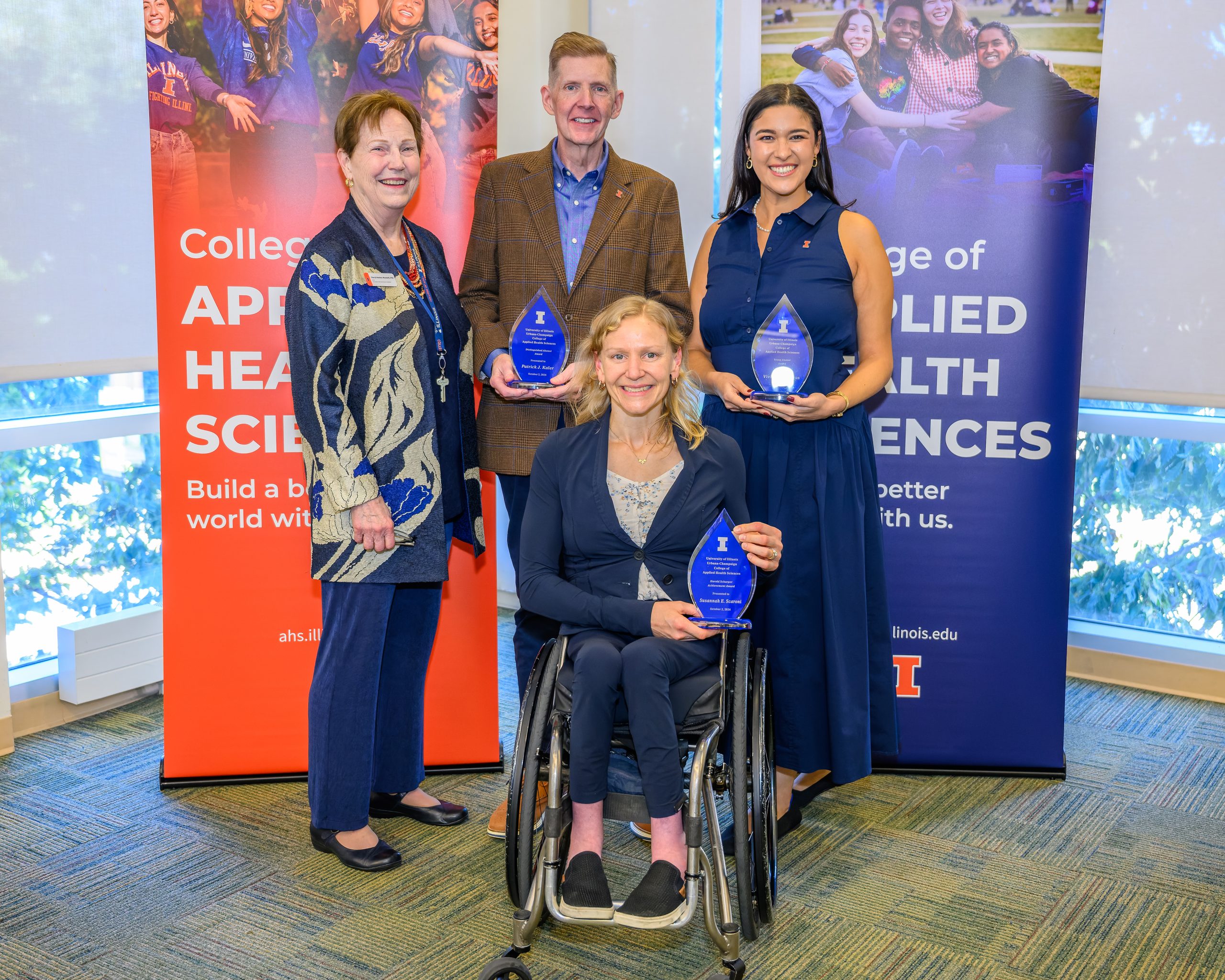
From left to right, Dean Cheryl Hanley-Maxwell, Patrick Kaler, Susannah Scaroni and Vivian Villegas. (Photo by Craig Pessman)

Walking between Huff and Freer halls during her first semester at the University of Illinois Urbana-Champaign, Vivian Villegas encountered something that surprised the friend beside her: an academic advisor who knew her name and remembered her first big test. 

Health and Kinesiology advisor Amy O’Neill stopped to ask how it had gone. For Villegas, a freshman from Dixon, Illinois, that small exchange helped make a large university feel manageable. 

Years later, the pediatric occupational therapist returned to accept the College of Applied Health Sciences’ 2026 Young Alumni Award, recognizing work that helps children find their own ways to participate and belong. 

Villegas joined tourism executive Patrick Kaler and Paralympic wheelchair champion Susannah Scaroni as the college’s 2026 alumni awards recipients. Their careers reach from classrooms to international competition to the communities that welcome travelers, connected by an Illinois education and a commitment to expanding opportunities. 

“Although their paths are very different, each has used an Illinois education to open doors for others and strengthen communities,” Dean Cheryl Hanley-Maxwell said. 

For Villegas, the recognition brought back another campus memory: watching the same awards ceremony as a student in 2016. 

“This really is a full-circle moment and one that I will cherish forever,” she said. 

She arrived at Illinois planning to become an occupational therapist and chose kinesiology as her major. Within the college, she found opportunities to work as a research assistant and serve as student council president her senior year. 

After earning her bachelor’s degree at Urbana-Champaign, she completed master’s and doctoral degrees in occupational therapy at the University of Illinois Chicago. 

Her work now focuses on children, including nonspeaking autistic students, in school and community settings. She helps students who use augmentative and alternative communication and has helped develop an early literacy curriculum for children in kindergarten through second grade. 

Her work also extends to research at the Children’s Participation and Environment Research Lab, teaching occupational therapy students an Illinois-Chicago and serving on the Board of Managers at GiGi’s Playhouse Chicago, which supports people with Down syndrome and their families. 

Accepting the award, Villegas emphasized the significance of recognition for clinicians whose daily contributions may draw little attention. She described herself as representing alumni “engaging in the meaningful everyday work that often goes unrecognized.” 

For Kaler, recipient of the Distinguished Alumni Award, the road back to Illinois began with a decision to step away from an established career. 

About a decade into the tourism industry, he returned to school with plans to earn a master’s degree and eventually become a professor. Research papers, seminars and discussions of theory made the transition demanding. 

“I won’t pretend that was an easy decision,” he said. 

His advisor, former Recreation, Sport and Tourism Department Head Carla Santos, helped him navigate the move from professional life to academia. But graduate school also clarified what Kaler missed. 

“I missed the people,” he said. “I missed the problem-solving and creating experiences that can truly change lives.” 

After earning his master’s degree in tourism in 2005, he took a job in Lake Tahoe, California, instead of continuing toward a doctorate. For someone who grew up in Rantoul, Illinois, the move stretched his expectations. 

“The thought of going to Lake Tahoe was never on my bingo card,” he said. 

Kaler’s career subsequently took him to Los Angeles, Northern Virginia and Buffalo, New York. Since 2014, he has led Visit Buffalo Niagara as president and CEO, with responsibilities that also include the Buffalo Convention Center and Buffalo Sports Commission. 

Hanley-Maxwell’s remarks placed that work in the context of community development, describing destination leadership as a way to support local businesses and create opportunities throughout a region. 

Kaler credited graduate study with strengthening his research and strategic thinking. He also credited colleagues, staff members, industry partners and family for helping make his career possible. 

Alongside his industry work, Kaler has shared his experience through teaching, lectures and appearances at national tourism conferences. 

Thank you for making this campus my favorite place to come home to.

Vivian Villegas

2026 Young Alumni Award winner

His advice to students left room for uncertainty. 

“The field will surprise you,” he said. “It might bring you back to school years later than you planned. It might take you far from where you thought you’d ever end up. Trust it anyway.” 

For Scaroni, opportunity is inseparable from access. 

The recipient of the Disability Resources and Educational Services’ Harold Scharper Achievement Award came to Illinois from tiny Tekoa, Washington, to study and train with its wheelchair racing program and renowned coach Adam Bleakney. She earned a bachelor’s degree in dietetics and a master’s degree in nutritional sciences and became a registered dietitian. 

Her athletic achievements include six medals across four Paralympic Games, with gold in the T54 5,000 meters at the Tokyo Games and four medals at the 2024 Paris Games. She also has won the Boston, Chicago and New York City marathons. 

A serious training accident in 2021 interrupted that career. Her return to elite competition added another chapter to a record that Hanley-Maxwell described as extending well beyond results, through mentorship, disability advocacy and work promoting wellness. 

In accepting her award, Scaroni focused on the people who helped make an accessible education possible. She credited Scharper and DRES founder Tim Nugent with demonstrating that everyone deserves the freedom education offers. 

“As many of us—and I would argue that those of us with disabilities, especially—know, freedom can feel like the absence of a barrier,” Scaroni said. 

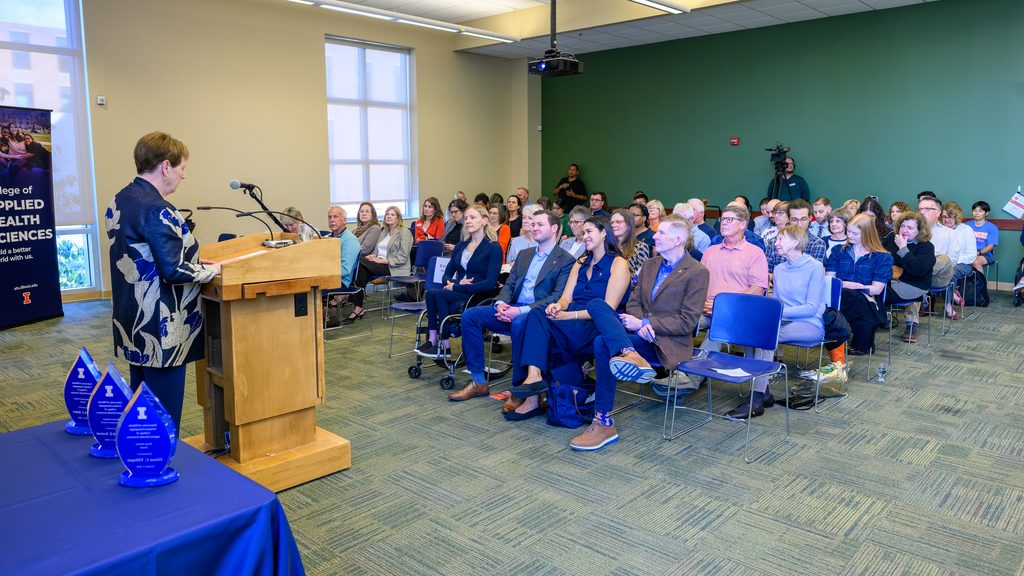
Dean Cheryl Hanley-Maxwell opened the ceremony with remarks about the winners. (Photo by Craig Pessman)

That freedom, she said, allowed her to pursue goals in athletics, academics and her profession. 

“For me, a physical disability has never been a barrier to any of my physical, academic, or professional dreams,” she said. 

Together, the honorees offered different measures of achievement: destinations strengthened, students supported and barriers removed. Their remarks also returned repeatedly to the people and experiences that helped them reach those milestones. 

For Villegas, that connection still feels personal whenever she returns to campus, whether to watch basketball, walk the Quad or share the university with loved ones. 

She closed by thanking the college for the award and, “more importantly, for making this campus my favorite place to come home to.” 

Editor’s note:

To reach Vince Lara-Cinisomo, email vinlara@illinois.edu.
 

Share on social

Related news

College of Applied Health Sciences
110 Huff Hall
1206 South 4th Street
Champaign, IL 61820
(217) 333-2131