Students in the Department of Recreation, Sport and Tourism in the College of Applied Health Sciences at the University of Illinois have had to adjust their internships because of the ongoing COVID-19 pandemic. Periodically, we will speak with them about how those changes have affected their summer plans and potentially career paths. Alex Yi was supposed to work at a law firm, but instead was part of the inaugural Illini RST Undergraduate Consulting (IRUC) program, created by RST department head Carla Santos and clinical assistant professor Mike Raycraft. He talked to AHS communications about his experience working for the NBA’s Oklahoma City Thunder and The Specialized Marketing Group.
How are your experiences different from what you expected?
My experience is exactly as I expected. Even though it is my first time participating in a remote internship, I had a good idea of how the internship would proceed.
Are you doing something for your internship than what you originally planned?
Before COVID-19, I was expected to intern at a law firm. The internship I am doing right now does not lead me to think about a different career path because I have always wanted to partake in an internship like this.
Has anything been frustrating about your change in internship status?
Nothing has been frustrating about the change in internship status because this internship is also extremely beneficial for me and helped me create a strong network for myself. I have always wanted to be in a position to network, but just never had the opportunity, so this internship is excellent in that sense.
What are you missing out on because of the pandemic, in terms of working face-to-face with people?
Working with people face to face is definitely the ideal way of getting things accomplished, but in the sports field, I think that people must be able to adapt to any and every situation possible in order to make things work. So, working with other people through video chat is a good experience to have because I will definitely have to do work through video chat or online again.
What advice do you have for future students who might have disrupted internships?
The best advice I can give other students who might have disrupted internships is to constantly try finding opportunities to connect with other people. Working and having an internship experience is extremely important, but knowing a lot of people within your field of work can sometimes be your best weapon or tool when finding an internship/job opportunity.
What other ways has COVID-19 affected you? Have you traveled? Have you been able to go home, see family?
I have been stuck on campus not being able to go home because of COVID-19, but this is still a good experience for me because this time period is teaching me to adjust to unexpected situations.
Students in the Department of Recreation, Sport and Tourism in the College of Applied Health Sciences at the University of Illinois have had to adjust their internships because of the ongoing COVID-19 pandemic. Periodically, we will speak with them about how those changes have affected their summer plans and potentially career paths. Javier Maldonado expected to work at a field house in Chicago, but instead was part of the inaugural Illini RST Undergraduate Consulting (IRUC) program, created by RST department head Carla Santos and clinical assistant professor Mike Raycraft. He talked to AHS communications about his experience working for The Specialized Marketing Group and the NBA’s Oklahoma City Thunder.
Q: How are your experiences different from what you expected?
A: My experiences are very different from what I had expected from my internship; I expected something where I would be hands-on and not behind a computer screen.
Q: Are you doing something different for your internship than what you originally planned?
A: No, not from when I found out about this internship and what it would be like. Since it’s begun, I don’t believe I have done anything different then what was originally planned.
Q: Does your internship lead you to think about a different career path?
A: It doesn’t necessarily drive to a different path, but it does open up my eyes to different fields within my major.
Q: What happened to your original internship?
A: I was waiting to hear back from a field house in Chicago but because of COVID-19, they didn’t know how many people they would actually need. Unfortunately, because of time, they weren’t able to give me an answer.
Q: Has anything been frustrating about your change in internship status?
A: The only frustrating part is being at home and having to work from home.
Q: What are you missing out on because of the pandemic, in terms of working face-to-face with people?
A: I feel like face-to-face is the biggest thing I am missing out on; I am a very hands-on learner and would have liked to learn from a professional face to face.
Q: What advice do you have for future students who might have disrupted internships?
A: The advice I have is to try and maintain a positive view on things. It’s going to be hard when things don’t go the way you expect but making the best out of situations goes a long way.
Q: What other ways has COVID-19 affected you? Have you traveled? Have you been able to go home, see family?
A: COVID-19 has just been a bummer and being stuck at home all the time hasn’t been fun, either.
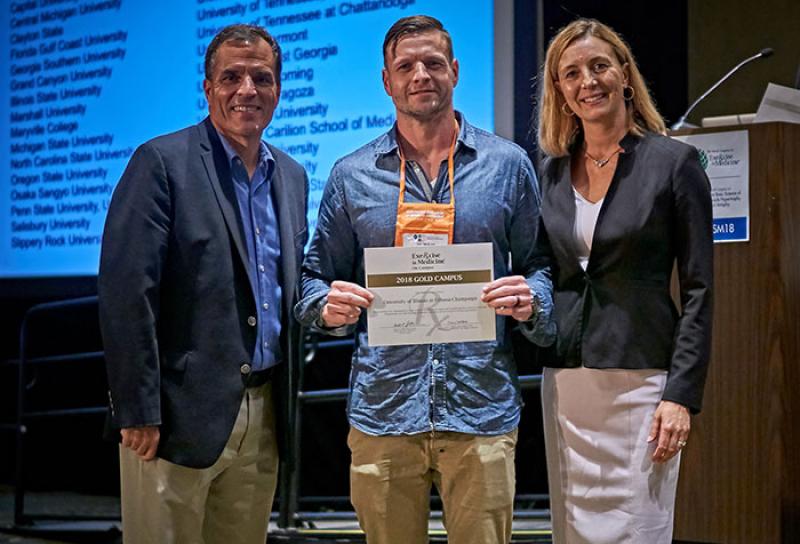
Illinois’ Exercise is Medicine–On Campus earned gold-level recognition from ACSM
Nick Burd, center, is chair of the Exercise Is Medicine—On Campus committee (Photo provided)
The Illinois Exercise is Medicine—On Campus initiative has been recognized by the American College of Sports Medicine as a gold-level campus. UIUC is being recognized as a healthy academic environment, with physical activity and exercise opportunities and the commitment to create a culture of wellness on campus.
By encouraging faculty, staff and students to engage in regular physical activity and exercise, EIM-OC is positively influencing the overall health of the community. A focus of the initiative is to make movement a part of the daily campus culture, assessing physical activity, and giving students tools to build good physical activity habits, said Alana Harris, Associate Director Assessment, Student Wellness, and Adventure Recreation at Illinois Campus Recreation, who was a member of the founding committee at Illinois in the fall of 2017.
“It is creating a space and a place for students to see all of the different ways they can engage in physical activity and find things they enjoy doing,” she said. “We serve as a hub for all of the things related to physical activity and exercise that are available as resources and services to students on our campus.”
EIM-OC at Illinois has members from across campus and the community, with representation from the following areas: Kinesiology and Community Health, Campus Recreation, Counseling Center, McKinley Health, Christie Clinic and the Kinesiology Students Association. KCH assistant professor Nick Burd is the committee chair, and other members include Harris, Dr. Scott Paluska (Christie Clinic), Felicia Fordyce (McKinley Health), Deidre Weathersby (Counseling Center) and Alexis King, who is serving as the grad student representative.
The program serves multiple objectives: relationship builder, recruiting student participants for other programs, and spreading the word on important topics of wellness. The committee is designed as a mix of professionals and students to engage listeners in different ways, as well as provide experience to student facilitators.
“Everybody was working independently with the same common goal of improving the health and well-being of students and faculty,” Burd said. “And this was an initiative to integrate us, people who have the same common goals—students and professionals on campus—to work together, to promote all of these great programs that we certainly have on campus. And that, I think, encompasses what EIM is.”
Harris agreed.
“We were doing great things already, but the recognition requirements state that your campus health center must discuss physical activity at health appointments. By simply asking students, during intake, at the McKinley Health Center if they are achieving the recommended 150-minutes of moderate intensity physical activity weekly we are building awareness and potentially giving a cue to action,” she said, “Something simple but potentially very impactful. We have partners at the Counseling Center who are represented on this committee … mental health is another new area of emphasis for this committee. And so we invited colleagues from the Counseling Center last year to assist in having conversations with students about the benefit of regular physical activity on mental health and cognition. Just recognizing that physical activity isn’t just for students who are already in good health, but that it has a positive impact no matter where you are on the health continuum and that your gateway to a more active lifestyle could be through many different doors on this campus.”
One of the main functions of the EIM program is making movement part of campus culture, but Burd and Harris were quick to point out that physical activity and exercise are different.
“Some of our initiatives have been around active transport,” Harris said. “So, building physical activity into your day. There is a deep pool of research supporting the benefits of moderate intensity exercise on health outcomes, but reductions in sedentary time and the accumulation of short bouts of physical activity throughout your day are also shown to have positive health effects. As part of our initiative, we encourage people to walk when they can, to ride their bikes when they can, and to engage structure moderate intensity exercise at the ARC if that’s what they enjoy.”
Harris says that as part of EIM month, in October every year, that the committee and Kinesiolosy students regularly set up activities on the quad.
“As students pass by on their way to class, we engage them. We bring Frisbees, soccer balls, skipping ropes, and footballs, and we had all different ways to ‘play’. We talk to them about opportunities on campus and the benefits of finding activities they enjoy doing to accumulate the recommended physical activity that they should get in a day, and that there are a lot of health benefits to that if that’s what you can fit in.”
But the part that “bumped us up into gold-level status” was the assessment piece, Burd said. “The first step of our assessment piece occurs at McKinley Health, where students provide information related to their physical activity levels, with the ultimate goal of McKinley Health to provide a referral system for students to increase their physical activity.”
Harris said there is no formal assessment of activity levels, but added, “We’re focusing on awareness building and identifying gaps in opportunities. We’ve put out marketing and promotional materials about wearing activity trackers and set up free physical fitness assessments, again as cues to action. We encourage people to put prompts on their calendars every 60 minutes to get up and move until it becomes habitual.”
Of course, because of COVID-19, keeping people active when just going outside is fraught with issues can be problematic, and the Activities and Recreation Center on campus is closed.
But Harris said “we have really focused on maintaining our community through virtual opportunities. We have Illini Running and Illini Cycling intramural programs, where people are tracking and logging their participation. Our group fitness classes are being offered for free over Zoom, and in the fall we plan to continue virtual offerings via Facebook Live. So we’re looking at connecting people and creating community around physical activity and exercise in a virtual way. Students have been really positive about this and we would not have had this shift in programming without COVID 19. I think that outdoor space may allow us to continue to meet people where they are as well. Connecting exercise with being outside could prove to have positive impacts as well. But I think this next year will focus a lot on engaging people and creating communities virtually.”
Students in the Master of Public Health program in the College of Applied Health Sciences at the University of Illinois have had to adjust their internships—known as Applied Practice Experiences—because of the ongoing COVID-19 pandemic. Periodically, we will speak with them about how those changes have affected their summer plans and potentially career paths. Today, we speak with Shivani Shah, who is working remotely as a research intern with the South Asian heart lifestyle intervention (SAHELI) and South Asians Active Together (SAATH) studies.
Q: How are your experiences different from what you expected?
A: Pre-COVID, I expected my experience with the SAHELI and SAATH research teams to be primarily community facing—I was going to be recruiting research participants and doing educational outreach. Now, my experience has been more focused on designing modified study arm materials and brainstorming implementation logistics for when research recruitment can resume.
Q: Are you doing something different for your APE than what you originally planned?
A: While I am at my planned APE site, the work certainly shifted to be less hands-on and more planning and logistics, as I previously mentioned. This has exposed me to details including the protocols and extensive planning that goes into putting together a robust research study, alongside the challenges of modifying these components due to COVID. While unplanned, I am seeing a completely new side of organizational management, which is meaningful.
Q: Does your APE lead you to think about a different career path?
A: I was previously hesitant about working in a research setting as I worried it would be more distant from communities. However, this experience quickly shifted my understanding, as I see my team making important contributions to both the research world and on the lives of community participants. I’d love to continue exploring community based participatory research in my career.
Q: What happened to your original APE?
A: I’m grateful that my APE site was able to keep me onboard in a remote capacity.
Q: Are you working remotely?
A: For the most part, yes. Given the importance of group cohesion and a basic medical examination for the research study efficacy, I was recently able to participate in a few minimal risk in-person activities.
Q: What are you missing out on because of the pandemic, in terms of working face-to-face with people?
A: My internship was primarily outreach and education-based, which was entirely people-facing. I was looking forward to connecting with community members and hearing their stories in addition to better understanding their needs and perceptions around health. I certainly wish I had this experience, especially because participants also generally really enjoy the in-person interactions.
Q: What advice do you have for future students who might have disrupted APEs?
A: The world is very unpredictable, and things may not go the way you initially anticipated. But ultimately, it’s part of the learning and growing process. Stay true to yourself and your goals—there are alternative pathways to learn and achieve your goals, and the MPH program faculty is an incredible resource in helping you get there.
Q: What other ways has COVID-19 affected you? Have you traveled? Have you been able to go home, see family?
A: This pandemic is a mentally and emotionally taxing event on the globe as a whole. It is difficult to find a new normal—as someone who loves being outdoors and struggles with online communications, it is an adjustment. Thankfully, however, I have the privilege of being home in the suburbs in the company of my family.
In the past five years, Chicago residents have purchased nearly 1,300 vacant lots and replaced weed trees and sagging fences with gardens and children’s play areas. In doing so, they have demonstrated that transferring city-owned vacant lands to local residents can be a successful strategy for cities seeking to reduce blight and strengthen neighborhoods.
In assessing the potential benefits of the City of Chicago’s “Large Lot Program,” a team led by scientists Paul Gobster of the USDA Forest Service’s Northern Research Station and Recreation, Sport and Tourism professor William Stewart of the University of Illinois examined the visual and social effects of resident-driven urban greening efforts in high-vacancy areas of the city’s south and west sides. In their most recent paper, published last week in the journal Landscape and Urban Planning, the research team found that the program has resulted in continued improvements in the condition and care of the purchased “large lots” over a five-year period and that these improvements were consistent across all five community areas studied.
“While planners around the world are experimenting with ways to address urban vacancy, few cities have the tools to assess how well their programs work after they are implemented,” Gobster said. “In this latest paper we develop a practical monitoring tool, the condition-care scale, and detail how it can be implemented by planners to assess the progress of vacant lot repurposing programs. The scale also holds promise for other applications related to urban greening and we encourage others to adapt it to their particular needs.
Previously reported findings from the study showed that visible changes to large lots in the year after purchase Ied to increases in lot “cues to care” including ornamental and vegetable gardens and social and recreational features, and that levels of lot condition and care were highest for owners who lived closest to their purchased large lot.
“In focus groups and a mail survey of large lot owners, we also found that residents who are improving the lots are gaining a stronger sense of place and belonging to their neighborhood, and they see the program is fulfilling community goals,” said Stewart of the College of Applied Healthj Sciences at Illinois. “Together our visual and social assessments show that ownership matters, and that through private stewardship of vacant neighborhood lands the Large Lot Program is helping to address issues of environmental and economic justice in communities that have been disenfranchised for decades.” The researchers’ next step is to try and quantify whether participating in the Large Lot Program is leading to broader social outcomes, including reductions in crime.
The City of Chicago collaborated with community groups to launch the Large Lot Program in 2014. Initially focused on the Greater Englewood area on the city’s south side, the program aims to reduce the inventory of more than 11,000 city-owned vacant lots by offering them to neighbors for $1; nearly 1,300 vacant lots have been purchased to date.
Co-authors of the new paper, “The Condition-Care Scale: A Practical Approach to Monitoring Progress in Vacant Lot Stewardship Programs,” include Alessandro Rigolon of the University of Utah and Sara Hadavi of Kansas State University. The paper is available through the Northern Research Station at https://www.nrs.fs.fed.us/pubs/60442
Students in the Master of Public Health program in the College of Applied Health Sciences at the University of Illinois had to adjust their internships—known as Applied Practice Experiences—because of the ongoing COVID-19 pandemic. Periodically, we will speak with them about how those changes affected their summer plans and potentially career paths. Today, we speak with Mateo Solis Rueda, who worked on the contact tracing team at the Howard Brown Health Center in Chicago.
Q: How are your experiences different from what you expected?
A: My initial expectation was to be on-site at the health organization throughout the week where we would work on contact tracing as a team. I pictured having a team leader who would guide us through the process of how to properly use the online system, and promptly address issues as they occurred. However, working remotely has presented with additional challenges. Although circumstances are less than ideal, we are powering through it all, and we are still able to maintain close contact through weekly meetings which are conducted virtually to address any problems and discuss future goals and obstacles we may encounter as we continue COVID-19 contract tracing.
Q: Are you doing something for your APE other than what you trained for?
A: I feel like my coursework provided me with adequate training for my APE. In my previous courses, we have discussed extensively about collecting data from community members. Additionally, we practiced hands on creating and administering surveys, as well as collecting, analyzing, and reporting our results. It is definitely interesting to see how this unravels in the real world, and how it differs from the classroom environment.
Q: Does your APE work lead you to think about a different career path?
A: Fortunately, my APE work surrounds one of my top interests in public health, infectious diseases. I am treating this as a great opportunity to get a feel for this discipline of public health. If anything, my work so far has reinforced my interest in this career path.
Q: You’re doing contract tracing for Spanish-speaking populations, as well as English. Are there differences in how you approach the two populations?
A: Due to a high demand for contract tracing within the Spanish-speaking population, I have only spoken with individuals who speak Spanish thus far. I have been pleased with the generally kind and open demeanor of all the individuals I have spoken with, as well as their willingness in allowing me to interview them and answer all my questions. Although, I have yet to contact someone who speaks English, I have thought about similarities and differences in approaching these two populations. Overall, I would say the approach would be very similar due to having a script we must stick with, and attempting to extract the identical information.
Q: What happened to your original APE?
A: My original plan was to conduct my APE at the local public health district (CUPHD), however with some guidance and encouragement from my instructor, we decided to switch it to working on contact tracing at a different health organization. Fortunately, I am still working alongside the original public health district, though it is now my ILE.
Q: Has anything been frustrating about your change in APE status?
A: Thankfully there have not been any major frustrations. Instructors, as well as supervisors and team members at the health organizations are all aware and understanding of the current unique circumstances. It has been interesting to watch everyone within the public health field come together and continue to help in any way they can.
Q: What are you missing out on because of the pandemic, in terms of working face-to-face with people?
A: I am missing out on the potential connections that could have been made within the community. Having to phone people at various hours of the day and asking for personal information makes it challenging to establish a connection at first, as many people are initially hesitant to answer questions. To overcome this, I try my best to start off with a bit of conversation to let them know I am only checking to ensure they are doing fine, while encourage them to stay safe. This seems to work well, as everyone I have spoken with has been gracious. A second thing I am missing out on is meeting and working alongside health professionals at the health organization. I have only met them through online video meetings, which is not the same as it would be in person. This makes communicating back and forth a bit slower and less personable.
Q: What advice do you have for future students who might have disrupted internships or APEs?
A: My advice is that if you ever find yourself frustrated or stuck, take it as a sign to pause, take a step back, and occupy yourself with something you enjoy. Go out for a run, a walk, a bike ride, read, take a nap, etc. After some time has passed, come back with a fresh mind and continue where you left off. I find that when I do this, I come up with new ideas, perhaps it might work for others. I also want to mention that the instructors are around to lend help whenever needed, so do not hesitate to reach out.
Q: What other ways has COVID-19 affected you? Have you traveled? Have you been able to go home, see family?
A: Due to COVID-19, I was pushed to move back to Chicago sooner than I previously anticipated. Stay-at-home orders, and shelter-in-place regulations added additional challenges and stresses to this move. Fortunately, I have been able to stay in contact with family and friends through social media, and virtual meetups. More recently, I was able to visit family while continuing to follow health guideline and remaining safe.
The wearable device tracked movement to aid patients with exercise technique
A new publication from Kinesiology and Community Health assistant professor Manuel Hernandez looks at how use of a wearable device combined with physical therapy can improve patient results.
The paper, entitled, “Design of a Low-Cost, Wearable Device for Kinematic Analysis in Physical Therapy Settings,” was published in the June 2020 edition of Methods of Information in Medicine.
Hernandez said he hoped to learn if test subjects—who were from the Champaign-Urbana area—had a positive or negative experience with a novel wearable device, and to identify key areas for improvement in future versions of the device, so as to improve how well future wearable devices get adopted.
The wearable device, Hernandez said, was a standalone suite of sensors that track movement (using IMUs, or inertial measurement units), together with a power supply and mini computer (i.e., a Raspberry Pi), aimed at aiding physical therapy patients in improving exercise technique, through the classification of different upper extremity exercises, monitoring of progress, and biofeedback.
Participants were asked to complete nine upper-extremity exercises while wearing the device: Standing row; external rotation with arm abducted 90 degrees; external rotation; bicep curl; forearm pronation/supination; wrist curls; lateral arm raise; front arm raise, and horizontal abduction.
The aim, Hernandez said, is to validate the ability of the wearable device to accurately identify different upper extremity exercises using machine learning techniques and improve the ergonomics and usability of the device through further miniaturization, increased wireless connectivity, and development of a companion smartphone app.
“It is important to note that everyone is unique and will benefit from personalized care following an injury,” Hernandez said. “We hope that through the integration of smart devices together with evidence-based physical therapy practices, we can achieve improved rehabilitation outcomes, such as a higher restoration of function and speed up recovery, by providing an affirmation of exercise quality, feedback on progress, and minimization of re-injury.”
The College of Applied Health Sciences has experts in many areas that have been affected by the COVID-19 outbreak. Periodically we will ask these experts about how their areas of expertise have been impacted and what we can expect in a post-COVID-19 world. Today, we ask KCH professor Jeff Woods about complicating risk factors, vaccine production and virus spread.
Jeff Woods (Photo by Jerry Thompson)
Q: What are some of the complicating risk factors of COVID-19?
A: There seem to be many conditions, including advanced age, that complicate the severity of SARS-CoV-2 infection. Others include cardiovascular disease, asthma, obesity, high blood pressure, and diabetes. Exacerbation of COVID-19 symptoms in those with underlying respiratory or heart problems is self-evident, but we do not know why other comorbidities make some susceptible to it. In addition, recent reports indicate that even young adults can experience hospitalization and severe symptoms. On the other hand, many others have tested positive without symptoms. Bottom line is that it is too early to tell all the factors that may make us susceptible to COVID-19 and it is too early to understand the mechanisms of why some condition increase or reduce severity. One factor that is always difficult to ascertain is the viral load of the inoculum that an infected person experienced. High loads should lead to more severe consequences. This is why wearing masks and reducing exposure to people via social distancing or reducing contact time is so important not just to prevent infection but also to lessen the viral load of exposure.
Q: The Spanish Flu erupted in spring, went dormant in the summer and then came back in the fall. Do you expect a similar pattern with COVID-19?
A: I do not think we know what to expect. This is a new virus we don’t know a lot about and comparing social dynamics as it relates to virus transmission across a century of time (e.g. comparing with Spanish Flu) is fraught with interpretive problems. The main reason that scientists believe that some viruses are seasonal have to do with living conditions—more people inside during winter, therefore greater chance of exposure and spread between people. In addition, some viruses are susceptible to light and humidity, both of which are lower in winter months thereby reducing fomite transmission.
Q: Dr. Fauci expressed hope for a vaccine within the next 6-8 months. But we haven’t been able to find a vaccination for the common cold. Is there any reason to have any greater hope for COVID-19 than we’ve had for these common diseases that have been around for decades?
A: Yes, I think so. The common cold has never shut down our economy before or caused significant human suffering or death. COVID-19 has. This fact alone has motivated much research and development regarding a vaccine. There is currently an unprecedented and well-funded effort to realize one or more SARS-CoV-2 vaccines in the near future. Scientists are also using different strategies, either targeting viral RNA or the ‘spike’ protein of the virus that increases the probability of success. That said, there are no guarantees in a war with a virus. One reason that you need an annual influenza vaccine is that influenza can mutate rather quickly. There is evidence that SARS-CoV-2 mutates more slowly, which is a good thing when trying to develop a universal vaccine against it.
Q: For people who have aging parents or relatives, how do we best protect them?
A: The best thing to do, at least until we get a successful vaccine, is to isolate them against potential infection. This means mask wearing and social distancing of at least six feet, but maybe more. This is important for older adults because their immune systems undergo senescence making the system less effective at combating pathogens or responding to vaccinations. If they get infected, there is a higher chance of a poor outcome.
Q: When will we know that the pandemic is lessening in the U.S.?
A: When the number of laboratory confirmed COVID cases (i.e. virus testing) drops and stays low for a significant time period. Symptom confirmed cases are not a great indicator because some people are infected and remain asymptomatic. Antibody tests tell us about individual exposure and in the case of some other viruses (e.g. influenza) indicates a certain level of protection from reinfection. However, at present, we do not know if antibody presence predicts protection against COVID. This big unanswered question needs to be answered. In short, we do not know if prior exposure leads to protective immunity or whether people can become reinfected after an initial exposure.