Master Plan: How campus investment will boost AHS master’s programs


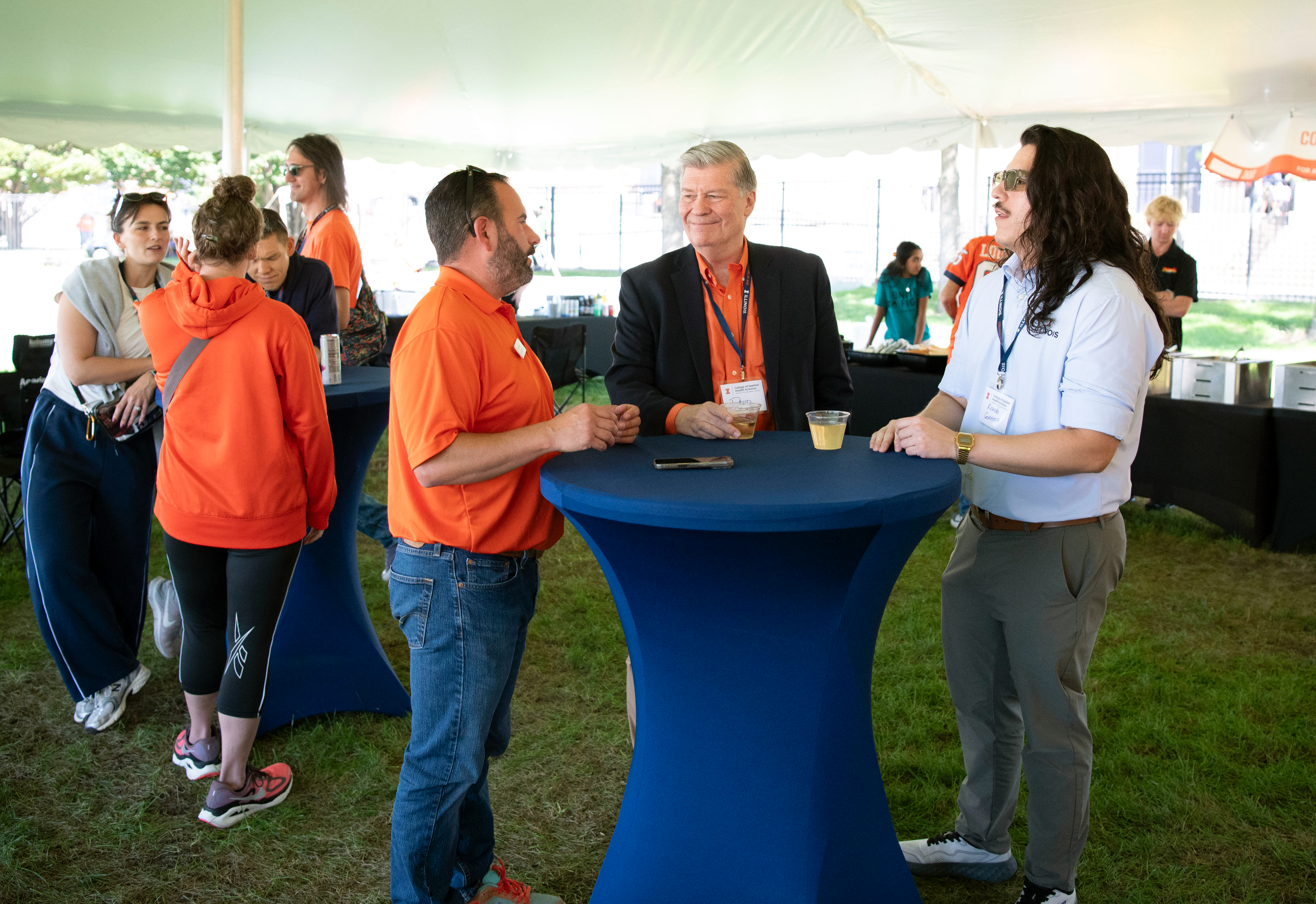
RST interim department head Bill Stewart, left, chats with MHA director Lynne Barnes and MPH director Pedro Hallal (Photo by Ethan Simmons)

Three master’s programs in the College of Applied Health Sciences are undergoing transformations for the digital age.

After receiving a $2.035 million award from the University of Illinois Investment for Growth program, AHS faculty, administrators and industry partners will collaborate to create online versions of the Master of Public Health and Master of Health Administration degrees. Additionally, the Master of Recreation, Sport and Tourism online degree will be restructured into three specialized programs: recreation and park management, sport management and administration, and tourism and event management.

The revamped online degrees are expected to expand the accessibility of AHS programs worldwide, reaching new students from underrepresented and nontraditional backgrounds.

“Going global has been a priority of this university for years,” said Pedro Hallal, Alvin M. and Ruth L. Sandall professor in the Department of Kinesiology and Community Health and director of the MPH program. “So now going global is a priority of this program as well.”

The addition of “stackable certificates” across each discipline will attract nontraditional students looking to boost their knowledge as well as mid-career professionals seeking expertise in their chosen industry.

Each program is committed to including new voices in their online instructional material, mainly experienced professionals working in the respective fields.

“It’ll be a nice blend,” said Lynne Barnes, the longtime top Carle Foundation Hospital administrator who was hired as director of the MHA program this fall. “We’ll have professors who really understand the knowledge base of the field, and we’ll also have clinical people who are working in the field doing the teaching, just like we do for the in-person program.”

The creation of new online master’s degree formats will start with collaboration with AHS’ online learning team. The online MPH program and restructured RST online master’s degrees will begin enrolling students in fall 2025; the online MHA program will debut in fall 2026.

“We’re taking the ‘growth’ term very seriously,” said Professor Bill Stewart, interim department head for RST. “This is a long-term investment for us, not just a one-off thing.”

MPH: ‘The perfect storm’ for growth 

To populations around the globe, the COVID-19 pandemic was a clarion call to the vital importance of public health infrastructure.

The awakening clearly reached young people pondering their life paths: According to data from the Association of Schools and Programs of Public Health, applications to public health graduate degree programs increased 40 percent from 2020 to 2021.

“It’s so much easier now to choose a career related to public health,” said KCH Associate Professor Andi Schwingel, who is working alongside Hallal in developing the online coursework.

“Going global has been a priority of this university for years. So now going global is a priority of this program as well.”

Pedro Hallal

HK Professor, director of the MPH program

For the University of Illinois’ MPH program, the decision to create an online program is also a matter of maturity, Hallal said. Four years have elapsed since the program obtained accreditation from the Council on Education for Public Health.

“Some people in your neighborhood will add a security camera, and you don’t think it’s important until your house gets robbed, and then you see, ‘Oh, I needed that camera,’” Hallal said. “I think that is exactly what happened with public health.

“It was the perfect storm for our time to grow.”

The work ahead will be rigorous, with 20-plus courses awaiting development. Faculty plan to work with external partners, such as public health professionals, to create new course content. And it will be suited to the future landscape of public health, Hallal said: How might climate change and global warming transform health needs? How can we address the coexistence of infectious diseases with chronic conditions, like hypertension and diabetes?

A target for the MPH online expansion is the non-traditional student population. The MPH program will offer six certificates: epidemiology, biostatistics, public health, one health, physical activity and health and health promotion.

“It’s the time for us to reach nontraditional students, we feel ready for it,” Schwingel said. “We want to keep the rigor, the quality that we’ve been giving students in their residential program to the online space as well.”

MHA: Making health administration accessible

The MHA program at Illinois is designed to prepare students for leadership in the healthcare industry.

What the MHA program has recently observed, according to KCH Assistant Professor Mina Raj, is an influx of requests for an online equivalent, especially among mid-career healthcare administrators.

“The pandemic has made salient how important the healthcare system is, and how important it is to have administrators who can respond to public health emergencies and other unpredictable situations,” Raj said.

The overriding goal for the online degree is accessibility, Raj said: What material can be packaged into a four-week or eight-week course? The MHA online degree will offer three professional certificates: health finance, healthcare quality and health informatics.

“I think for this group of professionals it’s really about giving them the context and rationale behind why certain decisions are made as administrators or within a healthcare organization, as well as the tools to anticipate the impacts or consequences of various administrative decisions,” Raj said. “We have faculty with different expertise, different professional backgrounds, and everyone is excited to teach these courses.”

The work has already begun for Barnes, who wants to incorporate seasoned industry experts into course content. Barnes came to the university after retiring from a 45-year career at Carle Foundation Hospital.

“I hope to use real clinicians, people doing the work like at Christie Clinic, Carle and OSF Healthcare to be part of the lectures, so that the students who are online, all over the world and all over the United States experience instruction through people who are actually doing the work,” Barnes said.

RST: Degrees for specialized industries

The Department of Recreation, Sport and Tourism has been a leader in online education, debuting the first online master’s program in the discipline back in 2008.

But there wasn’t much fanfare, Stewart said. Online degrees were seen as “second-class programs” two decades ago.

“We were there at the beginning of the front to move online learning into a respectable degree process of education,” Stewart said.

Today, recreation, sport and tourism combine for an estimated $90 billion global set of industries. The pandemic resulted in a surge of public interest in leisure time and nature exploration, opening up new opportunities for professionals in the field, Stewart said.

“[RST] is about what we do in our free time to extend who we are and add value to our lives,” Stewart said. “We’ve come to embrace our needs for leisure-time activities in the last two years in ways that enhance our well-being and nurture our souls.”

The upcoming split of the current online master’s program into three tracks is a response to internal and external trends. Enrollment in the online MS in RST has plateaued in recent years, while other institutions have introduced their own online degrees in the discipline.

Online degrees were seen as “second-class programs” two decades ago, but no longer, said Bill Stewart, center. (Photo by Ethan Simmons)

Meanwhile, the demands of the industry have become more specialized over time.

“There’s still a need for the generalist degree, but because of the growth, we are finding professionals out there who need more help with the specialty,” Stewart said.

Students and mid-career professionals will be able to enroll in a new slate of RST certificates in high-demand topics, including inclusive design, agricultural tourism, sport analytics, e-sport administration, and diversity, equity and inclusion.

The department is in the process of searching for a director of the RST online program, Stewart said, while tapping into a vast network of alumni to help develop new course content.

“Our alumni value the friends and faculty they came to know as students and find various ways to give back to the department,” Stewart said. “Many of our alums are leading remarkable careers in contexts related to recreation, sport and tourism; they readily share their expertise through assistance in course development, guest lectures, creating internship opportunities for our current students, and in some cases, teaching classes for us.

“Our students come here because they care about making people feel better, their well-being, their sense of community and health. They want to give back to the community and they want to give back to the department that gave them this path in life.”

Editor’s note:

To reach Ethan Simmons, email ecsimmon@illinois.edu.
 

Related news

Message from interim Department Head Bill Stewart


Hello friends and alumni of the Department of Recreation, Sport and Tourism, 

In my first couple of months as interim head, I’ve been grateful for the strong legacy and leadership network of our faculty, alumni and friends. With your goodwill and support across the years, the department has grown in strategic ways through expansion of teaching programs, along with extending the reach and visibility of our scholarly impacts. Dr. Carla Santos, the previous head who has moved into the AHS Dean’s Office, has left us in a solid position to engage our future.  

I hope this message finds you well and in good health. It is my pleasure to share with you our fall 2023 newsletter. As a takeaway message, please know that we are committed to keeping you informed about our programmatic developments—from innovative research projects to exciting student achievements to alumni in action.

We are thrilled to showcase the accomplishments of our students. This newsletter features inspiring stories of how our graduates are making their mark in the industry, and how our current students are working their way toward that goal through their coursework and life-changing internships.

Furthermore, we highlight a few of our faculty to illustrate how our research propels the department forward as a leader in advancing knowledge and influencing policy and practice. Whether you’re an alumnus, a current student or faculty member, we hope you enjoy our stories.

I’m hoping to connect with many of you over the coming year and invite you to stop by Huff Hall to visit your Illini family. Wishing you all an invigorating fall season!

Warm regards,

Bill Stewart
Interim Head
Department of Recreation, Sport and Tourism

Share on social

Related news

Message from Interim Dept. Head Bill Stewart


Bill Stewart (Photo by Jerry Thompson)

Greetings friends and alumni of the Department of Recreation, Sport and Tourism,

Welcome to the 2024 spring edition of the RST newsletter. This publication features research endeavors from our faculty, notable student accomplishments and the ongoing engagement of our esteemed alumni.

We were delighted this semester by a visit from Gov. J.B. Pritzker and saddened by the loss of a dear former colleague and mentor. We take great pride in showcasing the achievements of our students, and we shine a spotlight on faculty members, underscoring how their research endeavors propel our department forward as a trailblazer in advancing knowledge and shaping policy and practice. Whether you are an alum, a current student, or a member of our esteemed faculty, we trust that you will find these narratives both enlightening and enriching.

As I reflect on the past academic year serving as interim head, I am deeply appreciative of the rich legacy of leadership within our faculty and alumni. Your enduring goodwill and assistance have contributed to the strategic growth of our department, evident in the expansion of our educational offerings and the increased visibility of our scholarly endeavors.

Warm regards,

Bill Stewart
Interim Head
Department of Recreation, Sport and Tourism

Related news

Large Lot Program demonstrates the power of private land stewardship in addressing urban vacancy


In the past five years, Chicago residents have purchased nearly 1,300 vacant lots and replaced weed trees and sagging fences with gardens and children’s play areas. In doing so, they have demonstrated that transferring city-owned vacant lands to local residents can be a successful strategy for cities seeking to reduce blight and strengthen neighborhoods. 

In assessing the potential benefits of the City of Chicago’s “Large Lot Program,” a team led by scientists Paul Gobster of the USDA Forest Service’s Northern Research Station and Recreation, Sport and Tourism professor William Stewart of the University of Illinois examined the visual and social effects of resident-driven urban greening efforts in high-vacancy areas of the city’s south and west sides.  In their most recent paper, published last week in the journal Landscape and Urban Planning, the research team found that the program has resulted in continued improvements in the condition and care of the purchased “large lots” over a five-year period and that these improvements were consistent across all five community areas studied. 

“While planners around the world are experimenting with ways to address urban vacancy, few cities have the tools to assess how well their programs work after they are implemented,” Gobster said. “In this latest paper we develop a practical monitoring tool, the condition-care scale, and detail how it can be implemented by planners to assess the progress of vacant lot repurposing programs. The scale also holds promise for other applications related to urban greening and we encourage others to adapt it to their particular needs. 

Previously reported findings from the study showed that visible changes to large lots in the year after purchase Ied to increases in lot “cues to care” including ornamental and vegetable gardens and social and recreational features, and that levels of lot condition and care were highest for owners who lived closest to their purchased large lot.

“In focus groups and a mail survey of large lot owners, we also found that residents who are improving the lots are gaining a stronger sense of place and belonging to their neighborhood, and they see the program is fulfilling community goals,” said Stewart of the College of Applied Healthj Sciences at Illinois. “Together our visual and social assessments show that ownership matters, and that through private stewardship of vacant neighborhood lands the Large Lot Program is helping to address issues of environmental and economic justice in communities that have been disenfranchised for decades.” The researchers’ next step is to try and quantify whether participating in the Large Lot Program is leading to broader social outcomes, including reductions in crime.

The City of Chicago collaborated with community groups to launch the Large Lot Program in 2014. Initially focused on the Greater Englewood area on the city’s south side, the program aims to reduce the inventory of more than 11,000 city-owned vacant lots by offering them to neighbors for $1; nearly 1,300 vacant lots have been purchased to date.

Co-authors of the new paper, “The Condition-Care Scale: A Practical Approach to Monitoring Progress in Vacant Lot Stewardship Programs,” include Alessandro Rigolon of the University of Utah and Sara Hadavi of Kansas State University. The paper is available through the Northern Research Station at https://www.nrs.fs.fed.us/pubs/60442

Editor’s note:

To reach Vince Lara-Cinisomo, email vinlara@illinois.edu.
 

Share on social

Related news

Expert Q&A: COVID-19’s impact on Green Space


Parks were shut down earlier in the lockdown phase of COVID-19. (Stock image)

Q: What is the biggest impact of shutting down parks during this outbreak?

A: For many, our mental and physical health has taken a hit. Parks are places that encourage us to exercise, engage with others, and feel relaxed in a natural setting. I think Weight Watchers and therapists will have lots of new clients when we come out of this!

Q: Could this affect green space funding, whether local, state or federal, going forward?

A: The consequences of COVID-19 will likely effect the distribution of green space more than the amount of funding for green space.  There are many under-served populations where green space is scarce, particularly in urban areas.  We are likely to emerge from this crisis with a heightened sensitivity to questions of environmental justice related to park and green space for residents of marginalized communities.

Q: Does COVID-19 affect how future green space models are laid out, in terms of allowing for social distancing?

A: A key factor is related to density of visitors at the park. Current models for urban parks focus on distance and walkability to parks from home, they do not account for density of use on pathways once in the park. There will be renewed interests from park and green space agencies to work closely with local health departments to produce guidelines for operations and designs.

Q: Does COVID-19 actually increase the appeal and need for green space because of limited exercise options?

A: Yes, post-COVID America will likely value our green spaces more than ever.  Along with needing places to exercise, our sheltering-in-place practices have left us missing opportunities to be outdoors in nature, as well as seeing others as part of a community of people larger than ourselves. 

Q: Should parks be open, or is there a danger because of community spread?

A: There are dangers to opening up parks too soon, particularly playgrounds and activity centers that bring people together. Park venues that host community events, festivals, sport competitions, and concerts should be some of the last places to be opening in a post-COVID roll-out. With elderly populations being so vulnerable, recreational programs and facilities that cater to seniors will need to be especially cautious about re-opening. Infectious disease outbreaks should be treated like a natural hazard in terms of the risk posed to human lives.

Q: Waiving fees in parks has increased visitation. Is there a lesson to be learned there?

A: Most municipal and county parks do not have entrance fees and are freely open to the public.  However the policy of the National Park Service is being handled on a park-by-park basis working with the CDC for advice. For example, Indiana Dunes National Park, which is within an hour drive of Chicago’s loop, has closed all its buildings, restrooms and some park areas, however its 50 miles of hiking trails are open and provide safe space for exercise while social distancing—and are free.

Q: Some parks that have stayed open have cut services, to their detriment. Will that increase employment for parks going forward?
 
A: The short term will leave parks with a decrease in staff with severe cutbacks to hiring seasonal help—largely teens and young adults from nearby communities will be left without summer jobs. These seasonal positions are excellent opportunities to learn leadership skills, professional development, and at the same time provide needed services for community residents during summer months. In the long term, employment will increase due to an invigorated public consciousness about an enhanced need for green space and its newly appreciated connections to human mental, physical, social, and spiritual health.

Q: Will park staff now be educated in pandemic response, and do you think they should have been already trained? 

A: Most park staff already have training in various kinds of emergency response situations, however the COVID crisis will likely deepen the commitment for such training, improve the consistency of training across all personnel, and lead to reviewing health and emergency response protocol. In addition, working relationships between local health departments and park agencies will become more common and likely affect daily routines and programming.

Editor’s note:

To reach Vince Lara-Cinisomo, email vinlara@illinois.edu.
 

Related news

A Few Minutes With … Bill Stewart


AHS media relations specialist Vince Lara speaks with Bill Stewart, a professor in the department of Recreation, Sport and Tourism, to discuss Stewart’s research on the development of parks and conservation areas to enhance a public sense of place and promote environmental awareness.

Transcript

VINCE LARA: This is Vince Lara in the College of Applied Health Sciences at the University of Illinois. Today I spent a few minutes with Bill Stewart, professor in the Department of Recreation, Sport, and Tourism to discuss his research on the development of parks and conservation areas to enhance a public sense of place and promote environmental awareness.

And, Bill, I like to ask all the faculty when I meet with them this question. And that, is what inspires your research?

BILL STEWART:Yeah. Well, Vince, thank you for inviting me to be at this podcast. It’s really great to be here and to talk with you about this.

VINCE LARA: You bet.

BILL STEWART:What inspires my research? There’s a handful of things that do that. When I was a child, I was born and raised in Michigan. And my family was very much an outdoor enthusiast family. So I went to a lot of parks. I liked all four seasons. Winter activities, springtime romps, and summertime camping and swimming. I’ve always enjoyed being out in nature. And so that sort laid a foundation.

I went to my various programming. I had a previous life before I was an academic, and that previous life took on a couple of different job changes. I spent two years working for an oil company, and as a marketing technologist in a chemical and petroleum additives division. And that was really interesting to get a view of what life was like from the business side of an oil industry. I realized that there were some things that bothered me about the imprint that oil industry left on the environment, and I knew that they’re working hard at trying to reduce waste and pollution. But I thought it’d be better to maybe get more information about what I need to work for an oil company, or any sort of business to help with the environment.

And then I went back to school for my MBA at the University of Chicago. And I went to work for a consulting company, a worldwide consulting company. And I was in their construction engineering systems division. And I went around to a lot– I thought it’d be great to be a consultant where I help people with what they need to do.

And I found myself working for a company that built large petrochemical refinery plants in various places. I read some of their cultural impact statements and their environmental impact statements. And I thought to myself that there’s so much more to valuing nature than simply how many natives to move from one place to another, or how flat they need to make the earth to put the cement slab on to make it a refinery.

And so I went back to school at University of Arizona and the School of Natural Resources for another master’s and a PhD. Looking largely at forestry and watershed management, but I cared not so much about technical aspects of that. But I cared about how communities and individuals relate to development of natural resources. And that’s led me on this journey that I’ve been doing now for, gosh, 35 years or more. Where I really like to understand what other people think about nature, about why they value the places that they do, what some of their meanings are, and appreciate ways in which they connect with the natural environment.

VINCE LARA: You got your undergrad at Illinois, correct?

BILL STEWART:Yeah, I came here from undergraduate. I was in chemistry here. And I love learning about chemistry. It was just a fabulous undergraduate experience for me. And so it’s sort of need to come back to my alma mater to teach and do research.

VINCE LARA: What led you to academia? Because, like you said, you had this career before teaching. So, what was the path here?

BILL STEWART:Yeah. Good question, Vince. I can tell you’re good at this. What led me to an academic was that I’ve always liked reading and writing. And I came to find out during, let’s say my previous life, that I liked reading and writing what I want to read and write about. And I thought that an academic– although I clearly have some large public values that I work under at University of Illinois, I care about community well-being, public health, sustainability. Those are large questions that drive my research. But I could choose ways in which I implement those strategies through my teaching and scholarship.

And I found that the life of the academic to be one where I could be very productive, and I could blur the lines between my work and my let’s just say non-work time. I really like doing what I do. And one of the interesting things is when people ask me if I’m going to work this weekend– friends of mine in the community– I have to pause a bit. Because I’ve always, I guess, worked on the weekend. I just like to read and write about things that I care about in my teaching and research.

VINCE LARA: Interesting. So, your research involves conservation planning. Can you talk a little bit about that?

BILL STEWART:Yeah conservation planning, it’s a really huge concept. And my window into conservation planning has to do with bringing in stakeholders. Stakeholders are those people who are affected by or can affect environmental decision making. Often of a public need nature, like building a park, or developing a wetland, restoring a prairie. Those would be examples of environmental park development projects.

And for me, conservation planning is about working with communities to, at least in the Midwest here, to look at this corn or bean field on the outskirts of town that’s going to be a new development, and ask themselves to imagine what would that be like as a park. So they see it as a current cornfield, and they’re are wondering how to imagine what they need to be when they make that into some subdivisions and divide that up.

And to some extent it’s about land use planning, but to another extent it’s also about adding value to people’s lives. Each town has their unique heritage and their sense of identity on a landscape. And it’s fun to work with communities to understand what their own sense of history is about. And often, parks tend to be emblematic of those kinds of values that people have had historically in any given area their relationship with the locale.

For example, I think of Urbana and Champaign. They’re supposedly twin cities in ways that were clearly fraternal twins. You’ve got Urbana, whose parks are largely natural areas. They have this relationship with nature that says, nature should be restored and sort of untouched by humans. That the best kind of nature, the idealized park, is an environment where people are there to visit. And we’ve restored sort of a pristine nature, to some extent. Champaign parks are very different. Champaign parks have more of, I want to say, a progressive narrative of humans and nature. Where humans play a role of gardening, and they make them beautiful, and they’re meant for places for people to walk and have activities.

So although that they still have some very similar amenities, Urbana Park District has more natural areas. Champaign Park District has more cultural areas. And they’re very different views of what each town is like.

VINCE LARA: Interesting. Are we getting better at quantifying what a park means to an area? Whether it’s economically, or in non-tangible ways, are we getting better about understanding what green space means?

BILL STEWART:Yeah, that’s a great question there. I think of the notion of, what does any sort of environment mean as being one of place? The concept of place and place making really underscores a lot of my research. A sense of place is a uniqueness of a meaning that people feel as attachment to an environment. And their sense of place at a personal level where you might think about your grandmother’s pasture, and the personal relationship you have with that pasture, or your grandmother’s backyard.

When I think about community sense of place, is there something collective about the community that makes its relationship with its local environments unique to that locale? And so, your question is, are we getting better at quantifying that? Just to step back from that, I’d like to think we’re getting better understanding those relationships. Those relationships come in many kinds, as you mentioned. There’s the economic valuation, there is a personal valuation, there’s sociological, there’s emotional, there’s spirituality. There’s all sorts of ways in which we connect with environments.

And I’m going to say that we’re just tapping the surface of the iceberg in understanding ways that people and communities have come to identify and care about their environments. And that kind of research is urgently needed. We’ve got, at least when I was first born back in 1955– I’m dating myself here– there is 2.5 billion people on the Earth. Right now I think we’ve got 7.5 billion people on the Earth. So in my lifetime alone– I’m 65 this year– the Earth’s population has tripled. And in that time period there’s been– I’ve never noticed any one year the increase in people. But across my lifespan I’ve noticed there is coming to be a scarcity of wild lands, of open space, of wetlands, of spots that you could go out and enjoy nature.

And so I think that the more information we have about how people connect with an environment, I think the better off we’ll be as a society. Because we need to know that those empty spaces, supposedly that really are out of production, in fact are really valuable to people.

VINCE LARA: Now, you direct the Park and Environmental Behavior Research Lab. And as a researcher, you always have projects going on. Are there any that you have going on currently that you’re– you’re excited about all of them, I’m sure. But are there any that you want to talk about that are top of mind for you?

BILL STEWART:Yeah. You’re right on that. I’ve got the neatest group of graduate students and research projects that I’m currently doing. And they’ve added a lot of value to my life and my students’ lives. I guess there’s two that come to mind.

One has to do with the evaluation Chicago’s large lot program. As you may know, there’s an urban vacancy problem across most of the world’s cities. And it’s particularly acute in the northern tier of this country, through the Rust Belt, I’m going to say. Where people have moved out of the city and urban areas for various reasons. Often they abandon their house, and they abandon their house. At times, a city will come in and fold the house into its foundation, or just haul it off. And so this left with what was once a thriving neighborhood in an urban area has become a lot of empty lots there.

Just to give you some examples of this, Philadelphia has about 40,000 vacant lots. Buffalo has about 15 vacant lots. Cleveland about 25,000. Detroit has 125,000 vacant lots to the tune of 25 square miles in Detroit. Chicago has about 35,000 vacant lots. And I will say that these vacant lots are not evenly distributed around the city. They happen only in certain neighborhoods. And what Chicago has done, which is very innovative and quite bold, they developed this green healthy neighborhood plan in 2012. And a cornerstone of that plan to sell off these vacant lots to someone that owned property on the block for $1. And so for $1, if you own property on the block, you could purchase let’s say in the vacant lot next to you and do whatever you wanted to with it.

And so I’m evaluating the social and environmental impacts of that large lot policy. And, it’s good news. We found that it connects people to their sense of place, it connects people to their neighbors, which their neighbors help them further garden their spot, and they help to pick up debris. They’ve come to know their neighbors in a tighter fashion that creates this sense of place that was much stronger than what it used to be. Where the lights used to have a past, because it wasn’t– people would look out on the block and say, wow, that’s where so-and-so used to live, that’s what this other family used to live. And now they see empty lots. So it sort of was a lot with a past and not a future.

Now with this large lot policy, these lots have been bought up, now have a future for them. And so these neighborhoods, the people who stayed behind, they care deeply about their neighborhoods. They stayed behind not because they’re desperate. But because of family or community reasons, they decided to stay and slug it out through the hard times. And now they’re finally getting rewarded if they own property. They can, if they want to, purchase that lot and create a new vision of what that block could be by repurposing a once vacant lot.

VINCE LARA: Now, you’re obviously excited about the large lot research that you’re doing. Is there other research– and I like to call these moonshot projects, because they’re kind of off into the distance. They might not be attainable currently. But are there things that, given the resources and the time and the amount of graduate research assistants you need, that you think about? That you write down, you scribble on a piece of paper maybe at 3:00 in the morning and you’re like, oh, I wish I had the time to do this.

BILL STEWART:Yeah, that’s a really good question. So, I should step back just a minute and say that my research all revolves around a concept called place making. Where people, families, communities, individuals, they aspire to make their place something different and better than what it currently is. And that’s where the large lot project comes in. It’s about place making in an urban environment.

I guess I would continue on that line, as long as we’re talking about the large lot project, there is another moonshot project that deals with more of an urban ecological nature. Where I really have partnered with my colleagues Carena van Riper in Department of Natural Resource and Environmental Sciences, Paul Gobster, who is a landscape architect with the Forest Service. And Alessandro Rigolon, who’s a planner now with the University of Utah. That’s the large lot team.

There’s another forthcoming possibility, and I hope we get the invitation through the National Science Foundation, to invite us to submit a full blown proposal for what’s called a leader project, or long term ecological change for urban areas. And that’s largely working with ecologists out of Chicago that are based in various universities up there. And they’re looking for ways to couple social issues along with ecological issues. No longer can we study the ecology of a system and not be concerned about what– let’s include people in this ecological understanding.

So, I think it’d be really a neat challenge for myself and my students to do a more stronger coupling of healing communities with ecological communities, and try to understand just a baseline description of what is the nature of that relationship. And to some extent, are there interventions that can happen through policy triggers that the city can do– much like the large lot program– to further facilitate a healthy social ecological resilience? To make human communities more ready to respond to changes in their future.

VINCE LARA: My thanks to Bill Stewart. To hear more about Illinois and the College of Applied Health Sciences, find our podcast on iTunes, Spotify, and iHeartRadio by searching a few minutes. See you next time.

Related news

Helping to make the dirt go away


This previously empty lot has been converted into a relaxing haven

Dr. Bill Stewart has long been interested in what he calls “place making,” the transformation of environments into desirable places that promote health, happiness, and well-being. His research has focused on rural areas and public parks, including studies of park development on a former landfill and prairie restoration on the site of an army ammunition plant.

A professor in the Department of Recreation, Sport and Tourism, Dr. Stewart recently shifted his focus to place making in an urban setting. Funded by a grant from the US Department of Agriculture’s Forest Service, he has been assessing the effects of a vacant land redevelopment program in Chicago. Along with colleagues Paul Gobster, a research landscape architect with the Forest Service’s Northern Research Station, and RST colleague Dr. Carena Van Riper, Dr. Stewart is identifying both the benefits and challenges of Chicago’s Large Lot Program, a neighborhood stabilization initiative that is part of the city’s Green Healthy Neighborhoods Plan.

The Large Lot Program

Chicago has more than 20,000 vacant lots. They can become magnets for trash and crime, making neighborhood residents feel less safe and more disconnected from each other.

Under the terms of the program, residents who own property in the neighborhood may apply to purchase up to two vacant lots on the same block for $1 per lot. If the lot is not adjacent to their primary property, they must put a fence around it. They must keep the property groomed, pay taxes on it during their years of ownership, and retain ownership for at least five years. They may build on the lots, use them for private or community gardening or socializing, convert them into neighborhood playgrounds, and so on.

The initial offering of the vacant lots in 2014 focused on the Englewood, Woodlawn, and East Garfield Park neighborhoods on Chicago’s south and west sides. In the fall of 2015, Dr. Stewart and his colleagues began collecting data on environmental and social impacts of the program in these neighborhoods.

“The stereotype is that these neighborhoods are populated by desperate people who, for whatever reason, couldn’t move to more desirable neighborhoods or the suburbs,” Dr. Stewart said. “The reality is that residents in these neighborhoods remained behind because they care deeply about their neighborhoods and want to make them better.  Most have options to move, yet have chosen not to.”

What they’ve found

In an environmental assessment that compared lots before and after purchase, the researchers found that 40 percent of lot owners made changes in the first season, including cleaning up trash, mowing the grass, installing fences and signs, developing social and play areas, and planting flowers, vegetables, trees, and shrubs. Some residents had been maintaining the vacant lots for years before purchasing them, a phenomenon known as “guerilla gardening.” The Large Lot Program, however, provides lot owners with the incentive to do more than simply maintain the property.

The social assessment began with focus groups of residents who had purchased lots in the initial offering. Participants discussed what they were doing with their lots, problems they’d encountered, and impacts of lot development on social interaction.

“From the focus groups, we developed a questionnaire that reflected the experiences and language that residents’ used to describe their large lot activity and impacts,” Dr. Stewart said. In the summer of 2016, everyone who purchased a lot in the initial offering received the questionnaire, which had a remarkable response rate of 71 percent.

The researchers’ initial report to city officials noted that prior to lot ownership, undesirable street activity included public urination, drug activity, prostitution, illegal parking, and dumping. After ownership, residents reported increased social activity and changes in street activity. One resident said, “If people know the lot is vacant then they will do dirt in the lot. Ownership helps to make the dirt go away.” Residents experienced an increased sense of belonging and ownership of the neighborhood, as reflected in the comment, “A large lot is a great investment. It allows us to tell our own story, and it is a story so unlike the ones being told about Englewood.”

The greatest impact, however, may be on the social fabric of the neighborhood. As one resident observed, “What a powerful difference the lot has made on the block. It’s about beautification where people know that good things are possible, and it has changed the culture. The lot belongs to people who use it and they treat it like it’s theirs. People look out for one another now.”

What they do with the findings

The researchers are working closely with Chicago’s Department of Planning and Development and neighborhood associations.  The city has expanded the Large Lot Program into several other neighborhoods.  After working primarily in rural areas for nearly 30 years, Dr. Stewart says his experience with urban place-making has exposed him to a whole new literature, and he’s been learning a great deal from urban policy makers, his colleagues, and the residents themselves. “Their commitment to their neighborhoods is so sincere and their enthusiasm is contagious,” he said. “The experience has been both heartwarming and inspiring, and I’m looking forward to extending my work in this area.”

Share on social

Related news

College of Applied Health Sciences
110 Huff Hall
1206 South 4th Street
Champaign, IL 61820
(217) 333-2131