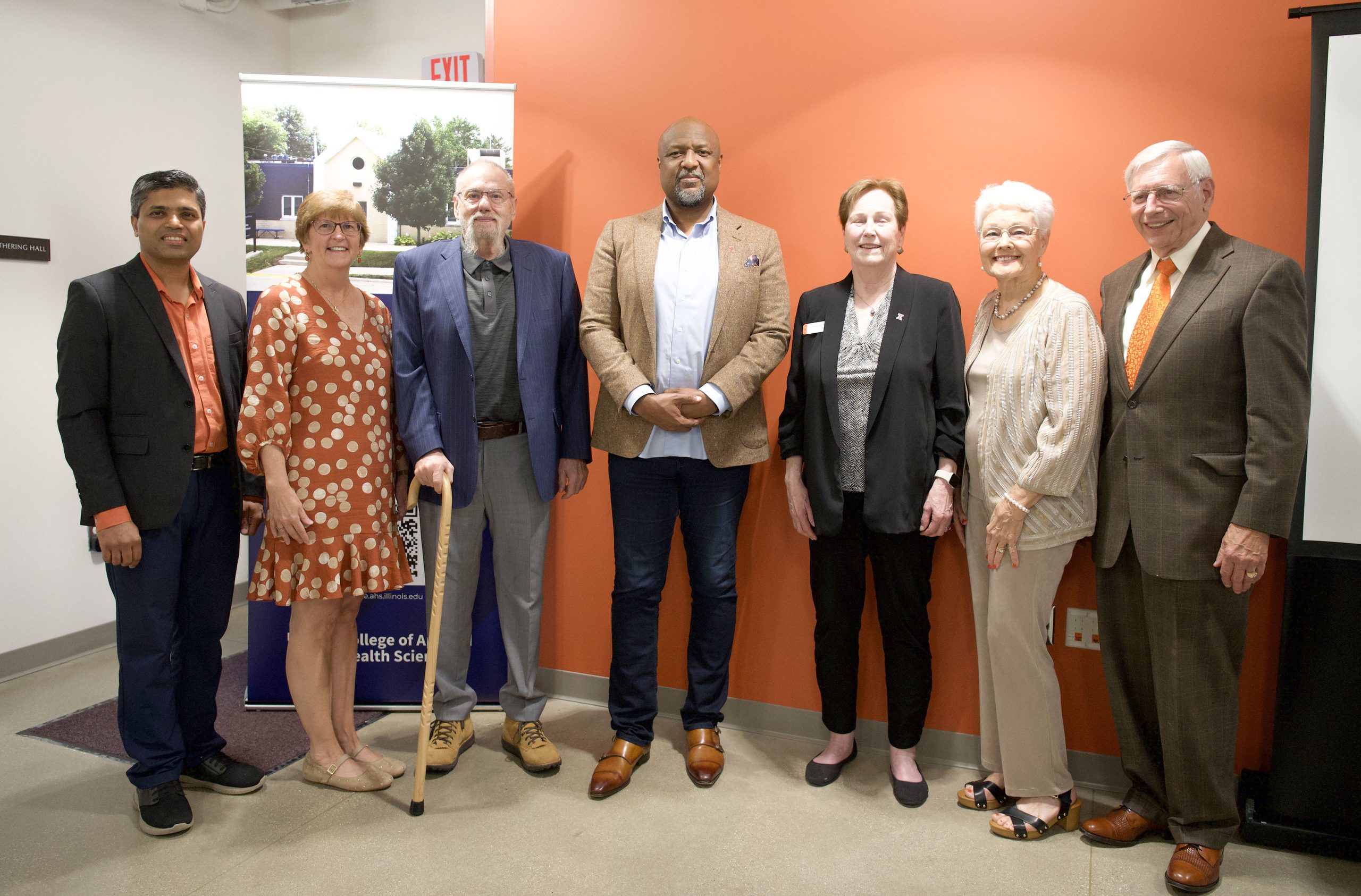
From left, Wendy Rogers, Raksha Mudar, Elizabeth Hsiao-Wecksler, Lynne Barnes and Cathy Emanuel (Photo by Carrie Wennerdahl)
Researchers from the University of Illinois Urbana-Champaign gathered Thursday to explore a strategic partnership with Advocates for Aging Care (AAC), a local grassroots organization working to bring an innovative skilled nursing facility to Champaign County.
The workshop brought together university faculty, clinicians and leaders to begin shaping how research, education and clinical practice could align to strengthen person-directed aging care.
The guest speaker was Susan Ryan, CEO of Maryland-based AgingIN, whose Green House model is a finalist for the project.
Building an Innovative Model for Skilled Nursing Care
The overarching goal is to establish The Cottages as a quality, person-directed skilled nursing setting inspired by the Green House model. Through collaboration with the university, project leaders aim to embed research into practice, pilot new technologies and create hands-on educational opportunities for students across disciplines.
The long-term vision is for The Cottages to serve as a flagship model for Illinois and the nation—distinguished not only by its design, but by its integration with a leading research university and its strengths in aging research, technology, design and education.
Turning Shared Interests into Action
The workshop was designed to generate potential models for collaboration based on the mutual needs of university researchers, clinicians, educators and students, as well as residents, families, caregivers and staff at The Cottages. Insights gathered during the session will inform the formation of working groups to advance the partnership.
“AAC is pleased to welcome researchers from the University of Illinois Urbana-Champaign as we identify new ways to advance person-directed skilled nursing care,” said AAC Steering Committee Chair Cathy Emanuel. “This unique Green House model can be strengthened by applying the latest research in aging technology, safety, environmental design, and innovative care practices. By partnering with the university, we aim to create a truly distinctive, high-quality care environment grounded in leading-edge research.”
Broad University Engagement
Interest across campus has been strong.
“We have been impressed by the level of enthusiasm we have seen as we organized this event,” said Wendy Rogers and Elizabeth Hsiao-Wecksler of the University of Illinois Urbana-Champaign. “Nearly 100 have already expressed interest in being engaged with The Cottages. They represent a broad spectrum of areas, including The Grainger College of Engineering, the College of Applied Health Sciences, Carle Illinois College of Medicine, the College of Liberal Arts and Sciences, the School of Social Work, the College of Media, the College of Fine and Applied Arts, the Interdisciplinary Health Sciences Institute, the Beckman Institute, Illinois Extension and UIC Nursing. We expect a long and fruitful relationship with Advocates for Aging Care, AgingIN, and The Cottages.”
Project leaders hope the Champaign County location will become a destination site for organizations seeking to implement innovative skilled nursing models—recognized not only for its Green House–inspired design, but also for its deep integration with university research, education and community engagement.
Additional details about construction timelines and future collaborative initiatives will be shared as planning progresses.
CAHME Announces the Initial Accreditation of the University of Illinois Urbana-Champaign, Master of Health Administration
Lynne Barnes is director of the MHA program and a longtime healthcare executive.
The Commission on Accreditation of Healthcare Management Education (CAHME) Board of Directors approved the initial accreditation of the University of Illinois Urbana-Champaign College of Applied Health Sciences’ Master of Health Administration for a four-year term.
The accreditation affirms that the Illinois MHA program meets CAHME’s high standards for healthcare management education and demonstrates a strong commitment to academic excellence, professional preparation and continuous improvement.
“We are pleased to have the recognition of the premier accrediting body for master’s degrees in health administration,” said Lynne Barnes, clinical professor and director of the MHA program and a longtime healthcare administrator. “The requirements are rigorous and further strengthen the quality of education and number of opportunities that we are providing for our students. This distinction will allow us to continue to attract top students from across the country and internationally.”
The four-year term of accreditation marks a significant milestone for the Illinois MHA program and reinforces its commitment to educating the next generation of healthcare leaders. An online MHA degree program will launch in 2026, along with several graduate certificates that will enhance specialized training in the field.
Cheryl Hanley-Maxwell, dean of the College of Applied Health Sciences—where the MHA program is housed in the Department of Health and Kinesiology—emphasized the significance of the milestone for the university and its students.
“This accreditation reflects the dedication and collaboration of our faculty and staff in building a curriculum that prepares graduates to become highly effective healthcare management professionals,” Hanley-Maxwell said. “Our mission is to equip students with the leadership skills, analytical expertise, and ethical foundation necessary to improve healthcare delivery systems and advance health outcomes in Illinois and beyond.”
CAHME accreditation is widely recognized as the benchmark of quality in graduate healthcare management education. Programs that earn accreditation undergo an extensive self-study process and peer review to ensure alignment with standards designed to prepare graduates for leadership roles in healthcare organizations.
“CAHME’s mission is to advance the quality of healthcare management education,” said Al Faber, interim president and CEO of CAHME. “CAHME-accredited programs have successfully navigated a complex and careful accreditation process managed by experts in the study and practice of healthcare management. The program meets the rigorous standards set by leading academicians and practitioners who are experts in their fields.”
Revamped online degrees are expected to expand the accessibility of AHS programs worldwide, reaching new students from underrepresented and nontraditional backgrounds
RST interim department head Bill Stewart, left, chats with MHA director Lynne Barnes and MPH director Pedro Hallal (Photo by Ethan Simmons)
Three master’s programs in the College of Applied Health Sciences are undergoing transformations for the digital age.
After receiving a $2.035 million award from the University of Illinois Investment for Growth program, AHS faculty, administrators and industry partners will collaborate to create online versions of the Master of Public Health and Master of Health Administration degrees. Additionally, the Master of Recreation, Sport and Tourism online degree will be restructured into three specialized programs: recreation and park management, sport management and administration, and tourism and event management.
The revamped online degrees are expected to expand the accessibility of AHS programs worldwide, reaching new students from underrepresented and nontraditional backgrounds.
“Going global has been a priority of this university for years,” said Pedro Hallal, Alvin M. and Ruth L. Sandall professor in the Department of Kinesiology and Community Health and director of the MPH program. “So now going global is a priority of this program as well.”
The addition of “stackable certificates” across each discipline will attract nontraditional students looking to boost their knowledge as well as mid-career professionals seeking expertise in their chosen industry.
Each program is committed to including new voices in their online instructional material, mainly experienced professionals working in the respective fields.
“It’ll be a nice blend,” said Lynne Barnes, the longtime top Carle Foundation Hospital administrator who was hired as director of the MHA program this fall. “We’ll have professors who really understand the knowledge base of the field, and we’ll also have clinical people who are working in the field doing the teaching, just like we do for the in-person program.”
The creation of new online master’s degree formats will start with collaboration with AHS’ online learning team. The online MPH program and restructured RST online master’s degrees will begin enrolling students in fall 2025; the online MHA program will debut in fall 2026.
“We’re taking the ‘growth’ term very seriously,” said Professor Bill Stewart, interim department head for RST. “This is a long-term investment for us, not just a one-off thing.”
MPH: ‘The perfect storm’ for growth
To populations around the globe, the COVID-19 pandemic was a clarion call to the vital importance of public health infrastructure.
The awakening clearly reached young people pondering their life paths: According to data from the Association of Schools and Programs of Public Health, applications to public health graduate degree programs increased 40 percent from 2020 to 2021.
“It’s so much easier now to choose a career related to public health,” said KCH Associate Professor Andi Schwingel, who is working alongside Hallal in developing the online coursework.
“Going global has been a priority of this university for years. So now going global is a priority of this program as well.”
Pedro Hallal
HK Professor, director of the MPH program
For the University of Illinois’ MPH program, the decision to create an online program is also a matter of maturity, Hallal said. Four years have elapsed since the program obtained accreditation from the Council on Education for Public Health.
“Some people in your neighborhood will add a security camera, and you don’t think it’s important until your house gets robbed, and then you see, ‘Oh, I needed that camera,’” Hallal said. “I think that is exactly what happened with public health.
“It was the perfect storm for our time to grow.”
The work ahead will be rigorous, with 20-plus courses awaiting development. Faculty plan to work with external partners, such as public health professionals, to create new course content. And it will be suited to the future landscape of public health, Hallal said: How might climate change and global warming transform health needs? How can we address the coexistence of infectious diseases with chronic conditions, like hypertension and diabetes?
A target for the MPH online expansion is the non-traditional student population. The MPH program will offer six certificates: epidemiology, biostatistics, public health, one health, physical activity and health and health promotion.
“It’s the time for us to reach nontraditional students, we feel ready for it,” Schwingel said. “We want to keep the rigor, the quality that we’ve been giving students in their residential program to the online space as well.”
MHA: Making health administration accessible
The MHA program at Illinois is designed to prepare students for leadership in the healthcare industry.
What the MHA program has recently observed, according to KCH Assistant Professor Mina Raj, is an influx of requests for an online equivalent, especially among mid-career healthcare administrators.
“The pandemic has made salient how important the healthcare system is, and how important it is to have administrators who can respond to public health emergencies and other unpredictable situations,” Raj said.
The overriding goal for the online degree is accessibility, Raj said: What material can be packaged into a four-week or eight-week course? The MHA online degree will offer three professional certificates: health finance, healthcare quality and health informatics.
“I think for this group of professionals it’s really about giving them the context and rationale behind why certain decisions are made as administrators or within a healthcare organization, as well as the tools to anticipate the impacts or consequences of various administrative decisions,” Raj said. “We have faculty with different expertise, different professional backgrounds, and everyone is excited to teach these courses.”
The work has already begun for Barnes, who wants to incorporate seasoned industry experts into course content. Barnes came to the university after retiring from a 45-year career at Carle Foundation Hospital.
“I hope to use real clinicians, people doing the work like at Christie Clinic, Carle and OSF Healthcare to be part of the lectures, so that the students who are online, all over the world and all over the United States experience instruction through people who are actually doing the work,” Barnes said.
RST: Degrees for specialized industries
The Department of Recreation, Sport and Tourism has been a leader in online education, debuting the first online master’s program in the discipline back in 2008.
But there wasn’t much fanfare, Stewart said. Online degrees were seen as “second-class programs” two decades ago.
“We were there at the beginning of the front to move online learning into a respectable degree process of education,” Stewart said.
Today, recreation, sport and tourism combine for an estimated $90 billion global set of industries. The pandemic resulted in a surge of public interest in leisure time and nature exploration, opening up new opportunities for professionals in the field, Stewart said.
“[RST] is about what we do in our free time to extend who we are and add value to our lives,” Stewart said. “We’ve come to embrace our needs for leisure-time activities in the last two years in ways that enhance our well-being and nurture our souls.”
The upcoming split of the current online master’s program into three tracks is a response to internal and external trends. Enrollment in the online MS in RST has plateaued in recent years, while other institutions have introduced their own online degrees in the discipline.
Online degrees were seen as “second-class programs” two decades ago, but no longer, said Bill Stewart, center. (Photo by Ethan Simmons)
Meanwhile, the demands of the industry have become more specialized over time.
“There’s still a need for the generalist degree, but because of the growth, we are finding professionals out there who need more help with the specialty,” Stewart said.
Students and mid-career professionals will be able to enroll in a new slate of RST certificates in high-demand topics, including inclusive design, agricultural tourism, sport analytics, e-sport administration, and diversity, equity and inclusion.
The department is in the process of searching for a director of the RST online program, Stewart said, while tapping into a vast network of alumni to help develop new course content.
“Our alumni value the friends and faculty they came to know as students and find various ways to give back to the department,” Stewart said. “Many of our alums are leading remarkable careers in contexts related to recreation, sport and tourism; they readily share their expertise through assistance in course development, guest lectures, creating internship opportunities for our current students, and in some cases, teaching classes for us.
“Our students come here because they care about making people feel better, their well-being, their sense of community and health. They want to give back to the community and they want to give back to the department that gave them this path in life.”
New Master of Health Administration director Lynne Barnes says, “After decades of working in healthcare, it’s really exciting for me to have the opportunity to impact the careers of future healthcare leaders.” Find out more about the past president of Carle Foundation Hospital and her move to lead the MHA program.
‘I’ll give them everything I’ve got,’ Lynne Barnes said about her new job.
A year of retirement felt like enough for Lynne Barnes, the longtime healthcare administrator.
After finishing her four-decade career at Carle Foundation Hospital as president, Barnes soon found herself auditioning for her newest challenge: directing the Master of Health Administration degree program in the College of Applied Health Sciences at the University of Illinois.
It was the third interview she’d ever taken, after her first Carle interview and her high school gig at the pastry chain Mister Donut.
Today, at 70, Barnes has “lots of energy, that’s a blessing,” she said. “I was ready to do something different.”
As the newest director of the six-year-old MHA program, Barnes brings an invaluable trove of administrative experience she hopes to impart to future healthcare leaders.
Barnes’s appointment officially began Aug. 1 when she succeeded two-year interim director Laura Rice.
“I’ll give them everything I’ve got, in terms of investing the program and helping it to grow in the ways that the university wants to see it grow,” Barnes said. “I want to see this program rise in the ranks of status.”
Raised in Catlin, Ill., Barnes was hired by Carle Health in January 1977 straight out of college as the system’s first occupational therapist. She went on to direct several departments and held numerous administrative roles before finishing her Carle career as president of the Urbana hospital.
“Throughout her career, Lynne has served the community and distinguished herself as a leader in healthcare innovation,” said Kim Graber, head of the Department of Kinesiology and Community Health. “Her background in clinical operations and occupational therapy, along with her distinguished experience as president of Carle Foundation Hospital, will provide graduate students in health administration with unrivaled leadership.
“Lynne has boundless energy and will help take our program to the next level.”
Barnes will continue to teach as a part-time clinical professor, a role she’s held at University of Illinois Urbana-Champaign since 2007. A frequent community volunteer, Barnes is board chair of the Stephens Family YMCA and Experience Champaign-Urbana, and previously served as a member of the United Way of Champaign County and Urbana City Council.
Barnes oversaw the growth of Carle Foundation Hospital’s therapy programs and clinical operations, leading the flagship location in the face of the COVID-19 pandemic before retiring in February, 2022.
“Everything I’ve done there is such a joy,” Barnes said. “I love healthcare, because all the time we’re just serving people, and serving people who are in a vulnerable situation.
“Nobody wants to have to go to the hospital. And I love the opportunity to serve people in that way and make that experience as palatable and positive as it can be under their circumstances. That is a joy.”
Barnes earned her bachelor’s degree in the emerging field of Occupational Therapy from the University of Illinois-Chicago in 1976, later obtaining her master’s degree in public administration from UIUC in 1988.
The MHA program was established in 2017 and accredited by the Council on Education for Public Health in 2019.
The opportunity to educate the next generation of healthcare leaders compelled Barnes to take the MHA directorship. She will work to develop the department’s new online MHA program and strengthen its position in the graduate landscape.
“The support has been terrific,” Barnes said. “I have no doubt we will be able to achieve these goals. I enjoy teamwork and I have already experienced that it is ‘all hands-on deck’ to continue to improve and optimize our educational opportunities for our students.
“After decades of working in healthcare, it’s really exciting for me to have the opportunity to impact the careers of future healthcare leaders.”
A gutsy start
Growing up the youngest of three, 30 miles east of the University of Illinois campus, Barnes said attending the U. of I. was basically inevitable.
Interested in taking a hands-on role within healthcare, Barnes enrolled in the new Occupational Therapy degree program, which sought to train physicians who could help patients with physical and sensory problems to regain their independence.
The program was run through the University of Illinois-Chicago, but the 10-student cohort studied on the Urbana-Champaign campus.
Upon graduating, Carle Hospital put out an ad for its first occupational therapist position. Half of Barnes’ class applied for the job, she said.
“The [physical therapy] director had a hard time figuring out who to hire,” Barnes said. “And he laid our resumes out on the table at home and his wife—who was the emergency department director at Carle—said, ‘Well, just pick the one that had the highest grade-point average.
“And I got the job.”
Barnes hit the ground running in Carle’s relatively small therapy department, back when the hospital only had about 150 beds.
I remember thinking, ‘I love this, I want to be a part of it.’ I’ve always had the desire to lead and share the enthusiasm and passion I have for whatever it is I’m doing. And I had that opportunity at Carle.”
Soon, her success led to a promising offer: work on her Ph.D. while teaching future occupational therapists on the UIC campus.
But Barnes went straight to administration and leveraged a proposal of her own. If she were to get a promotion, she’d grow her own occupational therapy department and stay at Carle Foundation. It worked.
“I was kind of gutsy, I had only been there a couple years,” she said.
Barnes quickly found an affinity for the business side of healthcare, growing the therapy department by about 60 employees before being promoted to Carle’s director of therapy.
Soon, the current CEO of Carle Healthcare, Jim Leonard, came to her office and asked if she’d like to be a vice president of the hospital.
“I was all about therapy, I was very focused on what I did,” she said. “But whether I could translate my leadership skills to other departments was unknown. They thought maybe I could, but they were taking a chance on me.”
The decision led to years of multifaceted administrative work for the Urbana hospital, while the system continued its growth trajectory, adding a handful of new hospitals across Illinois.
Barnes’ attention stayed fixed on Carle Foundation, where she took pride in handling complaints from patients and families in vulnerable situations.
“To me, a patient who’s had a complaint and had it successfully resolved is more loyal than a patient who’s never even had a problem. I’m competitive, and I like to win back people,” Barnes said.
“I love the atmosphere and culture of Carle, of always striving to fix things and make it better and push ourselves so we could be noted for having the best care around.”
Mission-driven healthcare leaders
While still at Carle, Barnes found a new passion bubbling up alongside her administrative duties. She took joy in passing on her knowledge to both peers and students.
Along with becoming teaching faculty at the College of AHS, she’s become a professional life coach, dispensing career advice for those inside her field and outside of it.
For the present and future students of the MHA program, Barnes wants to pass on the idea of healthcare as a mission-driven calling, not just a job.
“They’ve got to learn facts about what it’s like to run a healthcare system, but they also need what I would call the characteristics that make the kind of healthcare leader that you want. I try to blend them, and share with them the need for energy, for enthusiasm, the need for passion,” Barnes said.
With MHA embarking on the brand-new construction of an online degree, and the spotlight on healthcare after the COVID-19 pandemic, Barnes has high-minded goals for the future of the program.
“By the time I’m done, my goal is this place will be more well known and people will be clamoring to get their graduate degree from the University of Illinois Urbana-Champaign MHA program,” she said.
“That’s going to take work and it’s going to take connectivity, so I’m hoping I can use some of my healthcare connections to be able to get the word out.”
Longtime healthcare executive takes lead role in AHS
Lynne Barnes
Lynne Barnes, past president of Carle Foundation Hospital, has been hired as director of the Master of Health Administration degree program in the College of Applied Health Sciences at the University of Illinois.
Barnes’ appointment officially begins Aug. 1, succeeding interim director Laura Rice.
Raised in Catlin, Ill., Barnes was hired by Carle Health in January 1977 straight out of college as the system’s first occupational therapist. She directed several departments and worked numerous administrative roles before finishing her Carle career as president of the Urbana hospital.
“Throughout her career, Lynne has served the community and distinguished herself as a leader in healthcare innovation,” said Kim Graber, head of the Department of Kinesiology and Community Health. “Her background in clinical operations and occupational therapy, along with her distinguished experience as president of Carle Foundation Hospital, will provide graduate students in health administration with unrivaled leadership.
“Lynne has boundless energy and will help take our program to the next level.”
Barnes will continue to teach as a part-time clinical professor, a role she’s held at University of Illinois Urbana-Champaign since 2007. A frequent community volunteer, Barnes is board chair of the Stephens Family YMCA and Experience Champaign-Urbana, and previously served as a member of the United Way of Champaign County and Urbana City Council.
Barnes oversaw the growth of Carle Foundation Hospital’s therapy programs and clinical operations, leading the flagship location in the face of the COVID-19 pandemic before retiring in Feb. 2022.
Barnes earned her bachelor’s degree in the emerging field of Occupational Therapy from the University of Illinois-Chicago in 1976, later obtaining her master’s degree in public administration from Illinois in 1988.
The MHA program was established in 2017 and accredited by the Council on Education for Public Health in 2019.
The opportunity to educate the next generation of healthcare leaders compelled Barnes to take the MHA directorship. She will work to develop the department’s new online MHA program and strengthen its position in the graduate landscape.
“The support has been terrific,” Barnes said. “I have no doubt we will be able to achieve these goals. I enjoy teamwork and I have already experienced that it is ‘all hands on deck’ to continue to improve and optimize our educational opportunities for our students.
“After decades of working in healthcare, it’s really exciting for me to have the opportunity to impact the careers of future healthcare leaders.”