KCH changes name to HK


Beginning August 16, 2024, the name of the Department of Kinesiology and Community Health (KCH) will officially change to the Department of Health and Kinesiology (HK).

The new name better reflects significant changes in our disciplines, research interests and educational mission. Health and Kinesiology allows for a broader, more inclusive representation of a department that focuses on multiple aspects of health and physical activity in a diverse society. It also honors our legacy as leaders in the field of health and kinesiology, while pointing the way forward to a future that is both dynamic and innovative. 

We are excited about the new name and hope you are as well!

For more information, read our news release on the name change, and check out the News-Gazette‘s story on the decision.

Related news

The Martens pledge support to KCH grad students


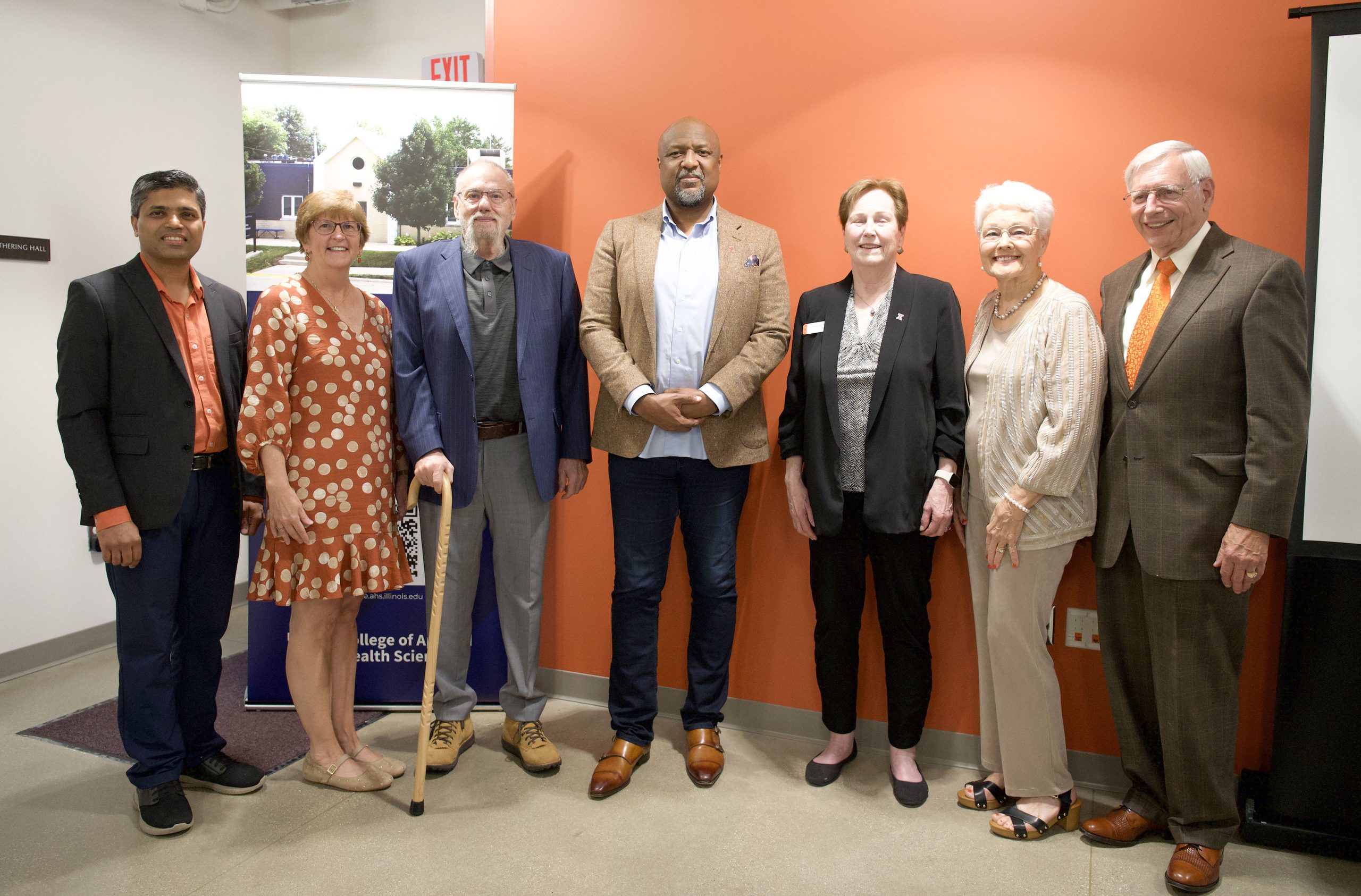
Julie and Rainer Martens pose at a recent reception at the College of Applied Health Sciences. (Photo by Jerry Thompson)

University of Illinois alums Rainer and Julie Martens are retired, but they can hardly stay still. 

From their current home base of Ormond Beach, Florida, the pair have stayed busy building out Pictona, a $16 million pickleball facility in Holly Hill with more than 1,400 members that hosts major U.S. tournaments. 

In their free time, the couple travels to remote locations across the globe together and documents their expeditions. In a recent visit to the Galapagos Islands, Rainer’s photography and Julie’s videography paired nicely. 

“We make a pretty good team,” said Rainer, 81, who taught sports psychology in the Illinois Department of Physical Education for 16 years.  

Through all their travels, the Martens say the University of Illinois has continued to hold a special place in their hearts. Giving back to the institution that helped launch their careers—now the Department of Kinesiology and Community Health at the College of Applied Health Sciences—made all the sense in the world. 

Together, they’ve created the Rainer and Julie Martens Physical Activity Endowment Fund, a $2 million joint gift that will fund $80,000 in annual scholarships for KCH graduate students in perpetuity. The gift will convey to the department upon the Martens’ passing. 

“Both of us were fortunate that when we finished our degree, we were not burdened by having to pay back loans,” said Julie, 74. “It makes life much easier. Then you can concentrate on what it is that your goal was and not have to worry about paying back a lot of money.” 

The Martens’ message to future recipients: “simply, is ‘do good,’” Rainer said. They want new students to be able to afford the same scholarly path they once took. 

“The difference this will make for some students is profound,” AHS Dean Cheryl Hanley-Maxwell said. “Both Rainer and Julie will live on in the students who are funded through their gift, they will continue to affect the health and wellness of communities and individuals in ways that are yet to be told.” 

Illinois laid a foundation for much of their early career success. Julie arrived at Illinois after completing her master’s at the University of Washington and obtained her doctorate in sports psychology in 1977, with Rainer as her advisor. Rainer obtained his Ph.D. from the U. of I. in 1968 and began his tenure as a research professor in sports psychology. 

Their lives both changed after Rainer founded the publishing company Human Kinetics in 1974 with his first wife, Marilyn, who passed away in 1991. Julie was the first employee of the publisher of books and journals in the physical activity field; Human Kinetics had swelled into a 300-person staff by the time she retired as its executive vice president in 2009.    

“I was fortunate to make lots of connections around the world in our field and the related exercise sciences and kinesiology fields,” Rainer said. “It was those connections that really let us start Human Kinetics, and it’s been the success of Human Kinetics that has given us the wherewithal to make contributions to our universities.”

Their fondest memories in Champaign-Urbana start with the group of students they worked with. The strong cohort of kinesiology scholars was highly motivating for Rainer as a professor, and Julie as a doctoral student. They both made “lifelong friends” and collaborators working long days in the Applied Life Studies Library. 

After each of them completed a day’s work, they’d make an afternoon visit to the Intramural Physical Education Building (IMPE)—the U. of I.’s previous campus recreation facility—where Rainer played handball and Julie played racquetball. 

“It was a great way to end the day, I think, for the both of us,” Julie said. 

A decision to give

No strangers to philanthropy, the Martens have used substantial sums to give back to the Champaign-Urbana community. It was their lead gift that helped build the $12 million Martens Center, a recreation community facility run by the Champaign Park District. 

The difference this will make for some students is profound.

Cheryl Hanley-Maxwell

Dean, College of Applied Health Sciences

By last fall, the couple had made clear that they were set on helping the Department of Kinesiology and Community Health in some way. The College of AHS staff and advancement team made it “pleasant to do so,” Rainer said, including Jean Driscoll, who they called a “terrific representative” of the college and university. 

“They made it very clear that they were totally open to whatever, however we wanted to structure the gift and didn’t ever try to direct us in a particular direction,” Julie said.  The Martens are both lifelong athletes, and Julie—a former tennis player—caught the pickleball bug around 2011. Driscoll and Dean Hanley-Maxwell recently visited them in Florida and got a free pickleball lesson from the couple on one of their own Pictona courts. “They’ve got potential”, Rainer said. 

Julie and Rainer visited campus earlier this month in a reception celebrating their estate gift, where they got to speak with faculty and graduate students whose shoes they were in decades ago. 

“It has been a true pleasure to communicate with Rainer and Julie through the course of this agreement,” said KCH Department Head Kim Graber. “They are kind, intelligent, and captivating individuals, and they have left an indelible footprint on the history of our department.”

In the meantime, the couple is heading to Svalbard, an archipelago of Norway that’s one of the northernmost inhabited areas in the world. They plan to photograph polar bears and other wildlife there in the summer before making another trip to South Africa in September. 

And they recently announced their plan to hand the reins of the Pictona pickleball facility to new leadership by the end of the year. 

“One of the things that we’re really proud of here is having had a career in physical activity and made it part of our personal life as well is that here we get to witness, every day, people enjoying physical activity in the form of pickleball,” Rainer said. 

“We’re looking at the future and trying to find the right personnel to replace us as we look at doing more travel, more photography, and actually getting to play pickleball more.”  
 

Editor’s note:

To reach Ethan Simmons, email ecsimmon@illinois.edu.
 

Related news

HK faculty, students honored

Graber is new president of AKA

HK Department Head and Professor Kim Graber took over in January as president of the American Kinesiology Association. Graber replaces Auburn Professor Jared Russell, while Utah Professor Tim Brusseau takes over as president-elect.

Hallal receives APHA honor

Pedro Hallal

Pedro Hallal, the Alvin and Ruth Sandall professor of kinesiology and director of the Master of Public Health program in the College of Applied Health Sciences, received the 2023 David P. Rall Award for Advocacy in Public Health for his COVID-19 research and public health messaging in the face of political opposition. Hallal developed the EPICOVID-19 project, which tracked the spread of COVID-19 across Brazil and uncovered racial health disparities that were regularly dismissed by then-Brazilian President Jair Bolsonaro. Hallal shared Brazil’s COVID-19 health data with the world despite threats to his livelihood and well-being from the Brazilian government.

Kevin Richards wins AERA award

HK Associate Professor Kevin Richards was selected as the recipient of the 2024 Catherine D. Ennis Scholar Award for the AERA SIG 93. This award is designed to recognize an outstanding scholar in the field of learning and instruction in physical education.

VanHoutan chosen for SHAPE honor

Kinesiology major Emma VanHoutan was selected to receive the SHAPE America Major of the Year award. The award is given annually to one outstanding undergraduate student in the field of health, physical education, recreation and/or dance. VanHoutan plans to graduate with a bachelor’s degree in 2024.

Strittmatter selected for AIESEP award

HK doctoral candidate Gabrielle Strittmater was selected as one of 21 doctoral students from around the world, and one of only three from the United States, to attend an international doctoral “summer school.” The summer school will provide time to interact with other doctoral students and faculty members while delving into topics of interest for aspiring researchers. The event will take place during the AIESEP conference this summer in Finland.

Long-time RST faculty member Espeseth remembered for work and friendship


Bob Espeseth was an RST faculty member for three decades (Photo provided)

It’s no surprise that a man who was as outgoing as Bob Espeseth dedicated his life to creating opportunities for others to be outdoors.

“When we grew up, we were always doing stuff, always camping a lot, being outdoors,” said Robert Espeseth, one of Bob’s five children with wife Mary Anne. “That was just us. Part of the trips was to get to see the country … we got to grow up seeing a lot of the parks and a lot of the country and different things. 

“He was always happy to meet everybody. He went out of his way when he traveled to look up people and stop in and visit, or at the very least call when he was in the area.”

Espeseth, who was a faculty member in the Department of Recreation, Sport and Tourism at Illinois from 1973-95, died on Dec. 15, 2023 at the age of 93. 

Espeseth grew up in Wisconsin and earned a degree in landscape architecture at the University of Wisconsin, all while serving in the ROTC. Espeseth’s ROTC commitment sent him into the Navy, where he was on active duty for three years. He was an ensign in the Navy when he was the films officer for the USS Purdy, a destroyer that traveled around the world to provide support in the Korean War.

“After he got out of the Navy, he went back and got his master’s degree, and then he started working for the Wisconsin parks system,” son Robert said. “He was instrumental in developing and modernizing a lot of the Wisconsin State Parks, the rails to trails.”

Espeseth also worked in parks administration in Michigan before coming to the University of Illinois, where he was a professor of leisure studies. Colleagues remembered him as warm and helpful.

“He was kind and fun-loving. He was very quick to laugh. Most of my memories are I would go for a run in the morning and he and Mary Ann would walk from their house on Healy Street down to Prospect Avenue.”

RST faculty member Kim Shinew

“And they were standing in front of this tree on Healy one day. And just something about it made me stop, which was unusual. When I run, I usually don’t stop. I stopped, and he said, ‘Do you know what kind of tree this is? And I said, ‘I have no idea, Bob. And he said, ‘It’s a ginkgo tree. They lose their leaves in one day.’ And he said, ‘Long after I’m not around, when you go by this tree, you think of me. And I always have. I always just thought of him when I ever go by that tree.”

In addition to his academic endeavors, Espeseth volunteered for more than 45 years for the Champaign County Forest Preserve District, first as an elected official and later as a foundation board member. His volunteer work and philanthropic endeavors played a significant role in establishing and caring for nearly 4,000 acres of preserves, the Museum of the Grand Prairie, and the Kickapoo Rail Trail.

“He knew the important role that public parks and places like forest preserves, the role that they play in overall life satisfaction and quality of life and places of exercise,” Shinew said. “I know that he really valued and appreciated the outdoors. He was an advocate for that in communities.”

“When I came and Bill McKinney was the (RST) department head, Bill’s area was public parks and recreation. Bob played a big role in that.”

Even now, Shinew said, the connection between landscape architecture and community planning and engagement—two other significant RST industry fields—is significant, a testament to Espeseth’s pioneering work.

Espeseth was also, not surprisingly, an advocate for environmental causes and helped to launch the Illinois-Indiana Sea Grant, which support coastal, marine and Great Lakes communities through research, extension and education. The Illinois-Indiana Sea Grant, one of 34 Sea Grants in the United States, is focused on the southern Lake Michigan region—104 miles of heavily urbanized and industrialized shoreline in Illinois and Indiana. Espeseth was at the helm of IISG from 1982 through 1994. 

But family and greenspace were really Espeseth’s loves. He was part of the National Parks and Recreation Association, and thanks to that, he took his family on many trips.

“We stopped at every state park and national park in the country,” Robert said. “Well, he would pose us, all of us—my brothers and I—in front of the sign to the park, the entrance to the park to take a picture of the entrance. Part of it was he wanted this file of information, but then he also could use it as family pictures. We used to joke that our father has the best collection of park entrances and bathrooms, because he’d always shoot the restroom facilities, how they were designed, how they were landscaped with natural stone or other things. 

“So we’re posed in front of stuff, whether it was in Yosemite, whether it was Yellowstone, whether it was in Grand Teton, whether it was in Craters of the Moon Park, you name it. We used to joke he has the most amazing collection of bathroom pictures in the United States. 

“That was how practical and frugal he was.” 

Related news

Men’s and women’s wheelchair basketball to play for gold in Paris


Brian Bell had 31 points for Team USA against Canada (Photo by Tullio M. Puglia/Getty Images for IPC)

Team USA’s wheelchair basketball teams have two shots at gold this weekend.

Illinois alum Brian Bell had 31 points as the Team USA men overcame an early deficit to beat Canada 80-43 Friday to advance to the gold medal game of the Paralympics in Paris.

The American men will seek an unprecedented third straight gold on Saturday against Great Britain.

The women, meanwhile, rallied to beat China—who they lost to in the semifinals in Tokyo three years ago—50-47 and will play for gold on Sunday.

For the men, Canada jumped out to an 8-2 lead and led 16-10 before the U.S. went on a 19-5 run and never looked back. Bell also had 10 rebounds and Jake Williams and Illini alum Steve Serio combined for 20 assists.

Bell credited Williams and Serio for allowing him to get open.

“I know that teams are going to jump Jake,” Bell told reporters. “He’s one of the best shooters in the world. So just to be able to capitalize on that, and then once they jump, being able to attack their two-on-one and utilize the inside presence.”

Canada was held to 38 percent shooting from inside the 3-point line and scored just 11 points in the entire second half as the U.S. cruised to victory.

“Our plan was to push up the tempo a little bit,” Bell said. “So press them a little bit, make their top threats a little tired. We know that that would benefit us as the game goes on because we can rotate some of our guys in and out.”

Serio, 36, who is competing in his fifth and final Paralympics, says that the gold medal match will be a night to remember, no matter the outcome.

“I’m sure there is going to be tons of emotions after the game, but honestly when it comes down to it, it has nothing to do with legacy, it has nothing to do with reflection, but I’m going to do everything I can do to help our team win a basketball game,” Serio said.

Editor’s note:

To reach Vince Lara-Cinisomo, email vinlara@illinois.edu.
 

Related news

Illini athletes lead the way for Team USA


Illini athletes lead the way for Team USA (Getty Images)

In a big night for wheelchair racing and jumps, Americans—led by athletes from the University of Illinois—brought home five medals in front of another electric crowd at the Stáde de France in Paris.

Illini Paralympians Susannah Scaroni, Brian Siemann and Daniel Romanchuk all brought home bronze in their wheelchair racing events.

Siemann, who is competing in his fourth Paralympic Games, earned his first career Paralympic medal in Sunday’s 400-meter T53 race. The 34-year-old won his first world championships medals in 2023 and said that trusting his training is what has helped him to peak at this point in his career.

“I’ve managed to do this with the support of my teammates,” he told reporters in Paris. “I’ve been lucky to train with some really great athletes. Real legends in the sport. I think they’ve always been the force that’s pulling me, sometimes quite literally, across the track to get a little bit better and a little bit faster. That’s what’s gotten me here. Their commitment to making me a better athlete.”

Siemann clocked a personal-best time of 47.84 and said it was an emotional moment.

“I couldn’t stop smiling when I saw my name on the board because I’ve been in that position when I’ve been waiting and I look and I see my name in fourth place by a hair. To finally see it up there and to race as fast and as well as I did is really exciting. There’s still more work to be done.”

Siemann said his training at the University of Illinois led him to reach his potential.

“I went off to Illinois as a student back in 2008 and so it’s like I’ve lived there almost now as long as I’ve lived in New Jersey, and so that really sort of did lay the foundation for my success today,” he said. “You know, it’s been a very long road to get here, but getting the opportunity to train with the best wheelchair athletes in the world on a daily basis has just pushed me to be that much better, not only in terms of my academics when I was a student but now also as an athlete, too.”

“Mo, we did it!,” he added, referencing Maureen Gilbert, coordinator, Office of Campus Life at Disability Resources and Educational Services, who is considered the heart of DRES and its trailblazing Paralympic training facility.

Scaroni took a risk on an inside line in the final 100-meters of the women’s 800-meter T54 and it paid off, resulting in her second medal in as many days. The now five-time Paralympic medalist earned bronze in 1:43.42, eking ahead of teammate and 20-time Paralympic medalist Tatyana McFadden, who clocked a time of 1:43.58 and finished fourth. The third American in the race, two-time Paralympian Hannah Dederick, also from the University of Illinois, kicked off her second Games with a seventh-place finish.

For Scaroni, both Paris medals have come as a result of strategic execution of her race plan. In today’s 800-meter, she sat at the back of the pack until the final 200 meters of the race, where she turned on the power and chose the correct line.

“There’s a lot of strategy, there’s a lot of going as hard as you can while being able to respond what’s going on,” she said. “I’ve realized Tokyo was Tokyo, this is a new Games. It’s been really fun for me to focus on the racing. Tokyo, no one had raced for awhile, and it was going to be kind of mysterious. Here, I know the strengths of this field and I’m just excited to race.”

Scaroni returns to the track for her 1,500-meter competition on Sept. 3, while McFadden and Dederick are set for the 100-meter on Sept. 4.

Scaroni credited the University of Illinois for her training.

“Illinois has prepared me in so many ways,” she said. “Not only am I surrounded by the best environment for a wheelchair racer but I also have an incredible education. They’re really highly ranked in nutrition, and so I was able to couple my nutrition degree with my sport and do a master’s in exercise sociology, and then that obviously has helped as well. So I think that as I’ve become a better athlete, I’ve become a better professional person with a disability by being surrounded by such an inclusive campus, and hopefully a good nutrition educator too.”

Also earning his second medal of the competition was Romanchuk, who found an extra gear at the end of the men’s 400-meter T54 and took bronze, just a day after winning the 5,000-meter event. Romanchuk’s time of 45.11 put him comfortably in third, over half a second ahead of the fourth-place finisher.

Roderick Townsend (gold, men’s high jump T47) and Jaleen Roberts (silver, women’s long jump T37) also won medals for Team USA in their respective sports.

On the basketball court, the U.S. men’s wheelchair basketball team won its third straight game Sunday, rallying past Australia 76-69 behind 18 points from Illinois alum Brian Bell. With a 3-0 finish, the U.S. secured the top spot in Group B, meaning they will face the fourth-place team of group A in the quarterfinals. The Americans return to the court on Tuesday for the quarterfinal round. Its opponent and game time are still to be determined.

Editor’s note:

To reach Vince Lara-Cinisomo, email vinlara@illinois.edu.
 

Related news

Health Technology program undergoes leadership change from Rogers to Mejia


Wendy Rogers, center, says Shannon Mejia, left, is ready to lead the Health Tech program (Photo provided)

Health and Kinesiology Professor Wendy Rogers, the founding director of the Health Technology Education Program in 2017, stepped aside in the summer of 2024 and Shannon Mejía, an associate professor in HK, was named her successor.

Rogers had already had an illustrious academic career, primarily at Georgia Tech, before coming to the University of Illinois Urbana-Champaign in 2017. Together with her husband, Dan Fisk—also a Ph.D. in the field of experimental psychology, Rogers created the Human Factors & Aging Laboratory in 2003 at Georgia Tech. After Fisk retired in 2013, Rogers relocated the lab to Illinois—where Fisk got his doctorate—four years later.

Rogers’ arrival at Illinois coincided with an Investment for Growth proposal led by the College of Applied Health Sciences and The Grainger College of Engineering aimed at developing the Health Technology Education Program. Health and Kinesiology Professor Jeff Woods, who spearheaded the IFG with Kesh Kesavadas, a professor of Industrial and Enterprise Systems Engineering, knew who he wanted to lead the Health Tech program.

“Jeff asked me if I would be willing to lead the educational component and I agreed,” said Rogers, who is the Shahid & Ann Carlson Khan Professor of Applied Health Sciences. 

“We hired Nicole Holtzclaw-Stone in January 2018 and the four of us (Jeff, Kesh, Nicole, and I) spent a lot of time together developing the Health Technology Education Program,” Rogers said.  “We shepherded our Master of Science in Health Technology through department and college educational policy committees, the Graduate College, the Faculty Senate, the Board of Trustees, and finally the Illinois Board of Higher Education. In December 2019, Nicole and I drove to Chicago for the Illinois Board of Higher Education meeting in case there were any questions but there were none and we were officially approved. We welcomed our first cohort in August of 2020,” during the COVID-19 pandemic.

Rogers said she always planned to get the Health Tech program established and build a strong foundation before passing it on.

“The time was right to transition to a new director, but we want to continue to build on the trajectory we are on,” she said. “The mission is to advance health technology education for learners at all levels through our interdisciplinary undergraduate certificate and minor (joint with Industrial & Enterprise Systems Engineering), our Master of Science in Health Technology (in collaboration with Grainger College of Engineering), and our Health Technology Professional Education Program.”

Mejía praised her predecessor’s vision. 

“She led the development and implementation of an innovative education program that provides cross training in user needs, human factors and user experience methodologies, and engineering principles to develop leaders who can speak the language of both health care and engineering,” Mejía said of Rogers. “To address the critical challenges facing health care today, it is essential to understand user needs and technological capabilities in order to assure that technological solutions truly support the well-being of individuals, families, organizations, and communities. We train students to fulfill this essential role. This program is one of a kind in the nation. And it is my privilege to take the program to its next level.”

Rogers said the move was eased by knowing Mejía was ready to step in.

“Dr. Mejía has been an active member of the Health Technology Education Program since its inception,” Rogers said. “She is the right person at the right time to take the program to the next level. She has a lot of energy and creative ideas. Together, with Dr. Katelyn Talbott as the assistant director, I know the program will continue to be successful and to grow.”

For her part, Talbott said Mejía “has great ideas for growth and increased recognition in the field.”

“As with any change in leadership, new leaders are able to bring their perspectives to the challenges and goals in front of them,” Talbott said. “Shannon will be no different. I look forward to working with Shannon as we work to grow all aspects of the Health Technology program.”

Rogers will continue in her roles as director of the McKechnie Family LIFE Home, program director of CHART: Collaborations in Health, Aging, Research, and Technology and director of Human Factors & Aging Laboratory.  “I have plenty to keep me busy and I look forward to having more time to devote to these activities,” she said.

As a recognition of their continued support of the MS-HT program, Rogers and Fisk have endowed the Wendy A. Rogers Health Technology Travel Award. The award will provide master’s students with the opportunity to travel to conferences to share their own work, to learn from other researchers, and to participate in networking opportunities. Additional donations to the fund are welcome and will help to provide travel support for more students.

Donation instructions for mail or online gifts are on uif.uillinois.edu/how-to-give. For online donations, in the dropdown menu under Gift Designation, click on the “Other” box and enter Fund #777754 or “Wendy A. Rogers Health Technology Travel Award” or write this information on the memo line of your check.

“In August of 2024 we welcome our fifth cohort into the program,” Rogers said of the Health Tech program. “Alumni from our program are already out in the working world making a difference in health technology to improve quality of life for all of us.”

Editor’s note:

To reach Vince Lara-Cinisomo, email vinlara@illinois.edu.
 

Related news

SPICE-Healthcare: Dietary assessments for culturally diverse older adults


A cross-campus team of researchers at the University of Illinois Urbana-Champaign, led by Kinesiology and Community Health Assistant Professor Mina Raj, has received two grants to test an online platform designed to help dietitians, clinicians and food service personnel make dietary assessments and care plans that are tailored to patients’ medical and cultural needs. 

The web-based platform to Support Personalized and Inclusive Cuisines in Environments for Healthcare (SPICE-Healthcare), is in line to receive nearly $120,000 in grant support to test its usability with community partner ClarkLindsey Village and other healthcare organizations. 

“We will conduct usability testing locally but also with clinicians from other parts of the country,” Raj said. 

Raj focuses her research at the College of Applied Health Sciences on healthcare administration and disparities, particularly on supporting the needs of diverse older adults and family caregivers. Her preliminary studies inform the purpose of SPICE-Healthcare. 

Collaborators include KCH Associate Professor Naiman Khan, an expert in nutrition and health behaviors and outcomes; Margarita Teran-Garcia, assistant dean and program leader of Integrated Health Disparities at Illinois Extension; Ian Brooks, director of Center of Health Informatics; and Lisa Gatzke, who leads the User Interface and User Experience Team at The National Center for Supercomputing Applications (NCSA). 

“This team has been in conversations for over a year contributing their expertise in nutrition, community outreach, informatics, and design to come up with the platform that aims to improve health service delivery for culturally diverse older adults,” Raj said. “Working together across disciplines has been pivotal to bringing this idea to reality.”
 
To develop and test this electronic-dietary assessment tool (eDA), the team received a $50,000 seed grant from the Personalized Nutrition Initiative, a University of Illinois project led by the Office of the Vice Chancellor for Research and Innovation, partnered with Carl R. Woese Institute for Genomic Biology and College of Agricultural, Consumer and Environmental Sciences at Illinois.

The Personalized Nutrition Initiative recruits an interdisciplinary group of researchers to investigate ways to optimize human health by making nutrition recommendations based on the individual’s genetics, microbiome and metabolome, along with their dietary history and phenotype. 

Another $68,210 is heading to the project from Illinois Chancellor Robert Jones’ Call to Action Research Program, an annual $2 million commitment that funds research targeting racial inequities and injustices.  

SPICE-Healthcare is meant to assist the growing population of older adults from culturally diverse backgrounds who are enrolling in long-term care services. Many long-term care facilities and hospitals lack inclusive cuisine for different cultural, ethnic and religious identities. 

When food isn’t personalized to these needs and preferences, these older adults face risks of undernourishment, unintentional weight loss, or overburdened family caregivers, investigators say. 

Interviews with institutional leaders at ClarkLindsey and other community organizations suggested that a “point of care” resource to improve culturally tailored nutrition assessments was sorely needed. 

The first phase of the platform, a click-through prototype electronic-dietary assessment, is almost ready for testing, Raj said. 

“We will then continue working with our collaborators at NCSA to refine the tool to be culturally tailored,” she said.

Editor’s note:

To reach Ethan Simmons, email ecsimmon@illinois.edu.
 

Related news

KCH becomes Health and Kinesiology


The University of Illinois at Urbana-Champaign’s College of Applied Health Sciences is proud to announce a significant milestone in its ongoing commitment to advancing health sciences education and research. Effective Aug. 16, the Department of Kinesiology and Community Health will officially change its name to the Department of Health and Kinesiology.

The new name better reflects significant changes in our disciplines, research interests, and educational mission. Health and Kinesiology allows for a broader, more inclusive representation of a department that focuses on multiple aspects of health and physical activity in a diverse society. It also honors our legacy as leaders in the field of health and kinesiology, while pointing the way forward to a future that is both dynamic and innovative. 

The name change was a decision that was made based on goals highlighted in the KCH Strategic Plan and upon the recommendation of the KCH Restructuring Task Force. It was supported by multiple stakeholders and was recently approved by the College of Applied Health Sciences, UIUC Senate, and Board of Trustees.

Cheryl Hanley-Maxwell, dean of the College of Applied Health Sciences, expressed enthusiasm about the department’s name change, saying, “The renaming of our department to Health and Kinesiology aligns with our strategic vision of fostering interdisciplinary collaboration and addressing the multifaceted aspects of health and wellness. This change reflects our commitment to providing innovative education, conducting impactful research, and serving our communities.”

HK Department Head Kim Graber said, “As the department evolves to better reflect the dynamic landscape of health and movement sciences, we believe the change to Health and Kinesiology not only embraces our commitment to comprehensive wellness but also underscores our dedication to advancing research, education and outreach in these vital areas.”

The Department of Health and Kinesiology offers a wide range of undergraduate, graduate and doctoral programs aimed at preparing students for careers in health promotion, exercise science, public health, rehabilitation, and related fields. With world-class faculty and state-of-the-art facilities, the department equips students with the knowledge, skills, and practical experience needed to excel in diverse healthcare settings.

Editor’s note:

To reach Vince Lara-Cinisomo, email vinlara@illinois.edu.
 

Related news

College of Applied Health Sciences
110 Huff Hall
1206 South 4th Street
Champaign, IL 61820
(217) 333-2131