Hello, members of the Kinesiology and Community Health family,
As we wrap up the academic year, I am delighted to present the latest—and final—edition of the Kinesiology and Community Health newsletter. I say final because, as you all know, the department will officially be known as the Department of Health and Kinesiology as of July 1. We have a lot to be proud of from this past year, and a lot to look forward to.
Within these pages, you will read more about our historic name change, delve into the captivating research endeavors our faculty is pursuing, and we’ll showcase the achievements of some of our outstanding students. Their commitment to academic excellence and their steadfast dedication to cultivating healthier communities are truly admirable.
In conclusion, I urge you to immerse yourselves in the spring 2024 Kinesiology and Community Health newsletter, drawing inspiration from its contents, and persistently embodying the ethos of well-being and community in all your endeavors.
Here’s to a fruitful and invigorating summer.
Warm regards,
Kim Graber Head, Department of Kinesiology and Community Health
Beginning August 16, 2024, the name of the Department of Kinesiology and Community Health (KCH) will officially change to the Department of Health and Kinesiology (HK).
The new name better reflects significant changes in our disciplines, research interests and educational mission. Health and Kinesiology allows for a broader, more inclusive representation of a department that focuses on multiple aspects of health and physical activity in a diverse society. It also honors our legacy as leaders in the field of health and kinesiology, while pointing the way forward to a future that is both dynamic and innovative.
We are excited about the new name and hope you are as well!
Giving back to the institution that helped launch their careers makes all the sense to Julie and Rainer Martens
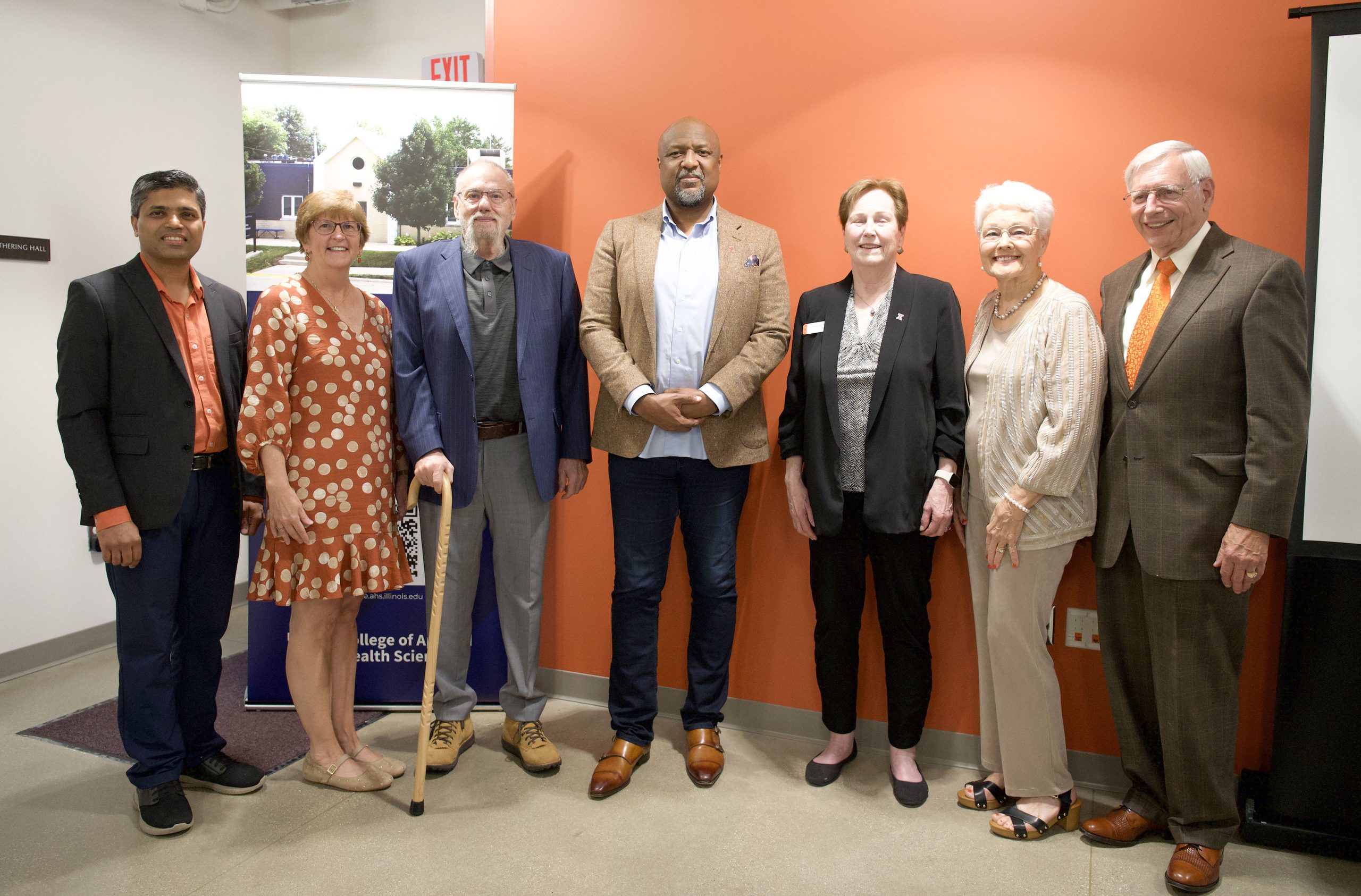
Julie and Rainer Martens pose at a recent reception at the College of Applied Health Sciences. (Photo by Jerry Thompson)
University of Illinois alums Rainer and Julie Martens are retired, but they can hardly stay still.
From their current home base of Ormond Beach, Florida, the pair have stayed busy building out Pictona, a $16 million pickleball facility in Holly Hill with more than 1,400 members that hosts major U.S. tournaments.
In their free time, the couple travels to remote locations across the globe together and documents their expeditions. In a recent visit to the Galapagos Islands, Rainer’s photography and Julie’s videography paired nicely.
“We make a pretty good team,” said Rainer, 81, who taught sports psychology in the Illinois Department of Physical Education for 16 years.
Through all their travels, the Martens say the University of Illinois has continued to hold a special place in their hearts. Giving back to the institution that helped launch their careers—now the Department of Kinesiology and Community Health at the College of Applied Health Sciences—made all the sense in the world.
Together, they’ve created the Rainer and Julie Martens Physical Activity Endowment Fund, a $2 million joint gift that will fund $80,000 in annual scholarships for KCH graduate students in perpetuity. The gift will convey to the department upon the Martens’ passing.
“Both of us were fortunate that when we finished our degree, we were not burdened by having to pay back loans,” said Julie, 74. “It makes life much easier. Then you can concentrate on what it is that your goal was and not have to worry about paying back a lot of money.”
The Martens’ message to future recipients: “simply, is ‘do good,’” Rainer said. They want new students to be able to afford the same scholarly path they once took.
“The difference this will make for some students is profound,” AHS Dean Cheryl Hanley-Maxwell said. “Both Rainer and Julie will live on in the students who are funded through their gift, they will continue to affect the health and wellness of communities and individuals in ways that are yet to be told.”
Illinois laid a foundation for much of their early career success. Julie arrived at Illinois after completing her master’s at the University of Washington and obtained her doctorate in sports psychology in 1977, with Rainer as her advisor. Rainer obtained his Ph.D. from the U. of I. in 1968 and began his tenure as a research professor in sports psychology.
Their lives both changed after Rainer founded the publishing company Human Kinetics in 1974 with his first wife, Marilyn, who passed away in 1991. Julie was the first employee of the publisher of books and journals in the physical activity field; Human Kinetics had swelled into a 300-person staff by the time she retired as its executive vice president in 2009.
“I was fortunate to make lots of connections around the world in our field and the related exercise sciences and kinesiology fields,” Rainer said. “It was those connections that really let us start Human Kinetics, and it’s been the success of Human Kinetics that has given us the wherewithal to make contributions to our universities.”
Their fondest memories in Champaign-Urbana start with the group of students they worked with. The strong cohort of kinesiology scholars was highly motivating for Rainer as a professor, and Julie as a doctoral student. They both made “lifelong friends” and collaborators working long days in the Applied Life Studies Library.
After each of them completed a day’s work, they’d make an afternoon visit to the Intramural Physical Education Building (IMPE)—the U. of I.’s previous campus recreation facility—where Rainer played handball and Julie played racquetball.
“It was a great way to end the day, I think, for the both of us,” Julie said.
A decision to give
No strangers to philanthropy, the Martens have used substantial sums to give back to the Champaign-Urbana community. It was their lead gift that helped build the $12 million Martens Center, a recreation community facility run by the Champaign Park District.
The difference this will make for some students is profound.
Cheryl Hanley-Maxwell
Dean, College of Applied Health Sciences
By last fall, the couple had made clear that they were set on helping the Department of Kinesiology and Community Health in some way. The College of AHS staff and advancement team made it “pleasant to do so,” Rainer said, including Jean Driscoll, who they called a “terrific representative” of the college and university.
“They made it very clear that they were totally open to whatever, however we wanted to structure the gift and didn’t ever try to direct us in a particular direction,” Julie said. The Martens are both lifelong athletes, and Julie—a former tennis player—caught the pickleball bug around 2011. Driscoll and Dean Hanley-Maxwell recently visited them in Florida and got a free pickleball lesson from the couple on one of their own Pictona courts. “They’ve got potential”, Rainer said.
Julie and Rainer visited campus earlier this month in a reception celebrating their estate gift, where they got to speak with faculty and graduate students whose shoes they were in decades ago.
“It has been a true pleasure to communicate with Rainer and Julie through the course of this agreement,” said KCH Department Head Kim Graber. “They are kind, intelligent, and captivating individuals, and they have left an indelible footprint on the history of our department.”
In the meantime, the couple is heading to Svalbard, an archipelago of Norway that’s one of the northernmost inhabited areas in the world. They plan to photograph polar bears and other wildlife there in the summer before making another trip to South Africa in September.
And they recently announced their plan to hand the reins of the Pictona pickleball facility to new leadership by the end of the year.
“One of the things that we’re really proud of here is having had a career in physical activity and made it part of our personal life as well is that here we get to witness, every day, people enjoying physical activity in the form of pickleball,” Rainer said.
“We’re looking at the future and trying to find the right personnel to replace us as we look at doing more travel, more photography, and actually getting to play pickleball more.”
HK Department Head and Professor Kim Graber took over in January as president of the American Kinesiology Association. Graber replaces Auburn Professor Jared Russell, while Utah Professor Tim Brusseau takes over as president-elect.
Hallal receives APHA honor
Pedro Hallal
Pedro Hallal, the Alvin and Ruth Sandall professor of kinesiology and director of the Master of Public Health program in the College of Applied Health Sciences, received the 2023 David P. Rall Award for Advocacy in Public Health for his COVID-19 research and public health messaging in the face of political opposition. Hallal developed the EPICOVID-19 project, which tracked the spread of COVID-19 across Brazil and uncovered racial health disparities that were regularly dismissed by then-Brazilian President Jair Bolsonaro. Hallal shared Brazil’s COVID-19 health data with the world despite threats to his livelihood and well-being from the Brazilian government.
Kevin Richards wins AERA award
HK Associate Professor Kevin Richards was selected as the recipient of the 2024 Catherine D. Ennis Scholar Award for the AERA SIG 93. This award is designed to recognize an outstanding scholar in the field of learning and instruction in physical education.
VanHoutan chosen for SHAPE honor
Kinesiology major Emma VanHoutan was selected to receive the SHAPE America Major of the Year award. The award is given annually to one outstanding undergraduate student in the field of health, physical education, recreation and/or dance. VanHoutan plans to graduate with a bachelor’s degree in 2024.
Strittmatter selected for AIESEP award
HK doctoral candidate Gabrielle Strittmater was selected as one of 21 doctoral students from around the world, and one of only three from the United States, to attend an international doctoral “summer school.” The summer school will provide time to interact with other doctoral students and faculty members while delving into topics of interest for aspiring researchers. The event will take place during the AIESEP conference this summer in Finland.
The University of Illinois at Urbana-Champaign’s College of Applied Health Sciences is proud to announce a significant milestone in its ongoing commitment to advancing health sciences education and research. Effective Aug. 16, the Department of Kinesiology and Community Health will officially change its name to the Department of Health and Kinesiology.
The new name better reflects significant changes in our disciplines, research interests, and educational mission. Health and Kinesiology allows for a broader, more inclusive representation of a department that focuses on multiple aspects of health and physical activity in a diverse society. It also honors our legacy as leaders in the field of health and kinesiology, while pointing the way forward to a future that is both dynamic and innovative.
The name change was a decision that was made based on goals highlighted in the KCH Strategic Plan and upon the recommendation of the KCH Restructuring Task Force. It was supported by multiple stakeholders and was recently approved by the College of Applied Health Sciences, UIUC Senate, and Board of Trustees.
Cheryl Hanley-Maxwell, dean of the College of Applied Health Sciences, expressed enthusiasm about the department’s name change, saying, “The renaming of our department to Health and Kinesiology aligns with our strategic vision of fostering interdisciplinary collaboration and addressing the multifaceted aspects of health and wellness. This change reflects our commitment to providing innovative education, conducting impactful research, and serving our communities.”
HK Department Head Kim Graber said, “As the department evolves to better reflect the dynamic landscape of health and movement sciences, we believe the change to Health and Kinesiology not only embraces our commitment to comprehensive wellness but also underscores our dedication to advancing research, education and outreach in these vital areas.”
The Department of Health and Kinesiology offers a wide range of undergraduate, graduate and doctoral programs aimed at preparing students for careers in health promotion, exercise science, public health, rehabilitation, and related fields. With world-class faculty and state-of-the-art facilities, the department equips students with the knowledge, skills, and practical experience needed to excel in diverse healthcare settings.
The Lifetime Fitness Program sports an eight-decade history at the University of Illinois of helping adults ages 55 and older stay fit
Members of the Lifetime Fitness Program swing medicine balls overhead for an upper body exercise. Classes in the spring and fall terms are hosted at the Campus Recreation Center East in Urbana. (Photo provided)
It’s 7:30 a.m. at Campus Recreation Center East on the campus of the University of Illinois Urbana-Champaign, and Charmaine Young swings a 10-pound exercise ball around her head before lowering to the exercise mat for a “Superman” pose, which works her back muscles.
Young is 86 years old, but you’d never guess it based on how she moves in the Lifetime Fitness Program, the five-day-a-week group exercise class run by the Department of Kinesiology and Community Health. She’s been returning to the class each semester for nearly 38 years.
“I live alone, and outside of a log or a tree limb, I can pick up whatever I need,” Young said. “The [Lifetime Fitness Program] is such a part of me, it’s hard to take it apart.”
The Lifetime Fitness Program, “LFP” for short, sports an eight-decade history at the University of Illinois of helping adults ages 55 and older stay fit, while supporting the college’s research goals.
The program recently changed hands after longtime KCH Professor Ken Wilund, who ran LFP for more than a decade, left for the University of Arizona.
But Lifetime Fitness quickly found fresh legs under it, with two first-year faculty at the College of Applied Health Sciences at the helm: KCH Assistant Professors Jack Senefeld and Emerson Sebastião.
“[Wilund] was looking for someone else to sort of liven up the program,” Senefeld said. “He asked Emerson and I if we would be involved, and we both excitedly said yes.”
Of course, the program didn’t just “fall in their laps,” Sebastião said. Both faculty have research bona fides in exercise science, especially for older adults.
What they’ve quickly discovered is a fitness group brimming with devotees, many of whom have been coming back to the weekday classes for decades. And there’s room for more.
“COVID was not a fun time for society, and a lot of community-based, physical activity-based programs had really dwindling communities,” Senefeld said. “Our goal has been to promote the program and increase the number of people that know about it, because the people who know about it, love it.”
While the pair of faculty members administer the program and oversee its research, the 7 a.m. to 8:30 a.m. weekday classes are run by undergraduate students for class credit and supervised by graduate students Ashley Morgan and Kaitlyn Pawelczyk. Sebastião, like Wilund before him, still attends a couple of sessions each week.
“Having this close connection, being able to work with the older adults, it’s good to be around them. It’s fun—it helps me in other areas as well,” he said. “Talking about building community, I think it’s important to be there, show our faces.”
LFP is a community unto itself. Each class radiates positivity, even in those early mornings.
“That’s an awesome part of the Lifetime Fitness Program, the social, community aspect of it. Not even just for the members, it’s even been like that for me,” said Pawelczyk, a first-year grad student coordinator for the program studying Nutritional Sciences. “Everyone is so supportive, caring, invested in each other’s lives from an exercise standpoint and from an intentional standpoint. Everyone wants to know how everyone is doing and support them.”
A reservoir for research
The year was 2009, and Sandy Goss Lucas had recently retired from the University of Illinois, where she directed the Introductory Psychology curriculum. A friend of hers tipped her off to a study in kinesiology, researching whether women’s weight was better controlled through diet or exercise, and Lucas decided to join.
She was put on the exercise track and found out that the regimen increased the participants’ bone density, among other positive things, she said. For her participation, she got a small payment and a free semester of the Lifetime Fitness Program.
“We were intersecting with people who were doing Lifetime Fitness anyway, so I went to see what it was all about,” she said. “And I got hooked.”
The friendly atmosphere, challenging exercises, and “phenomenal” student instructors immediately appealed to her. Lucas, now 74, has been coming back for the past 15 years.
“It’s just been one of the best experiences of my life,” she said.
Having this close connection, being able to work with the older adults, it’s good to be around them.
Emerson Sebastião
HK assistant professor
Many of Lucas’ classmates found the class in the same way, after going through a research study in the college. That’s intentional: Many KCH faculty are interested in recruiting older adults for exercise studies, but after the study elapses, older adults might not have a place to stay in touch, Sebastião said.
“This program also serves that purpose—to have a place to go after research studies are done, and then they can be integrated with that group and then start building their community and keep exercising, which is the main focus,” he said. “We want them to be long-term exercisers, not just for 12 weeks, which is normally how a study would last.”
The exercise is “vigorous,” according to 20-year LFP attendee Fran Hacker, who said the regular activity helped her recovery from cancer.
“When we’re off a week or two, I can notice the difference,” she said. But the program’s different classes—stretches in the morning, strength work, water aerobics and yoga—are designed to be functional, instructors said.
“You want to tailor the program to the fact that they are older adults. We want to be careful of balance, of the knees, obviously, but we want to make it fun,” Pawelczyk said.
The next frontier for the professors is getting new research elements off the ground, Senefeld said. Many of the adults who keep coming back to Lifetime Fitness are interested in their health; Senefeld and Sebastião are planning to implement regular assessments on various fitness metrics, from strength and aerobic capacity to walking speed.
“They’re really interested to know if they’re slowing down, and so we can help them quantify that and provide that feedback and then use that to look at how does physical exercise benefit older adults,” Senefeld said.
The Lifetime Fitness team recently published a program overview in Kinesiology Review, running through the structure of the program, its physical benefits for older adults and experiential learning for the student instructors.
The group’s social ties have kept the cohort going strong, even through the COVID-19 pandemic. When classes were canceled in early 2020, a group of exercisers began meeting at West Side Park for spaced-out, masked-up outdoor yoga. The tradition of meeting on weekends has kept up ever since, said Mike Sims, an 11-year participant in LFP.
“We text each other and meet on Saturdays and sometimes go out for coffee and watch movies after that,” Sims said. “The [social aspect] opens up a whole atmosphere bigger than just exercising.”
Just three weeks after a knee replacement surgery, Lucas was back in class stretching with the rest of the cohort. Her classmates and the student instructors were, as always, ready to welcome her back.
“We’re a very close group, right now we have people going through breast cancer, ovarian cancer, chemo. People have gone through all kinds of things, we take a meal, we stay in touch, we check up on each other,” she said.
“I just feel very, very strongly that this group has kept me sane.”
(Members of the Lifetime Fitness Program pay $30 a month for full membership. Summer classes run until August 11, MWF from 8-9 a.m. at Freer Hall. Fall classes will resume Monday-Friday at CRCE on August 28).
Research project will culminate in a live culinary workshop for local retirement community
ClarkLindsey’s executive chef, DeAngelo Newson, presents a special Hanukkah dinner for residents: beef brisket with latkes and sufganiyot. In 2025, ClarkLindsey food personnel will test out culturally diverse seasonings as part of a KCH research project.
For many older adults from diverse cultural backgrounds, reluctance to enroll in long-term care facilities may start in the cafeteria.
Mina Raj, an assistant professor in the Department of Kinesiology and Community Health at the University of Illinois Urbana-Champaign, surveyed 140 Asian American family caregivers and found that one of the biggest obstacles for their relatives living in long-term care is the lack of culturally relevant food options.
An upcoming research project from Raj and her team will put an international range of seasonings to the test at an eager local retirement community.
Raj will organize a live culinary workshop at ClarkLindsey, a retirement community in Urbana. The workshop is aimed at educating ClarkLindsey’s food personnel how to incorporate culturally diverse seasonings (i.e., herbs or spices) into common dishes. Afterwards, personnel and residents will learn about the seasonings and taste the modified meals for themselves.
“I realized I need one place that is willing to work with us,” Raj said. “If you can build evidence in one place and show something works, you can have that data to start convincing others a model like this could work.”
The hope, Raj said, is the workshop will provide some proof of concept for other long-term care facilities that are trying to enroll a more diverse clientele, while potentially reducing food waste and promoting cultural inclusivity.
The study is funded by a two-year grant from the McCormick Science Institute, which sponsors research on the health effects of culinary herbs and spices. The population at ClarkLindsey, with its longstanding research connections with the College of Applied Health Sciences and Illinois at large, is ready and willing to participate.
“As people grow older, often the dining experience is the highlight of their day, having good food with good community and good conversation,” said Laura Edwards, vice president of strategy & innovation at the nonprofit retirement home. “I’m really excited to see where this goes.”
A logical connection
When she began exploring the topic with registered dietitians and food service directors in long-term care facilities in a project funded by the Center on Health, Aging, and Disability, Raj met some resistance to the idea of incorporating a more diverse set of ingredients into LTC menus.
Professionals she surveyed worried that lack of cultural knowledge among their food personnel and the cost of ingredients would pose significant barriers to a culinary revamp, especially if their resident populations were majority White and most familiar with American/Western cuisine.
However, the consequences of excluding dietary desires of culturally diverse older adults could be wide ranging, Raj posits. Many populations of these cultures will need significant institutional care in the coming decades, and refusal to eat the food at long-term care facilities could lead to negative health outcomes, including frailty. This can often place substantial additional demands on their family members to prepare and deliver meals.
A leading candidate for collaboration emerged just across town. The College of AHS’ Wendy Bartlo, assistant director of strategic initiatives and research relations, serves on ClarkLindsey’s board. She connected Raj with Edwards, who organizes research opportunities at the nonprofit retirement home.
As people grow older, often the dining experience is the highlight of their day, having good food with good community and good conversation. I’m really excited to see where this goes.”
Laura Edwards
Vice president of strategy & innovation at ClarkLindsey.
Edwards, an AHS alumna who obtained her B.S. in Community Health in 2012, began working at ClarkLindsey as an intern just before graduating. She’s seen the frequent research collaborations with College of AHS and Illinois led by an astute, participatory resident population, and this project fit the bill perfectly.
“Whenever we hear about interesting research that could benefit the lives of older adults, we are very interested to know more, because it’s our mission to ensure older adults can live their best lives,” Edwards said.
According to recent data, most ClarkLindsey residents are connected to the university in some way. In 2018, 42 percent of them were Illinois alumni and 57 percent were current faculty or emeriti. More than a quarter of the near-300 residents had reportedly participated in Illinois research.
“If there’s an opportunity to participate in research, our residents are very eager to get involved,” Edwards said. “Why these projects are so successful is these [professors] feel like they’re defending their dissertation again, because they’re getting questions right and left.”
ClarkLindsey’s executive chef, DeAngelo Newson, already experiments with cross-cultural dishes with his staff. Residents usually choose between a traditional “option A” for dinner or a more adventurous “option B”— recent examples include Indian cuisine, oxtail, and Hanukkah-themed latkes and sufganiyot.
“I anticipate it being a popular and exciting experience for our residents and for our staff as well,” Edwards said.
The plan
This year, Raj and her team, including her doctoral student Ammarah Mashhood and undergraduates Sabeen Sadruddin and Harshita Varanasi, will conduct another nationwide survey of dietitians and food service personnel working in long-term care to understand their awareness of culturally diverse seasonings and ability to prepare meals with those ingredients in mind.
In 2025, planning for the workshop will commence.
In the current agenda, ClarkLindsey food personnel will be treated to an educational session on the use and history of the seasonings on day one of the workshop delivered by chefs from the McCormick Science Institute. Then, they’ll witness two demonstrations from South Asian and Hispanic/Latin American dietitians on culturally tailored meals that are both diabetes-friendly and heart-healthy, followed by taste panels and acceptability surveys.
(Luis Gutierrez-Munoz, a nutritional sciences master’s student, will help develop these specialized recipes.)
The meals will include common vegetables and culinary staples such as green beans, potatoes and rice, prepared and seasoned in different ways, Raj said. She’s particularly excited to see how personnel and residents respond to the educational part of the exercise, and whether their cultural awareness shifts after the workshop.
“We want to emphasize the “why” in this workshop. Most trainings on diverse cultures focus on the “what,” but when it comes to food every culture has a rich history of culinary traditions and norms. Teaching about, and ultimately incorporating culturally diverse seasonings, could present a meaningful, and low-cost, approach to raising awareness among staff and sense of belonging for our diverse older adults,” Raj said.