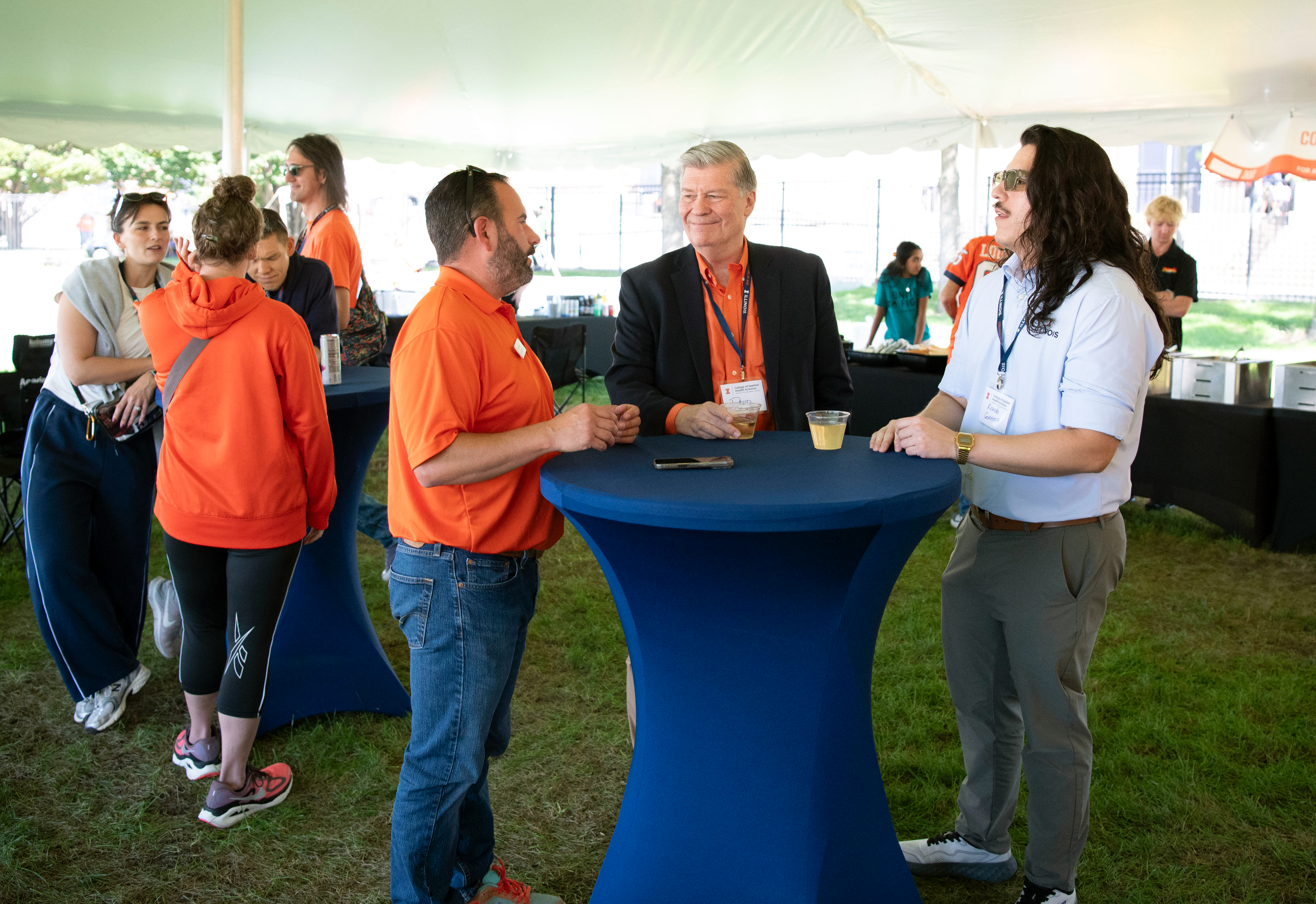
AHS students present diverse projects for Undergrad Research Week


Kinesiology juniors Elizabeth Martinez (center) and Aubrey Cervantes (left) present their research at the AHS Undergrad Research Expo on April 24, 2024. (Photo: Ethan Simmons)

For a freshman at the College of Applied Health Sciences, Saiesha Bollapragada’s research portfolio is impressive. 

At last week’s Undergraduate Research Symposium, the I-Health major got to present the results from her first research project, “Public Health Preparedness Among UIUC Students During Extreme Heat Conditions,” where she examined students’ awareness and handling of severe heat in the spring semester. 

She completed her study with a push from Students Pursuing Applications, Research and Knowledge, or SPARK, an AHS program that jump-starts incoming undergraduate students research experiences by pairing them with professors in the college. Bollapragada was placed with Recreation, Sport, and Tourism Associate Professor Mariela Fernandez, whose experience with urban environmental injustices fit her research topic perfectly. 

“Professor Fernandez motivated me to start this project on my own,” Bollapragada said. “There’s a lot more reading involved than I thought there was, it was a lot of work preparing for the symposium, but if it’s something you’re interested in it’s a fun process.” 

Students, faculty and staff got a taste of the findings from AHS’ budding student researchers during the AHS Undergraduate Research Expo at Huff Hall on Wednesday, April 24, where a roster of undergraduates gave poster presentations on a diverse range of research topics.
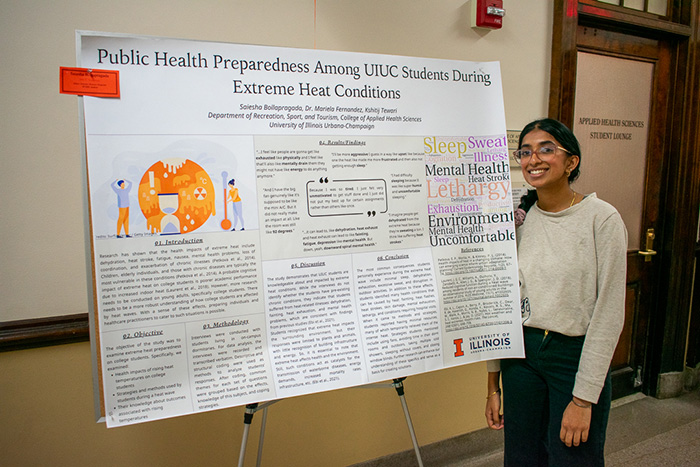
An AHS freshman smiles next to her research poster

Many students spearheaded their own research projects with significant support and guidance from faculty and graduate students. Others, like a group of Speech and Hearing Science students from the Intellectual DisAbilities Communication Lab led by Associate Professor Marie Moore Channell, provided updates on long-range research projects they’ve assisted with on campus. 

Three SHS seniors, Emma Mueller, Abigail Keasler and Liz Gremer, presented initial findings from their glimpse into the Speech Accessibility Project, an ongoing research endeavor looking to make voice recognition software—such as Apple’s Siri or Amazon’s Alexa—more accessible for people with different speech patterns.

Each of the students has helped recruit participants with Down syndrome or aided vocal transcriptions from the samples they’ve collected. Under the leadership of Channell, the lab hopes to collect 240,000 voice samples from 400 participants. 

“Our poster looked into the recruiting process with that population and took a look at patterns of articulation differences exhibited by individuals with Down syndrome,” said Mueller, who transcribed vocal samples for the project. 

All three of the students met in Channell’s lab, and immediately found research responsibilities once the Down syndrome portion of the project came under Channell’s purview. 

“It’s been very rewarding, very interesting and very impactful,” Keasler said. “A lot of families in meetings or over the phone say, ‘Siri doesn’t really understand what we’re trying to say,’ so this is very important and I can’t wait to see the results of it.” 

Coming to a project affiliated with SHS with “so much publicity and so much money coming in is encouraging,” said Gremer, who has helped recruit participants and set up their first meetings for collecting voice samples. 
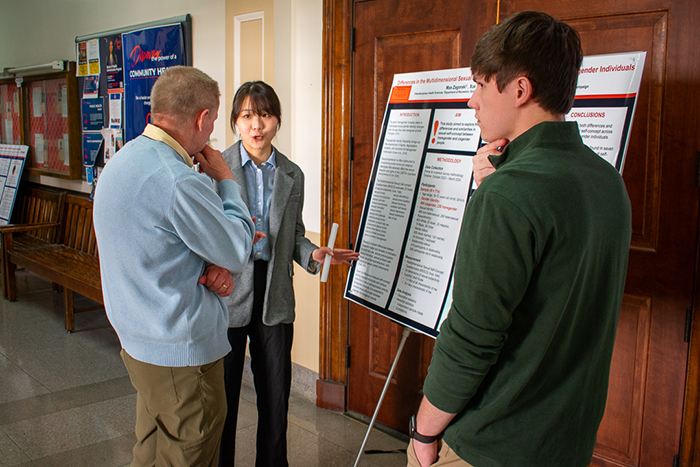
A man in a blue sweater listens to students give a research poster presentation.

AHS student programs, such as the first-generation focused Mannie L. Jackson Illinois Academic Enrichment and Leadership Program (I-LEAP), were well represented in the research symposium. I-LEAP juniors Elizabeth Martinez and Aubrey Cervantes, both studying kinesiology, brought results from their research collaboration on high-intensity interval training. 

Working within KCH Professor Steve Petruzzello’s Exercise Psychophysiology Lab, the pair analyzed 25 participants’ emotional responses to high-intensity exercise, compared with their scores and symptoms of several mental health qualities: namely anxiety, depression and neuroticism. 

“We were looking at exercise adherence—how can we get more people to get more active—and we were really interested in HIIT exercise, so we put it all together in one research project,” Cervantes said. 

What they found: Participants with more symptoms of depression reported more negative affect responses during the HIIT exercise, while anxiety and neuroticism didn’t show significant predictive power, they said.

“This is my first hands-on [study] that I can call my own and Aubrey’s,” said Martinez, who’s applying to physical therapy schools. “My favorite part is meeting with the participants. It’s so fun getting to know everyone, even if there’s a lot more hours behind the desk just plugging and chugging data.” 

Editor’s note:

To reach Ethan Simmons, email ecsimmon@illinois.edu
 

Related news


Outdoor Recreation Consortium: An RST trip to the Smokies—for class credit


Assistant Professor Nick Pitas (first row on left) poses with RST 199 students at the Great Smoky Mountains Institute in Tennessee.

Kiara Frausto thinks she might’ve been “kind of spoiled” in her first visit to a national park. 

That’s because the University of Illinois junior was treated to a week full of hands-dirty field research at the Great Smoky Mountains Institute—where students banded birds, caught salamanders and listened to Appalachian folk stories—and it all counted for course credit. 

“It’s probably going to be hard to beat this one,” Frausto said. “Now I want to see all the other national parks.” 

Buses full of students from seven universities rolled into the Great Smoky Mountains Institute at Tremont in Tennessee just after spring break, ready for a week of experiential learning in the country’s most visited national park. 

For the first time in more than a decade, University of Illinois students got to join the group, known as the Outdoor Recreation Consortium. The roster of involved universities has shifted over the years; Illinois dropped out years ago without a faculty member to run the trip. 

But now, with second-year Recreation, Sport and Tourism Assistant Professor Nick Pitas at the helm, Illinois has returned to the fold. 

This year, nine students took the eight-week RST 199 course: Outdoor Recreation Consortium, which culminated in a six-day stayaway visit to the Smokies. 

Students and faculty from six other schools took part this year, including Penn State University, North Carolina State, East Carolina, University of Missouri, Texas A&M and Western Illinois.

Pitas is well-traveled alumnus of the course, which has been around in some form for 46 years. He enrolled and visited the Smokies while he was a student at Penn State, then rejoined the trip as a teaching assistant—twice—before eventually teaching it as a faculty member. 

“This was my fifth time going,” Pitas said. “But first time as a faculty here at Illinois.” 

What kept him returning to the trip were the rich, hands-on experiences that embodied all the concepts the course had prepared them for. Once in the Smokies, students hear from real National Park Service rangers and administrators, natural resource scientists and community partners, all while assisting them with field research data collection. 

At Illinois, RST 199’s eight week were spent introducing students to the operations of a national park, through its history and cultural context, the wide biodiversity in the region, and the management of the park’s record visitor numbers. Students also broke off into “committees” to help organize the trip, from transportation logistics all the way to morale-boosting exercises. 

“From a professional standpoint, I think it opens their eyes, hopefully, to the breadth of opportunities that are available in the outdoor recreation, natural resource, and tourism space,” Pitas said. “But the bulk of the learning is when we’re there. It’s like going to summer camp except with an extra learning component baked into it.” 

Michela Ossola, a senior in natural resources and environmental sciences at ACES, helped map the ideal driving route to the Tremont Institute in Blount County, Tennessee. Once there, daily trips to the forest and engaging learning sessions kept the time flying by.

“It’s a week detox of being off your phone, and every evening we’d have people come by, folk storytellers, folk music, a bear caller. A lot of those things you don’t get for free these days,” Ossola said. “It’s definitely a highlight in the four years I’ve gone to U of I.” 

Many of the students this year, like Ossola and Frausto, came from the College of ACES. Undergrad students in the college are required to complete a field experience before they graduate. 

But Pitas would like to grow the number of Applied Health Sciences students who come through the class, like Genna Peters, a junior in RST who’s interested in pursuing an outdoor recreation career post-graduation. 

Peters loved getting to know the professionals from the Appalachia area, like a park ranger who was enrolled in the Western Cherokee tribe and mingling with students from all the other universities. 

“The biggest experience for me being around all these other people my age who shared in the same interest and wanted to go into the same field as me,” she said. “It was really cool to know this park has this giant history of all these different people who work there, but they also really truly treasure the culture and history of the park itself.” 

As much as the field knowledge broadens horizons for the students who go, Pitas knows the relationships they build are just as important. 

“It’s not always the case that an adult has a chance to have a camp experience and just go and be with people they know and people they don’t know, and have that of connection and experience together,” Pitas said. 

“I feel very lucky to have the chance to do it, would be my overarching feeling this semester. This is awesome. Can’t believe I get to do this for work.” 

Editor’s note:

To reach Ethan Simmons, email ecsimmon@illinois.edu.
 

Share on social

Related news

DRES alum’s posthumous gift takes spotlight: ‘I don’t think she ever forgot her debt’


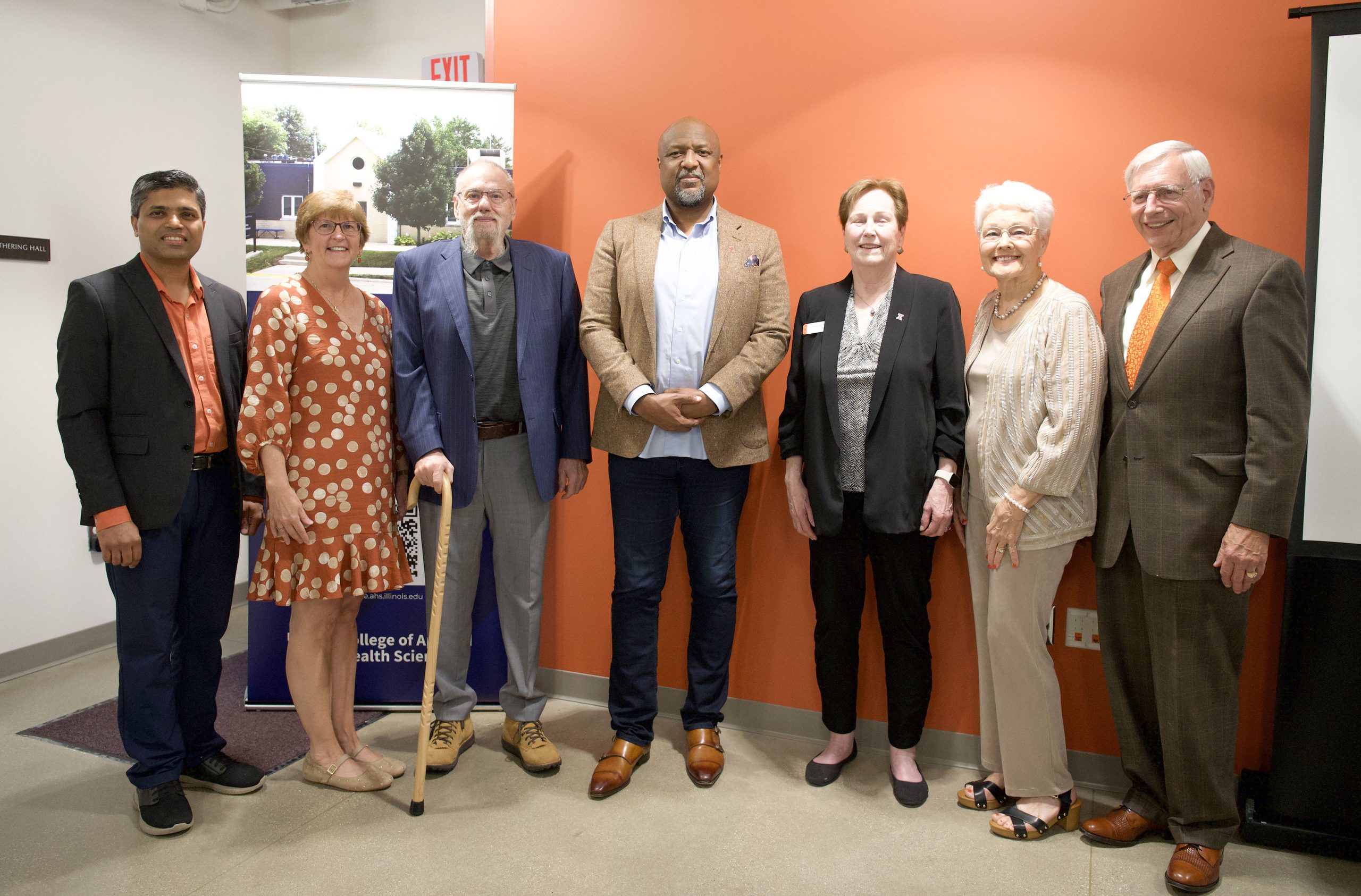
The family of Susan J. Chaplinsky sits on her memorial bench in the center of the Disability Resources and Educational Services building. Her siblings Kathy, Amy, Molly and Pete sat with her plaque. (Photo by Ethan Simmons)

To honor their sister’s time at the University of Illinois, the siblings of Susan Jane Chaplinsky thought a memorial bench in the open-air plaza of Disability Resources and Educational Services would be a fitting tribute. 

Because the work of DRES was a big part of what propelled Chaplinsky, living with juvenile rheumatoid arthritis, to become an acclaimed business scholar and beloved instructor. She said so herself.  

“[DRES at Illinois] … put me on a path to achieve the professional success I have attained over the course of my life,” Chaplinsky wrote in her will. “It remains a unique institution for students with disabilities to level the inequities caused by life and health and allows them to achieve a measure of success.  I would be proud to have my name associated with an institution with these goals and aspirations.”

Upon her passing in November 2022, Chaplinsky dedicated a substantial portion of her wealth to the DRES: A $3.4 million estate gift which will support two endowment funds for Illinois students with disabilities. 

The family got to witness the memorial for Chaplinsky at the DRES 75th Anniversary Open House on April 19, surrounded by staff, alumni and visitors. College of Applied Health Sciences Dean Cheryl Hanley-Maxwell gave thanks to the family and to Chaplinsky for her generosity. 

”It’s going to change much of what we can do here at DRES, I can’t thank you guys enough for being willing to be here with us today to celebrate Susan’s commitment to us,” Hanley-Maxwell said. “Susan is an example of many students who have graduated from the University of Illinois who look back on DRES and say, ‘If it weren’t for DRES, I don’t know what I would have done.’” 

‘A lifeline’

Chaplinsky graduated from Illinois in 1975 with her bachelor’s in economics. She went a couple hours north to obtain her MBA and a Ph.D. in Economics from the University of Chicago. 

What followed was a stellar academic and teaching career, where Chaplinsky taught finance at the University of Michigan, Northwestern University, and eventually the University of Virginia’s Darden School of Business, where she spent her final 28 years. 

But with her early obstacles, she charted a course her family could’ve never foreseen.  

In sixth grade, Chaplinsky was diagnosed with a severe form of juvenile rheumatoid arthritis. In a matter of months, Chaplinsky went from being an active, able-bodied preteen to needing a wheelchair to get around day to day. 

Growing up in Palatine, Illinois, a village 30 miles northwest of Chicago, Susan’s sister Kathy would bring her lunches during high school, since Susan couldn’t access the cafeteria with her wheelchair. As Chaplinsky confronted her new health challenges, others began to place unfair limits on her abilities. 

“My sister was always very smart, brilliant, but there was no guidance counselor encouraging her to look at colleges,” Kathy Arter said. 

“Then our parents learned about the program at Illinois, and it was just like a lifeline to them. There was a place that not only could accommodate her, but they wanted her there.”

Illinois, with its wheelchair accessible campus and the Division of Rehabilitation Education Services led by director Tim Nugent, was an opportunity too promising to pass up. After being accepted onto campus, Chaplinsky’s life and confidence transformed, her siblings said. 

Every time they’d visit her at Allen Hall, she was surrounded by friends, going out to bars or movie showings on campus, living a regular student’s life.  

But she took her studies seriously, and Nugent played a hand in that. Chaplinsky “talked a lot about Nugent,” Arter said; he was demanding, and held high expectations for the students he worked with. 

“Some of that, with Susan, she left here with that: ‘They expect me to go on and be a success, I won’t disappoint them,’” Arter said. “I don’t think Susan ever forgot her debt to the university, for that opportunity.” 

An outpouring of support flowed from the UVA campus after Chaplinsky’s passing. Her siblings didn’t always get to see the teaching side of Susan; a memorial event they attended allowed them to see a new side of their sister. 

“The great passion of her life was teaching,” said her sister, Amy Meehan. “She was interested in students, she always rooted for the underdog. She just views this gift as an extension of that: ‘I can help for years to come.’” 

Plenty of the traits they knew well—Chaplinsky’s sports fandom and dry humor, for example—also shined through in their remembrances. 

“She’s funny, she’s brilliant,” sister Molly Gillis said. “I think about all the time, her footprint is ginormous when she had so many things that could’ve limited her reach and they didn’t.” 

The siblings and extended family made a big showing at the DRES Open House. They gratefully packed in around their sister’s newly arrived memorial bench and posed for pictures in the cool spring weather. 

“Maybe somebody sees that bench, and it gives them the confidence, the energy to go forward, to dream big, and to do something they didn’t think they could do,” brother Pete Chaplinsky said. 

Editor’s note:

To reach Ethan Simmons, email ecsimmon@illinois.edu.
 

Related news

AHS Get to Know: Laura Mattie, Ph.D.


Photo by caption

How would you describe your primary research interests? 

My primary research interest is learning how young children with neurodevelopmental disabilities develop early social and communication skills to inform parent-implemented early language interventions.

Why did you decide to apply to work at Illinois?

I applied to Illinois because it was one of the only job postings that targeted expertise in children with disabilities and family well-being, which signified that my work was already valued.

What are you working on right now? 

I have 4 main projects right now: 

  • The Power of the Point Project focuses on the predictors of early language development in toddlers with Down syndrome and fragile X syndrome.
  • ASD Screening Tools in Down Syndrome is a large-scale survey of caregivers of individuals 6-18 years old that aims to determine how to best use autism screening tools for this population.
  • The Speech Accessibility Project aims to make voice recognition technology useful for individuals who may have diverse speech patterns and disabilities, including people with Down syndrome.
  • A Foundational Study of Adaptive Behaviors in Individuals with Down Syndrome is a survey of caregivers to learn about the practical, conceptual, and social skills used in everyday life by their children with Down syndrome who are between birth to 22 years old.

What’s a fun fact you’d like to share about yourself? 

I am a twin mom to 15-month-old girls, so much of my free time is chasing after them! When I do have some down time, I enjoy rewatching TV shows like “The Office” and “Parks & Recreation,” reading, and snuggling with our dogs.

Editor’s note:

To reach Ethan Simmons, email ecsimmon@illinois.edu.
 

Related news


College of Applied Health Sciences
110 Huff Hall
1206 South 4th Street
Champaign, IL 61820
(217) 333-2131