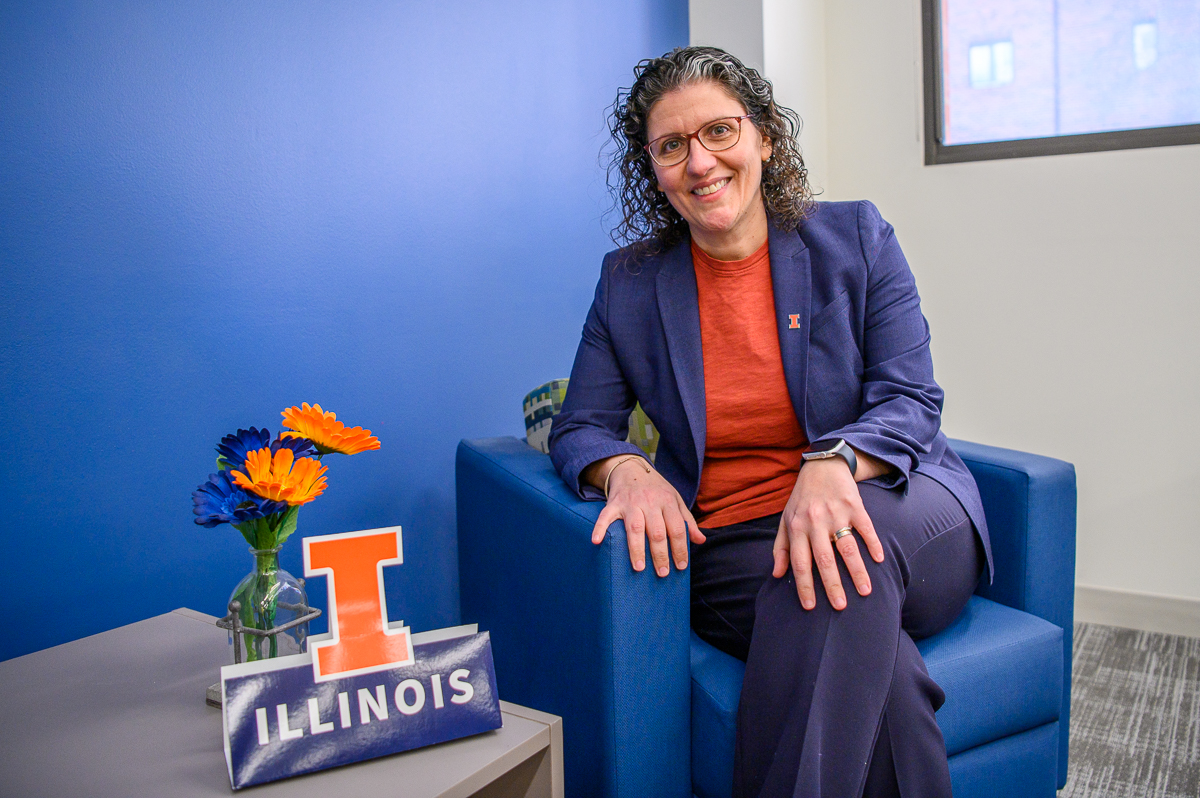
Georgia Malandraki’s First 100 Days
May 15, 2026 | Laura Payne
The Office of Recreation and Park Resources is making tangible impacts for communities and nonprofits

On any given day, a graduate student at the University of Illinois Urbana-Champaign might be found leading a focus group in a small Illinois town, presenting data to local officials or helping design the future of a community park. It’s not a simulation—it’s real work with real impact, made possible by the Office of Recreation and Park Resources.
Since its founding in the mid-1960s by Joseph Bannon, Ph.D., ORPR—which is affiliated with the Department of Recreation, Sport and Tourism in the College of Applied Health Sciences at Illinois—has been guided by a simple but powerful vision: connect research to real-world practice while strengthening communities through parks and recreation. Decades later, that vision is not only alive: it’s expanding to enhance ORPR’s reach and impacts.
In recent years, ORPR has worked with more than 20 community and nonprofit organizations, helping them tackle challenges ranging from facility planning to capacity building toward helping communities enhance their health and quality of life for their residents. At the heart of this work is a commitment to service, education and collaboration.
“We take our lead from the communities, as they are experts of their own communities and we partner with them on their projects,” said Laura Payne, director of ORPR. “Students gain hands-on experience while helping organizations make meaningful, data-informed decisions.”
That hands-on experience is transformative. Students don’t just learn theory; they conduct focus groups, analyze survey data and present recommendations to real clients. For many, it becomes a defining part of their professional journey.
“The experience I gained with ORPR helped my application stand out,” said Aaron Hoyle-Katz, a recent master’s graduate who secured a park planner position with the Champaign County Forest Preserve District. “I wasn’t just learning about planning—I was doing it.”
ORPR’s impact extends far beyond the classroom. In Naperville, a needs assessment conducted by ORPR revealed strong demand for a multipurpose recreation facility—insight that guided efforts to secure funding for a new community activity center and to acquire additional land to preserve, restore and maintain parks and extend multiuse trails. In the village of Brookfield, feasibility studies are shaping the future of local multipurpose community recreation spaces.

Perhaps one of the most compelling examples comes from the village of Crete. There, ORPR partnered with multiple municipal agencies to conduct a comprehensive community needs assessment. Through shared planning workshop sessions, the Park District, Library District, Village and Township aligned around common goals.
The results were tangible. Community feedback highlighted priorities such as expanded bike infrastructure, more youth and adult programming and the need for a central gathering space. Since the project concluded, Crete has already acted, purchasing and transforming a building into a community center.
For students, projects such as these often evolve into deeper research opportunities. Hoyle-Katz, for example, conducted his thesis research on trail development in Crete, uncovering both community concerns and opportunities for collaboration. Another graduate student, Ryan McGrath, partnered with the Illinois Park and Recreation Association to study how agencies responded to the COVID-19 pandemic—work that now helps guide future resilience planning.
ORPR’s reach also extends into the classroom. Through partnerships with courses such as the Community and Open Space Design Studio in the Department of Landscape Architecture, students collaborate directly with municipalities such as Rock Island, helping reimagine parks such as Mel McKay Park while gaining invaluable design and planning experience.
Looking ahead, ORPR continues to push the boundaries of research and practice. In collaboration with the Rails-to-Trails Conservancy, the team is assessing research on the economic, social and health outcomes of trails to assist in developing an impact calculator that will help communities demonstrate the return on investment in multiuse trails. They are also working on initiatives to position parks and trails as solutions to social isolation and loneliness.
At its core, ORPR is more than a program—it’s a bridge. Between students, educators and professionals. Between research, education and real-world application. And between communities and the resources they need to thrive.
When students leave here, they’re not just prepared—they’re experienced. And the organizations they serve professionally and communities we work with are stronger because of it.
Editor’s note:
To reach Laura Payne, email lpayne@illinois.edu.
Share on social
May 13, 2026 | Ethan Simmons
AI could revolutionize disease prevention—but flawed data could deepen health inequalities

In the view of University of Illinois public health researcher Bruno Nunes, artificial intelligence shapes up as a potent tool to predict and prevent public health problems, such as chronic diseases.
But before AI-powered models are deployed in public health settings, they must be trained on richer data sets so they don’t amplify inequalities that exist in our healthcare system and society.
“To reach this future, we need to have better data to develop these models,” said Nunes, associate professor at the Department of Health and Kinesiology at the College of Applied Health Sciences. “Machine learning is a data learning process. It’s not just about using the fanciest algorithm—the problem is if you don’t have good data, you won’t have a good model.”
Trained as an epidemiologist, Nunes is focused on public health strategies: how to prevent chronic disease and promote positive health outcomes at the population level, in some cases before people visit the doctor’s office.
Artificial intelligence is already widely deployed in healthcare settings to better diagnose patients, especially reading medical imagery like X-rays, MRIs and CT scans.
With machine learning’s superior ability to detect patterns using huge tranches of data, Nunes envisions a future where models can accurately predict the risks of developing chronic diseases and allow populations to intervene earlier than before.
Part of this, Nunes argues, is AI may help us untangle “multimorbidity.” Many healthcare patients show up to the doctor’s office with two or more diseases, such as hypertension combined with diabetes or high cholesterol, which complicates management and quality of life.
“Our health system and services are tailored to one disease. But in most cases, especially when talking about populational aging, most people are presenting different diseases at the same time,” Nunes said. “And the worst part of that is when we aren’t able to manage this patient well because they have such complex conditions and interactions.”
His recent research has tested machine learning models on their ability to predict real-world outcomes. One recent study showed that machine learning models can predict a population’s dental service usage with solid accuracy but show poorer results with certain demographic subgroups.
Machine learning is a data learning process. It’s not just about using the fanciest algorithm—the problem is if you don’t have good data, you won’t have a good model.
Bruno Nunes
HK Associate ProfessorNunes collaborated on a study that used an AI model to predict dental service use for adults in Southern Brazil. The model used 47 different characteristics—sociodemographic data, behavioral traits and oral and general health markers—to predict whether participants went to the dentist in the past year from a cohort study in Pelotas.
Though the machine learning model’s predictions were largely accurate, it performed significantly worse across the board for mixed-race individuals in the study compared to Black and white participants, making the model unsuitable for real-world implementation in its current form.
“None of the models are perfect: they present an error rate, and we need to deal with it,” Nunes said. “But if this error rate is higher for a subgroup of the population, the subgroup may be under- or over-diagnosed.
“If the model is not so good for people who already present with historical inequalities in the health system, the model can amplify these inequalities instead of decrease them.”
Nunes tries to teach his students to frame the right questions in his new class, Artificial Intelligence in Public Health, which debuted in fall 2026 in HK.
Through critical discussions, he hopes to get students to think more about how “AI can fit into the big picture of public health,” and construct their own models around the right questions.
“In most cases we tend to develop models for disease-related consequences or for problems which we already have an effective public health strategy, for example—but what if we could create equitable models to predict the problems in advance or issues without scalable solutions?” Nunes said.
“You can’t just press a button to develop a machine learning model. You must have prior knowledge of the topic, skills and abilities to interpret the model considering public health principles. How can it be useful to solve the disease burden at the population level?”
Editor’s note:
To reach Bruno Nunes, email nunesb@illinois.edu
“Dental services use prediction among adults in Southern Brazil: A gender and racial fairness-oriented machine learning approach” is available online.
DOI: 10.1016/j.jdent.2025.105929The database is publicly available: https://dataverse.harvard.edu/dataset.xhtml?persistentId=doi:10.7910/DVN/BTLAAD
Share on social
Feb. 25, 2026
CAHME Announces the Initial Accreditation of the University of Illinois Urbana-Champaign, Master of Health Administration

The Commission on Accreditation of Healthcare Management Education (CAHME) Board of Directors approved the initial accreditation of the University of Illinois Urbana-Champaign College of Applied Health Sciences’ Master of Health Administration for a four-year term.
The accreditation affirms that the Illinois MHA program meets CAHME’s high standards for healthcare management education and demonstrates a strong commitment to academic excellence, professional preparation and continuous improvement.
“We are pleased to have the recognition of the premier accrediting body for master’s degrees in health administration,” said Lynne Barnes, clinical professor and director of the MHA program and a longtime healthcare administrator. “The requirements are rigorous and further strengthen the quality of education and number of opportunities that we are providing for our students. This distinction will allow us to continue to attract top students from across the country and internationally.”
The four-year term of accreditation marks a significant milestone for the Illinois MHA program and reinforces its commitment to educating the next generation of healthcare leaders. An online MHA degree program will launch in 2026, along with several graduate certificates that will enhance specialized training in the field.
Cheryl Hanley-Maxwell, dean of the College of Applied Health Sciences—where the MHA program is housed in the Department of Health and Kinesiology—emphasized the significance of the milestone for the university and its students.
“This accreditation reflects the dedication and collaboration of our faculty and staff in building a curriculum that prepares graduates to become highly effective healthcare management professionals,” Hanley-Maxwell said. “Our mission is to equip students with the leadership skills, analytical expertise, and ethical foundation necessary to improve healthcare delivery systems and advance health outcomes in Illinois and beyond.”
CAHME accreditation is widely recognized as the benchmark of quality in graduate healthcare management education. Programs that earn accreditation undergo an extensive self-study process and peer review to ensure alignment with standards designed to prepare graduates for leadership roles in healthcare organizations.
“CAHME’s mission is to advance the quality of healthcare management education,” said Al Faber, interim president and CEO of CAHME. “CAHME-accredited programs have successfully navigated a complex and careful accreditation process managed by experts in the study and practice of healthcare management. The program meets the rigorous standards set by leading academicians and practitioners who are experts in their fields.”
For more information, visit cahme.org.
Editor’s note:
To reach CAHME, email dalexander@cahme.org .
Share on social
July 14, 2025 | Adelyn Mui

Imagine sitting in a busy café, struggling to follow a conversation as voices and background clatter blend together. For many people with hearing loss, this is a daily challenge—yet traditional hearing tests, conducted in silent rooms with isolated tones, fail to reflect these real-world difficulties. At the University of Illinois, a team of researchers is working to bridge that gap by developing more accurate and meaningful hearing assessments that simulate everyday listening environments.
Sadie Braun, an audiologist and clinical assistant professor in the Department of Speech and Hearing Science in the College of Applied Health Sciences, is the team’s primary investigator and recently received a $30,000 pilot grant from the Center for Health, Aging, and Disability. She is working with Dan Fogerty, an SHS associate professor, on a project titled “Creation of Speech-in-Noise Profiles for Clinical Fitting of Hearing Technologies.”
The project has two goals, the first being to analyze and better understand speech-in-noise testing results from clinical environments.
“Instead of simply pressing a button when you hear a tone, we’re trying to get more out of tests that already exist which mirror real-world scenarios,” Braun said. “For example, it is fairly common now to play full sentences while background voices are talking at the same time—more like what someone might hear at a party or in a restaurant. We want to use these results to help understand the nuances in what causes understanding-in-noise difficulties on an individual basis.”
The second goal of the project goes a step further: not just measuring how many mistakes a person makes during a hearing test, but understanding what kind of mistakes—and why they happen.
“Right now, clinical hearing tests can tell you that someone misunderstood a sentence, but not how they misunderstood it,” Fogerty said. “Our approach focuses on the types of errors people make and the conditions under which those errors occur.”
By analyzing these mistakes—called error profiles—the team hopes to gain new insights into what’s actually causing the difficulty. For example, one person might confuse similar sounds, like saying “cat” instead of “cats,” which could suggest a problem with sound clarity. Another person might only repeat the second half of a sentence, pointing to a possible cognitive issue like memory or processing speed.
“We’re identifying patterns across different types of errors,” Braun said. “Then we compare those patterns with results from standard hearing tests to see if there are connections. That could help us predict which patients need which kinds of interventions.”
Data collection will begin in the fall and participants will come from patients who come to the Audiology & Speech-Language Pathology Clinic and have consented to their audio recordings being used for this study. Braun said the tests focus more on adults, primarily those in their 50s and upward.
With those error profiles, the team hopes to use those to improve hearing aid fittings and outcomes for patient satisfaction.
“Different types of errors can have different real-life consequences,” Fogerty said. “Identifying the reasons why someone misunderstands speech will help the clinician identify recommendations to address those specific difficulties.”
With support from CHAD, the pilot grant will allow Braun and Fogerty to gather foundational data, refine their testing protocols and begin developing detailed error profiles. Their ultimate goal is to translate this information into better hearing aid fittings, more accurate diagnoses and improved quality of life for patients.
Looking ahead, the team plans to apply for additional funding to expand the project and validate their findings across broader patient populations.
Braun emphasized the strength of the partnership at the core of this work.
“This is a true collaboration between research and clinical practice,” she said. “Dr. Fogerty brings deep expertise in auditory research, while I bring the day-to-day clinical experience. Together, we’re approaching the same problem from different angles—and that’s what gives this project real potential to move the field forward.”
Share on social
May 22, 2025 | Vince Lara-Cinisomo
Themes of visionary leadership and George Huff were briefly overshadowed by Grimace

The theme of the 2025 Sapora Symposium was visionary leadership, coinciding with the 100th anniversary of Huff Hall and paying tribute to the legacy of George Huff. Only one thing could potentially overshadow that, and it is purple and lovable: Grimace.
The iconic McDonald’s character—who’s ostensibly a tastebud—made his appearance during one of the final Sapora panels on March 28 at the Armory. Grimace’s appearance coincided with a panel on viral marketing. Grimace became a good luck charm for the New York Mets after throwing out the first pitch at a game in June 2024, leading to a winning streak and a purple seat dedicated to him at Citi Field.
But beside the big, purple spectacle, this year’s symposium carried greater significance as it coincided with the Huff centennial, a cornerstone of Illini academics and a testament to the university’s rich sports heritage. The event celebrated not only a century of excellence in sports and recreation but also paid tribute to the enduring legacy of George Huff, the visionary coach and administrator who transformed athletics at Illinois and beyond.
The Sapora Symposium was created and developed by the alumni advisory board of the Department of Recreation, Sport and Tourism in honor of the Department’s founder, Dr. Allen Sapora. Sapora was a cornerstone to the education and careers of many of our alumni. In recent years, the department has hosted the likes of the Stanley Cup, Governor J.B. Pritzker, Theo Epstein, and celebrated the lives of Illini legends Lou Henson, Red Grange and Theresa Grentz.
“Sapora is one of the signature components of the RST undergraduate experience,” said Clinical Associate Professor Mike Raycraft, who created the course. “It is always exciting to recruit high profile guests and inspire students to consider classroom knowledge in the context of industry leaders and influencers.”
The spring 2025 series was presented by The Specialized Marketing Group Inc., a global sports, promotional and experiential marketing company.
“Not only is this an incredible opportunity for students to learn from and connect with some of the most influential, successful people in Recreation, Sports and Tourism, it gives those of us who are already in the industry the opportunity to speak directly to the youth that will shape the future of our business,” said TSMGI founder and CEO Jordan S. Bressler. “We are thrilled to be a part of something that allows students the unique opportunity to gain invaluable knowledge and perspective as they determine what route they may wish to take.”
“Sapora is one of the signature components of the RST undergraduate experience.”
Mike Raycraft
This year’s symposium is particularly noteworthy as it honored George Huff, a legendary figure whose influence continues to resonate within the Illinois community. As the university’s athletic director from 1901-36, Huff played a pivotal role in shaping modern college athletics. His foresight led to the construction of Memorial Stadium and the establishment of key athletic programs that set a precedent for institutions nationwide. Under his leadership, Illinois became a powerhouse in collegiate sports and his innovations in athletic administration laid the foundation for modern sports management practices.
Huff Hall has stood as a beacon of athletic excellence for a century. Originally constructed in 1925 as the Men’s New Gym, the facility was later renamed in honor of Huff to recognize his contributions to the university’s athletic legacy. Over the decades, Huff Hall has hosted countless historic moments, from a speech by First Lady Eleanor Roosevelt during World War II to championship basketball games to landmark wrestling matches to dance marathons, embodying the spirit of competition and community that Huff championed throughout his career.
The 2025 Sapora Symposium kicked off with an evening with RST alums Dee Brown and James Augustine at the Hubbard Inn, included a weekly Zoom webinar speaker series, continued with an all-day professional development event on campus and concluded with a site visit examining opportunities and impacts related to the WNBA’s Chicago Sky, Wintrust Sports Complex at the Village of Bedford Park, and MLB’s Chicago White Sox in April. In addition, it also included a pickleball fundraising event to benefit the Cunningham Children’s Home.
Raycraft and his work on the course sparked TSMGI’s involvement.

“The platform that Mike has created creates so much opportunity for amazing conversations and discussions,” said Carly Eilian, vice president of public relations and communications at TSMGI, based in Deerfield, Illinois. “We love being a part of something that allows students the unique opportunity to gain invaluable knowledge and perspective as they determine what route they may wish to take.”
Eilian said the symposium gives students the opportunity to learn from some of the most influential people in the recreation, sport and tourism industries, and that it allows people in the industry a direct pipeline to the next generation.
“We hope to continue the momentum of the symposium making it a must-attend event for our industry and prospective industry members,” she said.
Beyond the academic and professional development opportunities, the symposium also served as a celebration of the Illinois spirit. Alumni, faculty and students came together to honor Huff Hall’s centennial, reflecting on its storied past and looking ahead to its future role in fostering athletic and academic excellence. As the University of Illinois celebrates the 100th anniversary of Huff Hall, the 2025 Sapora Symposium stands as a fitting tribute to a man whose impact on collegiate athletics and sports management remains unparalleled.
As a testament to that, RST has established the Huff Society Fund. Gifts to the Huff Society Fund empower students in the Recreation, Sport, and Tourism program by supporting scholarships, hands-on learning opportunities, and event costs. Your generosity helps make transformative experiences—such as guest speaker events, experiential trips, and transportation—accessible to all students.
Donations to the Huff Society Fund will also allow the department to recognize, recruit and retain top students while preparing them to become future leaders in the field. Donors to the Huff Society Fund join a passionate community of supporters dedicated to shaping the next generation of RST professionals
Editor’s note:
To reach Vince Lara-Cinisomo, email vinlara@illinois.edu.
April 03, 2024 | Anna Flanagan
The College of Applied Health Sciences boasts a diverse student body in which 33 percent of the students belong to historically underrepresented racial and ethnic groups and 149 students are from other countries

The Republic of Ghana has the second-largest population in West Africa. Until recently, Emmanuel Dubure was one of its more than 32 million inhabitants. He said the part of the country where he grew up faces many health challenges, and he wanted to develop the expertise to make a difference. He chose to study in the United States, he said, because “the U.S. has the best educational system at the graduate level and is a hub for research and experts in many fields.”
Dubure aspires to work at the community level to improve health back home. He learned of Illinois on LinkedIn and liked the idea of obtaining his master’s degree in community health from a well-ranked Research 1 university.
“Most importantly, I chose to come here because the College of Applied Health Sciences had faculty doing good research in my area of interest, which is the use of nutrition education to improve health, particularly in relation to chronic conditions,” he said.
Dubure described his experience at Illinois as “amazing” and said he would strongly recommend it to other international students.
“I have met a lot of wonderful people, both students and professors. The environment here is very stimulating and supportive of learning,” he said. “AHS is very multicultural, which gives you an opportunity to learn about different cultures. It also helps you feel at home because you meet other people from your home country.”
The University of Illinois Urbana-Champaign boasts one of the largest international student populations among public institutions in the United States. According to the university’s Vision 2030 Global Strategy document, the first international students arrived on campus just four years after the university was founded. In 1907, the University of Illinois Urbana-Champaign became the first university in the nation to create the position of international student advisor, an early recognition of the benefits of worldwide perspectives in education and scholarship.
Marta Schneider, associate director for global communication at Illinois International, said the university’s global strategy puts a high priority on intentional engagement in Global South countries.
“The number of students from the African continent have indeed been increasing, with Nigeria being among the top 10 represented countries at Illinois in 2021 and 2022,” she said. “The university also is committing resources to increasing ties with Latin America and underrepresented parts of Asia.”
Bill Stewart, interim head of the Department of Recreation, Sport and Tourism, thinks encouraging international enrollments is a good idea.
“A world-class university needs a world-class student body to prepare future professionals for careers that will involve advancing relationships across international and cultural boundaries,” he said. “International students elevate class discussions and activities and research programs by sharing insights and cultural values.”
As a result, he adds, domestic students often better understand cultural differences and similarities and reflect on their own cultural heritage. International students can increase understanding of a common sense of humanity.
This has certainly been the case for Sandraluz Lara-Cinisomo, associate professor of kinesiology and community health. Her research addresses disparities in the mental health of women and mothers in different racial, ethnic and immigrant groups and the military. In her Laboratory for Emotion and Stress Assessment, she has graduate students from Nigeria, Ethiopia and The Republic of The Gambia. She said the insights that international students provide on perinatal mental health disparities are critical for addressing the diverse needs of mothers not only globally but also within the United States.
MaryEllen Mendy
Doctoral candidate, Community Health
“International students have lived experiences that are valuable when considering risk factors for perinatal mental health, barriers to care and innovative strategies that respect diverse communities’ cultural and linguistic needs,” Lara-Cinisomo said.
Domestic students also benefit from learning, she added, that while public health crises abroad may appear identical to ones in the United States, they may actually involve layers of complex cultural and political systems that aren’t observed here.
One of Lara-Cinisomo’s mentees, Mary Ellen Mendy, hails from the smallest country within mainland Africa, the Republic of The Gambia. Women in The Gambia face many challenges to their physical and mental health. After completing her Ph.D. in community health, Mendy hopes to apply all that she has learned from this program and her Master of Public Health program at the University of Illinois Springfield to making a difference back home.
“The skills I am developing are already paving the way for my future career as a researcher,” Mendy said. “I have received so much training in the Laboratory for Emotion and Stress Assessment lab, which I greatly value.”
Mendy said she already has recommended the program to friends back in The Gambia: “The University of Illinois Urbana-Champaign is a prestigious institution, and I am extremely proud of being a student here. I wouldn’t want other international students to miss out on these crucial opportunities.”
Like their domestic colleagues, international students also benefit from the exposure to different cultures. Kenyan student Byron Juma said he has seen the months fly by as he’s grown “leaps and bounds” from his interactions with students from different parts of the world.
“I have taken classes from different departments and appreciated the opportunities to interact with students from diverse academic and social backgrounds and nationalities,” he said. “Such interactions have enriched my academic life and allowed me to view my research from different perspectives. Furthermore, these interactions have allowed me to learn and appreciate other cultures, thus building my emotional and social intelligence.”
Juma, who is pursuing a Ph.D. in recreation, sport and tourism, has researched doping in sport in Africa and Europe. The unique closed-league system and heavy commercialization of sport in the United States offered an exciting new perspective for his research. The possibility of studying with RST Assistant Professor Julian Woolf, one of the world’s leading scholars on the topic, was also enticing.
“I firmly believe that AHS has some of the best faculty in the country,” Juma said. “Getting a degree in the college counts as a prestigious achievement.”
Juma also noted that the outstanding diversity of the student body in AHS, where 33 percent of the students belong to historically underrepresented racial and ethnic groups and 149 students are from other countries, makes it easy to feel at home.
Nigerian student Jemimah Bakare, who is pursuing a master’s degree in community health, agrees.
“The campus’ commitment to diversity and inclusion makes it an attractive choice for an international student,” she said. “The sense of belonging and the opportunities for cultural exchange are enriching aspects of the university experience that I believe are essential for personal growth and academic success.”
Bakare’s interests focus on the management of type 2 diabetes and chronic kidney disease in older adults. She was drawn to the strong academic and research reputation of the campus and the college as well as the student body diversity.
“The academic rigor and quality of instruction have exceeded my expectations,” she said. “Furthermore, the university’s emphasis on research and practical application of knowledge has provided me with valuable hands-on experiences that will undoubtedly contribute to my future career in community health.”
Because of this combination of academic excellence, diversity and translational research opportunities, Bakare would “wholeheartedly” recommend the University of Illinois Urbana-Champaign and the College of Applied Health Sciences to other Nigerian students. In addition, she said, the support services and resources available to international students at the university help to ensure a smooth transition to life in the United States.
April 25, 2025 | Pamela Hadley, Charles and Kay Stenberg Professor and SHS Department Head

Dear Students, Faculty, Alumni and Friends of the Department of Speech and Hearing Science,
As we step into the energy of spring 2025, I’m excited to share the latest updates from our department. It’s been a remarkable year, and we have so much to celebrate!
Our commitment to advancing the field of communication sciences and disorders continues to grow. In this edition, we highlight the inspiring achievements of our faculty, students and alumni. We have stories on a newly established aphasia group, multiple grants on understanding and improving hearing in noise, how our research translates to the lives of friends and family and an introduction to one of our new faculty members.
Take a moment to explore the stories in this newsletter and reflect on the incredible work in SHS. Together, we’re pushing boundaries, advancing new approaches to treatment, and improving lives of children and adults.
A heartfelt thank you to our dedicated faculty, staff and students—your passion and perseverance are the heart of our success.
Wishing you a vibrant and inspiring spring season!
Sincerely,
Pamela Hadley, Ph.D.
Charles and Kay Stenberg Professor and Head

With sidebar!
March 31, 2025 | Vince Lara-Cinisomo
This year marked the 76th anniversary of the first NIWBT

The University of Illinois and Illinois Wheelchair Athletics played host last week to the 47th Annual National Intercollegiate Wheelchair Basketball Tournament and even though neither Illini team took home a title, the event at the State Farm Center was still an opportunity to showcase Illinois as a trailblazer for disability resources and adaptive sports.
This year marked the 76th anniversary of the first NIWBT, which was hosted in 1949 at a University of Illinois satellite campus in Galesburg, Illinois. The tournament was organized by Dr. Tim Nugent, the first director of Disability Resources and Educational Services, also known as DRES. In honor of the man known as the “father of accessibility,” the tournament winner is awarded the coveted Timothy J. Nugent Championship Trophy.
This season’s NIWBT featured 11 men’s teams and 6 women’s teams competing in 21 total games across four days, from March 26-29.
In terms of results, the Illini women’s team reached the semifinals after beating City University of New York 72-19, but lost to Texas-Arlington 59-40. The Illini women did defeat Arizona, 62-37, for a third-place finish.
Women’s coach Stephanie Wheeler praised the fans for making their voices heard.
“You could hear their screams, you could hear their I-L-Ls, you could hear them say the names of the players,” Wheeler said. “It’s that kind of energy that translates on court.”
The Illinois men beat Eastern Washington 79-39 in their first-round game, but were defeated by Alabama 65-47 in their second game. The Illini men did cap their play by beating Missouri 51-34 in a consolation game.
In the men’s bracket, top-seed Arizona beat Texas-Arlington 75-65 to win the Nugent trophy. For the women, top-seeded Alabama beat UTA 67-52 to secure the title, its fifth straight title since 2019 (the 2020 tournament was canceled because of the COVID-19 pandemic).
The Illinois men last won an NIWBT title in 2010, while the Illini women have yet to capture the Nugent trophy since women’s play began in 2011. Despite the teams’ current droughts, both programs hold 29 championships between them.
Three members of the men’s team—Ryan Fitzpatrick, Sebastian Milan and Martrell Stevens—left Champaign-Urbana shortly after the tournament to play for Team USA in the IWBF Men’s U23 Americas Championship from April 2-6 in Bogota, Colombia. That tournament features Brazil, Canada, Colombia and Team USA, competing for two qualification spots at the 2025 IWBF Men’s U23 World Championship, taking place in São Paulo, Brazil in June.
Next year’s NIWBT will be played at the University of Arizona.
Editor’s note:
To reach Vince Lara-Cinisomo, email vinlara@illinois.edu.
Share on social