Sapora Symposium 2026: The power of community


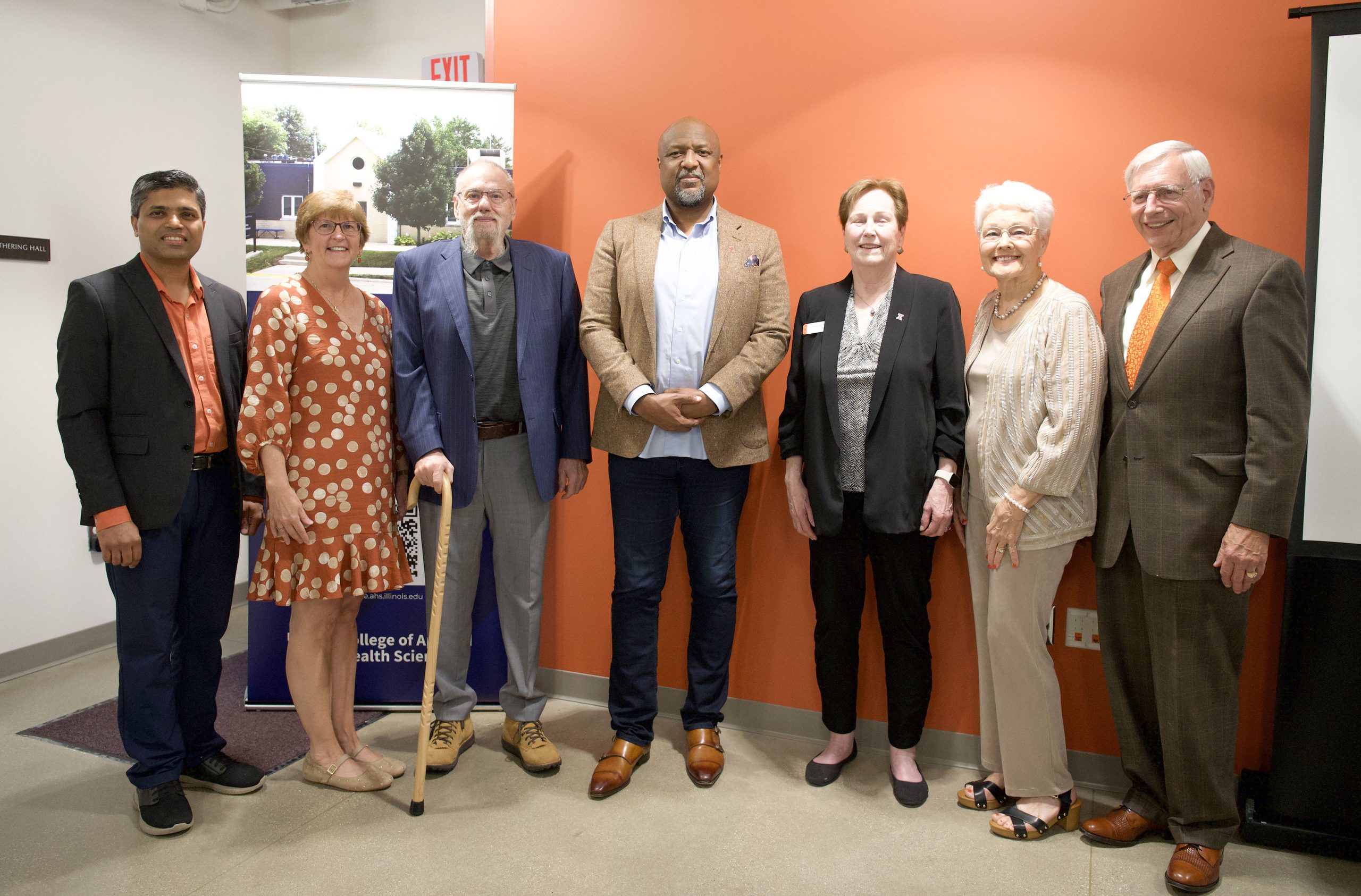
The theme of the 2026 Sapora Symposium was ‘the power of community.’ (Photo by Ethan Simmons)

The 2026 Sapora Symposium once again brought the RST community together in a powerful way—connecting students, alumni and industry leaders through meaningful engagement and shared learning.

Centered on this year’s theme, the power of community, the Symposium explored how civic engagement, marketing, and social and digital innovation shape professional pathways across recreation, sport, and tourism.

The series kicked off on January 29 in Chicago with keynote remarks by Michael Strautmanis of the Barack Obama Presidential Center, whose insights on leadership and community development set the tone for the weeks ahead.

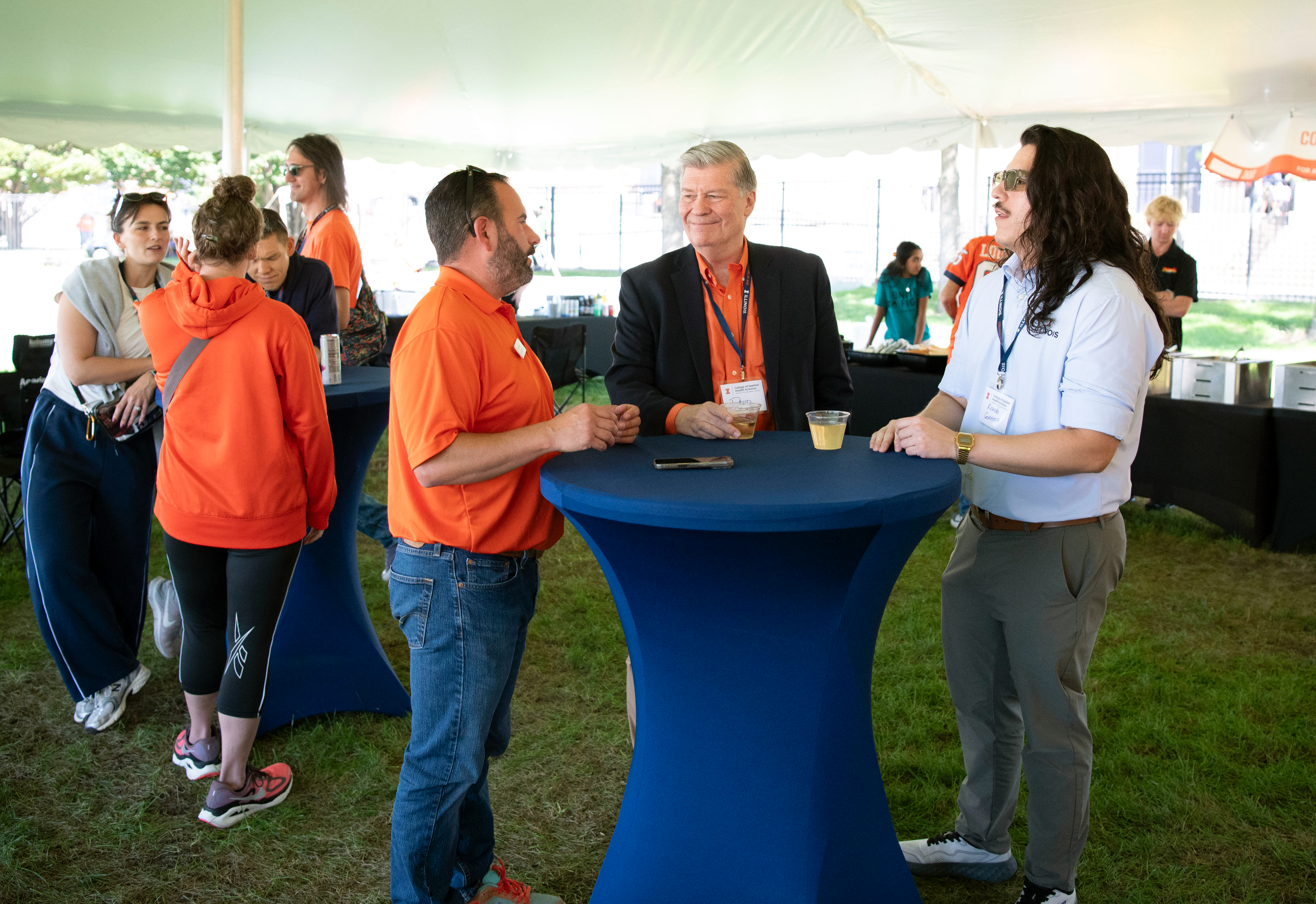
The main event, held March 6 at the Illini Union, welcomed more than 130 undergraduate and graduate students and over 35 speakers and table hosts—most of them RST alumni. Throughout the day, students engaged directly with professionals, turning conversations into mentorship and networking into lasting connections.

We are deeply grateful to TSMGI for their continued partnership and to the outstanding group of speakers and guests who generously shared their time and expertise:

2026 Participating Speakers & Guests

  • Jordan Bressler – TSMGI 
  • Reese Bressler – TSMGI 
  • Jamie Bronska – Chicago White Sox 
  • Glenn Eden – Chicago Civic Leader / Choose Chicago 
  • Carly Eilian – TSMGI 
  • Christian Evans – Indianapolis Pacers 
  • Brian Floriani – Bernie’s Book Bank 
  • Abri Forrest – TSMGI 
  • Melissa Garritano – Special Olympics Illinois 
  • Megan Gaseor – Chicago Cubs 
  • Parker Gray – DIA Marketing Street Team 
  • Joe Kennedy – Obama Presidential Center 
  • Chris Marciani – TMRW Sports 
  • Andrew McCarthy – TSMGI 
  • Alexis McCay – KemperSports 
  • Nick McDuffee – Village of Savoy Parks and Recreation 
  • Brendon McGuire – DIA Football Video 
  • Lauren Mroz – National Basketball Association 
  • Alex Munoz – NASCAR 
  • Tristan Nelson – Oklahoma City Thunder 
  • Joe Ronovsky – Village of Bedford Park / Wintrust Sports Complex 
  • Carmen Rossi – 8 Hospitality 
  • Alex Roux – Big Ten Network 
  • Rebecca Seldin – TSMGI 
  • Liam Sise – La Grange Park District 
  • Joey Spathis – TSMGI 
  • Mark Steinberg – Excel Sports Management 
  • Christine Stromberg – United States Tennis Association 
  • Angela Tzortis – Chicago Cubs 
  • Rachel Wright – TSMGI 

Your collective engagement—spanning sport organizations, tourism and destination marketing, recreation and park systems, community development, nonprofit leadership, and agency work—created an exceptional experience for our students and reflected the full breadth of the RST field.

Thank you for being part of Sapora 2026.


Share on social

Related news

2025 Sapora Symposium: Honoring a century of legacy at Huff Hall


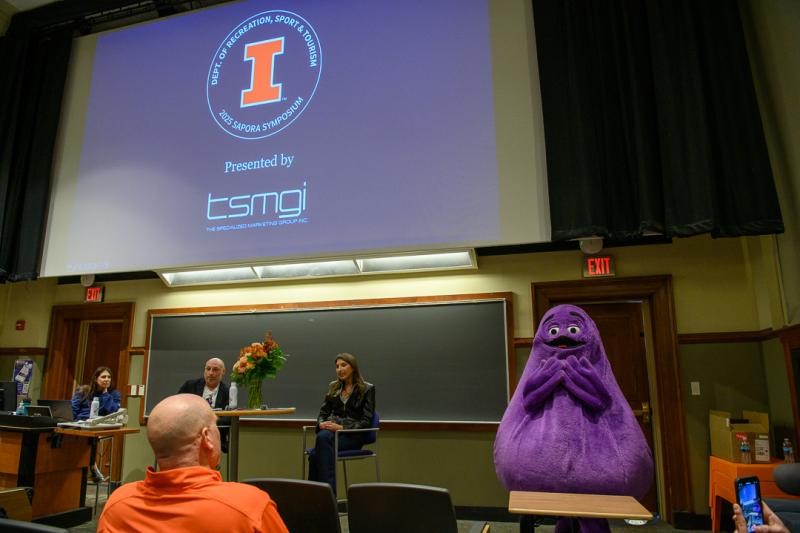
Lovable McDonald’s character Grimace made a surprise appearance at the 2025 Sapora Symposium (Photo by Ethan Simmons)

The theme of the 2025 Sapora Symposium was visionary leadership, coinciding with the 100th anniversary of Huff Hall and paying tribute to the legacy of George Huff. Only one thing could potentially overshadow that, and it is purple and lovable: Grimace.

The iconic McDonald’s character—who’s ostensibly a tastebud—made his appearance during one of the final Sapora panels on March 28 at the Armory. Grimace’s appearance coincided with a panel on viral marketing. Grimace became a good luck charm for the New York Mets after throwing out the first pitch at a game in June 2024, leading to a winning streak and a purple seat dedicated to him at Citi Field. 

But beside the big, purple spectacle, this year’s symposium carried greater significance as it coincided with the Huff centennial, a cornerstone of Illini academics and a testament to the university’s rich sports heritage. The event celebrated not only a century of excellence in sports and recreation but also paid tribute to the enduring legacy of George Huff, the visionary coach and administrator who transformed athletics at Illinois and beyond.

The Sapora Symposium was created and developed by the alumni advisory board of the Department of Recreation, Sport and Tourism in honor of the Department’s founder, Dr. Allen Sapora. Sapora was a cornerstone to the education and careers of many of our alumni. In recent years, the department has hosted the likes of the Stanley Cup, Governor J.B. Pritzker, Theo Epstein, and celebrated the lives of Illini legends Lou Henson, Red Grange and Theresa Grentz.

“Sapora is one of the signature components of the RST undergraduate experience,” said Clinical Associate Professor Mike Raycraft, who created the course. “It is always exciting to recruit high profile guests and inspire students to consider classroom knowledge in the context of industry leaders and influencers.”

The spring 2025 series was presented by The Specialized Marketing Group Inc., a global sports, promotional and experiential marketing company.

“Not only is this an incredible opportunity for students to learn from and connect with some of the most influential, successful people in Recreation, Sports and Tourism, it gives those of us who are already in the industry the opportunity to speak directly to the youth that will shape the future of our business,” said TSMGI founder and CEO Jordan S. Bressler. “We are thrilled to be a part of something that allows students the unique opportunity to gain invaluable knowledge and perspective as they determine what route they may wish to take.”

“Sapora is one of the signature components of the RST undergraduate experience.”

Mike Raycraft

This year’s symposium is particularly noteworthy as it honored George Huff, a legendary figure whose influence continues to resonate within the Illinois community. As the university’s athletic director from 1901-36, Huff played a pivotal role in shaping modern college athletics. His foresight led to the construction of Memorial Stadium and the establishment of key athletic programs that set a precedent for institutions nationwide. Under his leadership, Illinois became a powerhouse in collegiate sports and his innovations in athletic administration laid the foundation for modern sports management practices.

Huff Hall has stood as a beacon of athletic excellence for a century. Originally constructed in 1925 as the Men’s New Gym, the facility was later renamed in honor of Huff to recognize his contributions to the university’s athletic legacy. Over the decades, Huff Hall has hosted countless historic moments, from a speech by First Lady Eleanor Roosevelt during World War II to championship basketball games to landmark wrestling matches to dance marathons, embodying the spirit of competition and community that Huff championed throughout his career.

The 2025 Sapora Symposium kicked off with an evening with RST alums Dee Brown and James Augustine at the Hubbard Inn, included a weekly Zoom webinar speaker series, continued with an all-day professional development event on campus and concluded with a site visit examining opportunities and impacts related to the WNBA’s Chicago Sky, Wintrust Sports Complex at the Village of Bedford Park, and MLB’s Chicago White Sox in April. In addition, it also included a pickleball fundraising event to benefit the Cunningham Children’s Home.

Raycraft and his work on the course sparked TSMGI’s involvement.

Mike Raycraft, right, with a special guest at the Sapora Symposium (Photo by Ethan Simmons)

“The platform that Mike has created creates so much opportunity for amazing conversations and discussions,” said Carly Eilian, vice president of public relations and communications at TSMGI, based in Deerfield, Illinois. “We love being a part of something that allows students the unique opportunity to gain invaluable knowledge and perspective as they determine what route they may wish to take.”

Eilian said the symposium gives students the opportunity to learn from some of the most influential people in the recreation, sport and tourism industries, and that it allows people in the industry a direct pipeline to the next generation.

“We hope to continue the momentum of the symposium making it a must-attend event for our industry and prospective industry members,” she said.

Beyond the academic and professional development opportunities, the symposium also served as a celebration of the Illinois spirit. Alumni, faculty and students came together to honor Huff Hall’s centennial, reflecting on its storied past and looking ahead to its future role in fostering athletic and academic excellence. As the University of Illinois celebrates the 100th anniversary of Huff Hall, the 2025 Sapora Symposium stands as a fitting tribute to a man whose impact on collegiate athletics and sports management remains unparalleled.

As a testament to that, RST has established the Huff Society Fund. Gifts to the Huff Society Fund empower students in the Recreation, Sport, and Tourism program by supporting scholarships, hands-on learning opportunities, and event costs. Your generosity helps make transformative experiences—such as guest speaker events, experiential trips, and transportation—accessible to all students. 

Donations to the Huff Society Fund will also allow the department to recognize, recruit and retain top students while preparing them to become future leaders in the field. Donors to the Huff Society Fund join a passionate community of supporters dedicated to shaping the next generation of RST professionals

Editor’s note:

To reach Vince Lara-Cinisomo, email vinlara@illinois.edu.
 

Related news

2025 Sapora Symposium: Honoring a century of legacy at Huff Hall


Lovable McDonald’s character Grimace made a surprise appearance at the 2025 Sapora Symposium (Photo by Ethan Simmons)

The theme of the 2025 Sapora Symposium was visionary leadership, coinciding with the 100th anniversary of Huff Hall and paying tribute to the legacy of George Huff. Only one thing could potentially overshadow that, and it is purple and lovable: Grimace.

The iconic McDonald’s character—who’s ostensibly a tastebud—made his appearance during one of the final Sapora panels on March 28 at the Armory. Grimace’s appearance coincided with a panel on viral marketing. Grimace became a good luck charm for the New York Mets after throwing out the first pitch at a game in June 2024, leading to a winning streak and a purple seat dedicated to him at Citi Field. 

But beside the big, purple spectacle, this year’s symposium carried greater significance as it coincided with the Huff centennial, a cornerstone of Illini academics and a testament to the university’s rich sports heritage. The event celebrated not only a century of excellence in sports and recreation but also paid tribute to the enduring legacy of George Huff, the visionary coach and administrator who transformed athletics at Illinois and beyond.

The Sapora Symposium was created and developed by the alumni advisory board of the Department of Recreation, Sport and Tourism in honor of the Department’s founder, Dr. Allen Sapora. Sapora was a cornerstone to the education and careers of many of our alumni. In recent years, the department has hosted the likes of the Stanley Cup, Governor J.B. Pritzker, Theo Epstein, and celebrated the lives of Illini legends Lou Henson, Red Grange and Theresa Grentz.

“Sapora is one of the signature components of the RST undergraduate experience,” said Clinical Associate Professor Mike Raycraft, who created the course. “It is always exciting to recruit high profile guests and inspire students to consider classroom knowledge in the context of industry leaders and influencers.”

The spring 2025 series was presented by The Specialized Marketing Group Inc., a global sports, promotional and experiential marketing company.

“Not only is this an incredible opportunity for students to learn from and connect with some of the most influential, successful people in Recreation, Sports and Tourism, it gives those of us who are already in the industry the opportunity to speak directly to the youth that will shape the future of our business,” said TSMGI founder and CEO Jordan S. Bressler. “We are thrilled to be a part of something that allows students the unique opportunity to gain invaluable knowledge and perspective as they determine what route they may wish to take.”

This year’s symposium is particularly noteworthy as it honored George Huff, a legendary figure whose influence continues to resonate within the Illinois community. As the university’s athletic director from 1901-36, Huff played a pivotal role in shaping modern college athletics. His foresight led to the construction of Memorial Stadium and the establishment of key athletic programs that set a precedent for institutions nationwide. Under his leadership, Illinois became a powerhouse in collegiate sports and his innovations in athletic administration laid the foundation for modern sports management practices.

Huff Hall has stood as a beacon of athletic excellence for a century. Originally constructed in 1925 as the Men’s New Gym, the facility was later renamed in honor of Huff to recognize his contributions to the university’s athletic legacy. Over the decades, Huff Hall has hosted countless historic moments, from a speech by First Lady Eleanor Roosevelt during World War II to championship basketball games to landmark wrestling matches to dance marathons, embodying the spirit of competition and community that Huff championed throughout his career.

The 2025 Sapora Symposium kicked off with an evening with RST alums Dee Brown and James Augustine at the Hubbard Inn, included a weekly Zoom webinar speaker series, continued with an all-day professional development event on campus and concluded with a site visit examining opportunities and impacts related to the WNBA’s Chicago Sky, Wintrust Sports Complex at the Village of Bedford Park, and MLB’s Chicago White Sox in April. In addition, it also included a pickleball fundraising event to benefit the Cunningham Children’s Home.

Raycraft and his work on the course sparked TSMGI’s involvement.

Grimace interacting with his fans (Photo by Ethan Simmons)

“The platform that Mike has created creates so much opportunity for amazing conversations and discussions,” said Carly Eilian, vice president of public relations and communications at TSMGI, based in Deerfield, Illinois. “We love being a part of something that allows students the unique opportunity to gain invaluable knowledge and perspective as they determine what route they may wish to take.”

Eilian said the symposium gives students the opportunity to learn from some of the most influential people in the recreation, sport and tourism industries, and that it allows people in the industry a direct pipeline to the next generation.

“We hope to continue the momentum of the symposium making it a must-attend event for our industry and prospective industry members,” she said.

Beyond the academic and professional development opportunities, the symposium also served as a celebration of the Illinois spirit. Alumni, faculty and students came together to honor Huff Hall’s centennial, reflecting on its storied past and looking ahead to its future role in fostering athletic and academic excellence. As the University of Illinois celebrates the 100th anniversary of Huff Hall, the 2025 Sapora Symposium stands as a fitting tribute to a man whose impact on collegiate athletics and sports management remains unparalleled.

As a testament to that, RST has established the Huff Society Fund. Gifts to the Huff Society Fund empower students in the Recreation, Sport, and Tourism program by supporting scholarships, hands-on learning opportunities, and event costs. Your generosity helps make transformative experiences—such as guest speaker events, experiential trips, and transportation—accessible to all students. 

Donations to the Huff Society Fund will also allow the department to recognize, recruit and retain top students while preparing them to become future leaders in the field. Donors to the Huff Society Fund join a passionate community of supporters dedicated to shaping the next generation of RST professionals.

Editor’s note:

To reach Vince Lara-Cinisomo, email vinlara@illinois.edu.
 

Related news

Pritzker to RST students: Stay in Illinois


J.B. Pritzker was the invited speaker at the kickoff to the 2024 Sapora Symposium (Photo provided)

If there is one thing Illinois Gov. J.B. Pritzker knows about, it’s hospitality.

A member of the family that owns the Hyatt hotel chain, Pritzker on Jan. 25 gave the opening remarks for the Sapora Symposium—organized by the Department of Recreation, Sport and Tourism at the University of Illinois Urbana Champaign—and implored students to “stay in Illinois.”

“My advice is stay in the state of Illinois because a lot is happening here that is going to be good for your careers,” said the 59-year-old Pritzker. “It’s not just the governor trying to convince you to do something that you don’t want to do. It’s the governor telling you that I have seen a real change in the way this state thinks of itself and the opportunity that exists, particularly in travel and tourism and recreation.”

Pritzker was the invited speaker at the recent kickoff to the Sapora Symposium, a semester-long class that features alumni and other professionals who share insight on current issues in recreation, sport and tourism. This year’s theme, according to instructor Michael Raycraft, a teaching associate professor, is the “important roles for recreation, sport, and tourism agencies in the revival of the economic, social, and environmental dimensions of Chicagoland in the post-pandemic era.”

Among the topics that came up during the discussion with Pritzker—moderated by Raycraft and RST alumni and adjunct faculty member Carmen Rossi—were contemporary issues in parks, tourism and sport and their importance to Illinois’ future. 

“Not just because I come from a family that’s been involved in tourism and the hospitality industry, but from a state perspective, it is one of the easiest ways to boost revenues,” Pritzker said.

Pritzker—a Democrat—touted his administration’s recent success in the tourism sphere, primarily securing the Democratic National Convention, slated for Aug. 19-22 at the United Center. 

“It is my job to get major conventions to come to the state,” he said. “In politics, it’s like the Super Bowl every four years. It brings 50,000 people, and they’re going to spend weeks on end beforehand, setting up and bringing people in. The delegations are going to fill all the hotels here.

“We won it for a couple of reasons. There are politics involved. But  … what mattered most was when (the DNC committee) came here, they were blown away. Because our hotels are in close proximity to one another. Hotels are close to all the places that the convention will take place. And everybody knows summer in Chicago is one of the best things in the world.”

Pritzker ended his remarks by saying the state’s “tourism economy is booming coming out of Covid.”

“My advice to you all is, stay in Illinois because we’re headed in the right direction if you want to be in this economy, in this tourism and recreation world.”

Editor’s note:

To reach Vince Lara-Cinisomo, email vinlara@illinois.edu.
 

Related news

Pritzker connects tourism, recreation to state’s economic boom


If there is one thing Illinois Gov. J.B. Pritzker knows about, it’s hospitality.

A member of the family that owns the Hyatt hotel chain, Pritzker on Jan. 25 gave the opening remarks for the Sapora Symposium—organized by the Department of Recreation, Sport and Tourism at the University of Illinois Urbana-Champaign—and implored students to “stay in Illinois.”

“My advice is stay in the state of Illinois because a lot is happening here that is going to be good for your careers,” said the 59-year-old Pritzker. “It’s not just the governor trying to convince you to do something that you don’t want to do. It’s the governor telling you that I have seen a real change in the way this state thinks of itself and the opportunity that exists, particularly in travel and tourism and recreation.”

Pritzker was the invited speaker at the recent kickoff to the Sapora Symposium, a semester-long class that features alumni and other professionals who share insight on current issues in recreation, sport and tourism. This year’s theme, according to instructor Michael Raycraft, a teaching associate professor, is the “important roles for recreation, sport, and tourism agencies in the revival of the economic, social, and environmental dimensions of Chicagoland in the post-pandemic era.”

Among the topics that came up during the discussion with Pritzker—moderated by Raycraft and RST alumni and adjunct faculty member Carmen Rossi—were contemporary issues in parks, tourism and sport and their importance to Illinois’ future. 

“Not just because I come from a family that’s been involved in tourism and the hospitality industry, but from a state perspective, it is one of the easiest ways to boost revenues,” Pritzker said.

Pritzker—who is in his second term as governor—touted his administration’s recent success in the tourism sphere, primarily securing the Democratic National Convention, slated for Aug. 19-22 at the United Center. 

“It is my job to get major conventions to come to the state,” he said. “In politics, it’s like the Super Bowl every four years. It brings 50,000 people, and they’re going to spend weeks on end beforehand, setting up and bringing people in. The delegations are going to fill all the hotels here.

“We won it for a couple of reasons. There are politics involved. But  … what mattered most was when (the DNC committee) came here, they were blown away. Because our hotels are in close proximity to one another. Hotels are close to all the places that the convention will take place. And everybody knows summer in Chicago is one of the best things in the world.”

Pritzker ended his remarks by saying the state’s “tourism economy is booming coming out of Covid.”

“My advice to you all is, stay in Illinois because we’re headed in the right direction if you want to be in this economy, in this tourism and recreation world.”

Related news

Sapora Symposium: Lou Henson


The panel discussion of legendary coach Lou Henson will include his family members and colleagues. The theme of this year’s Sapora Symposium is Sports and Social Justice.

Lou Henson

Share on social

Related news

A Few Minutes With … Alan Nathan


Alan Nathan

At the Sapora Symposium, University of Illinois emeritus professor of physics Alan Nathan speaks with College of Applied Health Sciences media relations specialist Vince Lara about his research on the physics of baseball.

Transcript

VINCE LARA: This is Vince Lara at the College of Applied Health Sciences at the University of Illinois. Today I spend a few minutes with Alan Nathan, emeritus professor of physics at Illinois, and renowned baseball physicist. Alan recently gave a presentation at the Sapora Symposium on the campus of Illinois.

Alan, Rob Arthur, who you know, recently wrote about the baseball– “Did they dejuice the baseball? Did they rejuice the baseball? The answer is both, depending on the day.” I’m wondering what your opinion is.

ALAN NATHAN: Well, the thing that Rob did was he looked at so-called drag coefficient. So it’s a measure of how much speed the ball loses as its going through the air. So it’s a very important factor for fly balls. The more the air drag, the less likely it is to be a home run. Turns out, you can measure these things actually very, very well, just with all of the pitching data that we have from Statcast. We have thousands and thousands and thousands of pitches that we can analyze, and if you look over the last couple of years, and even within any given year, you see a lot of fluctuations up and down of this quantity, suggesting that the ball itself is quite variable from one ball to the other, and you see changes from year to year. So for example, in 2018, the drag was somewhat higher than it had been in 2017. The ball didn’t carry as far, and consequently fewer home runs. Things reversed again in 2019, where the drag was down– home runs were up. And then the post-season happened, and home runs are up, home runs were down, and then they were up, and it became a rather confused situation. I think it’s probably fair to say it’s still a somewhat confused situation. Although one thing I would say about the postseason, of course– you have fewer games being played than on a typical day during the regular season, so you sort of have to take that into account. But–

VINCE LARA: And better pitching, too.

ALAN NATHAN: And better pitching, colder weather on the average. I mean, there are all kinds of things you have to take into account.

VINCE LARA: Mm-hmm. OK. You know, Rob also wrote at the beginning of this season, that the ball had lower drag, and that was something that was later corroborated by MLB officials. Your 2014 study however, found that the primary reason for variation is due to a difference in the drag properties of different types of baseball. And there’s even variation within a given type. So are you talking about the seam height, or are you talking about the inside of the ball, are you like– what sorts of things were you looking at in that study?

ALAN NATHAN: Yeah. Well, the study that I did in 2014 was entirely simply looking at trajectories of baseballs, and measuring how far they’d gone. We didn’t dissect the ball or do anything on the inside of the ball. What we did do is we did measure the seam height, and we found that there was a definite correlation between the seam height and the drag. So the higher the seams, the more drag, the less well the ball carries. We found that particularly when looking at different types of balls. So at the time, the NCAA was using a raised seam baseball. They have since switched to a flat seam baseball. And we definitely found that that raised seam baseball simply didn’t carry as far. In fact, the fact that the ball didn’t carry as far led the NCAA to switch to a flat seam ball, to basically get more home runs.

VINCE LARA: Right.

ALAN NATHAN: So we didn’t look at the interior of the ball, we didn’t look at the seams. Now in our initial study from Major League Baseball, which took place in 2017– the report was issued in 2018– we were looking at the home run increase over the 2015-17 period, and we found you could pretty much attribute all that increase in home runs to drag. However, we really were not able at that time to figure out what exactly changed in the ball that would lead to more drag– or less drag, and therefore more home runs. Now for sure it’s true that, as I said, the drag was up, homers down in 2018, and the reverse in 2019. The home committee of Major League Baseball sort of got back into action around mid-season this year, and we’re–

VINCE LARA: Which you’re part of.

ALAN NATHAN: Which I’m part of. And we are getting close.

VINCE LARA: OK.

ALAN NATHAN: We’re getting close to the point where we’re going to go public with our findings.

VINCE LARA: Interesting.

ALAN NATHAN: I can’t talk about it, what they are, but we’re getting quite close to that. Hopefully maybe at the Winter Meetings, which will be in a few weeks.

VINCE LARA: OK. You know, Rob Manfred has said– and Rawlings has said– that the baseball recipe remains the same, regardless of year. However, Meredith Willis, who you also know, and Rob Arthur concluded this year that ball construction was different, including lower seam height. Do you have any insight into that? Like, how that happens? If baseball’s saying it’s not– you know, baseball’s saying that the recipe is the same.

ALAN NATHAN: Well, for sure. I believe it’s true that the recipe is the same. I mean, I really do believe– I visited the plant in Costa Rica where the balls are made a couple of years ago. We’ve talked extensively with people from Rawlings. There are changes that are made, but largely due to the fact that you’re dealing with organic materials– wool, leather, cotton– and there’s variation in those materials. So– but the process really hasn’t changed. There could very well be differences from one ball to another within a given year, differences in average properties of the balls from one year to another, and that’s just a natural consequence of the materials that are used and the actual process that’s made. I mean, there’s a lot of hand work that’s done to create a baseball, particularly sewing the cotton threads through the leather on the outside– that’s all done by hand.

So for sure, Meredith Wills has taken some balls apart, she’s found differences from one year to the next. Her latest article came out, in fact, just yesterday, and she looked at the postseason balls, and– OK, she drew some conclusions there. What she hasn’t done– because she really has no way to do it– is to show in any conclusive way that whatever changes she does see actually affect the drag on the ball. That is something that we, our group, is actually uniquely able to do, because we can take baseballs– we have large samples of baseballs, we can take them into the laboratory, we can measure their drag with very, very high precision, much higher precision than you can actually measure by tracking pitches in a ballgame. And we can measure seam height very accurately, we could measure the roundness of the ball, we can measure the thickness of the seam, and the surface of the ball. I mean, the drag is largely a surface effect. It’s the air interacting with the ball, and the only thing the air sees is the surface of the ball. So you know, you could pretty well isolate it. Is it– to be something associated with the leather, the smoothness of the leather, for example? Or something to do with the seams? And if you look at a baseball, there’s a lot of little holes there in the leather, and the seams are sticking up, and there’s a lot going on there, and no one has been able to model this from a fundamental physics point of view from First Principles. So ultimately, you’re stuck with just doing the best measurements you can, which is I believe what we’re able to actually do.

VINCE LARA: Now, the very fact that Major League Baseball has your committee, and the very fact that you looked at things like a humidor in the Diamondbacks’ park in Chase Field, says to me that Major League Baseball is concerned about this explosion of home runs. Now–

ALAN NATHAN: I have no inside information.

VINCE LARA: OK.

ALAN NATHAN: I don’t question people’s motivations at all, so I can’t say what’s on their mind. I don’t interact directly with Rob Manfred.

VINCE LARA: OK.

ALAN NATHAN: I do interact with the people I interact with– Reed MacPhail. MacPhail’s a famous name in baseball, this is the fourth generation MacPhail.

VINCE LARA: OK, fourth generation.

ALAN NATHAN: And Morgan Sword is the other person I interact with. And I can tell you, from having talked with him extensively, that– I don’t know what their bosses are thinking, but they for sure are very concerned.

VINCE LARA: OK.

ALAN NATHAN: And I can also say that having–

VINCE LARA: Are they concerned because it’s affecting the integrity of the game?

ALAN NATHAN: I guess– I don’t know. Look, I don’t want to characterize why they’re concerned. I know they’re concerned. I mean, maybe they’re just concerned because they’re getting a lot of bad publicity, I don’t know.

VINCE LARA: Right, right.

ALAN NATHAN: But they are concerned. And I know Rawlings is concerned. I think Rawlings is largely concerned because of bad publicity.

VINCE LARA: Sure.

ALAN NATHAN: They really don’t like all the bad publicity they’re getting, and sometimes they’re even a little defensive about it. But all by way of saying, that I think they’re– I believe, personally, that they’re all honest brokers, that they really are– for whatever their reasons– are trying to figure out why there is an increase in home runs. If the ball has changed, what has changed? How can we, going forward, better control the production of the ball? And I really do believe that they are genuinely concerned about that, but I don’t know their motivations for being concerned.

VINCE LARA: I’m going to ask you something that I asked Charlie Young, who was on an earlier podcast. Which came first for you, your love of baseball or your love of physics?

ALAN NATHAN: It’s an interesting question. So I like to tell people that I have been a physicist all of my professional life. I’ve been a baseball fan virtually all of my life. Now, it is true that I had a long career as a nuclear physicist– faculty member here at the University of Illinois, teaching physics, doing research. And it was really well into the game that I got interested in baseball. So although I’ve– in applying physics to baseball, I’ve been interested in baseball, but in the specific job of applying physics to baseball, it’s been much more recent. It’s been over 20 years, but still I was well into my career when that happened.

VINCE LARA: What sparked that?

ALAN NATHAN: Interesting question.

VINCE LARA: Yeah.

ALAN NATHAN: There’s actually an interesting story. So the physics department has this outreach program where we give talks on Saturday mornings– used to be for high school honor students, but now they’ve opened it up to the public, they call it Physics for Everyone. And way back in 1997, it was my turn to give a talk. And normally the faculty talk about their research but they present it in a way that the general public can understand it. So I was thinking of doing something like that, but then there was this book called The Physics of Baseball, written by another physics professor, that I had had in my bookshelf for about five or six years. I bought the book, I thought I’ll do this one someday, but I never read it. All right, so then I said, you know, I’m going to talk about the physics of baseball, which will force me to read the book, and I’ll learn something and it’ll be a one shot deal but it’ll be kind of fun. And it would have been a one shot deal, never to be returned to, except that there was a News Gazette reporter in the audience who interviewed me afterwards, wrote it up in the front page of the Sunday paper, and then everyone started calling me up to give talks, and this and that, and then it just sort of blossomed from there.

VINCE LARA: My thanks to Alan Nathan. This has been “A Few Minutes With.”

Related news

Day one of Sapora Symposium about Grange


RST students, wearing replicas of Red Grange’s jersey, gather around his statue in Grange Grove (Photo by Fred Zwicky)

The first day of the 16th annual Sapora Symposium was intended to be a tribute to Red Grange, the former Illini football star who put college football and the NFL on the map in the 1920s.

And while Grange was a main subject of the afternoon panel, so was the message from other speakers from the College of Applied Health Sciences and the Recreation, Sport and Tourism Department about the futures of most of the student attendees.

AHS Dean Cheryl Hanley-Maxwell, RST department head Carla Santos and Illini basketball coach Brad Underwood all implored RST students to embrace the opportunities that Sapora afforded them, while bracing for the careers that await them.

“This is your first opportunity for professional development,” Dean Hanley-Maxwell said to the 350 students and other guests at the Colonnade Club within Memorial Stadium. “RST has given students like you an extraordinary opportunity to learn from and network with people you might work with. You are tomorrow’s leaders. How will you learn from what you hear? Will it spark a passion in you?”

Coach Underwood, whose son Tyler is an RST student with a concentration in sport management, spoke about the rewards in industries that come with an RST degree, but also warned of the sacrifices and struggles.

“I was 26 years in the profession before I became a head Division I basketball coach. I’ve gone backward in salary several times,” the third-year Illinois coach said. “But I have never worked a day in my life. This is a passion. What you’re getting ready to take on in life, is very, very special.

“It’s an extremely competitive field. Don’t be bashful, don’t be shy. You don’t make it in this field that way. (But) don’t let it be work, let it be a passion.”

The Grange panelists then took center stage, moderated by former Illinois sports information director Mike Pearson. Former Sports Illustrated writer Lars Anderson, who wrote “The First Star: Red Grange and the Barnstorming Tour That Launched the NFL,” in 2009, was the first to speak and talked about how the man nicknamed the Galloping Ghost transcended sports in the 1920s because ‘What they were seeing from Grange was unlike anything else.”

Chris Willis, the head of research for NFL Films and author of the new book, “Red Grange: The Life and Legacy of the NFL’s First Superstar,” said some people claimed Grange saved the NFL.

“He was the first superstar athlete who joined the NFL. His legacy was almost a blueprint of what the modern player does today. He left school early, signed with an agent, got a huge contract, got endorsements, appeared in Hollywood movies, and won NFL championships. He has a huge legacy.”

Day Two of the Sapora Symposium — named for Dr. Allen Sapora, a pioneer in recreation education and research at Illinois — was termed a “Career Diversity and Global Readiness Summit, and speakers include former Illini basketball star Deon Thomas, Midwest Living Magazine publisher Melissa Luebbe, and Illinois physics emeritus professor and renowned physics-of-baseball researcher Alan Nathan.

The Sapora Symposium was created and developed by the alumni advisory board of the Department of Recreation, Sport and Tourism in honor of Dr. Sapora. Dr. Sapora was a cornerstone to the education and careers of many of our alumni. He believed in mentoring younger generations and in providing them with critical connections to professionals in the field.

Editor’s note:

To reach Vince Lara-Cinisomo, email vinlara@illinois.edu.
 

Related news

College of Applied Health Sciences
110 Huff Hall
1206 South 4th Street
Champaign, IL 61820
(217) 333-2131