The intern who turned an ejection into a career lesson


In Derek Dye’s 2012 internship with the Daytona Cubs, he sold concessions, cleaned the bleachers, worked the soundboard, even dressed as the mascot. (Provided)

At their best, college internships are valuable learning experiences. Derek Dye didn’t expect his to involve getting tossed out of a baseball game.

That was the viral story for this University of Illinois alum’s first big-time summer job with Minor League Baseball, working as a stadium operations intern in August 2012. Back then, Dye was a rising senior in the Recreation, Sport and Tourism program at Illinois, eager to break into the sports industry. 

“I would’ve done anything to work in sports,” Dye said. “The minor league was the main target for me, a lot of people wanted to get their foot in the door.” 

Growing up in Moline, Illinois, sports were truly his life: Dye ran a backyard football club in high school and developed a passion for sports data of the major leagues. His dream was to become the general manager for the Chicago Cubs. 

When college neared, he applied to relevant programs across the state that could help him reach his goals. He eventually broke through the waitlist for the University of Illinois’ Recreation, Sport and Tourism program in the spring of 2009. 

“The RST major was the first thing I was looking at, I thought it was the perfect fit,” Dye said. 

It’s customary for RST students to work an internship in the field before they graduate. Baseball’s minor league was his main target, including the Quad City River Bandits in his hometown. 

The summer before his senior year at Illinois, he landed a seemingly perfect role: an internship with the Daytona Cubs, the Minor League Baseball team in Daytona Beach, Florida, and affiliate of the Chicago Cubs. 

He ended up taking out a $1,700 loan from his grandma to live in a Daytona Beach apartment. When the summer of 2012 began, Dye began a do-everything internship for the Cubs: serving stadium food and beverage, cleaning the bleachers, selling tickets and running the soundboard, all for a $50-a-week stipend. 

“You’re gone!”

A picture of the Daytona Cubs soundboard’s options for “bad call.” (Provided).

August 1, 2012. The Fort Myers Miracle faced off against the Daytona Cubs.

At the top of the eighth inning, a Fort Myers batter hit a ground ball to short. The Cubs threw it first, and the umpire called it safe. But Dye, sitting up in the press box, thought it was an out. Earlier that week, Daytona had added an array of audio snippets on the soundboard to play for a “bad call.” 

One of them was an organist’s rendition of “Three Blind Mice.” Dye clicked on it. 

Umpire Mario Seneca’s head perked up, then he turned and pointed to the press box. “You’re gone!” 

The crowd was puzzled, and Seneca continued to gesture up to the soundboard, where Dye was at the helm. “Turn the sound off the rest of the night.” 

Fear washed over him. 

“As you can imagine, being 21 years old and 1,200 miles away from home, my first reaction is ‘what just happened? I’m gonna get fired,” Dye said. “I can’t believe this is actually happening.” 

(Through the shock, Dye fired off a tweet about his ejection, and later uploaded the live footage of the incident to the Daytona Beach Cubs YouTube channel.) 

Ejected from his post, the press box was silent: no batter walkups, no anything. The fans started to announce the game themselves, standing from the stands and shouting out the players’ names who were up to bat. 

After the game, Dye resumed his usual grunt work, leaf-blowing peanuts from the stands. Then his phone started ringing off the hook: calls came in from reporters at CBS, ESPN, Major League Baseball. 

News of his ejection was trending on Twitter. Everyone wanted to know about the soundboard guy—an intern—who was thrown out of the game for playing Three Blind Mice. 

“I tried to talk to as many people as I could,” Dye said. He took calls until 2 a.m. 

After waking, WGN called him. Unbeknownst to him, it was live on air. He answered questions from his closet so he wouldn’t wake up his roommates.

Dye’s ejection contended for the Minor League Baseball “Moment of the Year.”

He went to the ballpark the next day, and 45 more publications were there to talk to him. 

The fallout from the league arrived immediately. Florida State League Commissioner called the incident a “mockery of the game” and fined the team $525.

Dye was banned from the press box for the remainder of his internship. But the team’s general manager, Brady Ballard, covered the fee for his barely paid intern. 

“It showed me he saw the big picture,” Dye said. “I was a 21-year-old intern doing my work to engage the crowd and cut my teeth in sports. He didn’t shy away from it, and his support also helped the story grow legs.” 

And the Daytona Cubs sold out their stadium the very next game. 

“I think the legend behind it had more sticking power than it would nowadays,” Dye said.  “Every year it comes up in August for the anniversary.” 

‘Your rep is your personal brand in the industry’

When Dye returned for his senior year at Recreation, Sport and Tourism, advisor and instructor Ryan Gower—now chancellor of Illinois Eastern Community Colleges—asked one of his classes: “Anyone have any funny stories from their internships?” 

Everyone looked back at Dye and laughed. He had gotten texts from classmates about his ejection for the whole month. 

After working in the sports world, Dye is now the director of marketing for Chicagoland’s Affy Tapple.

“Instead of putting my head down, I was able to turn what could’ve been a really negative thing into a really fun story,” Dye said.

He took classes from RST’s many memorable professors, including Clinical Associate Professor Michael Raycraft and Adjunct Instructor Kyle Emkes, and experienced the breadth of the leisure and tourism side of the major in classes with Professor Carla Santos and Professor Emeritus Kim Shinew. 

He also took on new roles in his budding sports career, working 40-hour weeks while interning for Illinois Division of Intercollegiate Athletics. He helped the kids club and worked with spring sports teams, such as softball and tennis.

Words from instructor and former Illinois volleyball coach Don Hardin lingered with him: if you want to work in sports, you’ll have to handle the tough stuff. 

“There’s going to be grunt work, not everything is going to be a glamorous stop,” Dye said, paraphrasing Hardin’s advice. “You’re going to have to be on the front lines, and your rep is your personal brand in the industry.” 

After graduating in 2013, Dye interned with Tampa Bay Rays and later managed eCommerce for Sports Collectibles, a sports memorabilia seller. Today, he’s the marketing director for Affy Tapple, a caramel apple producer in Chicagoland. 

His degree at RST continually comes in handy at his newest role, where he’s had to manage people and organize big events. Dye hasn’t become a Major League general manager, but the moment he feared would stain his reputation ended up shaping how he shows up for others.  

“Being on the ground level, you see everything and learn how to make the best of tough situations,” Dye said. “I’ll never be hard on someone for trying their best.” 

Editor’s note:

To reach Ethan Simmons, email ecsimmon@illinois.edu.
 

Share on social

Related news

Remembering pioneering scholar Jack Kelly


Jack Kelly, a professor in the Department of Leisure Studies at Illinois for many years, died on Feb. 10, 2025, at the age of 94 (University archives)

Jack Kelly, a professor in the Department of Leisure Studies at Illinois for many years, died on Feb. 10, 2025, at the age of 94. Faculty members of the Department of Recreation, Sport and Tourism collaborated to write this remembrance of Kelly.

Professor Emeritus Jack Kelly was a trailblazer in the field of Leisure Studies and was instrumental in establishing the field of Leisure Studies. Kelly anticipated many societal issues and trends in the 1970s and early 1980s that advanced knowledge of healthy aging, the study of work and leisure, socialization and leisure and family leisure. 

“We as a field owe Jack a great deal,” said retired RST faculty member Kim Shinew, who joined Kelly at the University of Illinois in 1993.  “He catapulted us forward by making our research more relevant, and he increased our visibility to others outside the field.” Dr. Kelly’s research laid the theoretical foundations of the field through seminal works such as Leisure; Sociology of Leisure; Freedom to Be: A New Sociology of Leisure; and Leisure Identities and Interactions.

Kelly was one of the first leisure scholars to recognize that research advances were not keeping pace with societal trends and issues. He pushed the field to address the sociological and psychological aspects of leisure, which offered important advancements in leisure research and contributed to the development of professional best practices. A dynamic teacher, Kelly emphasized the connections between research and professional practice. 

“I was fortunate to be a student in Dr. Kelly’s final LEIS 501 course in the early 1990s,” said RST faculty member Michael Raycraft. “He made it clear that an appreciation of leisure theory was critical for practitioners as it guided informed decisions and was the basis for effective RST programming. That was heavy stuff for a kid fresh out of business school. I am grateful to have learned from one of the best!”

Kelly’s pioneering research and dynamic teaching are stellar accomplishments in their own rite, but even more impressive since higher education was his second career. 

Kelly grew up in Chicago and studied philosophy at Monmouth College and then earned an M.A. in Theology from Yale University to pursue a career as a congregational minister. Newly married to his beloved wife Ruth, the couple moved to rural Montana where Kelly served in two parishes that were so far apart, he flew his Cessna airplane back and forth between church services. In the 1960s, he decided to change careers and earned both master’s and doctoral degrees in sociology from the University of Oregon. 

Kelly spent most of his career at Illinois as a professor in the Department of Leisure Studies and the Institute for Human Development. He was also the Director of the Gerontology and Aging Studies program. “He enjoyed mentoring young faculty and encouraging them to conduct creative and meaningful research,” Shinew said. “Over coffee on campus or dinner at his home, Jack stressed the importance of research to advance the field.”  

Faculty member Monika Stodolska remembers meeting Kelly when she joined the faculty in 1999. “He mentored me in the first course I taught at UIUC. Jack taught Theories and Concepts of Leisure for a long time, and I began teaching the course when he retired from our faculty. I still use some of the classic texts that Jack put on the reading list. His legacy lives on.” 

Jack’s life exemplified his knowledge of the importance of leisure throughout the lifespan. He practiced what he preached.

Kim Shinew

Retired RST faculty member

After retiring, Kelly remained active doing research, teaching and publishing journal articles and books. He returned to Illinois in 2001 for one semester to teach a graduate course on Sociology of Leisure and connect with faculty and students. 

Faculty member Laura Payne recalled her first meeting with Dr. Kelly when she joined the department in 2001. 

“Jack was so welcoming and tried to connect with me,” Payne said. “We got together and discussed our shared interests in trends and issues, especially about health and aging, and I learned a lot from our thought-provoking conversations.”

A prolific writer, Kelly authored 11 books, many of which were considered seminal, including the classic conceptual and theoretical texts already mentioned, and widely read books such as Leisure, Activity and Aging, Recreation Business, and Recreation Trends and Markets in the 21st Century, whom he co-authored with Dr. Rodney Warnick, a faculty member at the University of Massachusetts.  

Kelly had a wide range of leisure interests. He enjoyed the arts, tennis, singing, reading, flying and the outdoors. After he retired, he and Ruth spent time at their homes on Beaver Island, Michigan and on Jekyll Island, Georgia where they enjoyed bicycling, tennis and other outdoor pursuits. 

“Jack’s life exemplified his knowledge of the importance of leisure throughout the lifespan. He practiced what he preached,” Shinew said.  

Related news

2025 Sapora Symposium: Honoring a century of legacy at Huff Hall


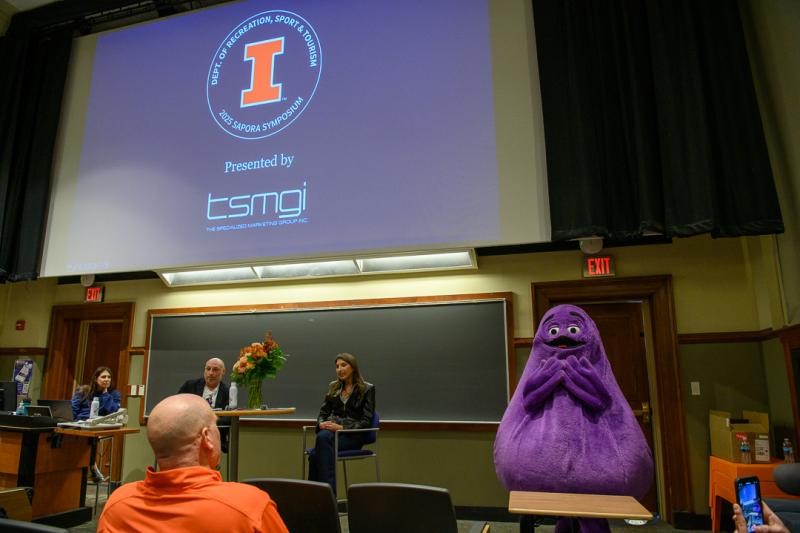
Lovable McDonald’s character Grimace made a surprise appearance at the 2025 Sapora Symposium (Photo by Ethan Simmons)

The theme of the 2025 Sapora Symposium was visionary leadership, coinciding with the 100th anniversary of Huff Hall and paying tribute to the legacy of George Huff. Only one thing could potentially overshadow that, and it is purple and lovable: Grimace.

The iconic McDonald’s character—who’s ostensibly a tastebud—made his appearance during one of the final Sapora panels on March 28 at the Armory. Grimace’s appearance coincided with a panel on viral marketing. Grimace became a good luck charm for the New York Mets after throwing out the first pitch at a game in June 2024, leading to a winning streak and a purple seat dedicated to him at Citi Field. 

But beside the big, purple spectacle, this year’s symposium carried greater significance as it coincided with the Huff centennial, a cornerstone of Illini academics and a testament to the university’s rich sports heritage. The event celebrated not only a century of excellence in sports and recreation but also paid tribute to the enduring legacy of George Huff, the visionary coach and administrator who transformed athletics at Illinois and beyond.

The Sapora Symposium was created and developed by the alumni advisory board of the Department of Recreation, Sport and Tourism in honor of the Department’s founder, Dr. Allen Sapora. Sapora was a cornerstone to the education and careers of many of our alumni. In recent years, the department has hosted the likes of the Stanley Cup, Governor J.B. Pritzker, Theo Epstein, and celebrated the lives of Illini legends Lou Henson, Red Grange and Theresa Grentz.

“Sapora is one of the signature components of the RST undergraduate experience,” said Clinical Associate Professor Mike Raycraft, who created the course. “It is always exciting to recruit high profile guests and inspire students to consider classroom knowledge in the context of industry leaders and influencers.”

The spring 2025 series was presented by The Specialized Marketing Group Inc., a global sports, promotional and experiential marketing company.

“Not only is this an incredible opportunity for students to learn from and connect with some of the most influential, successful people in Recreation, Sports and Tourism, it gives those of us who are already in the industry the opportunity to speak directly to the youth that will shape the future of our business,” said TSMGI founder and CEO Jordan S. Bressler. “We are thrilled to be a part of something that allows students the unique opportunity to gain invaluable knowledge and perspective as they determine what route they may wish to take.”

“Sapora is one of the signature components of the RST undergraduate experience.”

Mike Raycraft

This year’s symposium is particularly noteworthy as it honored George Huff, a legendary figure whose influence continues to resonate within the Illinois community. As the university’s athletic director from 1901-36, Huff played a pivotal role in shaping modern college athletics. His foresight led to the construction of Memorial Stadium and the establishment of key athletic programs that set a precedent for institutions nationwide. Under his leadership, Illinois became a powerhouse in collegiate sports and his innovations in athletic administration laid the foundation for modern sports management practices.

Huff Hall has stood as a beacon of athletic excellence for a century. Originally constructed in 1925 as the Men’s New Gym, the facility was later renamed in honor of Huff to recognize his contributions to the university’s athletic legacy. Over the decades, Huff Hall has hosted countless historic moments, from a speech by First Lady Eleanor Roosevelt during World War II to championship basketball games to landmark wrestling matches to dance marathons, embodying the spirit of competition and community that Huff championed throughout his career.

The 2025 Sapora Symposium kicked off with an evening with RST alums Dee Brown and James Augustine at the Hubbard Inn, included a weekly Zoom webinar speaker series, continued with an all-day professional development event on campus and concluded with a site visit examining opportunities and impacts related to the WNBA’s Chicago Sky, Wintrust Sports Complex at the Village of Bedford Park, and MLB’s Chicago White Sox in April. In addition, it also included a pickleball fundraising event to benefit the Cunningham Children’s Home.

Raycraft and his work on the course sparked TSMGI’s involvement.

Mike Raycraft, right, with a special guest at the Sapora Symposium (Photo by Ethan Simmons)

“The platform that Mike has created creates so much opportunity for amazing conversations and discussions,” said Carly Eilian, vice president of public relations and communications at TSMGI, based in Deerfield, Illinois. “We love being a part of something that allows students the unique opportunity to gain invaluable knowledge and perspective as they determine what route they may wish to take.”

Eilian said the symposium gives students the opportunity to learn from some of the most influential people in the recreation, sport and tourism industries, and that it allows people in the industry a direct pipeline to the next generation.

“We hope to continue the momentum of the symposium making it a must-attend event for our industry and prospective industry members,” she said.

Beyond the academic and professional development opportunities, the symposium also served as a celebration of the Illinois spirit. Alumni, faculty and students came together to honor Huff Hall’s centennial, reflecting on its storied past and looking ahead to its future role in fostering athletic and academic excellence. As the University of Illinois celebrates the 100th anniversary of Huff Hall, the 2025 Sapora Symposium stands as a fitting tribute to a man whose impact on collegiate athletics and sports management remains unparalleled.

As a testament to that, RST has established the Huff Society Fund. Gifts to the Huff Society Fund empower students in the Recreation, Sport, and Tourism program by supporting scholarships, hands-on learning opportunities, and event costs. Your generosity helps make transformative experiences—such as guest speaker events, experiential trips, and transportation—accessible to all students. 

Donations to the Huff Society Fund will also allow the department to recognize, recruit and retain top students while preparing them to become future leaders in the field. Donors to the Huff Society Fund join a passionate community of supporters dedicated to shaping the next generation of RST professionals

Editor’s note:

To reach Vince Lara-Cinisomo, email vinlara@illinois.edu.
 

Related news

Immersive learning: RST faculty guide students out of the classroom and into the real world


Renata Endres, right, teaches RST 185: Get Your Kicks on Route 66 (Photo provided)

By JONATHAN KING

Renata Endres is taking her belief in an applied teaching approach on the road—on Route 66, to be precise.

“I believe the most effective way to bridge the gap between the classroom and industry application is to experience concepts firsthand outside the classroom,” said Endres, teaching assistant professor of Recreation, Sport and Tourism who teaches RST 185: Get Your Kicks on Route 66

That is why Endres and fellow RST faculty members design and lead innovative educational practicums that immerse students in experiential learning environments.

These courses have become very popular among students, but RST faculty continue to pioneer new trails out of the classroom to foster rich educational experiences.

One example is Endres’ new Route 66 course, co-designed with Mike Raycraft, an RST clinical associate professor. In this course, students visit sites along the historic Route 66 corridor to deepen their understanding of heritage tourism; agritourism; and recreation, sport and tourism management.  

“Whether pursuing careers in these fields or something entirely different, the range of firsthand experience illustrates how the development of technical skills we learn in the classroom must be coupled with soft skills to achieve professional success,” Endres said. 

Agrotourism is something of a specialty for Endres, who helps students apply classroom knowledge to real-world challenges, such as how fluctuating crop prices may prompt farmers to adopt agritourism to diversify revenue. She additionally takes her expertise into RST 290: Experiencing Agritourism with RST faculty members Laura Payne and Nick Pitas, as well as RST 199: Recreation, Sport and Tourism Economics in Croatia. 

“My most memorable part of the Route 66 experience was being able to travel along the mother road with friends, classmates, co-workers and some of my favorite professors in RST,” said Riley Joyce, a student in Endres’ course. “It was really beneficial to see how Route 66 has impacted both Illinois and St. Louis over the years in both tourism and agrotourism worlds.”

Assistant Professor Sharon Zou is another RST faculty member whose educational innovations are bridging the gap between the classroom and the real world. Zou co-teaches an innovative community-based learning course, Place Making and Rural Tourism in China, in tandem with Wei (Windy) Zhao from the School of Architecture and Molly Briggs from the School of Art and Design. The course is supported by the university’s Transdisciplinary Global South Community-Based Learning Program Development Grant to facilitate interdisciplinary global service learning for Illinois students. 

For this new interdisciplinary course, Zou and RST students joined architecture students and art and design students for a learning opportunity in rural China. In February 2025, students and faculty traveled to Xihu Village in Jiangxi Province, China, to co-design a locally rooted, sustainable tourism development plan for the people of Xihu who wanted support to strategically plan and develop a place-making and tourism initiative. 

For the course, students benefited from immersion in local culture. They visited an ancestral celebration during Lunar New Year, took a scenic hike on the historical Hui Merchant Route for tea trading, toured a tea factory, visited the historical village of Chengkan, listened to a talk by an architect specialized in rural tourism development, met with a village head and representative from local rural revitalization company and took a tour to see the company’s current efforts in tourism infrastructure development. 

To develop their tourism model, students met with community stakeholders to conduct asset mapping and a market analysis of the community. They asked questions such as: What do you want for your village? What are the local sources of historical and cultural pride? How can we help you preserve your cultural pride while developing a sustainable tourism plan? What infrastructure is there to support tourists? What form of economic distribution will benefit community well-being? 

That feedback will help students co-design a sustainable tourism development plan for the village. RST students gained knowledge of how rural communities can leverage tourism to achieve economic, socio-cultural and environmental sustainability. Students worked directly with local stakeholders and gained valuable skills in asset mapping, competitor analysis, market analysis, community visioning, tourist experience development and destination branding. 

Additionally, architecture students worked on design proposals that challenged common “revitalization” methods, and art and design students developed wayfinding plans and memory-making designs to include cultural, historical and phenomenological village features.

“We wanted to understand the desires of the community to help them design a sustainable tourism model that showcases the cultural pride and natural beauty of their village while also contributing to the community’s well-being,” Zou said. This project emphasizes an equitable partnership to provide firsthand, practical, interdisciplinary education for Illinois students and simultaneously facilitate a locally rooted vision that will preserve and share the village’s heritage. 

“Our RST out-of-the-classroom experience is different from your typical study abroad program,” Zou said. “We’re going to put you to work, and ideally, it will be a transformative experience that students can leverage for their professional careers and social competencies.”

Sharon Zou and RST students joined architecture students and art and design students for a learning opportunity in rural China
Sharon Zou, right, and RST students joined architecture students and art and design students for a learning opportunity in rural China (Photo provided)

When Zou isn’t teaching hands-on learning in rural China, she also works with Richard Proffer from Illinois Extension and RST students to develop a sustainable tourism plan for Elmwood, Illinois, a town that is known for being the artistic origin of the famous Illinois alma mater sculpture. Beyond these two tourism practicums, Zou studies recreation and tourism consumer insights to inform sustainable funding models for public land and parks in the U.S., with a particular focus on national parks such as Indiana Dunes National Park and the greater Yellowstone ecosystem which includes private, state and federal lands.

RST experiential learning trips go beyond academics: they teach students independence, adaptability, resilience, confidence and cultural awareness. While navigating a new environment, students will learn to coexist with diverse groups, develop strong communication skills and gain invaluable social and intercultural competencies.

“Prospective students should join one of these experiential courses to gain practical, hands-on knowledge and build valuable industry connections,” Endres said. “Networking with experts in the field provides a competitive edge in their career development. And socially, these classes provide students an opportunity for a shared bonding experience that can’t be duplicated in the classroom.”

Related news

2025 Sapora Symposium: Honoring a century of legacy at Huff Hall


Lovable McDonald’s character Grimace made a surprise appearance at the 2025 Sapora Symposium (Photo by Ethan Simmons)

The theme of the 2025 Sapora Symposium was visionary leadership, coinciding with the 100th anniversary of Huff Hall and paying tribute to the legacy of George Huff. Only one thing could potentially overshadow that, and it is purple and lovable: Grimace.

The iconic McDonald’s character—who’s ostensibly a tastebud—made his appearance during one of the final Sapora panels on March 28 at the Armory. Grimace’s appearance coincided with a panel on viral marketing. Grimace became a good luck charm for the New York Mets after throwing out the first pitch at a game in June 2024, leading to a winning streak and a purple seat dedicated to him at Citi Field. 

But beside the big, purple spectacle, this year’s symposium carried greater significance as it coincided with the Huff centennial, a cornerstone of Illini academics and a testament to the university’s rich sports heritage. The event celebrated not only a century of excellence in sports and recreation but also paid tribute to the enduring legacy of George Huff, the visionary coach and administrator who transformed athletics at Illinois and beyond.

The Sapora Symposium was created and developed by the alumni advisory board of the Department of Recreation, Sport and Tourism in honor of the Department’s founder, Dr. Allen Sapora. Sapora was a cornerstone to the education and careers of many of our alumni. In recent years, the department has hosted the likes of the Stanley Cup, Governor J.B. Pritzker, Theo Epstein, and celebrated the lives of Illini legends Lou Henson, Red Grange and Theresa Grentz.

“Sapora is one of the signature components of the RST undergraduate experience,” said Clinical Associate Professor Mike Raycraft, who created the course. “It is always exciting to recruit high profile guests and inspire students to consider classroom knowledge in the context of industry leaders and influencers.”

The spring 2025 series was presented by The Specialized Marketing Group Inc., a global sports, promotional and experiential marketing company.

“Not only is this an incredible opportunity for students to learn from and connect with some of the most influential, successful people in Recreation, Sports and Tourism, it gives those of us who are already in the industry the opportunity to speak directly to the youth that will shape the future of our business,” said TSMGI founder and CEO Jordan S. Bressler. “We are thrilled to be a part of something that allows students the unique opportunity to gain invaluable knowledge and perspective as they determine what route they may wish to take.”

This year’s symposium is particularly noteworthy as it honored George Huff, a legendary figure whose influence continues to resonate within the Illinois community. As the university’s athletic director from 1901-36, Huff played a pivotal role in shaping modern college athletics. His foresight led to the construction of Memorial Stadium and the establishment of key athletic programs that set a precedent for institutions nationwide. Under his leadership, Illinois became a powerhouse in collegiate sports and his innovations in athletic administration laid the foundation for modern sports management practices.

Huff Hall has stood as a beacon of athletic excellence for a century. Originally constructed in 1925 as the Men’s New Gym, the facility was later renamed in honor of Huff to recognize his contributions to the university’s athletic legacy. Over the decades, Huff Hall has hosted countless historic moments, from a speech by First Lady Eleanor Roosevelt during World War II to championship basketball games to landmark wrestling matches to dance marathons, embodying the spirit of competition and community that Huff championed throughout his career.

The 2025 Sapora Symposium kicked off with an evening with RST alums Dee Brown and James Augustine at the Hubbard Inn, included a weekly Zoom webinar speaker series, continued with an all-day professional development event on campus and concluded with a site visit examining opportunities and impacts related to the WNBA’s Chicago Sky, Wintrust Sports Complex at the Village of Bedford Park, and MLB’s Chicago White Sox in April. In addition, it also included a pickleball fundraising event to benefit the Cunningham Children’s Home.

Raycraft and his work on the course sparked TSMGI’s involvement.

Grimace interacting with his fans (Photo by Ethan Simmons)

“The platform that Mike has created creates so much opportunity for amazing conversations and discussions,” said Carly Eilian, vice president of public relations and communications at TSMGI, based in Deerfield, Illinois. “We love being a part of something that allows students the unique opportunity to gain invaluable knowledge and perspective as they determine what route they may wish to take.”

Eilian said the symposium gives students the opportunity to learn from some of the most influential people in the recreation, sport and tourism industries, and that it allows people in the industry a direct pipeline to the next generation.

“We hope to continue the momentum of the symposium making it a must-attend event for our industry and prospective industry members,” she said.

Beyond the academic and professional development opportunities, the symposium also served as a celebration of the Illinois spirit. Alumni, faculty and students came together to honor Huff Hall’s centennial, reflecting on its storied past and looking ahead to its future role in fostering athletic and academic excellence. As the University of Illinois celebrates the 100th anniversary of Huff Hall, the 2025 Sapora Symposium stands as a fitting tribute to a man whose impact on collegiate athletics and sports management remains unparalleled.

As a testament to that, RST has established the Huff Society Fund. Gifts to the Huff Society Fund empower students in the Recreation, Sport, and Tourism program by supporting scholarships, hands-on learning opportunities, and event costs. Your generosity helps make transformative experiences—such as guest speaker events, experiential trips, and transportation—accessible to all students. 

Donations to the Huff Society Fund will also allow the department to recognize, recruit and retain top students while preparing them to become future leaders in the field. Donors to the Huff Society Fund join a passionate community of supporters dedicated to shaping the next generation of RST professionals.

Editor’s note:

To reach Vince Lara-Cinisomo, email vinlara@illinois.edu.
 

Related news

Pritzker to RST students: Stay in Illinois


J.B. Pritzker was the invited speaker at the kickoff to the 2024 Sapora Symposium (Photo provided)

If there is one thing Illinois Gov. J.B. Pritzker knows about, it’s hospitality.

A member of the family that owns the Hyatt hotel chain, Pritzker on Jan. 25 gave the opening remarks for the Sapora Symposium—organized by the Department of Recreation, Sport and Tourism at the University of Illinois Urbana Champaign—and implored students to “stay in Illinois.”

“My advice is stay in the state of Illinois because a lot is happening here that is going to be good for your careers,” said the 59-year-old Pritzker. “It’s not just the governor trying to convince you to do something that you don’t want to do. It’s the governor telling you that I have seen a real change in the way this state thinks of itself and the opportunity that exists, particularly in travel and tourism and recreation.”

Pritzker was the invited speaker at the recent kickoff to the Sapora Symposium, a semester-long class that features alumni and other professionals who share insight on current issues in recreation, sport and tourism. This year’s theme, according to instructor Michael Raycraft, a teaching associate professor, is the “important roles for recreation, sport, and tourism agencies in the revival of the economic, social, and environmental dimensions of Chicagoland in the post-pandemic era.”

Among the topics that came up during the discussion with Pritzker—moderated by Raycraft and RST alumni and adjunct faculty member Carmen Rossi—were contemporary issues in parks, tourism and sport and their importance to Illinois’ future. 

“Not just because I come from a family that’s been involved in tourism and the hospitality industry, but from a state perspective, it is one of the easiest ways to boost revenues,” Pritzker said.

Pritzker—a Democrat—touted his administration’s recent success in the tourism sphere, primarily securing the Democratic National Convention, slated for Aug. 19-22 at the United Center. 

“It is my job to get major conventions to come to the state,” he said. “In politics, it’s like the Super Bowl every four years. It brings 50,000 people, and they’re going to spend weeks on end beforehand, setting up and bringing people in. The delegations are going to fill all the hotels here.

“We won it for a couple of reasons. There are politics involved. But  … what mattered most was when (the DNC committee) came here, they were blown away. Because our hotels are in close proximity to one another. Hotels are close to all the places that the convention will take place. And everybody knows summer in Chicago is one of the best things in the world.”

Pritzker ended his remarks by saying the state’s “tourism economy is booming coming out of Covid.”

“My advice to you all is, stay in Illinois because we’re headed in the right direction if you want to be in this economy, in this tourism and recreation world.”

Editor’s note:

To reach Vince Lara-Cinisomo, email vinlara@illinois.edu.
 

Related news

RST 180 a ‘once-in-a-lifetime-trip’


RST 180, which returned in 2022 after a two-year hiatus due to COVID-19, is a three-credit course that concludes with a 12-day tour of recreation, sport and tourism-related destinations in Indiana, Ohio, New York, Massachusetts, and Pennsylvania. This year’s trip included stops in sites such as the Rock and Roll Hall of Fame, Niagara Falls, the Baseball Hall of Fame, the Olympic training site in Lake Placid, the site of Woodstock in Bethel, N.Y., the 9/11 Memorial in Shanksville, Pa., and the Ohio State Reformatory, the site of the movie “The Shawshank Redemption.”

On May 23, more than two dozen students, along with RST Clinical Associate Professor Mike Raycraft, boarded a bus and set out from the University of Illinois campus on their way east.

As much as the trip is about learning the logistics and operations of iconic RST sites, it is also an epic road trip—complete with a five-hour delay due to a bus breakdown.

“My favorite part of the trip was meeting some of the best people and friends that I have ever met,” said rising sophomore Matthew Wargo. “From the beginning, we had to hang out with each other while we waited 5-plus hours for a new bus, and those hours really helped us to bond as a group before we embarked on the bus journey.”

Rising sophomore Nicole Dudek agreed.

“My favorite part of the trip was bonding with all my classmates and making lifelong friendships,” she said. “One instance that sticks out to me is when we all went on a cruise around Glimmerglass Lake in Cooperstown [upstate New York]. We had a free day to spend however we liked, but all of us chose to spend it with each other. It was really a moment where we bonded despite being from different walks of life.”

Rising senior Olivia Butters was another student on the trip. Butters is studying business management and is minoring in RST, with an emphasis on Sports Management. Ideally, she would like to work in a collegiate athletics department in operations or facility management,and this type of trip allows her to see those operations up close.

Butters said she was especially excited to meet with Mark Thomas—the recently retired Western District Director for State Parks in New York—whose role  included oversight of Niagara Falls.

“I was very excited to hear about his experience running such a large state park,” Butters said. “He had so much knowledge and gave us such a great experience at the Falls.”

Dudek, who plans to pursue a career in outdoor recreation/tourism, was also excited to meet with Thomas, but the most important visit to her was unexpected.

“Cooperstown ended up being the site that was most significant to me, which initially came as a surprise,” she said. “Going into the trip all I knew the town for was the Baseball Hall of Fame, which I was interested in but didn’t expect to fawn over. It ended up being two of my favorite days of the trip.”

Visiting new places and spaces is fun for the students, but they also understand the importance of the trip, in terms of their futures.

“I wanted to explore what career options there were in the field, as well as network with professionals across the country,” Dudek said.

As much as the journey  provided students and future professionals with lifelong benefits—especially crucial experience that will inform their future careers—it also included something unique.

“My favorite part of the trip was meeting everyone. I got onto the bus on the first day only knowing two people in the class, and by the last day I could easily call each person on the bus a friend,” Butters said. “I couldn’t say no to this once-in-a-lifetime opportunity.”

Matthew Wargo agreed.

“We all had a great time together—even now, a few weeks after the trip ended, we are already making plans to hang out with each other in the fall and later this summer,” he said. “I wouldn’t trade the friends I made on this trip for anything in the world.”

Editor’s note:

To reach Vince Lara-Cinisomo, email vinlara@illinois.edu.
 

Share on social

Related news

What makes RST’s ‘Hall of Fame tour’ course click?


Students visited many noted tourism sites during the RST180 course this summer (Photo provided)

The Hall of Fame tour that serves as the essence of the Recreation, Sport and Tourism 180 experiential course has been the subject of much discussion since it was introduced in 2016.

The 12-day excursion component of the course—led by RST Clinical Associate Professor Mike Raycraft—spans more than 2,000 miles and has drawn attention from local news channels, magazines and newspapers over the years. Students visit notable tourism sites including the Rock and Roll Hall of Fame, the Baseball Hall of Fame and the NFL Hall of Fame as well as historic destinations in Ohio, New York, Pennsylvania and New Jersey.  

But what makes the course so beloved by its participants? Students who took the course and went on the spring 2024 trip along with a few RST professionals who lead tours on the trip weighed in.

For Axel Mueller, a sophomore studying sport management, getting to know other students was what made RST 180 truly special. 

“I was able to meet so many other people within the RST department and get a better understanding of the recreation and tourism side, because at school, I don’t ever see those people much.”

Mueller recalled one of the trip’s hiccups where the lift on their charter bus broke down during a rainy day in New York. The group had stopped for lunch at the famed Anchor Bar, the birthplace of Buffalo chicken wings, and on the way out the lift that was supposed to help Kendall Speaks, an RST major and wheelchair basketball team member, get onto the bus broke, leaving the group stuck in a parking lot for more than an hour.

“I had to squat down, have her wrap her arms around my neck, pick her up, and then carry her to her seat on the bus,” Mueller said. “Of course, Dr. Raycraft was able to arrange another bus that day.”

It was that type of attitude, from Mueller and others in the group, that turned what could have been a deeply frustrating situation into a humorous anecdote, and the tour continued without major issues after that point.

Another aspect of the course Mueller appreciated was getting the opportunity to talk to experts in his prospective field of sports management. 

“It definitely opened my eyes a little bit—there’s so many things I can do with a sport management major,” he said. “I would say it broadened my perspective rather than narrowed it.”

Carter Blount, another sophomore in RST, put his perspective on the tour plainly:

“Professor Raycraft makes the trip,” he said. “ He’s done this for so long. He knows all these people and has crazy connections, and he definitely makes it enjoyable.”

Blount went on Raycraft’s spring break study abroad course to London, and despite the exhausting overnight flight and packed schedule, he enjoyed it and was influenced to enroll in the RST 180 course for the second half of the semester. Blount wasn’t alone in this; he said around 20 students who went to London that spring also enrolled in RST 180 this year.

A few fond memories for Blount included cramming into one hotel room with everyone to watch the NBA playoffs, walking the Princeton campus at night where he coincidentally met a student who had gone to the same high school as he did, and watching the sun set over the lake in Cooperstown, New York. 

“I can’t think of a single night where I wasn’t in someone else’s room,” Blount said, referring to the close-knit evenings the group spent together after the day’s tours were done.

“It reaffirms my perspective that there are Illinois people everywhere, but also in places you would never think of,” Marshall said. “It’s a reminder to just keep my eyes open and look for connections wherever I can find them.

Todd Marshall

RST student

Blount spoke about the positive experiences the group had with their hosts, with the students who were able to ask questions about internships, careers and their own experiences breaking into the industry. He also discussed how the class itself enhances the trip, saying “you spent eight weeks studying the places you’re going to visit, so it’s cool to go see them all at the end.”

Todd Marshall, an RST graduate student at the University of Illinois, had a slightly different experience than the other students on the trip. As a graduate student working closely with Raycraft, he got an inside look at what it takes to organize and deliver experiential learning opportunities that will serve him well as he enters the field. Marshall was heartened by the large number of alumni they connected with at the locations they visited, taking the opportunity to learn from people not much older than him who successfully made it in the sport management industry.

“It reaffirms my perspective that there are Illinois people everywhere, but also in places you would never think of,” Marshall said. “It’s a reminder to just keep my eyes open and look for connections wherever I can find them.”

Chris Willis first met Raycraft in 2019, while he was doing research for his book on Red Grange, an Illinois alum who played for the Chicago Bears from 1929 to 1934 and is one of the most famous NFL players of the 20th century. When they met, Raycraft mentioned the tour, leading Willis to offer his expertise as head archivist at NFL Films in New Jersey. Despite the COVID-19 pandemic preventing the addition to the tour for a few years, eventually students were able to visit the studio, libraries and research facilities at the headquarters.

“We provided an overview and general information about what NFL Films does, and the facility is a big part of that,” Willis said. “We have everything under one roof.”

Willis is no stranger to hosting tours at the facility, saying they have around five or six per year, usually with friends or family of employees or groups of students like the ones from the Department of Recreation, Sport and Tourism. Willis confessed he enjoys leading student tours the most, saying he prefers “talking to a younger crowd.”

“Some of the subjects we study are between 50 and 100 years old, so it’s fun to interact with younger students or fans and show them what we do or talk to them about NFL history or the history of NFL films,” he said. 

The highlight of the tour was the studio, according to Willis. Many students, sports fans themselves, recognized the place where many of the NFL’s talk shows are filmed and enjoyed seeing the back end of their favorite sports productions. 

Mark Thomas found his love for working at parks while working at a summer camp in Rockford as a teen. After graduating from the department of Parks and Recreation (now RST) in 1975, he managed the grounds of a college campus for seven years until it closed. For a long time, Thomas found jobs outside of the industry, doing work in consulting, retail and politics before he was able to work his way back into parks, where he was asked to host RST 180 at Niagara Falls in 2016. At that point, he had been serving as the western regional director of state parks in New York since 2007, with a main office in Niagara Falls.

“I have a tremendous amount of experience,” Thomas said. “The students have a lot of great questions about the park, and so I’m able to elaborate on that for them.”

When the RST 180 students first arrived at Niagara Falls at night, the lights (a $4 million system whose installation Thomas took part in overseeing) shined orange and blue to welcome the tour, an experience cited by many students who went on the trip. They saw the natural landscape and participated in the Maid of the Mist boat tour offered by the American side of the park. Thomas said the students were curious and engaged with the tour, regarding both the history of the falls and the logistics behind managing them.

“They love the tourist experience—who wouldn’t, right? It’s a great experience, but they also embrace the learning aspect of the visit as well.”

Grace Burns, a senior majoring in statistics and minoring in RST with hopes to go into sports analytics post-graduation, was excited by the prospect of the course but admitted to feeling anxious about going on a long trip with complete strangers. Her worries ended up being unfounded.

“Going into it not knowing anyone, I was definitely really nervous,” she said. “I was like ‘Oh my gosh, what did I get myself into?’ But I met so many people. I’m almost glad I didn’t go with my friends because it allowed me to branch out more.”

Burns’ favorite memories from the trip include a night she and several other members of the tour went out for karaoke in Albany, and listening to a panel at the NCAA headquarters where she was able to speak to someone with a career in sports analytics and recordkeeping.

“That’s what initially got me into sports analytics,” she said. “I love all the records in sports, especially baseball—there seems to be a stat for everything. So, it was really neat to hear from him.” 

RST 180 exemplifies the passion for educating, events and entertainment, and accommodating all who travel, whether they are sports fans, history buffs, or national park enthusiasts. The class and tour provide a unique experience for students that puts them on both sides of this transaction. 

“I would encourage everyone to look into the class even if you’re not RST affiliated and even if you don’t know anyone,” Burns said. “It sounds clichéd, but it was really awesome, even if you’re not into sports.”

Related news

Students bring volunteer force to ‘Medfest’


A small team of student audiologists-in-training conducted hearing examinations for nearly 100 athletes (Photo provided)

The stage was set at Wintrust Sports Complex in the Village of Bedford Park—a suburb of Chicago—when nearly 600 Special Olympics athletes from across the state began to stream in.

With the help of a substantial volunteer staff, including more than 25 students from the College of Applied Health Sciences at the University of Illinois Urbana-Champaign, many of the athletes left the facility ready to play.

As part of the 22nd annual “MedFest” event, hundreds descended on Bedford Park to help athletes from Special Olympics Illinois receive their physical certifications to compete in the state.

In the most recent edition, hosted on Nov. 30, students from the Departments of Speech and Hearing Science and Recreation, Sport and Tourism took time out of their fall break from classes to help the event run smoothly.

A small team of student audiologists-in-training conducted hearing examinations for nearly 100 athletes, while 15 RST students helped from the event management side, signing in the athletes and directing them to the right locations.

“You can tell that they got so comfortable and were having a blast, talking with athletes and interacting with them,” said Melissa Garritano, senior director of Special Olympics Illinois region D, which covers the Chicagoland area. “Thinking back to when I was at the U. of I., I wish I would’ve done stuff like this. They drove up two hours to spend the day with us—the athletes loved them.”

The connection stemmed from Bedford Park’s budding partnership with the College of AHS. The Department of Recreation, Sport and Tourism has a grant with the Village of Bedford Park, which heavily invested in the Wintrust Sports Complex. The project-heavy facility hosts community events on a regular basis, atop of its normal sports operations.

Joe Ronovsky, chief business officer of Village of Bedford Park, is a two-time RST graduate. He saw that the complex could serve as a real-world “lab setting” for community engagement projects led by RST faculty and students.

“Frankly, it’s kind of a one-stop shop, and it’s an opportunity for me as a teacher to show how all these things interact with each other,” said RST Clinical Associate Professor Michael Raycraft.

MedFest was set up to provide free medical screenings for Special Olympics athletes. Wintrust Sports Complex at Bedford Park began partnering with Special Olympics Illinois about a year and a half ago.

“Their facility is unbelievable,” Garritano said. She met Raycraft through their common connections to the Wintrust Complex.

Nicole Dudek, a junior in the RST program, was taken aback by the organizational strength and scale of the event. She started her day at MedFest positioned at the height and weight station, an entry point for many of the athletes.

When students showed up around 8:30 a.m., the Special Olympics staff had the gear and answers: nametags, T-shirts, and where each student would be working within the complex.

“From the event management side of things, you could tell how well-run this event was start to finish,” Dudek said. “It helped to have such a large open space and so many volunteers, and everyone worked well together with the sole goal to help these students get their necessary medical certifications.”

The “noisy, upbeat” energy of the event bolstered the volunteer experience for RST senior Carson Bounds.

“As you could imagine, with 450 kids taking a field trip to a large indoor sport facility during a school day, they all were quite excited to be there,” Bounds said.

Third-year audiology student Yadira Espinoza appreciated the pre-event workshop on how to work with a special needs population.

“Since it was a Special Olympics event, it was important for us to know what to expect; that every kid will be different depending on their needs and accommodations,” she said.

The athletes—ranging from elementary schoolers to full-grown adults—had a variety of responses to the hearing tests. Espinoza used her bilingual fluency to help some of the families who only spoke Spanish, she said.

“These opportunities are very important because they provide more or confirm what we learn in the classroom. It’s different to work with someone who may have Down syndrome or a speech delay; seeing it firsthand really makes a difference and puts you in a situation to put your critical thinking in place,” she said.

Students from RST and SHS teamed up at MedFast (Photo provided)

SHS audiology students are regular volunteers in the community, typically getting out for a handful of outreach events per semester, such as a recent visit to the ClarkLindsey retirement community in Urbana.

Clinical associate professor Sadie Braun supervised the audiology students in the volunteer event. Seeing her students persist with the athletes who didn’t respond right away to testing made the experience worthwhile.

“The athlete got this sense of pride when they were doing what we were asking them to do,” Braun said.

“It was awesome and unique to bring the U of I [audiology] crew up,” Garritano added. “Some of those athletes they got to see may have never had a hearing test in their life.”

Ronovsky thanked Raycraft and Village of Bedford Park President David Brady for tying together all the stakeholders in November’s event.

“Seeing the large group of RST and Speech and Hearing Science students volunteering at MedFest really tied together the meaning of community we’re trying to build at the Wintrust Sports Complex, in Bedford Park and throughout the state of Illinois,” Ronovsky said. “These Illini students are the next leaders in our communities.”

Editor’s note:

To reach Ethan Simmons, email ecsimmon@illinois.edu.
 

Related news

RST 180 ‘Once-in-a-lifetime’ trip for students


Students finished up the RST 180 Hall of Fame tour with a stop at the Pro Football Hall of Fame and then took in the sights of the Indianapolis Motor Speedway from the brick finish line before returning home in Champaign!

RST 180 has a rather dry course title: Professional Applications. But for the students who take the class, it is anything but.

RST 180, which returned in 2022 after a two-year hiatus due to COVID-19, is a three-credit course that concludes with a 12-day tour of recreation, sport and tourism-related destinations in Indiana, Ohio, New York, Massachusetts, and Pennsylvania. This year’s trip included stops in sites such as the Rock and Roll Hall of Fame, Niagara Falls, the Baseball Hall of Fame, the Olympic training site in Lake Placid, the site of Woodstock in Bethel, N.Y., the 9/11 Memorial in Shanksville, Pa., and the Ohio State Reformatory, the site of the movie “The Shawshank Redemption.”

On May 23, more than two dozen students, along with RST Clinical Associate Professor Mike Raycraft, boarded a bus and set out from the University of Illinois campus on their way east.

As much as the trip is about learning the logistics and operations of iconic RST sites, it is also an epic road trip—complete with a five-hour delay due to a bus breakdown.

“My favorite part of the trip was meeting some of the best people and friends that I have ever met,” said rising sophomore Matthew Wargo. “From the beginning, we had to hang out with each other while we waited 5-plus hours for a new bus, and those hours really helped us to bond as a group before we embarked on the bus journey.”

Rising sophomore Nicole Dudek agreed.

“My favorite part of the trip was bonding with all my classmates and making lifelong friendships,” she said. “One instance that sticks out to me is when we all went on a cruise around Glimmerglass Lake in Cooperstown [upstate New York]. We had a free day to spend however we liked, but all of us chose to spend it with each other. It was really a moment where we bonded despite being from different walks of life.”

Rising senior Olivia Butters was another student on the trip. Butters is studying business management and is minoring in RST, with an emphasis on Sports Management. Ideally, she would like to work in a collegiate athletics department in operations or facility management,and this type of trip allows her to see those operations up close.

Butters said she was especially excited to meet with Mark Thomas—the recently retired Western District Director for State Parks in New York—whose role  included oversight of Niagara Falls.

“I was very excited to hear about his experience running such a large state park,” Butters said. “He had so much knowledge and gave us such a great experience at the Falls.”

Dudek, who plans to pursue a career in outdoor recreation/tourism, was also excited to meet with Thomas, but the most important visit to her was unexpected.

“Cooperstown ended up being the site that was most significant to me, which initially came as a surprise,” she said. “Going into the trip all I knew the town for was the Baseball Hall of Fame, which I was interested in but didn’t expect to fawn over. It ended up being two of my favorite days of the trip.”

Visiting new places and spaces is fun for the students, but they also understand the importance of the trip, in terms of their futures.

“I wanted to explore what career options there were in the field, as well as network with professionals across the country,” Dudek said.

As much as the journey  provided students and future professionals with lifelong benefits—especially crucial experience that will inform their future careers—it also included something unique.

“My favorite part of the trip was meeting everyone. I got onto the bus on the first day only knowing two people in the class, and by the last day I could easily call each person on the bus a friend,” Butters said. “I couldn’t say no to this once-in-a-lifetime opportunity.”

Matthew Wargo agreed.

“We all had a great time together—even now, a few weeks after the trip ended, we are already making plans to hang out with each other in the fall and later this summer,” he said. “I wouldn’t trade the friends I made on this trip for anything in the world.”

Editor’s note:

To reach Vince Lara-Cinisomo, email vinlara@illinois.edu.
 

Share on social

Related news

College of Applied Health Sciences
110 Huff Hall
1206 South 4th Street
Champaign, IL 61820
(217) 333-2131