In 2023, the College of Applied Health Sciences chose four AHS graduates to receive alumni awards. These awards serve as a testament to the unwavering dedication and great contributions of our graduates.
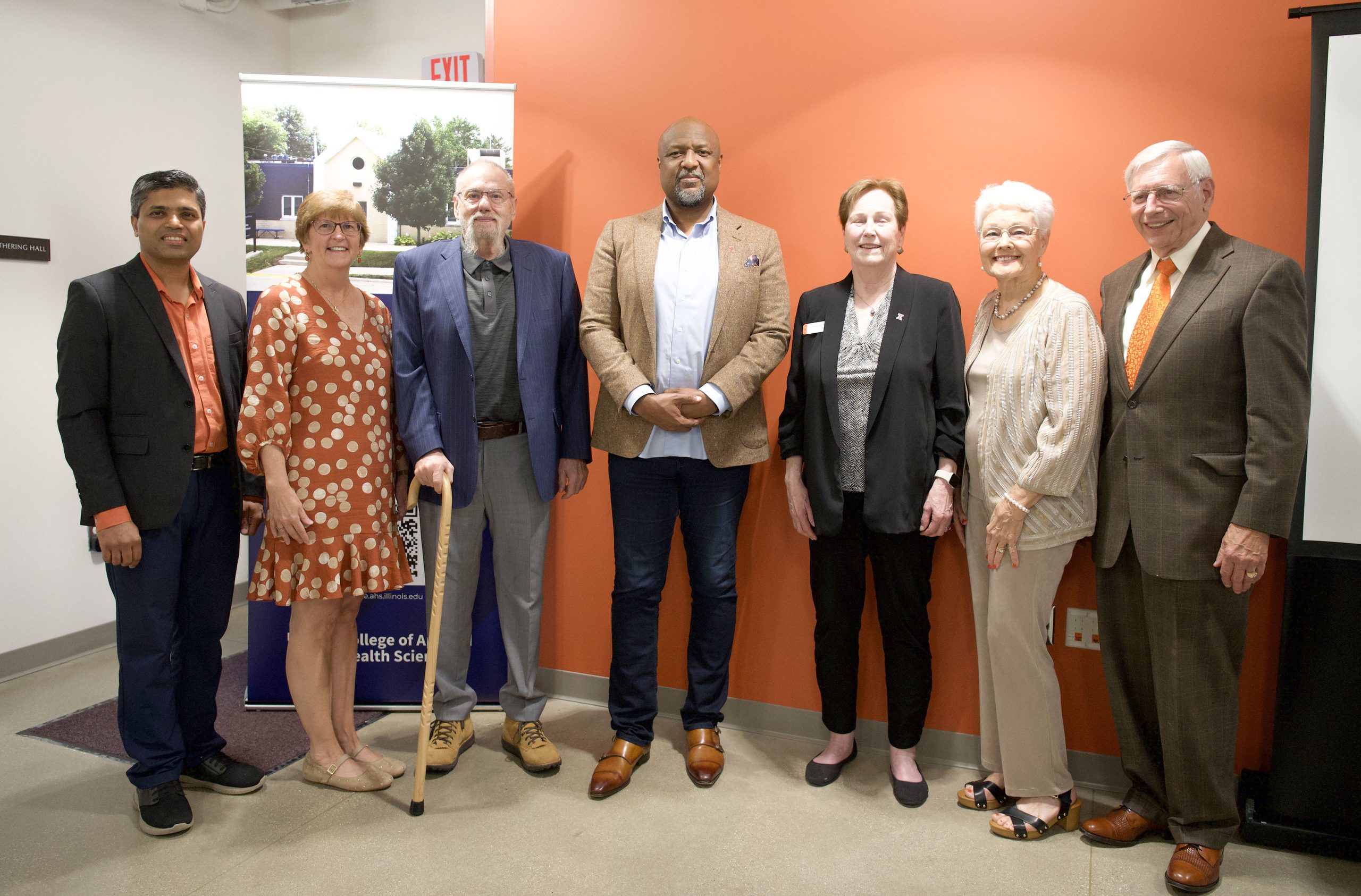
Dean Cheryl Hanley-Maxwell, left, stands with alumni award winners Michael Leach, Saul Morse and Walter Johnson. William Haskell was unable to attend the ceremony. (Photo by Jerry Thompson)
Young Alumni Award Michael Leach Recreation, Sport and Tourism
Michael Leach was appointed as the first-ever chief diversity and inclusion director for the White House in January of 2021. Leach, who earned his bachelor’s degree from RST in 2009, spent more than five years working for the National Football League on the NFL Management Council and later worked for the Chicago Bears and Miami Dolphins.
“I am truly humbled and honored to receive the 2023 Young Alumni Award from the University of Illinois at Urbana-Champaign,” Leach said. “My time in the College of Applied Health Sciences, and the institution more broadly, was nothing short of transformative.”
Harold Scharper Award Saul Morse Disability Resources and Educational Services
Saul Morse earned his bachelor’s degree (1969) and law degree (1972) at the University of Illinois and since has focused his practice on legislative matters, health law, insurance and municipal law. In 2010, with the passage of the Affordable Care Act, Morse was asked by the Illinois Department of Insurance to establish and manage an insurance pool for individuals with pre-existing health conditions.
“The Harold Scharper award is of great importance to me,” Morse said. “I came to the University of Illinois as a 17-year-old freshman. At the time, no other university in this country had a program which fully included students with a disability in all aspects of campus life, from academics to housing to activities. Most of what I have been able to do personally, professionally and within the broader community is due to the DRES program of the college.”
Distinguished Alumni Award William Haskell Kinesiology and Community Health
William Haskell is an internationally renowned researcher and emeritus professor of medicine at Stanford University. Haskell earned his Ph.D. in exercise physiology from the University of Illinois in 1966, and his work and achievements have clearly fulfilled the Illinois mission.
“It is truly an honor to receive the Distinguished Alumni award,” Haskell said. “Attending the University of Illinois at Urbana-Champaign offered me the opportunity to study and work with a large range of outstanding faculty and students, many of whom became exceptional leaders in exercise science research and teaching, as well as lifelong colleagues and friends.”
Walter Johnson Recreation, Sport and Tourism
Walt Johnson was born in Watseka, Ill., and graduated from the University of Illinois in 1958 with an undergraduate degree from the RST program. Later he entered the graduate program in RST and had the privilege of learning from both Professor Charles Brightbill and Dr. Alan Sapora. Upon graduation from the RST master’s program in 1962, Johnson moved immediately into a career in parks and recreation, where he served in a number of key leadership positions.
“The University of Illinois has always been the reason for my success and the lifestyle I live today,” Johnson said. “It gave me knowledge, hope and encouragement. Growing up on a farm and spending hours on a John Deere tractor since age 8, and milking cows, planting, cultivating and raising cattle and pigs, I determined I did not want to be a farmer.”
The Warrior-Scholar Project partners with American colleges and universities to host brief, intensive, no-cost college prep experiences for both enlisted Veterans and service members transitioning into civilian life
Photo by caption
For Chez Veterans Center director of operations Andy Bender, the function of the Warrior-Scholar Project is straightforward: Offer military Veterans a two-week-long academic “boot camp” to reacquaint themselves with the classroom environment before heading to a college or university.
“One of the hardest things a service member is going to do is leave the service,” Bender said. “We really enjoy having the Warrior-Scholar Project here because it reflects what we want to be a part of: Making that transition.”
In June 2024, the Chez Veterans Center, the hub for military Veteran populations at the University of Illinois, hosted a cohort of higher-ed-bound Veterans for the third year in a row.
The Warrior-Scholar Project partners with American colleges and universities to host brief, intensive, no-cost college prep experiences for both enlisted Veterans and service members transitioning into civilian life.
The Chez Center brought in Warrior-Scholars for the first time in 2022, with a week of STEM-centered coursework taught by Illinois faculty. This year’s edition doubled the session’s length, adding a Humanities track of classes for participants.
The cohort of 15 students and six fellows all hailed from outside of Illinois. Most hadn’t ever visited the Champaign-Urbana campus; though they may not choose Illinois for school, the experience still has a hand in their higher ed journeys.
The two-week schedule was filled with visits to various campus landmarks and labs, including the McKechnie Family LIFE Home, and a robotics and automation demonstration at the Agricultural and Bioengineering research farm. Humanities seminars focused on the United States’ founding principles and documents that the Veterans were sworn to defend.
Assistant Professor of Political Science Alicia Uribe-McGuire led one of their first seminars, teaching an engaged class on the origin and execution of the U.S. Constitution.
“I’ve always thought that the more a student wants it, the better a student they are. And I think they want it,” Uribe-McGuire said shortly after her seminar discussion. “I’ve had Veterans in my classes before, and they’re some of the best students.”
One frequent class contributor was Cody Lepp, an eight-year Navy SEAL who decided to return to school while still serving in the military. After three years taking online classes through National University in San Diego, Lepp is heading into his senior year and he wanted to use WSP to see how he measured up in the in-person classroom environment.
“I came in with an open mindset, hopefully I can learn some new things,” Lepp said. “What I hope to get out of it is practice applying my skills, seeing where I stand against the majority of my fellows.”
Jonathan Banasihan had spent seven years as a technician for the U.S. Navy when a new challenge—going back to school—entered his purview. The Warrior-Scholar Project seemed a great opportunity to refamiliarize himself with the flow of a classroom.
Banasihan, the son of Filipino immigrants, never thought college was an option. With a bachelor’s degree from American University and now planning to go to law school at George Washington University, Banasihan feels he left the academic boot camp with far more than advertised.
“I didn’t think that I could do the things that I did in college until I came here,” said Banasihan, now a facilitator for the Warrior-Scholar Project. “The confidence that WSP gave me to not just be uncomfortable, but to stretch myself in ways that I never really expected or wanted to was huge.”
Banasihan is ushering through student Veterans who were in his same position.
“UIUC has been an incredible, incredible partner. I can’t say anything but good things about this place,” Banasihan said.
Among Veterans’ challenges reintegrating after their service, higher education can be a “completely different animal,” Bender said.
“If you’re like some service members—if you’ve spent four, five, six years—how long has it been since you were in a classroom? You might have some of those creeping doubts come in. Can I make it? Am I going to fit in? Is this going to be successful?” he said.
“(WSP) is providing the confidence to these service members that we can do it. That there is a future beyond my service time. That there is a way to make it.”
Steve Serio celebrates Team USA’s Paralympic gold in Paris (Getty Images)
By VINCE LARA-CINISOMO
If this really was Steve Serio’s final Paralympic Games appearance, he went out in style.
The University of Illinois Urbana-Champaign alum had 24 points, 10 rebounds and eight assists as Team USA won its record third straight Paralympic Games gold medal, holding off Great Britain 73-69 in Paris.
“This team has grown so much over the course of the last couple of years,” said Serio, the five-time Paralympian, team captain and graduate of the College of Applied Health Sciences. “We knew that Great Britain was going to be a great opponent, a really tough group of guys. Right now, we’re just excited that we won a basketball game and got to bring home another gold medal for our country.”
Serio and Jake Williams combined for 19 points in the first quarter for the U.S., including a late 3-pointer from Serio to put Team USA in the lead. Great Britain clawed back within three points with three minutes to go in the game, but timely buckets from Serio, Williams, and Illinois alum Brian Bell as well as a few defensive stops put the game to bed. Team USA won its third consecutive gold medal—the first time that’s ever been accomplished—and its eighth all time.
Before the game, Serio said the Paris Games would be his last.
“This entire Games I’ve tried to be present,” Serio said. “Live in the moment more than I have in the past. You look at the game, you look at this experience a little bit differently when you know it’s going to be your last one. I can’t think of a better way to go out, I’m going to remember this for a really long time.”
The USA women’s wheelchair basketball team won a silver medal, falling short in its attempt at gold. The U.S. lost in the final to defending champ Netherlands, 63-49. The women’s team, which included Illini athletes Kaitlyn Eaton, Ali Ibanez and Emily Oberst, has not won gold since 2016.
In track and field, Illinois alum Susannah Scaroni took her fourth medal of the 2024 Games, winning bronze in the women’s marathon T54 came after a battle with Australian Madison de Rozario and China’s Zhaoqian Zhou.
“There was a moment in the race where Madison and I were working so hard and going back and forth and honestly, I didn’t care what color the medal was, but I was hoping she and I could get silver and bronze,” Scaroni said. “That’s what happened and I’m so happy for her.”
As for other Illini athletes competing in Paris, two-time medalist Daniel Romanchuk was Team USA’s top men’s finisher, taking fourth in the men’s T54 race with a time of 1:32.23. Romanchuk won the second Paralympic title of his career in Paris in the 5,000-meter T54 race on the track and also took bronze in the 400-meter.
Seven-time Paralympian Aaron Pike followed Romanchuk with a seventh-place finish in 1:36.23.
Matching Pike’s seventh-place finish on the women’s side was Tatyana McFadden, who won her 21st Paralympic medal in Paris and became the most decorated U.S. Paralympic track and field athlete in history.
Two-time Paralympic medalist Brian Siemann and two-time Paralympian Jenna Fesemyer rounded out Team USA’s results in 11th and 13th place in the men’s and women’s races, respectively. Siemann, who in his fourth Paralympic Games won his first two medals in Paris, finished in 1:51.56 while Fesemyer clocked a time of 2:05.42.
Students visited many noted tourism sites during the RST180 course this summer (Photo provided)
The Hall of Fame tour that serves as the essence of the Recreation, Sport and Tourism 180 experiential course has been the subject of much discussion since it was introduced in 2016.
The 12-day excursion component of the course—led by RST Clinical Associate Professor Mike Raycraft—spans more than 2,000 miles and has drawn attention from local news channels, magazines and newspapers over the years. Students visit notable tourism sites including the Rock and Roll Hall of Fame, the Baseball Hall of Fame and the NFL Hall of Fame as well as historic destinations in Ohio, New York, Pennsylvania and New Jersey.
But what makes the course so beloved by its participants? Students who took the course and went on the spring 2024 trip along with a few RST professionals who lead tours on the trip weighed in.
For Axel Mueller, a sophomore studying sport management, getting to know other students was what made RST 180 truly special.
“I was able to meet so many other people within the RST department and get a better understanding of the recreation and tourism side, because at school, I don’t ever see those people much.”
Mueller recalled one of the trip’s hiccups where the lift on their charter bus broke down during a rainy day in New York. The group had stopped for lunch at the famed Anchor Bar, the birthplace of Buffalo chicken wings, and on the way out the lift that was supposed to help Kendall Speaks, an RST major and wheelchair basketball team member, get onto the bus broke, leaving the group stuck in a parking lot for more than an hour.
“I had to squat down, have her wrap her arms around my neck, pick her up, and then carry her to her seat on the bus,” Mueller said. “Of course, Dr. Raycraft was able to arrange another bus that day.”
It was that type of attitude, from Mueller and others in the group, that turned what could have been a deeply frustrating situation into a humorous anecdote, and the tour continued without major issues after that point.
Another aspect of the course Mueller appreciated was getting the opportunity to talk to experts in his prospective field of sports management.
“It definitely opened my eyes a little bit—there’s so many things I can do with a sport management major,” he said. “I would say it broadened my perspective rather than narrowed it.”
Carter Blount, another sophomore in RST, put his perspective on the tour plainly:
“Professor Raycraft makes the trip,” he said. “ He’s done this for so long. He knows all these people and has crazy connections, and he definitely makes it enjoyable.”
Blount went on Raycraft’s spring break study abroad course to London, and despite the exhausting overnight flight and packed schedule, he enjoyed it and was influenced to enroll in the RST 180 course for the second half of the semester. Blount wasn’t alone in this; he said around 20 students who went to London that spring also enrolled in RST 180 this year.
A few fond memories for Blount included cramming into one hotel room with everyone to watch the NBA playoffs, walking the Princeton campus at night where he coincidentally met a student who had gone to the same high school as he did, and watching the sun set over the lake in Cooperstown, New York.
“I can’t think of a single night where I wasn’t in someone else’s room,” Blount said, referring to the close-knit evenings the group spent together after the day’s tours were done.
“It reaffirms my perspective that there are Illinois people everywhere, but also in places you would never think of,” Marshall said. “It’s a reminder to just keep my eyes open and look for connections wherever I can find them.
Todd Marshall
RST student
Blount spoke about the positive experiences the group had with their hosts, with the students who were able to ask questions about internships, careers and their own experiences breaking into the industry. He also discussed how the class itself enhances the trip, saying “you spent eight weeks studying the places you’re going to visit, so it’s cool to go see them all at the end.”
Todd Marshall, an RST graduate student at the University of Illinois, had a slightly different experience than the other students on the trip. As a graduate student working closely with Raycraft, he got an inside look at what it takes to organize and deliver experiential learning opportunities that will serve him well as he enters the field. Marshall was heartened by the large number of alumni they connected with at the locations they visited, taking the opportunity to learn from people not much older than him who successfully made it in the sport management industry.
“It reaffirms my perspective that there are Illinois people everywhere, but also in places you would never think of,” Marshall said. “It’s a reminder to just keep my eyes open and look for connections wherever I can find them.”
Chris Willis first met Raycraft in 2019, while he was doing research for his book on Red Grange, an Illinois alum who played for the Chicago Bears from 1929 to 1934 and is one of the most famous NFL players of the 20th century. When they met, Raycraft mentioned the tour, leading Willis to offer his expertise as head archivist at NFL Films in New Jersey. Despite the COVID-19 pandemic preventing the addition to the tour for a few years, eventually students were able to visit the studio, libraries and research facilities at the headquarters.
“We provided an overview and general information about what NFL Films does, and the facility is a big part of that,” Willis said. “We have everything under one roof.”
Willis is no stranger to hosting tours at the facility, saying they have around five or six per year, usually with friends or family of employees or groups of students like the ones from the Department of Recreation, Sport and Tourism. Willis confessed he enjoys leading student tours the most, saying he prefers “talking to a younger crowd.”
“Some of the subjects we study are between 50 and 100 years old, so it’s fun to interact with younger students or fans and show them what we do or talk to them about NFL history or the history of NFL films,” he said.
The highlight of the tour was the studio, according to Willis. Many students, sports fans themselves, recognized the place where many of the NFL’s talk shows are filmed and enjoyed seeing the back end of their favorite sports productions.
Mark Thomas found his love for working at parks while working at a summer camp in Rockford as a teen. After graduating from the department of Parks and Recreation (now RST) in 1975, he managed the grounds of a college campus for seven years until it closed. For a long time, Thomas found jobs outside of the industry, doing work in consulting, retail and politics before he was able to work his way back into parks, where he was asked to host RST 180 at Niagara Falls in 2016. At that point, he had been serving as the western regional director of state parks in New York since 2007, with a main office in Niagara Falls.
“I have a tremendous amount of experience,” Thomas said. “The students have a lot of great questions about the park, and so I’m able to elaborate on that for them.”
When the RST 180 students first arrived at Niagara Falls at night, the lights (a $4 million system whose installation Thomas took part in overseeing) shined orange and blue to welcome the tour, an experience cited by many students who went on the trip. They saw the natural landscape and participated in the Maid of the Mist boat tour offered by the American side of the park. Thomas said the students were curious and engaged with the tour, regarding both the history of the falls and the logistics behind managing them.
“They love the tourist experience—who wouldn’t, right? It’s a great experience, but they also embrace the learning aspect of the visit as well.”
Grace Burns, a senior majoring in statistics and minoring in RST with hopes to go into sports analytics post-graduation, was excited by the prospect of the course but admitted to feeling anxious about going on a long trip with complete strangers. Her worries ended up being unfounded.
“Going into it not knowing anyone, I was definitely really nervous,” she said. “I was like ‘Oh my gosh, what did I get myself into?’ But I met so many people. I’m almost glad I didn’t go with my friends because it allowed me to branch out more.”
Burns’ favorite memories from the trip include a night she and several other members of the tour went out for karaoke in Albany, and listening to a panel at the NCAA headquarters where she was able to speak to someone with a career in sports analytics and recordkeeping.
“That’s what initially got me into sports analytics,” she said. “I love all the records in sports, especially baseball—there seems to be a stat for everything. So, it was really neat to hear from him.”
RST 180 exemplifies the passion for educating, events and entertainment, and accommodating all who travel, whether they are sports fans, history buffs, or national park enthusiasts. The class and tour provide a unique experience for students that puts them on both sides of this transaction.
“I would encourage everyone to look into the class even if you’re not RST affiliated and even if you don’t know anyone,” Burns said. “It sounds clichéd, but it was really awesome, even if you’re not into sports.”
Marni Boppart, second from right, poses with husband Stephen, left, her daughters, and Chancellor Robert Jones, center. (Photo by Darrell Hoemann)
Marni Boppart’s trajectory to named professorship at the University of Illinois Urbana-Champaign began as a kid playing in the Pine Barrens of New Jersey.
Boppart, a professor in the Department of Health and Kinesiology in the College of Applied Health Sciences, was named the Saul J. Morse and Anne B. Morgan Professor at an investiture ceremony on Sept. 6.
But long before her illustrious career studying cellular biomechanics and muscle began, Boppart’s interests were taking roots in the woods.
“I would describe myself as a very active kid growing up,” she said at the investiture. “All our recreational time was spent outdoors playing baseball, basketball, kickball, riding my bike and jumping over ramps and doing crazy things that my mom still doesn’t know about. I grew up in in the Pine Barrens of New Jersey, and the woods were our playground. I mention this because it really influenced my decision to pursue my first degree in biology at the University of New Hampshire. This provided the opportunity to continue to explore the great outdoors, hiking, rock climbing, skiing, and even trying my hand at hang gliding—without hurting myself.”
As a biology major, Boppart was required to take a course in immunology and was assigned to write a paper on the effects of exercise on immune function.
“I thought, ‘Well, this was a really odd topic. What would exercise have anything to do with immune cells in the body? If you recall, the 80’s were defined by the fitness craze,” she said. “I think I still have my ThighMaster and Jane Fonda tapes sitting in a closet somewhere. The idea that exercise could be beneficial for health and prevent disease was still relatively new. What started as a simple class assignment grew into a life-long obsession with wanting to understand how exercise or the process of muscle contraction could benefit not only muscle, but all organ systems and whole body health.”
Boppart spent time in the Air Force as an aerospace physiologist, then decided to pursue a Ph.D. in Applied Anatomy and Physiology at Boston University. Working with two “powerhouse investigators” in the field of exercise science—Roger Fielding at BU and Laurie Goodyear at Harvard Medical School—the trio was able to document some of the first observations of molecular changes occurring in human muscle as a result of exercise.
“Like most researchers, I had more questions than answers at the end of my doctoral program: How does exercise, or the process of contraction stimulate molecular changes in muscle, what do these changes really mean for structure and function, and going back to my original interest, what is released by muscle into the circulation that might influence whole body health?,” she said.
For Boppart, those question led to what is now a 30-year career studying muscle.
Using transgenic mice, Boppart and her lab partners were able to determine that the integrin complex not only controlled molecular signaling in muscle, but also contributed to skeletal muscle remodeling and growth in response to exercise.
“But then everything changed in 2013,” she said.
That year, Boppart said, she and her lab mates were the first to report that exercise can result in the accumulation of perivascular stem cells in muscle.
“We found that these cells secrete beneficial factors that not only influence muscle remodeling and growth, but structures outside of muscle as well, including vessels and the brain. And so we started to wonder … could these stem cells be used to treat a disease or condition?”
Boppart’s interest in healthy aging led to a study of whether stem cells could be used to address age-related disabilities, particularly slowing the progression of muscle loss. While she found that stem cells were not effective in slowing the progression of muscle loss or regrowing muscle after disuse, she did find if she isolated nanoparticles (or extracellular vesicles or exosomes) from the stem cells first and then injected them into the aged mice, they could successfully recover muscle growth, which is the first step in preventing disability. That discovery led to new sources of funding, including funding from NASA and private foundations such as the Allen Institute.
Cheryl Hanley-Maxwell, dean of the College of Applied Health Sciences, praised Boppart and her work.
“Being named to an endowed position is a singular honor for faculty members,” Hanley-Maxwell said. “Those who hold named professorships are at the top of their fields, and that is certainly true of our honoree today. When I think of Marni, I think of unwavering integrity, deep intellectual curiosity, unconditional dedication to her students, and absolute passion for her work. And humility.”
The named professorship is endowed by Saul Morse and Anne Morgan. Morse earned two degrees at the University of Illinois, including a law degree and is an alumnus of AHS’s Disability Resources and Educational Services. He retired in 2023 after a 50-year career in law. Morgan is a clinical psychologist who retired after more than 30 years of practice in health psychology.
“I would like to thank our donors, Saul and Anne, for their generous contributions to the University of Illinois and the College of Applied Health Sciences,” Boppart said. “I am deeply honored and humbled by this recognition. And I am humbled because, as I look around the room, I see many experts in the fields of health, aging, and disability. To know that several of you nominated me for this award is a bit overwhelming. Thank you for this opportunity. I will remember tonight always.”
Boppart thanked her mentors, HK Department Head Kim Graber and Professor Jeff Woods, as well as her collaborators and colleagues.
Turning toward her future plans, Boppart is energized about what’s next.
“We would like to use our funding and this professorship to translate our EV therapy to humans. I’m confident we can do this,” she said. “Not only because clinical trials with stem cell-derived EVs are already occurring in the U.S. in places like the Mayo Clinic, but also because I have an amazing interdisciplinary research team to help make it possible.”
Wendy Rogers said she always planned to get the Health Tech program established and build a strong foundation before passing it on
Wendy Rogers, center, says Shannon Mejia, left, is ready to lead the Health Tech program (Photo provided)
Health and Kinesiology Professor Wendy Rogers, the founding director of the Health Technology Education Program in 2017, stepped aside in the summer of 2024 and Shannon Mejía, an associate professor in HK, was named her successor.
Rogers had already had an illustrious academic career, primarily at Georgia Tech, before coming to the University of Illinois Urbana-Champaign in 2017. Together with her husband, Dan Fisk—also a Ph.D. in the field of experimental psychology, Rogers created the Human Factors & Aging Laboratory in 2003 at Georgia Tech. After Fisk retired in 2013, Rogers relocated the lab to Illinois—where Fisk got his doctorate—four years later.
Rogers’ arrival at Illinois coincided with an Investment for Growth proposal led by the College of Applied Health Sciences and The Grainger College of Engineering aimed at developing the Health Technology Education Program. Health and Kinesiology Professor Jeff Woods, who spearheaded the IFG with Kesh Kesavadas, a professor of Industrial and Enterprise Systems Engineering, knew who he wanted to lead the Health Tech program.
“Jeff asked me if I would be willing to lead the educational component and I agreed,” said Rogers, who is the Shahid & Ann Carlson Khan Professor of Applied Health Sciences.
“We hired Nicole Holtzclaw-Stone in January 2018 and the four of us (Jeff, Kesh, Nicole, and I) spent a lot of time together developing the Health Technology Education Program,” Rogers said. “We shepherded our Master of Science in Health Technology through department and college educational policy committees, the Graduate College, the Faculty Senate, the Board of Trustees, and finally the Illinois Board of Higher Education. In December 2019, Nicole and I drove to Chicago for the Illinois Board of Higher Education meeting in case there were any questions but there were none and we were officially approved. We welcomed our first cohort in August of 2020,” during the COVID-19 pandemic.
Rogers said she always planned to get the Health Tech program established and build a strong foundation before passing it on.
“The time was right to transition to a new director, but we want to continue to build on the trajectory we are on,” she said. “The mission is to advance health technology education for learners at all levels through our interdisciplinary undergraduate certificate and minor (joint with Industrial & Enterprise Systems Engineering), our Master of Science in Health Technology (in collaboration with Grainger College of Engineering), and our Health Technology Professional Education Program.”
Mejía praised her predecessor’s vision.
“She led the development and implementation of an innovative education program that provides cross training in user needs, human factors and user experience methodologies, and engineering principles to develop leaders who can speak the language of both health care and engineering,” Mejía said of Rogers. “To address the critical challenges facing health care today, it is essential to understand user needs and technological capabilities in order to assure that technological solutions truly support the well-being of individuals, families, organizations, and communities. We train students to fulfill this essential role. This program is one of a kind in the nation. And it is my privilege to take the program to its next level.”
Rogers said the move was eased by knowing Mejía was ready to step in.
“Dr. Mejía has been an active member of the Health Technology Education Program since its inception,” Rogers said. “She is the right person at the right time to take the program to the next level. She has a lot of energy and creative ideas. Together, with Dr. Katelyn Talbott as the assistant director, I know the program will continue to be successful and to grow.”
For her part, Talbott said Mejía “has great ideas for growth and increased recognition in the field.”
“As with any change in leadership, new leaders are able to bring their perspectives to the challenges and goals in front of them,” Talbott said. “Shannon will be no different. I look forward to working with Shannon as we work to grow all aspects of the Health Technology program.”
Rogers will continue in her roles as director of the McKechnie Family LIFE Home, program director of CHART: Collaborations in Health, Aging, Research, and Technology and director of Human Factors & Aging Laboratory. “I have plenty to keep me busy and I look forward to having more time to devote to these activities,” she said.
As a recognition of their continued support of the MS-HT program, Rogers and Fisk have endowed the Wendy A. Rogers Health Technology Travel Award. The award will provide master’s students with the opportunity to travel to conferences to share their own work, to learn from other researchers, and to participate in networking opportunities. Additional donations to the fund are welcome and will help to provide travel support for more students.
Donation instructions for mail or online gifts are on uif.uillinois.edu/how-to-give. For online donations, in the dropdown menu under Gift Designation, click on the “Other” box and enter Fund #777754 or “Wendy A. Rogers Health Technology Travel Award” or write this information on the memo line of your check.
“In August of 2024 we welcome our fifth cohort into the program,” Rogers said of the Health Tech program. “Alumni from our program are already out in the working world making a difference in health technology to improve quality of life for all of us.”
Six-time weightlifing champion Andy Askow is pursuing a Ph.D. at the University of Illinois (Photo provided)
To anyone who knows Andy Askow, the marrying of his personal interests and research interests is no surprise.
The Ph.D. candidate in the Department of Health and Kinesiology is a six-time national powerlifting champion. He’s also planning to defend his dissertation in the fall and graduate from the College of Applied Health Sciences at the University of Illinois Urbana-Champaign in December.
Askow’s dissertation is focused on a randomized controlled trial aiming to understand the role of dietary protein distribution throughout the day and dietary protein source on daily muscle protein synthetic rates throughout a nine-day intervention.
“We can’t look at nutrition without working with the exercise component as well,” said Askow, whose advisor is HK Associate Professor Nick Burd. “Certainly, it cradles a holistic approach to research and setting up to research and setting up the experiments.”
Askow came to Illinois in 2019 after completing his master’s degree in exercise physiology and sport science at Texas Christian University. Before that, he completed his bachelor’s degree in kinesiology and exercise science at University of Wisconsin-La Crosse.
While at TCU, Askow—a Wisconsin native—came to Illinois for the summer to work as a research associate. During that time, he found he wanted to return to the Midwest for his Ph.D., and found a perfect fit in Burd’s Nutrition and Exercise Performance Group.
“We have an interest in trying to identify innovative approaches to promote muscle health across the lifespan,” Askow said. “And every day is complete chaos. It’s really inconsistent, but it’s a fun inconsistent. It doesn’t get stale, because nothing’s ever the same.”
Burd agreed.
“It’s always exciting,” Burd said. “Andy and I were just sitting here for a few hours this morning, trying to figure out some data sets. And I literally told him, ‘This is where you earned your Ph.D.’ It’s fun, being a critical thinker, and being in the trenches in terms of answering the questions, generating that cutting edge information and then sharing it with other people.”
In addition to carrying his course load and his workouts, Askow has also made time for awards. He’s won four scholarships, most recently the Laura J. Huelster Award in spring 2024.
“Being a Ph.D. student, there aren’t a lot of opportunities for external confirmation that you’re doing things the right way. Winning these awards has been a nice reminder that hard work pays off and that I’m on the right path.”
As for future plans, Askow has been collaborating with Dr. Andrew Jagim, the director of Sports Medicine Research at the Mayo Clinic in Wisconsin, and hopes to return there after graduation.
As much mentorship as he offers, Burd knows that students, especially doctoral students, have to be self-starters.
“I’m just there to help them stay afloat and steer them in the right direction, but they’re really doing it on their own,” Burd said. “They’re just very self-driven. I’m there to help create a positive learning environment for him and help culture those passions and foster those passions.”
“The people that have been here have been some of my closest friends and collaborators,” Askow said. “I think you can’t get through a Ph.D. without having a good group around you or, it’s certainly not going to be very nice if you try.”
The Audiology and Speech-Language Pathology Clinic at the University of Illinois, located at 2001 S. Oak St. in Champaign, was recently certified to provide services for patients covered by Medicare. To expand on this exciting change, The College of Applied Health Sciences spoke with Rabel Lohana, the clinic’s practice manager. This interview has been lightly edited for length and clarity.
A clinician speaks with a patient at the Audiology and Speech-Language Pathology Clinic, which is now Medicare-certified. (Photo by Brian Stauffer)
Q: Could you explain in your own words what this Medicare certification means for the clinic?
The Medicare status change aligns perfectly with our clinic’s mission to provide accessible and high-quality health care to our community. By becoming Medicare certified, we can now serve a broader segment of our population, particularly older adults and those with disabilities, and ensuring that everyone has access to the medical care they need. So that’s the most important thing for us, that we are able to complete and fully accomplish the mission that the clinic runs with.
Q: Does this change mean that more people in the community can access the clinic’s services than before?
Absolutely. We can extend our services to Medicare beneficiaries who may have previously faced barriers to accessing care at our clinic because we were not Medicare certified. So this means a significant portion of our community, especially older adults, will now have more options for their health care needs.
Q: Has this change already taken effect, or is there still some time until these people can access the clinic?
It takes effect immediately. We are accepting Medicare patients and provide them with full range of services our clinic offers. We are good to go.
Q: For those who have never even heard of the clinic or been around it before, could you describe how the clinic functions and the people that are running it?
It’s a teaching facility, so we have students in our clinic. They are supervised by our ASHA-certified clinicians. We have staff members, me as practice manager, and a clinic business specialist who takes care of our billing, our pre-authorization for insurances. We have five SLPs and one audiologist right now. It’s a teaching facility. We provide a great experience for our students, a learning experience. But they are always supervised by our clinicians.
Q: For the students, how do you think this Medicare certification will affect their learning? What kind of opportunities do you think it’s going to afford them?
This change significantly enhances student opportunities to apply their learning in real-world scenarios. With a broader patient base, students will have the chance to encounter a wide variety of medical conditions and treatment scenarios. This will allow specifically seeing the older population that they were not able to see when we were not Medicare certified, which is invaluable for their education and professional development.
Q: Are you anticipating an increase in how many people are coming by to schedule appointments because of this change?
Yes, we do anticipate an increase in utilization of our services. We have a few patients on the waitlist in audiology and a few clients in speech-language pathology services, and we have scheduled them. And we do expect to see the increased flow of that population at our clinic.
Q: For people that are interested in using these services, how can they find out whether they’re eligible to use the clinic, whether they’re on Medicare or not?
We will be updating probably our website with that information. They can go to our clinic website, shsclinic.shs.illinois.edu, and look at the insurances we accept. And Medicare is one of those.
Along with that, we are trying to do some of our outreach events, where we would be educating our community by letting them know that this is what now we are accepting. Also, we do appreciate people calling us and knowing more about the services and the insurance benefits that they can get from a clinic. We are open to accept a variety of insurances. Please call us and find out at (217) 333-2205.