New program helps student Veterans navigate transition to campus life


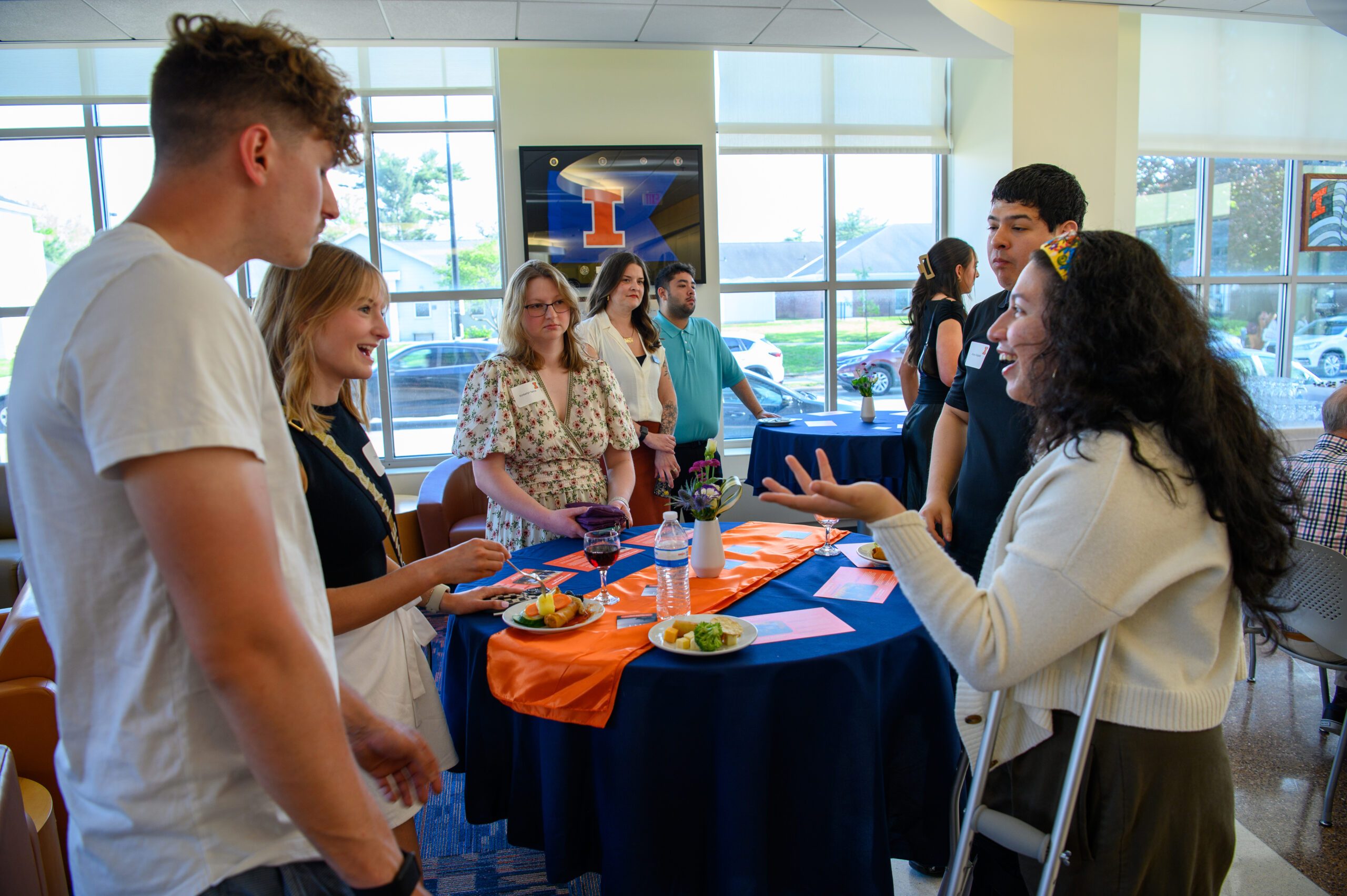
The VRTP connects students with individualized guidance and campus resources (Photo by Ethan Simmons)

For many military Veterans, the transition from active service to college life can be as challenging as any mission they faced in uniform.

The loss of structure, leadership and a clearly defined sense of purpose often coincides with the demands of navigating an unfamiliar university system, balancing family and financial responsibilities and determining a new professional direction.

A new initiative at the University of Illinois Urbana-Champaign aims to ease that transition.

The Veteran Residential Transition Program, or VRTP, housed at the Chez Veterans Center, was created to support Veterans as they move from military service into higher education. The program combines housing assistance, individualized case management, career development and academic support to help student Veterans establish stability and build a path toward long-term success.

“Success isn’t about how students use a program; it’s about how they move forward over time,” said Ingrid Wheeler, associate director of student success and wellbeing at the Chez Veterans Center.

Wheeler said many Veterans arrive on campus highly capable but suddenly without the structure that guided their military experience.

“In the military, individuals operate within a highly structured system with clear leadership, direction and shared purpose,” she said. “When they leave, that system is gone almost overnight. Even highly capable people can suddenly find themselves without a clear sense of direction or support.”

Rather than focusing solely on services or engagement activities, VRTP was designed to help rebuild the conditions that allow Veterans to make meaningful progress toward goals they define for themselves.

The program emphasizes early stability through housing and structured support, while connecting students with individualized guidance and campus resources. At the center of the model are case managers, who work one-on-one with participants throughout their transition.

“Case managers play a central role,” Wheeler said. “They provide a form of transitional leadership, helping students make sense of their situation, identify next steps and connect to the right supports at the right time.”

Success isn’t about how students use a program; it’s about how they move forward over time.”

Ingrid Wheeler

Associate director of student success and wellbeing, Chez Veterans Center

The goal, she added, is not to create dependence on the program but to help students regain confidence and independence.

“The goal isn’t to keep students connected to VRTP,” Wheeler said. “It’s to help them regain structure, find direction and move forward confidently without needing us.”

A key component of the program is the Individualized Transition Plan, which helps students identify priorities, set goals and assess their progress. Unlike a traditional roadmap, however, the plan is designed to evolve as students’ needs and aspirations change.

“We expect it to change, and when it does, that’s often a sign that progress is happening,” Wheeler said.

Case managers use the plans as a framework for ongoing conversations, helping students evaluate challenges and opportunities as they arise. Progress is measured through multiple indicators, including academic performance, personal stability, career development and tools such as the Military Transition Scale, developed by Health and Kinesiology Associate Professor Chung-Yi Chiu.

To develop the scale, Chiu conducted interviews with 16 student veterans to better understand their experiences transitioning from military service to higher education. Based on these interviews, she created the Military Transition Scale and collaborated with Dustin Lange, assistant director of the Chez Veterans Center, along with several student Veterans, to ensure the items were meaningful, relevant and easy to understand. Additional data collection was conducted to validate the scale across the nation. Michael Lotspeich-Yadao, assistant director of research and evaluation at Chez, has assisted in survey data collection.

Chiu said the Military Transition Scale evaluates several dimensions of transition experiences, needs and challenges, including motivation; career trajectory; social networking and support system; effective study skills; benefits of military service; self-awareness; existing and future resources; barriers, personal strength, and coping; and attitude toward veterans. These dimensions highlight the complex and multidimensional nature of the transition process.

Chez uses the scale to assess how well student veterans have adapted to higher education while balancing new academic roles with existing personal and family responsibilities, Chiu said. Based on the results, case managers can identify needs and connect student veterans with appropriate resources and services. Because transition is dynamic and changes over time, the scale can also be administered periodically to monitor progress and adjust support accordingly. The goal of the Military Transition Scale is not simply to identify challenges, but to help student Veterans thrive and successfully integrate their military experiences into meaningful academic and civilian lives.

Rather than focusing solely on graduation rates or retention statistics, Wheeler said the program emphasizes what she calls “trajectory”—the direction and quality of a student’s progress over time.

“Traditional metrics tell you where someone ended,” she said. “Trajectory tells you what it took to get there and whether it will sustain.”

One student’s experience illustrates the approach.

A Veteran enrolled in VRTP entered the university uncertain about academic and career goals. While taking a career development course designed for military-connected students, it became apparent that the student’s aspirations differed from more conventional career pathways. A theater major interested in costume design for theater and film productions, the student needed support tailored to a creative profession.

Program staff responded by connecting the student with industry professionals, including leaders at Flyover Film Studios in Rantoul, Illinois, and an Illinois alumnus working in the field. The student received individualized coaching to develop a professional resume and online portfolio showcasing costume design and theater work.

The result, Lange said, was far more significant than a potential internship opportunity.

“The most significant outcome was not simply the possibility of an internship or future employment opportunity,” he said. “It was the transformation from uncertainty and limited career direction to a clear professional pathway supported by industry connections, mentorship and a growing sense of confidence.”

The program also recognizes that practical concerns and personal growth are deeply interconnected.

“We don’t treat those as separate things,” Wheeler said. “You can’t think about purpose when you’re just trying to stay stable.”

By addressing housing, finances and other basic needs first, the program creates conditions that allow students to focus on larger questions about identity, career direction and life after military service.

Creating a sense of belonging is another priority. Wheeler said VRTP encourages connections among Veterans while also helping students build relationships across the broader university community.

“Our goal isn’t to be the one place students belong,” she said. “It’s to help them build belonging across the places where their lives actually happen.”

To achieve that, the Chez Veterans Center works with academic units, campus offices and community partners to ensure Veterans encounter supportive environments throughout campus and beyond.

“Students don’t need one place to belong,” Wheeler said. “They need to feel like they belong in their classes, their workplaces and their broader lives.”

As the program continues to grow, Wheeler said future expansion efforts would focus on strengthening the elements that have proven most effective: reaching students earlier, increasing access to stable housing and improving coordination among academic, career and health services.

“Growth only matters if it preserves what makes the model work,” she said.

Ultimately, Wheeler said, the program’s mission remains straightforward.

“The goal is simple,” she said. “Help more students move forward, without losing the quality and timing of support that makes that possible.”

Editor’s note:

To reach Vince Lara-Cinisomo, email vinlara@illinois.edu.
 

Share on social

Related news

At 10 years, Chez Veterans Center honors its family and friends


After long journeys to Urbana-Champaign, the Chez family joined each other at the campus center bearing their name, beaming with pride. 

The Chez family (from left: Ilyse Chez, Eden Macknin, Julie and Eric Chez) smiles at the 10th anniversary celebration of the center.

Thirteen years ago, Ron Chez—a 1962 University of Illinois graduate and Army veteran turned investor and philanthropist—provided a lead gift to build the Chez Veterans Center. Since then, the campus hub has assisted the transition to higher education and beyond for many hundreds of student Veterans and military-connected students since its opening a decade ago. 

Though Ron couldn’t be there for its 10-year anniversary, his son Eric, daughter-in-law Julie and granddaughters Ilyse and Eden traveled from locations across the country to attend on his behalf, and see the center’s community reflect on its first 10 years.

As they mingled with students and recent graduates who have benefited from the Chez Veterans Center, the family was moved to see Ron’s commitment realized before them. 

“It’s something we’re going to look at with continual pride, the growth and change of direction from where it was 10 years ago,” Eric Chez said. “Seeing that it’s all working and paying off is very rewarding.” 

The Chez Veterans Center has evolved since its doors first opened in 2015. Initially named the Chez Center for Wounded Veterans in Higher Education, the center’s scope has expanded to support new generations of student Veterans who didn’t see combat, as well as students from military families. The name was shortened to the Chez Veterans Center in 2019, after students and staff supported the change. 

With residential services available for student Veterans, combined with research opportunities, scholarships, classes and counseling, the Chez Veterans Center is a first-of-its-kind facility supporting Veterans’ transition to university life. On average, about 600 students have visited the center each semester since its opening. 

“The Chez Veterans Center is more than a building—clearly,” said Cheryl Hanley-Maxwell, dean of the College of Applied Health Sciences, the center’s home college. “It’s a space for healing, discovery, growth and empowerment. Every day it opens doors to Veterans who are reshaping their lives through educational service.”

“We’re honored to have the Chez family members here who carry forward Ron’s vision with compassion and grace,” she said at the center’s 10-year celebration. “I can’t tell you how much your presence means to our community.”

‘What a beautiful place’

In his early days as director of the Chez Veterans Center, Andy Bender was looking for as much thoughtful guidance as he could find. His chats with Ron Chez, including a visit to his home in Florida a couple years ago, helped Bender as he was getting on his feet. 

“Mr. Chez has been willing to listen to me, to guide and to provide advice and support,” Bender said. “To be honest, I don’t think I’ve ever had the experience where somebody is willing to give that kind of time in this way.” 

The 10-year celebration held on May 8 brought together the center’s students, staff and supporters together under one roof. It was the first time the Chez family visited the center together since its groundbreaking ceremony in Urbana, back in fall 2013. 

Cheryl Hanley-Maxwell, dean of the College of Applied Health Sciences.

Hearing stories of how the center has made a difference in students’ lives touched the Chez family, including Ilyse Chez, who works as a middle school counselor in Oregon. 

“What a beautiful place,” she said. “I think I underestimated all the aspects here. I wasn’t aware of how much it’s grown and expanded, and to see the benefits in action has been such a wonderful experience.”  

Back in 2012, Ron Chez pledged $6 million to cover nearly half of the center’s construction costs. The Chez Family Foundation has continued philanthropic work across the country and the Illinois campus, including a scholarship program for students with disabilities.  

“Being a Veteran is a really big part of his identity, and to begin to do something like this and create such a meaningful and profound impact like this is really special to him,” said Ron’s granddaughter Eden Macknin. “He feels a great deal of pride and gratitude to be able to provide for people who haven’t been taken care of as they should.” 

One graduating senior who stuck around for the festivities was Sam Bautista, a four-year Air Force Veteran who’s obtaining his degree in Community Health at Illinois. Bautista is keenly aware of how the Chez Veterans Center played a “crucial role” in his adjustment to college. 

“Veterans transitioning out are told by society that you need to ‘fit in’ to what society is. And that’s true in many aspects, but to have a place where you’re surrounded by Veterans who understand your experience, that’s what Chez provides for all of us here,” Bautista said. “The friends I’ve made here have said it’s one place for Veterans to call home while here at Illinois.” 

Education was always Bautista’s end goal. His next stop is a graduate program at the University of North Carolina at Chapel Hill. 

“A lot of Veterans are hard on themselves—they need to give themselves credit for what they’ve done but then move onto their next chapter and enjoy it too,” he said. “Veterans are go-getters, we’re trained to be, it’s ingrained in us. When we find that passion again, you can reignite the fire you have in the military.” 

Sam Bautista (right) speaks with Michael and Susan Haney at the Chez Center’s 10th anniversary celebration.

A few key supporters were recognized for making the work of the Chez Veterans Center possible. 

  • Joe Rank, an Illinois alumnus, Vietnam War Veteran and member of the Chez advisory board, was presented the center’s inaugural Guidon Award for his continued partnership with the center. 
  • Susan and Michael Haney, alumni and longtime educators whose Ronald D. Paulsgrove Student Support Fund, named for Susan’s cousin who served in Vietnam, covers the non-academic costs of college for student Veterans
  • Naomi Winslow, who decided to honor her late husband Wayne, an Army and Air Force Veteran, by providing a named gift to the Chez Veterans Center. The center’s common area kitchen is now named after the couple. 
  • Tanya Gallagher, previous dean of the College of Applied Health Sciences who championed the Chez Center’s creation while she worked for Illinois. Gallagher was presented with a flag that had flown over the center.

Editor’s note: To learn more about the Chez Veterans Center, visit chezveteranscenter.ahs.illinois.edu

Share on social

Related news

(Joe) Rank and file: Retired Naval officer became a Chez Center guide


Now retired, Joe Rank, left, is using his time to help support the Chez Veterans Center. (Photo provided)

By fall 1965, the conflict between North and South Vietnam had escalated, as had the United States’ military involvement. With the draft looming, Urbana teenager Joe Rank, newly enrolled at the University of Illinois, joined the Naval ROTC unit at the advice of one of his fraternity brothers a year after reserve officer training was no longer compulsory.

After four years as an undergraduate student majoring in advertising, Rank was deployed to Vietnam, where his responsibilities included pinging enemy submarines and managing gunners aboard the destroyer USS Lyman K. Swenson and the cruiser USS England.

Following his three-year tour, Rank returned to the university and embarked on several career journeys. He taught new cohorts of reserve officers, helmed a $20 million Navy advertising campaign, and developed two decades of relationships at the University of Illinois Alumni Association.

“If anybody 55 years ago said, ‘You’re going to make a career of the Navy,’ I would’ve told them they were absolutely crazy,” Rank said. “All of life’s twists and turns, I couldn’t have planned it.”

The retired Rank, now 76, is helping sustain a campus resource he could’ve used as a military veteran who returned for further education: the Chez Veterans Center.

“Joe is a bridge between the university’s deep history in the veteran community and what the future can be,” said Chez Director of Operations Andy Bender. “Joe has the passion for this work, being able to take the things we need and then bringing in the support to do it.”

“They’ve got a clear mission now to serve all veterans,” Rank said of the Chez Center. “Veterans bring diversity to the campus.”

Rank, who lives in Urbana with his wife, Pam, has strong ties with his identities as an Illinois alumnus and veteran. While visiting the Vietnam Memorial Wall, Rank made a charcoal rubbing of the etched name of Marine Corps 2nd Lt. David Skibbe, a fellow Illinois Naval ROTC officer who died during a mission in 1970.

When he returned from Vietnam, Rank became an instructor for Illinois ROTC classes, earning the title of assistant professor of naval science while obtaining his master’s degree in advertising.

Three years of 18-hour days in Vietnam made the daily study grind feel easy.

Veterans bring diversity to the campus.

Joe Rank

Illinois alumnus and retired Naval officer

“I was at the library at 8 o’clock in the morning, got my work done by 4 p.m.,” Rank said. “I had that discipline—I got one B in graduate school.”

Rank soon went back to sea, when the Navy did something that “didn’t make much sense” to him at the time: Brought Rank in as director of national advertising for Navy recruiting.

After 20 years of active-duty service, Rank faced the test of reintegrating into civilian life and passed with flying colors. The mission of the Chez Center has connected with him from the start.

While serving as vice president of membership and marketing at the Alumni Association, he was brought into an ad hoc committee to address the vision of Chez, then known as the Center for Wounded Veterans in Higher Education.

“The intent was it would be much like [Disability Resources and Educational Services] was for the World War II vets. It would accommodate severely, profoundly injured military veterans who wanted to come back to college.”

Like DRES, Chez has morphed its service to apply to a wider range of students and staff. On the advisory committee, the word “wounded” was eliminated from the title as Chez became a one-stop shop for military-connected people on campus.

“Originally, it was a welcoming cocoon for people to recreate that military atmosphere and camaraderie. But in reality, the whole idea is to get people comfortable enough with the university and the civilian environment and push them out, get them involved in their major,” Rank said.

“The idea is not to segregate them into a pseudo-military unit, but get them comfortable with what they’re going to experience in civilian life.”

Rank’s support of the Chez Center is multifaceted as both a donor and member of its advisory board.

“He’s a great sounding board for me,” Bender said. “He’s been a part of this project since the very beginning. “He’s a great supporter of us, of the veterans, and of the university at large.”

Editor’s note:

To reach Ethan Simmons, email ecsimmon@illinois.edu.
 

Related news

Chez Veterans Center again plays host to Warrior-Scholar Project


Photo by caption

For Chez Veterans Center director of operations Andy Bender, the function of the Warrior-Scholar Project is straightforward: Offer military Veterans a two-week-long academic “boot camp” to reacquaint themselves with the classroom environment before heading to a college or university. 

“One of the hardest things a service member is going to do is leave the service,” Bender said. “We really enjoy having the Warrior-Scholar Project here because it reflects what we want to be a part of: Making that transition.” 

In June 2024, the Chez Veterans Center, the hub for military Veteran populations at the University of Illinois, hosted a cohort of higher-ed-bound Veterans for the third year in a row. 

The Warrior-Scholar Project partners with American colleges and universities to host brief, intensive, no-cost college prep experiences for both enlisted Veterans and service members transitioning into civilian life.

The Chez Center brought in Warrior-Scholars for the first time in 2022, with a week of STEM-centered coursework taught by Illinois faculty. This year’s edition doubled the session’s length, adding a Humanities track of classes for participants. 

The cohort of 15 students and six fellows all hailed from outside of Illinois. Most hadn’t ever visited the Champaign-Urbana campus; though they may not choose Illinois for school, the experience still has a hand in their higher ed journeys. 

The two-week schedule was filled with visits to various campus landmarks and labs, including the McKechnie Family LIFE Home, and a robotics and automation demonstration at the Agricultural and Bioengineering research farm. Humanities seminars focused on the United States’ founding principles and documents that the Veterans were sworn to defend. 

Assistant Professor of Political Science Alicia Uribe-McGuire led one of their first seminars, teaching an engaged class on the origin and execution of the U.S. Constitution. 

“I’ve always thought that the more a student wants it, the better a student they are. And I think they want it,” Uribe-McGuire said shortly after her seminar discussion. “I’ve had Veterans in my classes before, and they’re some of the best students.”

One frequent class contributor was Cody Lepp, an eight-year Navy SEAL who decided to return to school while still serving in the military. After three years taking online classes through National University in San Diego, Lepp is heading into his senior year and he wanted to use WSP to see how he measured up in the in-person classroom environment. 

“I came in with an open mindset, hopefully I can learn some new things,” Lepp said. “What I hope to get out of it is practice applying my skills, seeing where I stand against the majority of my fellows.”
 
Jonathan Banasihan had spent seven years as a technician for the U.S. Navy when a new challenge—going back to school—entered his purview. The Warrior-Scholar Project seemed a great opportunity to refamiliarize himself with the flow of a classroom. 

Banasihan, the son of Filipino immigrants, never thought college was an option. With a bachelor’s degree from American University and now planning to go to law school at George Washington University, Banasihan feels he left the academic boot camp with far more than advertised. 

“I didn’t think that I could do the things that I did in college until I came here,” said Banasihan, now a facilitator for the Warrior-Scholar Project. “The confidence that WSP gave me to not just be uncomfortable, but to stretch myself in ways that I never really expected or wanted to was huge.” 

Banasihan is ushering through student Veterans who were in his same position. 

“UIUC has been an incredible, incredible partner. I can’t say anything but good things about this place,” Banasihan said. 

Among Veterans’ challenges reintegrating after their service, higher education can be a “completely different animal,” Bender said. 

“If you’re like some service members—if you’ve spent four, five, six years—how long has it been since you were in a classroom? You might have some of those creeping doubts come in. Can I make it? Am I going to fit in? Is this going to be successful?” he said. 

“(WSP) is providing the confidence to these service members that we can do it. That there is a future beyond my service time. That there is a way to make it.” 

Editor’s note:

To reach Ethan Simmons, email ecsimmon@illinois.edu.
 

Share on social

Related news

Chez Center hosts program to ready veterans for higher ed


Apsan Bishwokarma looks over notes in a Warrior-Scholar Project class, hosted at the Chez Veterans Center. (Photo by Ethan Simmons)

While Adam Sherman Jr. sat for the two-hour bus ride from Chicago O’Hare Airport to the University of Illinois Urbana-Champaign campus, a pit was forming in his stomach. 

He’d spent six years in the Navy, stationed in Japan and California for three years apiece, sometimes working out at sea for six or 12 months at a time. But a few preparatory problem sets for the Warrior-Scholar Project’s academic boot camp had him stumped. 

“I didn’t know if I’d be able to knock off the dust and the rust to get going in this program,” said Sherman, who grew up in New Jersey. 

After spending four days in the camp absorbing astronomy and physics lectures from University of Illinois faculty at the Chez Veterans Center, Sherman’s first taste of higher education was going “really smooth,” he said. 

“They broke it down in a way that’s really digestible, and they’re building it up in a way where it’s really fast-paced, but it’s comprehensible,” he said.  

This July, 15 student Veterans took classes and teamed up on projects in the Chez Veterans Center, the University of Illinois’ one-stop shop for military-connected students. The center has hosted the nonprofit Warrior-Scholar Project for the three consecutive years. 

The Warrior-Scholar Project, or WSP for short, takes place in college campuses across the country as an eight-day higher ed experience for military Veterans of all ages. 

The WSP and Chez Veterans Center’s missions are aligned—both are dedicated to easing the transition of military-connected students back into education and civilian life. 

“The premise of WSP is really about showing them they can do it, giving them the confidence they can leave the military and go to a place like the University of Illinois,” said Chez Veterans Center Director of Operations Andy Bender. 

“I think what’s great for us in particular is (WSP) follows our mission. We’re all about the successful transition from the military into higher education—this is a good steppingstone for it. But it also gets a lot of our campus partners who may not have connections to the military to come and meet these students.” 

WSP Education Programs Coordinator Rebecca Mills called Illinois’ Chez Veterans Center one of the program’s “top campus stakeholders,” for going “above and beyond” for student cohorts. A core component for both organizations: Showing Veterans that the talents they’ve built in the service are transferable to the classroom.

“It’s less the content—we know they’re capable, we know they have the experience. But how do they use the skills they developed in the military to be successful in higher ed?” Mills said. 

Warrior-Scholar Project student-veterans chat during a tour of Hourglass Medical in Illinois Research Park, alongside Chez Veterans Center staff.
A whopping 88 percent of Warrior-Scholar Project alumni have either obtained a college degree or are on track to complete one (Photo by Ethan Simmons)

Some students, such as Sherman, enter the Warrior-Scholar Project with no college credits. Others, such as Sergio Perez Jr., a 26-year-old Marine Corps veteran from Oklahoma, used WSP to re-familiarize himself with the pace of university life.  

When he left the service in October 2023, he “had one goal in mind: and that was to go back and finish my degree,” he said. 

“For me, WSP was a ‘two birds with one stone’ type of deal, because University of Illinois was actually one of the schools I’m thinking about applying to in the future,” Perez added. “When I saw they still had openings for this, I thought, ‘You know what? I can do a quick campus tour while still self improving.’ So this has given me a better understanding of how this campus functions.”

A whopping 88 percent of Warrior-Scholar Project alumni have either obtained a college degree or are on track to complete one, according to their internal statistics. This year, Illinois also hosted WSP’s annual alumni conference, where bootcamp graduates return to network and listen to industry professionals with military connections. 

A Veteran careers panel discussion included Mona Dexter, Comcast’s vice president of Military and Veteran Affairs; Michael Pett, Uber’s head of Military and Veteran Programs at Uber; Erica Jeffries Purdo, vice president of Strategy and Operations at Johnson & Johnson; and Tommy Jones, senior director of Military and Talent Programs at Walmart. 

During the campus visit, the student cohort got to tour Research Park businesses such as Caterpillar’s Innovation Center and Hourglass Medical, a wearable technology company. Before they left campus, Chez staff brought them to a celebratory visit to the Colonnades Club in Memorial Stadium, itself a tribute to U. of I. veterans who fought in World War I. 

“Illinois might be one of the best-kept secrets in higher ed; You walk into a building and learn about a Nobel prize winner who invented something you use every day,” Bender said. “We’ve had a couple people who’ve told us, ‘I wanna come here.’”

Editor’s note:

To reach Ethan Simmons, email ecsimmon@illinois.edu.
 

Related news

College of Applied Health Sciences
110 Huff Hall
1206 South 4th Street
Champaign, IL 61820
(217) 333-2131