Roots and reach: Malandraki named Khan Professor in Applied Health Sciences 


Georgia Malandraki, center, called the professorship a milestone and a homecoming (Photo by Mike Heiniger)

The investiture of Georgia Malandraki as the Shahid and Ann Carlson Khan Professor of Applied Health Sciences was, in many ways, a story about roots and the far-reaching branches they sustain. 

Held at Huff Hall, the ceremony brought together university leaders—such as Provost John Coleman—faculty, family, mentors and donors to celebrate Malandraki’s appointment to one of the college’s most prestigious endowed positions. The event underscored both her global impact as a scientist and clinician and the philanthropic vision that made the professorship possible. 

“This is a special occasion, not only for our college and university, but for the broader community,” said Cheryl Hanley-Maxwell, dean of the College of Applied Health Sciences. She described endowed professorships as among the most meaningful traditions in academia, recognizing excellence while enabling innovation through donor support. 

The professorship is funded by Shahid Khan and Ann Carlson Khan, whose longstanding ties to the university date back to their time as students. Their contributions span multiple colleges and initiatives, including major investments in facilities, academic programs and community outreach. 

Shahid “Shad” Khan, who arrived in the United States from Pakistan to study industrial engineering, built a business empire after purchasing automotive supplier Flex-N-Gate. Ann Carlson Khan, who studied business at Illinois, later turned her focus to philanthropy, helping guide the family’s charitable efforts through the Khan Foundation. Together, they have supported causes ranging from education and the arts to healthcare and community development. 

“It’s absolutely a joy and a privilege to be here … and all the ideas and thoughts we’ve had (and) what we wanted to do here, and it’s wonderful to see it come to life,” Shad Khan said. 

Their gift establishing the Khan Professorship reflects a commitment to advancing research and leadership in applied health sciences. “Because of you, we are able to support leaders like Dr. Malandraki, whose work is improving lives across the globe,” Hanley-Maxwell said. 

For Malandraki, the honor marks both a professional milestone and a personal homecoming. 

An internationally recognized expert in swallowing disorders, she returned in January to her alma mater, Illinois, as head of the Department of Speech and Hearing Science after building a distinguished career at Purdue University. There, she led pioneering work in the Imaging, Evaluation, and Treatment of Swallowing Research Laboratory and Clinic, advancing understanding of how the brain controls swallowing and developing new approaches to rehabilitation. 

Her research—supported by the National Institutes of Health and other major funders—has explored cutting-edge interventions, including telehealth and wearable technologies designed to expand access to care. Her work has earned numerous accolades, including the American Speech-Language-Hearing Association’s Early Career Contributions in Research Award and designation as an ASHA Fellow. 

Yet in her remarks, Malandraki focused less on accolades and more on the journey that led her to the moment. 

“I’m profoundly humble to be given this distinguished honor and opportunity,” she said. 

Born and raised in Crete, Greece, Malandraki is a first-generation college student whose path to academia was shaped by family, perseverance and early exposure to the transformative power of education. She recalled leaving Greece in 2002 for the United States with a book gifted by her sister, containing a handwritten Cretan poetic verse (mantinada) that would come to define her outlook: “Tree branches must never forget their roots, for when the roots run dry, the branches wither, too.” 

Those roots, she said, began with her parents, Maria and Andreas Malandrakis, who never had the chance to attend college but insisted their children would. Education was not optional in their household; it was woven into daily life. 

“My earliest memories are of our family gathered around the kitchen table, everyone studying,” she said. “Reading and education were simply part of daily life. My mother survived World War II as a child. (My parents) raised six children, and I was, believe it or not, the sixth. My mother often joked that raising me felt like raising six more all at once. Despite the issues they faced, including raising me, there was never any debate in our home. Their children would have the opportunities today they themselves did not.” 

Tree branches must never forget their roots, for when the roots run dry, the branches wither, too.

Georgia Malandraki

SHS Department Head and Professor

Another formative influence was her nephew, Telemachus, who was born when she was 10 years old. Telemachus was diagnosed with autism at a time when speech and support services were scarce. Watching her family navigate those challenges helped shape her decision to pursue speech and language therapy, first in Greece and later in the United States. 

“Growing up alongside Telemachus, I witnessed firsthand both his challenges and my family’s determination to support him, an experience that profoundly shaped my career path,” she said. 

She earned her bachelor’s degree at the Technological Educational Institute of Patras, followed by a master’s degree from Ohio University and a doctorate from Illinois, making her return to campus especially meaningful. 

“This moment is a full circle,” Hanley-Maxwell noted in introducing Malandraki. 

Colleagues describe Malandraki as a leader who blends rigorous science with compassion and mentorship. Beyond her research achievements, she has served in key leadership roles, including as president of the Dysphagia Research Society, and is widely recognized for her commitment to evidence-based care and collaborative scholarship. 

In accepting the professorship, Malandraki emphasized gratitude and responsibility. 

“I accept the Khan Professorship with humility, gratitude and a deep sense of responsibility,” she said. “To my family, mentors, trainees, collaborators and colleagues, thank you for being my roots, my support system and my inspiration.” 

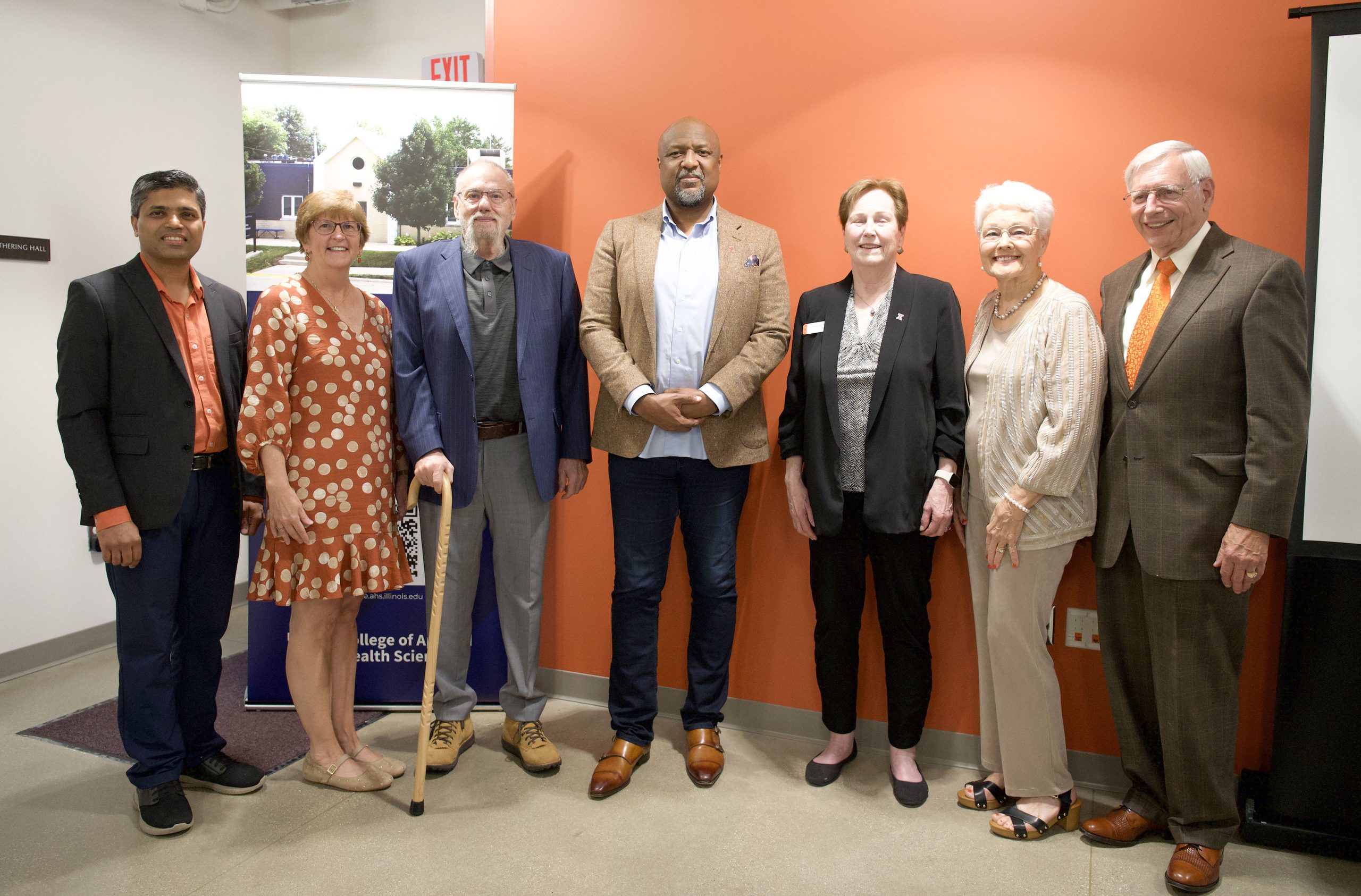
Kim Graber, left, Georgia Malandraki, center, and Wendy Rogers, far right, are the three Khan Professors of Applied Health Sciences, as endowed by Shahid Khan, right. (Photo by Mike Heiniger)

She framed the honor not as an endpoint, but as a platform for continued impact, particularly in improving access to care and advancing research that bridges science and clinical practice. 

“May our work continue to grow strong branches, deeply rooted in those who came before us, and reaching ever higher toward a future that improves lives,” she said. 

The ceremony concluded with closing remarks from Hanley-Maxwell, who highlighted the collective effort behind the achievement, from donors and university leadership to colleagues and family members. 

“Dr. Malandraki, congratulations once again,” she said. “We are proud to celebrate your achievements and excited for the impact you will continue to make as the Khan Professor.” 

As attendees gathered for a reception following the ceremony, the significance of the moment lingered, not just as a celebration of one scholar’s accomplishments, but as a testament to the interplay of opportunity, philanthropy and purpose. 

In the language of Malandraki’s sister’s verse, the investiture honored both the strength of the roots and the promise of the branches yet to grow. 

Editor’s note:

To reach Vince Lara-Cinisomo, email vinlara@illinois.edu.
 

Share on social

Related news

Two AHS faculty members recognized for excellence in instruction


SHS Associate Professor Mary Flaherty (left) and HK Adjunct Instructor Christy Bazan were recognized for excellence in instruction.

Every year, the University of Illinois Office of the Provost recognizes faculty members for excellence in instruction, who are nominated by committees of faculty, staff and students at each college.

This year, two Applied Health Sciences faculty members won campus awards for their teaching and mentorship in the classroom: Speech and Hearing Science Associate Professor Mary Flaherty won for Excellence in Undergraduate Teaching, and Health and Kinesiology Adjunct Instructor Christy Bazan won for Excellence in Online Teaching.

Both instructors will be recognized at the university’s Celebration of Academic Excellence on Wednesday, March 25, at the Krannert Center for the Performing Arts.

On top of mentoring student researchers through her Child Speech Research Lab, Flaherty teaches undergraduate- and graduate-level courses in Speech and Hearing Science, such as SHS 358: Understanding Research Methods in Communications Sciences and Disorders and SHS 352: Hearing Health and Society, along with advanced SHS 552: Pediatric Audiology and SHS 570: Evidence-Based Practice for SLPs and AuDs.

Bazan, a licensed environmental health practitioner, teaches several community health-oriented classes in the college and Department of Health and Kinesiology, including AHS 199: Applied Data Solutions in Health Sciences, HK 204: Drug Use and Misuse—a subject she co-authored a book on—HK 207: Introduction to Epidemiology and HK 408: Environmental Health.

The College of Applied Health Sciences asked them about what this recognition means to them, and what they’d like to say to students past and present.

What does this recognition mean to you?

Bazan: I am honored and grateful to receive this online teaching award.  With support from AHS and my colleagues, many doors were opened to me that allowed me to grow in teaching in online environments.  From course redesign, Open Education development, video recoding lectures and developing online content, I have placed emphasis in my courses that shows how important it is to ensure students learn and have experiences just like they might when taking an in-person course.

Flaherty: This recognition means a great deal to me because my undergraduate teaching is centered on helping students learn how to evaluate information responsibly and use evidence thoughtfully in real-world decisions. Many students encounter an overwhelming amount of health and science information online, and a core goal of my teaching is to help them distinguish credible evidence from oversimplified or misleading claims. I aim to make research feel accessible and relevant, while also supporting students as individuals through structure, feedback, and mentorship. Being recognized for this work affirms the importance of teaching students not just what to learn, but how to think, question and apply evidence with care.

Anything you’d like to say to past and current students?

Bazan: My goal as an educator is to cultivate learners who are critical thinkers, empathetic communicators and lifelong learners. I want students to leave my courses not only with knowledge of content but with the confidence and tools to apply that knowledge ethically and creatively in their own lives and in their own communities. Keep learning, learn things in new ways, connect with your professor and your peers in your online classes and engage thoughtfully in an increasingly interconnected world.

Flaherty: This award belongs to my students. I love teaching, and I care deeply about undergraduates and their growth, both inside and outside the classroom. My students show up with curiosity, honesty and a willingness to engage deeply, and they continually remind me why this work matters. Their questions, perspectives and trust shape how I teach, and their commitment to learning pushes me to be a better instructor every year. I am grateful to every student who has shared their time, effort and openness with me. This recognition reflects what we have built together.

Editor’s note:

To reach Mary Flaherty, email maryflah@illinois.edu.
To reach Christy Bazan, email cbazan3@illinois.edu.
 

Share on social

Related news

AHS Alumni Awards celebrate leadership, resilience and service


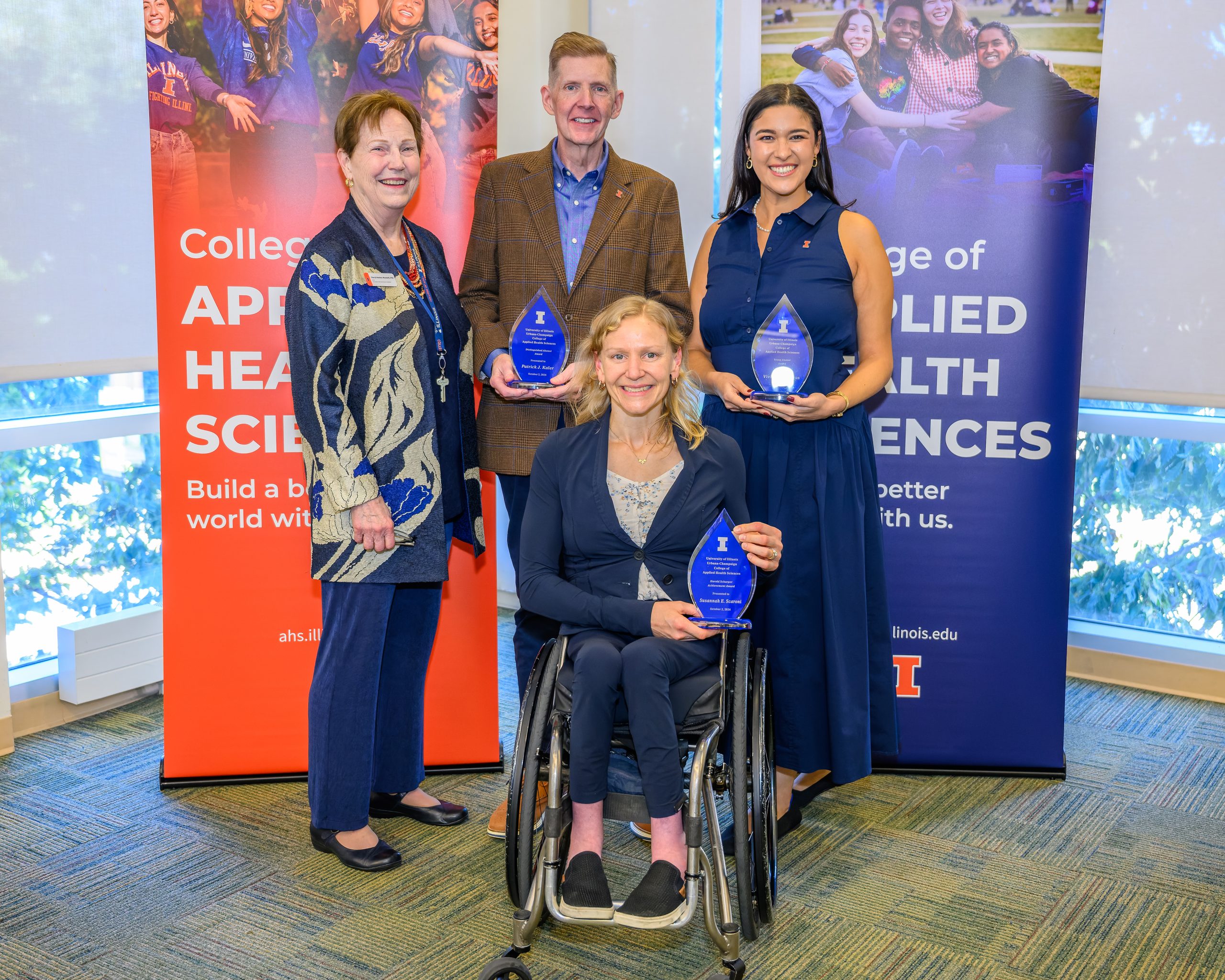
AHS Dean Cheryl Hanley-Maxwell, second from left, poses with AHS alumni award winners Jack Groppel, left, Adrienne Albrecht, right, and Brandon Buchanan, far right. (Photo by Craig Pessman).

The College of Applied Health Sciences at the University of Illinois Urbana-Champaign once again shined a light on extraordinary alumni at its annual Alumni Awards celebration, held during Homecoming weekend. This year’s honorees—Dr. Jack Groppel, Justice Adrienne Albrecht and Brandon Buchanan—embody the college’s enduring mission of advancing health, equity and human potential.

The ceremony, led by Dean Cheryl Hanley-Maxwell, is designed not only to recognize the professional accomplishments of alumni but also to share the personal journeys that shaped their paths. “The individuals who receive these awards never fail to impress and fascinate me,” Hanley-Maxwell said. “As you hear their stories today, I’m sure you’ll find yourself saying, ‘Wow!’ many times, just as I have.”

Distinguished Alumni Award: Dr. Jack Groppel

Few careers demonstrate the power of seizing opportunity quite like that of Jack Groppel, recipient of the 2025 AHS Distinguished Alumni Award. An internationally recognized scholar in the science of human performance, Groppel has been a professor, tennis coach, entrepreneur, author, corporate consultant and motivational speaker.

And yet none of that would have happened without the University of Illinois.

“If the leaders in this college hadn’t given me a shot, I’d be counting wolves in Wyoming,” he said.

Growing up in a small southern Illinois town, Groppel was drawn to sports early, teaching himself to play tennis and eventually becoming one of the top junior players in the St. Louis area. Determined to play for the University of Illinois, he convinced men’s tennis coach Dan Olson to give him a chance—a story that foreshadowed a career marked by persistence and boldness.

His academic path was less direct. Pressured to pursue a “practical” major, Groppel earned a degree in wildlife biology. Yet his passion for athletics led him to graduate study in biomechanics at Illinois, where mentor Dr. Charles Dillman helped redirect his career. Groppel later completed a Ph.D. in exercise physiology at Florida State University before returning to Illinois as a professor and head tennis coach.

“How do you go from crying yourself to sleep at 22 to this?,” Gropple said, referencing his unhappy time seeking a career in the wildlife industry. “I have been truly blessed in my life, thanks to my time at the University of Illinois.”

After a decade, Groppel made another daring move: leaving a tenured faculty position to work in Florida at the Saddlebrook Resort. That leap led him to co-found the Human Performance Institute with Dr. Jim Loehr, a venture later acquired by Johnson & Johnson. Groppel became a pioneer in applying the training principles of elite athletes to business leaders, co-authoring the influential book The Corporate Athlete. He went on to brief Congress on worksite wellness, share stages with global icons like Muhammad Ali and Margaret Thatcher, and earn induction into three tennis halls of fame.

Groppel credits the University of Illinois with giving him the scientific foundation and teaching passion that shaped his career.

One of his mentors was Thomas K. Cureton, considered the father of physical fitness. After a semester working with Cureton and others in the precursor to what is now known as the  Department of Health and Kinesiology in AHS, Groppel was hooked.

“AHS molded me into a person who can do quality research,” he said. “It all began with leaders in AHS taking a chance on me. It started in that small town and on those small farms where young Jack dared to dream big.”

Harold Scharper Award: Justice Adrienne Albrecht

If Groppel’s story is about breaking down doors, Adrienne Albrecht’s is about perseverance and the power of access. Recipient of the Harold Scharper Award, presented by the Division of Disability Resources and Educational Services, Albrecht retired in 2024 as a Justice of the Third District Appellate Court of Illinois, capping a distinguished legal career.

Born in Kankakee as the eighth of 10 children, Albrecht was diagnosed with Marfan syndrome, a connective tissue disorder that severely impaired her vision. In the 1960s, long before disability rights laws provided protections, her mother fought to secure accommodations like front-row seating and access to blackboards. “My mother was extraordinary,” Albrecht said. “She understood what I needed and made sure I got it.”

“If the leaders in this college hadn’t given me a shot, I’d be counting wolves in Wyoming.

Jack Groppel

Distinguished Alumni Award winner

DRES founder Tim Nugent also played a vital role. Several of Albrecht’s siblings, who also had Marfan syndrome, attended Illinois with the support of DRES scholarships.

“I can’t tell you what a profound effect the University of Illinois had on my entire family. Imagine this family of 10 children, thinking they could all go to college and have great careers. The University of Illinois was just so crucial to my family,” she said.

Despite limited assistive technology at the time, Albrecht thrived academically, drawn to international relations before pursuing law. A constitutional history course sparked her passion for legal analysis, while her visual impairment forced her to develop a near-photographic memory—an asset in her legal work.

Over a 30-year career, Albrecht became known for her skill, adaptability and dedication to justice. She was among the first attorneys in Kankakee to integrate personal computers into her practice, eventually teaching technology courses for the Illinois State Bar Association. She served on the circuit court bench before her appointment to the appellate court, where she helped interpret Illinois’ landmark cashless bail statute.

Her proudest moments, however, were deeply personal. “People approach me in the grocery store to thank me, to tell me I made a difference in their lives,” she said. “That means more than anything.”

Dean Hanley-Maxwell said Nugent would be proud to see how Albrecht carried forward his legacy of inclusion and access.

“(Nugent) would join all of us in AHS and DRES in saying that you are richly deserving of this award,” Hanley-Maxwell said.

Young Alumni Award: Brandon Buchanan

Brandon Buchanan was honored with the AHS Young Alumni Award for his leadership in health equity and hospital administration. Buchanan is now associate chief operating officer of Orlando Health Dr. P. Phillips Hospital, but his path began in Champaign with a shift in academic focus.

Originally a journalism major, Buchanan found his calling while volunteering at Smile Healthy, a clinic providing dental care to underserved populations. “Community health took a holistic approach to how society looks at health and well-being,” he said. Inspired, he switched majors and pursued graduate training in health administration.

That decision launched a career devoted to improving access to care. Buchanan managed HIV and STI outreach programs at Ohio State, then spent nearly seven years at Endeavor Health in Chicago. There, he built the health equity impact team from a one-person office into a 30-member department that improved mammogram screening rates, reduced hypertension in Black communities, and expanded community education.

Now in Florida, Buchanan serves on the board of the local YMCA and mentors students pursuing careers in healthcare administration. “I’m proud when I see them flourish and shine,” he said.

Hanley-Maxwell praised Buchanan’s blend of leadership and compassion: “You cannot go wrong when you are committed to improving your community through service, fairness and respect.”

Editor’s note:

To reach Vince Lara-Cinisomo, email vinlara@illinois.edu.
 

Share on social

Related news

Pedro Hallal honored with King James McCristal Distinguished Scholar award


Pedro Hallal accepts the King James McCristal Distinguished Scholar Award on Wednesday, Sept. 23, 2025.

Like many young researchers, Pedro Hallal thought his first study would be groundbreaking and potentially change the paradigm of the study of physical activity. Ultimately, he said, it didn’t, but now, with the value of experience at hand, he understands that was OK.

“We are trained to think of things that no one has ever studied. But science is much more about consistency of results nowadays, than about brand-new findings,” said Hallal, the Alvin M. and Ruth L. Sandall Professor in the Department of Health and Kinesiology at the University of Illinois Urbana-Champaign. “We do research because of the questions; we don’t start with the answers.”

Thanks to that curiosity and because of the breadth of his research, Hallal on Sept. 24 was awarded the King James McCristal Distinguished Scholar Award, one of the most prestigious recognitions in the College of Applied Health Sciences. The award honors faculty whose scholarly contributions have significantly advanced their disciplines while elevating the reputation of the university.

For Hallal—whose research has transformed global understanding of physical activity and health—the honor represents both a recognition of past achievements and an encouragement to push forward in addressing one of the world’s most pressing public health challenges: physical inactivity.

“Professor Hallal’s scholarly work has substantially elevated the profile of his department, our college and the university by advancing public health knowledge and global health equity,” said Cheryl Hanley-Maxwell, dean of the College of Applied Health Sciences.

A Global Lens on Physical Activity

Hallal, who is also director of AHS’ Master of Public Health program, has built an international reputation for his research on physical inactivity, a phenomenon he argues must be understood in the context of modern life.

“Today, we have fewer people being active,” Hallal said. “Most of them are indoors, looking at a screen. We have to think about what physical activity is today, not decades ago. The notion that physical activity is good for health has been known for centuries. Only since the 1950s and ‘60s have we really been studying it.”

His scholarship began in Brazil, where his master’s thesis—“Physical Inactivity: Prevalence and Associated Variables in Brazilian Adults”—found that 41.1 percent of the surveyed population did not meet recommended activity levels of 150 minutes per week. This early work set the stage for his career-long focus on understanding inactivity as both a personal and societal issue.

Hallal’s impact expanded dramatically with his contributions to a series in The Lancet, one of the most influential medical journals in the world. His research revealed that one-third of adults worldwide—approximately 1.5 billion people—failed to achieve the minimum recommended level of physical activity. Equally concerning, four-fifths of children ages 13 to 15 fell short of the one-hour daily activity guideline. The findings underscored physical inactivity as a global pandemic, drawing international attention to a public health crisis with profound implications for chronic disease and health equity.

Hallal has often said that this work in The Lancet is the “research I am most proud of.”

Redefining Scientific Inquiry

Throughout his career, Hallal has emphasized the importance of scientific rigor and humility.

That philosophy has guided him to produce a body of work that does not merely identify problems but interrogates the systems that perpetuate them. His studies consistently highlight how socioeconomic and geographic inequalities shape access to safe and purposeful physical activity.

“Access to safe, purposeful physical activity must be a societal priority,” Hallal said. By framing physical inactivity not only as an individual choice but also as an issue of structural inequities, he has pushed the field toward broader, more inclusive approaches to solutions.

Access to safe, purposeful physical activity must be a societal priority

Pedro Hallal

Professor of Health and Kinesiology

A Legacy of Impact

The King James McCristal Distinguished Scholar Award cements Hallal’s place among the most influential scholars at Illinois. The recognition highlights not only his academic achievements but also his role in shaping the conversation around health equity worldwide.

From uncovering high rates of inactivity in Brazil to leading global efforts to quantify physical inactivity, Hallal has consistently produced research that informs public policy, inspires further scientific exploration, and elevates the role of physical activity in public health discourse.

Looking Ahead: Challenging Assumptions

As Hallal reflects on the future of his field, he sees opportunities to question prevailing assumptions and generate new lines of inquiry.

He is particularly interested in challenging the idea that “every movement counts.” While small bursts of activity are beneficial, Hallal believes that the global challenge lies in ensuring people have the opportunity for meaningful, sustained physical activity. He also underscores the importance of recognizing how time scarcity and resource inequality reinforce global disparities in health behaviors.

“I think this place, this campus and college, are in a great position to tackle these things,” Hallal said. “We are already one of the country’s leaders in the field, and we are one of the most productive groups in the world on this topic.”

Editor’s note:

To reach Vince Lara-Cinisomo, email vinlara@illinois.edu.
 

Share on social
Related news

Tacoria Humphrey is leaping further—in sport, school and life


Big Ten long jump champ Tacoria Humphrey has plans beyond her track and field competitions. (Photo courtesy of Fighting Illini)

She races down the rubberized runway, determination pumping through her arms, energy coursing across her strides and focus blazing in her eyes. With a mighty leap, she seems to sail through the air. Sand mushrooms under her shoes as she lands in the pit, the crowd roaring. That’s Tacoria Humphrey—champion of the 2025 Big Ten Long Jump.

Humphrey started track in middle school at Raymond Park Middle School on Indianapolis’ east side, where she broke two records in the high jump and 200 meter. Now, she’s well-decorated: she earned All-American honors in both indoor and outdoor seasons after winning back-to-back Big Ten long jump titles, placed fourth at the NCAA outdoor championships, recorded the third-longest indoor jump in NCAA history as national runner-up and earned a spot on The Bowerman Watch List. Humphrey said her success came from confidence.

“I feel like track is a mental sport,” Humphrey said. “If you believe you can do something, you’re most likely going to be able to do it, whereas if you’re scared or thinking about other people, that’s going to take over your mind and you’re not going to do well.”

Humphrey also attributed her many accomplishments to her training and her coach, Petros Kyprianou, the current director of Track & Field and Cross Country at the University of Illinois Urbana-Champaign.

“He has inspired me the most because he really believes in me, and when somebody just believes in you so much, you start to believe in yourself,” Humphrey said. “He’s just so thrilled to coach me, and he sees that I have a bright future and it just makes me want to accomplish everything to the highest level I can.”

She recalled a moment at the 2025 regionals for the NCAA Outdoor Championships. Competitors only had three jumps, and Humphrey’s weren’t up to the number she needed to qualify for nationals.

“After my second jump, he talked with me,” Humphrey said. “He was giving me that pep talk, like, ‘You got this. This is what you’ve been training for,’ and helping me calm down. I literally went from 15th place to fourth, and I qualified.”

Kyprianou was the one who encouraged Humphrey to switch her event from high jump to long jump her sophomore year of college. 

“I definitely was like, ‘This is weird,’ but I love trying new things,” Humphrey said. “I never expected to change events and to do so good in that event, but I 100% don’t regret it.”

“I always love helping people. I’m a people person.

Tacoria Humphrey

Community Health major and Dike Eddleman Athlete of the Year

Outside of her national achievements, Humphrey was recently named a Dike Eddleman Athlete of the Year, presented annually to the top Fighting Illini male and female athlete. The University of Illinois Athlete of the Year was first awarded in 1940, and was named in honor of the 11-time UI letterman and Olympian Dwight “Dike” Eddleman in 1993, who is generally considered the greatest athlete in the history of Illinois Athletics.

Caitlin Clarke, a health and kinesiology teaching assistant professor and chair of the Academic Progress and Eligibility Committee, said that sport performance is typically not the only factor that goes into choosing the recipient of the Dike Eddleman award.

“This is part of the culture of Illinois Athletics—they’re not going to go for someone who’s just really good at their sport and doesn’t care about academics at all,” Clarke said. “We get some really phenomenal students who are both really good at their sport and also really good at their major.”

At Illinois, Humphrey is a community health major, with a concentration in health education and health planning and promotion. 

“I always love helping people,” Humphrey said. “I’m a people person.”

This summer, she’s participating in the Health and Kinesiology 471 internship program and working with Wellness4Every1, an organization dedicated to ensuring equitable access to high-quality arts and wellness programs for students in diverse communities. Clarke, additionally a lead faculty for the community health internship program, said Humphrey is doing a great job stepping into the professional world.

“She’s future-thinking, because she knows that she wants to compete professionally for a while, but she isn’t just checking off a box with this internship,” Clarke said. “This experience really pushes students to learn how to communicate professionally, which is an important skill anywhere and can be difficult to navigate.”

Clarke said it’s important for all student athletes to also excel outside of their sport.

“Most of our student athletes are going to go on to careers that are not always directly related to sports, so you have to have a plan,” Clarke said. “You don’t want that plan to be, ‘Well, I just kind of did okay in my major.’ You want to be the rock star that gets into a successful career so that you can enjoy your life and do more to help other people around you.”

Currently, Humphrey is preparing to become a pro athlete. Her first pro meet was the USA Track and Field Championships at the end of July. 

“I’ll be a little nervous, but not really, because I’ve been jumping big marks that are close to what pros jump,” Humphrey said. “I’m eager to have better competition, and that will definitely push me.”

For her, success means a gold medal, and with her trademark confidence, it’s not a matter of if—but when.


Share on social

Related news

First-generation student week was about honoring the trailblazers


RIHANNA SHEGOG

Kinesiology first-year student Rihanna Shegog grew up between Bradley and Shawneetown, Illinois—essentially, at both ends of the state.

It wasn’t until a college fair her senior year of high school that the University of Illinois first came on her radar. “Which is crazy, because it’s such a big school,” she said.

Shegog credits her time with I-LEAP—an AHS leadership program that supports first-generation college students—for helping her adjust to campus life.

“At first I felt a lot of pressure because I’m the first one in my family to go to college,” Shegog said. “But they really just want me to be happy and successful.”


VINCENT ANELLI

Vincent Anelli’s decision to come to Illinois was “a pretty obvious” one, he said, when he factored in the realistic tuition with the university’s top-notch speech and hearing science program. Now a sophomore, Anelli credits I-LEAP for teaching the basics of applying to research positions and internships early on.

“Being a first-gen scholar, there’s a lot of pressure to it, especially because my parents worked really hard for me to be here,” Anelli said. “It definitely helps me refocus, that I’m here for my academics. It’s a little daunting at times, but it’s a big motivator.”


AVA MONTAÑEZ

Freshman Ava Montañez searched for college programs that would help support a career in the sports industry. Illinois rose to the top of her list with its RST degree. And her family has helped her transition into college life. As the youngest of six siblings, Montañez leaned on her older twin sisters for advice in the application process. Together, they’re part of the first generation in their family to pursue higher education.

“I went to a small elementary school and middle school; coming to a school like this was a big change because I’m so used to knowing everyone around,” Montañez said. “But I had friends from my old school who came with me, and I have the I-LEAP program with staff I can go to.”


CLARISSA HARRINGTON

Clarissa H

Clarissa Harrington was drawn to Illinois after a high school field trip to Champaign-Urbana, 90 minutes from her hometown of Springfield.

The sophomore initially wanted to join a pre-medicine track, but the focus of community health aligned best with her interests.

“After taking my first intro class and learning about community health and public health, I realized it was avbetter fit for me,” Harrington said. “I stayed in because I think it does a great job of helping minority communities on a large scale.”

The first-generation college student says she acclimated to campus “really fast,” serving on the I-LEAP student advisory board to help shape the university experience for incoming students on her same path.

Related news

Graber honored as Shahid and Ann Carlson Khan Professor in Applied Health Sciences


Anyone who has been fortunate enough to work with Kim Graber should be thankful she wasn’t a very good cook.

Kim Graber was appointed as the Shahid and Ann Carlson Khan Professor in AHS on April 22 (Photo by Craig Pessman)

Graber, the head of the Department of Health and Kinesiology in the College of Applied Health Sciences, was appointed as the Shahid and Ann Carlson Khan Professor in AHS on April 22. 

In a heartfelt ceremony attended by university leadership, colleagues, students and alumni, Graber was recognized for her outstanding contributions to research, education and service over a career spanning more than three decades.

Graber, who grew up in Barrington, Illinois, said she did not think about becoming a professor because, at that time, “Career opportunities for women were limited, and girls were taught to dream about a career in teaching, nursing, or secretarial work.”

So, when she started college at Valparaiso University, she began as a student in home economics. 

“That, however, lasted only a year because I didn’t enjoy cooking and wasn’t very good at it, as my family will attest,” she said during her investiture ceremony.

The event was opened by Cheryl Hanley-Maxwell, dean of the College of Applied Health Sciences, who highlighted the significance of an endowed professorship. 

“Endowed professorships enable us to recognize, reward and retain outstanding scholars whose work brings renown not only to them but also to the college and the university,” Hanley-Maxwell said.

Hanley-Maxwell emphasized that such honors are reserved for faculty members at the pinnacle of their fields, affirming Graber’s well-deserved recognition.

The investiture ceremony also paid tribute to Shahid and Ann Carlson Khan, whose philanthropy made the professorship possible. Hanley-Maxwell recounted the Khans’ inspiring journey from their days as University of Illinois students to becoming leading entrepreneurs and philanthropists. Shad Khan’s story, from washing dishes for $1.20 an hour to leading a multi-billion-dollar global enterprise, was shared as a testament to resilience, innovation and community spirit.

Today, the Khans’ support extends across the university, including significant contributions to the Krannert Center for the Performing Arts, the College of Business, the College of Veterinary Medicine and the Khan Annex to Huff Hall.

Following remarks from University Provost John Coleman, the ceremony turned its focus to Graber’s achievements. After Valparaiso, she transferred to the University of Iowa to study physical education, setting her on her current path.

Graber’s academic journey took her to Columbia University for a master’s degree in movement sciences, an experience she describes as “the best year of my life.”

Graber embraced New York and would have continued for her doctorate at Columbia if not for the fact that the university didn’t offer teaching assistantships, and the accumulation of debt. So, she pursued her doctorate at the University of Massachusetts at Amherst, developing a passion for understanding how individuals learn and socialize into teaching professions.

“It’s where I learned to understand research, write like a scholar and think like an academic,” she said.

It’s where I learned to understand research, write like a scholar and think like an academic.

Kim Graber

Shahid and Ann Carlson Khan Professor

Graber’s research, grounded in teacher socialization theory, has significantly influenced how scholars and practitioners view learning and professional development in education, particularly within physical education.

Graber’s work has been widely published in leading journals such as Teaching and Teacher Education, Research Quarterly for Exercise and Sport, Quest, and Kinesiology Review. She has been a leading voice in examining how undergraduate education shapes future educators, and her later work has expanded to issues such as legislative policy in schools, children’s wellness, curriculum design, and the demographics of teacher educators.

Beyond her research, Graber is a well-recognized as an educator and mentor. Her devotion to undergraduate education has earned her prestigious awards, including the University of Illinois’ Distinguished Teacher/Scholar Award and the college’s Phyllis J. Hill Award for Exemplary Mentoring. 

She emphasized the joy of teaching, saying, “To play a small role in preparing individuals to make a better future for others is very satisfying.”

Her service contributions are equally significant. As department head of Health and Kinesiology, Graber assumed leadership just as the COVID-19 pandemic unfolded. Undeterred by unprecedented challenges, she spearheaded efforts to revitalize the department through strategic planning, curriculum redesign and faculty expansion. Under her leadership, the department saw a substantial decrease in the student-to-faculty ratio, bolstering its academic standing.

In her speech, Graber expressed profound thanks to Shahid and Ann Carlson Khan for their support, to her mentors and collaborators such as Tom Templin and Amy Woods, and to her colleagues, students and family. She also shared touching stories of the relationships that sustained her through her academic life, including the pivotal support of her mother, now 95 years old, whose wisdom and encouragement made her achievements possible.

“She and my dad are the reason I attended college,” Graber said. “It was a family expectation that has served me well. As she will tell you, I’ve always been fiercely independent and determined, and she had the wisdom to set me free. That freedom has led to a very rich life and fulfilling career. Thanks, mom.”

In closing, Graber thanked for Khans for their “many contributions to the greatness of the University of Illinois.

“You are role models for sharing your success with others, and that is no small feat. Thank you from the bottom of my heart.”

Editor’s note:

To reach Vince Lara-Cinisomo, email vinlara@illinois.edu.
 

Related news

2024 RST Awards

Congratulations to the recipients of 2024 scholarships and awards. The undergraduate and graduate students recognized within these pages have shown outstanding dedication and creativity in the pursuit of their personal and professional goals. We are very proud of your achievements. Click the link to read the PDF program.

College of Applied Health Sciences
110 Huff Hall
1206 South 4th Street
Champaign, IL 61820
(217) 333-2131