Pamela Hadley honored with Stenberg Endowed professorship


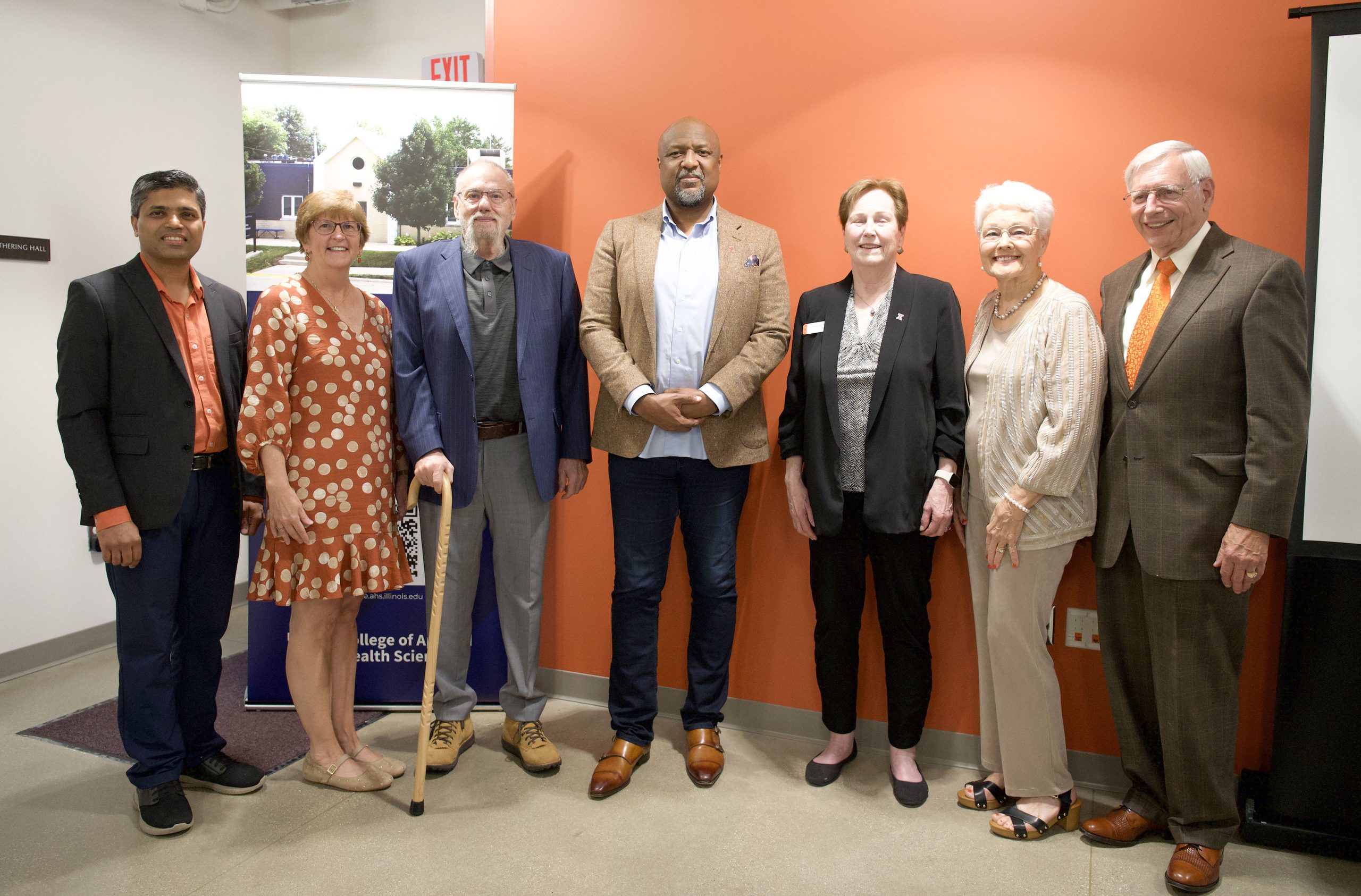
Pamela Hadley, center, with faculty and staff of the Department of Speech and Hearing Science (Photo by Craig Pessman)

The daughter of a farmer in rural Illinois, Pamela Hadley had no “schema” for becoming a university professor. But a high school career filled with self-expression helped guide her toward an illustrious academic career that was culminated with a top honor.

Hadley, the head of the Department of Speech and Hearing Science and a professor, was appointed as the inaugural Charles and Kay Stenberg Endowed Professor in Disability Research in a ceremony on April 30.

The appointment is a testament to Hadley’s decades-long dedication to advancing the science of language development in young children, particularly those with developmental language disorder, said Cheryl Hanley-Maxwell, dean of the College of Applied Health Sciences.  

“Pam Hadley has made significant contributions to language science through highly regarded translational research, mentored numerous students into clinical and academic careers, and benefitted the department, university and profession at large through a variety of service activities,” Hanley-Maxwell said.  

The named professorship “is an honor that is accorded to outstanding scholars who have well-established records of excellence in research, teaching, and public engagement,” Hanley-Maxwell added.

The professorship was made possible by a generous endowment from Charles and Kay Stenberg, both Illinois alumni who experienced firsthand the challenges of navigating life with disabilities in an era before the Americans with Disabilities Act. Though they have passed, their legacy lives on through their commitment to disability research and through the continued support of Kay’s brother, Hugh Wishart. 

“Chuck and Kay were passionate about accessibility and believed deeply in supporting research that improves the lives of people with disabilities,” Hanley-Maxwell said.
Hadley also expressed deep gratitude to the Stenberg family, colleagues, students, and family members who shaped her journey. 

“This is rightfully a shared honor,” she said. “I’m profoundly humbled to be named the Charles and Kay Stenberg Professor. The Stenbergs faced and overcame many barriers, and they endowed this professorship to help others do the same.”

Hadley reflected on a life shaped by both personal experience and professional purpose. Raised in rural Henry County, Illinois, she credited her parents for instilling in her a love for inquiry and compassion. Her father, a farmer, encouraged her to solve story problems at dinner. Her mother, a nurse, brought her along on Saturday visits to residents in a skilled nursing facility. “We’d call that volunteering as a conversational partner today,” she joked, noting it was her first exposure to the impact of communication in caregiving.

Her academic journey took her from Augustana College, where she experienced immersive clinical training, to the University of Kansas, where she joined a research preschool program that would shape her scholarly trajectory. 

“It was in that preschool that I first noticed how children with communication disorders were not socially integrated,” she said. That observation led to a research assistantship, publications, and ultimately a Ph.D. in  child language under the mentorship of Professor Mabel Rice.

Pam Hadley has made significant contributions to language science through highly regarded translational research, mentored numerous students into clinical and academic careers, and benefitted the department, university and profession at large through a variety of service activities.

Cheryl Hanley-Maxwell

Dean, College of Applied Health Sciences

Over her career, Hadley has led pioneering longitudinal studies that have reshaped how clinicians and researchers understand early language development. Her work has focused on early identification and intervention for children with Developmental Language Disorder (DLD)—a condition that affects 7 to 10 percent of school-aged children and often goes undiagnosed until it has already begun to impact learning and social development.

She led a groundbreaking multi-site clinical trial, supported by the National Institute on Deafness and Other Communication Disorders, evaluating a parent-implemented language intervention. 

“I’m thrilled to report that the caregiver-implemented intervention resulted in positive effects on vocabulary and grammar,” she said, noting that the professorship would play a critical role in disseminating these findings to clinicians and families.

As head of the Department of Speech and Hearing Science, Hadley led with empathy and pragmatism during the COVID-19 pandemic. She established virtual check-ins, championed remote accessibility, and helped the department resume clinical services quickly and safely. Her leadership style, she said, is grounded in the deep respect she holds for her colleagues and their shared mission: “to promote improved communication and health for individuals with disabilities across the lifespan.”

Throughout the ceremony, attendees were reminded of Hadley’s enduring commitment to education. Undergraduate and graduate students alike benefit from her guidance, both in the classroom and in the lab. As one of the few national experts on early grammatical assessment and intervention, her work translates directly into tools and strategies used by speech-language pathologists and parents.

In concluding her remarks, Hadley acknowledged her most personal source of support—her family. Her husband, Matt Rispoli, a retired SHS faculty member, and their daughters have shared in the journey. 

“They’ve always graciously shared me with my students and my work,” she said, adding that the family’s shared love of hiking serves as a cherished escape from her many professional responsibilities.

As Dean Hanley-Maxwell presented the medallion that accompanies a named professorship, she emphasized what the moment represented: a celebration of achievement, but also a reaffirmation of the university’s mission to foster research that has real-world impact. 

“Pam, your outstanding work has added to the prestige of this college and university,” she said. “We are grateful for and proud of your commitment to helping children with language disabilities get a better start in life.”

Editor’s note:

To reach Vince Lara-Cinisomo, email vinlara@illinois.edu.

 

Related news

Graber honored as Shahid and Ann Carlson Khan Professor in Applied Health Sciences


Anyone who has been fortunate enough to work with Kim Graber should be thankful she wasn’t a very good cook.

Kim Graber was appointed as the Shahid and Ann Carlson Khan Professor in AHS on April 22 (Photo by Craig Pessman)

Graber, the head of the Department of Health and Kinesiology in the College of Applied Health Sciences, was appointed as the Shahid and Ann Carlson Khan Professor in AHS on April 22. 

In a heartfelt ceremony attended by university leadership, colleagues, students and alumni, Graber was recognized for her outstanding contributions to research, education and service over a career spanning more than three decades.

Graber, who grew up in Barrington, Illinois, said she did not think about becoming a professor because, at that time, “Career opportunities for women were limited, and girls were taught to dream about a career in teaching, nursing, or secretarial work.”

So, when she started college at Valparaiso University, she began as a student in home economics. 

“That, however, lasted only a year because I didn’t enjoy cooking and wasn’t very good at it, as my family will attest,” she said during her investiture ceremony.

The event was opened by Cheryl Hanley-Maxwell, dean of the College of Applied Health Sciences, who highlighted the significance of an endowed professorship. 

“Endowed professorships enable us to recognize, reward and retain outstanding scholars whose work brings renown not only to them but also to the college and the university,” Hanley-Maxwell said.

Hanley-Maxwell emphasized that such honors are reserved for faculty members at the pinnacle of their fields, affirming Graber’s well-deserved recognition.

The investiture ceremony also paid tribute to Shahid and Ann Carlson Khan, whose philanthropy made the professorship possible. Hanley-Maxwell recounted the Khans’ inspiring journey from their days as University of Illinois students to becoming leading entrepreneurs and philanthropists. Shad Khan’s story, from washing dishes for $1.20 an hour to leading a multi-billion-dollar global enterprise, was shared as a testament to resilience, innovation and community spirit.

Today, the Khans’ support extends across the university, including significant contributions to the Krannert Center for the Performing Arts, the College of Business, the College of Veterinary Medicine and the Khan Annex to Huff Hall.

Following remarks from University Provost John Coleman, the ceremony turned its focus to Graber’s achievements. After Valparaiso, she transferred to the University of Iowa to study physical education, setting her on her current path.

Graber’s academic journey took her to Columbia University for a master’s degree in movement sciences, an experience she describes as “the best year of my life.”

Graber embraced New York and would have continued for her doctorate at Columbia if not for the fact that the university didn’t offer teaching assistantships, and the accumulation of debt. So, she pursued her doctorate at the University of Massachusetts at Amherst, developing a passion for understanding how individuals learn and socialize into teaching professions.

“It’s where I learned to understand research, write like a scholar and think like an academic,” she said.

It’s where I learned to understand research, write like a scholar and think like an academic.

Kim Graber

Shahid and Ann Carlson Khan Professor

Graber’s research, grounded in teacher socialization theory, has significantly influenced how scholars and practitioners view learning and professional development in education, particularly within physical education.

Graber’s work has been widely published in leading journals such as Teaching and Teacher Education, Research Quarterly for Exercise and Sport, Quest, and Kinesiology Review. She has been a leading voice in examining how undergraduate education shapes future educators, and her later work has expanded to issues such as legislative policy in schools, children’s wellness, curriculum design, and the demographics of teacher educators.

Beyond her research, Graber is a well-recognized as an educator and mentor. Her devotion to undergraduate education has earned her prestigious awards, including the University of Illinois’ Distinguished Teacher/Scholar Award and the college’s Phyllis J. Hill Award for Exemplary Mentoring. 

She emphasized the joy of teaching, saying, “To play a small role in preparing individuals to make a better future for others is very satisfying.”

Her service contributions are equally significant. As department head of Health and Kinesiology, Graber assumed leadership just as the COVID-19 pandemic unfolded. Undeterred by unprecedented challenges, she spearheaded efforts to revitalize the department through strategic planning, curriculum redesign and faculty expansion. Under her leadership, the department saw a substantial decrease in the student-to-faculty ratio, bolstering its academic standing.

In her speech, Graber expressed profound thanks to Shahid and Ann Carlson Khan for their support, to her mentors and collaborators such as Tom Templin and Amy Woods, and to her colleagues, students and family. She also shared touching stories of the relationships that sustained her through her academic life, including the pivotal support of her mother, now 95 years old, whose wisdom and encouragement made her achievements possible.

“She and my dad are the reason I attended college,” Graber said. “It was a family expectation that has served me well. As she will tell you, I’ve always been fiercely independent and determined, and she had the wisdom to set me free. That freedom has led to a very rich life and fulfilling career. Thanks, mom.”

In closing, Graber thanked for Khans for their “many contributions to the greatness of the University of Illinois.

“You are role models for sharing your success with others, and that is no small feat. Thank you from the bottom of my heart.”

Editor’s note:

To reach Vince Lara-Cinisomo, email vinlara@illinois.edu.

 

Related news

Boppart calls investiture a career highlight


Marni Boppart, second from right, poses with husband Stephen, left, her daughters, and Chancellor Robert Jones, center. (Photo by Darrell Hoemann)

Marni Boppart’s trajectory to named professorship at the University of Illinois Urbana-Champaign began as a kid playing in the Pine Barrens of New Jersey.

Boppart, a professor in the Department of Health and Kinesiology in the College of Applied Health Sciences, was named the Saul J. Morse and Anne B. Morgan Professor at an investiture ceremony on Sept. 6.

But long before her illustrious career studying cellular biomechanics and muscle began, Boppart’s interests were taking roots in the woods.

“I would describe myself as a very active kid growing up,” she said at the investiture. “All our recreational time was spent outdoors playing baseball, basketball, kickball, riding my bike and jumping over ramps and doing crazy things that my mom still doesn’t know about. I grew up in in the Pine Barrens of New Jersey, and the woods were our playground. I mention this because it really influenced my decision to pursue my first degree in biology at the University of New Hampshire. This provided the opportunity to continue to explore the great outdoors, hiking, rock climbing, skiing, and even trying my hand at hang gliding—without hurting myself.”

As a biology major, Boppart was required to take a course in immunology and was assigned to write a paper on the effects of exercise on immune function. 

“I thought, ‘Well, this was a really odd topic. What would exercise have anything to do with immune cells in the body? If you recall, the 80’s were defined by the fitness craze,” she said. “I think I still have my ThighMaster and Jane Fonda tapes sitting in a closet somewhere. The idea that exercise could be beneficial for health and prevent disease was still relatively new. What started as a simple class assignment grew into a life-long obsession with wanting to understand how exercise or the process of muscle contraction could benefit not only muscle, but all organ systems and whole body health.”

Boppart spent time in the Air Force as an aerospace physiologist, then decided to pursue a Ph.D. in Applied Anatomy and Physiology at Boston University. Working with two “powerhouse investigators” in the field of exercise science—Roger Fielding at BU and Laurie Goodyear at Harvard Medical School—the trio was able to document some of the first observations of molecular changes occurring in human muscle as a result of exercise.

“Like most researchers, I had more questions than answers at the end of my doctoral program: How does exercise, or the process of contraction stimulate molecular changes in muscle, what do these changes really mean for structure and function, and going back to my original interest, what is released by muscle into the circulation that might influence whole body health?,” she said.

For Boppart, those question led to what is now a 30-year career studying muscle.

Using transgenic mice, Boppart and her lab partners were able to determine that the integrin complex not only controlled molecular signaling in muscle, but also contributed to skeletal muscle remodeling and growth in response to exercise.

“But then everything changed in 2013,” she said.

That year, Boppart said, she and her lab mates were the first to report that exercise can result in the accumulation of perivascular stem cells in muscle.

“We found that these cells secrete beneficial factors that not only influence muscle remodeling and growth, but structures outside of muscle as well, including vessels and the brain. And so we started to wonder … could these stem cells be used to treat a disease or condition?”

Boppart’s interest in healthy aging led to a study of whether stem cells could be used to address age-related disabilities, particularly slowing the progression of muscle loss. While she found that stem cells were not effective in slowing the progression of muscle loss or regrowing muscle after disuse, she did find if she isolated nanoparticles (or extracellular vesicles or exosomes) from the stem cells first and then injected them into the aged mice, they could successfully recover muscle growth, which is the first step in preventing disability. That discovery led to new sources of funding, including funding from NASA and private foundations such as the Allen Institute.

Cheryl Hanley-Maxwell, dean of the College of Applied Health Sciences, praised Boppart and her work.

“Being named to an endowed position is a singular honor for faculty members,” Hanley-Maxwell said. “Those who hold named professorships are at the top of their fields, and that is certainly true of our honoree today. When I think of Marni, I think of unwavering integrity, deep intellectual curiosity, unconditional dedication to her students, and absolute passion for her work. And humility.”

The named professorship is endowed by Saul Morse and Anne Morgan. Morse earned two degrees at the University of Illinois, including a law degree and is an alumnus of AHS’s Disability Resources and Educational Services. He retired in 2023 after a 50-year career in law. Morgan is a clinical psychologist who retired after more than 30 years of practice in health psychology.

“I would like to thank our donors, Saul and Anne, for their generous contributions to the University of Illinois and the College of Applied Health Sciences,” Boppart said. “I am deeply honored and humbled by this recognition. And I am humbled because, as I look around the room, I see many experts in the fields of health, aging, and disability. To know that several of you nominated me for this award is a bit overwhelming. Thank you for this opportunity. I will remember tonight always.”

Boppart thanked her mentors, HK Department Head Kim Graber and Professor Jeff Woods, as well as her collaborators and colleagues.

Turning toward her future plans, Boppart is energized about what’s next.

“We would like to use our funding and this professorship to translate our EV therapy to humans. I’m confident we can do this,” she said. “Not only because clinical trials with stem cell-derived EVs are already occurring in the U.S. in places like the Mayo Clinic, but also because I have an amazing interdisciplinary research team to help make it possible.”

Editor’s note:

To reach Vince Lara-Cinisomo, email vinlara@illinois.edu.
 

Related news

College of Applied Health Sciences
110 Huff Hall
1206 South 4th Street
Champaign, IL 61820
(217) 333-2131