The study analyzed cognitive performance for groups of older adults (ages 70 to 84) with untreated hearing loss
A new study published in the medical journal The Lancet found that hearing aids might slow cognitive decline for at-risk older adults with hearing loss.
Sadie Braun, audiologist and clinical assistant professor in the Department of Speech and Hearing Science in the College of Applied Health Sciences at the University of Illinois, said she’ll incorporate these findings into her counseling with patients.
“For people who have any sort of high risk for cognitive decline such as dementia (or) Alzheimer’s, this study tells us that those individuals should get hearing aids as soon as they need them,” Braun said. “The average person waits 5 to 7 years or more to get hearing aids once they know they have a hearing loss.”
The study, co-led by Dr. Frank Lin of Johns Hopkins University School of Medicine and the Bloomberg School of Public Health, analyzed cognitive performance for groups of older adults (ages 70 to 84) with untreated hearing loss.
Participants were randomly assigned to either the control group that received counseling on disease prevention, or to the intervention group, which received regular audiology treatment and hearing aids.
Researchers followed up with participants every six months for three years. For participants at lower risk of cognitive decline, hearing aid interventions showed no significant effect on cognitive function. But for participants with high risk for dementia, cognitive decline slowed by 48 percent over the three-year period.
“That’s a pretty amazing statistic to me,” Braun said. “We’ve known there was a correlation between hearing loss and cognitive decline, but there were a lot of unknowns regarding the exact nature of that correlation as well as whether hearing aids or other treatments could have a positive impact.”
The connection between hearing loss and dementia is well-documented, but the “why” is still up for research inquiry, Braun said. Regardless, the finding adds to the growing list of reasons for adults to check their hearing sooner rather than later.
Long-term speech understanding can improve the earlier a patient uses hearing aids, Braun said.
“Cognitive health is something that people really care about,” Braun said. “I think this is going to cause more people to be more concerned about a mild or moderate hearing loss.”
For at-risk adults and anyone interested in checking their hearing, Braun recommends a visit to an audiologist.
The Audiology and Speech Language Pathology Clinic at 2001 S. Oak Street in Champaign is open to all patients, regardless of affiliation to the University of Illinois and accepts some insurance plans. It is operated by the College of Applied Health Sciences’ Department of Speech and Hearing Science.
New patients are required to schedule an appointment by calling 217-333-2205 or emailing shsclinic@illinois.edu.
A scholarship formed by recent Illini wheelchair basketball players supports today’s athletes
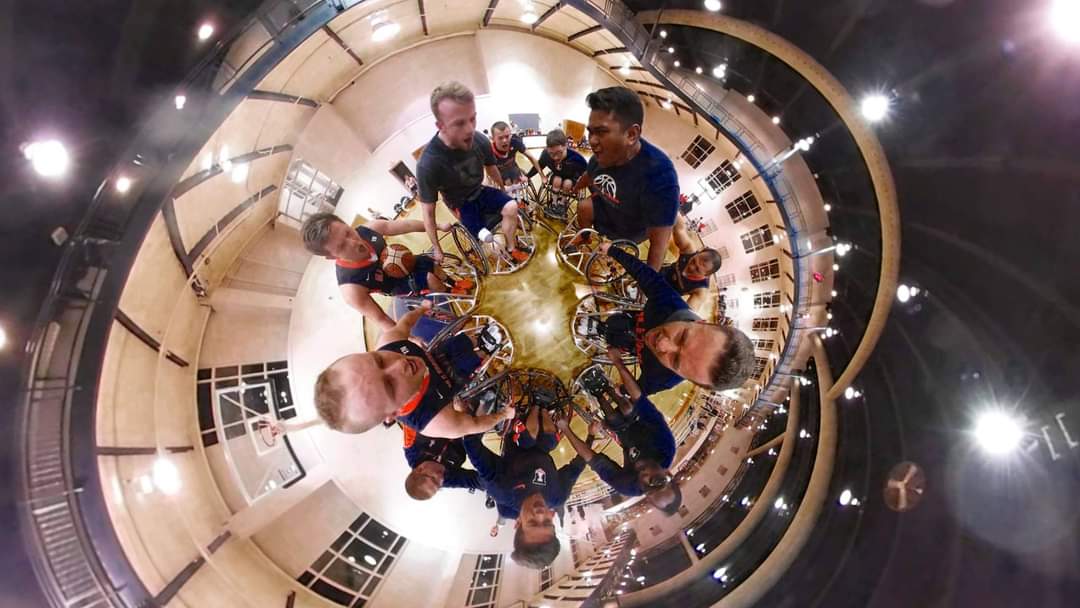
The 2016-17 wheelchair basketball men’s team poses in front of Grange Grove. Several alumni contributed to a legacy scholarship to support current wheelchair basketball athletes.
In the heat of an Illinois men’s wheelchair basketball season, intense morning practices roll into sociable team meals and lively late-night gaming sessions. The hours spent between busy student-athlete schedules—on buses and dorm rooms—are where teammates became brothers.
For all that the Illinois men’s wheelchair basketball teams of the early 2010s accomplished on the court—a National Wheelchair Basketball Association intercollegiate championship and three second-place finishes under former Coach Mike Frogley and Coach Matt Buchi—they’ve surpassed that off it, starting careers and raising families.
Now, the alums of this so-called “Band of Brothers” have come together once more to support the next generation of Illini wheelchair sport athletes through the establishment of an annual scholarship.
Their contributions, through “The Fighting Illini Wheelchair Basketball Alumni Legacy Scholarship Fund,” have been granted to two wheelchair basketball athletes in the past two terms.
“This scholarship is born from people that truly love each other and care about the future of the program at the University of Illinois,” said Mak Nong, former Illinois wheelchair basketball player and founder of the fund. “For us to be able to give back and make things easier for the future generation, that’s our moral obligation: to make this place even better than it was for us.”
The most recent recipient, rising senior Mary Wagstaff of the women’s wheelchair basketball team, used the $1,200 to pay out the remainder of her spring semester tuition.
Wagstaff “was both surprised and extremely honored” to receive the recognition, she said. Men’s team junior Martrell Stevens, now a team co-captain, received the inaugural sum in 2022.
For the alumni who funded this scholarship, it represents a continued commitment to growing the game of wheelchair basketball. Many have taken jobs in the field of adaptive athletics, managing sports programs designed for children and adults with disabilities.
Moreover, the fund honors what money can’t capture: the enduring teachings from their coaches and tight teammate bonds that have carried far beyond their last plays on the basketball floor.
“I think at a certain point towards the end of our run, we started realizing these really were the golden years,” Nong said. “But even now, establishing the scholarship and still talking as adults, we’re making the platinum era now, right?”
Tight Bonds
Maureen Gilbert wears many hats as coordinator for the Office of Campus Life at Disability Resources and Educational Services, better known as DRES. To more than 29 classes of Illinois wheelchair student-athletes, she’s “Mo,” director of their athletic programs, point-person for travel and eligibility questions and trusted confidante. Some lovingly call her “Mom.”
On bus rides with track and field and basketball events, one can usually tell if the team is gelling off the floor, Gilbert said. Team chemistry always takes work to develop, but some teams bond faster than others.
“Once in a while, you get those athletes who seem to click and they make it happen themselves,” Gilbert said. “Like with Mak’s group.”
The men’s basketball team gets hyped up. (Photo provided)
Martinez Johnson joined the team in 2013 as a transfer student from Atlanta. It didn’t take long for the memories to start stacking up with his teammates.
“[We’d] just hang out and make sure we were doing our best to balance our social life, school and basketball,” Johnson said. “And we leaned on each other to make sure everyone was doing OK mentally as well.”
Just before the school year, Johnson recalls the team traveling to the 4H campground of Allerton Park for several memorable exercises. In what’s now a yearly tradition under Coach Buchi, the players wrote down their individual fears for the season before throwing them into a burning campfire.
“When I came in 10 years ago as a coach, that was one of the first things that I tried to do: have a bonding experience to learn about each other outside of basketball,” Buchi said. “And that’s what really bonds a lot of these guys for a lifetime, a comfortable place to be vulnerable as young men with our team.
“That bonding took a while to get there, but it just needed activities and locations to blossom.”
Jacob Tyree’s favorite memories with the team tend to revolve around food: morning rushes to Original House of Pancakes or Merry Ann’s Diner after long, physical practices, or cherished visits to Cravings, the Asian cuisine restaurant.
“It could be a really crappy practice, like maybe things just were not clicking on the court—coach is yelling at you for things, your teammates are yelling at you for things—and then you go out afterwards and it’s now a positive bonding experience,” Tyree said.
As the teammates graduated and dispersed across the country and the world, those relationships stayed strong.
A random, gloomy day in the early weeks of the COVID-19 pandemic led Nong to check in with many of his old teammates. He’d been pondering ways to give back to the things “he truly cared about,” and Illinois neared the top of Nong’s list.
His calls gave way to proposals: “Would you want to contribute to a scholarship?”
After checking with DRES and the College of Applied Health Sciences advancement team, the groundwork was laid.
“Mak took the lead on all of that,” Gilbert said. “In fact, it was a great gift when they told me what they were doing. It gives a good example to our current students of paying forward and how to support those who come after you.”
The generosity didn’t stop with the scholarship, either. In the spring, program alumni used crowdfunding to finance customized, tailored suit jackets for the graduating seniors on the men’s and women’s wheelchair basketball teams.
“It was a surreal full circle moment to see my alumni, the guys that I coached, are now taking care of the players that I’m coaching now,” Buchi said.
For us to be able to give back and make things easier for the future generation, that’s our moral obligation: to make this place even better than it was for us.
Mak Nong
Illinois Class of 2017, wheelchair basketball player
Life After Basketball
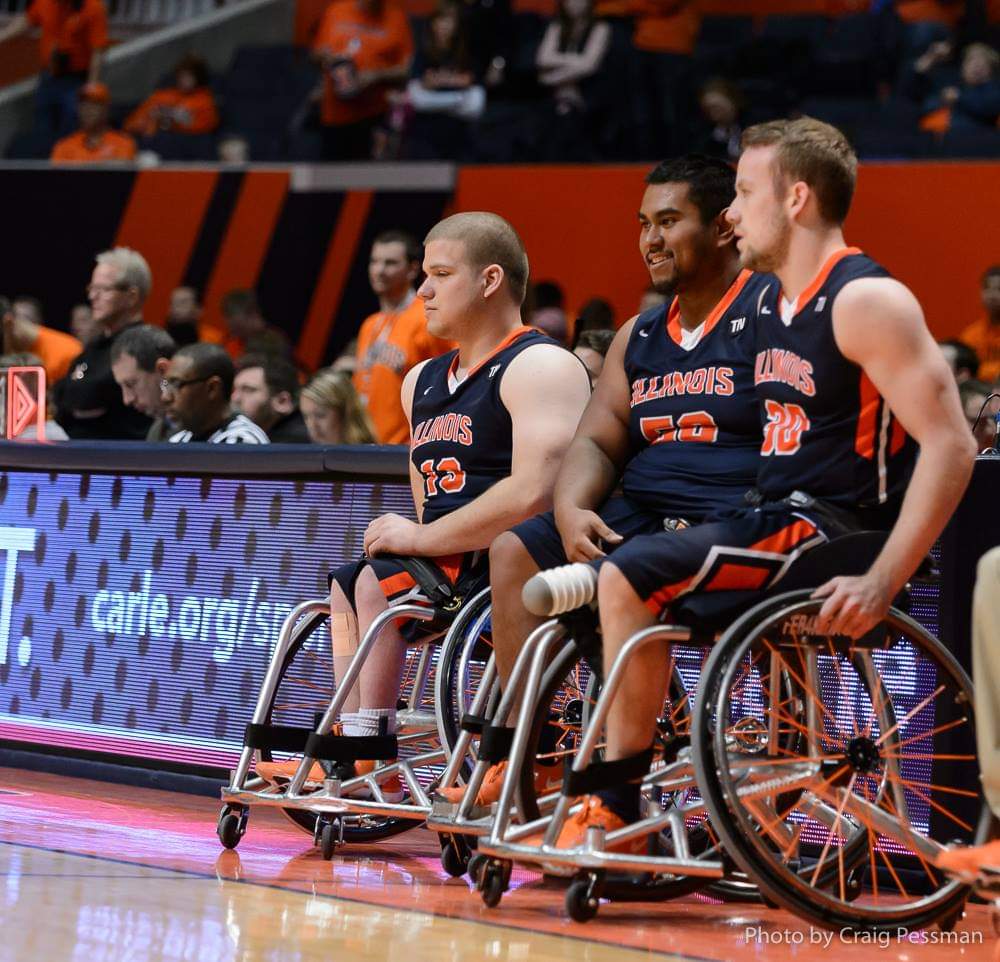
Mak Nong (center) prepares to check into the game. (Photo by Craig Pessman)
After graduating in 2017, Nong played professional wheelchair basketball in Europe for a spell, winning a league championship for LUC Handibasket in Lille, France. What stuck with him was the governance over the sport that was present overseas.
“To them, it was just sport. People without disabilities were playing wheelchair basketball and getting paid to do it,” Nong said. “So, I was thinking, ‘How do I spread this joy to people?’ Recreation is a big opportunity for that.”
Years after graduating, many members of the wheelchair basketball teams have stayed in the orbit of adaptive sports, committing time and effort to growing the scene in myriad ways.
Nong is a program manager for Great Lakes Adaptive Sports Association (GLASA) in Lake Forest, Ill., overseeing a wide range of sports programs—from football, tennis, track and field, swimming, soccer—suited to disabled athletes of all ages.
His journey truly began as a young boy pushing along his wheelchair in Los Cerritos Mall near Long Beach, Calif. Longtime coach Lisa Hilborn noticed Nong and asked if he’d be interested in trying wheelchair sports.
“I didn’t want to do it at all, I was freaking out, but then I went to a practice and I fell in love with it and kept going back,” Nong said. “I’m trying to spread the love she gave to me to other people.”
By the time he was a senior in high school, Nong was heavily recruited for wheelchair basketball. Coach Frogley’s pitch from the University of Illinois stood out from the pack.
“He stressed the importance of education, he catered to me as not only a person but an athlete as well. Just having that balance and showing that we can use sport as a tool to get to where our success is,” Nong said.
Tyree, too, has found a career in the field as training coordinator for Move United, a nonprofit committed to facilitating adaptive sports opportunities. He returned to his hometown of Roanoke, Va., to found the Roanoke Stars Wheelchair Basketball program.
Like other program alums, he repeatedly credits his coaches’ attention to detail for his professional success.
“We all saw ourselves as having our roles, and thought about how do we support each other to fill in the gaps where this is my weakness, but that’s your strength? When I’m struggling, I can lean on you a little bit more,” Tyree said. “I think that that mindset really fell into creating that excellence and trickled into what we do full-time.”
Alums who haven’t found careers in adaptive athletics have stayed around the game in some way, like Derek Hoot and Johnson, who started recording podcasts about it.
In the “Push Podcast,” the pair of alums discuss the happenings of U.S. wheelchair basketball and bring on established guests. The duo wants to break its hiatus soon, Johnson said.
“Wheelchair basketball has made a big impact on all our lives. Being able to find a sports community as individuals with disabilities is huge,” Johnson said. “I think that’s a big reason we have all stuck around adaptive athletics, is we know the change it made in our lives could be duplicated for the next generation.”
Buchi subscribes to the coaching axiom that a “successful season” can’t be determined until the players leave the program and grow into adults. Ten years in, those seeds are starting to sprout: Buchi is beginning to see talented recruits who’ve been coached by his own wheelchair basketball alums.
“The next step is happening, I have so many of my guys that are actually coaching and are giving back to juniors programs,” Buchi said. “They get to put a little bit of our Illinois stamp on these kids before I even get them.
“Our alumni need to think as soon as they graduate, how do I give back to the guys that are coming up next? Because there’s always going to be that next person that comes up and you want them to have the best experience possible.”
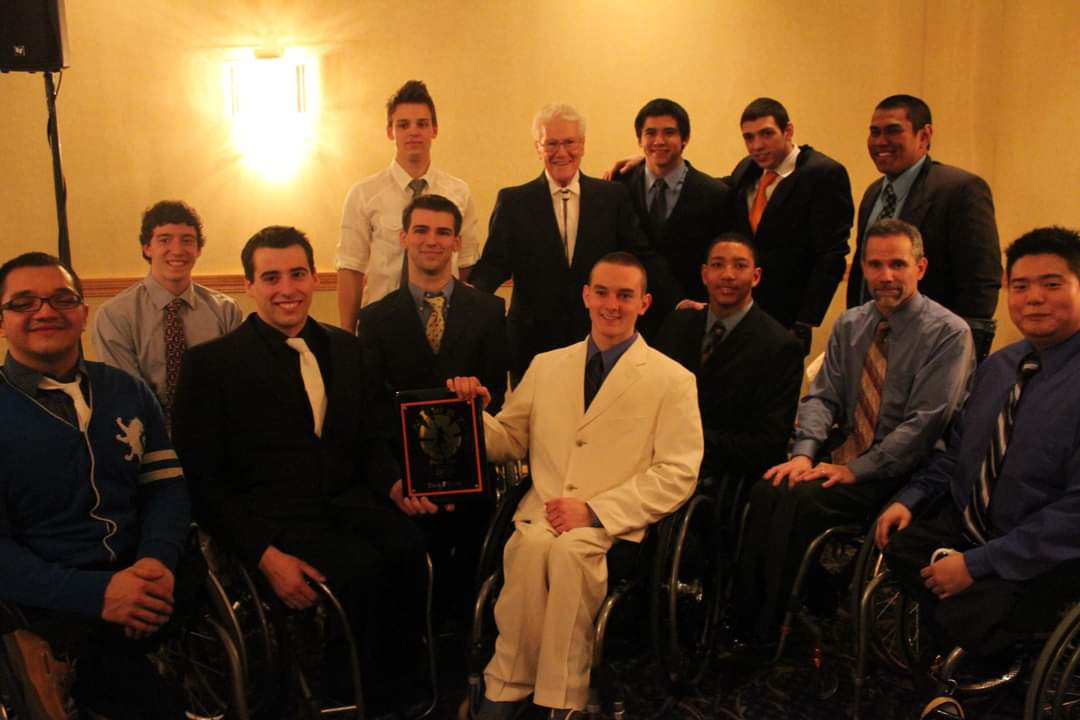
Teammates pose with Coach Mike Frogley (bottom row, second from right) and legendary accessibility pioneer Tim Nugent (second row, second from left).
Chez again hosts two‑week Warrior‑Scholar Project boot camp for veterans
Warrior-Scholar Project students listen to a lecture about the U.S. Constitution from Assistant Professor of Political Science Alicia Uribe-McGuire. (Photo by Ethan Simmons)
For Chez Veterans Center director of operations Andy Bender, the function of the Warrior-Scholar Project is straightforward: Offer military Veterans a two-week-long academic “boot camp” to reacquaint themselves with the classroom environment before heading to a college or university.
“One of the hardest things a service member is going to do is leave the service,” Bender said. “We really enjoy having the Warrior-Scholar Project here because it reflects what we want to be a part of: Making that transition.”
In June 2023, the Chez Veterans Center, the hub for military populations at the University of Illinois, hosted a cohort of higher-ed-bound Veterans for the second year in a row.
The Warrior-Scholar Project partners with American colleges and universities to host brief, intensive, no-cost college prep experiences for both enlisted Veterans and service members transitioning into civilian life.
The Chez Center brought in Warrior-Scholars for the first time in 2022, with a week of STEM-centered coursework taught by Illinois faculty. This year’s edition doubled the session’s length, adding a Humanities track of classes for participants.
The cohort of 15 students and six fellows all hailed from outside of Illinois. Most hadn’t ever visited the Champaign-Urbana campus; though they may not choose Illinois for school, the experience still has a hand in their higher ed journeys.
The two-week schedule was filled with visits to various campus landmarks and labs, including the AHS McKechnie Family LIFE Home, and a robotics and automation demonstration at the Agricultural and Bioengineering research farm. Humanities seminars focused on the United States’ founding principles and documents that the Veterans were sworn to defend.
Assistant Professor of Political Science Alicia Uribe-McGuire led one of their first seminars, teaching an engaged class on the origin and execution of the U.S. Constitution.
“I’ve always thought that the more a student wants it, the better a student they are. And I think they want it,” Uribe-McGuire said shortly after her seminar discussion. “I’ve had Veterans in my classes before, and they’re some of the best students.”
One frequent class contributor was Cody Lepp, an eight-year Navy SEAL who decided to return to school while still serving in the military. After three years taking online classes through National University in San Diego, Lepp is heading into his senior year and he wanted to use WSP to see how he measured up in the in-person classroom environment.
“I came in with an open mindset, hopefully I can learn some new things,” Lepp said. “What I hope to get out of it is practice applying my skills, seeing where I stand against the majority of my fellows.”
Cody Lepp stands in a classroom of the Chez Center after a lecture (Photo by Ethan Simmons)
Jonathan Banasihan had spent seven years as a technician for the U.S. Navy when a new challenge—going back to school—entered his purview. The Warrior-Scholar Project seemed a great opportunity to refamiliarize himself with the flow of a classroom.
Banasihan, the son of Filipino immigrants, never thought college was an option. With a bachelor’s degree from American University and now planning to go to law school at George Washington University, Banasihan feels he left the academic boot camp with far more than advertised.
“I didn’t think that I could do the things that I did in college until I came here,” said Banasihan, now a facilitator for the Warrior-Scholar Project. “The confidence that WSP gave me to not just be uncomfortable, but to stretch myself in ways that I never really expected or wanted to was huge.”
Banasihan is ushering through student Veterans who were in his same position.
“UIUC has been an incredible, incredible partner. I can’t say anything but good things about this place,” Banasihan said.
Among Veterans’ challenges reintegrating after their service, higher education can be a “completely different animal,” Bender said.
“If you’re like some service members—if you’ve spent four, five, six years—how long has it been since you were in a classroom? You might have some of those creeping doubts come in. Can I make it? Am I going to fit in? Is this going to be successful?” he said.
“(WSP) is providing the confidence to these service members that we can do it. That there is a future beyond my service time. That there is a way to make it.”
MedFest was set up to provide free medical screenings for Special Olympics athletes.
A small team of student audiologists-in-training conducted hearing examinations for nearly 100 athletes (Photo provided)
The stage was set at Wintrust Sports Complex in the Village of Bedford Park—a suburb of Chicago—when nearly 600 Special Olympics athletes from across the state began to stream in.
With the help of a substantial volunteer staff, including more than 25 students from the College of Applied Health Sciences at the University of Illinois Urbana-Champaign, many of the athletes left the facility ready to play.
As part of the 22nd annual “MedFest” event, hundreds descended on Bedford Park to help athletes from Special Olympics Illinois receive their physical certifications to compete in the state.
In the most recent edition, hosted on Nov. 30, students from the Departments of Speech and Hearing Science and Recreation, Sport and Tourism took time out of their fall break from classes to help the event run smoothly.
A small team of student audiologists-in-training conducted hearing examinations for nearly 100 athletes, while 15 RST students helped from the event management side, signing in the athletes and directing them to the right locations.
“You can tell that they got so comfortable and were having a blast, talking with athletes and interacting with them,” said Melissa Garritano, senior director of Special Olympics Illinois region D, which covers the Chicagoland area. “Thinking back to when I was at the U. of I., I wish I would’ve done stuff like this. They drove up two hours to spend the day with us—the athletes loved them.”
The connection stemmed from Bedford Park’s budding partnership with the College of AHS. The Department of Recreation, Sport and Tourism has a grant with the Village of Bedford Park, which heavily invested in the Wintrust Sports Complex. The project-heavy facility hosts community events on a regular basis, atop of its normal sports operations.
Joe Ronovsky, chief business officer of Village of Bedford Park, is a two-time RST graduate. He saw that the complex could serve as a real-world “lab setting” for community engagement projects led by RST faculty and students.
“Frankly, it’s kind of a one-stop shop, and it’s an opportunity for me as a teacher to show how all these things interact with each other,” said RST Clinical Associate Professor Michael Raycraft.
MedFest was set up to provide free medical screenings for Special Olympics athletes. Wintrust Sports Complex at Bedford Park began partnering with Special Olympics Illinois about a year and a half ago.
“Their facility is unbelievable,” Garritano said. She met Raycraft through their common connections to the Wintrust Complex.
Nicole Dudek, a junior in the RST program, was taken aback by the organizational strength and scale of the event. She started her day at MedFest positioned at the height and weight station, an entry point for many of the athletes.
When students showed up around 8:30 a.m., the Special Olympics staff had the gear and answers: nametags, T-shirts, and where each student would be working within the complex.
“From the event management side of things, you could tell how well-run this event was start to finish,” Dudek said. “It helped to have such a large open space and so many volunteers, and everyone worked well together with the sole goal to help these students get their necessary medical certifications.”
The “noisy, upbeat” energy of the event bolstered the volunteer experience for RST senior Carson Bounds.
“As you could imagine, with 450 kids taking a field trip to a large indoor sport facility during a school day, they all were quite excited to be there,” Bounds said.
Third-year audiology student Yadira Espinoza appreciated the pre-event workshop on how to work with a special needs population.
“Since it was a Special Olympics event, it was important for us to know what to expect; that every kid will be different depending on their needs and accommodations,” she said.
The athletes—ranging from elementary schoolers to full-grown adults—had a variety of responses to the hearing tests. Espinoza used her bilingual fluency to help some of the families who only spoke Spanish, she said.
“These opportunities are very important because they provide more or confirm what we learn in the classroom. It’s different to work with someone who may have Down syndrome or a speech delay; seeing it firsthand really makes a difference and puts you in a situation to put your critical thinking in place,” she said.
Students from RST and SHS teamed up at MedFast (Photo provided)
SHS audiology students are regular volunteers in the community, typically getting out for a handful of outreach events per semester, such as a recent visit to the ClarkLindsey retirement community in Urbana.
Clinical associate professor Sadie Braun supervised the audiology students in the volunteer event. Seeing her students persist with the athletes who didn’t respond right away to testing made the experience worthwhile.
“The athlete got this sense of pride when they were doing what we were asking them to do,” Braun said.
“It was awesome and unique to bring the U of I [audiology] crew up,” Garritano added. “Some of those athletes they got to see may have never had a hearing test in their life.”
Ronovsky thanked Raycraft and Village of Bedford Park President David Brady for tying together all the stakeholders in November’s event.
“Seeing the large group of RST and Speech and Hearing Science students volunteering at MedFest really tied together the meaning of community we’re trying to build at the Wintrust Sports Complex, in Bedford Park and throughout the state of Illinois,” Ronovsky said. “These Illini students are the next leaders in our communities.”