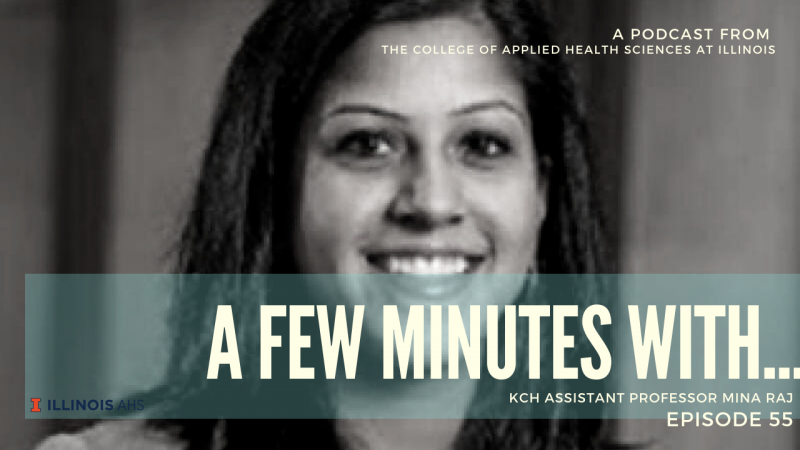
A Few Minutes With … Mina Raj


Transcript

VINCE LARA: Hi, and welcome to another edition of A Few Minutes With, a podcast that showcases Illinois’ college of Applied Health Sciences. I’m Vince Lara. And today I’m speaking with PCH Assistant Professor Mina Raj about why she chose Illinois, teaching during a pandemic, and her research with caregivers of older adults. So Mina, thanks so much for speaking with me today. I always try to find out about faculty and how they got their start, especially new faculty like yourself. So did you always want to teach?

MINA RAJ: Thank you so much for doing this with me today, this podcast. So I have always enjoyed teaching. And I did look forward to it, especially since my experiences of teaching as a graduate student. As a graduate student, I think it’s been really rewarding to observe students evolve in their critical thinking about a topic over the course, form evidence-based opinions about different topics, and especially policies in the health care classes that I teach, and discover new aspects of our health care system that they are passionate about but they didn’t necessarily understand, though they can resonate from their personal experiences as being patients.

VINCE LARA: Yeah, interesting. I wonder, typically, when a person goes into research, there’s something that sparked their agenda, what they wanted to look into. And one of your primary research agendas is incorporating caregivers into health care. And I’m curious what made you look into that? What was the impetus for doing that kind of research?

MINA RAJ: Sure. So during my PhD, my dissertation research was focused on understanding how older adults and their family caregivers make decisions about geriatric care. So geriatrics is the medical field that specializes in the care for older adults, especially those with complex clinical conditions. And then some other projects where I was working to understand patients with cancer, it was kind of a similar situation of recognizing that family caregivers are really influential in health care and in medical decision making.

But they aren’t really talked about that much in policy in that way. So the way we think mostly about family caregivers are their assistance with things like eating and dressing and transportation and meal preparation. But they’re really kind of neglected from health care conversations. And I think my research seeks to really help caregivers because these are the people that are supporting patients who are going through intense challenging periods of their lives. And so seeing this major gap in our policies and in research led me to want to focus on supporting caregivers so that they can support their care recipients.

VINCE LARA: Mm-hmm. I want to take a step back. I meant to ask you first, what made you choose Illinois?

MINA RAJ: Yeah. So that’s a great question. There was a lot that I enjoyed. When I visited Illinois, I found the first thing that struck me was how supportive and what an emphasis there is on the campus on collaboration within the department, as well as across the departments.

So I’ve already sort of started forming teams with people in fields that I previously knew very little about, and I’m learning so much. And it’s really nice to think outside the box and get to be creative. And that’s my other point is that it seems like the kind of place where I can be very creative, a place where your ideas can really translate into different types of technology or different types of policies. And seeing ideas come to fruition like that was something that really sparked my interest in Illinois.

VINCE LARA: Mm-hmm. One of the things that you also look at, switching back to your research, is you look at technology to support caregivers. And I’m wondering what sort of technology do you use?

MINA RAJ: Yeah. So I examine a variety of different technologies. So for instance, within health technology, there’s the electronic health record, which if you go to the doctor’s office, you might sign onto your patient portal before you go to the office in order to fill out a questionnaire. Then when you go to your doctor’s office, your doctor might be on the computer filling out information about you into the electronic health record or the computer system. And so this is one type of technology that I look at in terms of policies or design to integrate caregivers so that they can access their care recipient’s patient portal or health record.

Another type of technology to look at is telemedicine. And in the past several months, we’ve seen a huge shift to telemedicine visits for health care. So this is where a patient might visit their doctor through a phone or through video conferencing. And so, again, how do we allow caregivers to be part of that visit? We know that caregivers often assist their relatives to the doctor’s office, may take notes, may provide the doctor with more information about the patient’s concerns, and how do we make the same situation happen when we’re doing care over telemedicine.

VINCE LARA: Mm-hmm. You reference telemedicine. And obviously, telemedicine has become an important part of how we treat people and that’s because of the pandemic. And I’m wondering, how has the pandemic changed how you teach and also how you conduct research?

MINA RAJ: Sure. So in terms of my research, I would say that it has led me to shift a little bit more to survey research. I’m a mixed-methods researcher. So I do primary data collections through surveys, interviews, focus groups, as well as secondary data. And so I’ve really been focusing on developing online surveys and analyzing secondary data.

I have missed being able to interview key participants and conduct focus groups. I’ve done a little bit of that through virtual modes. But it’s a little bit different. You don’t really get to form the same type of relationship with your participants, which is key to building trust in the context of research, especially.

And so I think that’s a similar situation in terms of teaching, where I’ve definitely seen a lot of positive benefits of online teaching. I think, for instance, I’ve noticed that students may even be more comfortable with speaking up in class. I think there are a lot of really great polls and breakout rooms and other opportunities for creating an interesting classroom environment. But again, one of the things I miss is that face to face, walking into the classroom, and seeing students and getting to know them in a different way and feeling the enthusiasm in a room when students understand a concept that relates to something in their lives that they’ve experienced.

VINCE LARA: Mm-hmm. I’m interested in your most recent publication. In it, you looked at characteristics that helped shape medical trainees and their specialties in treating geriatrics. And you spoke about geriatrics earlier. What kind of characteristics do you mean when you talk about the characteristics that help shape their specialties?

MINA RAJ: Sure. So I drew upon a sociological framework for that particular study that says that the way that we decide what career or specialty in medicine we go into– this can actually apply to any career; it’s actually called a model of careership– is a combination of personal experiences, our social network and social circle and those experiences, and then institutional characteristics. So this can be the school that we are educated in, the medical institution that we go to and get our training in. And so we have a really significant workforce shortage in geriatrics.

We need over 20,000 geriatricians in order to meet demand for our current aging population. And so geriatrics happens to be a pretty new field that was really developed in the 1980s. And we’ve had problems with recruiting medical trainees to go into geriatrics.

Now, one of the earlier areas of discussion was that medical trainees may have poor attitudes towards aging and may not really understand the aging process and may think of it negatively. And so a lot of institutions have implemented training and skills and exposure to older adults in order to mitigate the effect of that characteristic. And so I felt like that didn’t solve the whole problem.

There’s still something missing in our understanding of what’s going on. So I decided in that study to focus on those three characteristics, so personal, social, and institutional. And what I found was that institutional characteristics were particularly influential in this qualitative study of trainee interest in geriatrics.

So this can include things like do you have many geriatricians in leadership positions who are role models to medical trainees and teach medical trainees about what it means to be a geriatrician? How close by are geriatrics clinics to where residents are training? So that’s another way that different institutions can influence the exposure of their trainees have to geriatrics and also make them feel like it’s a different type of medicine. It’s a complex type of medicine. And it requires different skills. But it’s still medicine.

And so I think one of the main conclusions of the paper is that we need to expand our understanding of complexity in medicine. It can be knowing a lot about an organ system or about a part of the body. But it can also mean knowing about the lifespan and knowing about the health care system and an older adult’s social and economic circumstances.

VINCE LARA: I know researchers are always looking at what’s next, right? You have to always think about publishing. So I wonder, what’s next for you? Like, what do you hope to tackle next? And I know you’re building collaborations here at UIUC. And so what do you have on the horizon?

MINA RAJ: Sure. I so my main area is going to continue to be looking at different ways of designing technologies and policies to integrate family caregivers into health care teams. And so this involves both what do these technologies look like and then in addition, what do our policies need to look like in order to make sure that this integration is both effective and also safe? So for instance, if caregivers can see their older relative’s medical record, we want to make sure that we have policies in place to protect patient privacy and caregiver privacy and make sure that caregivers aren’t discriminated against in a workplace because maybe they have certain health risks. And so that is really what I see as the primary area of my research agenda.

Another project that I’m really excited about and I’m working on right now is actually a text-based survey of youth across the United States. So these are adolescents aged 14 to 24. And so this text-based text message-based survey, prompts qualitative responses. And the questions that I have asked are to get a sense of how young adults and youth in the US think about family caregiving and their potential for being a family caregiver in the future, including what policies or educational practices or health care practices they perceive meeting in order to carry out potential caregiving responsibilities while promoting their well-being and their educational and professional success.

VINCE LARA: My Thanks to Mina Raj. For more podcasts on Illinois’ College of Applied Health Sciences, search A Few Minutes With in iTunes, Spotify, IHeartRadio, radio.com, and other places you get your podcast fix. Thanks for listening and see you next time.

Share on social

Related news

A Few Minutes With … KCH Assistant Professor Sheena Martenies


Transcript

VINCE LARA: Hi, and welcome to another edition of A Few Minutes With, a podcast that showcases Illinois’ College of Applied Health Sciences. I’m Vince Lara, and today I’m speaking with KCH Assistant Professor, Sheena Martenies, about why she chose Illinois, teaching during a pandemic, and her research experience. Did you always want to teach?

SHEENA MARTENIES: So, I didn’t ever really envision myself as a teacher as I was going through graduate school, as I was going through my postdoc. But I took a position as an adjunct lecturer in the last year of my postdoc at Colorado State. And I was teaching at the University of Northern Colorado, and I really enjoyed it. I loved talking to the students. I was working with MPH, Masters of Public Health students, about environmental health, and I really enjoyed it. I found it very rewarding. So I never really envisioned myself being a teacher, but I found that it’s something that I really enjoy and I’m thankful for the opportunity to get to continue that and to continue to grow as an educator. It’s been really rewarding.

VINCE LARA: Yeah. You mentioned that you grew up in Southern California. I wonder how you made your way to the Midwest and the University of Illinois?

SHEENA MARTENIES: Yeah. So that was– it’s a little bit of a journey. I did my undergraduate degree in San Diego. I went to San Diego State. And then after that, I got a job. And the recession in 2008 hit and I didn’t have a job anymore, and so I kind of bounced around. And eventually, I decided to pursue a Master of Public Health degree, and I moved to Washington D.C. to do that. And I thought I was going to be a regulator. I wanted to work for EPA, or maybe the Department of Energy. And I had a really wonderful advisor when I was at GW, and they really pushed me to pursue my doctoral degree. And so I moved to Ann Arbor, Michigan and went to the University of Michigan, and got my PhD.

So I had been in the Midwest before, and I really enjoyed my time in Ann Arbor, but I moved out to Colorado to do a postdoc, like I mentioned, at Colorado State University, and loved being out in the Mountain West. It was just really, really wonderful having mountains, and all the hiking, and all that great stuff.

But then the opportunity to come to the University of Illinois came up, and I thought, well, you know, I loved being in a college town in the Midwest. Maybe this would be a great place for me. It didn’t hurt that my partner was originally from Michigan, and so he got to be a little closer to home as well. So when that opportunity came up, it felt very appropriate for me to come back to the Midwest.

VINCE LARA: Yeah. You really can’t beat the Midwest college towns, for sure. You know, you– what’s it been like teaching in this pandemic? You know, I’m sure you prefer being in a classroom with students. But you know, what kind of challenges have you experienced, or have there been, maybe, benefits of Zoom teaching that you didn’t anticipate?

SHEENA MARTENIES: There is definitely some challenges, but a lot of opportunities as well. I think one of the biggest challenges, like you mentioned, is just not being there in the classroom. It’s hard to get that real-time feedback from your students, or really make those kind of personal level connections.

Another thing is that I’m really new to teaching. Like I said before, this is not something that I’ve done a whole lot of in my graduate career. And so now that I’m an Assistant Professor, I’m really trying to learn how to teach, and learn how to teach online. So that’s been a little bit of a challenge, but it’s been wonderful. There’s so many supportive resources here on campus that have really allowed me to make the best of teaching online.

One of the things that I think that’s been sort of unexpectedly helpful is that students– you’re able to meet with students one-on-one in a more effective way. You know, office hours aren’t always accessible to people. They’ve got scheduling conflicts. They have family obligations that don’t really allow them to come to campus when you might be holding office hours. But it’s really easy to hop on a quick, 20-minute Zoom meeting.

And so I think sometimes there are opportunities to meet with students, and we’ve got a much more robust framework for doing those types of quick, one-on-one opportunities that might be always accessible to students. And so I think that has been a real benefit of this online environment, where we’ve got these kind of quick and easy meetings, and people are generally more available if they don’t have to come all the way to campus, or come all the way to your office.

VINCE LARA: Most of the faculty that I speak to here at the University of Illinois– the faculty, I find that there are different things that inspire their research– something that happened to them, some experience along the way. And I wonder what your inspiration was?

SHEENA MARTENIES: Sure. So like I mentioned, I grew up in Southern California. And I can remember we lived in Ventura County, and we would drive into the San Fernando Valley to go visit my grandparents. And you know, you’d come over this small mountain pass and you’d drop down into the valley, and every time, it didn’t matter what time of year it was, there was always just this thick brown haze hanging over where my grandparents lived. And I just remember that from my childhood.

And then I took some courses in college and in graduate school and just realized how important environmental health is. It’s one of those things that, a lot of people don’t have control over their environment. They live where they live because of their socioeconomic status, or their job, or their family. And so they’re just sort of in the environment that they’re in. And so I think that there are a lot of really interesting research and policy questions we can ask about the environment and environmental health.

And so I think that is really where my interest comes from, I think. Just knowing that those exposures are out there, they’re largely involuntary, and they can have a pretty dramatic impact on a person’s health.

VINCE LARA: Yeah, which leads into my next question which is about your research and focusing on pollution and child health outcomes. And can you talk a little bit more about what that is?

SHEENA MARTENIES: Sure. So I’m particularly interested in air pollutant exposures that happen during the prenatal period and during that early life period, and sort of what the subsequent health outcomes are for children. So we know that developing fetuses, infants, and small children, they have respiratory symptoms that are rapidly developing. Their bodies are undergoing a lot of changes, and they might be really susceptible to those air pollutant exposures.

So a lot of the research I’m doing right now is with a cohort study based in Denver, Colorado called Healthy Start. And this is a group of children that have been followed from their prenatal period on, and we’ve been able to look at things like air pollution in the prenatal period, some of those features of the built environment. You know, whether there are a lot of trees and parks or a lot of paved surfaces– those types of factors.

And we’ve found that there are some relationships between those early life exposures and those prenatal exposures to outcomes like birth weight, which is a really good neonatal indicator of later life outcomes like obesity and respiratory health. So we’re starting to explore how the environment in which children develop and then grow impacts their long-term health. And so that’s a line of research that I’m really interested in continuing as we start to understand how these environmental exposures that are really not voluntary impact children’s health.

VINCE LARA: At an R I University, you always are thinking of what’s next in the pipeline. And I wonder, is there something that you have planned, post-vets research for your next project?

SHEENA MARTENIES: Yeah. That’s a really great question. I am becoming increasingly interested in some of the spaces that children spend their time outside of their home. A lot of environmental epidemiology and environmental health research that looks at childhood health outcomes really focuses on home environments, and those are so important.

We want all children to grow up in a healthy home, but we also know that kids, especially young kids, don’t spend all of their time at home. A lot of children might be spending time in daycare facilities or preschools, and I’m becoming more interested in what’s going on in those types of environments.So I’m hoping to partner with some of the faculty here on campus in the Family Resiliency Center and in the College of Engineering to start to look at those types of indoor spaces– those child care facilities, those preschools. Try to understand what the exposures might be in those spaces so that we can get a more complete idea of what early childhood exposures might be for kids as they grow up.

VINCE LARA: My thanks to Sheena Martenies. For more podcasts on Illinois’ College of Applied Health Sciences, search A Few Minutes With on iTunes, Spotify, iHeart Radio, Radio.com, and other places you get your podcast fix. Thanks for listening, and see you next time.

Editor’s note:

To reach Vince Lara-Cinisomo, email vinlara@illinois.edu.
 

Share on social

Related news

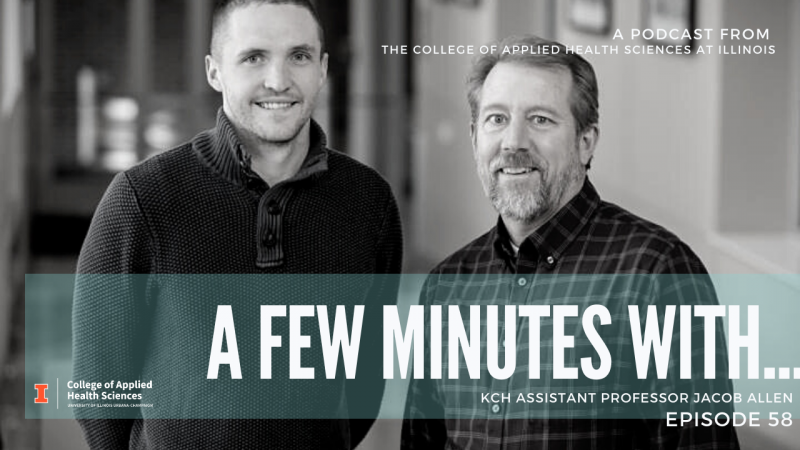
A Few Minutes With … Jacob Allen


Transcript

VINCE LARA: Hi, and welcome to another edition of A Few Minutes With, the podcast that showcases Illinois College of Applied Health Sciences. I’m Vince Lara, and today, I’m speaking with KCH Assistant Professor Jacob Allen about his research on how exercise, stress, and diet influence gut microbial communities.

So I’m talking with Jacob Allen, who is a new addition to the Department of Kinesiology and Community Health. And, Jacob, I notice from your CV that you had done your undergrad and master’s at the University of North Carolina at Chapel Hill. And yet you left Chapel Hill, which is a lovely place in which I lived for a while, for Chambana, which we’re covered in snow this morning. Tell me, what made you do that? What prompted your move here?

JACOB ALLEN: That’s a good question. Well, so I did my bachelor’s in exercise science with a minor in biology. And coming out of undergrad, I didn’t really know what I wanted to do– surprise, surprise, a little bit young. But I was interested in exercise physiology, and so I decided to stay on and do a master’s program in the Exercise Physiology group at UNC-Chapel Hill.

And I did my masters in working with breast cancer survivors, where we looked at how exercise affected inflammatory markers in these patients that were coming off of breast cancer treatments to see if exercise could reduce some of the systemic inflammation they experienced. So that was my foray into exercise. And then because I was looking at inflammatory markers, these proteins called cytokines in the blood, I started getting interested in immunology.

And at the time, and still is, Jeff Woods, Dr. Woods here at University of Illinois, was prominent and one of the few exercise immunologists in the field. So I figured if I was going to study exercise and study the immune system, I should probably go get a PhD with somebody that knows what they’re doing. And so I looked up Jeff’s name and gave him a call.

And that’s what started my process of moving to Champaign to do my PhD in 2013 to look at exercise and the immune system. And so I came to Illinois, and I took off from there, where we started to look at both the immune system, but also the microbes in the gut and how the microbes affect the immune system. So I guess it was more of a career path that took me from Chapel Hill, where it’s a little bit warmer, to Champaign, Illinois.

VINCE LARA: Right, yeah, absolutely. And then the opportunity to work with Jeff obviously is a big part of it.

JACOB ALLEN: Right, yup, it was, definitely.

VINCE LARA: Yeah. So you talked about how your research focuses on exercise and diet and how they influence gut microbiota. What led you to study that? Usually there’s some sort of inspiration to what a researcher decides to study. Was there something in your early life that led you to look into that?

JACOB ALLEN: You know what? I wish I could say there was some beautiful epiphany I had or something like that. But I can’t really tag it to anything specific. I’d say I’m interested in questions that we don’t understand, and that’s probably why I did biology.

And when I started in Jeff’s lab, there was this emerging topic of the microbiome and these trillions of microbes that live in our gut that we still don’t know exactly what they do. And so it kind of just spiraled into studying it. Again, like I said, I was an exercise scientist looking at how exercise affects breast cancer survivors.

And it got me interested in the immune system. And then being interested in the immune system led me to study the microbiome. And what we know now is that the microbes in our gut are really important for training the immune system and establishing the immune system, and then in many inflammatory diseases, affecting the immune system. And so the study of the microbes tied in directly with my interest in immunology. And so that’s how I got to studying the gut microbiota.

VINCE LARA: How granular can we get in terms of, if you change one food, if you stop eating one food, can you determine how that affects the gut and how it affects disease?

JACOB ALLEN: That’s a great question. Number one, I’ll say, it depends– depends on the food. We know a lot about– relatively a lot– about certain types of food with regards to the microbiota. One of them is dietary fiber and something that our lab is interested in.

So fiber comes in different forms, but in one of the forms, it’s a soluble, fermentable fiber. And what that means is that it can reach the colon, where most of the microbes are. And the microbes use that fiber as food, as a sugar source.

And so what we know is that by feeding the microbes with this fiber– and again, there’s various types of it– we can change the microbiota quite extensively. What’s still not understood is how different types of fiber feed the microbiota differentially. And does that matter for our health?

And what’s important is that once the microbes get a hold of these– this food type, this fiber– they can degrade it into these bioactive molecules that then affect our immune system. So we’re still trying to understand that process of how the microbes feed off of these– off of our diet. What type of metabolites do they produce? How does that change the microbial communities? And then how does that all affect our immune system and our health is our interest in our lab.

VINCE LARA: What you’ve said is that you wanted to provide a new perspective on environmental conditions and microbiota. Is that tying into what you’re looking into?

JACOB ALLEN: Exactly. You know, our lab is named Integrative Microbiota Lab. And the reason for that is that I think that in science, we’re really good at isolating things and tying down to what we call a mechanism, which is really important. And that’s part of our lab, too.

But in especially humans, as we walk through our daily life, we’re doing all sorts of things. We have different exercise patterns. We have different levels of psychological stress. And that’s another component of my lab, is looking at how stress affects the microbes as well.

And then obviously, we all have different dietary patterns. And so trying to tease out those factors and how they regulate the microbiome in a daily life is the purpose. And my long-term goal of my lab is to look at these individual environmental factors in isolation. And then long-term, how are they all together affecting the microbes in the gut?

VINCE LARA: Can you tease out things like physical stress versus mental stress? Or is that something that you even can separate?

JACOB ALLEN: Another great question. There’s debate among this in the field of how to define stress in humans. And obviously, it’s all based off of the experience of the person.

But we can measure certain biomarkers that correlate heavily with stress. So we know some classical pathways that are activated by psychological stress– the hypothalamic pituitary axis, which ultimately results in the release of a glucocorticoid called cortisol, which I’m sure many are familiar with. And so we can look at levels of cortisol in the blood, but also, more long-term, elevations of cortisol in things like hair roots and stuff like that to see if these individuals are experiencing acute levels of stress, which we all experience, or if they’re experiencing stress on a chronic level on a daily basis, where we see this long-term elevation of hormones associated with stress.

So the short answer is it’s complicated. But we can at least get somewhat of a diagnostic of how stressed people are or individuals are based off of some of the hormonal responses we see in the blood and other tissues.

VINCE LARA: Interesting. You know, you recently received a grant along with Jeff Woods to study age-related dysbiosis and physical resilience. What can you tell me about that project? I mean, first of all, what’s age-related dysbiosis?

JACOB ALLEN: Yeah, so first, the word “dysbiosis,” for those that don’t know, is essentially a broad term to suggest a disrupted microbial community in the gut. And so there’s various forms of, quote, “dysbiosis.” But what we know is that if the community of microbes in your gut is healthy, it usually is fairly stable and goes through similar– has similar patterns amongst individuals that stays fairly stable over time.

What we see with, quote, “dysbiosis” is that those communities become less stable and less even. So you sometimes get what we call pathobiont species that expand in the gut. And these are potentially bacteria that might induce some negative consequence on our immune system or other components of physiology. And so that’s what we term– what we call dysbiosis. And what the age part is that there’s accumulating evidence that aging, getting older, might contribute to some form of dysbiosis.

And what we’re studying with this grant– so it’s a one-year grant funded by the NIH that will hopefully extend into a longer grant– is to see how antibiotic exposure affects the microbiome in aged populations. And there’s a couple of reasons for this. One of them is that aged individuals tend to consume antibiotics more extensively because they’re experiencing more sickness as they get older. And so we want to study it on that level.

And number two, obviously, these antibiotics affect the microbiome. And so we want to see if a, quote, “aged microbiome” responds differentially to antibiotics versus a young, healthy microbiome. And so to test this, we’re using first, a preclinical model, which is a mouse model, to test these hypotheses.

And tying it in, we think that those microbes, if we disrupt them in old animals, there’s going to be consequences both within the gut, but we also think that is affecting their physical resilience– so how well they perform on particular tasks such as exercise tasks. And so that’s our hypothesis going in. And of course, we don’t know the answers yet, and that’s why we’re running the studies.

But we think that the aged animals will respond differentially to the antibiotics and maybe not recover as well. And that might lead to some potential issues with how they move and how they respond to challenges. So that’s the purpose of the grant, if that makes any sense.

VINCE LARA: Yeah, absolutely. How symbiotic is the relationship between exercise and gut health? Does one influence the other more?

JACOB ALLEN: Yeah, that’s a great question. So some of my PhD work showed that exercise changes the microbiome. And it increases some beneficial metabolites that we think are health-promoting.

And one of them is called a short-chain fatty acid that initiates some overall anti-inflammatory and beneficial effects on our tissue. Now, whether it’s, quote, “good” or “bad,” I think we still need to figure out. There’s definitely changes with exercise and the microbiome. But again, trying to delineate the long-term effects and whether it’s good or bad is still up for debate and up for what we need to investigate with our science.

Your other question– does gut health affect exercise? And I think that that’s another open question in the field. Is there some gut-brain signaling that affects motivational behavior to exercise? And that really has not been investigated at all to my knowledge. So I think you bring up a good point. And it’s something we don’t know quite yet.

VINCE LARA: Yeah. You mentioned that you’re hoping that this grant with Jeff is going to be a long-term grant– multiyear. But researchers always have to look to the next thing, right? And so I’m curious what you’re working on or what your next big project might be.

JACOB ALLEN: Yeah. There’s a couple. Currently, I did some work that was independently funded at the end of my postdoc that I was able to take with me to start my lab here in Illinois, focused on some of the stress effects on the microbiome. And so we’re currently, in the lab, really interested in how the microbes interact with the cells that line the gut, called epithelial cells.

And what we found is this really intricate interaction between the gut microbes and these epithelial cells. You think of it as like a tit for tat. As the epithelial cells, which are our cells that line the gut, produce some molecules, they change the microbes. The microbes then feed back and change those epithelial cells.

And what we found is that stress, for some unknown reason, really changes the profile of these epithelial cells. And we’re not sure why yet. But what the evidence is pointing towards is that those changes in epithelial cells with stress is really driving the microbial changes that we see in the gut, and potentially in negative ways.

And so we’re trying to understand that process in a little more detail in our lab currently. So that’s the next frontier where we’re focused. And then we have some other focuses, too, particularly with exercise.

And going back to the integrative portion of it, we’re interested in how exercise and dietary fiber interact to modify the microbiome. We know that both in isolation change the microbiome. But really, not a lot of work has been done with a focus on how the interaction of diet and exercise might change the microbes and what that might mean for our health. So that’s another focus of the lab currently as well.

VINCE LARA: My thanks to Jacob Allen. For more podcasts on Illinois’s College of Applied Health Sciences, search A Few Minutes With on iTunes, Spotify, iHeart Radio, Radio.com, and other places you get your podcast fix. Thanks for listening, and see you next time.

Editor’s note:

To reach Vince Lara-Cinisomo, email vinlara@illinois.edu.
 

Share on social

Related news

College of Applied Health Sciences
110 Huff Hall
1206 South 4th Street
Champaign, IL 61820
(217) 333-2131