Q&A with RST student Emily Jordan


VINCE LARA: All right, so Emily, the first question I wanted to ask you is what made you choose the University of Illinois?

EMILY JORDAN: Well, originally, back in 2020, when I was about to graduate with my associate’s degree, I went to Danville Area Community College, where my associate’s is from. My original plan, before COVID hit, I went and visited three different schools, and the U of I was one of them just because I actually only live about 45 minutes away from campus, so I grew up coming over here coming the games and stuff all the time. So I was already kind of familiar with everything. I just wanted to see what the actual school was like.

So when I visited here originally, I was thinking I was going to major in communications because that’s what my associate’s is in. So when I did my visit over here, I actually spoke with a communications advisor, and I told her what I wanted to do and everything, and she actually redirected me to RST, which is where I’ll be graduating now. So that’s how it ended up. I realized that it was a good fit for me. I’m familiar with it over here. I could live at home, save money, and everything like that, so that ended up being why I came over here.

VINCE LARA: Yeah, and that answers the second question I had for you, which was why RST? And RST does have some similarities to communications. So when you were looking into RST at first, what really appealed to you there?

EMILY JORDAN: I guess I wanted something that was very people-based. I feel like I need communication with people all the time. I don’t see myself working at a sit down job. I need that interaction and everything. And so when I looked into RST more, after discussing different options with that communications advisor, I kind of figured out like, OK, these classes look really appealing to me, it all seems really enjoyable and something that could lead me to a really strong career, and it’s focusing on something that I really want to do, and more sport-based.

Communications is like a big bubble, so it’s really wide, and that’s why you can kind of go different routes with them. So that’s why I wasn’t sure what it was like over here, but I realized that RST encompassed a lot of things that I wanted to learn about and kind of navigate through as I got my bachelor’s degree.

VINCE LARA: Yeah, that’s a good point. And you talked about it being a big bubble, but it’s interesting that I noticed recently– part of the reason I’m having Emily on the podcast is that she won the Joan Braswell Scholarship at the RST scholarship ceremony, and as part of that social media post that we did over here, it mentioned that you wanted to be an athletic director. So I wonder how you made that leap from a communications associate’s degree to RST to now thinking about that as a future career?

EMILY JORDAN: Well, I took a class last semester, in the fall of 2021, and actually, that was my first semester physically on campus because my junior year, when I transferred here, everything was online. So when I came over here in person as a senior last semester, I was kind of worried and intimidated a little bit– a big school and everything. But once I got settled down in the classes and stuff, I felt comfortable in everything.

But one of the classes that I took was Dr. Welty-Peachey’s class. It’s RST 430, and it’s a Sport and Development class, and that was probably one of my favorite ones I’ve taken over here. It talks about how we can use sport as a tool to kind of help develop athletes and develop different parts of life as well as helping athletes be better in the sport that they want to be in.

And I think that kind of opened my eyes as to, OK, I think I have a passion for trying to fix the problems that are within sports because obviously, everything has issues and flaws, but I think that that’s where I found my passion was that I want to keep, especially, kids and youth and high school athletes involved in sports just because I know all the benefits that come from playing and participating in them.

So that’s kind of where I learned like, OK, I feel like, as an athletic director, I could help navigate athletes into the routes that they want to go in and steer them in the right direction and resolve those problems that are taking place as of today. And that’s kind of where I learned that being an AD might be a good fit for me.

VINCE LARA: I’m curious about what or who inspired your love of sports.

EMILY JORDAN: So I’m the youngest of my family. I have two older brothers, and I grew up watching them play sports. They played soccer, a little bit of football, a lot of basketball, track, baseball a little bit, so I just like grew up watching them play everything and, of course, as a younger little sister, you want to do everything that your older brothers or siblings are doing.

So that’s kind of how I got into playing T-ball as a little kid, and then that grew into softball, and then I played soccer just like they did and ended up playing school volleyball, and I ran a little bit of track and played basketball like them. So that’s kind of where it stemmed from. I mentioned before, too, we would always as a family come over to the U of I and watch basketball games and football games. So I kind of just grew up playing them and being around them all the time. We talk about it all the time still today. So that’s kind of where that all stems from.

VINCE LARA: Yeah, that makes sense. And recently, you were an announcer for the Men’s National Junior College Athletic Association Division II basketball tournament. How did that come about? Did you express interest? Did someone seek you out? Tell me how that came together.

EMILY JORDAN: When I was at Danville Area Community College, I took some college classes, like dual credit classes, in high school, so I was already familiar with DACC. And then when I graduated high school, that’s where I finished my associates at for that remaining one year. And one of the classes I took was like a media production class, and the assistant professor I had, her named Laura Hensgen, and she’s kind of in charge of the media department there and everything, and DACC has hosted that tournament, the championship portion of the tournament for– I think it’s been 29 years, I believe. So they’re very familiar with it and everything.

So they have broadcasters and the radio and the livestream come out and everything, and there was myself and another student in her class at the time that was interested in media broadcasting, media stuff, sports in general, and she just asked us if we would be interested in doing it, if that would be a good opportunity to expand our horizons a little bit and get us some experience and everything. So I’m not going to lie, I was a little intimidated just because it’s a big setting and everything, but myself and the other student ended up doing it that first year of 2020.

But then, of course, COVID happened, so that season got cut short. And then when I actually came over here to the U of I my junior year, she asked me to come back, even though I wasn’t a student at DACC anymore. She asked me to come back and commentate again, and so I did it with that student there that following year, as well as I did it with my dad too. So it was really cool to do it, come back and do it, and do it for a full season because I didn’t get that opportunity before. But that’s kind of how it all got started and everything.

VINCE LARA: You said you did it with your dad. Is your dad a broadcaster?

EMILY JORDAN: Yeah, so I live over in Vermilion County, and one of the radio stations, he will do some high school basketball games here and there. And they’ve asked him to do that tournament, the NJCAA tournament there, so he did that one with me. We’ve actually called some of the Vermilion County high school basketball tournament games together too, so it’s been really fun to have that experience with my dad too because, obviously, that doesn’t come around too often, but it was really a lot of fun to do it with him as well as with that teacher at DACC and the other student at DACC.

VINCE LARA: Sure, and DACC being, of course, Danville Area Community College, just for our listeners’ context there. So the obvious next question to you is why not pursue sports media because it seems like you’re really passionate about it and your dad is involved, and so why not go that way?

EMILY JORDAN: Well, I think it goes back to that class that I took last semester. I think that the media world obviously is a huge part of today’s society and how we function and everything, how we get our information, and spread information, and stuff like that. I think it’s a super unique job. Originally, I wanted to do social media or marketing for a team of some sort. That was my original thought.

But I think I was passionate about it too, and broadcasting I enjoy and everything, but I think that where my– I want to get like a lot of fulfillment out of what I do, so I think that helping athletes in some way, making sure they stay involved in sports and, like I said, fixing the issues that are in the systems right now, I think those are really important so we can see the same participation levels throughout time and everything.

And I feel like I’ll get the most fulfillment out of doing something like that versus doing a sports media type job, I would say, just because that I know I’d be helping more people in that way. Not that sports media, obviously, is any– isn’t bad or anything, but I just think I would get more fulfillment out of helping athletes and stuff like that.

VINCE LARA: Sure. Have you had a chance at all to spend any time with Josh Whitman or kind of shadow him?

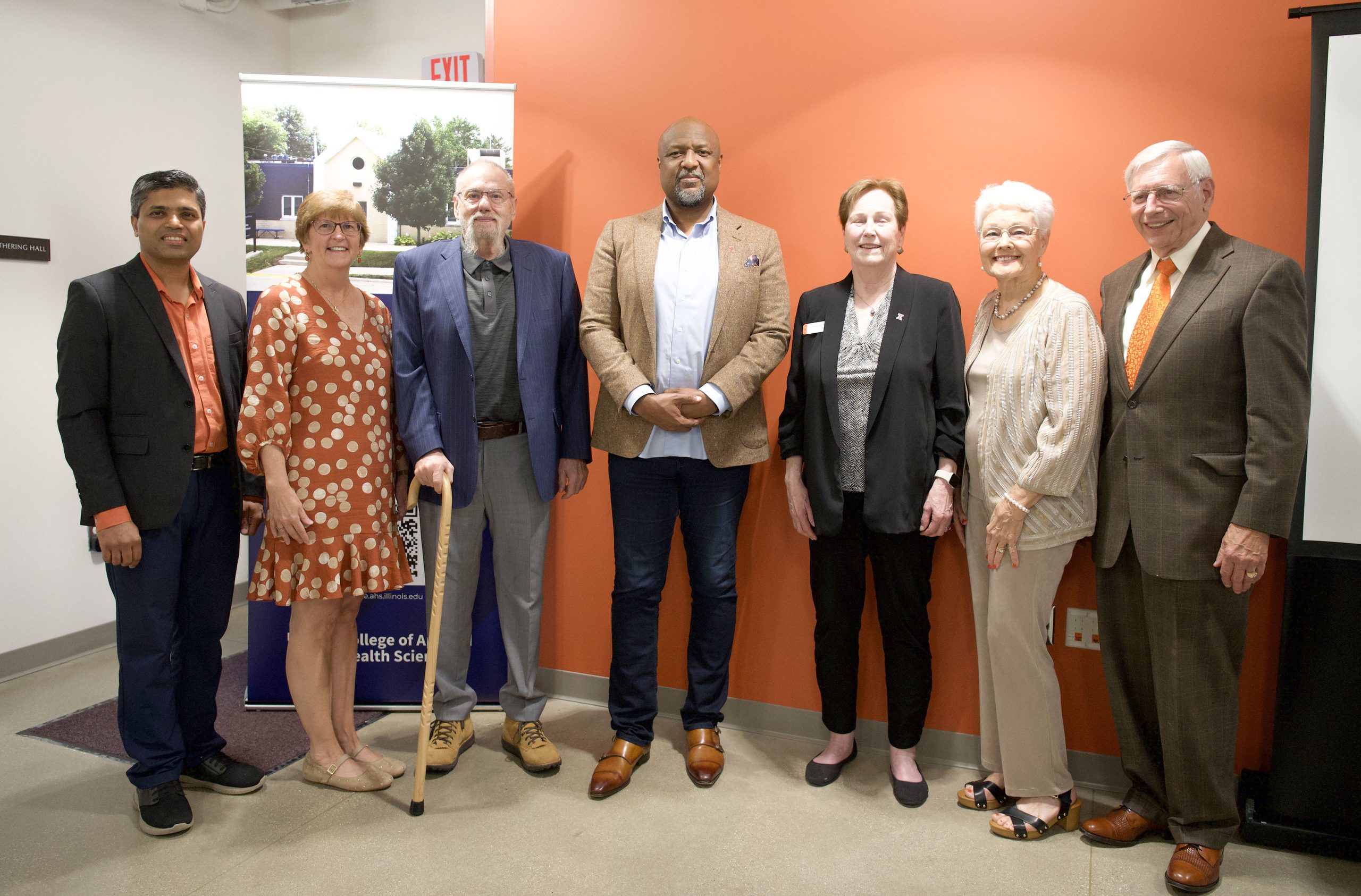
EMILY JORDAN: No, but I’m going to be doing my internship as part of– I’m not sure if you know, but the RST internship we have to do as part of our degree work requirement– this summer, I will be doing it under the athletic director and the media productions person Laura as I mentioned before. I’ll be working under them this summer at DACC as well. So that’ll be, I think, a really good interesting time for me and kind of allow me to see what it’s like being an AD, so I’m really looking forward to that as well.

VINCE LARA: Yeah, that’s terrific. And I think to wrap up I’d like to just ask, what would you tell other students who may be in a similar situation that you were at the end of your associate’s degree about RST, and how would you recommend the program to them?

EMILY JORDAN: I would say, when I was getting ready to transfer and I was looking at the schools I was looking at, the U of I seems massive. I mean, that was my initial thought, and what I told my parents and everything, but there’s 50,000 to 60,000 kids that come here, and it just seems so big and everything.

But when I actually came here and visited campus and stuff and saw that it’s like you know broken down into colleges and then your major and everything, I think that it helped it be more appealing to me, and also made me feel more at ease and comfortable with coming here, especially since it is so big. But in all honesty, I still feel like I’m kind of going to a community college. I’m not traveling across campus for classes or sitting in super big classes with 100 to 200 kids or anything like that. I really feel comfortable here knowing that I’m in the right major, and then with RST, I think that you’re going to get a lot of experiences out of being in that major.

It’s not necessarily a lot of book work. Obviously, there’s things you take from text and apply it to real life, but I think it’s more real life scenarios that you learn hands-on and in the classroom that can help you further on in your career. So I think that’s why it was so eye-opening for me and really attractive to me to come to RST because I felt that I would get the most out of majoring in this major. So it just felt like that. It felt comfortable, it felt right, and it just, like I said, would be an awesome experience for anyone, I think, who’s interested in this kind of work.


Related news

A Few Minutes With … Mina Raj


Transcript

VINCE LARA: Hi, and welcome to another edition of A Few Minutes With, a podcast that showcases Illinois’ college of Applied Health Sciences. I’m Vince Lara. And today I’m speaking with PCH Assistant Professor Mina Raj about why she chose Illinois, teaching during a pandemic, and her research with caregivers of older adults. So Mina, thanks so much for speaking with me today. I always try to find out about faculty and how they got their start, especially new faculty like yourself. So did you always want to teach?

MINA RAJ: Thank you so much for doing this with me today, this podcast. So I have always enjoyed teaching. And I did look forward to it, especially since my experiences of teaching as a graduate student. As a graduate student, I think it’s been really rewarding to observe students evolve in their critical thinking about a topic over the course, form evidence-based opinions about different topics, and especially policies in the health care classes that I teach, and discover new aspects of our health care system that they are passionate about but they didn’t necessarily understand, though they can resonate from their personal experiences as being patients.

VINCE LARA: Yeah, interesting. I wonder, typically, when a person goes into research, there’s something that sparked their agenda, what they wanted to look into. And one of your primary research agendas is incorporating caregivers into health care. And I’m curious what made you look into that? What was the impetus for doing that kind of research?

MINA RAJ: Sure. So during my PhD, my dissertation research was focused on understanding how older adults and their family caregivers make decisions about geriatric care. So geriatrics is the medical field that specializes in the care for older adults, especially those with complex clinical conditions. And then some other projects where I was working to understand patients with cancer, it was kind of a similar situation of recognizing that family caregivers are really influential in health care and in medical decision making.

But they aren’t really talked about that much in policy in that way. So the way we think mostly about family caregivers are their assistance with things like eating and dressing and transportation and meal preparation. But they’re really kind of neglected from health care conversations. And I think my research seeks to really help caregivers because these are the people that are supporting patients who are going through intense challenging periods of their lives. And so seeing this major gap in our policies and in research led me to want to focus on supporting caregivers so that they can support their care recipients.

VINCE LARA: Mm-hmm. I want to take a step back. I meant to ask you first, what made you choose Illinois?

MINA RAJ: Yeah. So that’s a great question. There was a lot that I enjoyed. When I visited Illinois, I found the first thing that struck me was how supportive and what an emphasis there is on the campus on collaboration within the department, as well as across the departments.

So I’ve already sort of started forming teams with people in fields that I previously knew very little about, and I’m learning so much. And it’s really nice to think outside the box and get to be creative. And that’s my other point is that it seems like the kind of place where I can be very creative, a place where your ideas can really translate into different types of technology or different types of policies. And seeing ideas come to fruition like that was something that really sparked my interest in Illinois.

VINCE LARA: Mm-hmm. One of the things that you also look at, switching back to your research, is you look at technology to support caregivers. And I’m wondering what sort of technology do you use?

MINA RAJ: Yeah. So I examine a variety of different technologies. So for instance, within health technology, there’s the electronic health record, which if you go to the doctor’s office, you might sign onto your patient portal before you go to the office in order to fill out a questionnaire. Then when you go to your doctor’s office, your doctor might be on the computer filling out information about you into the electronic health record or the computer system. And so this is one type of technology that I look at in terms of policies or design to integrate caregivers so that they can access their care recipient’s patient portal or health record.

Another type of technology to look at is telemedicine. And in the past several months, we’ve seen a huge shift to telemedicine visits for health care. So this is where a patient might visit their doctor through a phone or through video conferencing. And so, again, how do we allow caregivers to be part of that visit? We know that caregivers often assist their relatives to the doctor’s office, may take notes, may provide the doctor with more information about the patient’s concerns, and how do we make the same situation happen when we’re doing care over telemedicine.

VINCE LARA: Mm-hmm. You reference telemedicine. And obviously, telemedicine has become an important part of how we treat people and that’s because of the pandemic. And I’m wondering, how has the pandemic changed how you teach and also how you conduct research?

MINA RAJ: Sure. So in terms of my research, I would say that it has led me to shift a little bit more to survey research. I’m a mixed-methods researcher. So I do primary data collections through surveys, interviews, focus groups, as well as secondary data. And so I’ve really been focusing on developing online surveys and analyzing secondary data.

I have missed being able to interview key participants and conduct focus groups. I’ve done a little bit of that through virtual modes. But it’s a little bit different. You don’t really get to form the same type of relationship with your participants, which is key to building trust in the context of research, especially.

And so I think that’s a similar situation in terms of teaching, where I’ve definitely seen a lot of positive benefits of online teaching. I think, for instance, I’ve noticed that students may even be more comfortable with speaking up in class. I think there are a lot of really great polls and breakout rooms and other opportunities for creating an interesting classroom environment. But again, one of the things I miss is that face to face, walking into the classroom, and seeing students and getting to know them in a different way and feeling the enthusiasm in a room when students understand a concept that relates to something in their lives that they’ve experienced.

VINCE LARA: Mm-hmm. I’m interested in your most recent publication. In it, you looked at characteristics that helped shape medical trainees and their specialties in treating geriatrics. And you spoke about geriatrics earlier. What kind of characteristics do you mean when you talk about the characteristics that help shape their specialties?

MINA RAJ: Sure. So I drew upon a sociological framework for that particular study that says that the way that we decide what career or specialty in medicine we go into– this can actually apply to any career; it’s actually called a model of careership– is a combination of personal experiences, our social network and social circle and those experiences, and then institutional characteristics. So this can be the school that we are educated in, the medical institution that we go to and get our training in. And so we have a really significant workforce shortage in geriatrics.

We need over 20,000 geriatricians in order to meet demand for our current aging population. And so geriatrics happens to be a pretty new field that was really developed in the 1980s. And we’ve had problems with recruiting medical trainees to go into geriatrics.

Now, one of the earlier areas of discussion was that medical trainees may have poor attitudes towards aging and may not really understand the aging process and may think of it negatively. And so a lot of institutions have implemented training and skills and exposure to older adults in order to mitigate the effect of that characteristic. And so I felt like that didn’t solve the whole problem.

There’s still something missing in our understanding of what’s going on. So I decided in that study to focus on those three characteristics, so personal, social, and institutional. And what I found was that institutional characteristics were particularly influential in this qualitative study of trainee interest in geriatrics.

So this can include things like do you have many geriatricians in leadership positions who are role models to medical trainees and teach medical trainees about what it means to be a geriatrician? How close by are geriatrics clinics to where residents are training? So that’s another way that different institutions can influence the exposure of their trainees have to geriatrics and also make them feel like it’s a different type of medicine. It’s a complex type of medicine. And it requires different skills. But it’s still medicine.

And so I think one of the main conclusions of the paper is that we need to expand our understanding of complexity in medicine. It can be knowing a lot about an organ system or about a part of the body. But it can also mean knowing about the lifespan and knowing about the health care system and an older adult’s social and economic circumstances.

VINCE LARA: I know researchers are always looking at what’s next, right? You have to always think about publishing. So I wonder, what’s next for you? Like, what do you hope to tackle next? And I know you’re building collaborations here at UIUC. And so what do you have on the horizon?

MINA RAJ: Sure. I so my main area is going to continue to be looking at different ways of designing technologies and policies to integrate family caregivers into health care teams. And so this involves both what do these technologies look like and then in addition, what do our policies need to look like in order to make sure that this integration is both effective and also safe? So for instance, if caregivers can see their older relative’s medical record, we want to make sure that we have policies in place to protect patient privacy and caregiver privacy and make sure that caregivers aren’t discriminated against in a workplace because maybe they have certain health risks. And so that is really what I see as the primary area of my research agenda.

Another project that I’m really excited about and I’m working on right now is actually a text-based survey of youth across the United States. So these are adolescents aged 14 to 24. And so this text-based text message-based survey, prompts qualitative responses. And the questions that I have asked are to get a sense of how young adults and youth in the US think about family caregiving and their potential for being a family caregiver in the future, including what policies or educational practices or health care practices they perceive meeting in order to carry out potential caregiving responsibilities while promoting their well-being and their educational and professional success.

VINCE LARA: My Thanks to Mina Raj. For more podcasts on Illinois’ College of Applied Health Sciences, search A Few Minutes With in iTunes, Spotify, IHeartRadio, radio.com, and other places you get your podcast fix. Thanks for listening and see you next time.

Share on social

Related news

A Few Minutes With … KCH Assistant Professor Sheena Martenies


Transcript

VINCE LARA: Hi, and welcome to another edition of A Few Minutes With, a podcast that showcases Illinois’ College of Applied Health Sciences. I’m Vince Lara, and today I’m speaking with KCH Assistant Professor, Sheena Martenies, about why she chose Illinois, teaching during a pandemic, and her research experience. Did you always want to teach?

SHEENA MARTENIES: So, I didn’t ever really envision myself as a teacher as I was going through graduate school, as I was going through my postdoc. But I took a position as an adjunct lecturer in the last year of my postdoc at Colorado State. And I was teaching at the University of Northern Colorado, and I really enjoyed it. I loved talking to the students. I was working with MPH, Masters of Public Health students, about environmental health, and I really enjoyed it. I found it very rewarding. So I never really envisioned myself being a teacher, but I found that it’s something that I really enjoy and I’m thankful for the opportunity to get to continue that and to continue to grow as an educator. It’s been really rewarding.

VINCE LARA: Yeah. You mentioned that you grew up in Southern California. I wonder how you made your way to the Midwest and the University of Illinois?

SHEENA MARTENIES: Yeah. So that was– it’s a little bit of a journey. I did my undergraduate degree in San Diego. I went to San Diego State. And then after that, I got a job. And the recession in 2008 hit and I didn’t have a job anymore, and so I kind of bounced around. And eventually, I decided to pursue a Master of Public Health degree, and I moved to Washington D.C. to do that. And I thought I was going to be a regulator. I wanted to work for EPA, or maybe the Department of Energy. And I had a really wonderful advisor when I was at GW, and they really pushed me to pursue my doctoral degree. And so I moved to Ann Arbor, Michigan and went to the University of Michigan, and got my PhD.

So I had been in the Midwest before, and I really enjoyed my time in Ann Arbor, but I moved out to Colorado to do a postdoc, like I mentioned, at Colorado State University, and loved being out in the Mountain West. It was just really, really wonderful having mountains, and all the hiking, and all that great stuff.

But then the opportunity to come to the University of Illinois came up, and I thought, well, you know, I loved being in a college town in the Midwest. Maybe this would be a great place for me. It didn’t hurt that my partner was originally from Michigan, and so he got to be a little closer to home as well. So when that opportunity came up, it felt very appropriate for me to come back to the Midwest.

VINCE LARA: Yeah. You really can’t beat the Midwest college towns, for sure. You know, you– what’s it been like teaching in this pandemic? You know, I’m sure you prefer being in a classroom with students. But you know, what kind of challenges have you experienced, or have there been, maybe, benefits of Zoom teaching that you didn’t anticipate?

SHEENA MARTENIES: There is definitely some challenges, but a lot of opportunities as well. I think one of the biggest challenges, like you mentioned, is just not being there in the classroom. It’s hard to get that real-time feedback from your students, or really make those kind of personal level connections.

Another thing is that I’m really new to teaching. Like I said before, this is not something that I’ve done a whole lot of in my graduate career. And so now that I’m an Assistant Professor, I’m really trying to learn how to teach, and learn how to teach online. So that’s been a little bit of a challenge, but it’s been wonderful. There’s so many supportive resources here on campus that have really allowed me to make the best of teaching online.

One of the things that I think that’s been sort of unexpectedly helpful is that students– you’re able to meet with students one-on-one in a more effective way. You know, office hours aren’t always accessible to people. They’ve got scheduling conflicts. They have family obligations that don’t really allow them to come to campus when you might be holding office hours. But it’s really easy to hop on a quick, 20-minute Zoom meeting.

And so I think sometimes there are opportunities to meet with students, and we’ve got a much more robust framework for doing those types of quick, one-on-one opportunities that might be always accessible to students. And so I think that has been a real benefit of this online environment, where we’ve got these kind of quick and easy meetings, and people are generally more available if they don’t have to come all the way to campus, or come all the way to your office.

VINCE LARA: Most of the faculty that I speak to here at the University of Illinois– the faculty, I find that there are different things that inspire their research– something that happened to them, some experience along the way. And I wonder what your inspiration was?

SHEENA MARTENIES: Sure. So like I mentioned, I grew up in Southern California. And I can remember we lived in Ventura County, and we would drive into the San Fernando Valley to go visit my grandparents. And you know, you’d come over this small mountain pass and you’d drop down into the valley, and every time, it didn’t matter what time of year it was, there was always just this thick brown haze hanging over where my grandparents lived. And I just remember that from my childhood.

And then I took some courses in college and in graduate school and just realized how important environmental health is. It’s one of those things that, a lot of people don’t have control over their environment. They live where they live because of their socioeconomic status, or their job, or their family. And so they’re just sort of in the environment that they’re in. And so I think that there are a lot of really interesting research and policy questions we can ask about the environment and environmental health.

And so I think that is really where my interest comes from, I think. Just knowing that those exposures are out there, they’re largely involuntary, and they can have a pretty dramatic impact on a person’s health.

VINCE LARA: Yeah, which leads into my next question which is about your research and focusing on pollution and child health outcomes. And can you talk a little bit more about what that is?

SHEENA MARTENIES: Sure. So I’m particularly interested in air pollutant exposures that happen during the prenatal period and during that early life period, and sort of what the subsequent health outcomes are for children. So we know that developing fetuses, infants, and small children, they have respiratory symptoms that are rapidly developing. Their bodies are undergoing a lot of changes, and they might be really susceptible to those air pollutant exposures.

So a lot of the research I’m doing right now is with a cohort study based in Denver, Colorado called Healthy Start. And this is a group of children that have been followed from their prenatal period on, and we’ve been able to look at things like air pollution in the prenatal period, some of those features of the built environment. You know, whether there are a lot of trees and parks or a lot of paved surfaces– those types of factors.

And we’ve found that there are some relationships between those early life exposures and those prenatal exposures to outcomes like birth weight, which is a really good neonatal indicator of later life outcomes like obesity and respiratory health. So we’re starting to explore how the environment in which children develop and then grow impacts their long-term health. And so that’s a line of research that I’m really interested in continuing as we start to understand how these environmental exposures that are really not voluntary impact children’s health.

VINCE LARA: At an R I University, you always are thinking of what’s next in the pipeline. And I wonder, is there something that you have planned, post-vets research for your next project?

SHEENA MARTENIES: Yeah. That’s a really great question. I am becoming increasingly interested in some of the spaces that children spend their time outside of their home. A lot of environmental epidemiology and environmental health research that looks at childhood health outcomes really focuses on home environments, and those are so important.

We want all children to grow up in a healthy home, but we also know that kids, especially young kids, don’t spend all of their time at home. A lot of children might be spending time in daycare facilities or preschools, and I’m becoming more interested in what’s going on in those types of environments.So I’m hoping to partner with some of the faculty here on campus in the Family Resiliency Center and in the College of Engineering to start to look at those types of indoor spaces– those child care facilities, those preschools. Try to understand what the exposures might be in those spaces so that we can get a more complete idea of what early childhood exposures might be for kids as they grow up.

VINCE LARA: My thanks to Sheena Martenies. For more podcasts on Illinois’ College of Applied Health Sciences, search A Few Minutes With on iTunes, Spotify, iHeart Radio, Radio.com, and other places you get your podcast fix. Thanks for listening, and see you next time.

Editor’s note:

To reach Vince Lara-Cinisomo, email vinlara@illinois.edu.
 

Share on social

Related news

A Few Minutes With … Jacob Allen


Transcript

VINCE LARA: Hi, and welcome to another edition of A Few Minutes With, the podcast that showcases Illinois College of Applied Health Sciences. I’m Vince Lara, and today, I’m speaking with KCH Assistant Professor Jacob Allen about his research on how exercise, stress, and diet influence gut microbial communities.

So I’m talking with Jacob Allen, who is a new addition to the Department of Kinesiology and Community Health. And, Jacob, I notice from your CV that you had done your undergrad and master’s at the University of North Carolina at Chapel Hill. And yet you left Chapel Hill, which is a lovely place in which I lived for a while, for Chambana, which we’re covered in snow this morning. Tell me, what made you do that? What prompted your move here?

JACOB ALLEN: That’s a good question. Well, so I did my bachelor’s in exercise science with a minor in biology. And coming out of undergrad, I didn’t really know what I wanted to do– surprise, surprise, a little bit young. But I was interested in exercise physiology, and so I decided to stay on and do a master’s program in the Exercise Physiology group at UNC-Chapel Hill.

And I did my masters in working with breast cancer survivors, where we looked at how exercise affected inflammatory markers in these patients that were coming off of breast cancer treatments to see if exercise could reduce some of the systemic inflammation they experienced. So that was my foray into exercise. And then because I was looking at inflammatory markers, these proteins called cytokines in the blood, I started getting interested in immunology.

And at the time, and still is, Jeff Woods, Dr. Woods here at University of Illinois, was prominent and one of the few exercise immunologists in the field. So I figured if I was going to study exercise and study the immune system, I should probably go get a PhD with somebody that knows what they’re doing. And so I looked up Jeff’s name and gave him a call.

And that’s what started my process of moving to Champaign to do my PhD in 2013 to look at exercise and the immune system. And so I came to Illinois, and I took off from there, where we started to look at both the immune system, but also the microbes in the gut and how the microbes affect the immune system. So I guess it was more of a career path that took me from Chapel Hill, where it’s a little bit warmer, to Champaign, Illinois.

VINCE LARA: Right, yeah, absolutely. And then the opportunity to work with Jeff obviously is a big part of it.

JACOB ALLEN: Right, yup, it was, definitely.

VINCE LARA: Yeah. So you talked about how your research focuses on exercise and diet and how they influence gut microbiota. What led you to study that? Usually there’s some sort of inspiration to what a researcher decides to study. Was there something in your early life that led you to look into that?

JACOB ALLEN: You know what? I wish I could say there was some beautiful epiphany I had or something like that. But I can’t really tag it to anything specific. I’d say I’m interested in questions that we don’t understand, and that’s probably why I did biology.

And when I started in Jeff’s lab, there was this emerging topic of the microbiome and these trillions of microbes that live in our gut that we still don’t know exactly what they do. And so it kind of just spiraled into studying it. Again, like I said, I was an exercise scientist looking at how exercise affects breast cancer survivors.

And it got me interested in the immune system. And then being interested in the immune system led me to study the microbiome. And what we know now is that the microbes in our gut are really important for training the immune system and establishing the immune system, and then in many inflammatory diseases, affecting the immune system. And so the study of the microbes tied in directly with my interest in immunology. And so that’s how I got to studying the gut microbiota.

VINCE LARA: How granular can we get in terms of, if you change one food, if you stop eating one food, can you determine how that affects the gut and how it affects disease?

JACOB ALLEN: That’s a great question. Number one, I’ll say, it depends– depends on the food. We know a lot about– relatively a lot– about certain types of food with regards to the microbiota. One of them is dietary fiber and something that our lab is interested in.

So fiber comes in different forms, but in one of the forms, it’s a soluble, fermentable fiber. And what that means is that it can reach the colon, where most of the microbes are. And the microbes use that fiber as food, as a sugar source.

And so what we know is that by feeding the microbes with this fiber– and again, there’s various types of it– we can change the microbiota quite extensively. What’s still not understood is how different types of fiber feed the microbiota differentially. And does that matter for our health?

And what’s important is that once the microbes get a hold of these– this food type, this fiber– they can degrade it into these bioactive molecules that then affect our immune system. So we’re still trying to understand that process of how the microbes feed off of these– off of our diet. What type of metabolites do they produce? How does that change the microbial communities? And then how does that all affect our immune system and our health is our interest in our lab.

VINCE LARA: What you’ve said is that you wanted to provide a new perspective on environmental conditions and microbiota. Is that tying into what you’re looking into?

JACOB ALLEN: Exactly. You know, our lab is named Integrative Microbiota Lab. And the reason for that is that I think that in science, we’re really good at isolating things and tying down to what we call a mechanism, which is really important. And that’s part of our lab, too.

But in especially humans, as we walk through our daily life, we’re doing all sorts of things. We have different exercise patterns. We have different levels of psychological stress. And that’s another component of my lab, is looking at how stress affects the microbes as well.

And then obviously, we all have different dietary patterns. And so trying to tease out those factors and how they regulate the microbiome in a daily life is the purpose. And my long-term goal of my lab is to look at these individual environmental factors in isolation. And then long-term, how are they all together affecting the microbes in the gut?

VINCE LARA: Can you tease out things like physical stress versus mental stress? Or is that something that you even can separate?

JACOB ALLEN: Another great question. There’s debate among this in the field of how to define stress in humans. And obviously, it’s all based off of the experience of the person.

But we can measure certain biomarkers that correlate heavily with stress. So we know some classical pathways that are activated by psychological stress– the hypothalamic pituitary axis, which ultimately results in the release of a glucocorticoid called cortisol, which I’m sure many are familiar with. And so we can look at levels of cortisol in the blood, but also, more long-term, elevations of cortisol in things like hair roots and stuff like that to see if these individuals are experiencing acute levels of stress, which we all experience, or if they’re experiencing stress on a chronic level on a daily basis, where we see this long-term elevation of hormones associated with stress.

So the short answer is it’s complicated. But we can at least get somewhat of a diagnostic of how stressed people are or individuals are based off of some of the hormonal responses we see in the blood and other tissues.

VINCE LARA: Interesting. You know, you recently received a grant along with Jeff Woods to study age-related dysbiosis and physical resilience. What can you tell me about that project? I mean, first of all, what’s age-related dysbiosis?

JACOB ALLEN: Yeah, so first, the word “dysbiosis,” for those that don’t know, is essentially a broad term to suggest a disrupted microbial community in the gut. And so there’s various forms of, quote, “dysbiosis.” But what we know is that if the community of microbes in your gut is healthy, it usually is fairly stable and goes through similar– has similar patterns amongst individuals that stays fairly stable over time.

What we see with, quote, “dysbiosis” is that those communities become less stable and less even. So you sometimes get what we call pathobiont species that expand in the gut. And these are potentially bacteria that might induce some negative consequence on our immune system or other components of physiology. And so that’s what we term– what we call dysbiosis. And what the age part is that there’s accumulating evidence that aging, getting older, might contribute to some form of dysbiosis.

And what we’re studying with this grant– so it’s a one-year grant funded by the NIH that will hopefully extend into a longer grant– is to see how antibiotic exposure affects the microbiome in aged populations. And there’s a couple of reasons for this. One of them is that aged individuals tend to consume antibiotics more extensively because they’re experiencing more sickness as they get older. And so we want to study it on that level.

And number two, obviously, these antibiotics affect the microbiome. And so we want to see if a, quote, “aged microbiome” responds differentially to antibiotics versus a young, healthy microbiome. And so to test this, we’re using first, a preclinical model, which is a mouse model, to test these hypotheses.

And tying it in, we think that those microbes, if we disrupt them in old animals, there’s going to be consequences both within the gut, but we also think that is affecting their physical resilience– so how well they perform on particular tasks such as exercise tasks. And so that’s our hypothesis going in. And of course, we don’t know the answers yet, and that’s why we’re running the studies.

But we think that the aged animals will respond differentially to the antibiotics and maybe not recover as well. And that might lead to some potential issues with how they move and how they respond to challenges. So that’s the purpose of the grant, if that makes any sense.

VINCE LARA: Yeah, absolutely. How symbiotic is the relationship between exercise and gut health? Does one influence the other more?

JACOB ALLEN: Yeah, that’s a great question. So some of my PhD work showed that exercise changes the microbiome. And it increases some beneficial metabolites that we think are health-promoting.

And one of them is called a short-chain fatty acid that initiates some overall anti-inflammatory and beneficial effects on our tissue. Now, whether it’s, quote, “good” or “bad,” I think we still need to figure out. There’s definitely changes with exercise and the microbiome. But again, trying to delineate the long-term effects and whether it’s good or bad is still up for debate and up for what we need to investigate with our science.

Your other question– does gut health affect exercise? And I think that that’s another open question in the field. Is there some gut-brain signaling that affects motivational behavior to exercise? And that really has not been investigated at all to my knowledge. So I think you bring up a good point. And it’s something we don’t know quite yet.

VINCE LARA: Yeah. You mentioned that you’re hoping that this grant with Jeff is going to be a long-term grant– multiyear. But researchers always have to look to the next thing, right? And so I’m curious what you’re working on or what your next big project might be.

JACOB ALLEN: Yeah. There’s a couple. Currently, I did some work that was independently funded at the end of my postdoc that I was able to take with me to start my lab here in Illinois, focused on some of the stress effects on the microbiome. And so we’re currently, in the lab, really interested in how the microbes interact with the cells that line the gut, called epithelial cells.

And what we found is this really intricate interaction between the gut microbes and these epithelial cells. You think of it as like a tit for tat. As the epithelial cells, which are our cells that line the gut, produce some molecules, they change the microbes. The microbes then feed back and change those epithelial cells.

And what we found is that stress, for some unknown reason, really changes the profile of these epithelial cells. And we’re not sure why yet. But what the evidence is pointing towards is that those changes in epithelial cells with stress is really driving the microbial changes that we see in the gut, and potentially in negative ways.

And so we’re trying to understand that process in a little more detail in our lab currently. So that’s the next frontier where we’re focused. And then we have some other focuses, too, particularly with exercise.

And going back to the integrative portion of it, we’re interested in how exercise and dietary fiber interact to modify the microbiome. We know that both in isolation change the microbiome. But really, not a lot of work has been done with a focus on how the interaction of diet and exercise might change the microbes and what that might mean for our health. So that’s another focus of the lab currently as well.

VINCE LARA: My thanks to Jacob Allen. For more podcasts on Illinois’s College of Applied Health Sciences, search A Few Minutes With on iTunes, Spotify, iHeart Radio, Radio.com, and other places you get your podcast fix. Thanks for listening, and see you next time.

Editor’s note:

To reach Vince Lara-Cinisomo, email vinlara@illinois.edu.
 

Share on social

Related news

A Few Minutes With … Rachel Hoopsick


Transcript

VINCE LARA: Hi, and welcome to another edition of A Few Minutes With, the podcast that showcases Illinois’ College of Applied Health Sciences. I’m Vince Lara and today I’m speaking with KCH Assistant Professor Rachel Hoopsick about her research inspiration, dealing with the pandemic, and her current projects.

Rachel, so commonly when I do these interviews, I ask people what inspired them to choose their path. And so I’d like to start off with that. How did you decide you wanted to be a teacher? Did you always want to teach and go down this line?

RACHEL HOOPSICK: Oh, gosh. Yes and no. So I was always interested in health and health care. But I think that the idea of being a University professor was completely out of the realm of possibilities for me as far as what I would be doing when I grew up. So I was the first person in my family to go to college. So I didn’t grow up with role models around me in this type of a career. So as a young child, my dad worked in a factory that manufactured vehicle engines, and my mom worked in an administrative support role at a chemical manufacturing plant. So as a first-gen student, I ended up finding myself working as a tutor a lot. And partly, it was out of interest in teaching, but it was mostly out of necessity to support myself. So once I finished my master’s degree in public health, a colleague of mine took a chance on me and hired me as an adjunct instructor to teach health courses. And I continued to adjunct while earning my PhD. And here I am nine years later with a wealth of different teaching experiences that I have wholeheartedly enjoyed. And I eventually became a health education specialist and also briefly worked as a health educator in a program that served pregnant women with substance use disorders. So collectively, all of those experiences made me realize that I enjoyed all of the different aspects of public health, including research, practice, and teaching.

VINCE LARA: Now, why did you pick your line of research? I’m always interested in that. Was there something in your past, was there something in your history that made you decide, this is what I want to study, and this is what I want to look at?

RACHEL HOOPSICK: Sure. So I grew up in a fairly low-income neighborhood in New York State that was just absolutely decimated by the opioid overdose crisis. And those communities were just riddled with social and environmental justice problems. And looking back, that’s probably how I ended up in public health and researching substance use in mental health specifically.

Most of the research on substance use and mental health tends to focus on individual-level risk factors, so meaning the characteristics or attributes of the person that put them at risk for problematic substance use or poor mental health. But we don’t live in bubbles. People don’t live in bubbles. So in my research, I try to consider other factors, so how our relationships with other people affect our health, the communities that we live in and the resources and social norms within those communities, policy-level factors and how that shapes our outcomes, including the war on drugs, and organizational-level factors. So what are the practices, programs, and policies in workplaces that affect our risk and resilience to psychiatric problems? And I think to that end, my work has focused primarily on populations with high-stress occupations and life circumstances.

So military-connected families obviously deal with a lot of stress. And serving in the military is a stressful occupation. As a PhD student, I was fortunate enough to be able to start working on my mentors cohort study that followed military-connected families over time, focusing on their mental health and substance use across the lifespan. And that experience really solidified for me my interest in working with populations with high-stress occupations, because I think that there are a lot of practical things that we could and should be doing in workplaces to protect the health and well-being of workers beyond just addressing hazards to physical health.

VINCE LARA: I gotcha. Now, you said you’re from Upstate New York. You’re from Buffalo, if I can say that. So why the University of Illinois? You lived in a cold place. You came to another cold place. So you weren’t looking for a lifestyle change, necessarily. But what about UIUC drew you here?

RACHEL HOOPSICK: I will say this– that we do get much more snow in Buffalo, so this is actually a step up in climate for me. So this is great. All joking aside, the University of Illinois, and I think the Department of Kinesiology and Community Health in particular, made it really easy for me to know that I was accepting the right position when I was looking for a faculty position in public health. So I interviewed for multiple positions across the country and was really struck by U of I and how different they were from most of those other institutions, and particularly with respect to both diversity and the role of public health within those institutions.

So now, when you think about the time that we’re living in, we’re really going through a reckoning with the legacy of systemic inequity, racial injustice amidst a global pandemic. So it was really imperative for me to be a part of an institution that shares my values. And in my interactions with faculty, staff, and students in the College of Applied Health Sciences, it became really apparent to me that by accepting a position in kinesiology and community health, I would be stepping into a role where kindness and compassion are valued and public health is paramount. So I absolutely love the U of I community.

VINCE LARA: That’s great. Speaking of COVID and speaking of– yeah, I mean you–

RACHEL HOOPSICK: How could we not go there?

VINCE LARA: Exactly you almost cannot bring it up, right? So as an epidemiologist what has surprised you most about COVID and how people have dealt with it?

RACHEL HOOPSICK: I have many thoughts about COVID as an epidemiologist. So I think the most surprising thing about this pandemic is the way in which we, collectively as a country, are continuing to rely on a vaccine-only approach to the pandemic, which places the burden on the individual to protect themselves when there are a lot of other non-pharmaceutical interventions that we could also be leveraging in addition to vaccines. So in essence, we’re attempting to solve a collective public health crisis with individual-level measures only. And I think that strategy was a bit doomed from the start. So I’ll preface this by saying that my perspective here is shaped not only by my experience and training as an epidemiologist, but also as a parent of an immunocompromised child with complex medical needs who’s too young to be vaccinated. So from my perspective, we have many other tools in our public health toolkit to address this pandemic and do a better job at protecting our most vulnerable community members, but they’re severely underutilized, including mask mandates– although we’re fortunate here in the state of Illinois to have a state mask mandate, that is certainly not the case across the country. We could be leveraging vaccine mandates, expanding access to free masks and testing, and also thinking about socioeconomic measures like a temporary paid shutdown, hazard pay for frontline workers, temporary moratoriums on evictions and student loans. I think the list goes on and on. There are many other things that we could be doing to address issues around the pandemic that we’re not leveraging at least at this point. So I think what’s most surprising is not anything related to the virus itself. It’s doing exactly what viruses do. But for me, I think the surprising piece is more how our elected officials have chosen to address the problem, prioritizing economic factors over human factors.

VINCE LARA: Interesting. Speaking of that, speaking of our elected officials– so recently, there have been reports that the Biden administration has thought about at least advising a way for us to live with COVID rather than eradicating it. It doesn’t appear the virus is going anywhere. So are you of the opinion that we have to deal with living with COVID for probably years?

RACHEL HOOPSICK: So I think that, yes, we’re going to have to continue to deal with COVID-19 for an extended period of time. But I also really dislike the framing of this being the, quote unquote, “new normal.” So I don’t think that, as a society, that we should be normalizing our hospitals being overflowed and being stretched beyond their functional capacity. We shouldn’t be normalizing poor access F to testing and quality masks. And we certainly shouldn’t be normalizing mass death to the tune of thousands of people per day dying from coronavirus.

So learning to live with the virus, I think, requires you to ignore all of these things that collectively are very traumatic. We are nowhere near reaching a level of endemicity or– that is, COVID-19 is not an endemic state or at being at an ongoing low level. We are very much in a surge right now. And it’s actually the worst point of the pandemic so far as far as cases per day.

So I think instead of learning to live with things the way that they are, we also need to be thinking about implementing policies that shape a better normal from where we are right now. A lot of the folks shaping policy that frames the acceptance of this ongoing mass infection, disability, and death are also the same folks who have the luxury of being fully vaccinated, having easy access to masks and testing, and who are able to safely work from home.

We need to demand a public health response that considers some of our most vulnerable people in our communities, so thinking about front-line workers who are working in unsafe conditions, thinking about disabled and immunocompromised people, and also thinking about our children, most of whom are not fully vaccinated. So I think that in this framing of the pandemic, we need to be lifting up the voices of those people instead of normalizing the pandemic itself.

VINCE LARA: I think there’s been a big question about how to reach the people who are vaccine-hesitant, let’s say, who are maybe subject to misinformation or just don’t have the ability to get the information they need. And I’m wondering how– and I’m sure you get questions, given what you do, about vaccines. How do you reach those people, and what do you tell them?

RACHEL HOOPSICK: Sure. Number one, I would say that if you are waiting for the science before you get vaccinated, we have it. It’s here. More than 9 billion doses of the COVID-19 vaccines have been administered globally, and it is the best individual action that you can take to protect yourself against severe illness, hospitalization, and death. But unfortunately, many people do remain unvaccinated, including all children under age five who are currently ineligible for COVID-19 vaccination at this point. So those trials are still ongoing.

But I do want to point out that throughout the pandemic, not all of the people who are unvaccinated are truly vaccine-hesitant. So we’ve had some real problems with vaccine equity and reaching populations in underserved communities, particularly when you think about front-line workers who might be unable to take time off of work to receive a vaccine or who are unable to get time off of work to rest after the vaccine. So we know that many people feel a little under the weather after their first or second dose or even the booster. And more importantly, many of the people who are working in front-line jobs also can’t afford to take unpaid time off of work to either get the vaccine or recover from it.

So there’s a lot more that we can do to reach these populations. And there are a number of different policies that we could put into place to make vaccination less burdensome. And on a global level, we have even worse issues related to vaccine distribution. Much of the Global South remains unvaccinated or only partially vaccinated. So here we have a real need to address patent issues around the manufacturing of the vaccines to create better vaccine equity on a global level, which will be absolutely critical to eventually, hopefully, ending the pandemic and the ongoing new variants of concern. We have to think about this issue on a global scale.

VINCE LARA: Illinois is an R1 university, as you know. And so the projects that you’re working on are always top of mind for researchers. So what projects are you currently working on that you’re excited about? I’m sure you’re all excited about all of them, but–

RACHEL HOOPSICK: Yeah. So I’ll briefly tell you about– there are three major projects that I’m working on at the moment, two of which I carried over with me from the university at Buffalo. So right now, I’m currently a co-investigator on a study called Operation SAFETY, which stands for Soldiers And Families Excelling Through the Years. So this is a longitudinal study of the health and well-being of US Army Reserve and National Guard soldiers and their partners. And that study is primarily focused on substance-related outcomes and is funded by the National Institute on Drug Abuse.

A second study that I’m a co-investigator on is a longitudinal study that compares the outcomes of people who use opioids, who are participating in the nation’s first opioid intervention court, to people who are participating in a traditional drug treatment court program. So when you think about drug treatment court programs, oftentimes they can be seen as coercive. And there are some punitive measures that are involved. So for example, in traditional drug treatment court, if an individual who uses opioids tests positive for opioids during the course of their participation in that program, the judge may sanction them and send them to jail.

So in Buffalo, New York, they have implemented an opioid intervention court which takes a little bit more of a public health approach to addressing the opioid overdose crisis in that region. So the court system there recognized that traditional drug treatment court was not working because they had so many court participants who would die, fatally overdose between their visits with the court judge. So they implemented a new program that puts rapid access to evidence-based treatment at the forefront and really gets rid of those punitive measures like sending someone to jail for continuing to use that substance. So that’s the second project that I’m working on from the University of Buffalo. Something brand new that I’m working on here at the University of Illinois with some lovely undergraduate research assistants from our department here in Kinesiology and Community Health is a pilot study focused on health care worker stress. So working in the health care industry was, I think, a stressful occupation even prior to the COVID-19 pandemic. But now it is just– the stress working in the health care industry has exponentially increased.

So our team is working on a pilot study that will examine the social and environmental influences on substance use, mental health, and suicidality of people who are working in health care settings, particularly as it relates to all of those workplace policies, programs, and practices that are implemented or not implemented during the ongoing COVID-19 pandemic. A bit of what we know about health care workers already with respect to substance use and mental health has really focused on physicians.

So we know that burnout is really high among physicians, and physicians are at risk for suicide and addiction and other psychiatric problems. But I would also argue that physicians are also in a very high-wage occupation. They have much more social capital, more resources and support and autonomy over their positions than many other people who are also working in health care settings.

So through this pilot study, I’m hoping to gather data from a range of health care occupations, including those low-wage health care occupations, so thinking about perhaps certified nurses’ aides, LPNs, dietary staff, housekeeping and maintenance staff. So these are other people who are also collectively experiencing this very stressful pandemic working in a high-risk, high-stress occupation but who don’t have as many systems and support in place, perhaps, as physicians might. So this is my next new, exciting project. And I have a really great team of folks who are working with me to make this happen.

VINCE LARA: That’s great, Rachel. Thanks so much for taking the time to talk with us today.

RACHEL HOOPSICK: It was wonderful. Thanks for chatting with me as well, Vince.

VINCE LARA: My thanks to Rachel Hoopsick. For more podcasts on Illinois College of Applied Health Sciences, search A Few Minutes With on iTunes, Spotify, iHeartRadio, radio.com, and other places you get your podcast fix. Thanks for listening, and see you next time.

Editor’s note:

To reach Vince Lara-Cinisomo, email vinlara@illinois.edu.
 

Share on social

Related news

A Few Minutes With … Justin Aronoff


Transcript

VINCE LARA: Hi, and welcome to another edition of A Few Minutes With, the podcast that showcases Illinois College of Applied Health Sciences. I’m Vince Lara, and today I’m speaking with Justin Aronoff, an assistant professor in the Department of Speech and Hearing Science, about his research on the binaural auditory system as it relates to cochlear implants.

All right, Dr. Aronoff, thank you for joining me on this edition of the podcast. And commonly, I ask guests of the podcast about their inspirations for their research. So what made you look into auditory research? And you do primarily cochlear implants. So what made you look into that kind of research?

JUSTIN ARONOFF: So I kind of fell into this area. I was actually– I was having a bad experience at a postdoc. And there was another research position at the institute that I was at. And it was a hearing aid lab, primarily, that happened to have one cochlear implant project.

And I ended up on that project. So it’s a complete chance I ended up working a cochlear implant users at all. And I just fell in love with this field. I fell in love with the work. And it’s so rewarding to work with cochlear implant users.

One of the unique things about working with this patient population is that you tend to be individuals who come back to lab, you know, sometimes month after month for years. We’ll see them, and so we build up these relationships. It becomes very rewarding.

And it’s also a population that really values the research. So we do what is not necessarily the most exciting experiments to be in. We have people listen to beeps for five hours sometimes, which sounds very thrilling, I know. And I do sometimes ask them, look, I really appreciate that you’re coming in here and doing these incredibly boring experiments. I got to ask why, though. I appreciate it, but why are you doing it?

And what they often respond is they say, well, you know, I realize that what this device has done for me is a miracle. And I realize that the reason that it does what it does for me is because 20 years ago, there was someone sitting in a chair like this, listening to beeps for hours on end. And I really want to pay it forward. I really want to give to the next generation. And that type of sentiment is really kind of motivating to me, kept me really interested in continuing and working in this field.

VINCE LARA: Yeah, you kind of answered my next question, but I’ll ask it anyway. So you did your undergrad work in teaching, in the teaching of Spanish.

JUSTIN ARONOFF: Yes.

VINCE LARA: So then you followed with a masters in linguistics, which makes sense, right? You had these two– you had a pattern here. And then that led to Speech and Hearing Science. And that’s primarily because of how you felt about the population within that demographic, if you will?

JUSTIN ARONOFF: Well, I didn’t find cochlear implants until my postdoc.

VINCE LARA: OK.

JUSTIN ARONOFF: So my path was definitely fortuitous, to say the least. So when I was an undergrad here at U of I, in teaching Spanish, I did study abroad in Spain. And I took a linguistics course. And that got me very interested in linguistics.

And when I came back to campus, the only linguistics course that fit into my schedule was a neurolinguistic course by Molly Mack. And that really got me interested in the brain, and language, language acquisition. And so I went on and did my master’s in linguistics.

I was actually in the PhD program in linguistics at the University of Southern California. And as I got more and more interested into the neuro side of it, it felt like it didn’t quite fit into just the narrow range of neurologistics. I was interested in broader issues in neuroscience. And so I actually changed over into the neuroscience program to finish up my PhD.

And as I was doing that, I had the naive idea that, hey the auditory system seems like a fairly easy system to work with and to understand. But I was definitely a little naive at the time. And so that got me interested in working auditory work, and led to working at the House Ear Institute, and then eventually into doing postdoc there.

VINCE LARA: Mmhmm, now, Dr. Aronoff, for you listeners, recently received a seven-figure grant for a project that examines how the binary– binaural auditory system works. And so I’m curious, so the binaural system, for those of you who are uninitiated in this, is how the brain combines signals from our two ears. But I’m curious, why is that important?

JUSTIN ARONOFF: So having the ability to combine information from two ears can help in a lot of different situations. One of the big benefits is noisy environments. So typically, when you’re in a noisy environment– let’s say you’re at a restaurant– you’ve got the person you’re listening to is right in front of you but you’ve got all this background noise. You might have a table to side where those people are talking, you’re trying to tune them out.

The ability to basically attend to and separate out these spatially distinct sources of sound is dependent on the fact that you have two ears and that you can combine that information so it allows you to better focus on the person that you want to attend to, depending on wherever they are in space.

It’s also really important for localizing. So when you only have one ear, you really can’t tell if a sound is coming from the left or the right, especially if you don’t know what the volume is. There are some tricks you can use. But in general, most people are just very, very bad at being able to even tell the side that a sound is on when they only have one ear. Having two ears allows you to localize where the sound is.

You know, and also, patients also describe that having two ears makes the world seem fuller. It’s just this kind of qualitative sense to the world with two ears that you also don’t get having one ear alone.

VINCE LARA: Hmm. Your research is primarily focused on the importance of the study relative to cochlear implants. And–

JUSTIN ARONOFF: Yeah.

VINCE LARA: –the study states that you plan to maximize binaural benefits. And I wonder how you propose to do that.

JUSTIN ARONOFF: So one of the things that we found, my lab and other labs in this field, is that one of the big detriments in terms of getting those benefits from having two ears is when the information that you’re getting from the left and the right ear are mismatched.

And this can happen in a number of different ways. But the way that we see it happening with cochlear implants has to do with where the cochlear implant array is sitting, within the left or right cochlear, within the left and right ear, as well as what neurons are actually surviving in those two ears.

So it turns out that if you do not stimulate the same places, the same relative neurons in the left or the right ear, your ability to localize or ability to use these binaural cues and these cues that you get from having two ears decreases quite a lot.

Now, we know that there are potentially some mechanisms that can help you with that. There’s some ability to adapt. And our lab and other labs have looked at the ability to adapt to this mismatch between the two ears. It’s not clear how limited that is. We know you can do it in terms of the perception of what sounds like the same pitch in the two ears. Whether or not that translates to other things or not is not clear yet.

And really, what we’re trying to understand is how does that adaptation affect your ability? How do we need to change how we program these devices? When do we need to change? So if adaptation can handle a lot, maybe we can wait. If adaptation cannot handle a lot, then we need to start reprogramming very early on when you first get these devices.

And so we’re trying to look at kind of how do you manipulate where the stimulation is, how do you manipulate how similar the stimulation is in the two ears in order to improve those binaural benefits.

VINCE LARA: You helped develop a test that measures spectral resolution. And I’m wondering– two questions– what’s spectral resolution? And what’s the test?

JUSTIN ARONOFF: So spectral resolution is basically your ability to tell that two notes that you’re playing on the piano are not the same note. So people who have poor spectral resolution basically are not going to be able to tell that two notes that are roughly two notes apart are actually not the same note. And this is a common problem that we see with cochlear implant users.

And the reason that this is important is because it turns out that your ability to understand speech in a noisy environment really relates, in part, to your spectral resolution. And that’s something that we know that is a problem for cochlear implant users, as well as other patient populations.

So this is a test that I co-developed with David Landsberger when we were both at the House Ear Institute. And basically, this is a spectral-temporally modulated ripple test, or the SMRT. We’ve since modified it to create a version that can be used in the clinics as well, that’s the SMRT Lite for computeRless Measurement or SLRM. And basically what these measures are, they sound a lot like 1980s arcade sounds.

VINCE LARA: Hmm.

JUSTIN ARONOFF: And basically, it’s a fairly easy test. You just need to tell which sound is different, all right? And so you’ll hear three sounds that kind of sound– it’s kind of Space Invaders-y sound. And you’re trying to tell what’s [? different. ?] We’re manipulating, and there is some of the spectral properties, basically how close together these little ripples that we have across the spectrum, how close together they are and whether you can tell that one of them is closer than the other two.

VINCE LARA: Hmm.

JUSTIN ARONOFF: So it’s a fairly easy test for people to do. We’re not asking them to do anything but tell which one is different. And what’s nice about it is it turns out that it correlates well with speech perception in quiet as well as in noise. We’ve found that other labs around the world have found that as well.

So it turns out to be a nice kind of proxy test. Why the clinics have gotten interested in this is because one of the big problems that a lot of clinics have– I work with UIC in Chicago, for instance– is that they’ll often have patient populations that speak a wide range of languages, where English is not the native language. And when English is not your native language, testing someone on speech perception in English can be problematic because you don’t know if the problem is an auditory problem or if it’s a language problem.

VINCE LARA: Mmhmm.

JUSTIN ARONOFF: And so what’s nice about this test is that it’s a non-linguistic test. It doesn’t depend on languages. These are, like I said, kind of arcade-type sounds. There’s no linguistic content. But it does predict language performance.

VINCE LARA: Using your master’s in linguistics there, I would imagine.

JUSTIN ARONOFF: Yeah.

VINCE LARA: Yes. You know, you’re at an R1 university. And with that, your time is often dominated by research here at the University of Illinois. But teaching is a part of your responsibilities as well. And so I’m wondering what’s your favorite course to teach?

JUSTIN ARONOFF: That is a hard question. It’s hard to choose one, for sure. I really do enjoy teaching. And obviously, I got my degree in teaching. And I’m a licensed teacher in the state of Illinois. I come from a family of teachers. So it’s something I’m very passionate about.

If pressed, I would have to say it’s probably SHS280, Communication Neuroscience. It’s something that’s in that area where I got my PhD. I’m definitely very passionate about neuroscience. I really liked the large undergrad classes. I like those classes where this might be their first exposure to the area and you can really see the growth and the coming in really knowing next to nothing about the topic area, and then leaving. You can see kind of the growth of balance that they come out with.

So it’s a really rewarding class. And it’s just a fun class.

VINCE LARA: My thanks to Justin Aronoff. For more podcasts on Illinois College of Applied Health Sciences, search A Few Minutes With on iTunes, Spotify, iHeart Radio, radio.com, and other places you get your podcasts fix Thanks for listening, and see you next time.

Editor’s note:

To reach Vince Lara-Cinisomo, email vinlara@illinois.edu.
 

Share on social

Related news

A Few Minutes With … Dan Fogerty


Editor’s note:

To reach Vince Lara-Cinisomo, email vinlara@illinois.edu.
 

Transcript

VINCE LARA: Hi, and welcome to another edition of A Few Minutes With, the podcast that showcases Illinois College of Applied Health Sciences. I’m Vince Lara and today I’m speaking with SHS associate Professor Dan Fogerty about why he chose Illinois, teaching during a pandemic, and his research on the interaction between speech and noise. Dan, Thanks for being on the podcast. I appreciate it. You’re a Wisconsin guy, but what led you to teach at the University of Illinois?

DAN FOGERTY: I think it can be summarized in probably one word here, and that’s opportunity. Illinois has a long history of excellence in speech and hearing research and teaching and that tradition continues today. I see Illinois as a place where I can grow my research program.

I can attract high quality students and interact with them, as well as interact with experts who share related interests. Both within the departments and across campus. And so I think there’s a real collaborative atmosphere here at Illinois that I think is both important and rewarding.

VINCE LARA: Dan, did you always want to teach?

DAN FOGERTY: So I started out my career as a speech language pathologist. So the clinician who was focused in helping people attain functional skills for communication. And in many ways therapy is a form of teaching, although at the time I certainly didn’t think of myself directly as a teacher. The times that I felt most successful when I think back, are when I’ve helped someone overcome a challenge that they’ve had and in order to do something that they value. It has often been in the form of helping someone gain knowledge or skills to help them do something. And this happens both inside and outside the classroom where I have the opportunity to do just that.

So I think I am doing exactly what I’ve always wanted to do but I didn’t always know what to call it, what career to find it in, or even if I should call it teaching, but it certainly is.

VINCE LARA: What’s teaching been like in a pandemic? What sort of challenges have you experienced?

DAN FOGERTY: I’ve been teaching for a number of years and one of the things that I miss the most is the classroom environment. There’s an energy in the classroom where students are working together to solve problems. And while many of those activities or learning objectives can be translated to an online environment, for me, it’s been difficult to create and feel a sense of community. But on the other hand, the pandemic has really forced an opportunity to be creative about teaching. To re-evaluate things that I’ve done before, to seek out resources and how I can do things better. So through this process I’ve learned a lot. And I think that many of those tools and resources that have been discovered or created during this time was will still stay around and can still be used to enhance interactivity and engagement of courses, both online and in person in the future.

VINCE LARA: Commonly Dan, I find when I do these interviews, researchers had some sort of experience that they’ve had that inspires their research and I’m wondering what that was for you.

DAN FOGERTY: There have been the experiences that I’ve experienced both as a clinician and really just as an individual with members of my own family, where people have difficulty hearing. That poses significant challenges for them to participate in the life of others.

And this is a very common problem. So nearly one in three people between 65 and 75 have hearing loss. If you go over 75, half of individuals have hearing loss. And that hearing losses associated with cognitive decline later in life as well.

The good news is that hearing loss is also one of the largest modifiable factors for preventing dementia. Modifiable means that we can do something about it. We have the knowledge and the tools now to improve communication and cognitive function later in life. It involves protecting our hearing and it involves using appropriate hearing devices like hearing aids.

And in addition to just hearing loss, made listening environments are complex, they’re challenging. Think about going to a restaurant but there’s a lot of noise, or even trying to type at the TV on in the background. Listening in noisy environments presents even more challenges. Particularly, to those who have hearing loss, but really for anyone, even those who don’t.

Anyone can have difficulty with communication. And so what inspires me is that there is a real opportunity here. An opportunity to address a problem that so many people have difficulty with, to improve our ability to communicate with each other, to prevent cognitive decline. Communication is really central to our human experience and we can do something to increase access to that.

VINCE LARA: My background is communications, and so often in communications we talk about separating the noise from the message in order to facilitate communication. Is that similar to your research on interactions between speech and noise?

DAN FOGERTY: I think this is an interesting comparison. So we can think about noise really coming in two different types. We can think about noise as a purely acoustic signal. So you can think about road noise or the roar of a lawnmower or a hairdryer. And in the presence of that noise it can be hard to understand speech because these noises in the background mask the speech. They cover it up.

But in many cases, the noise that we hear can have its own meaning as well. So let’s say we’re in a lecture hall and we’re trying to listen to someone present but there are a couple of people in the back who are talking. In that context, we can think of that background speeches and noise that covers up what we’re trying to listen to, the presenter. But the people in the back of the room are also communicating real meaningful information.

And so we can also have competition from that meaningful information. So this is a sensory task, listening to speech that is partially masked by some other signal. But it’s also a cognitive task, one where we’re trying to find the message and separated out from competing sources of information. And I think it’s that latter task that we can really draw some parallels here.

So how do you hear the message you are trying to find when there are so many other sources of information that can be competing for your attention.

VINCE LARA: Part of your research looks at factors that predict how people perform in noisy conditions. And I’m wondering, what does that entail?

DAN FOGERTY: So it entails these sensory abilities. The ability to detect, to process sound, to detect moments in time when the intended speech pops out above the background noise. But it also entails certain cognitive and linguistic abilities. So this can be the ability to attend the message, to inhibit competing messages, to hold information in memory, and be able to use that information to facilitate future understanding and processing.

And these abilities can also interact with our previous experiences and skilled language as well.

VINCE LARA: Dan at an R1 university, research is always going on. You always have that next project you’re working on while you’re working on projects that are currently in front of you. So what’s next in your research pipeline?

DAN FOGERTY: So we already know a lot about the types of conditions that make it difficult for us to understand speech, and general principles that we can employ to improve understanding for groups of listeners. But people can have challenges understanding speech for different reasons and therefore, they can make different errors in understanding the message. And those errors have real consequences in terms of the actions someone might take.

So you can think about someone misunderstanding health information from their doctor. So I’m interested in identifying not just if someone is having difficulty, but why they’re having difficulty. How it might be different from someone else who might have the same level of performance, in terms of understanding it but they’re having different errors, different underlying sources that are resulting in that difficulty.

And this can lead to potentially different consequences for the individual. So I want to be able to characterize those individual differences and really look at what we can do to intervene on an individual level to maximize speech understanding.

VINCE LARA: My Thanks to Dan Fogarty. For more podcasts on Illinois College of Applied Health Sciences, search A Few Minutes With on iTunes, Spotify, iHeart Radio, radio.com and other places you get your podcast fix. Thanks for listening, and see you next time.

Share on social

Related news

A Few Minutes With … adjusting to online instruction during COVID-19


Vince Lara of the College of Applied Health Sciences at the University of Illinois speaks with Keiko Ishikawa of the Speech and Hearing Science Department and Neha Gothe of the department of Kinesiology and Community Health about the transition to online instruction at Illinois.

Transcript

VINCE LARA: Hi, and welcome to another edition of “A Few Minutes With,” the podcast that showcases Illinois’ College of Applied Health Sciences. I’m Vince Lara, and today I’m speaking with Keiko Ishikawa of Speech and Hearing Science and Neha Gothe of Kinesiology and Community Health about the transition to online instruction during the coronavirus crisis.

So just a simple question, where are you setting up in your house as you transition into this world of online instruction?

KEIKO ISHIKAWA: Well, I actually set up a home office at my house. I didn’t have a really official space from home before. But we actually created a room for me to work in next eight weeks.

VINCE LARA: That’s great. How about you, Neha?

NEHA GOTHE: Yeah, I think a similar situation for me as well. We have an office space in our house. And so I have a standing desk. I was able to connect with the AHS IT team and get all the more access softwares that I need on my laptop so I am able to access– and also remotely access my office computer if I need some documents or some softwares.

VINCE LARA: Have either of you had online instruction prior to this, whether it’s with Illinois or any other university?

KEIKO ISHIKAWA: I will start. So yes, I actually tried to make a hybrid course last semester for AHS 300, which is the undergraduate level anatomy and physiology course. So in that class– in half of the class, which is almost all the lectures, were done online. And then class met for laboratory activities. So I was not new to this type of online instruction. But full online instruction is a first for me.

VINCE LARA: How about you, Neha?

NEHA GOTHE: Yeah, this is completely new for me. I have never taught online classes before in any small or big capacity. So this was a first transition for me to use an online software, such as Zoom which has worked really well for us thus far, and connecting with students. And also trying to then adjust your syllabus coursework, grading rubric accordingly so things move on to a smoother transition.

I think in this situation what certainly did help was I was able to see and connect with my students for the first half of our semester. And so the students know me. I can put a name and a face together when I’m on Zoom with more than 100 students in one of my classes. And so it does certainly help to have had that in-person interaction prior to just switching to online.

VINCE LARA: Yeah, I’ve heard that anecdotally as well that that helped having that first part of the semester interaction. Do either of you think that this kind of experience would make it more likely that you’d be involved in online instruction in the future? Why don’t you start, Neha.

NEHA GOTHE: For me, certainly. I think I have already been thinking and brainstorming about ideas in which I could either transition my course to an online course or perhaps think of a hybrid format. So perhaps meeting in person for once a week and then doing some other activities for the course remotely. And I think to some extent it does work to my advantage being in the field of kinesiology and community health.

All our coursework is very applied, at least the coursework that I teach in the context of health and behavior, health promotion, exercise and health, psychology. These are all the things that are very practically, very applicable to students. A lot of my assignments involve students to try something with their family or friends. And so I can really see this connection where I could do certainly the theory and instruction in person once a week and perhaps connect with my students remotely in a hybrid format.

VINCE LARA: And Keiko, what do you think?

KEIKO ISHIKAWA: Yes, it really, in a good way, forced me to be creative and think what else I can do for the class that I haven’t been preparing for online courses. And like Neha said, my classes typically are also very applied, so there’s some concrete knowledge that our students need to develop. And then those things are easily communicated via online courses or prerecorded lectures. So it’s really reasonable to do a hybrid format.

VINCE LARA: There are advantages to working from home, no commute, no dressing up. But are you– let’s start with you, Keiko. Are you enjoying working from home?

KEIKO ISHIKAWA: Yes and no, I would say.

VINCE LARA: Yes.

KEIKO ISHIKAWA: Yes because no commute. And it’s nice to have two minutes to my lunch break.

However, there are challenges. And also I’m missing my colleagues. It’s not the same. I’m all by myself in the house. So that is a disadvantage, I think.

VINCE LARA: And Neha, what do you think?

NEHA GOTHE: Yeah, I think even for me, I think the biggest change was not seeing any of my colleagues and students. So I think I had to get adjusted to that or trying to see them through Zoom meetings and online meetings that we set up. But in terms of working from home itself, I feel like sometimes it has been a struggle to draw boundaries just because you are at home.

You wake up. You get on with your work. And you’re just working all day. And so I feel like when I used to come into work at the university, I had kind of fixed hours. And I know that once I left my office, it was time to do other things. But that boundary has been shifted a little bit.

It’s a little more loose when I’m working from home. So there has definitely been some adjustments that I have made, and a schedule that I have created. And just some logistical edits that I have made my calendar, so that way, I can stay on task and still have kind of a work hour routine through the week.

VINCE LARA: Keiko, you mentioned technological challenges. Talk about some of those. Is it Zoom itself? Is it something else that’s been a challenge particularly?

KEIKO ISHIKAWA: OK, technological challenges. Well, I’m not sure at this point technological challenge-wise. So I haven’t tried the Zoom instruction– synchronous instruction this week.

VINCE LARA: OK.

KEIKO ISHIKAWA: That was just because we were not sure about the bandwidth, whether that was standard for all the classes to meet. So we’ll figure it out. We’ll test it out and see how that goes little by little. So I guess unknowns, what is that technology capable of and how much is what it can take is a challenge at this point.

VINCE LARA: Neha, what about you?

NEHA GOTHE: Yeah, I think since we’ve been transitioning to working from home and also having lectures online, I think without an IT department, you are really your own person to solve your tech problems. And so I think some of the most common issues I’ve had this first week after spring break is usually to do with low internet or poor internet connections, either on my end or on the other person’s end– either the student or a colleague.

Occasionally, some low quality video calls similar to the bandwidth situation that Keiko mentioned, and maybe sometimes some softwares or program which I wish I had access to and which are loaded on my work computer. But I don’t necessarily have an easy connection unless I do a remote access and jump through a few other hoops.

VINCE LARA: Right. Keiko, you mentioned you haven’t had synchronous classes yet, but I’m just wondering, maybe you can answer this anyway. What’s student participation been like?

KEIKO ISHIKAWA: So what I have done is– so I have asynchronous part, which I prerecord lectures, as I told you earlier. And so they’re supposed to watch this and work on the assignments. So it is, in a way, the classroom arrangement.So I have office hours that I established. And they are supposed to– I mean, they’re not supposed to, they are welcome to join me anytime, ask questions. This week in particular, I think they’re still adjusting. So only a few students have participated in the office hours. I’m hoping to see more faces virtually.

VINCE LARA: And how about you, Neha?

NEHA GOTHE: Yeah, the same for me. We’ve tried both with asynchronous and then, like Keiko does, recording my lectures and then posting a video. I’m really learning a lot about all of the features you can have, even built in Microsoft PowerPoint, when you can do your narration. And then you can also have your audio and screen slideshow recorded.So that as well as complementing it with the Zoom and being able to record your video in Zoom and screenshares. I think those two have been my go-to this first week, and both of them have worked really well for us. Also, one of the classes I teach is a lecture and discussion class. So it’s KINES 201, that’s Physical Activity Research Methods.

It’s a large class. It’s over 100 students. And I lecture for the class twice a week. And the students break out into smaller discussion groups with their teaching assistants for more in-depth knowledge and practice. And so those lab sections, my teaching assistants have been absolutely enjoying the synchronous through Zoom. I think they enjoy seeing the students.

Because it’s a small group, there is more of the possibility of having some more conversations and Q&As. And my TAs tell me that they absolutely love it. So I think there are definitely pros to both, and both have worked really well for me thus far.

VINCE LARA: Yeah, it’s interesting that you mentioned that because I was going to ask next about lab work or similar in-person instruction. And have either of you thought about or even started working on workarounds to lab work? Or even now that we can’t do in-person data collection any longer or in-person instruction, how do you work around those limitations? Keiko, you can answer first.

KEIKO ISHIKAWA: Yeah, I can start. So we actually were very timely in this matter that the US publishing online service study, which was just approved by IRB. So we were just in time to do this, and we are launching actually a survey risk of vocal injury in university faculty. And we included some of the questions regarding how this transition to online teaching have affected your voice use and whether you are feeling like your voice is getting tired more and what not. So that’s one of– actually just coincidentally is something that worked for us.

But at the same time, we are also looking into doing some experiments online. For example, we do speech perception studies, which listeners listen to some stimuli and then give us responses. So we are working very quickly to transition to online format for this kind of experiment.

VINCE LARA: Neha?

NEHA GOTHE: Yeah, so for us, it was a little bit different. We were amidst one of our research studies where it was a site-based exercise trial. So we invited participants to come to campus and exercise with us for a period of 12 weeks. And we were right smack in the middle. We were at week 6.

And so now, with no face-to-face in-person interaction, we have had to transition our exercise sessions remote or online. And then it’s been working well so far. We were a little bit hesitant since our population is older adults. And so we weren’t sure about how technology would be embraced by them.

But we’ve had Zoom meetings, again, synchronous Zoom exercise classes with our participants. And things have worked out really well so far. This has been the first week. But thus far, we’ve had less technical issues than I had anticipated.

For our study measurements, we have been trying to explore other opportunities and services, either through the university IT department or some other commercially available softwares. Qualtrics is a great resource that is available through the university. So for any questionnaire data that researchers might want to collect, Qualtrics would be a great place to launch your surveys online. And I’m connecting with some other colleagues in professional organizations to get some sense of how some of those other unique measurements could be collected online, which are not necessarily as simple as questionnaires.

VINCE LARA: I’m wondering what you both think of take-home exams. Why don’t you start, Keiko.

KEIKO ISHIKAWA: OK. Yes, exam is- how to administer exam online is something that I have to think about and I’m still making my plans for the final exam. Obviously, you cannot do a simple multiple choice questions–

VINCE LARA: Right.

KEIKO ISHIKAWA: –as you may do in the classrooms. So we need to alter the format of the questions and the type of questions you ask. So that is a challenge for sure. It will be much more time intensive on the side of graders. So yes, I’m finding that is a challenge.

VINCE LARA: And how about you, Neha?

NEHA GOTHE: Yeah, so I’ve been trying to go back and look through my rubric and grading rubrics. Thankfully, a variety of my assignments were online for students to do because they were take-home assignments. They had to try different kinds of exercise routines, and do a self-reflection about it. Or they were experiential activities. So those are largely unaffected by this transition.

But the exams, for sure, I’m connecting with my teaching assistants. And we are trying to make some judgment about what did we want students to know and learn for the course, and is there a way to evaluate that learning without having to do an exam necessarily. So we are also exploring other opportunities for grading, maybe adding in an assignment or two, or doing an in-person Q&A, or using some based polling during a class to make sure that the students have understood the content.

So I think my focus has—it was always to make sure that the exams are meant to evaluate the learning for the student in the course. But given this transition to an online format, I’m trying to explore ways in which I could test that learning in other settings.

VINCE LARA: Do either of you have students who are on internships that have gotten interrupted? And what do you do about that? Neha, if you want to handle that first.

NEHA GOTHE: Yeah, we have every semester between, I would say, 5 through 20 undergraduate research assistants. Since a lot of my research is campus-based, we have participants—research participants will come to our labs and participate in a variety of exercise, and fitness, and cognitive activities. We have had an army of undergraduate students who help us with all that in-person assessment and training.

So for them, I have had to creatively think of ways in which they could do other things remotely and still get somewhat of a research experience. So we have been doing and brainstorming ideas, such as doing an online journal club. So that would involve me giving an overview of the research process more towards the end of publications, manuscripts. How do we find the correct evidence? How do you read a journal article?

So for a lot of our undergraduate research students, these are new experiences, and they’re a little bit different from their day-to-day collection that they are used to. So I’m just exploring other ways in which I could give them glimpses of the research spectrum and the research experience without necessarily for them having to come into a lab and collect data.

VINCE LARA: Right. And Keiko, how about you?

KEIKO ISHIKAWA: OK, so for research experience in my lab, they are able to do a lot at home online. So we are not severely affected by it. Except that we were collecting data from audio screening clinic where we had a face-to-face interaction with the participants. So that had to stop.

And then that was—that is affecting a bit of the graduate students who are getting clinical practicum hours through the clinic. But that is only tip of an iceberg. We, as a clinical training program, our graduate students are severely affected by losing training sites, like schools and hospitals. They are unable to do their training at this point for indefinite time. We are very concerned about this.

And telehealth seems to be a really good solution to this problem. However, right now, we have a regulation where the telesupervision is not allowed. So we are quickly working to see how we can petition for changing this regulation, at least for the moment.

VINCE LARA: My thanks to Keiko and Neha. For more podcasts on Illinois’ College of Applied Health Sciences, search “A Few Minutes With” on iTunes, Spotify, iHeart Radio, Radio.com, and other places you get your podcast fix. Thanks for listening, and see next time.

Related news

A Few Minutes With … Toni Liechty


Toni Liechty (Photo by Brian Stauffer)

Vince Lara speaks with Toni Liechty, an associate professor in the department of Recreation Sport and Tourism to talk about her research on why people get involved in fitness programs, what keeps them involved, and how life stage and body image impact that involvement.

Transcript

VINCE LARA: Hi, and welcome to another edition of A Few Minutes With, the podcast that showcases Illinois’s College of Applied Health Sciences. I’m Vince Lara and today I’m speaking with Toni Liechty, an associate professor in the Department of Recreation Sport and Tourism, to talk about her research on why people get involved in fitness programs, what keeps them involved, and how life stage and body image impact that involvement.

All right. Sitting with Toni Liechty. Toni, thank you for being on the podcast. I really appreciate it. You know, commonly, when I meet with faculty, I ask them about their inspirations for their research. Because usually, there’s something that inspired you to look at what you study. And so for you, how did you get interested in your line of study?

TONI LIECHTY: So, I think maybe I might be a little different than some folks. I never had any interest in doing research or becoming a professor at all. In my field, in recreation sport and tourism, a lot of people go into the profession. And it’s not as common to go into research. And I thought that’s what I was going to do.

I used to work at a summer camp that was a sport and fitness camp. Which means that a lot of parents sent their kids there because they wanted them to lose weight. And while I was there, I in some ways saw that it was an amazing place for kids to come. I heard some kids say things like, I feel really comfortable at camp because I don’t feel like I’m going to get bullied because of my weight and things like that.

At the same time, I saw some things that were really problematic. You know, kids would share stories of how they would lose five pounds over the weekend and these sort of unhealthy weight loss issues. Another thing that I heard that kind of broke my heart was, I still remember a camper telling me that she said, I love swimming. It’s one of my favorite things to do. But I only swim at camp because at home, I don’t want to be the fat kid in the pool. And it kind of broke my heart that she would have something that she loved to do that would be good for her, but her body image made it so that she felt that she couldn’t do that.

And then I started to hear it more often, people saying, well, I like to play tennis. But I won’t play tennis because people will be looking at me if I were a little short skirt. Or even in other sports like soccer or basketball, I don’t want to run up and down the field and have people looking at my body.

And I thought initially, this was a thing that made sense at this weight loss camp. But when I came home and I decided to do a master’s degree, I started to notice it very commonly. Other people who I wouldn’t think of as having a weight issue still felt uncomfortable about their body.

And I think part of the reason that I really wanted to do a master’s degree was because, as a professional, I looked for information about how to improve our camp, how to make it better, how to address these body image issues in the setting. And I couldn’t find the information that I wanted. I didn’t feel like there was enough in terms of understanding of management of camps and sport facilities and so on. I didn’t feel like there was enough information about addressing body image issues specifically.

So that’s why I decided I was going to go back to school and study this. And I thought I was going to go back to school and study it so that I could come back to the camp and do a better job. But I kind of got hooked on the whole research thing and it went from there.

VINCE LARA: So you never really wanted to teach or anything. But the research part of it kind of sucked you in, I guess.

TONI LIECHTY: Especially in terms of how I viewed that it could make a difference in the professional world and how it could help to sort of make people’s lives better in a very noticeable way or direct way.

VINCE LARA: You know, some of your research looks at why people get into fitness programs and what keeps them there. And I’m interested, what led to that line of research?

TONI LIECHTY: Well, so when I started looking at body image, there’s a lot of research that says that people start out– that having a poor body image might encourage someone to start a fitness program. But it generally doesn’t lead to long term participation. Because if your motivation is just to look good and you start doing something physically active, it’s very unlikely you’re going to see results immediately. And if your only motivation was to see a physical result in terms of your appearance, then that result doesn’t happen so you stop doing the activity.

So I wanted to start to understand what else encourages people to be active, how can we get away from just the appearance factor, help to address different types of motivations that will keep people participating longer.

There’s also a lot of research saying that body image doesn’t lead to the most healthy behaviors. So if I’m trying to lose weight because of the way I look, I’m more likely to do sort of unhealthy dieting, excessive exercise, things that are going to just be focused on the way that I look.

Whereas if I’m motivated by my general health, I want to feel good, I want to interact with my friends, I want to get outdoors, things like that, I’m more likely to engage in healthy behaviors. So the idea is trying to shift people’s motivation and their reasons for physical activity away from the appearance focus and toward other types of things.

VINCE LARA: I’m curious if you ever are asked to consult with, let’s say, Planet Fitness or any of these other sorts of chains that pop up.

TONI LIECHTY: There’s a tension there.

VINCE LARA: OK.

TONI LIECHTY: Because I think there’s sort of an old fashioned thinking that if we can make people feel bad about the way they look, it will motivate them to be active.

VINCE LARA: Interesting.

TONI LIECHTY: And that’s the old school marketing approach, right? If you tell people, oh, you gained weight over the holidays. Don’t you want to lose that weight so that you can look good in a bikini in the summer, that it will encourage people to join your gym. But what we know from the research is that if people join the gym or whatever because of body shaming, then they do not continue to participate. So the difficulty in getting people to accept what the research says as opposed to what may seem a little bit more logical to them.

VINCE LARA: You know, one of your studies looks at barriers to physical activity. And what are some of those barriers and how do you go about trying to combat them?

TONI LIECHTY: I mean, the first barrier I was interested in was just the body image in general, being sort of self-conscious about the way you look. I think for a lot of people– So one of the things that people will report most commonly is that their barrier is time. They’ll say, well, I don’t have time to do it. Yet we know from research that people have time to do a whole lot of other things, right? They have time. Everybody has 24 hours in a day.

So it’s not necessarily how much time you have, but how you choose to allocate your time and what things you prioritize. A lot of people don’t prioritize physical activity because it’s not as easy or enjoyable as pulling out your phone and surfing on social media or doing something that’s more fun.

So one of the barriers, and is going to sound silly, but is just the fact that exercise is not fun for a lot of people. And I am not– I think a lot of people get into studying physical activity because they’re fitness gurus. But I am not a fitness guru. I don’t like going to the gym. I don’t like running. I don’t like working out in the traditional sense.

VINCE LARA: Sure.

TONI LIECHTY: But I like playing tennis. I like hiking. I like doing a lot of things that are active if they have something else that makes them enjoyable. And so for me, well, we also know in terms of research that there is a certain percentage of the population that would probably be active no matter what. They enjoy being active. But that’s a relatively small proportion. And most people, the majority of us don’t particularly like being physically active.

So I’m trying to help figure out how we can make physical activity more fun, more enjoyable, and more of a priority for people. If they have a barrier of just the inertia of getting started, if they view physical activity as a chore, if they think of it as something negative, if they don’t have anyone to participate with, that’s going to be more boring than if they want to do something that’s social.

And then there are a lot of barriers that people face just in their community. They face just the cost. We even hear people say that they don’t go to an activity that’s relatively low cost even if it’s only a couple of dollars. If their income is very low, that couple of dollars on a regular basis is not something they can afford.

Being in their local neighborhood, a lot of people are not willing or able to travel a long distance to work out at a gym or to hike in a park or something like that. So it needs to be relatively accessible to help people overcome that inertia of getting out and doing something active.

VINCE LARA: So what do you try to do to combat those things? Is there a movement that you– do reach out to, let’s say, a local park or community or something like that?

TONI LIECHTY: One of the things that we’ve been doing– So, I’m particularly interested in different life stages. And one group of people that are particularly inactive are older adults. And so, we’ve been working a little bit with Aurora Park District to find out what they do to help get people more active and what they do that is successful and is less successful.

And some of the things that they’ve been doing, one thing that they do is they have a punch card system so that people can buy a punch card. And every time they go to a class, they just take one punch. And that makes it so that they’re not paying for a whole class if they know that they’re not going be able to come every time. It makes it more cost effective. It also makes it feel less overwhelming to pay, say, a large amount of money for a session if they can’t afford it all at once.

And they make the classes fun. They make sure that there’s variety from class to class. They have fun music. They do fun moves during the act during the process. They encourage social interaction so that you come out come out and you hang out with your friends and you all laugh together and have a good time together. And it may sound silly, but fun is a pretty enticing element of any kind of leisure activity. So specifically for physical activity, which is not viewed as being very fun, if you can make it fun, that’s going to get people coming back.

VINCE LARA: You talked about looking at specific segments of people. So one specific segment you look at is women who play tackle football, really interesting. How did you get involved with that?

TONI LIECHTY: So I actually knew someone. She was a mature student who had come back to school. And she took a class from me and I was talking a little bit about body image. And she came up to me after class and said, this really resonated with me because I’ve always had a poor body image because I’ve always been really big. And I wanted to do things like figure skating. This was when I lived in Canada and figure skating’s very popular.

She said, but I never felt that I could do figure skating because I don’t have a body for it. And as an adult, I started playing tackle football and I realized that suddenly, instead of being a negative thing, my size was a positive thing. People appreciated, they wanted me on their team because I was big. So I thought, that’s such a unique setting. That’s such a unique sport that celebrates a bigger body, which is very uncommon for women.

You know, I used to do gymnastics or I played basketball or softball or tennis, different sports that have a sort of body that’s an ideal. And when I started talking to these women on the team, they said, what’s awesome about football for women specifically is that we can be any size that we are, whatever our body is now, and there will be a position that suits us. So instead of me trying to make my body be the way that the sport requires, I have the body that I have and I just find a position on the team that suits the way that my body is. And that makes a big difference in terms of the way I view my body and appreciate what my body can do instead of how my body looks.

VINCE LARA: Interesting. That’s a league in Canada for women who play tackle football?

TONI LIECHTY: Yeah. And there are leagues in the US, too. They’re just not as well-known.

VINCE LARA: Really interesting. You know, Illinois is an R1 university. So research projects are your bailiwick, right. And typically, there’s always a lot in your pipeline. So what have you got going on that you’re really excited about that you’re ready to talk about? It’s at that stage that you’re ready to talk about?

TONI LIECHTY: I think the thing that I’m kind of focusing on right now is a study I’m doing on roller derby. A colleague of mine out of Eastern Illinois University had kind of an in with some local roller derby leagues. And we did, actually, a photo voice approach where we asked the participants to take photographs of what roller derby means to them.

And they took photos of themselves doing derby. They took photos of their outfits. They took photos of their team, their family, and so on. And we interviewed them asking, why did you take these photos? Tell us about your experiences with roller derby.

And in some ways, there were some similarities to the football study in that they said, it’s a really cool sort of empowering sport that celebrates your body instead of telling you to fight your body and make it a certain way. That sense of celebrating your body as it is also encourages you to keep participating because there’s not a constant frustration that my body’s not correct, quote unquote, for this sport.

They also talked a lot about the social aspect and how they felt a lot of social support with the team, which kept them coming back. And a lot of people talked about how participating in that sport in that moment served a really valuable need for them. Like maybe they were going through a divorce or dealing with a health issue or something like that. They found this team and this sport and they were able to enjoy doing something physically active. They felt strong and empowered. They had this social network. So it really filled a lot of needs in their life.

And again, I think that’s one thing that we sometimes miss out on about physical activity. A lot of times, if you’re thinking, OK, I have 30 minutes in the day or a couple of hours in the day. If I can just only get physical activity out of it, that might not be a good enough use of my time. But if I can get physical activity. I can also get fun. I can also develop friendships. I can also develop connections in the community and all these different things, then that’s much a better use of my time, more efficient use of my time.

I don’t know that they all said it in those exact words. But a lot of them just talk about getting multiple benefits from participating in a given sport. And that’s another way that I think we can help promote ongoing activity and physical activity, or ongoing participation in physical activity.

VINCE LARA: My thanks to Dr. Liechty. For more podcasts on Illinois College of Applied Health Sciences, search A Few Minutes With on iTunes, Spotify, iHeartRadio, Radio.com, and other places you get your podcast fix. Thanks for listening and see you next time.

Related news

Podcast: A Few Minutes With … David Strauser


Vince Lara, media relations specialist at the College of Applied Health Sciences at the University of Illinois, speaks with David Strauser, professor of Kinesiology and Community Health at Illinois, about Dr. Strauser’s research on work personality and vocational behavior with a focus on people with chronic health conditions and disabilities.

Transcript

VINCE LARA: Hi, and welcome to another edition of A Few Minutes With, the podcast that showcases Illinois College of Applied Health Sciences. I’m Vince Lara, and today I’ll speak to Dr. David Strauser of our Kinesiology and Community Health Department about his research on work personality and vocational behavior with a focus on people with chronic health conditions and disability.

All right. Speaking with Dr. David Strauser. Dr. Strauser, I appreciate you taking the time to come on with our podcast. The first question I ask when I meet with faculty is I’m interested– I do my prep as any journalist would, and I try to find out– hmm, I wonder what led this person to our fine institution? Your background is at the University of Wisconsin-Madison is where you got your degrees. So I wonder what led you to Illinois.

DAVID STRAUSER: That’s a good question. There’s probably a variety of things that led me to the University of Illinois. I came to the University of Illinois from the University of Memphis where I spent 10 years. And that was the first job that I got after completing my PhD at the University Wisconsin-Madison. Down there, I started a research center, had about 30 people working for me. We were doing a lot of work across the state of Tennessee in the southeast.

And then this opportunity came available at the University of Illinois. And I think for a combination of probably family reasons, being a native Midwesterner, and also an opportunity to be at a school like Illinois, it just seemed like a nice opportune time to make that switch from the University of Memphis to the University of Illinois. And a chance to be in a Big Ten school, at a big research school just seemed like a hard opportunity to turn down.

Also, I think Illinois is a little bit unusual compared to other programs in the Big Ten that have my area of study that it focused a little bit more on health and health behavior. And so that was something that maybe initially didn’t come into the mix but became a point of what I really appreciated over the course of my time here.

VINCE LARA: Are you from the Midwest originally?

DAVID STRAUSER: I’m from Madison, Wisconsin originally.

VINCE LARA: That makes sense. I know research is a big part of this job, obviously. But did you always want to teach? Was that something that was top of mind, or was it the research first for you?

DAVID STRAUSER:: That’s a really good question. And I would say it’s probably teaching first, research second. I started out as an undergraduate thinking that I would go on and do– as an athlete, I was going to go on and do coaching of some kind. So I think that was always kind of my focus as an undergraduate.

And I had some very influential faculty people who pulled me aside and said, hey, what about me be doing this? What about looking at this opportunity? And that started to peak my interest enough to go look into it a little bit deeper. After completing my undergraduate, I was out in the private sector for about a year or so and decided, you know, this is good, but really being affiliated with the university and pursuing that academic work would really be something that I’d want to do as a career.

With that then became the teaching, and then the research developed through my work as a doctoral student to really look at their research. But I was very much trained from faculty at UW Madison who trained me as a professor. So when we talk about a professor, in my opinion, it’s the research, teaching, and service together. It’s not just one aspect of it. So that relates to your first question about being in Illinois. I think Illinois gives me an opportunity to do all three of those core components of being a professor, and that’s teaching, research, and service.

VINCE LARA: Focusing on that research part, now, your research, to an extent, focuses on work, health, and well-being. And I’m wondering, commonly with researchers, there’s something that inspired them to look at that. And I was wondering if there’s anything that inspired you to look at those research lines.

DAVID STRAUSER:: Yeah, that’s an interesting story probably as a reflecting back on it. Again, as I was an athlete in college and struggled with injuries in college, it became losing the opportunity to compete in college because of injuries. I guess that was happening at the same time that I had some of these influential faculty in my year talking about, hey, what about pursuing rehabilitation psychology as a career? What about some of those things? So I guess serendipity of those things coming together.

That extended then to probably my first job, as I mentioned, before I went back to graduate school, and that was working with injured workers in Southern California. And through that and my own experience of injury and then working with industrial injured workers solidified my interest into working with people with disabilities as a whole and working with people who are having problems working– pursuing their careers because they have an injury or illness.

VINCE LARA: Yeah. You get some of your research was in marginalized workers. Could you talk a bit about that?

DAVID STRAUSER: Yeah, I think that’s a pretty big term, marginalized workers, in that it’s a good word. It’s an encompassing word. I look at– especially right now, for probably about the last 15 years, I’ve really looked at young adults who are having a hard time entering the labor market for some reason related to a chronic health condition, whether that’s cancer– I do a large group of that. Could be some mental health issues, autism.

So they’ve been marginalized because they have a chronic health condition. We have a project right now where we’re looking at foster care youth, formerly incarcerated or justice involved youth. So you’re correct to save my work has always looked at people who’ve been marginalized from entry or participation in the labor market, usually because of some chronic health condition or combination thereof.

So my research has focused a lot on undergraduate– or I mean younger adults in terms of their entrance in the labor market. Probably an advocacy side of me has continued to deal with industrial injured workers– I’ll use that term– people who’ve been injured on the job and advocating for their overall well-being and helping them manage and deal with their loss. So that’s probably more of an outreach service component of it than it is a research part, where my research is primarily focusing on these young adults’ entrance into the labor market.

VINCE LARA: So what particularly do you deal with? Is it trying to overcome the stigma of what these workers have dealt with?

DAVID STRAUSER: Most people who have chronic health conditions are likely to experience difficulty in meeting the demands of working how it’s typically performed. So they’re having some issue with meeting the job requirements or figuring out how they identify with the labor market. They may– for example, somebody might have an interest in doing something as a career, but because they have a limitation or a functional impairment, can’t pursue that, so that causes a lot of stress. So I deal with that.

There also is just a lot of people right now and a lot that we more to learn about mental health that they’re having a lot of mental health issues that are impacting their ability to function on the job and meet the demands on the job. So they might get a job but they can’t keep a job. And so after a period of time, they start to develop that resume that looks very scattered, very thin in terms of duration on the job. And that becomes then stigmatizing and marginalized.

So stigma is an issue, obviously, that everybody deals with with chronic health conditions. That is something I deal with, but I’m more interested in how they fit to the environment, how do they see themselves fitting as a worker, and how did they develop their identity as a worker.

VINCE LARA: Has your research ever led to you being a consultant for either a company or perhaps an industry looking to help these marginalized workers get back in?

DAVID STRAUSER: I do a lot of work with a group called Children’s Brain Tumor Foundation, where I work a lot with them to help young adult cancer survivors and businesses help understand issues related to cancer survivors, try to help that fit. So yes, I’ve worked with some non-profits and some NGOs to work with them to understand, develop plans, develop programs to help them address these issues.

VINCE LARA: You developed what’s called the Illinois Work and Well-being Model. I’m interested about that. Tell me a little bit what that is.

DAVID STRAUSER: Yeah, the Illinois Work and Well-Being Model is kind of a byproduct of my 30 years of in this field of how I was thinking about career stuff and finally came together for me as a model, where in our field, in the health field, we use a lot of the International Classification of Functioning or the ICF. So I use components of the ICF and then Common Career Development domains and mesh those two together.

And the model really tries to explain about how people’s functioning and how their personal environmental factors impact how they function and how their functioning impacts the career domains of how people become aware of what they are in terms of what they want to do, their vocational identity, how they go about acquiring jobs, and how they go about maintaining jobs.

And so that model helps provide a framework for research, and it’s guided a lot of my research over my whole career. Probably the last four or five years it’s been formalized as a model that we’re using to guide our research, to help us identify factors and variables. But also, we’ve been using it quite a bit with practitioners to help them guide their services to identify where interventions might need to be placed, where are points of intervention.

So as an example, if we’re having a person, a young adult cancer survivor who has a brain tumor, they’re trying to figure out, where do I fit into the world of work? What am I going to do? How am I going to do it? We might want to look at their functioning. What are the residual factors of their brain tumor? How do they function in terms of physically, cognitively, emotionally? And how do they communicate? And look at that.

However, even though as we look at those factors or those components, we also understand that personal factors, psychological factors such as resilience, hope, self-efficacy, impact how they perceive their functioning. In addition, environmental factors– ethnicity, social class. I say ethnicity. Ethnicity is a personal factor, but their cultural background. Their social factors, their schooling, their family also impact how they perceive their functioning.

So we want to make sure that we’re looking at all those factors and then how do they relate over to the career domain and those three factors I talked about in terms of awareness. We call it awareness. Basically, vocational identity. Acquisition and maintenance.

VINCE LARA: You always have research going on, several projects in the pipeline. That’s one of the things you have to do.

DAVID STRAUSER: Right.

VINCE LARA: What are some of the ones that you have that you’re excited about, that can talk about, say?

DAVID STRAUSER: Yeah. We actually have a lot of good stuff going on right now, and I’m very excited about it. We’re at a good time. We’re having a lot of data and a lot of projects. So we are right now– a couple things. In terms of the cancer group, we have several data sets right now, one with Dana Farber, one with Children’s Brain Tumor Foundation, where we’re looking at these psychological career factors that impact employment and employment outcomes with a group of brain tumor survivors.

What’s really exciting about that, and this might– compared to people in other areas like epidemiology or even breast cancer, our data set combined right now is we have about 300 brain tumor survivors. That’s quite a good number for brain tumor survivors. So it’s a hard group to get. So we have some data there that we’re starting to analyze and look at working with these Dana Farber and Children’s Brain Tumor Foundation that look at what are these factors that impact employment outcomes.

And we’re very excited about that. We have several papers submitted right now. They’re under review. A couple of papers that have been accepted that are looking at using the Illinois Model, as we talked about, looking at how functioning and perception of functioning impacts the different domains of career. Highlight to that would be we’re starting to get good evidence to suggest that how people’s emotional function, the perceptions of their emotional functioning, really impact a lot of their identity development, contributes some to the acquisition phase.

Conversely, we know that people now who start to– how they perceive themselves physically really has a lot to do with how they perceive their ability to maintain a job. So what we can start to do there is start to parse out of, where people are in their career development, what our interventions need to target and what areas of functioning do we need to maybe support or address to maximize outcomes? So that’s very exciting with that.

Another population that we’re starting to look at or another group that we’re working with is, as I mentioned, a broader group of people with disabilities looking at developing some instruments related to the Illinois Work and Well-Being Model. We have a couple of instruments being developed right now to measure some of those constructs within the model, so we’re very excited about that. That’s not as maybe exciting, but for us, that’s a very practical piece.

Another area that we’re really starting to get into because we have seen it quite a bit with the young adults in foster care and the formerly incarcerated young adults is the issue of trauma and how trauma is impacting them, but how trauma is impacting their perceptions of their career development and their career development opportunities. And not surprisingly, we’re finding again there’s quite a bit of an impact there in terms of how much trauma, how they’re experiencing that trauma, how they feel about that trauma, how close to the surface, so to speak, that trauma is is going to be impacting a lot of how they see themselves as a worker, their identity, and their motivation to pursue those things.

VINCE LARA: My thanks to David Strauser. For more podcasts on Illinois’ College of Applied Health Sciences, search A Few Minutes With on iTunes, Spotify, iHeart Radio, Stitcher, and other places you get your podcasts fix. Thanks for listening, and see you next time.

Related news

College of Applied Health Sciences
110 Huff Hall
1206 South 4th Street
Champaign, IL 61820
(217) 333-2131