AHS Alumni Awards celebrate leadership, resilience and service


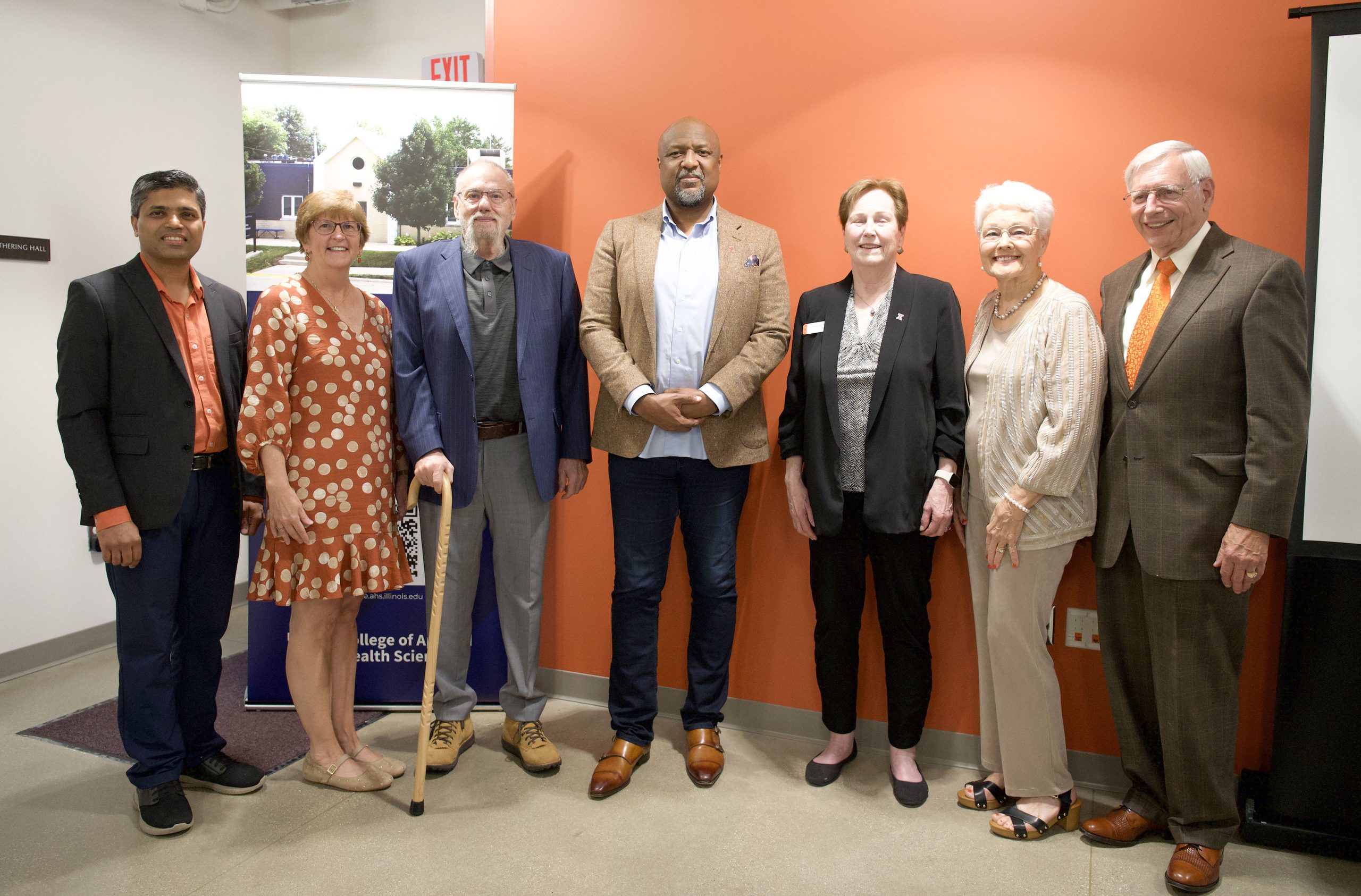
AHS Dean Cheryl Hanley-Maxwell, second from left, poses with AHS alumni award winners Jack Groppel, left, Adrienne Albrecht, right, and Brandon Buchanan, far right. (Photo by Craig Pessman).

The College of Applied Health Sciences at the University of Illinois Urbana-Champaign once again shined a light on extraordinary alumni at its annual Alumni Awards celebration, held during Homecoming weekend. This year’s honorees—Dr. Jack Groppel, Justice Adrienne Albrecht and Brandon Buchanan—embody the college’s enduring mission of advancing health, equity and human potential.

The ceremony, led by Dean Cheryl Hanley-Maxwell, is designed not only to recognize the professional accomplishments of alumni but also to share the personal journeys that shaped their paths. “The individuals who receive these awards never fail to impress and fascinate me,” Hanley-Maxwell said. “As you hear their stories today, I’m sure you’ll find yourself saying, ‘Wow!’ many times, just as I have.”

Distinguished Alumni Award: Dr. Jack Groppel

Few careers demonstrate the power of seizing opportunity quite like that of Jack Groppel, recipient of the 2025 AHS Distinguished Alumni Award. An internationally recognized scholar in the science of human performance, Groppel has been a professor, tennis coach, entrepreneur, author, corporate consultant and motivational speaker.

And yet none of that would have happened without the University of Illinois.

“If the leaders in this college hadn’t given me a shot, I’d be counting wolves in Wyoming,” he said.

Growing up in a small southern Illinois town, Groppel was drawn to sports early, teaching himself to play tennis and eventually becoming one of the top junior players in the St. Louis area. Determined to play for the University of Illinois, he convinced men’s tennis coach Dan Olson to give him a chance—a story that foreshadowed a career marked by persistence and boldness.

His academic path was less direct. Pressured to pursue a “practical” major, Groppel earned a degree in wildlife biology. Yet his passion for athletics led him to graduate study in biomechanics at Illinois, where mentor Dr. Charles Dillman helped redirect his career. Groppel later completed a Ph.D. in exercise physiology at Florida State University before returning to Illinois as a professor and head tennis coach.

“How do you go from crying yourself to sleep at 22 to this?,” Gropple said, referencing his unhappy time seeking a career in the wildlife industry. “I have been truly blessed in my life, thanks to my time at the University of Illinois.”

After a decade, Groppel made another daring move: leaving a tenured faculty position to work in Florida at the Saddlebrook Resort. That leap led him to co-found the Human Performance Institute with Dr. Jim Loehr, a venture later acquired by Johnson & Johnson. Groppel became a pioneer in applying the training principles of elite athletes to business leaders, co-authoring the influential book The Corporate Athlete. He went on to brief Congress on worksite wellness, share stages with global icons like Muhammad Ali and Margaret Thatcher, and earn induction into three tennis halls of fame.

Groppel credits the University of Illinois with giving him the scientific foundation and teaching passion that shaped his career.

One of his mentors was Thomas K. Cureton, considered the father of physical fitness. After a semester working with Cureton and others in the precursor to what is now known as the  Department of Health and Kinesiology in AHS, Groppel was hooked.

“AHS molded me into a person who can do quality research,” he said. “It all began with leaders in AHS taking a chance on me. It started in that small town and on those small farms where young Jack dared to dream big.”

Harold Scharper Award: Justice Adrienne Albrecht

If Groppel’s story is about breaking down doors, Adrienne Albrecht’s is about perseverance and the power of access. Recipient of the Harold Scharper Award, presented by the Division of Disability Resources and Educational Services, Albrecht retired in 2024 as a Justice of the Third District Appellate Court of Illinois, capping a distinguished legal career.

Born in Kankakee as the eighth of 10 children, Albrecht was diagnosed with Marfan syndrome, a connective tissue disorder that severely impaired her vision. In the 1960s, long before disability rights laws provided protections, her mother fought to secure accommodations like front-row seating and access to blackboards. “My mother was extraordinary,” Albrecht said. “She understood what I needed and made sure I got it.”

“If the leaders in this college hadn’t given me a shot, I’d be counting wolves in Wyoming.

Jack Groppel

Distinguished Alumni Award winner

DRES founder Tim Nugent also played a vital role. Several of Albrecht’s siblings, who also had Marfan syndrome, attended Illinois with the support of DRES scholarships.

“I can’t tell you what a profound effect the University of Illinois had on my entire family. Imagine this family of 10 children, thinking they could all go to college and have great careers. The University of Illinois was just so crucial to my family,” she said.

Despite limited assistive technology at the time, Albrecht thrived academically, drawn to international relations before pursuing law. A constitutional history course sparked her passion for legal analysis, while her visual impairment forced her to develop a near-photographic memory—an asset in her legal work.

Over a 30-year career, Albrecht became known for her skill, adaptability and dedication to justice. She was among the first attorneys in Kankakee to integrate personal computers into her practice, eventually teaching technology courses for the Illinois State Bar Association. She served on the circuit court bench before her appointment to the appellate court, where she helped interpret Illinois’ landmark cashless bail statute.

Her proudest moments, however, were deeply personal. “People approach me in the grocery store to thank me, to tell me I made a difference in their lives,” she said. “That means more than anything.”

Dean Hanley-Maxwell said Nugent would be proud to see how Albrecht carried forward his legacy of inclusion and access.

“(Nugent) would join all of us in AHS and DRES in saying that you are richly deserving of this award,” Hanley-Maxwell said.

Young Alumni Award: Brandon Buchanan

Brandon Buchanan was honored with the AHS Young Alumni Award for his leadership in health equity and hospital administration. Buchanan is now associate chief operating officer of Orlando Health Dr. P. Phillips Hospital, but his path began in Champaign with a shift in academic focus.

Originally a journalism major, Buchanan found his calling while volunteering at Smile Healthy, a clinic providing dental care to underserved populations. “Community health took a holistic approach to how society looks at health and well-being,” he said. Inspired, he switched majors and pursued graduate training in health administration.

That decision launched a career devoted to improving access to care. Buchanan managed HIV and STI outreach programs at Ohio State, then spent nearly seven years at Endeavor Health in Chicago. There, he built the health equity impact team from a one-person office into a 30-member department that improved mammogram screening rates, reduced hypertension in Black communities, and expanded community education.

Now in Florida, Buchanan serves on the board of the local YMCA and mentors students pursuing careers in healthcare administration. “I’m proud when I see them flourish and shine,” he said.

Hanley-Maxwell praised Buchanan’s blend of leadership and compassion: “You cannot go wrong when you are committed to improving your community through service, fairness and respect.”

Editor’s note:

To reach Vince Lara-Cinisomo, email vinlara@illinois.edu.
 

Share on social
Related news

Pedro Hallal honored with King James McCristal Distinguished Scholar award


Pedro Hallal accepts the King James McCristal Distinguished Scholar Award on Wednesday, Sept. 23, 2025.

Like many young researchers, Pedro Hallal thought his first study would be groundbreaking and potentially change the paradigm of the study of physical activity. Ultimately, he said, it didn’t, but now, with the value of experience at hand, he understands that was OK.

“We are trained to think of things that no one has ever studied. But science is much more about consistency of results nowadays, than about brand-new findings,” said Hallal, the Alvin M. and Ruth L. Sandall Professor in the Department of Health and Kinesiology at the University of Illinois Urbana-Champaign. “We do research because of the questions; we don’t start with the answers.”

Thanks to that curiosity and because of the breadth of his research, Hallal on Sept. 24 was awarded the King James McCristal Distinguished Scholar Award, one of the most prestigious recognitions in the College of Applied Health Sciences. The award honors faculty whose scholarly contributions have significantly advanced their disciplines while elevating the reputation of the university.

For Hallal—whose research has transformed global understanding of physical activity and health—the honor represents both a recognition of past achievements and an encouragement to push forward in addressing one of the world’s most pressing public health challenges: physical inactivity.

“Professor Hallal’s scholarly work has substantially elevated the profile of his department, our college and the university by advancing public health knowledge and global health equity,” said Cheryl Hanley-Maxwell, dean of the College of Applied Health Sciences.

A Global Lens on Physical Activity

Hallal, who is also director of AHS’ Master of Public Health program, has built an international reputation for his research on physical inactivity, a phenomenon he argues must be understood in the context of modern life.

“Today, we have fewer people being active,” Hallal said. “Most of them are indoors, looking at a screen. We have to think about what physical activity is today, not decades ago. The notion that physical activity is good for health has been known for centuries. Only since the 1950s and ‘60s have we really been studying it.”

His scholarship began in Brazil, where his master’s thesis—“Physical Inactivity: Prevalence and Associated Variables in Brazilian Adults”—found that 41.1 percent of the surveyed population did not meet recommended activity levels of 150 minutes per week. This early work set the stage for his career-long focus on understanding inactivity as both a personal and societal issue.

Hallal’s impact expanded dramatically with his contributions to a series in The Lancet, one of the most influential medical journals in the world. His research revealed that one-third of adults worldwide—approximately 1.5 billion people—failed to achieve the minimum recommended level of physical activity. Equally concerning, four-fifths of children ages 13 to 15 fell short of the one-hour daily activity guideline. The findings underscored physical inactivity as a global pandemic, drawing international attention to a public health crisis with profound implications for chronic disease and health equity.

Hallal has often said that this work in The Lancet is the “research I am most proud of.”

Redefining Scientific Inquiry

Throughout his career, Hallal has emphasized the importance of scientific rigor and humility.

That philosophy has guided him to produce a body of work that does not merely identify problems but interrogates the systems that perpetuate them. His studies consistently highlight how socioeconomic and geographic inequalities shape access to safe and purposeful physical activity.

“Access to safe, purposeful physical activity must be a societal priority,” Hallal said. By framing physical inactivity not only as an individual choice but also as an issue of structural inequities, he has pushed the field toward broader, more inclusive approaches to solutions.

Access to safe, purposeful physical activity must be a societal priority

Pedro Hallal

Professor of Health and Kinesiology

A Legacy of Impact

The King James McCristal Distinguished Scholar Award cements Hallal’s place among the most influential scholars at Illinois. The recognition highlights not only his academic achievements but also his role in shaping the conversation around health equity worldwide.

From uncovering high rates of inactivity in Brazil to leading global efforts to quantify physical inactivity, Hallal has consistently produced research that informs public policy, inspires further scientific exploration, and elevates the role of physical activity in public health discourse.

Looking Ahead: Challenging Assumptions

As Hallal reflects on the future of his field, he sees opportunities to question prevailing assumptions and generate new lines of inquiry.

He is particularly interested in challenging the idea that “every movement counts.” While small bursts of activity are beneficial, Hallal believes that the global challenge lies in ensuring people have the opportunity for meaningful, sustained physical activity. He also underscores the importance of recognizing how time scarcity and resource inequality reinforce global disparities in health behaviors.

“I think this place, this campus and college, are in a great position to tackle these things,” Hallal said. “We are already one of the country’s leaders in the field, and we are one of the most productive groups in the world on this topic.”

Editor’s note:

To reach Vince Lara-Cinisomo, email vinlara@illinois.edu.
 

Share on social

Related news

Measuring pain in postpartum women: A first look


Sandraluz Lara-Cinisomo

Bringing a new baby into the world is often described as joyful, overwhelming, and exhausting all at once. But what’s less often talked about is how the postpartum body—and brain—handle pain, especially for mothers dealing with postpartum depression.

A team of researchers led by Sandraluz Lara-Cinisomo, an associate professor in the Department of Health and Kinesiology at Illinois, recently took a bold step to explore that question. Their study, published in Psychiatry Research: Neuroimaging, asked: Can we measure how new moms’ brains respond to pain using fMRI ? And would moms even be willing to do it?

It turns out the answer is yes.

The study focused on 13 women, 11 without depression and 2 with postpartum depression. The point was to see if the idea would work: Would new moms come into a lab, be willing to experience a controlled pain test while researchers measured their brain activity?

The “pain test” was simple but effective: participants were exposed to a cold-pain device while in the scanner, enough to be uncomfortable but not unsafe. The experiment was repeated five times, during which the women reported how intense and how unpleasant the pain felt.

“Although there is growing interest in the postpartum brain, including in the context of depression, the focus on postpartum pain has stalled,” Lara-Cinisomo said. “Birthing people experience changes that are not often observable. fMRI offers an opportunity to measure their minds process pain while creating a space for them to tell us how it feels to be in pain. This study is the first step toward unveiling how postpartum depression affects pain perception.”

The researchers then compared those reports to what was happening in their brains.

For the women without depression, the scans showed activation in the places you’d expect:

  • The amygdala (linked to the assessment of pain intensity)
  • The insula (a key hub for processing physical sensations of pain)
  • The anterior cingulate cortex, or ACC (involved in emotional components of pain)

When the researchers compared women with depression to those without, they found higher brain responses in the depressed group. Still, those differences were not significant, likely due to the small sample size.

Where things got interesting was in how the women described their pain.

Even though the numbers didn’t hit statistical significance, there was a clear pattern: women with higher depression symptoms tended to find the pain more unpleasant and intense.  The depressed group also tended to report the onset of pain earlier in the experiment than the non-depressed group.

So, what is the takeaway from this study?

First, it proved the concept. Postpartum women were willing to take part and found the process acceptable. That matters because there’s often concern about asking new moms to volunteer for time-consuming or physically demanding studies.

Second, it showed that fMRI can capture real brain activity linked to pain in this group. That opens the door to larger-sample studies that could dig deeper into how PPD changes the pain experience—and maybe test which treatments (such as therapy, medication or support programs) improve mood and pain.

The study also adds to the growing recognition that postpartum health is complex. It’s not just about healing physically or adjusting emotionally—it’s about how those two processes interact in ways that can shape daily life for mothers.

Lara-Cinisomo and her co-authors are clear about what’s next: larger studies, with more women experiencing postpartum depression, and identifying interventions to help alleviate their physical and psychological discomfort. That way, they can track how the brain responds to pain might shift as symptoms improve.

Editor’s note:

To reach Vince Lara-Cinisomo, email vinlara@illinois.edu.
 

Share on social
Related news

College of Applied Health Sciences
110 Huff Hall
1206 South 4th Street
Champaign, IL 61820
(217) 333-2131