Renovating for the Future


Conducting 21st century research and instruction in 20th century space can be challenging. Architects designing buildings 40 to 100 years ago could never have imagined the scope of the investigations in which faculty would be engaged, from the macro to the molecular level. Nor could they have predicted with any accuracy how departments would grow and change over the years.

Take the Women’s Gymnasium, for example.

An ambitious plan

Built in the early 1930s, what is now known as Freer Hall provided expanded facilities for the women’s physical education department, which had outgrown its space in the Woman’s Building (now the English Building). The last of 11 Georgian-style buildings on the Urbana-Champaign campus designed by renowned architect Charles Platt, the Women’s Gymnasium housed administrative offices, classrooms, and gymnasium spaces that were used for recreation, intramural sport competitions, and physical education research. Louise Freer, the women’s physical education director for whom the building was later renamed, added a lounge area in 1932 to provide a social space in the building.

The original design called for wings on both ends of the building, with the north wing housing a swimming pool. Funding was exhausted before the wings could be constructed, but the original vision was partially fulfilled in 1968 when a pool wing was added on the north end of the building. Administered by Campus Recreation, the pool served as the home venue for the Illinois Fighting Illini women’s swimming and diving team during renovations to the Intramural Physical Education Building, now known as the Activities and Recreation Center (ARC).

Four years after the pool wing was added, the Department of Physical Education for Women merged with the Department of Physical Education for Men and Freer Hall became home to the School of Physical Education. Renamed the Department of Kinesiology in 1987, the rapidly growing discipline began to strain against the limitations imposed by the nearly 60-year-old building. It wasn’t until the mid-2000s, however, that the College of Applied Health Sciences was able to undertake its first efforts to address some of the department’s pressing needs.

Between 2005 and 2011, two renovation projects converted the north and south gyms on the third floor into office and research space. Ten offices and an exercise science laboratory were carved out of the north gym space, while the south gym became facilities for research on neurocognitive kinesiology and the neuroscience of dance in health and disability. By this time, the women’s swimming and diving team had returned to the ARC, and with outstanding pool facilities existing in both that building and the Campus Recreation Center East, the College lobbied successfully to take ownership of the Freer Hall pool.

The vision for the north wing renovation was ambitious: to convert nearly 48,000 square feet gained by filling in the pool and removing lockers and showers into modern, collaborative research and teaching space. In January 2015, the University of Illinois Board of Trustees approved campus funding for the College’s plan to renovate the north wing “to develop needed spaces that directly support the long-range vision for the Department of Kinesiology and Community Health and the College of Applied Health Sciences at Urbana-Champaign.”

The pool infill renovation is the most comprehensive building project undertaken by the College to date. It includes modifications that will bring the building into compliance with the American with Disabilities Act, including the addition of an elevator that will give access to the fourth floor, previously unreachable by individuals with disabilities. (A new ADA-compliant entrance on the south side of Freer Hall was completed in 2018.) Half of the fourth floor will house new mechanical systems, including central air conditioning, while the other half will contain office space for visiting faculty and postdoctoral scholars.

The highlight of the renovation is the multipurpose testing and research facility that will occupy the first floor of the former pool wing. Described as an “historic renovation” by Dr. Amy Woods, head of the Department of Kinesiology and Community Health, the project will significantly enhance the department’s teaching, research, and outreach missions.

“This new space will include office and conference rooms, a large lifestyle intervention center including areas for blood collection and nutrition studies, a laboratory for motion capture, an exercise physiology wet lab, and other labs for kinesiology research,” she said. “The laboratories in this new space will be shared resources that facilitate multiple research studies as well as faculty and student interactions.” The space also will house a state-of-the-art video production facility for online classes. The comprehensive $20 million project has not been without its challenges, but is expected to be completed during the Fall 2019 semester.

A more welcoming environment
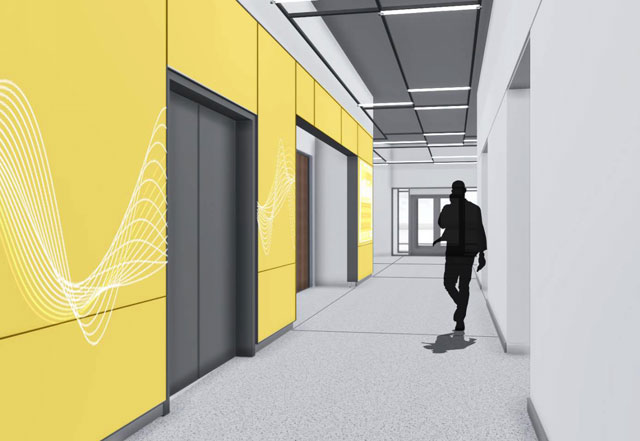
architectural rendering of lobby elevator area in Speech and Hearing Science Building

Also slated for completion this year is a $2.4 million renovation of the Speech and Hearing Science Building, built in the mid-1970s.

Originally conceived as a half-million dollar project to increase research space on the second floor, the College was able to expand the scope of the renovation through a campus initiative to repurpose underused facilities. Bill Goodman, former associate dean in AHS who is now a special assistant to Dean Cheryl Hanley-Maxwell, said the initial plan was to convert small rooms that had served as assessment rooms for the Speech-Language Pathology Clinic into usable space.

“The assessment rooms were rendered obsolete when the clinic moved to the Research Park area south of campus,” he said. “Our plan was to combine several of these smaller rooms into space that would be suitable for faculty research.”

The larger project will renovate more than 5,000 square feet on the second and first floors of the building, not only to provide for better research and teaching facilities but also to create a friendlier, more welcoming image for the Department of Speech and Hearing Science.

“You really had to hunt for the department’s administrative offices,” Mr. Goodman said. “The building didn’t have a very friendly or welcoming environment.”

The renovation project necessitated the disbursement of speech and hearing science faculty to alternative office space around campus. That’s been inconvenient, said SHS department head Karen Kirk, but the new facilities will make the temporary displacement worthwhile.

“The renovations will provide much-needed additional laboratory and student work space,” she said. “It also will give us enhanced meeting spaces of varying sizes that can be used for student seminars, research presentations, and large faculty meetings.”

Dr. Kirk also is excited about the relocation of administrative offices to the first floor, which will increase both the perceived and actual accessibility of SHS, and about the increased functionality and attractiveness of lobby areas on the first and second floors, which are used for student orientations, prospective student visits, and graduation receptions.

Also moved from the Speech and Hearing Science Building to allow for renovations was the University of Illinois Audiology Clinic, which now shares space with the Speech-Language Pathology Clinic in Research Park. That move is a permanent one, Dr. Kirk said, and will allow the department to provide integrated services to clients across the lifespan. And, she added, “Our clients are pleased with the free parking on site.”

Share on social

Related news
 

A Celebration of Excellence


Karen McKechnie, left, James McKechnie, and Dr. Amy Woods (Photo by Anna Flanagan)

When Dr. Amy Woods was in third grade, school was a place where you were expected to be quiet and inactive. It was 1968, and there was no organized physical education in her elementary school. One day, a day she still remembers vividly, a physical education major from nearby Newberry College visited the class.

“And he stood at the front of the class and said, ‘We’re going to exercise.’ And there was a charge in the air,” she recalled. “That really was a pivotal moment for me.”

That physical education major who led her class in jumping jacks may never know the impact he had on her, but Dr. Woods went on to become a physical education major herself at Winthrop College in Rock Hill, South Carolina. She earned a master’s degree at the University of Tennessee and taught physical education in Newberry, South Carolina, for two years before pursuing her PhD in physical education instruction and curriculum at the University of South Carolina. She joined the Department of Kinesiology and Community Health in 2005 after teaching at Columbia College, St. Olaf College, and Indiana State University, and is currently the head of the department.

Last February, Dr. Woods’ many professional accomplishments were celebrated as she was named the first James K. and Karen S. McKechnie Professor in the College of Applied Health Sciences.

Through her research, publications, invited lectures, and conference presentations, she has become internationally recognized for her work on school-based physical activity and the career cycles of K-12 physical education teachers. Part of her research focuses on the support that is needed to sustain innovative practices in teaching. She also studies factors that contribute to teachers’ self-efficacy, or their belief in their ability to succeed, as well as the power of productive reflection in professional development. Her findings have informed policies and practices in teacher education.

In the Pedagogical Qualitative Research Lab, which she co-directs with Dr. Kim Graber, Dr. Woods is investigating the benefits of recess. “You might look at recess as just an innocuous activity for children,” she said, “but it’s where they get a good bit of physical activity each day.” She is specifically interested in whether recess yields more benefits before or after lunch. Current federal policy encourages physical activity before lunch because children waste less food. But her team’s research into the impact of recess on physical activity, nutritional intake, body fat, and cognitive function calls that policy into question.

Dr. Woods, who is a Fellow of the National Academy of Kinesiology, says her ultimate goal is to help K-12 teachers promote health-enhancing physical activity that keeps children moving as much as reasonably possible in schools.

“We are intensely proud of our connection to this University.”

James and Karen McKechnie graduated from the University of Illinois in 1970, he with a degree in chemistry and she with a degree in physical education. He went on to become an orthopedic surgeon with practices in Mattoon and Urbana-Champaign that were managed by Mrs. McKechnie. As avid skiers and swimmers, they have long known the benefits of physical activity in their own lives. But Dr. McKechnie said that as they age, “We have an increasingly direct appreciation of the role that physical fitness plays in our ability to continue as productive and mentally fit citizens.”

The McKechnies are members of the President’s Council and Chancellor’s Circle, and their support has been enjoyed by the College of Liberal Arts and Sciences, Fighting Illini Athletics, and the University of Illinois library as well as AHS. They endowed the James K. and Karen S. McKechnie Lab of the AHS Center on Health, Aging, and Disability, located in the Khan Annex. Mrs. McKechnie serves on the AHS Board of Visitors.

In endowing the James K. and Karen S. McKechnie Professorship in the College of Applied Health Sciences, they hope to contribute to and continue the longstanding tradition of excellence for which the University is known. Dr. McKechnie lauded Dr. Woods’ selection as the inaugural recipient, saying, “I’ll be eager to learn of the contributions Dr. Woods makes in maximizing our human potential and assisting us with making the most productive, most comfortable, and most enjoyable use of the time that each of us has allotted to us in this world.”

Related news

A Journey to Empowerment


Harold Scharper Award recipient Kevin Fritz is flanked by Susann Sears, director of Beckwith Residential Support Services, and Pat Malik, former director of Disability Resources and Educational Services.

Kevin Fritz’s disability made his childhood difficult. People noticed his wheelchair before they noticed him. The severity of his disability made it impossible for him to perform the tasks of daily living for himself, and he was often hospitalized with intense illnesses. Despite all of this, he had a strong will to succeed.

So when his health finally stabilized during high school, his thoughts immediately turned to taking advantage of opportunities. It was the first time he felt empowered in his life.

“That was the first time I truly felt authority or power to do something,” he said. “And I did. I immersed myself in academics. I tried to learn things. I tried to become more articulate, sensitive, ambitious.”

In his junior year, he came across an article in New Mobility magazine that listed the top ten universities for people with disabilities. What intrigued him most about the article were the photos of people in wheelchairs.

“They were doing things, going to classes, wearing clothing that wasn’t from a hospital. It was fascinating,” he said.

The University of Illinois was at the top of the list. Although this Pennsylvania resident wasn’t even sure where Illinois was, he called the Division of Disability Resources and Educational Services (DRES) and spoke with Susann Sears, who now directs the Beckwith Residential Support Services program for people with severe physical disabilities who require personal assistants. She recommended a campus visit.

“She said I could take a tour on a special bus that was accessible and see the place where I would live with other students and get care,” he said. “That was the second time in my life that I felt empowered.”

His father drove him 12 hours for the visit. The ride home was quiet, with Kevin feeling “shell-shocked and elated.” His father broke the silence, saying, “Kevin, if you can get in, you can go.”

At Illinois, Kevin learned how to maximize his quality of life. He credits Susann in particular with igniting a fire in him to push back when people said no. “She fought for me to change what is commonplace,” he said. “I have rights. I’m allowed to be here. I deserve to be here.”

He seized opportunity after opportunity, becoming the first student with a known physical disability to be elected to the Illinois Student Senate, which he also chaired, and to serve as director of the Illini Union Board. A student in Community Health, he served as president of Future Health Care Executives, the largest student organization in the College of Applied Health Sciences, and of the rehabilitation service fraternity Delta Sigma Omicron. He landed coveted internships with then-Senator Barack Obama and with Lynne Barnes, vice president of hospital operations at Carle, who encouraged Kevin to apply his analytical mind and passion to law school.

During his studies at Washington University School of Law, he served as the primary editor of the Washington University Journal of Law & Policy, as a board member of Wiley Rutledge Moot Court, and as executive director of advocacy for the National Association of Law Students with Disabilities. He won several mock trials as well as an Excellence in Oral Advocacy Award. As an associate in the firm Seyfarth Shaw LLP, he counsels clients on a wide range of employment issues. His courtroom experience covers the full spectrum of litigation. He co-chairs the firm’s All Abilities Affinity Group, which focuses on inclusion in the workplace, and speaks extensively on disability and diversity issues throughout Chicago.

Looking back on his days at Illinois, Kevin is grateful for the many opportunities that he had through his affiliations with AHS and DRES. He considers the University of Illinois to be a mechanism that allows people to master their lives, adding that he is very honored and proud to have mastered his own.

Share on social

Related news

Partnership focuses on autism


According to the A.J. Drexel Autism Institute, young adults with autism have the lowest rate of employment compared to young adults with other disabilities. Because people on the autism spectrum typically have difficulty with communication and social interactions, they may not perform well during conventional employment interviews. Indeed, the Drexel Institute found that young adults on the autism spectrum with the highest level of conversation skills are far more likely to have worked than those with the lowest conversation skills.

Companies are beginning to recognize that their hiring practices may be shutting out a large pool of talented individuals. In 2015, Microsoft launched a hiring program designed specifically to identify and recruit individuals on the autism spectrum who have the necessary qualifications to fill open positions.

Now the company is hoping to encourage more young adults on the autism spectrum to enter science, technology, engineering, and math, or STEM, fields, with an eye toward increasing the hiring pipeline of these students to Microsoft. To accomplish these goals, Microsoft has invested $200,000 in the Accessibility Lighthouse Program, a year-long collaboration of the College of Applied Health Sciences, the Department of Computer Science, and The Autism Program, a community-focused program of the Department of Human Development and Family Studies and the Department of Special Education.

Launched in June, the program developed from conversations among Illinois alumnus and current Microsoft director of university relations Harold Javid, who earned three degrees in engineering, Katheryne Rehberg, associate director of the University’s Office of Corporate Relations, and Pat Malik, director of the Division of Disability Resources and Educational Services (DRES), as well as a series of campus visits by Microsoft executives with faculty across campus.

In addition to recruiting more students on the autism spectrum to STEM fields, the program is funding the creation of a state-of-the-art digitally accessible classroom using Microsoft tools such as Office 365 and Translator. The Accessibility Lighthouse Project also provides for two graduate fellows in the College of Applied Health Sciences who are focused on increasing awareness of the importance of accessibility, and a graduate assistant in DRES who provides career support services to autistic students.

Accessibility advocates

Both Megan Bayles and Tim Yang have experience in the area of disability, which spurred their interest in applying for the Microsoft Digital Accessibility Graduate Fellowship Program. Megan, a master’s student in Dr. Wendy Rogers’ Human Factors and Aging Laboratory, worked with people with disabilities and older adults as an undergraduate student in psychology at Florida State University. Among her research interests are the use of technology to address social isolation and technology acceptance. Tim is a doctoral student in Dr. Yih-Kuen Jan’s Rehabilitation Engineering Research Laboratory. He began studying the design of wheelchairs for maximum comfort, health, and usability during his undergraduate studies in computer science at the University of Central Oklahoma. His current research seeks to leverage human factors engineering to develop user-centered smart wheelchairs.

As Lighthouse Program Fellows, Megan and Tim are enrolled in the Information Accessibility Design and Policy online certificate program offered by AHS, which consists of three courses on understanding disability and assistive technology, creating and procuring accessible electronic materials, and designing accessible web resources. They are applying their learning toward developing a manual to help professors make classrooms and courses more accessible and an instructional module about accessibility for new teaching assistants. Dr. Jeff Woods, director of the Center on Health, Aging, and Disability, says the role of the Fellows is that of accessibility advocates on campus.

“Many people are not aware of the importance of digital access and of providing students with multiple ways to access course information,” he said. “Even though the Lighthouse Program is targeting students on the autism spectrum, making courses more accessible will undoubtedly help other students as well.”

In addition to increasing awareness, Tim and Megan will work with a professor to revise a course with accessibility in mind with the ultimate goal of assessing whether adjustments impact instructor and course evaluations.

Making the transition to work

Digital accessibility is the bailiwick of Dr. Jon Gunderson, coordinator of the DRES Accessible Information Technology Group. The Lighthouse Project included funding for part-time student workers to continue development of open source web accessibility evaluation tools including the AInspector Sidebar add-on for Firefox browser and Functional Accessibility Evaluator (FAE) 2.0. Dr. Gunderson is the primary software developer of the open source OpenAjax Accessibility Evaluation library used in   AInspector Sideber and FAE 2.0 to evaluate web content for W3C Web Content Accessibility Guidelines (WCAG) 2.0 Level A and AA requirements. 

DRES also received funding for a half-time graduate assistant to provide career services to students on the spectrum. Adrienne Pickett, a PhD student in educational policy studies, will serve in that position until the Lighthouse Program ends in June 2019. She is organizing workshops on career-related topics including disability disclosure and counsels individual students on how to improve their job application materials.

Last summer, Adrienne developed a survey about summer employment for students served by DRES. Pat Malik says it’s important for people with disabilities, including autism, to experience what it’s like to be an employee.

“Some of our students haven’t had the opportunity to flip burgers at a fast-food restaurant or serve as lifeguards at the community pool,” she said, “so they haven’t had the opportunity to find out what is expected in order to get a paycheck, things such as getting to work on time, working with coworkers you don’t like, persevering when work is boring, and so on.”

Dr. Malik says about 125 students on the autism spectrum are currently registered with DRES and seek many of the same services other students with disabilities access, such as individual therapy to cope with struggles they have socially or academic coaching to help them organize course materials or prioritize work. Since not all students on the spectrum register with DRES, Dr. Malik believes it is important to educate career service providers across campus about working with autistic students. DRES is working with The Autism Program and The Career Center at Illinois to offer a campus-wide workshop on employing people with autism this spring.

She also views the Lighthouse Program as an opportunity to learn more from Microsoft about supporting people with autism. Through peer mentoring, team building exercises, organized social events, and other special programs, she says the company “walks the walk” when it comes to having a diverse workforce in which employees with autism and other disabilities are fully integrated. She is looking forward to continuing the collaboration that was initiated through the Accessibility Lighthouse Program to identify and develop new ways of helping students with disabilities make the transition to employment.

Share on social

Related news

College of Applied Health Sciences
110 Huff Hall
1206 South 4th Street
Champaign, IL 61820
(217) 333-2131