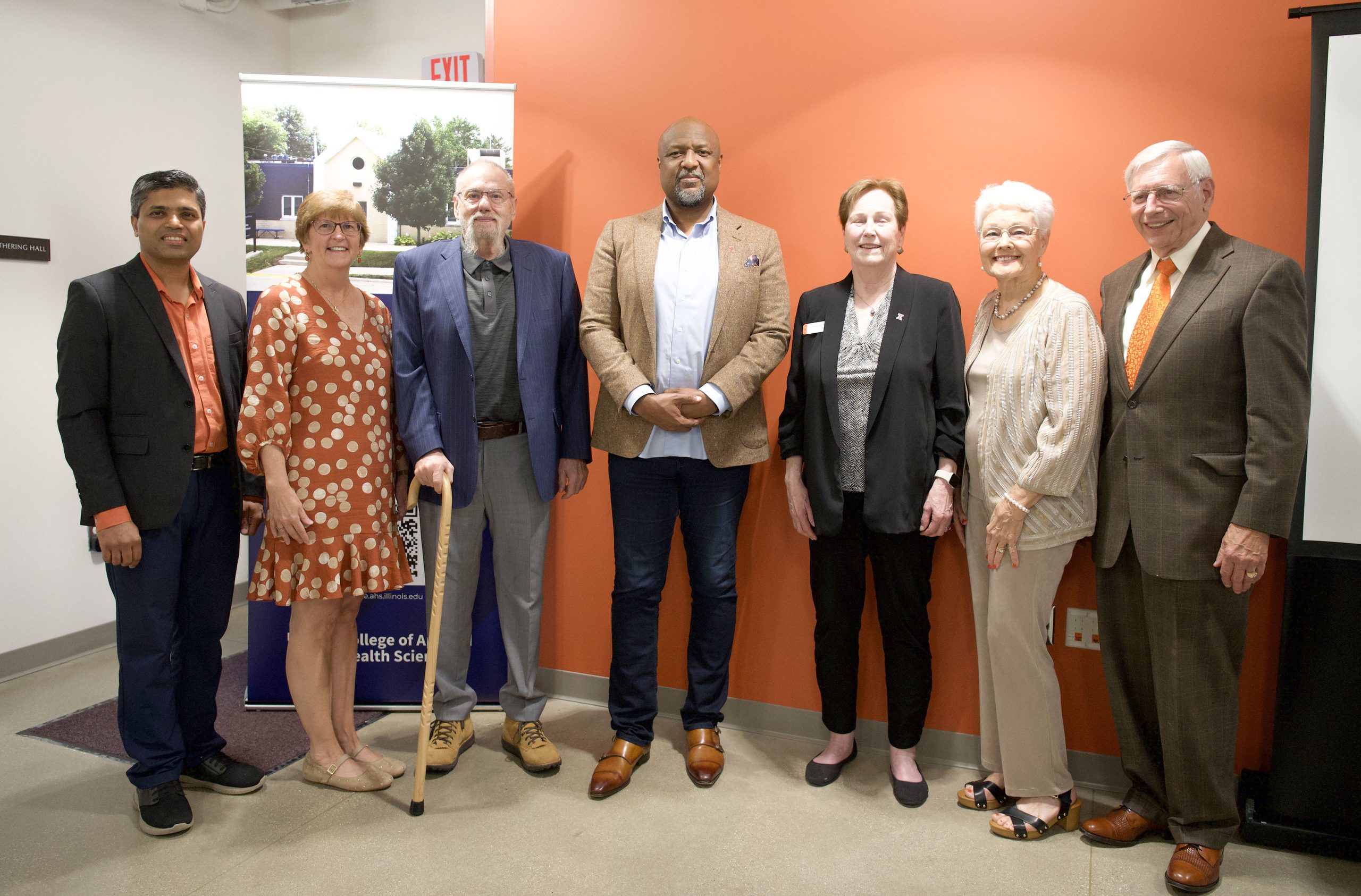
At the spring college meeting for the College of Applied Health Sciences, our faculty and staff gathered to celebrate this year’s college award winners, and give send-offs to two faculty leaders who are entering retirement: Speech and Hearing Science Professor and former Department Head Pamela Hadley and AHS Professor and Associate Dean for Research Jeff Woods.
(Two of our award winners, Christy Bazan and Mary Flaherty, won equivalent awards from campus as well.)
Here are our AHS college award winners for 2025-26. A recording of the meeting is available on Media Space:
AHS Staff Excellence Award
Chez Veterans Center Outreach Coordinator and Veteran Recruiter, Garrett Anderson
College of AHS Assistant to the Dean, Robbin King
AHS Excellence in Undergraduate Advising Award
Health and Kinesiology Academic Advisor, Patty Hudek
AHS Excellence in Undergraduate Teaching Award – Faculty
Speech and Hearing Science Associate Professor, Mary Flaherty
AHS Excellence in Undergraduate Teaching Award – Teaching Assistant
Health and Kinesiology Graduate Teaching Assistant, Ashley Morgan
AHS Access, Belonging and Community Awards
SHS student Zhitong Zhu
RST graduate research assistant Jenna Fesemyer-Ayers
RST Assistant Professor Yannick Kluch
Chez Veterans Center Research Assistant Professor Michael Lotspeich-Yadao
AHS Excellence in Guiding Undergraduate Research Award
Recreation, Sport and Tourism Assistant Professor, Joelle Soulard
AHS Excellence in Graduate and Professional Teaching Award
SHS Associate Professor, Dan Fogerty
AHS Excellence in Graduate Student Mentoring Award
HK Associate Professor, Laura Rice
AHS Excellence in Online Teaching Award
HK Instructor, Christy Bazan
Phyllis J. Hill Faculty Award for Exemplary Mentoring
Woods leaves a legacy of groundbreaking research and inspired mentorship
Jeff Woods, center, got a rousing sendoff from faculty and staff at the AHS college meeting on May 7. (Photo by Ethan Simmons)
After a noteworthy tenure spanning more than three decades at the University of Illinois, Jeffrey Woods, Ph.D., the associate dean for research in the College of Applied Health Sciences and a national leader in exercise physiology research, has announced his retirement, marking the end of an era for one of the campus’ most influential scholars in health and aging studies.
Woods, whose work has reshaped scientific understanding of how physical activity benefits the immune system and human health, retires as one of the College of Applied Health Sciences’ most honored researchers and mentors. Named the inaugural Mottier Family Professor in Applied Health Sciences in 2019, Woods leaves a legacy of groundbreaking research and institutional leadership that has influenced both scholars and students alike.
“When Jeff started his career at Illinois 32 years ago, life looked very different. His days began with an hour-long commute from Charleston, Illinois, to the University of Illinois. Even in tough winter conditions, he never complained; he simply did what needed to be done,” said Amy Woods, the James K. and Karen S. McKechnie Professor and associate dean for faculty affairs in AHS and Jeff’s wife.
“All the while, his impact extended far beyond home. He traveled widely, shared his expertise with colleagues around the world and contributed to NIH grant reviews, helping to shape the future of research in his field. Now, he has a well-earned chance to slow down and enjoy life on his own terms. Jeff’s dedication and integrity have made a lasting difference, and this milestone is so richly deserved. We are so proud of him and so grateful for the life we’ve built together.”
Woods earned his B.S. from the University of Massachusetts at Amherst, an M.S. from Springfield College and his Ph.D. in Exercise Science from the University of South Carolina. He joined the University of Illinois faculty in 1994, eventually holding appointments across multiple disciplinary programs, including the Departments of Health and Kinesiology, Nutritional Sciences and the Carle-Illinois College of Medicine.
In his retirement announcement, Woods credited the undergrad and graduate students he worked with, as well as faculty and staff, whom he called the “unsung heroes” of the university.
“It has been a great career at a great university,” he wrote. “I look forward to observing your future success through the lens of my emeriti role.”
Throughout his career, Woods became internationally respected for his pioneering research into how regular exercise counteracts inflammation, bolsters vaccine responses in older adults and, perhaps most notably, alters the gut microbiome in ways that promote health independent of diet. His research findings have appeared in over 140 peer-reviewed publications and helped define new directions in the study of aging and preventative health.
“Jeff has been a defining presence in the College of Applied Health Sciences—as a scientist, as a mentor and as a leader. His career represents the very best of our mission: rigorous research, collaborative innovation and an unwavering commitment to improving human health,” said Cheryl Hanley-Maxwell, dean of the College of Applied Health Sciences. “From the moment he arrived, he brought with him a spirit of curiosity and a deep belief in the transformative power of research.”
In addition to his pioneering scientific contributions, Woods served in numerous leadership capacities on campus. He was associate dean for research in the College of Applied Health Sciences and director of the Center on Health, Aging and Disability, where he guided interdisciplinary collaborations and championed integrative research programs aimed at improving the quality of life for aging populations.
Jeff has been a defining presence in the College of Applied Health Sciences—as a scientist, as a mentor and as a leader.
Cheryl Hanley-Maxwell
Dean, College of Applied Health Sciences
Colleagues and students will also remember him as a committed mentor. Over the years, Woods supervised more than 30 graduate students and served as a guiding force for early-career researchers, helping to cultivate a new generation of scholars in health sciences. His leadership extended beyond campus, with roles in national organizations and review panels that have shaped federal research agendas.
“One thing I’ve always appreciated about Jeff is the space he gave his trainees to grow,” said Jacob Allen, an associate professor in Health and Kinesiology. “As his Ph.D. student, he trusted me early on to think independently, take risks and develop my own scientific voice—practicing over and over how to communicate science clearly. That’s what ultimately matters: making an impact with your science. Jeff always reiterated that. That kind of environment is not easy to create, and it made a lasting impact on how I approach mentorship and science today. Now Jeff gets to apply that same approach to his golf game—plenty of time, plenty of reps, … but now no deadlines! Though he may still need a little extra ‘scientific creativity’ when his ball ends up in the woods.”
The Mottier Family Professorship, established through a generous estate gift honoring Charles and Audrey Phyllis Mottier, was awarded to Woods in recognition of his outstanding contributions to both science and education. At the investiture ceremony in 2019, Woods spoke warmly of the collaborative spirit of his colleagues and his gratitude for their daily challenges and inspirations.
As he steps away from his official duties, Woods said he looks forward to continuing to engage in collaborative projects, writing and opportunities to speak on issues at the intersection of exercise, aging and public health.
Pilot grants reignite Chad Symposium, fostering research collaboration and innovation
KCH Associate Professor Naiman Khan’s presentation was titled “Role of Omega-3 Lipid Metabolites in Obesity and Cognitive Function” (Photo by Lisa Bralts)
The first Center for Health, Aging, and Disability (CHAD) symposium since 2017 was a celebration of the research accomplished with the help of the Pilot Grant Program.
Three researchers from the College of Applied Health Sciences—Naiman Khan, an associate professor in Kinesiology and Community Health; Brian Monson, an assistant professor in Speech and Hearing Science, and Sharon Zou, an assistant professor in Recreation, Sport and Tourism, made a point of thanking CHAD’s grants for helping launch their studies.
Khan, whose presentation was titled “Role of Omega-3 Lipid Metabolites in Obesity and Cognitive Function,” said CHAD’s funding was vital to his work.
“CHAD was really helpful in us starting a new line of engagement of research,” he said.
CHAD director Jeff Woods, AHS’ associate dean for research, said to date, 38 pilot grants have been awarded since CHAD was launched in 2010, with $860,000 awarded to AHS researchers for pilot research. Woods described CHAD’s role as “work at the bookends of medicine … with the goal of improving people’s lives.”
“CHAD pilot grants are really important for junior faculty,” Zou said.
And the payoff has been well worth it, Woods said, citing the return on investment as approximately $16 in external funding to $1 in CHAD funding.
Zou’s presentation was titled “Exploring an Efficient and Equitable Entrance Fee for Public Lands: A Community-based investigation in the Indiana Dunes National Park.”
“I study how people have fun,” Zou said, explaining that it was vital for public parks and other tourism industries to build a sustainable revenue model and not to rely on decreasing funding from state and federal sources.
The primary purpose of Zou’s study was to “understand visitors’ and surrounding community residents’ perceptions of Indiana Dunes National Park user fees to inform a fee structure that balances revenue generation and equitable access.”
During and after the COVID-19 pandemic, Zou said, “parks saw explosions of people visiting.” While that was great for parks in terms of revenue, it also led to increasing operation costs at a time when government funding for these sites is being reduced.
“The specific goal is to find out how visitors see the park fees, and are they fair?,” Zou said.
The RST researcher said her preliminary findings indicate there was no consensus from study participants on what “fair” means, and that tension between fairness principles partly explains the longstanding controversy and debate on public land user fees.
Khan’s presentation focused on how poor lifestyle choices can predict an early onset of dementia, noting that obesity worldwide has increased threefold since the 1980s. The KCH researcher said his research, in conjunction with Aditi Das of Georgia Tech, suggested that the a deficiencyin the hormone dehydroepiandrosterone (DHEA)—which has been reported to have beneficial effects on obesity, diabetes mellitus, and serum lipids in animals—was associated with individuals with a body-mass index (BMI) of 25 or higher, which is classified as obese.
“BMI is inversely connected to cognitive function,” Khan said. “Only in obese individuals do we see DHEA increase in circulation.” Khan said his preliminary results found:
Circulating Omega-3 metabolites were higher among persons with higher weight status and the levels were associated with degree of fat mass
Circulating metabolites inversely associated with cognitive function
Only observed among persons with overweight and obesity
Selectively associated with hippocampal function
Implications for memory function
Khan said his overarching goal was to “develop effective lifestyle approaches to improve cognitive function.”
SHS’ Monson discussed his study called “Capturing Prenatal Auditory Experience.”
“If there was a pregnant woman in this audience, that baby would be hearing my voice, and perhaps making judgments,” he said, drawing laughter from the gathering. “How do we know? Because full-term newborns come to the world with memories of what they’ve heard, including the mother’s voice.”
In utero, Monson explained, was a unique acoustic environment. When preterm infants are delivered, they are placed into incubators, which rapidly changed the sound profile, he said. The consequences of those changes include increased risk for sensorineural hearing loss, auditory neuropathy, language and speech developmental delays, auditory attention deficits and auditory processing disorder.
Monson’s study involved a group of pregnant women wearing a LENA listening device twice a week during the third trimester, while the device was placed into cribs of very preterm infants at Carle Foundation Hospital three times a week through their stay in a neonatal intensive care unit (NICU).
“Fetuses are getting 2.5 hours a day of speech exposure vs. 32 minutes a day for very preterm infants,” he said. “It’s an alarming difference to me.” NICU infants may incur a deficit of about 150 hours of speech exposure over the course of the preterm period, he explained.
One of the possible mitigation strategies for very preterm infants could be to provide meaningful targets (about three hours a day of speech exposure) to optimize auditory exposures in NICU settings.
“The maternal heartbeat is never turned off in utero,” he said. “The maternal heartbeat is never turned on in NICU.”
Following the CHAD Pilot Grant success stories, Wendy Rogers, the Shahid and Ann Carlson Khan Professor of Applied Health Sciences, talked about the work of Collaborations in Health, Aging, Research, & Technology (CHART).
CHART’s mission is to enable successful aging through:
Fundamental research
Advanced technology development
Education of researchers, developers, healthcare professionals, older adults
Guidance for policy decision-making
Translation of these efforts to positively affect the lives of older adults
CHART was the first research theme of the College of Applied Health Sciences and boasts the development of the McKechnie Family LIFE Home, an interdisciplinary research facility and simulated home environment that helps promote community engagement, industry partnerships, healthcare collaborations and faculty innovation.
Also part of the symposium was the introduction of a new AHS research theme called CARD (Collaborations in the Advancement of Research on Disability), led by KCH Associate Professor Laura Rice and KCH Professor John Kosciulek. CARD is focused on enhancing the health and quality of life of people with disabilities—through research that addresses critical gaps in disability-related knowledge and outreach that engages individuals with disabilities.
CARD’s short-term goals include:
Develop a collaborative working group
Develop communication strategies
Establish a steering committee of stakeholders
Develop and implement outreach and engagement events
Longer-term goals include:
Host a bi-annual research symposium
Develop a “toolkit” for UIUC faculty to support the performance of disability-related research in the Champaign-Urbana area
Respond to disability-related funding opportunities
Establish a competitive program to provide supplemental funding to support ongoing disability research among junior faculty
Host a seminar series with external experts
Establish a research training program for students registered with DRES interested in doing research
Support the development of new research registries and/or expansion of current registries
The first CARD meeting is set for March 22.
In kicking off the symposium, AHS Dean Cheryl Hanley-Maxwell said CHAD was “one of the biggest attractions” of her decision to come to Illinois and lead the college.
“When I thought about CHAD, I thought it’d be interesting to lead a college that has this kind of momentum to it, and I’ve been proven correct, year after year,” she said. “CHAD provides students with real-world engagement, and plays an absolutely critical role in their professional development.”
Woods agreed.
“We’re helping put the next generation of scientists into the field.”
The College of Applied Health Sciences has experts in many areas that have been affected by the COVID-19 outbreak. Periodically we will ask these experts about how their areas of expertise have been impacted and what we can expect in a post-COVID-19 world. Today, we ask KCH professor Jeff Woods about complicating risk factors, vaccine production and virus spread.
Jeff Woods (Photo by Jerry Thompson)
Q: What are some of the complicating risk factors of COVID-19?
A: There seem to be many conditions, including advanced age, that complicate the severity of SARS-CoV-2 infection. Others include cardiovascular disease, asthma, obesity, high blood pressure, and diabetes. Exacerbation of COVID-19 symptoms in those with underlying respiratory or heart problems is self-evident, but we do not know why other comorbidities make some susceptible to it. In addition, recent reports indicate that even young adults can experience hospitalization and severe symptoms. On the other hand, many others have tested positive without symptoms. Bottom line is that it is too early to tell all the factors that may make us susceptible to COVID-19 and it is too early to understand the mechanisms of why some condition increase or reduce severity. One factor that is always difficult to ascertain is the viral load of the inoculum that an infected person experienced. High loads should lead to more severe consequences. This is why wearing masks and reducing exposure to people via social distancing or reducing contact time is so important not just to prevent infection but also to lessen the viral load of exposure.
Q: The Spanish Flu erupted in spring, went dormant in the summer and then came back in the fall. Do you expect a similar pattern with COVID-19?
A: I do not think we know what to expect. This is a new virus we don’t know a lot about and comparing social dynamics as it relates to virus transmission across a century of time (e.g. comparing with Spanish Flu) is fraught with interpretive problems. The main reason that scientists believe that some viruses are seasonal have to do with living conditions—more people inside during winter, therefore greater chance of exposure and spread between people. In addition, some viruses are susceptible to light and humidity, both of which are lower in winter months thereby reducing fomite transmission.
Q: Dr. Fauci expressed hope for a vaccine within the next 6-8 months. But we haven’t been able to find a vaccination for the common cold. Is there any reason to have any greater hope for COVID-19 than we’ve had for these common diseases that have been around for decades?
A: Yes, I think so. The common cold has never shut down our economy before or caused significant human suffering or death. COVID-19 has. This fact alone has motivated much research and development regarding a vaccine. There is currently an unprecedented and well-funded effort to realize one or more SARS-CoV-2 vaccines in the near future. Scientists are also using different strategies, either targeting viral RNA or the ‘spike’ protein of the virus that increases the probability of success. That said, there are no guarantees in a war with a virus. One reason that you need an annual influenza vaccine is that influenza can mutate rather quickly. There is evidence that SARS-CoV-2 mutates more slowly, which is a good thing when trying to develop a universal vaccine against it.
Q: For people who have aging parents or relatives, how do we best protect them?
A: The best thing to do, at least until we get a successful vaccine, is to isolate them against potential infection. This means mask wearing and social distancing of at least six feet, but maybe more. This is important for older adults because their immune systems undergo senescence making the system less effective at combating pathogens or responding to vaccinations. If they get infected, there is a higher chance of a poor outcome.
Q: When will we know that the pandemic is lessening in the U.S.?
A: When the number of laboratory confirmed COVID cases (i.e. virus testing) drops and stays low for a significant time period. Symptom confirmed cases are not a great indicator because some people are infected and remain asymptomatic. Antibody tests tell us about individual exposure and in the case of some other viruses (e.g. influenza) indicates a certain level of protection from reinfection. However, at present, we do not know if antibody presence predicts protection against COVID. This big unanswered question needs to be answered. In short, we do not know if prior exposure leads to protective immunity or whether people can become reinfected after an initial exposure.
The professorship was made possible through an estate gift of Charles and Audrey Phyllis Mottier
AHS Dean Cheryl Hanley-Maxwell congratulates Dr. Jeff Woods on becoming the first Mottier Family Professor
Dr. Jeff Woods, internationally renowned scholar in the area of exercise physiology, was named the first Mottier Family Professor of Applied Health Sciences in an investiture ceremony in the Alice Campbell Alumni Center on October 28.
Dr. Woods is a professor in the Department of Kinesiology and Community Health, Director of the Center on Health, Aging, and Disability, and Associate Dean for Research in the College of Applied Health Sciences. His research focuses on the effects of exercise on the immune system, the gut microbiome, and aging. He was among the first scholars to demonstrate that regular exercise can have an anti-inflammatory effect on the body and showed that exercise can improve the response to the flu vaccine in adults. He was the first to show that exercise, independent of diet, can affect the gut microbiome.
The author of more than 130 peer-reviewed scientific journal articles, Dr. Woods is a Fellow of the National Academy of Kinesiology and the American College of Sports Medicine. He completed his Ph.D. in Exercise Science at the University of South Carolina.
Among the many people he thanked in accepting his professorship were his AHS colleagues, who, he said, “…guide and challenge me and make this an inspiring place to work.”
The professorship was made possible through an estate gift of Charles and Audrey Phyllis Mottier, both of whom graduated from the University of Illinois. She completed her undergraduate degree in Physical Education for Women and had a lifelong interest in links between exercise, movement, and health. Sons Chip and Brad Mottier said they were excited to see their mother’s wish fulfilled.
“She believed participation was the height of enjoyment,” Chip said. Audrey Phyllis and Charles both lived life to the fullest, Brad added, and believed in making each day a little above average.
Microsoft knows first-hand the excellence of the STEM disciplines at Illinois, thanks to its director of university relations, three-time alumnus Harold Javid. In hopes of gaining more outstanding employees, the company funded a year-long initiative called Accessibility Lighthouse Program that seeks to build a clear career path for students on the autism spectrum.
According to the A.J. Drexel Autism Institute, young adults with autism have the lowest rate of employment compared to young adults with other disabilities. Because people on the autism spectrum typically have difficulty with communication and social interactions, they may not perform well during conventional employment interviews. Indeed, the Drexel Institute found that young adults on the autism spectrum with the highest level of conversation skills are far more likely to have worked than those with the lowest conversation skills.
Companies are beginning to recognize that their hiring practices may be shutting out a large pool of talented individuals. In 2015, Microsoft launched a hiring program designed specifically to identify and recruit individuals on the autism spectrum who have the necessary qualifications to fill open positions.
Now the company is hoping to encourage more young adults on the autism spectrum to enter science, technology, engineering, and math, or STEM, fields, with an eye toward increasing the hiring pipeline of these students to Microsoft. To accomplish these goals, Microsoft has invested $200,000 in the Accessibility Lighthouse Program, a year-long collaboration of the College of Applied Health Sciences, the Department of Computer Science, and The Autism Program, a community-focused program of the Department of Human Development and Family Studies and the Department of Special Education.
Launched in June, the program developed from conversations among Illinois alumnus and current Microsoft director of university relations Harold Javid, who earned three degrees in engineering, Katheryne Rehberg, associate director of the University’s Office of Corporate Relations, and Pat Malik, director of the Division of Disability Resources and Educational Services (DRES), as well as a series of campus visits by Microsoft executives with faculty across campus.
In addition to recruiting more students on the autism spectrum to STEM fields, the program is funding the creation of a state-of-the-art digitally accessible classroom using Microsoft tools such as Office 365 and Translator. The Accessibility Lighthouse Project also provides for two graduate fellows in the College of Applied Health Sciences who are focused on increasing awareness of the importance of accessibility, and a graduate assistant in DRES who provides career support services to autistic students.
Accessibility advocates
Both Megan Bayles and Tim Yang have experience in the area of disability, which spurred their interest in applying for the Microsoft Digital Accessibility Graduate Fellowship Program. Megan, a master’s student in Dr. Wendy Rogers’ Human Factors and Aging Laboratory, worked with people with disabilities and older adults as an undergraduate student in psychology at Florida State University. Among her research interests are the use of technology to address social isolation and technology acceptance. Tim is a doctoral student in Dr. Yih-Kuen Jan’s Rehabilitation Engineering Research Laboratory. He began studying the design of wheelchairs for maximum comfort, health, and usability during his undergraduate studies in computer science at the University of Central Oklahoma. His current research seeks to leverage human factors engineering to develop user-centered smart wheelchairs.
As Lighthouse Program Fellows, Megan and Tim are enrolled in the Information Accessibility Design and Policy online certificate program offered by AHS, which consists of three courses on understanding disability and assistive technology, creating and procuring accessible electronic materials, and designing accessible web resources. They are applying their learning toward developing a manual to help professors make classrooms and courses more accessible and an instructional module about accessibility for new teaching assistants. Dr. Jeff Woods, director of the Center on Health, Aging, and Disability, says the role of the Fellows is that of accessibility advocates on campus.
“Many people are not aware of the importance of digital access and of providing students with multiple ways to access course information,” he said. “Even though the Lighthouse Program is targeting students on the autism spectrum, making courses more accessible will undoubtedly help other students as well.”
In addition to increasing awareness, Tim and Megan will work with a professor to revise a course with accessibility in mind with the ultimate goal of assessing whether adjustments impact instructor and course evaluations.
Making the transition to work
Digital accessibility is the bailiwick of Dr. Jon Gunderson, coordinator of the DRES Accessible Information Technology Group. The Lighthouse Project included funding for part-time student workers to continue development of open source web accessibility evaluation tools including the AInspector Sidebar add-on for Firefox browser and Functional Accessibility Evaluator (FAE) 2.0. Dr. Gunderson is the primary software developer of the open source OpenAjax Accessibility Evaluation library used in AInspector Sideber and FAE 2.0 to evaluate web content for W3C Web Content Accessibility Guidelines (WCAG) 2.0 Level A and AA requirements.
DRES also received funding for a half-time graduate assistant to provide career services to students on the spectrum. Adrienne Pickett, a PhD student in educational policy studies, will serve in that position until the Lighthouse Program ends in June 2019. She is organizing workshops on career-related topics including disability disclosure and counsels individual students on how to improve their job application materials.
Last summer, Adrienne developed a survey about summer employment for students served by DRES. Pat Malik says it’s important for people with disabilities, including autism, to experience what it’s like to be an employee.
“Some of our students haven’t had the opportunity to flip burgers at a fast-food restaurant or serve as lifeguards at the community pool,” she said, “so they haven’t had the opportunity to find out what is expected in order to get a paycheck, things such as getting to work on time, working with coworkers you don’t like, persevering when work is boring, and so on.”
Dr. Malik says about 125 students on the autism spectrum are currently registered with DRES and seek many of the same services other students with disabilities access, such as individual therapy to cope with struggles they have socially or academic coaching to help them organize course materials or prioritize work. Since not all students on the spectrum register with DRES, Dr. Malik believes it is important to educate career service providers across campus about working with autistic students. DRES is working with The Autism Program and The Career Center at Illinois to offer a campus-wide workshop on employing people with autism this spring.
She also views the Lighthouse Program as an opportunity to learn more from Microsoft about supporting people with autism. Through peer mentoring, team building exercises, organized social events, and other special programs, she says the company “walks the walk” when it comes to having a diverse workforce in which employees with autism and other disabilities are fully integrated. She is looking forward to continuing the collaboration that was initiated through the Accessibility Lighthouse Program to identify and develop new ways of helping students with disabilities make the transition to employment.
Two studies–one in mice and the other in human subjects—offer the first definitive evidence that exercise alone can change the composition of microbes in the gut
Exercise can have an effect on your gut independent of diet, said Jeff Woods (Stock image)
Study Methods
In the first study, scientists transplanted fecal material from exercised and sedentary mice into the colons of sedentary germ-free mice, which had been raised in a sterile facility and had no microbiota of their own. In the second study, the team tracked changes in the composition of gut microbiota in human participants as they transitioned from a sedentary lifestyle to a more active one—and back again.
“These are the first studies to show that exercise can have an effect on your gut independent of diet or other factors,” said Jeffrey Woods, professor of Kinesiology and Community Health and director of the Center on Health, Aging, and Disability within the College of Applied Health Sciences. He led the research with former doctoral student Jacob Allen, now a postdoctoral researcher at Nationwide Children’s Hospital in Columbus, Ohio. The work with mice was conducted at the U. of I. and with scientists at the Mayo Clinic in Rochester, Minnesota, who develop and maintain the germ-free mice. The work in humans was conducted at Illinois.
What Was Found?
In the mouse study, changes in the microbiota of recipient mice mirrored those in the donor mice, with clear differences between those receiving microbes from exercised and sedentary mice. “That proved to us that the transplant worked,” Woods said.
Recipients of the exercised mouse microbiota also had a higher proportion of microbes that produce butyrate, a short-chain fatty acid that promotes healthy intestinal cells, reduces inammation and generates energy for the host. They also appeared to be more resistant to experimental ulcerative colitis, an inflammatory bowel disease. “We found that the animals that received the exercised microbiota had an attenuated response to a colitis-inducing chemical,” Allen said. “There was a reduction in inammation and an increase in the regenerative molecules that promote a faster recovery.”
In the human study, the team recruited 18 lean and 14 obese sedentary adults, sampled their gut microbiomes, and started them on an exercise program during which they performed supervised cardiovascular exercise for 30-60 minutes three times a week for six weeks. The researchers sampled participants’ gut microbiomes again at the end of the exercise program and after another six weeks of sedentary behavior. Participants maintained their usual diets throughout the course of the study.
Fecal concentrations of SCFAs, in particular, butyrate, went up in the human gut as a result of exercise. These levels declined again after the participants reverted to a sedentary lifestyle. Genetic tests of the microbiota confirmed that this corresponded to changes in the proportion of microbes that produce butyrate and other SCFAs.
The most dramatic increases were seen in lean participants, who had significantly lower levels of SCFA- producing microbes in their guts, to begin with. Obese participants saw only modest increases in the proportion of SCFA-producing microbes. The ratios of different microbes in the gut also differed between lean and obese participants at every stage of the study, the researchers said. “The bottom line is that there are clear differences in how the microbiome of somebody who is obese versus somebody who is lean responds to exercise,” Woods said. “We have more work to do to determine why that is.”
The Mayo Clinic-University of Illinois Alliance for Technology-based Healthcare and the National Institute of Diabetes and Digestive Kidney Diseases supported the study in mice. The human study was partially funded by a doctoral student research grant from the American College of Sports Medicine.