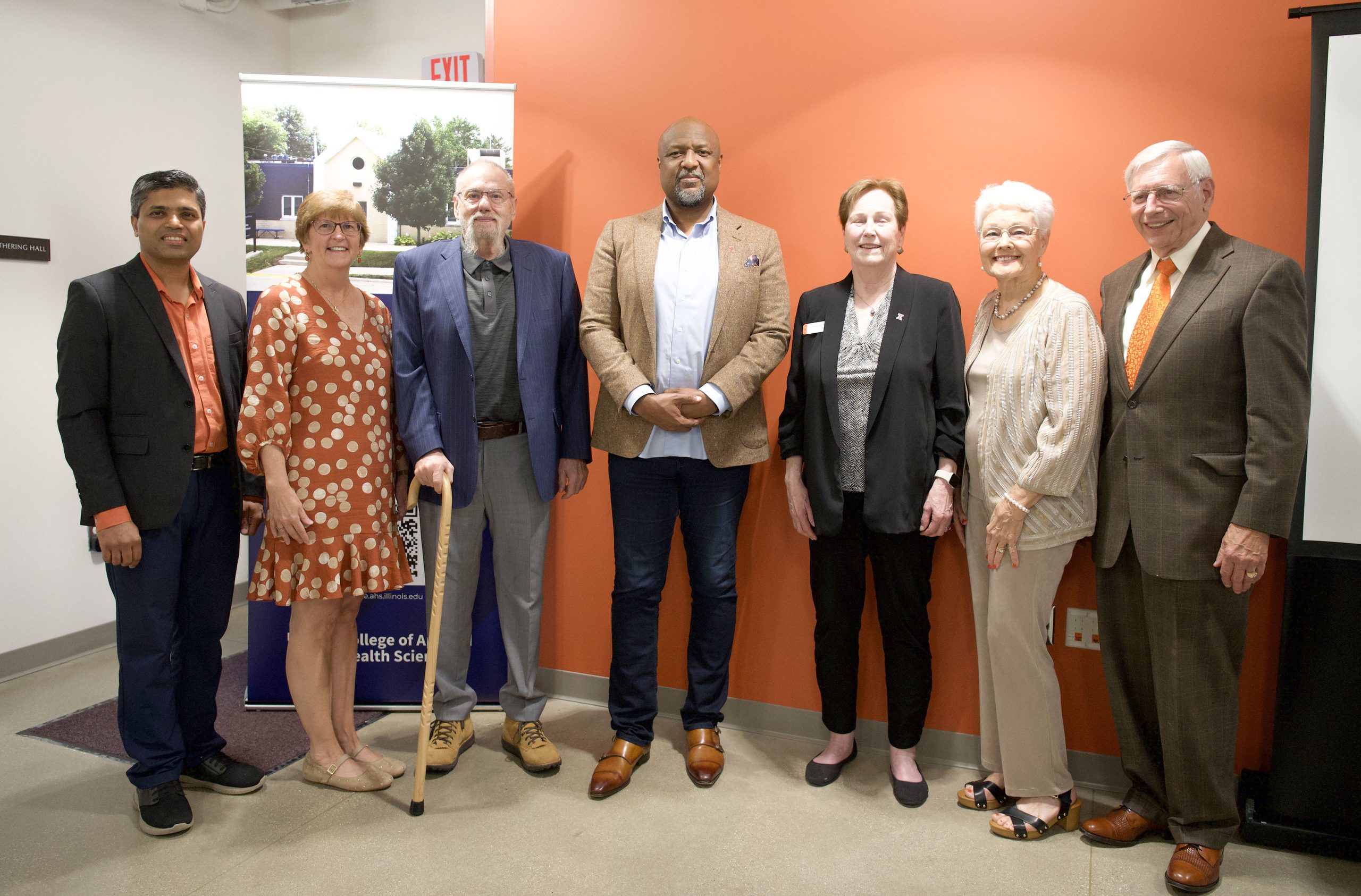
Jeff Woods’ retirement closes a chapter in the College of Applied Health Sciences 


Jeff Woods, center, got a rousing sendoff from faculty and staff at the AHS college meeting on May 7. (Photo by Ethan Simmons)

After a noteworthy tenure spanning more than three decades at the University of Illinois,  Jeffrey Woods, Ph.D., the associate dean for research in the College of Applied Health Sciences and a national leader in exercise physiology research, has announced his retirement, marking the end of an era for one of the campus’ most influential scholars in health and aging studies. 

Woods, whose work has reshaped scientific understanding of how physical activity benefits the immune system and human health, retires as one of the College of Applied Health Sciences’ most honored researchers and mentors. Named the inaugural Mottier Family Professor in Applied Health Sciences in 2019, Woods leaves a legacy of groundbreaking research and institutional leadership that has influenced both scholars and students alike.  

“When Jeff started his career at Illinois 32 years ago, life looked very different. His days began with an hour-long commute from Charleston, Illinois, to the University of Illinois. Even in tough winter conditions, he never complained; he simply did what needed to be done,” said Amy Woods, the James K. and Karen S. McKechnie Professor and associate dean for faculty affairs in AHS and Jeff’s wife. 

“All the while, his impact extended far beyond home. He traveled widely, shared his expertise with colleagues around the world and contributed to NIH grant reviews, helping to shape the future of research in his field. Now, he has a well-earned chance to slow down and enjoy life on his own terms. Jeff’s dedication and integrity have made a lasting difference, and this milestone is so richly deserved. We are so proud of him and so grateful for the life we’ve built together.” 

Woods earned his B.S. from the University of Massachusetts at Amherst, an M.S. from Springfield College and his Ph.D. in Exercise Science from the University of South Carolina. He joined the University of Illinois faculty in 1994, eventually holding appointments across multiple disciplinary programs, including the Departments of Health and Kinesiology, Nutritional Sciences and the Carle-Illinois College of Medicine.  

In his retirement announcement, Woods credited the undergrad and graduate students he worked with, as well as faculty and staff, whom he called the “unsung heroes” of the university.

“It has been a great career at a great university,” he wrote. “I look forward to observing your future success through the lens of my emeriti role.”

Throughout his career, Woods became internationally respected for his pioneering research into how regular exercise counteracts inflammation, bolsters vaccine responses in older adults and, perhaps most notably, alters the gut microbiome in ways that promote health independent of diet. His research findings have appeared in over 140 peer-reviewed publications and helped define new directions in the study of aging and preventative health.  

“Jeff has been a defining presence in the College of Applied Health Sciences—as a scientist, as a mentor and as a leader. His career represents the very best of our mission: rigorous research, collaborative innovation and an unwavering commitment to improving human health,” said Cheryl Hanley-Maxwell, dean of the College of Applied Health Sciences. “From the moment he arrived, he brought with him a spirit of curiosity and a deep belief in the transformative power of research.” 

In addition to his pioneering scientific contributions, Woods served in numerous leadership capacities on campus. He was associate dean for research in the College of Applied Health Sciences and director of the Center on Health, Aging and Disability, where he guided interdisciplinary collaborations and championed integrative research programs aimed at improving the quality of life for aging populations.  

Jeff has been a defining presence in the College of Applied Health Sciences—as a scientist, as a mentor and as a leader.

Cheryl Hanley-Maxwell

Dean, College of Applied Health Sciences

Colleagues and students will also remember him as a committed mentor. Over the years, Woods supervised more than 30 graduate students and served as a guiding force for early-career researchers, helping to cultivate a new generation of scholars in health sciences. His leadership extended beyond campus, with roles in national organizations and review panels that have shaped federal research agendas. 

“One thing I’ve always appreciated about Jeff is the space he gave his trainees to grow,” said Jacob Allen, an associate professor in Health and Kinesiology. “As his Ph.D. student, he trusted me early on to think independently, take risks and develop my own scientific voice—practicing over and over how to communicate science clearly. That’s what ultimately matters: making an impact with your science. Jeff always reiterated that. That kind of environment is not easy to create, and it made a lasting impact on how I approach mentorship and science today. Now Jeff gets to apply that same approach to his golf game—plenty of time, plenty of reps, … but now no deadlines! Though he may still need a little extra ‘scientific creativity’ when his ball ends up in the woods.” 

The Mottier Family Professorship, established through a generous estate gift honoring Charles and Audrey Phyllis Mottier, was awarded to Woods in recognition of his outstanding contributions to both science and education. At the investiture ceremony in 2019, Woods spoke warmly of the collaborative spirit of his colleagues and his gratitude for their daily challenges and inspirations.  

As he steps away from his official duties, Woods said he looks forward to continuing to engage in collaborative projects, writing and opportunities to speak on issues at the intersection of exercise, aging and public health. 

Editor’s note:

To reach Vince Lara-Cinisomo, email vinlara@illinois.edu.
 

Share on social

Related news

Raj partners with ClarkLindsey to test culturally diverse seasonings


ClarkLindsey’s executive chef, DeAngelo Newson, presents a special Hanukkah dinner for residents: beef brisket with latkes and sufganiyot. In 2025, ClarkLindsey food personnel will test out culturally diverse seasonings as part of a KCH research project.

For many older adults from diverse cultural backgrounds, reluctance to enroll in long-term care facilities may start in the cafeteria. 

Mina Raj, an assistant professor in the Department of Kinesiology and Community Health at the University of Illinois Urbana-Champaign, surveyed 140 Asian American family caregivers and found that one of the biggest obstacles for their relatives living in long-term care is the lack of culturally relevant food options. 

An upcoming research project from Raj and her team will put an international range of seasonings to the test at an eager local retirement community.  

Raj will organize a live culinary workshop at ClarkLindsey, a retirement community in Urbana. The workshop is aimed at educating ClarkLindsey’s food personnel how to incorporate culturally diverse seasonings (i.e., herbs or spices) into common dishes. Afterwards, personnel and residents will learn about the seasonings and taste the modified meals for themselves.  

“I realized I need one place that is willing to work with us,” Raj said. “If you can build evidence in one place and show something works, you can have that data to start convincing others a model like this could work.”  

The hope, Raj said, is the workshop will provide some proof of concept for other long-term care facilities that are trying to enroll a more diverse clientele, while potentially reducing food waste and promoting cultural inclusivity.  

The study is funded by a two-year grant from the McCormick Science Institute, which sponsors research on the health effects of culinary herbs and spices. The population at ClarkLindsey, with its longstanding research connections with the College of Applied Health Sciences and Illinois at large, is ready and willing to participate. 

“As people grow older, often the dining experience is the highlight of their day, having good food with good community and good conversation,” said Laura Edwards, vice president of strategy & innovation at the nonprofit retirement home. “I’m really excited to see where this goes.”

A logical connection 

When she began exploring the topic with registered dietitians and food service directors in long-term care facilities in a project funded by the Center on Health, Aging, and Disability, Raj met some resistance to the idea of incorporating a more diverse set of ingredients into LTC menus. 

Professionals she surveyed worried that lack of cultural knowledge among their food personnel and the cost of ingredients would pose significant barriers to a culinary revamp, especially if their resident populations were majority White and most familiar with American/Western cuisine. 

However, the consequences of excluding dietary desires of culturally diverse older adults could be wide ranging, Raj posits. Many populations of these cultures will need significant institutional care in the coming decades, and refusal to eat the food at long-term care facilities could lead to negative health outcomes, including frailty. This can often place substantial additional demands on their family members to prepare and deliver meals.

A leading candidate for collaboration emerged just across town. The College of AHS’ Wendy Bartlo, assistant director of strategic initiatives and research relations, serves on ClarkLindsey’s board. She connected Raj with Edwards, who organizes research opportunities at the nonprofit retirement home. 

Edwards, an AHS alumna who obtained her B.S. in Community Health in 2012, began working at ClarkLindsey as an intern just before graduating. She’s seen the frequent research collaborations with College of AHS and Illinois led by an astute, participatory resident population, and this project fit the bill perfectly. 

“Whenever we hear about interesting research that could benefit the lives of older adults, we are very interested to know more, because it’s our mission to ensure older adults can live their best lives,” Edwards said.  

According to recent data, most ClarkLindsey residents are connected to the university in some way. In 2018, 42 percent of them were Illinois alumni and 57 percent were current faculty or emeriti. More than a quarter of the near-300 residents had reportedly participated in Illinois research. 

“If there’s an opportunity to participate in research, our residents are very eager to get involved,” Edwards said. “Why these projects are so successful is these [professors] feel like they’re defending their dissertation again, because they’re getting questions right and left.”

ClarkLindsey’s executive chef, DeAngelo Newson, already experiments with cross-cultural dishes with his staff. Residents usually choose between a traditional “option A” for dinner or a more adventurous “option B”— recent examples include Indian cuisine, oxtail, and Hanukkah-themed latkes and sufganiyot. 

“I anticipate it being a popular and exciting experience for our residents and for our staff as well,” Edwards said. 

The plan

This year, Raj and her team, including her doctoral student Ammarah Mashhood and undergraduates Sabeen Sadruddin and Harshita Varanasi, will conduct another nationwide survey of dietitians and food service personnel working in long-term care to understand their awareness of culturally diverse seasonings and ability to prepare meals with those ingredients in mind. 

In 2025, planning for the workshop will commence. 

In the current agenda, ClarkLindsey food personnel will be treated to an educational session on the use and history of the seasonings on day one of the workshop delivered by chefs from the McCormick Science Institute. Then, they’ll witness two demonstrations from South Asian and Hispanic/Latin American dietitians on culturally tailored meals that are both diabetes-friendly and heart-healthy, followed by taste panels and acceptability surveys.

(Luis Gutierrez-Munoz, a nutritional sciences master’s student, will help develop these specialized recipes.) 

The meals will include common vegetables and culinary staples such as green beans, potatoes and rice, prepared and seasoned in different ways, Raj said. She’s particularly excited to see how personnel and residents respond to the educational part of the exercise, and whether their cultural awareness shifts after the workshop. 

“We want to emphasize the “why” in this workshop. Most trainings on diverse cultures focus on the “what,” but when it comes to food every culture has a rich history of culinary traditions and norms. Teaching about, and ultimately incorporating culturally diverse seasonings, could present a meaningful, and low-cost, approach to raising awareness among staff and sense of belonging for our diverse older adults,” Raj said.

Editor’s note:

To reach Mina Raj, email mraj@illinois.edu.
 

Related news

CHAD symposium returns with thanks for pilot grants


KCH Associate Professor Naiman Khan’s presentation was titled “Role of Omega-3 Lipid Metabolites in Obesity and Cognitive Function” (Photo by Lisa Bralts)

The first Center for Health, Aging, and Disability (CHAD) symposium since 2017 was a celebration of the research accomplished with the help of the Pilot Grant Program.

Three researchers from the College of Applied Health Sciences—Naiman Khan, an associate professor in Kinesiology and Community Health; Brian Monson, an assistant professor in Speech and Hearing Science, and Sharon Zou, an assistant professor in Recreation, Sport and Tourism, made a point of thanking CHAD’s grants for helping launch their studies.

Khan, whose presentation was titled “Role of Omega-3 Lipid Metabolites in Obesity and Cognitive Function,” said CHAD’s funding was vital to his work.

“CHAD was really helpful in us starting a new line of engagement of research,” he said. 

CHAD director Jeff Woods, AHS’ associate dean for research, said to date, 38 pilot grants have been awarded since CHAD was launched in 2010, with $860,000 awarded to AHS researchers for pilot research. Woods described CHAD’s role as “work at the bookends of medicine … with the goal of improving people’s lives.”

“CHAD pilot grants are really important for junior faculty,” Zou said.

And the payoff has been well worth it, Woods said, citing the return on investment as approximately $16 in external funding to $1 in CHAD funding. 

Zou’s presentation was titled “Exploring an Efficient and Equitable Entrance Fee for Public Lands: A Community-based investigation in the Indiana Dunes National Park.”

“I study how people have fun,” Zou said, explaining that it was vital for public parks and other tourism industries to build a sustainable revenue model and not to rely on decreasing funding from state and federal sources. 

The primary purpose of Zou’s study was to “understand visitors’ and surrounding community residents’ perceptions of Indiana Dunes National Park user fees to inform a fee structure that balances revenue generation and equitable access.”

During and after the COVID-19 pandemic, Zou said, “parks saw explosions of people visiting.” While that was great for parks in terms of revenue, it also led to increasing operation costs at a time when government funding for these sites is being reduced.

“The specific goal is to find out how visitors see the park fees, and are they fair?,” Zou said.

The RST researcher said her preliminary findings indicate there was no consensus from study participants on what “fair” means, and that tension between fairness principles partly explains the longstanding controversy and debate on public land user fees.

Khan’s presentation focused on how poor lifestyle choices can predict an early onset of dementia, noting that obesity worldwide has increased threefold since the 1980s. The KCH researcher said his research, in conjunction with Aditi Das of Georgia Tech, suggested that the a deficiencyin the hormone dehydroepiandrosterone (DHEA)—which has been reported to have beneficial effects on obesity, diabetes mellitus, and serum lipids in animals—was associated with individuals with a body-mass index (BMI) of 25 or higher, which is classified as obese.

“BMI is inversely connected to cognitive function,” Khan said. “Only in obese individuals do we see DHEA increase in circulation.” Khan said his preliminary results found:

  • Circulating Omega-3 metabolites were higher among persons with higher weight status and the levels were associated with degree of fat mass
  • Circulating metabolites inversely associated with cognitive function
  • Only observed among persons with overweight and obesity
  • Selectively associated with hippocampal function
  • Implications for memory function

Khan said his overarching goal was to “develop effective lifestyle approaches to improve cognitive function.”

SHS’ Monson discussed his study called “Capturing Prenatal Auditory Experience.”

“If there was a pregnant woman in this audience, that baby would be hearing my voice, and perhaps making judgments,” he said, drawing laughter from the gathering. “How do we know? Because full-term newborns come to the world with memories of what they’ve heard, including the mother’s voice.”

In utero, Monson explained, was a unique acoustic environment. When preterm infants are delivered, they are placed into incubators, which rapidly changed the sound profile, he said. The consequences of those changes include increased risk for sensorineural hearing loss, auditory neuropathy, language and speech developmental delays, auditory attention deficits and auditory processing disorder.

Monson’s study involved a group of pregnant women wearing a LENA listening device twice a week during the third trimester, while the device was placed into cribs of very preterm infants at Carle Foundation Hospital three times a week through their stay in a neonatal intensive care unit (NICU).

“Fetuses are getting 2.5 hours a day of speech exposure vs. 32 minutes a day for very preterm infants,” he said. “It’s an alarming difference to me.”
NICU infants may incur a deficit of about 150 hours of speech exposure over the course of the preterm period, he explained.

One of the possible mitigation strategies for very preterm infants could be to provide meaningful targets (about three hours a day of speech exposure) to optimize auditory exposures in NICU settings.

“The maternal heartbeat is never turned off in utero,” he said. “The maternal heartbeat is never turned on in NICU.”

Following the CHAD Pilot Grant success stories, Wendy Rogers, the Shahid and Ann Carlson Khan Professor of Applied Health Sciences, talked about the work of Collaborations in Health, Aging, Research, & Technology (CHART).

CHART’s mission is to enable successful aging through:

  • Fundamental research
  • Advanced technology development
  • Education of researchers, developers, healthcare professionals, older adults
  • Guidance for policy decision-making
  • Translation of these efforts to positively affect the lives of older adults

CHART was the first research theme of the College of Applied Health Sciences and boasts the development of the McKechnie Family LIFE Home, an interdisciplinary research facility and simulated home environment that helps promote community engagement, industry partnerships, healthcare collaborations and faculty innovation.

Also part of the symposium was the introduction of a new AHS research theme called CARD (Collaborations in the Advancement of Research on Disability), led by KCH Associate Professor Laura Rice and KCH Professor John Kosciulek. CARD is focused on enhancing the health and quality of life of people with disabilities—through research that addresses critical gaps in disability-related knowledge and outreach that engages individuals with disabilities. 

CARD’s short-term goals include:

  • Develop a collaborative working group
  • Develop communication strategies
  • Establish a steering committee of stakeholders
  • Develop and implement outreach and engagement events

Longer-term goals include:

  • Host a bi-annual research symposium
  • Develop a “toolkit” for UIUC faculty to support the performance of disability-related research in the Champaign-Urbana area
  • Respond to disability-related funding opportunities
  • Establish a competitive program to provide supplemental funding to support ongoing disability research among junior faculty
  • Host a seminar series with external experts
  • Establish a research training program for students registered with DRES interested in doing research
  • Support the development of new research registries and/or expansion of current registries

The first CARD meeting is set for March 22.

In kicking off the symposium, AHS Dean Cheryl Hanley-Maxwell said CHAD was “one of the biggest attractions” of her decision to come to Illinois and lead the college.

“When I thought about CHAD, I thought it’d be interesting to lead a college that has this kind of momentum to it, and I’ve been proven correct, year after year,” she said. “CHAD provides students with real-world engagement, and plays an absolutely critical role in their professional development.”

Woods agreed.

“We’re helping put the next generation of scientists into the field.”

Editor’s note:

To reach Vince Lara-Cinisomo, email vinlara@illinois.edu.
 

Related news

Allen gets grant to study additive effects of fiber and exercise


Can controlled increases in fiber intake and physical activity show additive effects?

KCH Assistant Professor Jacob Allen received a grant from the Center on Health, Aging & Disability for his project, “Gastrointestinal And Metabolic Effects from a Prebiotic, Lifting, and Aerobic iNtervention (GAMEPLAN).” Allen received $30,000 from CHAD for the 18-month project, which begins July 1.

Hannah Holscher, an associate professor of Nutrition in the College of Agricultural, Consumer & Environmental Sciences, and Riley Hughes, a postdoctoral fellow in Dr. Holscher’s lab, are collaborators on the project.

The project is focused on the independent and combined effects of prebiotic fiber consumption and exercise on the gut microbiome and human health. Allen said he and his collaborators are pursuing these studies because “Benefits of exercise and high fiber diets have been described in isolation. However, no controlled studies have looked at the potential additive effects of fiber and exercise.”

The combination of exercise and fiber could be beneficial for the majority of Americans who don’t get the recommended dietary fiber (more than 90 percent), or adequate exercise (more than 60 percent), Allen said.

Prebiotic fibers are substrate that are selectively utilized by host microorganisms conferring a health benefit, he said. Holscher added that prebiotics can be found naturally within foods like whole grains, onions, garlic, articokes, and bananas.

“For this study, we are using a prebiotic called short chain-fructooligosaccharides (aka. sc-FOS). We chose it for many reasons. One of the main reasons is because it is known to result in the production of beneficial metabolites produced by microbes that may synergize with exercise to promote metabolic adaptations.”

Another aim of the study is to improve body composition, but Allen stressed that does not necessarily mean weight loss.

“In fact, exercise interventions are often not accompanied by significant weight loss especially early on in the intervention, or fewer than six weeks”, he said.

“However, this does not mean that the exercise is not effective in improving health. For instance, body composition changes still occur with exercise despite no weight loss. Exercise training can lead to increased muscle mass and bone mass concurrent to reductions in fat. If you are only looking at a scale, these changes tend to negate each other. However adding muscle and losing fat is still very beneficial for metabolic health. Short end of it, exercise can still be beneficial without weight loss!”

Editor’s note:

To reach Jacob Allen, email jmallen5@illinois.edu.
 

Share on social

Related news

Raj gets CHAD grant to examine inclusive diets in long-term care


KCH Assistant Professor Mina Raj received a grant from the Center on Health, Aging, and Disability for her project entitled, ““Towards the development of guidelines for inclusive foods in long-term care.”

The CHAD Pilot Grant, which is valued at for $29,646 for 18 months starting July 1, aims to find out more about resident preferences for inclusive diets from the perspectives of long-term care (LTC) personnel, and understand the practice and regulatory barriers and facilitators to promoting inclusive diets in long-term care facilities in order to ultimately develop guidelines for implementing inclusive diets in long-term care facilities.

An inclusive diet, as defined in this study, is one that considers dietary preferences that may be informed by cultural norms or traditions.

The study is important, Raj said, because, “Food is a fundamental aspect of community and is also tied to mental and physical health outcomes. For instance, eating traditional foods has been linked with promoting joy and delight among patients with dementia.”

“We have an increasingly diverse aging population, and as our health system pursues health equity and addressing health disparities, it is critical to understand how to ensure that long-term facilities promote inclusiveness and belonging,” she said. “Even though the number of racial and ethnic minority older adults living in long-term care facilities in the U.S. has increased substantially in the last few decades, these older adults are still very reluctant to reside in long-term care facilities and a primary concern is the alignment of dietary preferences and options offered in facilities. Availability of preferred foods that align with cultural norms and traditions could promote food consumption thereby reducing the risk of frailty and associated health conditions among older adults.”

Another of the study’s goals is to identify regulatory barriers to inclusive diets in LTC facilities. For example, one regulatory barrier is the vendors or grocery stores from which LTC facilities are allowed to purchase prepared meals or ingredients for cooking in the facility. The vendors may not offer inclusive diets or grocery stores may not sell produce needed to prepare meals that are traditional to certain communities, Raj said. Raj said she hopes this study can inform modification of these types of regulations and contribute to inclusion and health equity in LTC facilities..

Raj said the study will focus on long-term care facilities across Illinois, Michigan and Indiana.

Share on social

Related news

College of Applied Health Sciences
110 Huff Hall
1206 South 4th Street
Champaign, IL 61820
(217) 333-2131