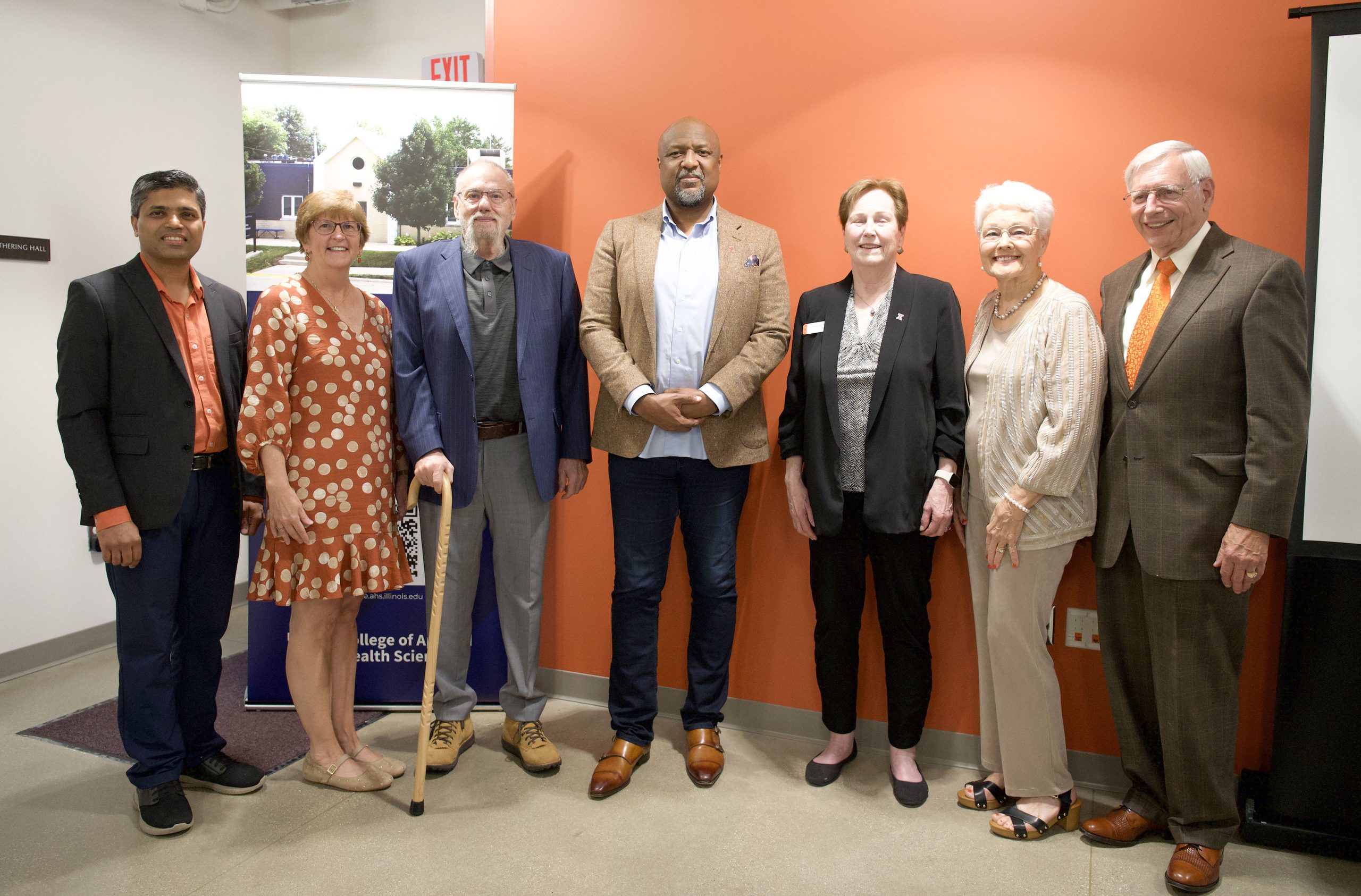
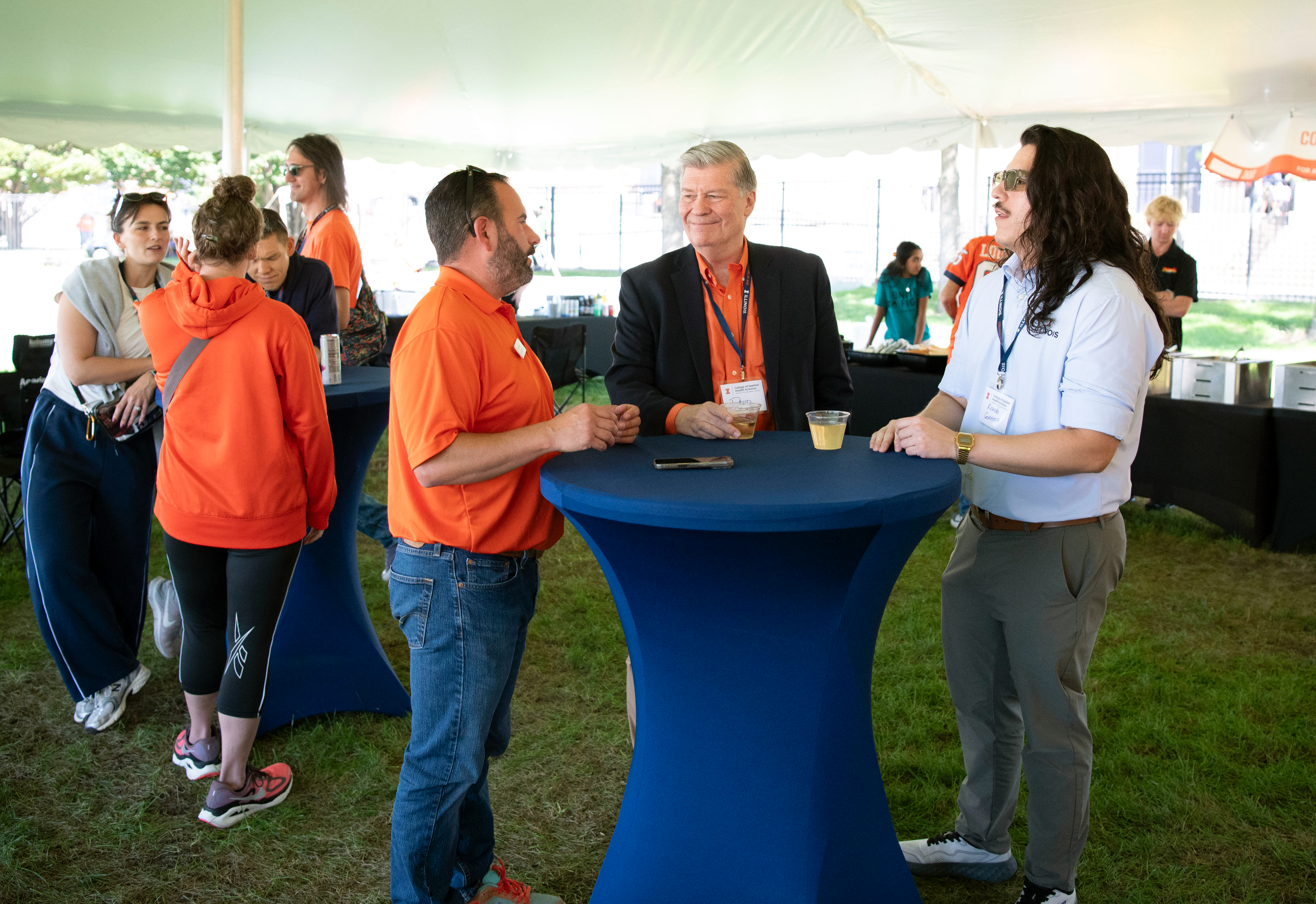
The theme of the 2026 Sapora Symposium was ‘the power of community.’ (Photo by Ethan Simmons)
The 2026 Sapora Symposium once again brought the RST community together in a powerful way—connecting students, alumni and industry leaders through meaningful engagement and shared learning.
Centered on this year’s theme, the power of community, the Symposium explored how civic engagement, marketing, and social and digital innovation shape professional pathways across recreation, sport, and tourism.
The series kicked off on January 29 in Chicago with keynote remarks by Michael Strautmanis of the Barack Obama Presidential Center, whose insights on leadership and community development set the tone for the weeks ahead.
The main event, held March 6 at the Illini Union, welcomed more than 130 undergraduate and graduate students and over 35 speakers and table hosts—most of them RST alumni. Throughout the day, students engaged directly with professionals, turning conversations into mentorship and networking into lasting connections.
We are deeply grateful to TSMGI for their continued partnership and to the outstanding group of speakers and guests who generously shared their time and expertise:
2026 Participating Speakers & Guests
Jordan Bressler – TSMGI
Reese Bressler – TSMGI
Jamie Bronska – Chicago White Sox
Glenn Eden – Chicago Civic Leader / Choose Chicago
Carly Eilian – TSMGI
Christian Evans – Indianapolis Pacers
Brian Floriani – Bernie’s Book Bank
Abri Forrest – TSMGI
Melissa Garritano – Special Olympics Illinois
Megan Gaseor – Chicago Cubs
Parker Gray – DIA Marketing Street Team
Joe Kennedy – Obama Presidential Center
Chris Marciani – TMRW Sports
Andrew McCarthy – TSMGI
Alexis McCay – KemperSports
Nick McDuffee – Village of Savoy Parks and Recreation
Brendon McGuire – DIA Football Video
Lauren Mroz – National Basketball Association
Alex Munoz – NASCAR
Tristan Nelson – Oklahoma City Thunder
Joe Ronovsky – Village of Bedford Park / Wintrust Sports Complex
Carmen Rossi – 8 Hospitality
Alex Roux – Big Ten Network
Rebecca Seldin – TSMGI
Liam Sise – La Grange Park District
Joey Spathis – TSMGI
Mark Steinberg – Excel Sports Management
Christine Stromberg – United States Tennis Association
Angela Tzortis – Chicago Cubs
Rachel Wright – TSMGI
Your collective engagement—spanning sport organizations, tourism and destination marketing, recreation and park systems, community development, nonprofit leadership, and agency work—created an exceptional experience for our students and reflected the full breadth of the RST field.
Administrative aide quietly sustained departmental success through dedication
‘I love my job. I love my faculty,’ Stefanie Cole said. (Photo by Ethan Simmons)
At the University of Illinois Urbana-Champaign, where academic reputations are built on research breakthroughs and classroom innovation, much of the daily work that keeps departments moving forward happens quietly. In the Department of Speech and Hearing Science, that steady presence for more than a decade has been Stefanie Cole.
Cole did not set out to build a long career in higher education administration. Having just completed her service in the U.S. Air Force, she was working as a medical office assistant at the Carle Cancer Center. She was a new wife, a new mother and new to the Champaign-Urbana area. Raised in a university town, she understood the rhythm of campus life and was looking for broader options with greater flexibility and room to grow professionally.
“The University of Illinois seemed like a great fit,” she said, adding that it offered stability, opportunities to advance and a chance to build on the skills she had developed in the military and in healthcare settings.
Thirteen years into her campus career, the opportunity to join Speech and Hearing Science found her. “It was the perfect time to explore some new challenges,” she said.
At the outset, Cole imagined she might stay in the role for five years, long enough to see her son through high school. Instead, she found a professional home. “I love my job. I love my faculty,” she said. When health issues arose within her family, the predictability and support of her department made staying an easy decision.
During her tenure, SHS has seen significant change. This semester marks the arrival of the department’s fourth head since she joined. The unit has undergone an extensive building remodel, and its audiology clinic operations were relocated and combined with speech-language pathology into a shared facility at Research Park. Faculty members have come and gone, reflecting national searches and shifting research priorities.
Yet some things, she says, have remained constant.
“Although some faculty have left and new faculty have arrived, the collegiality and cohesiveness has always remained outstanding,” Cole said.
As administrative aide, she occupies a role that is at once central and largely invisible. She describes her job as ensuring that the department’s work runs as smoothly as possible. Budgets, faculty searches, promotion and tenure dossiers, award programs and the daily churn of academic paperwork all pass through her office.
Georgia Malandraki, who replaced Pamela Hadley as department head of SHS in January 2026, said Cole’s steadiness has been immeasurable in her transition.
“In just a short time, Stefanie has become one of the people I rely on most. Stepping into a new leadership role is never easy, but she welcomed me with warmth and immediately made me feel supported. Her calm presence, deep knowledge of the department and genuine care for the people here have been invaluable. I already can’t imagine navigating this transition without her. She is the quiet strength behind so much of what we do, and I feel incredibly lucky to work with her.”
There is no typical day, Cole said. The academic calendar dictates a certain ebb and flow—admissions cycles, graduation, the annual student awards program each spring—but any carefully constructed to-do list can be upended by last-minute requests or unexpected crises.
“I come in the morning with the best laid plans of a set agenda of tasks for my day,” she said. “But I usually leave having accomplished many different tasks than I had originally planned.”
I enjoy having a front-row seat to the growth within the department.”
Stefanie Cole
SHS administrative aide
When deadlines tighten or complications arise, Cole holds herself to high standards. “I expect more from myself than anyone else specifically expects,” she said. “When things don’t go as planned, I want the best for the department and I am willing to step in to fill whatever hole that I can, however I can.”
Though her primary interactions are with faculty, students remain a meaningful part of her work. Planning the department’s annual student awards program is, she said, “such a treat.” The ceremony offers a rare pause in the academic year and a chance to meet families and celebrate achievements that represent years of clinical training and research.
The department’s clinical graduate programs are complex and often stressful. Cole believes students know they can walk into the administrative office with questions and feel comfortable doing so. “If we don’t have the answer, we work hard to point them in the right direction,” she said.
One of the most consequential aspects of her role involves shepherding faculty through promotion and tenure. The process is detailed, exacting and often years in the making. Watching those efforts culminate in successful promotion milestones, she said, reaffirms the importance of her work.
“I enjoy having a front-row seat to the growth within the department,” Cole said.
Her years across multiple campus roles have also given her insight into how a large public university functions. Policies, approvals and budget decisions move more slowly than they might in private industry, she said, not because of inefficiency but because of the many moving parts involved.
“The wheels of the university turn slower than other places,” she said. “There are a lot of moving parts and pieces that make up the ‘how’ and the ‘why’ we do what we do. Please be patient.”
Institutional memory is another quiet responsibility she carries. When she first arrived at SHS, much of the department’s history and procedural knowledge was undocumented, passed along informally from one person to the next. Today, only a handful of faculty members remain from those early years.
“It was ‘learn as we go,’” she said. Over the next few years, she hopes to document as much departmental history and practice as possible, preserving traditions and unwritten rules for the next generation of staff and faculty.
Of all her accomplishments, Cole said she is most proud of the support she provides to her department head and faculty and of the streamlined processes that have taken shape during her tenure. With a new department head now at the helm, she looks forward to the department’s next chapter.
Through stressful or thankless stretches, she credits the people around her for keeping her motivated. “Our faculty, staff and students are always gracious and appreciative of the work that we do,” she said.
In a university environment where recognition often centers on those at the lectern or in the lab, Cole’s work underscores another truth: institutions run on dedication as much as distinction. For more than a decade at Illinois, she has made sure that when others succeed, the path behind them is clear.
Editor’s note:
To reach Vince Lara-Cinisomo, email vinlara@illinois.edu
Donor-funded telehealth initiative aims to expand rural health care access
SHS will establish a rural telehealth site in Stephenson County to offer state-of-the-art remote clinical services that residents can easily access (Photo provided)
With a boost from donors, researchers and clinical faculty in the Department of Speech and Hearing Science are collaborating to introduce a new speech and hearing healthcare option for residents in rural areas of northern Illinois.
Partnering with the Illinois Extension, the department will establish a rural telehealth site in Stephenson County to offer state-of-the-art remote clinical services that residents can easily access. Upon successful testing and initiation, the department will be ready to expand these services to other counties.
The Speech and Hearing Science Rural Health and Telehealth Initiative was developed on a charge from new department head, Professor Georgia Malandraki, after a generous donation for the cause from David Shockey, attorney and two-time University of Illinois graduate from Freeport, Illinois.
“Our department has a strong history of leading telehealth research and advancing evidence-based practice in our field. I am deeply grateful for the support that made this initiative possible, allowing us to extend our impact and deliver high-quality speech, language, cognitive and hearing care to those who need it most,” Malandraki said.
“By building on our faculty’s expertise, we are also strengthening student training and preparing future clinicians and scientists to serve rural communities.”
Of 102 counties in Illinois, 82 are classified as rural by the state’s Department of Public Health. About 15 percent of Illinois residents reside in rural areas of the state, which are more likely to face healthcare staff shortages and limited access to specialty services.
“Part of what we’re trying to investigate right now is just what are the needs of the community, and how does that fold in with the opportunities and what we’re already offering,” said SHS Associate Professor Dan Fogerty, who researches speech perception and hearing loss. “With telehealth and remote services, you need to have the platform and infrastructure in order to provide those.”
For faculty at the Department of Speech and Hearing Science, these telehealth sites will be a chance to implement their ongoing research, outreach and clinical practices around telehealth in a new region.
The rural health initiative is steered by a task force of research and clinical faculty at Speech and Hearing Science, including Fogerty; Professor Raksha Mudar; Clinical Associate Professor Clarion Mendes, a speech-language pathologist; and Clinical Assistant Professor Sadie Braun, an audiologist.
“We have a flagship campus with a commitment to our communities. This is a way we can demonstrate that our services extend beyond our campus alone,” said Mudar, who directs the Aging and Neurocognition Lab. “We have built the evidence base—we have the expertise, so now it’s just bringing it all together to offer a more cohesive way to extend that to the community.”
For SHS students, the telehealth sites will provide opportunities to serve individuals in under-resourced areas using the latest remote care technology, broadening their hands-on experience before they become full-time clinicians.
The project is still early in development, but a crowd-funded campaign helped raise another $2,000 to support the establishment of both telehealth sites. The initiative will build on the teamwork from previous collaborations across the department, including a grant-funded project to create more accurate hearing tests.
“The nice thing about Speech and Hearing Science at Illinois is that the education, the research and the clinical practice are all integrated,” Fogerty said. “This is an excellent project to demonstrate that.”
Speech and Hearing Science Assistant professor Mariana Bahia, left, Department Head Georgia Malandraki and Clinical Associate Professor Clarion Mendes pose with the World Voice Day proclamations from Urbana and Champaign on April 16, 2026. (Photo by Ethan Simmons)
Dear colleagues, alumni, students and friends,
It has been a meaningful and energizing start to my return to campus, and I’m grateful for the warm welcome I’ve received from this community. In my first 100 days, I’ve had the opportunity to reconnect with many of you, listen carefully to your perspectives and begin advancing several initiatives that reflect both our department’s strengths and our ambitions for the future. In this issue, you’ll find a more in-depth look at that journey—what we’ve set in motion so far, and where we’re headed next.
One initiative that captures the spirit of our mission is the Rural Health and Telehealth Initiative. In collaboration with Illinois Extension partners and generous donor support, our department is working to establish rural telehealth sites in Illinois, expanding access to speech, language and hearing services for underserved communities. This effort is being led by colleagues in Speech and Hearing Science, alongside Extension, including Dan Fogerty, Raksha Mudar, Clarion Mendes, Sadie Braun and Margaret Larson, the county director for the first site. This initiative reflects the kind of interdisciplinary, community-engaged work that defines who we are.
Our faculty continue to lead in research and innovation. Brian Monson and Rohit Ananthanarayana have developed and patented a promising new algorithm designed to extract speech from noise using high-frequency signals—an advancement with significant implications for communication technologies and clinical applications. I’m also proud to share that Brian Monson has been elected as a fellow of the Acoustical Society of America, a well-deserved recognition of his contributions to the field.
We are also delighted to highlight the people who make our department thrive. This issue features a faculty spotlight on Jaime Bauer Malandraki, offering a closer look at her work and perspectives through a Q&A. You’ll also meet Stefanie Cole in our staff spotlight, recognizing her important contributions and dedication.
While it is impossible to capture all the extraordinary moments of the past 100 days in a single newsletter, a few truly stand out: celebrating our remarkable students with 33 awards alongside their families and friends; hosting a vibrant two-day SHS alumni and friends open house event where we shared our work, reconnected and envisioned the future together; and in early April, seeing our graduate programs rise to No. 11 (tied) in Speech-Language Pathology and No. 18 (tied) in Audiology in the U.S. News & World Report. These milestones speak to the momentum, excellence and spirit of our SHS community—something I am proud and inspired to witness every day.
Looking ahead, we are exploring exciting possibilities in emerging areas such as virtual reality applications for voice therapy, including ongoing efforts led by Pasquale Bottalico to secure funding and move this work forward.
Thank you for your continued engagement and support. Together, we are building on a strong foundation while embracing new opportunities to expand our impact in Illinois and beyond.
Shared values inspire innovative speech-hearing education and research
Jaime Bauer Malandraki, left, with Dean Cheryl Hanley-Maxwell, said she chose Illinois because of its culture that prioritizes inclusivity (Photo by Ethan Simmons)
When Jaime Bauer Malandraki began considering the next chapter of her career, she wasn’t simply looking for a new job. She was searching for an academic home, an institution whose values aligned with her own and where she could build innovative clinical and research programs for years to come. She found that match at the University of Illinois Urbana-Champaign, within the Department of Speech and Hearing Science.
“As we researched Illinois, I felt strongly that the values throughout the university, college and department closely align with my own,” said Bauer Malandraki, a clinical professor in SHS. “These include a strong commitment to student success, accessibility and the importance of diverse representation at all levels.”
For Bauer Malandraki, shared values are not a talking point—they are foundational to her work as a clinical educator and researcher. She believes that being part of an institution she can take pride in is essential to fostering a healthy, productive environment. At Illinois, she saw a campuswide culture that prioritizes inclusion, transparency and growth.
That alignment was especially important as she thought about the work she wants to be doing over the next five to 10 years. A specialist in swallowing disorders and aerodigestive sciences, Bauer Malandraki envisions expanding both educational and clinical opportunities for students while deepening community engagement and research in her field.
“I believe Illinois and the Department of Speech and Hearing Science offer an ideal setting for exploring innovative ways to engage students and the community,” she said.
Clinically, she sees room to grow programming around swallowing disorders, an area of speech-language pathology that intersects with complex medical care. That growth, she says, can happen in multiple directions: expanding hands-on training, strengthening research initiatives and building broader partnerships that increase the department’s medical footprint.
She is particularly eager to collaborate with colleagues in her home department to enhance clinical training in aerodigestive sciences. But her ambitions stretch beyond departmental lines. Illinois’ breadth as a major research university creates opportunities to work across disciplines, collaborations she hopes will broaden the medical scope of speech-language pathology training on campus.
The department’s culture has reinforced her confidence that Illinois was the right choice. Bauer Malandraki describes it as collegial and supportive, with a shared focus on sustainable growth and meaningful impact.
“There is an atmosphere of positivity and potential,” she said. “It makes it exciting to be part of.”
She also points to leadership style as a distinguishing feature. Compared with previous institutions—Bauer Malandraki most recently taught at Purdue University—she finds Illinois’ leadership approachable and engaged with an emphasis on transparent communication.
“Culturally, this helps foster a sense that we’re all in this together,” she said. That sense of shared purpose resonates deeply with her, particularly during what she describes as a time of transition and reimagining in higher education.
Innovation in teaching is another draw. Bauer Malandraki is eager to experiment with new ways of preparing graduate students for careers in medical speech-language pathology. While traditional hands-on clinical experiences in swallowing disorders remain central, she is interested in incorporating telehealth applications and simulated or virtual reality clinical experiences to expand access and deepen training.
“It’s important that we train excellent clinicians but it’s equally important that we equip them with the tools to sustain themselves in demanding professions.”
Jaime Bauer Malandraki
Clinical Professor, SHS
She also brings a strong commitment to the mental health and well-being of helping professionals. In addition to her clinical specialty, she hopes to develop an undergraduate course focused on preparing students from multiple disciplines to maintain personal and professional well-being while working in patient-facing roles.
“It’s important that we train excellent clinicians,” she said, “but it’s equally important that we equip them with the tools to sustain themselves in demanding professions.”
Her transition to campus has been marked by a warm welcome. Faculty and staff in the department, along with college leadership, made her feel valued from the interview process onward. Graduate students have also played a significant role.
“They are passionate about their academic studies and clinical training,” she said. “They’re eager to see the department grow further in the medical space, which has been wonderful to observe.”
Outside the classroom and clinic, Bauer Malandraki has embraced her new home in Champaign-Urbana. She and her family found what she describes as a great house in a welcoming neighborhood, and she appreciates the community’s inclusive culture.
A self-described “bookstore nerd,” she quickly discovered The Literary in downtown Champaign, praising its curated collection and inviting vibe. She also loves being in nature and has found solace in walks at Lake of the Woods Forest Preserve in Mahomet.
Like any major move, the transition came with challenges. The hardest part, she said, was the physical relocation and the process of establishing new routines. She relies heavily on daily structure for focus and productivity. Yet she also thrives on change.
“Overall, the adjustment has been a good challenge,” she said.
As she looks ahead to her first full year, Bauer Malandraki is eager to immerse herself in the daily life of the department and college, exploring ways she can contribute beyond her immediate responsibilities. As a specialized faculty member and the proud daughter of a Teamster, she is also interested in becoming involved with the Non-Tenure Faculty Coalition, underscoring her longstanding commitment to advocacy and professional equity.
Ultimately, Bauer Malandraki’s decision to join Illinois reflects more than a professional calculation. It represents a convergence of values, opportunity and vision. In the Department of Speech and Hearing Science, she sees a place where innovative clinical education, interdisciplinary research and a culture of shared purpose can come together—advancing not only her own career, but the future of the field she is passionate about.
Norrito is preparing students to see sport not just as an industry, but as a powerful force for social good.
RST postdoc Alessio Norrito will primarily work with Professor Yuhei Inoue, while collaborating across the department.
The Department of Recreation, Sport and Tourism at the University of Illinois Urbana-Champaign is pleased to welcome Alessio Norrito as a postdoctoral research associate. Norrito brings with him an international perspective, interdisciplinary expertise and a deep belief in the power of sport to improve lives and communities. He will primarily work with RST Professor Yuhei Inoue, while developing collaborations with other RST faculty members.
“Alessio is an excellent addition to the department, as his research can effectively bridge sport management, recreation and tourism, advancing our understanding of how these interrelated fields can work together to address some of the grand challenges facing today’s society,” Inoue said. “In addition, given his international background and experience, Alessio can share valuable global perspectives with RST faculty and students, strengthening an important dimension of our department.”
Norrito earned his Ph.D. in sport sociology and management from Loughborough University, one of the world’s leading institutions for sport research. Before joining Illinois, he served as a senior lecturer at Manchester Metropolitan University. His academic path, however, is rooted in a broader professional journey that spans continents and industries. Prior to entering higher ed, Norrito worked in marketing and e-commerce within the food and beverage sector, with professional experiences in Shanghai, China and Turin, Italy. Those early roles, he notes, shaped his understanding of organizations, markets and people—insights that continue to inform his research and teaching today.
Norrito has contributed to international research projects supported by organizations such as the International Olympic Committee, UNESCO and UEFA. His work has been recognized by the European Association for the Sociology of Sport, which awarded him the Young Researcher Award for his contributions to the field. Across these projects, his research consistently examines how sport and leisure can enhance well-being and strengthen communities, with particular attention to how organizations pursue social purpose at the intersection of global contexts and local realities.
That interdisciplinary focus made the U. of I. a natural next step.
“I think the University of Illinois has a unique take on the way that sport management should be, which strongly aligns with my ideas,” Norrito said. “I position my work in between sociology and management, firmly believing that the two disciplines should be in constant dialogue for solving pressing global issues, creatively and innovatively finding alternatives that benefit people globally.” He added that he found “matching values in the RST department,” allowing him to contribute meaningfully through sport management while being “strongly supported in the development and realization of this work.”
At the heart of Norrito’s research is a simple idea: sport helps people connect. “At its simplest, sport helps us talk to each other and know each other better,” he said. “These interactions make us feel emotions that either unite or divide us.” His work emphasizes that when organizations learn to harness the positive side of sport, it can generate feelings of being “loved, hopeful and ambitious.” What is often overlooked, he notes, is how everyday experiences—like playing or watching sports—can help individuals and communities imagine a shared future. “Sometimes the simple pleasures of life, like sport, can give us a direction of where we want to go in the future, either [individually] or collectively,” he said. “According to my research, this pursuit can generate diverse forms of happiness.”
Norrito’s international research collaborations have also reshaped his understanding of how global sport organizations operate. “I was surprised the most [by] just how valuable research is for global sport organizations,” he said. “My belief prior to these experiences was that research was something ‘for academics.’”
For students interested in working in sport at a global level, Norrito’s advice is clear: engage deeply with organizations’ strategic plans and think proactively about how to fit within them. “Your time in [U. of I.] is key to developing your future self, and taking the right courses can be key to becoming the person that you need to be to land that dream job,” he said.
This semester, Norrito is teaching RST 210: Management in RST, where he introduces students to management and leadership across recreation, sport and tourism contexts. His approach to leadership resists simple formulas.
“I strongly do not believe in a one-size-fits-all approach,” he said. “Instead I encourage RST students to engage in reflexivity. Reflecting on yourself is a key practice to understand what skills you need to develop to be the leader you want to be in the future.”
That philosophy is closely tied to how he brings his research into the classroom.
“My research leads me to believe that behind every social problem there is always an opportunity to solve it,” Norrito said. “And when this social problem is solved, it benefits those who have solved it, those who were affected by it and society as a whole.” He regularly draws on examples from his own work to show students how social impact, business and management are deeply connected—and how future professionals can align purpose with practice.
Norrito’s passion for sport as a subject of serious academic inquiry has personal roots. He recalled a formative moment from his high school years in Palermo, Italy.
“When I was in high school, in my hometown of Palermo, the science surrounding sport was not very popular,” he said. After submitting an assignment about soccer, he was told by a teacher that sport did not belong in the classroom—and he failed the assignment.
“The fact that my job now involves talking about sport inside a classroom is quite ironic,” he said, “but also tells the lesson that we should protect our beliefs and challenge assumptions that seem wrong to us.”
Now at Illinois, Norrito is doing exactly that—challenging assumptions, connecting disciplines and preparing the next generation of RST leaders to see sport not just as an industry, but as a powerful force for social good.
These Recreation, Sport and Tourism undergraduates landed summer internships abroad. Here’s what they learned
Every year, students studying Recreation, Sport and Tourism at the University of Illinois Urbana-Champaign venture across the United States for professional internships. Some even find work outside of the country.
The College of Applied Health Sciences spoke with two RST students set to graduate this May, David Shan and Juan Manrique, who spent last summer working abroad in China and Guatemala, respectively.
Their interviews have been lightly edited for length and clarity.
***
David Shan
RST student David Shan spent his early life in Californiabut went to middle and high school in Beijing, China. He was always into sports, participating in volleyball and badminton. He even founded a huge badminton tournament at his high school. Shan followed his passion to RST at Illinois, where he’s set to graduate early—and he’s already interned for some of the biggest gaming companies in the world.
What company did you intern for last summer?
I interned for Electronic Soul, a game studio and public-traded company in Hangzhou, China.
How did you get the job?
There are apps like LinkedIn and Handshake in Chinese markets for job applications. I scrolled through offers and applied for this role.
They asked, “How can you link your experience to the gaming industry?” I explained that games are part of sports, and that a lot of the classes I was taking at RST could prepare me for the job. Marketing, finance, event planning. I also talked about the badminton tournament I had been running. Those things all helped me get the job.
What was your day-to-day like?
At Electronic Soul, we’d have shows for some of the icons inside the games. We ran tournaments for the game they designed and helped prepare all the promotional materials. I was in the office for five days a week, from 9 a.m. to 6 p.m.
We had a big comic show for characters in the games. It was held in place for a week; we spent a bunch of time preparing for it. We set up the stage for the actors dressed as the characters.
I was also involved in the designing stage of one of the games they were launching, while they were still designing the characters. So I helped do some background research on how the characters could act in the game and what would make them appealing.
Any special takeaways?
Before I went to this company, I didn’t play games that often. The whole process of game design and launch, it was a whole new thing for me.
There are a bunch of different fields in RST, but any industry that’s more popular, I felt like I could grow a lot and it may be easier to get in.
Any advice for students searching for internships abroad?
One is, be more open. There are a lot of industries that we could go to, even though it’s not linked with our own major. People might think, how are games related to your major?
There are a lot of opportunities outside of the [U.S.]. Other countries are still developing, they have huge market opportunities for games and other industries as well. Don’t be shy or afraid.
I got another internship at Tencent, the biggest gaming company in the world, because they had a career fair. I flew there over the weekend and talked to the staff and got the job. Just be more active and try out everything.
What’s your experience been like here at RST?
The RST internship coordinator Hayley Hardin and advisor Jason Schroeder, they all taught us how to reach out to people, how to email and be active. Giving everything a shot. That mindset helped me prepare for my career and get job opportunities.
I’m passionate about entrepreneurship; that’s my long term goal. But in the short-term, I may go to other gaming companies. I’m interning at Tencent right now. After I graduate, I may use that experience to apply for a full-time role.
There are a lot of opportunities outside of the [U.S.]. Other countries are still developing, they have huge market opportunities (…) Don’t be shy or afraid.
David Shan
RST undergraduate
Juan Manrique at the Xelajú MC soccer field.
Juan Manrique, a senior in RST, got his Associate Degree in Computer Science from Harold Washington College in his home city of Chicago. A lifelong sports enthusiast and soccer player, he decided to come to Illinois for its sport management program.
At first, Manrique wanted to find a D1 soccer program to play for. But in his first summer internship outside of the states, he helped the program run behind the scenes.
What company did you intern for last summer?
The professional soccer club Xelajú MC in Quetzaltenango, Guatemala. They won the league championship back in 2012, when I was 10 years old. It was crazy seeing that on TV.
How did you get the job?
It’s a funny story, my grandfather was actually the president of Xelajú MC back in 1999–2000. But I didn’t use him as a resource at all. Instead, I sent the current president of the club a friend request on Facebook.
I basically told him, “I want to shadow you and help wherever I can.” I mentioned my granddad, and that both my dad and mom are from Guatemala. He accepted my friend request, and he had won the election to continue for a second term. At that club, it works like our presidential election, where they get elected to serve on new terms.
What was your day-to-day like?
When I arrived it was the offseason for the men’s team. The women’s team made the finals but unfortunately lost. I spent a lot of time learning different systems in the institution.
I was moving around the office and helping with whatever I could. I worked with the marketing and communications group, the media group of the team, even helped the utility group as well, making sure the players had their boots and their jerseys. It was pretty cool. That’s what made it interesting, was that every day was different.
Any special takeaways?
It’s a different culture, and a different way things are managed. Any resource we have here in the United States, it’s accessible. You have to work with limited resources, we didn’t have the best equipment, but we had to work with what we had.
The professor told me I was probably the first intern in the history of University of Illinois to do their summer internship in Guatemala. I told that to the soccer club over there; they had never had an intern in their existence. It was pretty cool.
Manrique sits at the club’s media table. He was told he’s “probably” the first student from the University of Illinois to land a summer internship in Guatemala.
Any advice for students searching for internships abroad?
It’s a great opportunity for people that want to take on a new challenge, learn about a different heritage and culture and see how things are managed. Businesses are managed differently in every country; every country has different standards, methods and techniques of how they should do things as an administration.
To do an internship abroad, you need to be familiarized and acquainted with what you’re gonna do. I had the luck that this is my favorite soccer team, and my family’s from there.
What’s your experience been like here at RST?
Doing the internship has opened my doors to working internationally, with them or another team, it has opened that path for me. I see RST is a community that’s growing; recreation, sport and tourism keeps exploding day by day. [The U.S.] is going to be co-hosting the World Cup. That’ll be huge. There’s a lot of opportunities out there, even remotely.
Our alumni play a vital role in sustaining the strength of our community
Hello alumni and friends of the Department of Recreation, Sport and Tourism,
As the spring semester comes to an end, I am pleased to share the latest edition of the Recreation, Sport and Tourism newsletter with our alumni community. This issue reflects the breadth of experiences, scholarship and impact that define RST, and I hope it reconnects you with the people and programs that continue to shape the field.
One of the highlights in this edition explores an exciting partnership centered on Wintrust Sports Complex and Bedford Park, where RST students have been directly involved in emergency planning efforts. This hands-on work exemplifies how our students apply classroom knowledge to real-world challenges, gaining valuable experience while contributing meaningfully to community resilience and safety.
We also take a reflective look at the history of Black runners in the Boston Marathon, a story that not only honors perseverance and achievement, but also underscores the evolving relationship between sport and social change. It is a powerful reminder of the broader cultural contexts in which recreation and sport exist.
Closer to home, we celebrate the contributions of Professor Laura Payne and her work documenting the history of the Office of Recreation and Park Resources. This story highlights the enduring legacy of outreach, research and public engagement that has long been a cornerstone of our department’s mission.
Our alumni network continues to be a source of pride and inspiration. In this issue, you’ll read about a group of RST graduates whose professional paths converged at the USTA, illustrating both the strength of our program and the lasting connections formed here. Their story is a testament to the collaborative spirit that defines our community.
We are also excited to spotlight the global opportunities available to our students, particularly through internships abroad that expand cultural understanding and professional growth. These experiences prepare students to lead in an increasingly interconnected world.
Please join me in welcoming our new postdoctoral researcher, Alessio Norrito, whose work will contribute to the department’s ongoing commitment to innovative research and thought leadership.
Finally, the 2026 Sapora Symposium brought together students, alumni and industry leaders across recreation, sport and tourism for a dynamic day centered on the theme of community. More than 130 students engaged with over 35 speakers and table hosts—many of them RST alumni—creating meaningful connections and mentorship opportunities. We are especially grateful to our alumni, partners and TSMGI for making this experience possible.
Thank you for your continued support and engagement with RST. Whether through mentorship, collaboration or simply staying connected, you play a vital role in sustaining the strength of our community. I hope you enjoy this issue and find it both informative and inspiring.
A “theater kid through and through,” Haupert (RST ‘21) helps realize the artistic dreams of her community as Palatine Park District’s first-ever cultural arts manager.
In her new role at the Palatine Park District, Laney Haupert carries administrative work to keep her local arts scene running .
From an early age, Laney Haupert dreamed of working in the theater—not acting on stage, but managing her favorite productions behind the scenes.
But life took her in an unexpected direction: as Palatine Park District’s cultural arts manager, Haupert carries administrative work to keep her local arts scene running from her position in parks and recreation.
“I had this lightbulb moment: I can work in cultural arts, do theater, put up shows, serve my community, and have all the benefits of working in the public sector,” Haupert said. “Taking this job was my Hannah Montana, ‘Best of Both Worlds’ moment.”
After a stint in the creative arts and a taste of park district life, Haupert went back to school, obtaining master’s degree online from the Department of Recreation, Sport and Tourism at the University of Illinois Urbana-Champaign in 2021. It gave her the tools to steer her career toward a new path.
“A master’s degree is something I always wanted to complete,” Haupert said. “Having found this program and hearing more about it, it was a great fit for where my career was at and where I saw my life going.”
Haupert is from Bartlett, Illinois, a village of 41,000 in the Chicago metro area. She grew up in community theater, starring in her local production of “The Velveteen Rabbit” when she was 8 years old. As she got older, she found more roles backstage: hanging curtains, doing makeup and building sets for local plays.
Haupert’s mother, Carrie Fullerton, always thought Haupert had the “personality for parks and recreation.” Fullerton is a two-time graduate of the RST program at Illinois and has served as executive director of the Arlington Heights Park District since 2020.
Haupert had different plans, at least at first. She obtained her Bachelor of Fine Arts in Theatre Administration from Millikin University in 2018, working as director of development for the school’s student-run studio theater. But after graduating, the job prospects were dry, so she found an administrative assistant role at the Glenview Park District—and found out she loved it.
“Sometimes it takes someone who is not your parent to realize how cool this thing is, that your parent has been spoon-feeding you,” she said. “I thought parks and recreation was something I really wanted to explore further.”
You have to remember the ‘why’ of what we’re doing, and who it’s for. It’s for the little version of you who really needed this at a certain point in life.
Laney Haupert
Cultural Arts Manager, RST ’21
In February 2020, she landed a role with the Bolingbrook Park District, managing both its gymnastics and theater programs. A month in, the COVID-19 pandemic hit, all in-person events were canceled and she had a “whole lot of nothing to do.”
Haupert’s graduation cap after obtaining her online master’s degree in RST reads “Don’t forget to play.” Today, she is the Palatine Park District’s first-ever cultural arts manager. (Photo provided)
But Haupert had a clearer idea of where she wanted to take her career. She wanted more knowledge—and a degree that connected to her new industry.
The flexibility of the RST online master’s program appealed to her: “Maybe you’re a sports person and love athletics, want to be around it doing recreation management. For me, my love has always been theater and live performance,” Haupert said.
The online format made it easier for her to balance coursework and her job, completing her master’s in a year and a half. RST’s online degree gave her “structure” that she sorely needed, especially early in the pandemic. The master’s program also helped her ace the test for her Certified Parks and Recreation Professional Certification, an industry qualification.
Haupert stayed with Bolingbrook until January 2022, when she began with the Deerfield Park District as its cultural arts and special events supervisor. That experience brought her to Palatine in 2024, where she’s continued to support young artists as the park district’s first ever cultural arts manager.
She supports all manner of performances year-round: multiple choirs, a community band, theater programs and dance recitals. Her big task is to cultivate a school-of-art brand for the park district, while getting “more and more people to do cool stuff with us,” she said.
With a fresh perspective on her role, Haupert is helping to realize the artistic dreams of kids growing up in the same lane she once did.
“The most important thing that’s been a throughline for me: if you’re having fun, you never work a day in your life,” Haupert said. “You have to remember the ‘why’ of what we’re doing, and who it’s for. It’s for the little version of you who really needed this at a certain point in life.”
In this capstone course, recreation, sport and tourism undergrads plan events from start to finish. The class has created several community highlights
Visitors to this year’s “Yappy Hour” event brought their pups to Riggs Beer Co. for drinks and fun. Recreation, Sport and Tourism students organized this event and several others this spring. (Photo by Ethan Simmons)
Tournaments for pickleball, spike ball and wheelchair basketball, a “yappy” hour at a local brewery with dogs invited, a fairy tale ball at a local library: Each spring, students in Recreation, Sport and Tourism help organize some of the semester’s most memorable events on and off campus.
And it all comes back to one class: Event Implementation in RST, which is required coursework for undergraduates in the RST major, and Sarah Agate’s “favorite class to teach.”
“In recreation, sport and tourism, regardless of what your job is, you’ll probably be involved in helping plan and facilitate events,” said Agate, teaching associate professor in the Department of RST in the College of Applied Health Sciences at the University of Illinois Urbana-Champaign. “I get emails from students even a few months later who have graduated and are working in their grown-up job, saying, ‘I hadn’t planned on doing events, but now that’s part of my job, and I feel so prepared and ready because of what we did.’”
Technically, Agate teaches two events courses—RST 460: Event Management in Recreation, Sport and Tourism and RST 465: Event Implementation in RST take place across the fall and spring semesters. The two-course sequence was an appealing feature for Agate before she was hired at the University of Illinois; it offered a more rewarding experience than the one-semester event classes she had taught at previous stops.
In fall, students group together, decide the event they want to support, then spend the next few months partnering with local agencies, finding sponsors and sharpening their event plans, including emergency and risk management.
Spring is all about promotion, execution and evaluation. This year, RST students in her class helped put on 11 events, starting with the Illinois Wheelchair Basketball Tournament on Feb. 13–14 and ending with a kids’ football camp on April 26.
After facilitating the events, the final project is the evaluation report. Students gather survey data from attendees and compile suggestions for their partnering agency of what went well and how the event could run even better next time.
Sarah Agate, teaching associate professor in RST.
The event planning process can feel “overwhelming” to undergraduates who are partnering to host big local events with lots of moving pieces. Agate planned a phase of her course to answer the question: how can we be ready if something goes wrong?
This year, Agate expanded the risk management section. She took students to a local crisis management training, including first aid demonstration and an active threat training with campus police officers.
Students are assigned a “venue risk assessment” for each event, where they check for first aid kits and defibrillator locations, whether exits were clearly marked and determine sheltering plans spots if severe weather were to come around.
“The saying that I have heard numerous times is something along the lines of, ‘Hopefully we don’t have any problems, but in the case that we do, we will be prepared for them,’” said RST senior Drew Erickson, who organized a “Yappy Hour” at the Riggs Beer Co. with seven of his classmates.
The group planned a rain date just in case of April showers. Of course, the event went smoothly on a sunny Urbana spring day, bringing together townies, their pups and local vendors over brews.
RST students Nina Bollman, Tariq Cotton, Kaden Feagin, Brandon Henderson, James Kruetz, TJ McMillen, Mac Resetich and Xavier Scott, hosted the ICON for Illini Kids Football Camp held April 26, 2026, at the Irwin Indoor Practice Facility.(Photo provided)
Many of the events have become community mainstays, like the annual Fairy Tale Ball at the Urbana Free Library, or the Illini Get Pickled pickleball tournament, now three years running.
RST junior Michael Evans has helped run the tournament since its inception, an event in Huff Gym first created by RST students Carson Bounds and Gavin Christopherson. The past two years, it raised more than $11,000 for Cunningham Children’s Home, a child welfare agency based in Urbana.
This year’s event had a recreational bracket with lots of student and faculty sign-ups and a second tourney with a new spin: a Greek house bracket for fraternity and sorority members to duke it out on the pickleball courts. This year, more than 50 teams signed on.
Though Evans had experienced behind-the-scenes event organizing through his work at Illinois Athletics, Agate’s courses gave Evans the “why” behind every step of the process.
“Compared to an Illini football game, our event is a blip on a map,” Evans said. “To see how much it takes for just this small pickleball tournament and the number of people from so many different places who have their hands in it—whether it be, ‘Oh hey, I know this person,’ or the people we talked to rent Huff Gym out, the sponsors … there’s a ton of people who just want to see this go well, and they want to support Cunningham.”
The events courses are designed as a capstone experience for students in the recreation, sport and tourism program, and Agate gets an extended front-row seat, as a rare instructor to see the same students for two semesters.
“I feel like I really get to know them,” Agate said. “It’s fun to see their skills develop over those eight months we have together, where they’re nervous at the beginning, then they get into the process with their professional. By spring, they’re event facilitators … it’s fun to watch their confidence grow.”