Through life’s challenges, RJ Fitzpatrick will keep pushing


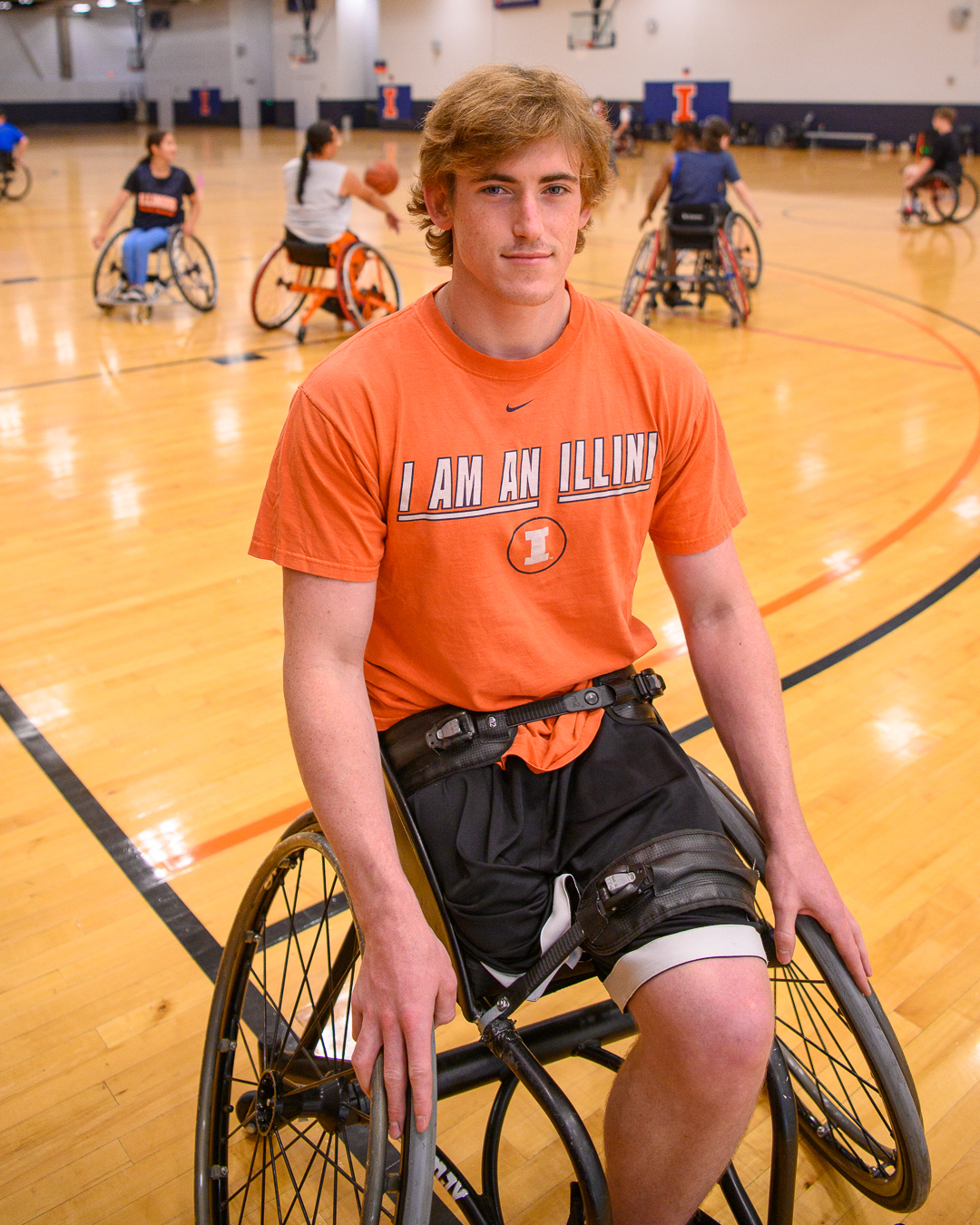
RJ Fitzpatrick, a senior in recreation, sport and tourism, at an Illinois wheelchair basketball skills camp this summer. (Photo by Ethan Simmons).

Against all odds, wheelchair basketball star RJ Fitzpatrick’s junior season at the University of Illinois Urbana-Champaign was a banner year​ on the court and in the classroom.  

He helped bring the Fighting Illini to a third-place finish in the National Intercollegiate Wheelchair Basketball Tournament in April and won the 2025​​-​​26 NWBA Player of the Year, the highest honor for collegiate players. He even earned a 4.0​ GPA​ in the spring semester, studying recreation, sport and tourism.   

“It was really nice to achieve, and it’s also hard, too, because my dad would be so proud of me for that,” Fitzpatrick said. “It was really tough not having him there, not seeing him in the crowd, because that was like his number one thing. He loved watching wheelchair basketball.”  

RJ Fitzpatrick is heading into his senior year at Illinois without his chief supporter: his father, Peter, who died ​in March ​after a two-year battle with brain can​cer​. The quintessential “sports dad,” Peter Fitzpatrick was his son’s biggest fan in the stands, though never quite his biggest critic.  

“That’s RJ himself,” Illinois men’s wheelchair basketball coach Jacob Tyree said.​ “That loss was felt to a magnitude that can’t be put into words—Peter was just a really unique person to have been intertwined with my athletes’ lives.”  

A new year brings new lessons and a new level of maturity for Fitzpatrick, a fierce competitor on the court with a kind, fun-loving presence in his daily life. And this year, he knows for sure: he’s not going it alone.  

“The support from the whole wheelchair basketball program has just been huge​,​” he said​​. ​​“​​Knowing I always have them in my corner, that just has made the whole thing a little bit easier, you know?​​ ​​​

“​​It’s always going to be hard, but knowing I have them has been so special.” 

Beginnings 

Fitzpatrick’s brand of physical, polished play—bumping in his chair for rebounds, drilling threes and dumping off swift passes to the interior—might feel like a style he was born with.  

But his story with wheelchair athletics began when he was an eighth grader attending Camp No Limits, a summer camp for kids with limb differences or limb loss. Fitzpatrick was born without his right leg, but he grew up playing able-bodied sports with his friends.  

​​A camp mentor let Fitzpatrick try out his sports chair for a spin.

“I remember it was super hard, because I was so used to playing stand-up basketball,” Fitzpatrick said. “Trying to figure out how to push the chair and also dribble and shoot from two feet lower was crazy to me.”  
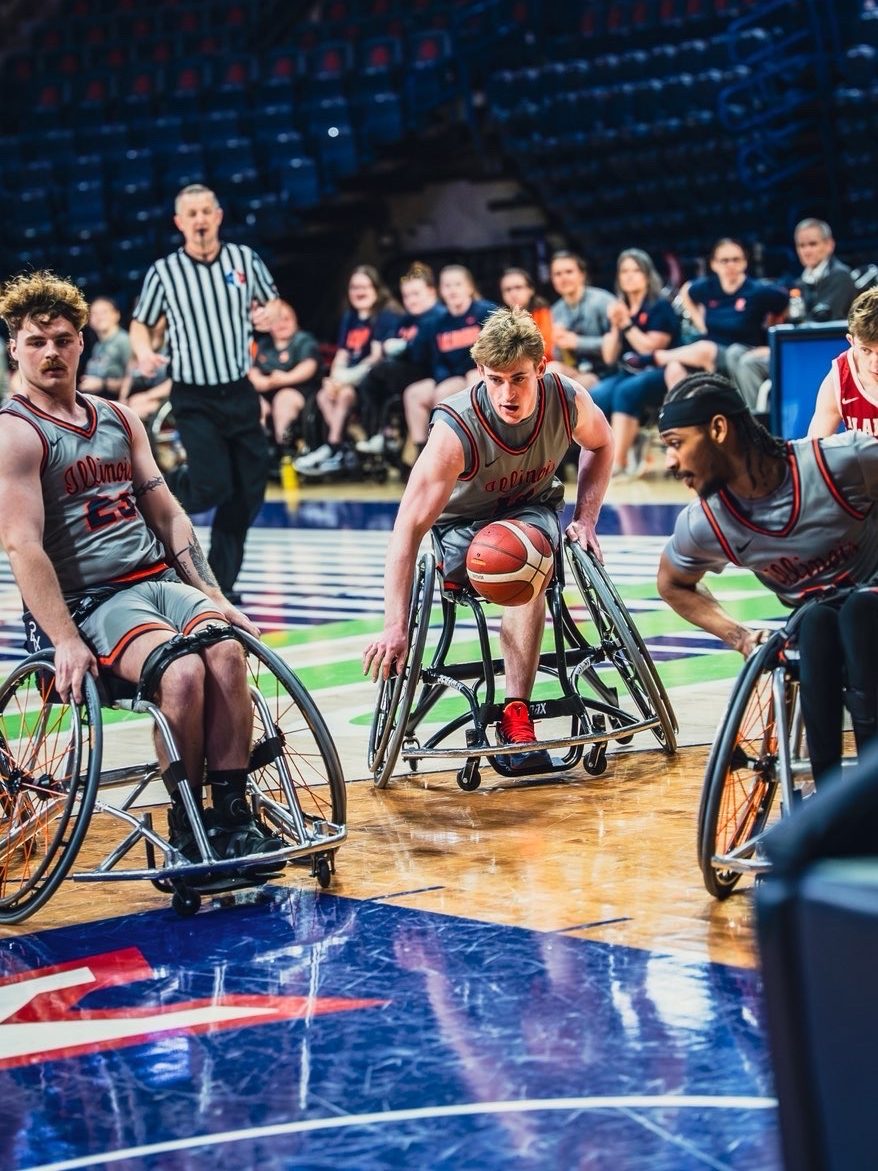
RJ Fitzpatrick (center) drives to the basket, flanked by teammates JM Davis (left) and Martrell Stevens. (Provided)

His high school hosted a wheelchair basketball exhibition game the following fall, and he gave it another shot.  

“That’s where the love for it all started,” Fitzpatrick said. “Once I got in it, I realized how much it leveled the playing field for me. I thought, ‘I could be pretty good at this.’”

He went on to play wheelchair basketball for New Britain High School, which had an adaptive sports program through the Ryan Martin Foundation, while swimming and running cross country for New Fairfield High School, using a prosthetic to run. His growing basketball talent drew attention, and he was offered a scholarship to play for the University of Illinois, 900 miles from his hometown of Sherman, Connecticut.  

He knew of the University of Illinois through one of his old Juniors Division teammates—recent RST graduate Martrell Stevens—who accepted an offer to play there. Its rich history of wheelchair athletics and accessibility through Disability Resources and Educational Services held broad appeal to Fitzpatrick.  

“There was always a feeling I had that I wanted to end up here,” Fitzpatrick said. “Even before I got recruited, right when I got to campus that first time, I kind of knew this was where I wanted to be.”  

Still, coming to the U. of I.’s 50,000-student campus from a town of 3,500 was a serious adjustment. Longtime teammates Grant Pierce and John Matthew “JM” Davis have formed his social bedrock while he’s been at the university. So much so, that they moved in together.       

“They’re brothers—they bicker, they fight—getting them to work together can be the hardest or easiest thing I do,” Tyree said. Many of the team’s funniest and fondest memories stem from those three, Tyree said, and their own brand of brotherly love. ​​Fitzpatrick​​ is usually the one stirring the pot.  

For the second year, the trio of big men will live in an Urbana house together for their senior season: “Those two, we’ve all just kind of stuck by each other’s side and been there for each other with anything that comes up,” Fitzpatrick said.  

A trying tournament  

After a two-year battle with glioblastoma, Peter Fitzpatrick—a longtime health and physical education teacher—passed away on March 9, 2026. His passing came just a week before the UTA College Classic in Arlington, Texas, a marquee wheelchair basketball tournament with seeding implications for nationals the next month.    

“We were even debating, ‘Do we not go?’” Tyree said. Both Illinois wheelchair basketball teams were thinking of diverting their travel to Peter’s funeral instead.

“Of course, me and my dad would want them to play,” Fitzpatrick said. Across the country, the team thought of how they could show support without physically being there for RJ and his family.  
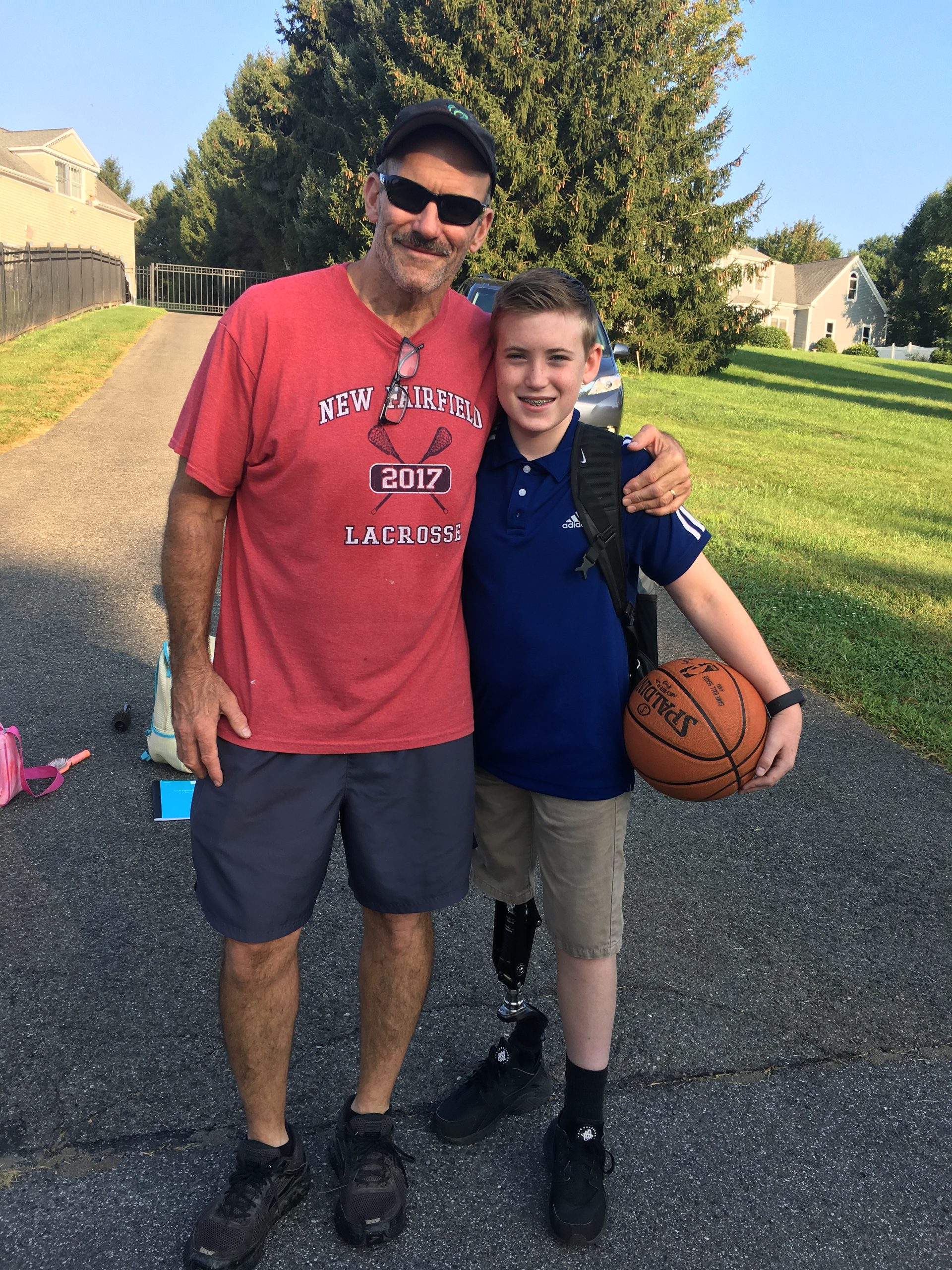
Peter and RJ Fitzpatrick in 2018. (Provided)

Halfway to Arlington, the team made a pit stop at a Walmart in Arkansas. After chatting with fellow coaches and DRES staff, Tyree went inside and grabbed a couple packages of black ribbon. Before the tournament games, members of the Illini men’s and women’s teams tied the ribbon around their chairs and wrists to pay respects to Peter, their biggest fan.  

Through his grief, RJ felt how the experience transformed the team.  

“Seeing how tight we were, as a whole program being one, those were some huge days for us to grow together,” Fitzpatrick said.  

Peter’s impact on the team resonated beyond supporting his son. He was a constant presence in the stands, and a supporter for RJ’s future Illinois teammate Gavin Ford—a sophomore from North Reading, Massachusetts—helping to get him into adaptive sports in the first place.  

The last time Peter saw his son play in person was at the fall alumni tournament, where Illinois wheelchair basketball players from years past came to battle the current-day roster.  

“My whole family came, and it was a really special time,” Fitzpatrick said. “I’m involved with the [St. John’s Catholic] Newman Center, and one of the priests came as well. It was special to see all these influential figures in my life.”  

It’s rare to find someone who excels in the classroom, as an athlete​​ and in how he treats other people—but that’s exactly who RJ is.

Sarah Agate

Teaching Associate Professor in Recreation, Sport and Tourism

After his playing days, Fitzpatrick dreams of working in a front office role for an NBA team or starting a wheelchair basketball program of his own closer to home in Connecticut. Recreation, Sport and Tourism has always made a sensible fit for his academic program at Illinois.  
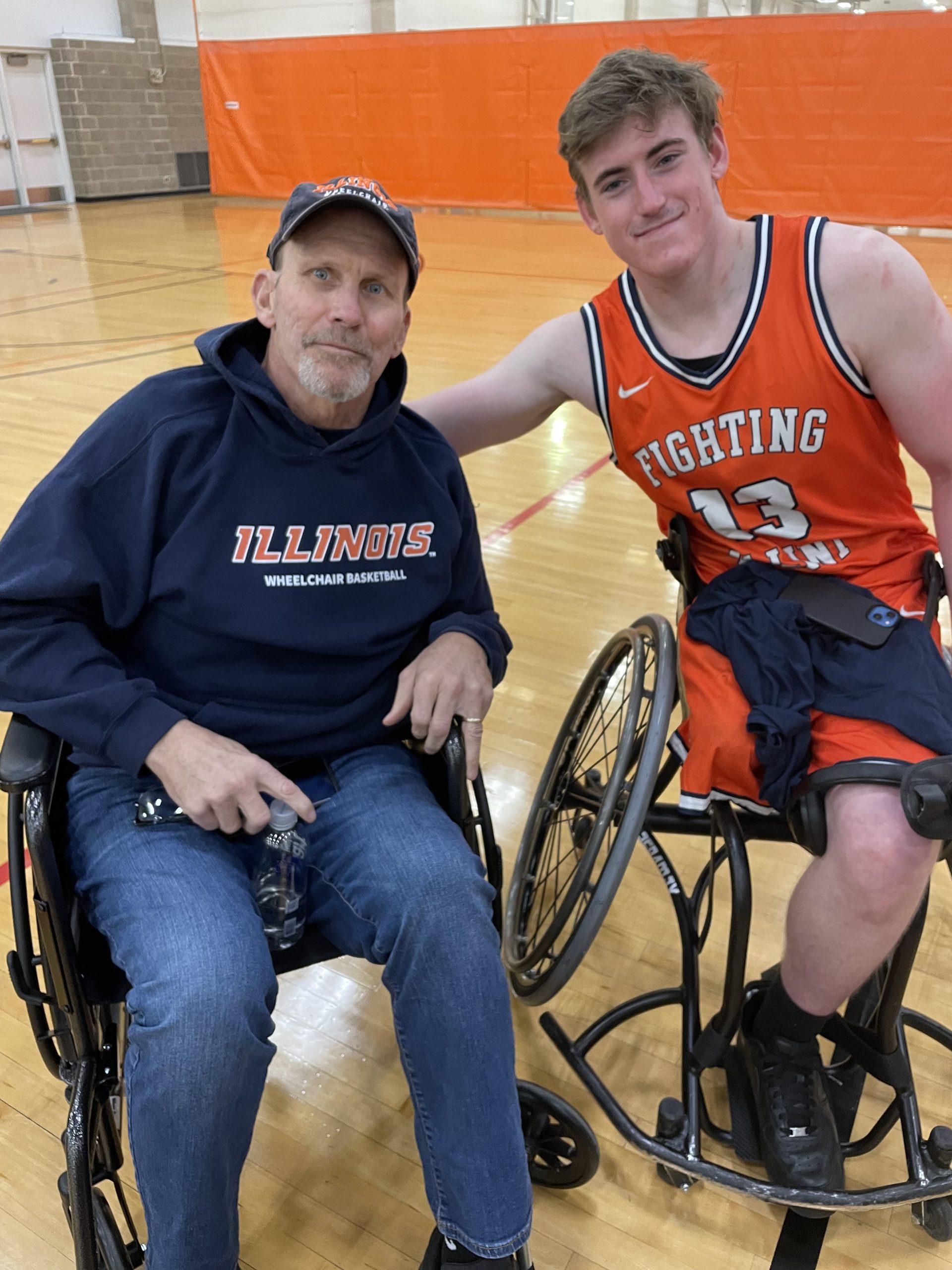
Peter and RJ Fitzpatrick in 2025. (Provided)

He got a small taste of what it takes to run a sports event of any kind when he helped organize the U. of I.’s spring wheelchair basketball tournament for a class—a tournament he was scheduled to play in himself.  

The courses Event Management and Implementation in Recreation, Sport and Tourism ​​opened a “new world” of small, behind-the-scenes details, from what it takes to get coaches and players organized to the volunteer force that helps a tournament run.  

And the class instructor, RST Teaching Associate Professor Sarah Agate, was understanding and flexible while Fitzpatrick and his family dealt with his father’s worsening illness and later grieved his passing.  

“She was really there for me in a huge way, knowing I had the support from her, constantly going home to Connecticut,” Fitzpatrick said. “I’d always bring it up to my mom and my sister, just how kind and supportive she was. I really hope that’s a contact and connection I can continue to build with her for the future. “  

In class, Fitzpatrick is “hard-working and responsible,” Agate said. “It’s rare to find someone who excels in the classroom, as an athlete​​ and in how he treats other people—but that’s exactly who RJ is.”  

His team-first attitude and humility were present in class. Agate didn’t even learn about Fitzpatrick’s Player of the Year honors until one of his classmates mentioned it to her. 

“What makes his accomplishments even more meaningful is that he achieved all of this while carrying the weight of losing his father.” 

Pushing forward 

Two third-place finishes at the NIWBT stamped a successful season for Illinois wheelchair basketball, but Fitzpatrick thinks the team is built for more.  

“I’m super confident with this group of guys we can finish even higher,” he said.  

Underneath his placid demeanor is a competitive intensity that churns for the whole team.  

“I tell people all the time, the character of who you are shows up on the court,” Tyree said. “You can watch a game of basketball, or any sport, and through an athlete’s actions you’ll see their core values embodied. Your actions, not intentions, reflect who you are to the world. 

“He has a mentality—that when it’s honed and brought out in the right ways—we’re fighting back. I don’t care if we’re down 40 points, if we’re down 2 points, I don’t care if we’re up 10, we’re still fighting and we’re going to see it all the way through. 
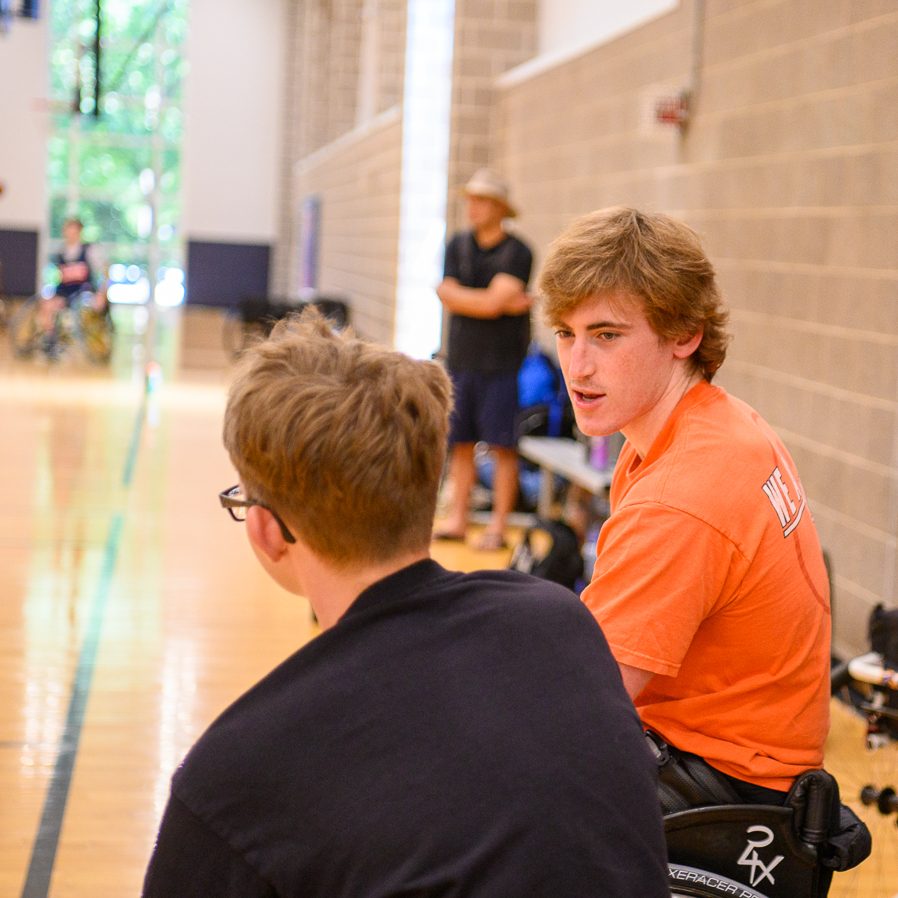
University of Illinois men’s wheelchair basketball senior RJ Fitzpatrick speaks to a camper at the Illini Premier Camp for young wheelchair basketball players on June 30, 2026.

“That’s something that’s really hard to ingrain in a player, and that’s where his character really shines.”  

As he matures into his role as a team leader, ​​Fitzpatrick​​​​​ is beginning to see himself as an ambassador for his sport and for the larger disability community.   

“I’m trying to continue to grow my relationships with the people on campus,” Fitzpatrick said. “Being an amputee, I’m a little more ‘obvious,’ and that’s a great way for me to talk to somebody about wheelchair basketball, or adaptive sports, and open up that world for them.”  

All those feelings were made fresh while he coached in this summer’s skill development camps for wheelchair basketball​ ​​at the Activities and Recreation Center. Fitzpatrick turned in a few 12-hour days mentoring kids of all skill levels: some were new to the sport; others were vying for a collegiate roster spot.  

“It’s special to see these dads come with their sons or daughters to camp and walk around campus​;​​​ I remember doing that with my dad,” Fitzpatrick said. “Because those were some of the best years of my life, the excitement of finding a school—those moments really warmed my heart.”  

In his experience, the grief “never really goes away.” But tender moments and new life lessons keep Fitzpatrick moving forward, with his father’s memories still held close.   

“Trying to live a little bit more like him really inspires me to keep pushing.”  
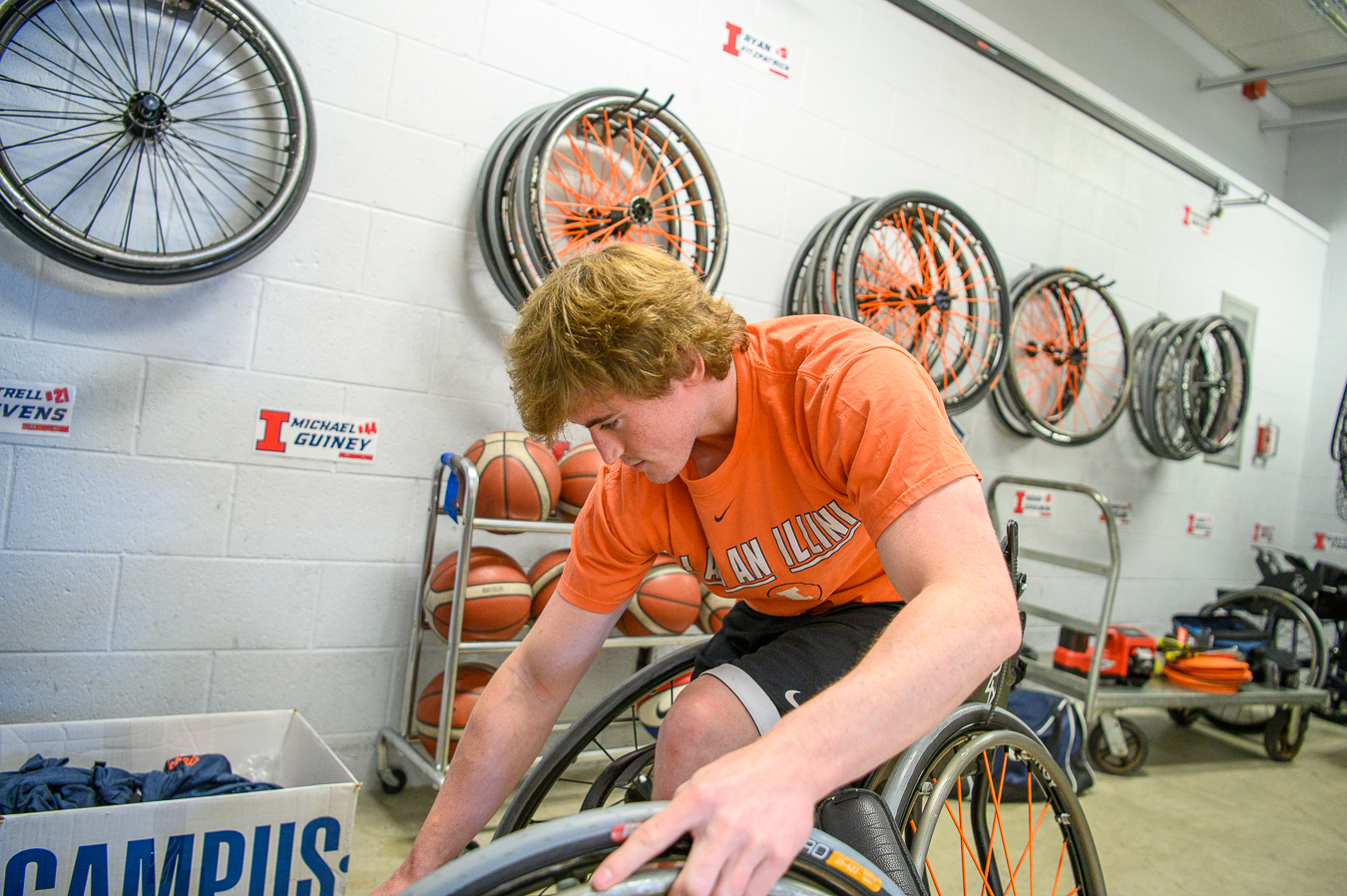
University of Illinois men’s wheelchair basketball star RJ Fitzpatrick helped run this year’s Illini Premier Camp for young wheelchair basketball players in late June. He’s heading into his senior year after a year of great accomplishments on the court, and one of his hardest years off of it.

Editor’s note:

Want to learn more about wheelchair basketball? Join the 8-week course: RST 265 Principles of Coaching Wheelchair Basketball, instructed by RST Graduate Student Morgan McCammon, four-year women’s wheelchair basketball player for Illinois.

To reach Ethan Simmons, email ecsimmon@illinois.edu.  

Share on social
Related news

Alessio Norrito joins RST as a postdoctoral researcher


RST postdoc Alessio Norrito will primarily work with Professor Yuhei Inoue, while collaborating across the department.

The Department of Recreation, Sport and Tourism at the University of Illinois Urbana-Champaign is pleased to welcome Alessio Norrito as a postdoctoral research associate. Norrito brings with him an international perspective, interdisciplinary expertise and a deep belief in the power of sport to improve lives and communities. He will primarily work with RST Professor Yuhei Inoue, while developing collaborations with other RST faculty members.

“Alessio is an excellent addition to the department, as his research can effectively bridge sport management, recreation and tourism, advancing our understanding of how these interrelated fields can work together to address some of the grand challenges facing today’s society,” Inoue said. “In addition, given his international background and experience, Alessio can share valuable global perspectives with RST faculty and students, strengthening an important dimension of our department.”

Norrito earned his Ph.D. in sport sociology and management from Loughborough University, one of the world’s leading institutions for sport research. Before joining Illinois, he served as a senior lecturer at Manchester Metropolitan University. His academic path, however, is rooted in a broader professional journey that spans continents and industries. Prior to entering higher ed, Norrito worked in marketing and e-commerce within the food and beverage sector, with professional experiences in Shanghai, China and Turin, Italy. Those early roles, he notes, shaped his understanding of organizations, markets and people—insights that continue to inform his research and teaching today.

Norrito has contributed to international research projects supported by organizations such as the International Olympic Committee, UNESCO and UEFA. His work has been recognized by the European Association for the Sociology of Sport, which awarded him the Young Researcher Award for his contributions to the field. Across these projects, his research consistently examines how sport and leisure can enhance well-being and strengthen communities, with particular attention to how organizations pursue social purpose at the intersection of global contexts and local realities.

That interdisciplinary focus made the U. of I. a natural next step.

“I think the University of Illinois has a unique take on the way that sport management should be, which strongly aligns with my ideas,” Norrito said. “I position my work in between sociology and management, firmly believing that the two disciplines should be in constant dialogue for solving pressing global issues, creatively and innovatively finding alternatives that benefit people globally.” He added that he found “matching values in the RST department,” allowing him to contribute meaningfully through sport management while being “strongly supported in the development and realization of this work.”

At the heart of Norrito’s research is a simple idea: sport helps people connect. “At its simplest, sport helps us talk to each other and know each other better,” he said. “These interactions make us feel emotions that either unite or divide us.” His work emphasizes that when organizations learn to harness the positive side of sport, it can generate feelings of being “loved, hopeful and ambitious.” What is often overlooked, he notes, is how everyday experiences—like playing or watching sports—can help individuals and communities imagine a shared future. “Sometimes the simple pleasures of life, like sport, can give us a direction of where we want to go in the future, either [individually] or collectively,” he said. “According to my research, this pursuit can generate diverse forms of happiness.”

Norrito’s international research collaborations have also reshaped his understanding of how global sport organizations operate. “I was surprised the most [by] just how valuable research is for global sport organizations,” he said. “My belief prior to these experiences was that research was something ‘for academics.’”

For students interested in working in sport at a global level, Norrito’s advice is clear: engage deeply with organizations’ strategic plans and think proactively about how to fit within them. “Your time in [U. of I.] is key to developing your future self, and taking the right courses can be key to becoming the person that you need to be to land that dream job,” he said.

This semester, Norrito is teaching RST 210: Management in RST, where he introduces students to management and leadership across recreation, sport and tourism contexts. His approach to leadership resists simple formulas.

“I strongly do not believe in a one-size-fits-all approach,” he said. “Instead I encourage RST students to engage in reflexivity. Reflecting on yourself is a key practice to understand what skills you need to develop to be the leader you want to be in the future.”

That philosophy is closely tied to how he brings his research into the classroom.

“My research leads me to believe that behind every social problem there is always an opportunity to solve it,” Norrito said. “And when this social problem is solved, it benefits those who have solved it, those who were affected by it and society as a whole.” He regularly draws on examples from his own work to show students how social impact, business      and management are deeply connected—and how future professionals can align purpose with practice.

Norrito’s passion for sport as a subject of serious academic inquiry has personal roots. He recalled a formative moment from his high school years in Palermo, Italy.

“When I was in high school, in my hometown of Palermo, the science surrounding sport was not very popular,” he said. After submitting an assignment about soccer, he was told by a teacher that sport did not belong in the classroom—and he failed the assignment.

“The fact that my job now involves talking about sport inside a classroom is quite ironic,” he said, “but also tells the lesson that we should protect our beliefs and challenge assumptions that seem wrong to us.”

Now at Illinois, Norrito is doing exactly that—challenging assumptions, connecting disciplines and preparing the next generation of RST leaders to see sport not just as an industry, but as a powerful force for social good.

Editor’s note:

To reach Alessio Norrito, email anorrito@illinois.edu.
 

Share on social

Related news

What two RST students learned from internships abroad


Every year, students studying Recreation, Sport and Tourism at the University of Illinois Urbana-Champaign venture across the United States for professional internships. Some even find work outside of the country.

The College of Applied Health Sciences spoke with two RST students set to graduate this May, David Shan and Juan Manrique, who spent last summer working abroad in China and Guatemala, respectively.

Their interviews have been lightly edited for length and clarity.

***

David Shan

RST student David Shan spent his early life in California but went to middle and high school in Beijing, China. He was always into sports, participating in volleyball and badminton. He even founded a huge badminton tournament at his high school. Shan followed his passion to RST at Illinois, where he’s set to graduate early—and he’s already interned for some of the biggest gaming companies in the world.

What company did you intern for last summer? 

I interned for Electronic Soul, a game studio and public-traded company in Hangzhou, China.

How did you get the job?

There are apps like LinkedIn and Handshake in Chinese markets for job applications. I scrolled through offers and applied for this role.

They asked, “How can you link your experience to the gaming industry?” I explained that games are part of sports, and that a lot of the classes I was taking at RST could prepare me for the job. Marketing, finance, event planning. I also talked about the badminton tournament I had been running. Those things all helped me get the job.

What was your day-to-day like?

At Electronic Soul, we’d have shows for some of the icons inside the games. We ran tournaments for the game they designed and helped prepare all the promotional materials. I was in the office for five days a week, from 9 a.m. to 6 p.m.

We had a big comic show for characters in the games. It was held in place for a week; we spent a bunch of time preparing for it. We set up the stage for the actors dressed as the characters.

I was also involved in the designing stage of one of the games they were launching, while they were still designing the characters. So I helped do some background research on how the characters could act in the game and what would make them appealing. 

Any special takeaways?

Before I went to this company, I didn’t play games that often. The whole process of game design and launch, it was a whole new thing for me.

There are a bunch of different fields in RST, but any industry that’s more popular, I felt like I could grow a lot and it may be easier to get in.

Any advice for students searching for internships abroad?

One is, be more open. There are a lot of industries that we could go to, even though it’s not linked with our own major. People might think, how are games related to your major?

There are a lot of opportunities outside of the [U.S.]. Other countries are still developing, they have huge market opportunities for games and other industries as well. Don’t be shy or afraid.

I got another internship at Tencent, the biggest gaming company in the world, because they had a career fair. I flew there over the weekend and talked to the staff and got the job. Just be more active and try out everything.

What’s your experience been like here at RST?

The RST internship coordinator Hayley Hardin and advisor Jason Schroeder, they all taught us how to reach out to people, how to email and be active. Giving everything a shot. That mindset helped me prepare for my career and get job opportunities.

I’m passionate about entrepreneurship; that’s my long term goal. But in the short-term, I may go to other gaming companies. I’m interning at Tencent right now. After I graduate, I may use that experience to apply for a full-time role.

There are a lot of opportunities outside of the [U.S.]. Other countries are still developing, they have huge market opportunities (…) Don’t be shy or afraid.

David Shan

RST undergraduate
Juan Manrique at the Xelajú MC soccer field.

Juan Manrique, a senior in RST, got his Associate Degree in Computer Science from Harold Washington College in his home city of Chicago. A lifelong sports enthusiast and soccer player, he decided to come to Illinois for its sport management program.

At first, Manrique wanted to find a D1 soccer program to play for. But in his first summer internship outside of the states, he helped the program run behind the scenes.

What company did you intern for last summer? 

The professional soccer club Xelajú MC in Quetzaltenango, Guatemala. They won the league championship back in 2012, when I was 10 years old. It was crazy seeing that on TV.

How did you get the job?

It’s a funny story, my grandfather was actually the president of Xelajú MC back in 1999–2000. But I didn’t use him as a resource at all. Instead, I sent the current president of the club a friend request on Facebook.

I basically told him, “I want to shadow you and help wherever I can.” I mentioned my granddad, and that both my dad and mom are from Guatemala. He accepted my friend request, and he had won the election to continue for a second term. At that club, it works like our presidential election, where they get elected to serve on new terms.

What was your day-to-day like?

When I arrived it was the offseason for the men’s team. The women’s team made the finals but unfortunately lost. I spent a lot of time learning different systems in the institution.

I was moving around the office and helping with whatever I could. I worked with the marketing and communications group, the media group of the team, even helped the utility group as well, making sure the players had their boots and their jerseys. It was pretty cool. That’s what made it interesting, was that every day was different.

Any special takeaways?

It’s a different culture, and a different way things are managed. Any resource we have here in the United States, it’s accessible. You have to work with limited resources, we didn’t have the best equipment, but we had to work with what we had.

The professor told me I was probably the first intern in the history of University of Illinois to do their summer internship in Guatemala. I told that to the soccer club over there; they had never had an intern in their existence. It was pretty cool.

Manrique sits at the club’s media table. He was told he’s “probably” the first student from the University of Illinois to land a summer internship in Guatemala.

Any advice for students searching for internships abroad?

It’s a great opportunity for people that want to take on a new challenge, learn about a different heritage and culture and see how things are managed. Businesses are managed differently in every country; every country has different standards, methods and techniques of how they should do things as an administration.

To do an internship abroad, you need to be familiarized and acquainted with what you’re gonna do. I had the luck that this is my favorite soccer team, and my family’s from there.

What’s your experience been like here at RST?

Doing the internship has opened my doors to working internationally, with them or another team, it has opened that path for me. I see RST is a community that’s growing; recreation, sport and tourism keeps exploding day by day. [The U.S.] is going to be co-hosting the World Cup. That’ll be huge. There’s a lot of opportunities out there, even remotely.

Editor’s note:

To reach Ethan Simmons, email ecsimmon@illinois.edu.
 

Share on social

Related news

Spring 2026: Message from RST Department Head Carla Santos


Hello alumni and friends of the Department of Recreation, Sport and Tourism,

As the spring semester comes to an end, I am pleased to share the latest edition of the Recreation, Sport and Tourism newsletter with our alumni community. This issue reflects the breadth of experiences, scholarship and impact that define RST, and I hope it reconnects you with the people and programs that continue to shape the field.

One of the highlights in this edition explores an exciting partnership centered on Wintrust Sports Complex and Bedford Park, where RST students have been directly involved in emergency planning efforts. This hands-on work exemplifies how our students apply classroom knowledge to real-world challenges, gaining valuable experience while contributing meaningfully to community resilience and safety.

We also take a reflective look at the history of Black runners in the Boston Marathon, a story that not only honors perseverance and achievement, but also underscores the evolving relationship between sport and social change. It is a powerful reminder of the broader cultural contexts in which recreation and sport exist.

Closer to home, we celebrate the contributions of Professor Laura Payne and her work documenting the history of the Office of Recreation and Park Resources. This story highlights the enduring legacy of outreach, research and public engagement that has long been a cornerstone of our department’s mission.

Our alumni network continues to be a source of pride and inspiration. In this issue, you’ll read about a group of RST graduates whose professional paths converged at the USTA, illustrating both the strength of our program and the lasting connections formed here. Their story is a testament to the collaborative spirit that defines our community.

We are also excited to spotlight the global opportunities available to our students, particularly through internships abroad that expand cultural understanding and professional growth. These experiences prepare students to lead in an increasingly interconnected world.

Please join me in welcoming our new postdoctoral researcher, Alessio Norrito, whose work will contribute to the department’s ongoing commitment to innovative research and thought leadership.

Finally, the 2026 Sapora Symposium brought together students, alumni and industry leaders across recreation, sport and tourism for a dynamic day centered on the theme of community. More than 130 students engaged with over 35 speakers and table hosts—many of them RST alumni—creating meaningful connections and mentorship opportunities. We are especially grateful to our alumni, partners and TSMGI for making this experience possible.

Thank you for your continued support and engagement with RST. Whether through mentorship, collaboration or simply staying connected, you play a vital role in sustaining the strength of our community. I hope you enjoy this issue and find it both informative and inspiring.

Warm regards,

Carla Santos, Department Head

Recreation, Sport and Tourism

Share on social

Related news

An online RST master’s degree affirmed Haupert’s career in the arts


In her new role at the Palatine Park District, Laney Haupert carries administrative work to keep her local arts scene running .

From an early age, Laney Haupert dreamed of working in the theater—not acting on stage, but managing her favorite productions behind the scenes. 

But life took her in an unexpected direction: as Palatine Park District’s cultural arts manager, Haupert carries administrative work to keep her local arts scene running from her position in parks and recreation. 

“I had this lightbulb moment: I can work in cultural arts, do theater, put up shows, serve my community, and have all the benefits of working in the public sector,” Haupert said. “Taking this job was my Hannah Montana, ‘Best of Both Worlds’ moment.” 

After a stint in the creative arts and a taste of park district life, Haupert went back to school, obtaining master’s degree online from the Department of Recreation, Sport and Tourism at the University of Illinois Urbana-Champaign in 2021. It gave her the tools to steer her career toward a new path. 

“A master’s degree is something I always wanted to complete,” Haupert said. “Having found this program and hearing more about it, it was a great fit for where my career was at and where I saw my life going.” 

Haupert is from Bartlett, Illinois, a village of 41,000 in the Chicago metro area. She grew up in community theater, starring in her local production of “The Velveteen Rabbit” when she was 8 years old. As she got older, she found more roles backstage: hanging curtains, doing makeup and building sets for local plays.

Haupert’s mother, Carrie Fullerton, always thought Haupert had the “personality for parks and recreation.” Fullerton is a two-time graduate of the RST program at Illinois and has served as executive director of the Arlington Heights Park District since 2020. 

Haupert had different plans, at least at first. She obtained her Bachelor of Fine Arts in Theatre Administration from Millikin University in 2018, working as director of development for the school’s student-run studio theater. But after graduating, the job prospects were dry, so she found an administrative assistant role at the Glenview Park District—and found out she loved it. 

“Sometimes it takes someone who is not your parent to realize how cool this thing is, that your parent has been spoon-feeding you,” she said. “I thought parks and recreation was something I really wanted to explore further.” 

You have to remember the ‘why’ of what we’re doing, and who it’s for. It’s for the little version of you who really needed this at a certain point in life.

Laney Haupert

Cultural Arts Manager, RST ’21

In February 2020, she landed a role with the Bolingbrook Park District, managing both its gymnastics and theater programs. A month in, the COVID-19 pandemic hit, all in-person events were canceled and she had a “whole lot of nothing to do.” 

Haupert’s graduation cap after obtaining her online master’s degree in RST reads “Don’t forget to play.” Today, she is the Palatine Park District’s first-ever cultural arts manager. (Photo provided)

But Haupert had a clearer idea of where she wanted to take her career. She wanted more knowledge—and a degree that connected to her new industry. 

The flexibility of the RST online master’s program appealed to her: “Maybe you’re a sports person and love athletics, want to be around it doing recreation management. For me, my love has always been theater and live performance,” Haupert said. 

The online format made it easier for her to balance coursework and her job, completing her master’s in a year and a half. RST’s online degree gave her “structure” that she sorely needed, especially early in the pandemic. The master’s program also helped her ace the test for her Certified Parks and Recreation Professional Certification, an industry qualification. 

Haupert stayed with Bolingbrook until January 2022, when she began with the Deerfield Park District as its cultural arts and special events supervisor. That experience brought her to Palatine in 2024, where she’s continued to support young artists as the park district’s first ever cultural arts manager. 

She supports all manner of performances year-round: multiple choirs, a community band, theater programs and dance recitals. Her big task is to cultivate a school-of-art brand for the park district, while getting “more and more people to do cool stuff with us,” she said. 

With a fresh perspective on her role, Haupert is helping to realize the artistic dreams of kids growing up in the same lane she once did. 

“The most important thing that’s been a throughline for me: if you’re having fun, you never work a day in your life,” Haupert said. “You have to remember the ‘why’ of what we’re doing, and who it’s for. It’s for the little version of you who really needed this at a certain point in life.” 

Editor’s note

To reach Ethan Simmons, email ecsimmon@illinois.edu.

Share on social
Related news

In RST event management course, preparation is the main event


Visitors to this year’s “Yappy Hour” event brought their pups to Riggs Beer Co. for drinks and fun. Recreation, Sport and Tourism students organized this event and several others this spring. (Photo by Ethan Simmons)

Tournaments for pickleball, spike ball and wheelchair basketball, a “yappy” hour at a local brewery with dogs invited, a fairy tale ball at a local library: Each spring, students in Recreation, Sport and Tourism help organize some of the semester’s most memorable events on and off campus.

And it all comes back to one class: Event Implementation in RST, which is required coursework for undergraduates in the RST major, and Sarah Agate’s “favorite class to teach.”

“In recreation, sport and tourism, regardless of what your job is, you’ll probably be involved in helping plan and facilitate events,” said Agate, teaching associate professor in the Department of RST in the College of Applied Health Sciences at the University of Illinois Urbana-Champaign. “I get emails from students even a few months later who have graduated and are working in their grown-up job, saying, ‘I hadn’t planned on doing events, but now that’s part of my job, and I feel so prepared and ready because of what we did.’”

Technically, Agate teaches two events courses—RST 460: Event Management in Recreation, Sport and Tourism and RST 465: Event Implementation in RST take place across the fall and spring semesters. The two-course sequence was an appealing feature for Agate before she was hired at the University of Illinois; it offered a more rewarding experience than the one-semester event classes she had taught at previous stops.

In fall, students group together, decide the event they want to support, then spend the next few months partnering with local agencies, finding sponsors and sharpening their event plans, including emergency and risk management.

Spring is all about promotion, execution and evaluation. This year, RST students in her class helped put on 11 events, starting with the Illinois Wheelchair Basketball Tournament on Feb. 13–14 and ending with a kids’ football camp on April 26.

After facilitating the events, the final project is the evaluation report. Students gather survey data from attendees and compile suggestions for their partnering agency of what went well and how the event could run even better next time.

Sarah Agate, teaching associate professor in RST.

The event planning process can feel “overwhelming” to undergraduates who are partnering to host big local events with lots of moving pieces. Agate planned a phase of her course to answer the question: how can we be ready if something goes wrong?

This year, Agate expanded the risk management section. She took students to a local crisis management training, including first aid demonstration and an active threat training with campus police officers.

Students are assigned a “venue risk assessment” for each event, where they check for first aid kits and defibrillator locations, whether exits were clearly marked and determine sheltering plans spots if severe weather were to come around.

“The saying that I have heard numerous times is something along the lines of, ‘Hopefully we don’t have any problems, but in the case that we do, we will be prepared for them,’” said RST senior Drew Erickson, who organized a “Yappy Hour” at the Riggs Beer Co. with seven of his classmates.

The group planned a rain date just in case of April showers. Of course, the event went smoothly on a sunny Urbana spring day, bringing together townies, their pups and local vendors over brews.

RST students Nina Bollman, Tariq Cotton, Kaden Feagin, Brandon Henderson, James Kruetz, TJ McMillen, Mac Resetich and Xavier Scott, hosted the ICON for Illini Kids Football Camp held April 26, 2026, at the Irwin Indoor Practice Facility. (Photo provided)

Many of the events have become community mainstays, like the annual Fairy Tale Ball at the Urbana Free Library, or the Illini Get Pickled pickleball tournament, now three years running.

RST junior Michael Evans has helped run the tournament since its inception, an event in Huff Gym first created by RST students Carson Bounds and Gavin Christopherson. The past two years, it raised more than $11,000 for Cunningham Children’s Home, a child welfare agency based in Urbana.

This year’s event had a recreational bracket with lots of student and faculty sign-ups and a second tourney with a new spin: a Greek house bracket for fraternity and sorority members to duke it out on the pickleball courts. This year, more than 50 teams signed on.

Though Evans had experienced behind-the-scenes event organizing through his work at Illinois Athletics, Agate’s courses gave Evans the “why” behind every step of the process.

“Compared to an Illini football game, our event is a blip on a map,” Evans said. “To see how much it takes for just this small pickleball tournament and the number of people from so many different places who have their hands in it—whether it be, ‘Oh hey, I know this person,’ or the people we talked to rent Huff Gym out, the sponsors … there’s a ton of people who just want to see this go well, and they want to support Cunningham.”

The events courses are designed as a capstone experience for students in the recreation, sport and tourism program, and Agate gets an extended front-row seat, as a rare instructor to see the same students for two semesters.

“I feel like I really get to know them,” Agate said. “It’s fun to see their skills develop over those eight months we have together, where they’re nervous at the beginning, then they get into the process with their professional. By spring, they’re event facilitators … it’s fun to watch their confidence grow.”

Editor’s note:

To contact Sarah Agate, email stagate@illinois.edu

Share on social

Related news

How ORPR is shaping the future of parks and recreation


The ORPR team has worked with more than 20 community and nonprofit organizations on facility planning, capacity building and more methods of improving residents health and quality of life, writes Director Laura Payne. (Photo provided)

On any given day, a graduate student at the University of Illinois Urbana-Champaign might be found leading a focus group in a small Illinois town, presenting data to local officials or helping design the future of a community park. It’s not a simulation—it’s real work with real impact, made possible by the Office of Recreation and Park Resources.

Since its founding in the mid-1960s by Joseph Bannon, Ph.D., ORPR—which is affiliated with the Department of Recreation, Sport and Tourism in the College of Applied Health Sciences at Illinois—has been guided by a simple but powerful vision: connect research to real-world practice while strengthening communities through parks and recreation. Decades later, that vision is not only alive: it’s expanding to enhance ORPR’s reach and impacts.

In recent years, ORPR has worked with more than 20 community and nonprofit organizations, helping them tackle challenges ranging from facility planning to capacity building toward helping communities enhance their health and quality of life for their residents. At the heart of this work is a commitment to service, education and collaboration.

“We take our lead from the communities, as they are experts of their own communities and we partner with them on their projects,” said Laura Payne, director of ORPR. “Students gain hands-on experience while helping organizations make meaningful, data-informed decisions.”

That hands-on experience is transformative. Students don’t just learn theory; they conduct focus groups, analyze survey data and present recommendations to real clients. For many, it becomes a defining part of their professional journey.

“The experience I gained with ORPR helped my application stand out,” said Aaron Hoyle-Katz, a recent master’s graduate who secured a park planner position with the Champaign County Forest Preserve District. “I wasn’t just learning about planning—I was doing it.”

ORPR’s impact extends far beyond the classroom. In Naperville, a needs assessment conducted by ORPR revealed strong demand for a multipurpose recreation facility—insight that guided efforts to secure funding for a new community activity center and to acquire additional land to preserve, restore and maintain parks and extend multiuse trails. In the village of Brookfield, feasibility studies are shaping the future of local multipurpose community recreation spaces.

A rendering of the Naperville park district’s multipurpose facility, born of a needs assessment by ORPR. (Photo provided)

Perhaps one of the most compelling examples comes from the village of Crete. There, ORPR partnered with multiple municipal agencies to conduct a comprehensive community needs assessment. Through shared planning workshop sessions, the Park District, Library District, Village and Township aligned around common goals.

The results were tangible. Community feedback highlighted priorities such as expanded bike infrastructure, more youth and adult programming and the need for a central gathering space. Since the project concluded, Crete has already acted, purchasing and transforming a building into a community center.

For students, projects such as these often evolve into deeper research opportunities. Hoyle-Katz, for example, conducted his thesis research on trail development in Crete, uncovering both community concerns and opportunities for collaboration. Another graduate student, Ryan McGrath, partnered with the Illinois Park and Recreation Association to study how agencies responded to the COVID-19 pandemic—work that now helps guide future resilience planning.

ORPR’s reach also extends into the classroom. Through partnerships with courses such as the Community and Open Space Design Studio in the Department of Landscape Architecture, students collaborate directly with municipalities such as Rock Island, helping reimagine parks such as Mel McKay Park while gaining invaluable design and planning experience.

Looking ahead, ORPR continues to push the boundaries of research and practice. In collaboration with the Rails-to-Trails Conservancy, the team is assessing research on the economic, social and health outcomes of trails to assist in developing an impact calculator that will help communities demonstrate the return on investment in multiuse trails. They are also working on initiatives to position parks and trails as solutions to social isolation and loneliness.

At its core, ORPR is more than a program—it’s a bridge. Between students, educators and professionals. Between research, education and real-world application. And between communities and the resources they need to thrive.

When students leave here, they’re not just prepared—they’re experienced. And the organizations they serve professionally and communities we work with are stronger because of it.

Editor’s note:

To reach Laura Payne, email lpayne@illinois.edu.
 

Share on social

Related news

Full circle: Illinois alumni reunite through friendship and the U.S. Open


Three Recreation, Sport and Tourism alums, Eva Schmidt, Chelcia Abajian and Christine Stromberg work together through the U.S. Tennis Association. “It’s incredible to see the three of us together again.” (Photo provided)

More than a decade after their time together at the University of Illinois Urbana-Champaign, three alumni from the Department of Recreation, Sport and Tourism have found themselves reunited in a place far removed from campus, yet deeply connected to their shared past.

Today, Chelcie Abajian, Eva Schmidt and Christine Stromberg work together through roles connected to the U.S. Tennis Association, contributing to the operations and hospitality surrounding one of the sport’s most prestigious events: the U.S. Open in New York. Their professional reunion, however, is only part of the story. At its core lies a friendship that began during their graduate school days at Illinois and endured long before their careers converged again.

Seeing one another again in the same professional space has been both surreal and deeply meaningful.

“It’s incredible to see the three of us together again,” said Abajian, who is senior manager, conferences and events at the USTA. “Even during the years we weren’t working side-by-side, our bond never wavered.”

Some of their most vivid memories from Illinois weren’t formed in classrooms or lecture halls, but in moments of spontaneity that helped cement their friendship. All three got both their undergraduate and graduate degrees in RST.

“My favorite memory from our Illinois days is more on a personal level,” Abajian said. “Just three months after we met, we took a spontaneous trip to New York City, which was Eva’s first time ever visiting. Looking back, that was the moment we knew this friendship was for the long haul. It’s pretty remarkable that the city where we first bonded as friends is now the same place where we’re making our mark together during the U.S. Open.”

Another favorite memory comes from the final days of their time at Illinois.

“My favorite memory together at Illinois was taking our graduation pictures at Memorial Stadium,” said Schmidt, now director of premium hospitality, office of the president with the USTA. “With the help of a colleague, we were able to take pictures in the Colonnades and it was a fun way to reflect on the last two years. Today, 12 years later, it’s surreal to be working together again, but I love the camaraderie!”

Their journey from classmates to colleagues was never guaranteed, but perhaps it wasn’t entirely surprising either.

“In a way, I think we always knew,” Abajian said. “Christine and I have been a team since 2008, first as student-athletes and now as colleagues who share a love for event operations and tennis.”

That long-standing partnership eventually played a role in bringing the trio back together professionally. When Abajian joined the USTA in 2022, she quickly realized the potential of reconnecting with familiar talent.

“When I landed at the USTA in 2022—due to Christine referring me—one of my first major events was managing the president’s suite,” she said. “I called Eva because her hospitality background was the missing piece of the puzzle for our staff. Watching her move into a full-time role afterward was the ‘full-circle’ moment we’d been building toward since college.”

Another member of the group shared a similar perspective about their eventual reunion.

“Similar to Chelcie’s answer, I always knew we’d be working together again in some capacity,” Schmidt said. “Our paths were always parallel and it was only a matter of time before they intersected.”

Even so, the exact setting was a surprise.

“When we were at Illinois, if I could have predicted where we would end up, at least for me and Eva, I thought it would be in Chicago somewhere, not all living in new places,” said Stromberg, who is director of U.S. Open Player Services. “The years after graduation, following each other’s careers and supporting each other in what we were pursuing is one of the things that kept us all together.”

Their individual career paths since college have been anything but identical.

Abajian remained closely tied to athletics after completing her master’s degree, eventually transitioning into her current role with the USTA.

“I stayed in college athletics until I shifted to the USTA in 2022,” she said. “I’m not surprised by my journey. I have a love for tennis and event management and this role marries the two together.”

Schmidt said her trajectory was far less predictable.

“My career journey since college has been completely nonlinear,” she said. “Every time I thought I had a pathway, I’d pivot and go the polar opposite direction. Working at the USTA has felt the most stable so far.”

Unexpected turns ultimately became a rewarding part of the journey.

“I never thought I’d end up outside of the state of Illinois but that’s my favorite part of my career path,” she said. “I never expected any of this and I continue to surprise myself. Who knows what’s next!”

For Stromberg, tennis itself became the unexpected thread tying everything together.

“Even though I grew up as a tennis player, my original goal was not to work in tennis,” she said. “I started taking opportunities as they arose and walked through some doors that were open and found the career path that I was ultimately looking for; I just didn’t know it’s what I was looking for.”

Many of the skills they rely on today trace directly back to their student-athlete experiences and time at Illinois.

“My skills go back to being a student-athlete,” Abajian said. “Most importantly: time management. I can juggle multiple tasks, prioritize what needs to get done and work my daily life around a schedule.”

Schmidt credited her early experiences working within Illinois athletics as formative.

“I was fortunate enough to have an internship in the Division of Intercollegiate Athletics as an undergrad that took me into my graduate assistantship at Illinois,” she said. “Those years were so formative and have influenced everything I’ve done.”

Accountability, Stromberg added, remains central to how she approaches leadership today.

“Similar to Chelcie, my skills go back to being a student-athlete,” she said. “In addition to what she mentioned, accountability is one of the most important things I learned and it drives how I make decisions and lead today.”

Their friendship has only strengthened as their relationship has shifted from classmates to colleagues.

“It has only grown,” Abajian said.

Working together professionally has also given them new perspectives on each other.

“It’s certainly grown and also allows us to approach things from a different perspective,” Schmidt added.

“It continues to grow every day,” Stromberg said.

One moment in particular made their shared journey feel complete.

During one U.S. Open, the three unexpectedly found themselves together in the player walk-on tunnel at Louis Armstrong Stadium during the retirement ceremony for American tennis player John Isner.

“In my first year full time with the USTA, the three of us found ourselves in the player walk-on tunnel at Louis Armstrong Stadium for John Isner’s retirement ceremony,” Schmidt said. “Each of us were there for different reasons and we had yet to organically bump into each other at the Open. We all paused and acknowledged the greatness of the moment and even took a selfie.”

Their long history together also shapes how they work.

“Having been friends since 2012, our professional partnership at the USTA is built on a decade-plus of mutual trust,” Abajian said. “This shared history allows us to solve problems with total confidence and zero hesitation. We are each other’s most reliable sounding board and always the first phone call when it’s time to get to work.”

Honesty is part of that dynamic as well.

“We aren’t afraid to tell each other the hard things,” Stromberg added. “That’s really where growth comes from.”

Looking back, each of them has advice for the younger versions of themselves who were navigating graduate school in Champaign-Urbana.

“Work hard, but work does not define you,” Abajian said. “Chill out on the perfectionism; mistakes are just proof that you’re actually out there trying things. Your worth doesn’t go up or down based on your productivity, so don’t forget to clock out and find some sun.”

Schmidt emphasized patience.

“Take a breath,” she said. “Don’t feel like you have to have your whole life figured out by 25.”

And while their professional futures may take them in different directions, one thing is certain: their friendship will remain constant.

“Our friendship comes first in our circle,” Abajian said. “We are fortunate to have each other to lean on for work and personal advice. We hope to keep growing and learning together in this organization.”

As Stromberg summed up, the next step might be uncertain, but the foundation they share is not.

“We don’t know where the professional path will take each of us,” she said. “But we know where our friendship will.”

Editor’s note:

To reach Vince Lara-Cinisomo, email vinlara@illinois.edu
 

Share on social

Related news

News Bureau: Nature videography replicates the mental health benefits of outdoor activities


RST graduate student Darcy Lu visited several parks and forest preserves in Florida to record video and sounds as part of a study on nature-based videography’s impact on mindfulness and well-being. Lu, who collected the samples while studying at the University of Florida in 2022, recently published her findings in the Journal of Sustainable Tourism. (Photo by Fred Zwicky / University of Illinois Urbana-Champaign)

New research led by a scholar at the University of Illinois Urbana-Champaign suggests that watching and creating videography of scenic locations cultivates nature-based mindfulness — conveying the same cognitive and emotional benefits as outdoor activities and fostering a deep sense of connection with nature.

Yue (Darcy) Lu, an Illinois doctoral student in Recreation, Sport and Tourism at the College of Applied Health Sciences, conducted a two-phase study that began with an ethnographic exploration of her experiences with mindfulness while she was recording audio and video of scenic destinations in Florida for another project.

Lu text-mined more than 3,000 reviews — which included videography of cherry blossoms and forest bathing in Japan, a live wildlife safari in South Africa and a sunset hike with a geologist in Thailand — to explore whether immersive digital experiences offered the same benefits as physical engagement with nature.

Read the full story online by Illinois News Bureau research editor Sharita Forrest.

Editor’s note:

To reach Yue (Darcy) Lu, email yuel12@illinois.edu

The paper “Videography-facilitated nature-based mindfulness at natural destinations” is available online.

DOI: 10.1080/09669582.2026.2614551
 

Share on social

Related news

The intern who turned an ejection into a career lesson


In Derek Dye’s 2012 internship with the Daytona Cubs, he sold concessions, cleaned the bleachers, worked the soundboard, even dressed as the mascot. (Provided)

At their best, college internships are valuable learning experiences. Derek Dye didn’t expect his to involve getting tossed out of a baseball game.

That was the viral story for this University of Illinois alum’s first big-time summer job with Minor League Baseball, working as a stadium operations intern in August 2012. Back then, Dye was a rising senior in the Recreation, Sport and Tourism program at Illinois, eager to break into the sports industry. 

“I would’ve done anything to work in sports,” Dye said. “The minor league was the main target for me, a lot of people wanted to get their foot in the door.” 

Growing up in Moline, Illinois, sports were truly his life: Dye ran a backyard football club in high school and developed a passion for sports data of the major leagues. His dream was to become the general manager for the Chicago Cubs. 

When college neared, he applied to relevant programs across the state that could help him reach his goals. He eventually broke through the waitlist for the University of Illinois’ Recreation, Sport and Tourism program in the spring of 2009. 

“The RST major was the first thing I was looking at, I thought it was the perfect fit,” Dye said. 

It’s customary for RST students to work an internship in the field before they graduate. Baseball’s minor league was his main target, including the Quad City River Bandits in his hometown. 

The summer before his senior year at Illinois, he landed a seemingly perfect role: an internship with the Daytona Cubs, the Minor League Baseball team in Daytona Beach, Florida, and affiliate of the Chicago Cubs. 

He ended up taking out a $1,700 loan from his grandma to live in a Daytona Beach apartment. When the summer of 2012 began, Dye began a do-everything internship for the Cubs: serving stadium food and beverage, cleaning the bleachers, selling tickets and running the soundboard, all for a $50-a-week stipend. 

“You’re gone!”

A picture of the Daytona Cubs soundboard’s options for “bad call.” (Provided).

August 1, 2012. The Fort Myers Miracle faced off against the Daytona Cubs.

At the top of the eighth inning, a Fort Myers batter hit a ground ball to short. The Cubs threw it first, and the umpire called it safe. But Dye, sitting up in the press box, thought it was an out. Earlier that week, Daytona had added an array of audio snippets on the soundboard to play for a “bad call.” 

One of them was an organist’s rendition of “Three Blind Mice.” Dye clicked on it. 

Umpire Mario Seneca’s head perked up, then he turned and pointed to the press box. “You’re gone!” 

The crowd was puzzled, and Seneca continued to gesture up to the soundboard, where Dye was at the helm. “Turn the sound off the rest of the night.” 

Fear washed over him. 

“As you can imagine, being 21 years old and 1,200 miles away from home, my first reaction is ‘what just happened? I’m gonna get fired,” Dye said. “I can’t believe this is actually happening.” 

(Through the shock, Dye fired off a tweet about his ejection, and later uploaded the live footage of the incident to the Daytona Beach Cubs YouTube channel.) 

Ejected from his post, the press box was silent: no batter walkups, no anything. The fans started to announce the game themselves, standing from the stands and shouting out the players’ names who were up to bat. 

After the game, Dye resumed his usual grunt work, leaf-blowing peanuts from the stands. Then his phone started ringing off the hook: calls came in from reporters at CBS, ESPN, Major League Baseball. 

News of his ejection was trending on Twitter. Everyone wanted to know about the soundboard guy—an intern—who was thrown out of the game for playing Three Blind Mice. 

“I tried to talk to as many people as I could,” Dye said. He took calls until 2 a.m. 

After waking, WGN called him. Unbeknownst to him, it was live on air. He answered questions from his closet so he wouldn’t wake up his roommates.

Dye’s ejection contended for the Minor League Baseball “Moment of the Year.”

He went to the ballpark the next day, and 45 more publications were there to talk to him. 

The fallout from the league arrived immediately. Florida State League Commissioner called the incident a “mockery of the game” and fined the team $525.

Dye was banned from the press box for the remainder of his internship. But the team’s general manager, Brady Ballard, covered the fee for his barely paid intern. 

“It showed me he saw the big picture,” Dye said. “I was a 21-year-old intern doing my work to engage the crowd and cut my teeth in sports. He didn’t shy away from it, and his support also helped the story grow legs.” 

And the Daytona Cubs sold out their stadium the very next game. 

“I think the legend behind it had more sticking power than it would nowadays,” Dye said.  “Every year it comes up in August for the anniversary.” 

‘Your rep is your personal brand in the industry’

When Dye returned for his senior year at Recreation, Sport and Tourism, advisor and instructor Ryan Gower—now chancellor of Illinois Eastern Community Colleges—asked one of his classes: “Anyone have any funny stories from their internships?” 

Everyone looked back at Dye and laughed. He had gotten texts from classmates about his ejection for the whole month. 

After working in the sports world, Dye is now the director of marketing for Chicagoland’s Affy Tapple.

“Instead of putting my head down, I was able to turn what could’ve been a really negative thing into a really fun story,” Dye said.

He took classes from RST’s many memorable professors, including Clinical Associate Professor Michael Raycraft and Adjunct Instructor Kyle Emkes, and experienced the breadth of the leisure and tourism side of the major in classes with Professor Carla Santos and Professor Emeritus Kim Shinew. 

He also took on new roles in his budding sports career, working 40-hour weeks while interning for Illinois Division of Intercollegiate Athletics. He helped the kids club and worked with spring sports teams, such as softball and tennis.

Words from instructor and former Illinois volleyball coach Don Hardin lingered with him: if you want to work in sports, you’ll have to handle the tough stuff. 

“There’s going to be grunt work, not everything is going to be a glamorous stop,” Dye said, paraphrasing Hardin’s advice. “You’re going to have to be on the front lines, and your rep is your personal brand in the industry.” 

After graduating in 2013, Dye interned with Tampa Bay Rays and later managed eCommerce for Sports Collectibles, a sports memorabilia seller. Today, he’s the marketing director for Affy Tapple, a caramel apple producer in Chicagoland. 

His degree at RST continually comes in handy at his newest role, where he’s had to manage people and organize big events. Dye hasn’t become a Major League general manager, but the moment he feared would stain his reputation ended up shaping how he shows up for others.  

“Being on the ground level, you see everything and learn how to make the best of tough situations,” Dye said. “I’ll never be hard on someone for trying their best.” 

Editor’s note:

To reach Ethan Simmons, email ecsimmon@illinois.edu.
 

Share on social

Related news

College of Applied Health Sciences
110 Huff Hall
1206 South 4th Street
Champaign, IL 61820
(217) 333-2131