Leisure and recreation were ways of life for Payne and led to her passion and career
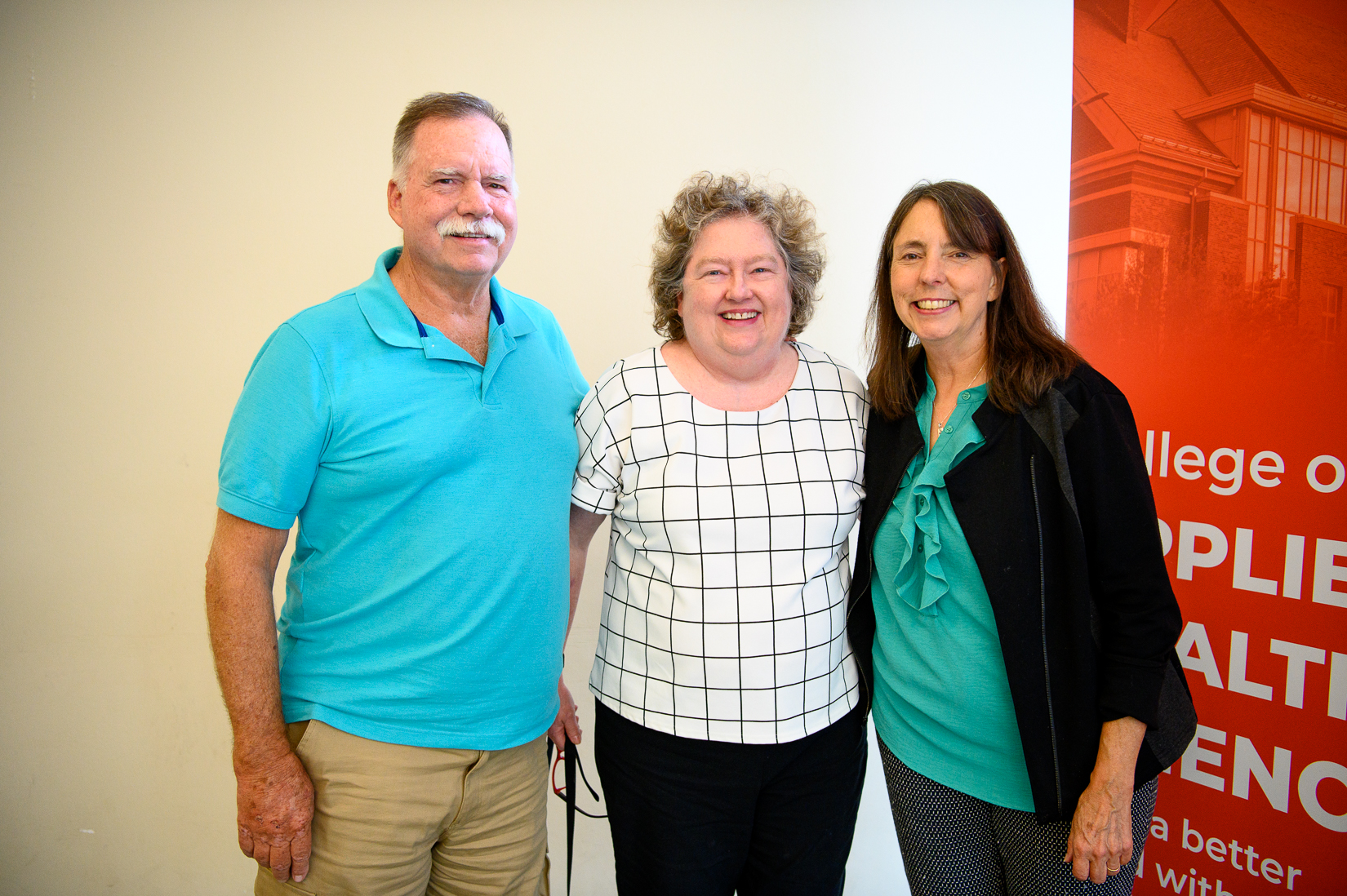
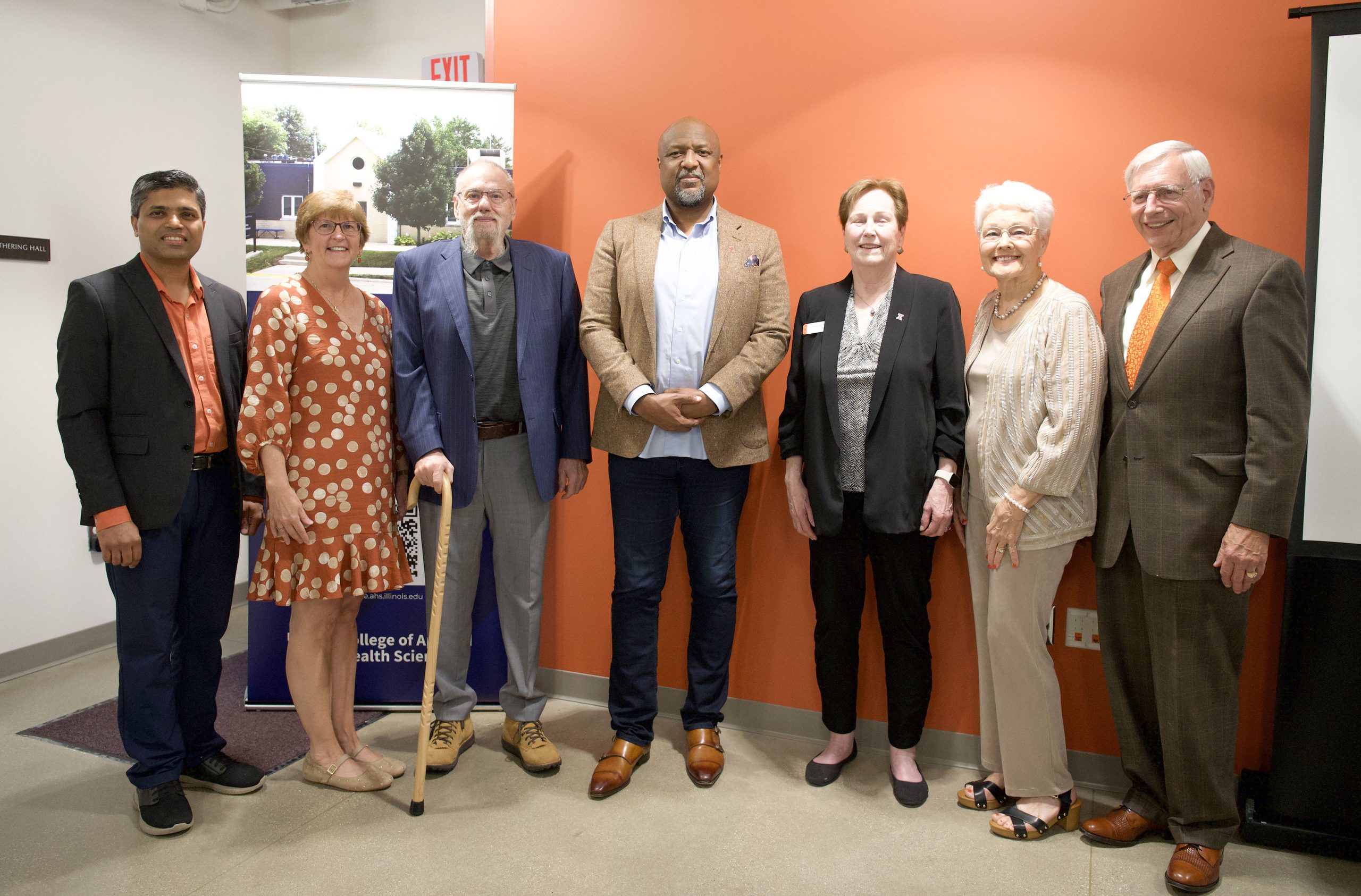
Laura Payne, right, was joined by brother Tom, left, and her cousin Mary Lynn O’Connor at the McCristal Lecture (Photo by Bridget Lee-Calfas)
For Laura Payne, the study of leisure is anything but idle work. It is a way to understand how people build identity, sustain relationships and protect their health across a lifetime, and how communities can make those benefits available to everyone.
That career-long commitment was celebrated as Payne was honored as the 2026 King James McCristal Distinguished Scholar in the College of Applied Health Sciences at the University of Illinois. The distinction recognizes outstanding scholarships and gives the college community an opportunity to learn from researchers whose work is shaping their fields and improving health and well-being.
Payne, whose scholarship explores how recreation affects quality of life, marked the honor with a lecture titled “Leisure, Health, and Well-Being: Expanding Research Impact Through Public Engagement.”
Her remarks traced the roots of her research from childhood experiences in suburban Chicago to questions about resilience, chronic disease and healthy aging.
“I’m really delighted and greatly appreciate this honor,” Payne said.
Growing up, she found that recreation helped shape her confidence and sense of self. Access to a park district opened a world of activities and eventually led to jobs at a swimming pool, first as a lifeguard and later as a pool manager. She did not realize recreation could become an academic field until she was well into an undergraduate communications degree. After several years at a Chicago management consulting firm, however, she knew she wanted to work with a mission that felt more personal.
Leisure and recreation had mattered deeply to Payne and her family. Over time, that understanding developed into an interest in aging, a subject she describes as inherently personal. One of the most important influences was her older brother, Tom, who was diagnosed in early adulthood with ankylosing spondylitis, a form of inflammatory arthritis. Payne watched him navigate disruptive symptoms, evolving treatments and changing lifestyle demands while remaining committed to the activities he loved.
She was struck by his resilience and by the grit of others who adapted cherished pursuits rather than surrendering them. “Tom, you were a big reason why I pursued this line of research,” she said during her remarks. Her mother’s concise philosophy offered another guide: “Healthy aging is about ‘adapt, adapt, adapt.’”
Those experiences helped Payne frame leisure not as an optional luxury but as an essential part of a good life. To prepare for her talk, she said she asked 25 people about what made a good day. Every participant named two leisure activities. Her research also found that people with broader leisure repertoires reported substantially better physical and mental health than those with fewer activities.
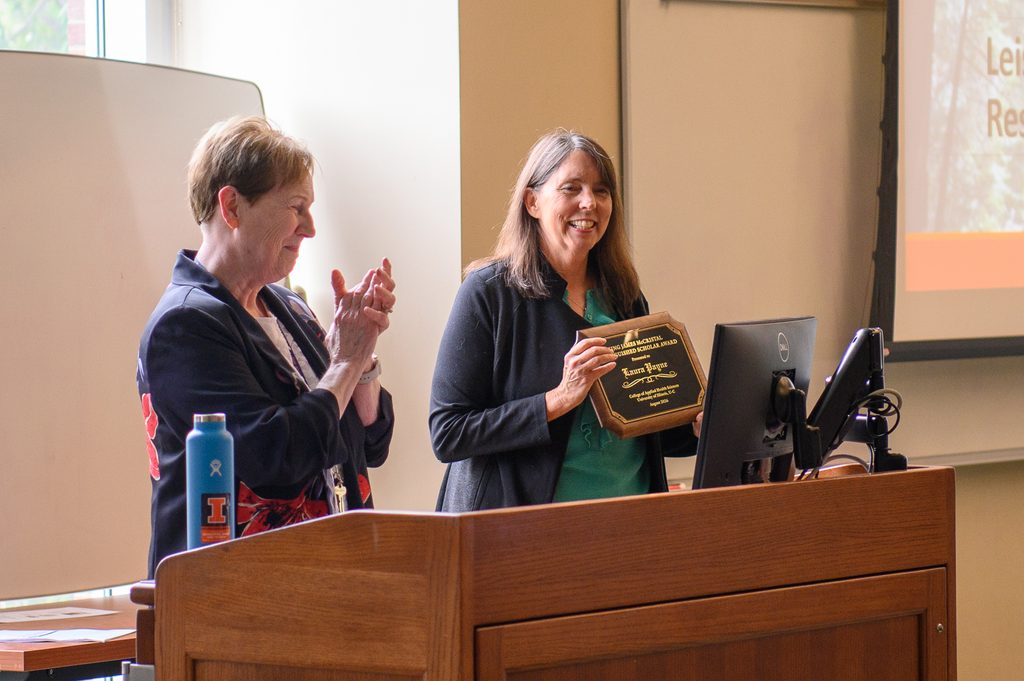
Laura Payne, right, accepts her plaque from Dean Cheryl Hanley-Maxwell (Photo by Bridget Lee-Calfas)
The findings carry increasing urgency as the population ages. Payne noted that people 100 and older are the fastest-growing segment of the older population, with many living more independently. Yet longer lives also bring challenges, including rising risk of developing chronic disease, uneven access to recreation and broader social conditions that affect whether people can pursue and define good health. Personal circumstances matter, too. Understanding healthy aging, in her view, requires attention to all of those forces and to what older adults are already doing well.
Cheryl Hanley-Maxwell, dean of the College of Applied Health Sciences, praised Payne as an accomplished scholar who has advanced understanding of leisure, health and well-being while ensuring that her research makes a difference beyond the university.
“Her work reflects a deep commitment not only to generating knowledge, but also to ensuring that research reaches beyond the university and makes a meaningful difference in the lives of individuals and communities,” Hanley-Maxwell said.
That public-facing commitment is especially visible in Payne’s leadership of the Office of Recreation and Park Resources, which she took over in 2020. Payne refreshed the office’s mission: to collaborate on recreation, sport and tourism initiatives that build healthy communities. Under her leadership, the office responds to community and industry needs, issues and trends while giving undergraduate and graduate students hands-on experience through projects.
Hanley-Maxwell said Payne’s approach demonstrates that research can have greater impact when scholars build relationships with communities, listen to the people their work is meant to serve and translate evidence into practices that are useful and accessible. That approach, the dean added, embodies the values of the McCristal honor.
The King James McCristal Scholar Award was established in 1988 to honor King McCristal, dean of AHS from 1961-1973.
“Dr. Payne’s research reminds us that leisure is far more than how we spend our free time,” Hanley-Maxwell said. “It can be an important contributor to health, quality of life, social connection and well-being, and a powerful avenue through which research can engage communities and create broader societal impact.”
For Payne, the recognition brings a career built around that idea full circle: from a child finding confidence through local recreation, to a scholar asking how leisure can help people adapt, connect and thrive, to a public-engagement leader working alongside communities to put that knowledge into practice.
The theme of the 2026 Sapora Symposium was ‘the power of community.’ (Photo by Ethan Simmons)
The 2026 Sapora Symposium once again brought the RST community together in a powerful way—connecting students, alumni and industry leaders through meaningful engagement and shared learning.
Centered on this year’s theme, the power of community, the Symposium explored how civic engagement, marketing, and social and digital innovation shape professional pathways across recreation, sport, and tourism.
The series kicked off on January 29 in Chicago with keynote remarks by Michael Strautmanis of the Barack Obama Presidential Center, whose insights on leadership and community development set the tone for the weeks ahead.
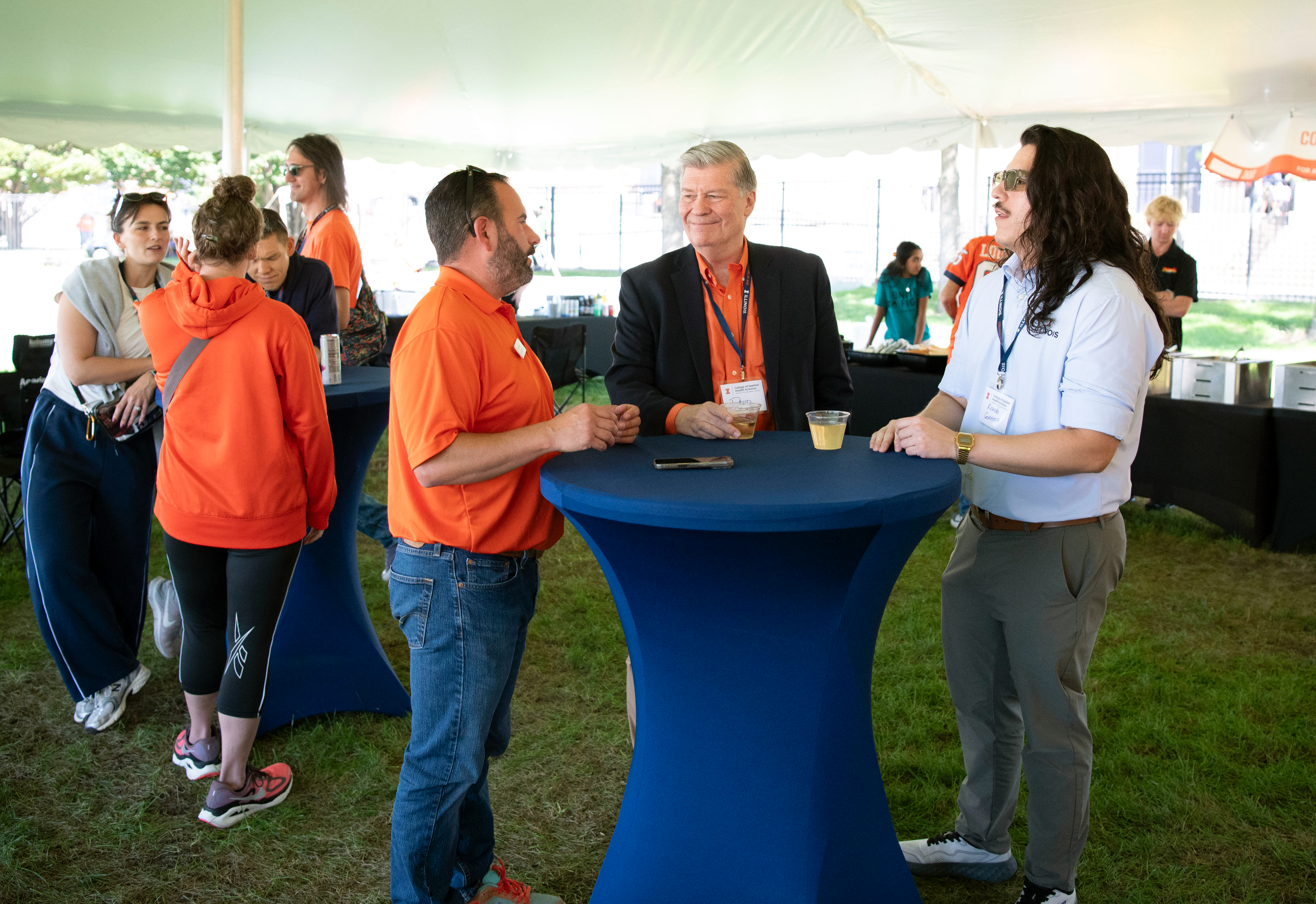
The main event, held March 6 at the Illini Union, welcomed more than 130 undergraduate and graduate students and over 35 speakers and table hosts—most of them RST alumni. Throughout the day, students engaged directly with professionals, turning conversations into mentorship and networking into lasting connections.
We are deeply grateful to TSMGI for their continued partnership and to the outstanding group of speakers and guests who generously shared their time and expertise:
2026 Participating Speakers & Guests
Jordan Bressler – TSMGI
Reese Bressler – TSMGI
Jamie Bronska – Chicago White Sox
Glenn Eden – Chicago Civic Leader / Choose Chicago
Carly Eilian – TSMGI
Christian Evans – Indianapolis Pacers
Brian Floriani – Bernie’s Book Bank
Abri Forrest – TSMGI
Melissa Garritano – Special Olympics Illinois
Megan Gaseor – Chicago Cubs
Parker Gray – DIA Marketing Street Team
Joe Kennedy – Obama Presidential Center
Chris Marciani – TMRW Sports
Andrew McCarthy – TSMGI
Alexis McCay – KemperSports
Nick McDuffee – Village of Savoy Parks and Recreation
Brendon McGuire – DIA Football Video
Lauren Mroz – National Basketball Association
Alex Munoz – NASCAR
Tristan Nelson – Oklahoma City Thunder
Joe Ronovsky – Village of Bedford Park / Wintrust Sports Complex
Carmen Rossi – 8 Hospitality
Alex Roux – Big Ten Network
Rebecca Seldin – TSMGI
Liam Sise – La Grange Park District
Joey Spathis – TSMGI
Mark Steinberg – Excel Sports Management
Christine Stromberg – United States Tennis Association
Angela Tzortis – Chicago Cubs
Rachel Wright – TSMGI
Your collective engagement—spanning sport organizations, tourism and destination marketing, recreation and park systems, community development, nonprofit leadership, and agency work—created an exceptional experience for our students and reflected the full breadth of the RST field.
Our alumni play a vital role in sustaining the strength of our community
Hello alumni and friends of the Department of Recreation, Sport and Tourism,
As the spring semester comes to an end, I am pleased to share the latest edition of the Recreation, Sport and Tourism newsletter with our alumni community. This issue reflects the breadth of experiences, scholarship and impact that define RST, and I hope it reconnects you with the people and programs that continue to shape the field.
One of the highlights in this edition explores an exciting partnership centered on Wintrust Sports Complex and Bedford Park, where RST students have been directly involved in emergency planning efforts. This hands-on work exemplifies how our students apply classroom knowledge to real-world challenges, gaining valuable experience while contributing meaningfully to community resilience and safety.
We also take a reflective look at the history of Black runners in the Boston Marathon, a story that not only honors perseverance and achievement, but also underscores the evolving relationship between sport and social change. It is a powerful reminder of the broader cultural contexts in which recreation and sport exist.
Closer to home, we celebrate the contributions of Professor Laura Payne and her work documenting the history of the Office of Recreation and Park Resources. This story highlights the enduring legacy of outreach, research and public engagement that has long been a cornerstone of our department’s mission.
Our alumni network continues to be a source of pride and inspiration. In this issue, you’ll read about a group of RST graduates whose professional paths converged at the USTA, illustrating both the strength of our program and the lasting connections formed here. Their story is a testament to the collaborative spirit that defines our community.
We are also excited to spotlight the global opportunities available to our students, particularly through internships abroad that expand cultural understanding and professional growth. These experiences prepare students to lead in an increasingly interconnected world.
Please join me in welcoming our new postdoctoral researcher, Alessio Norrito, whose work will contribute to the department’s ongoing commitment to innovative research and thought leadership.
Finally, the 2026 Sapora Symposium brought together students, alumni and industry leaders across recreation, sport and tourism for a dynamic day centered on the theme of community. More than 130 students engaged with over 35 speakers and table hosts—many of them RST alumni—creating meaningful connections and mentorship opportunities. We are especially grateful to our alumni, partners and TSMGI for making this experience possible.
Thank you for your continued support and engagement with RST. Whether through mentorship, collaboration or simply staying connected, you play a vital role in sustaining the strength of our community. I hope you enjoy this issue and find it both informative and inspiring.
A sponsored partnership serves as an experiential learning opportunity for Recreation, Sport and Tourism students
Students from RST 441 and faculty from the department have developed a model for emergency preparedness at the Wintrust Sports Complex at the Village of Bedford Park. (Photo provided)
On any given weekend, the parking lots around the Wintrust Sports Complex fill with minivans and team buses, their passengers streaming through the doors with duffel bags and folding chairs in tow. Inside, basketballs thud against hardwood, volleyballs whistle across nets and tournament brackets inch toward championships. Over the course of a busy stretch, as many as 2,000 athletes, coaches and family members can pass through the facility.
What most of them never see is the intricate choreography required to keep that many people safe, and the multiyear partnership quietly reshaping how that work gets done.
Over the past three years, the Village of Bedford Park, Wintrust and students and faculty from the Department of Recreation, Sport and Tourism in the College of Applied Health Sciences at the University of Illinois Urbana-Champaign have built a model for emergency preparedness that doubles as a proving ground for experiential learning. What began as a consulting-style project in faculty member Mike Raycraft’s course has evolved into a collaborative, partner-supported initiative central to the department’s engaged scholarship.
At its core, the collaboration reflects RST’s broader strategy: strengthening its national leadership in experiential education through a growing network of community, industry and governmental partnerships that give students high-impact, hands-on training opportunities while addressing real-world challenges.
One prominent example is the funded contract with Bedford Park and the Wintrust Sports Complex led by co-principal investigators Carla Santos—RST’s department head—and RST faculty members Mike Raycraft and Toni Liechty. Through that work, faculty and students are not only developing applied learning opportunities, but also assisting their sponsor in tackling pressing issues tied to community development and facility and operational readiness.
“Our sponsored partnership with Bedford Park and the Wintrust Sports Complex enables us to translate research into practice while providing students with direct, hands-on experience in the field,” Santos said. “Through engagement with practitioners and meaningful service to communities, our students develop the professional competencies, leadership skills and applied judgment that employers increasingly demand. This investment in experiential learning strengthens course relevance, deepens community impact and reinforces RST’s national reputation for preparing career-ready graduates.”
The practical engine behind much of that work is RST 441, a course led by Adjunct Instructor Robyn Deterding. In the class, graduate students function less like traditional students and more like consultants embedded in a working sports venue.
When the partnership began, Deterding said, the first task was to assess the complex’s existing safety infrastructure.
“Wintrust didn’t have much in the way of plans and emergency practices when we started,” she said. “So first we had to find out what they had, what they did and when they did it.”
Students evaluated routine facility checks, reviewed staff training frequency and examined equipment inspection practices. They presented recommendations to venue leadership, who were responsible for implementation. In the second year, the focus sharpened on evacuation planning—a critical need for a multicourt complex hosting youth tournaments, adult leagues, corporate events and special competitions, often simultaneously.
“You know you can’t prevent accidents and incidents from occurring,” Deterding said. “But you can plan and train for them. If they don’t happen, excellent. If they do, you have a plan to work from.”
The partnership has since expanded to include coordination with the Chicago Office of Emergency Management, Homeland Security and other public safety agencies. This year, students in RST 441 are partnering with the complex, the village and Chicago emergency officials to plan and deliver the Safe Chicago training program, an initiative designed to train up to 100 community and agency participants in CPR/AED, Narcan administration and Stop the Bleed techniques.
The Safe Chicago program represents the next phase of the “living lab” concept: moving beyond internal planning to outward-facing community resilience. By training coaches, staff, volunteers and local collaborators, the effort extends preparedness beyond the building’s walls.
For Bedford Park officials, the collaboration has provided both practical benefits and a long-term talent base.
“Our goal is to be able to develop a pipeline to give students an experience and give them an internship where they’re actually going to learn something and be in charge of the task with a project as opposed to going to an already established relationship,” said Joe Ronovsky, the village’s chief business officer. “We view this as like the lab in the Chicagoland area.”
That lab connects students with a broader ecosystem of sports and corporate partners, including the Chicago Sky, the Chicago White Sox, Wintrust Financial and Special Olympics Illinois.
“We really wanted to create kind of this lab that gave them real-life experience as opposed to just an internship where you’re cold calling or doing mailing,” Ronovsky said. “A real-life lab.”
For students, the difference is tangible. Rather than drafting hypothetical plans for a classroom grade, they are producing emergency guides, training protocols and communication strategies that can be adopted and implemented immediately.
“Any students working on these projects with us can actually go into a job interview and talk about things that have actually been done and implemented versus a hypothetical project that they did in grad school,” Ronovsky said.
The arrangement also acts as an external audit for the village and complex.
“The return on it for us is that we get third-party validation of changes or things that we need to implement,” Ronovsky said. “They’re the brightest minds, and one day all those students are going to be in leadership positions. The best thing you can do is just open up the opinions of the room and let all the brighter people talk and contribute to what we want to do. The return for us is just to be able to create this incubator.”
The inside of the Wintrust Sports Complex. (Photo provided)
Co-investigator Raycraft said the “leadership of Dave Brady and Chief Business Officer Joe Ronovsky has been transformative for the Village of Bedford Park.
“Their forward-thinking vision has accelerated economic development, strengthened tourism and elevated the village’s profile as a hub for sport, business and community engagement. Importantly, this collaborative environment has created a unique living laboratory for our students and faculty and provided opportunities to explore innovative ideas, conduct impactful research and contribute meaningfully to community-based service initiatives.”
Deterding emphasizes that emergency planning hinges on the principle of reasonable care, the obligation to take appropriate precautions to protect patrons. In a venue that can host thousands of visitors in a weekend, many of them minors, the stakes are high.
“Making sure everyone is receiving the same information and coordinating the work each is doing is difficult,” she said. “There are a lot of moving parts, but that’s what we do, and we do it well.”
Risk management can easily fade from attention in the absence of crisis, she acknowledged. Part of her role is ensuring that safety remains integrated into daily operations rather than relegated to a binder on a shelf.
The broader lesson, Santos said, is that experiential learning is most powerful when it serves both students and communities. The Bedford Park partnership complements a wider array of industry-engaged projects across RST, each designed to blur the line between classroom and field.
As whistles blow and crowds cheer inside the Wintrust Sports Complex, much of that work remains invisible. Yet embedded in updated evacuation guides, coordinated agency protocols and community-wide trainings is a model for how universities and municipalities can collaborate—strengthening public safety while preparing graduates ready to lead from day one.
In Bedford Park, the game plan now extends well beyond the court.
One embarrassing moment produced viral fame and lifelong lessons for this Recreation, Sport and Tourism alum.
In Derek Dye’s 2012 internship with the Daytona Cubs, he sold concessions, cleaned the bleachers, worked the soundboard, even dressed as the mascot. (Provided)
At their best, college internships are valuable learning experiences. Derek Dye didn’t expect his to involve getting tossed out of a baseball game.
That was the viral story for this University of Illinois alum’s first big-time summer job with Minor League Baseball, working as a stadium operations intern in August 2012. Back then, Dye was a rising senior in the Recreation, Sport and Tourism program at Illinois, eager to break into the sports industry.
“I would’ve done anything to work in sports,” Dye said. “The minor league was the main target for me, a lot of people wanted to get their foot in the door.”
Growing up in Moline, Illinois, sports were truly his life: Dye ran a backyard football club in high school and developed a passion for sports data of the major leagues. His dream was to become the general manager for the Chicago Cubs.
When college neared, he applied to relevant programs across the state that could help him reach his goals. He eventually broke through the waitlist for the University of Illinois’ Recreation, Sport and Tourism program in the spring of 2009.
“The RST major was the first thing I was looking at, I thought it was the perfect fit,” Dye said.
It’s customary for RST students to work an internship in the field before they graduate. Baseball’s minor league was his main target, including the Quad City River Bandits in his hometown.
The summer before his senior year at Illinois, he landed a seemingly perfect role: an internship with the Daytona Cubs, the Minor League Baseball team in Daytona Beach, Florida, and affiliate of the Chicago Cubs.
He ended up taking out a $1,700 loan from his grandma to live in a Daytona Beach apartment. When the summer of 2012 began, Dye began a do-everything internship for the Cubs: serving stadium food and beverage, cleaning the bleachers, selling tickets and running the soundboard, all for a $50-a-week stipend.
“You’re gone!”
A picture of the Daytona Cubs soundboard’s options for “bad call.” (Provided).
August 1, 2012. The Fort Myers Miracle faced off against the Daytona Cubs.
At the top of the eighth inning, a Fort Myers batter hit a ground ball to short. The Cubs threw it first, and the umpire called it safe. But Dye, sitting up in the press box, thought it was an out. Earlier that week, Daytona had added an array of audio snippets on the soundboard to play for a “bad call.”
One of them was an organist’s rendition of “Three Blind Mice.” Dye clicked on it.
Umpire Mario Seneca’s head perked up, then he turned and pointed to the press box. “You’re gone!”
The crowd was puzzled, and Seneca continued to gesture up to the soundboard, where Dye was at the helm. “Turn the sound off the rest of the night.”
Fear washed over him.
“As you can imagine, being 21 years old and 1,200 miles away from home, my first reaction is ‘what just happened? I’m gonna get fired,” Dye said. “I can’t believe this is actually happening.”
Ejected from his post, the press box was silent: no batter walkups, no anything. The fans started to announce the game themselves, standing from the stands and shouting out the players’ names who were up to bat.
After the game, Dye resumed his usual grunt work, leaf-blowing peanuts from the stands. Then his phone started ringing off the hook: calls came in from reporters at CBS, ESPN, Major League Baseball.
News of his ejection was trending on Twitter. Everyone wanted to know about the soundboard guy—an intern—who was thrown out of the game for playing Three Blind Mice.
“I tried to talk to as many people as I could,” Dye said. He took calls until 2 a.m.
After waking, WGN called him. Unbeknownst to him, it was live on air. He answered questions from his closet so he wouldn’t wake up his roommates.
Dye’s ejection contended for the Minor League Baseball “Moment of the Year.”
He went to the ballpark the next day, and 45 more publications were there to talk to him.
The fallout from the league arrived immediately. Florida State League Commissioner called the incident a “mockery of the game” and fined the team $525.
Dye was banned from the press box for the remainder of his internship. But the team’s general manager, Brady Ballard, covered the fee for his barely paid intern.
“It showed me he saw the big picture,” Dye said. “I was a 21-year-old intern doing my work to engage the crowd and cut my teeth in sports. He didn’t shy away from it, and his support also helped the story grow legs.”
And the Daytona Cubs sold out their stadium the very next game.
“I think the legend behind it had more sticking power than it would nowadays,” Dye said. “Every year it comes up in August for the anniversary.”
‘Your rep is your personal brand in the industry’
When Dye returned for his senior year at Recreation, Sport and Tourism, advisor and instructor Ryan Gower—now chancellor of Illinois Eastern Community Colleges—asked one of his classes: “Anyone have any funny stories from their internships?”
Everyone looked back at Dye and laughed. He had gotten texts from classmates about his ejection for the whole month.
After working in the sports world, Dye is now the director of marketing for Chicagoland’s Affy Tapple.
“Instead of putting my head down, I was able to turn what could’ve been a really negative thing into a really fun story,” Dye said.
He took classes from RST’s many memorable professors, including Clinical Associate Professor Michael Raycraft and Adjunct Instructor Kyle Emkes, and experienced the breadth of the leisure and tourism side of the major in classes with Professor Carla Santos and Professor Emeritus Kim Shinew.
He also took on new roles in his budding sports career, working 40-hour weeks while interning for Illinois Division of Intercollegiate Athletics. He helped the kids club and worked with spring sports teams, such as softball and tennis.
Words from instructor and former Illinois volleyball coach Don Hardin lingered with him: if you want to work in sports, you’ll have to handle the tough stuff.
“There’s going to be grunt work, not everything is going to be a glamorous stop,” Dye said, paraphrasing Hardin’s advice. “You’re going to have to be on the front lines, and your rep is your personal brand in the industry.”
After graduating in 2013, Dye interned with Tampa Bay Rays and later managed eCommerce for Sports Collectibles, a sports memorabilia seller. Today, he’s the marketing director for Affy Tapple, a caramel apple producer in Chicagoland.
His degree at RST continually comes in handy at his newest role, where he’s had to manage people and organize big events. Dye hasn’t become a Major League general manager, but the moment he feared would stain his reputation ended up shaping how he shows up for others.
“Being on the ground level, you see everything and learn how to make the best of tough situations,” Dye said. “I’ll never be hard on someone for trying their best.”
Huff Hall today, left, and the building in 1924. (Photo illustration by Michelle Hassell).
By Anna Flanagan
Many people still think of the home of the College of Applied Health Sciences as Huff Gym. The building opened in 1925 as the New Gymnasium, giving the University of Illinois men’s basketball team what was then state-of-the-art facilities for home games. Renamed for longtime athletic director and coach George Huff in 1936 after his death, Huff Gym later became Huff Hall to better reflect its significant role in the academic life of the university.
The four hallways on the first floor of the building surround the gym, which is still used for volleyball, wrestling and gymnastics events. But faculty associated with Huff have cemented its scholarly reputation as the site of pioneering research and groundbreaking advancements in health and leisure studies.
The Father of Physical Fitness
The early academics residing in Huff Gym were the faculty of the School of Physical Education. They included Seward Staley, who served as director and dean from 1936 to 1960. Staley was a strong advocate of building physical education programs around a sport-based curriculum and conducted extensive research on physical education and sport throughout his career. He guided the School of Physical Education to prominence as a leader in health-related research.
Staley’s own commitment to research-based practice influenced his faculty recruitment. In 1941, Thomas “T.K.” Cureton, known as the “father of physical fitness,” joined the School of Physical Education. He established the Physical Fitness Research Laboratory in Huff Hall, one of the first of its kind in the nation. He conducted cutting-edge research on what he called the six primary components of physical fitness—endurance, flexibility, agility, strength, power and balance—and revolutionized existing knowledge about weight and fitness, oxygen’s role in athletic performance and the role of exercise in cardiovascular health, among other things.
As Jack Berryman, then the official historian of the American College of Sports Medicine, observed in a 1996 article in Research Quarterly for Exercise and Sport, Cureton was the only fitness enthusiast of the 1950s (a group that included Charles Atlas and Jack LaLanne) “who produced the research to substantiate his beliefs regarding the positive influence of physical activity on health.” Cureton’s work helped to elevate the reputation of physical education and led to the establishment of research labs in departments across the country.
In addition to the hundreds of journal articles, books and research monographs published during his career, Cureton shared his beliefs widely through numerous lectures around the world, called Cureton Clinics, and frequent appearances in magazine and newspaper articles and on television programs focused on health and fitness. His son, Kirk Cureton, who himself had a long and distinguished career in kinesiology at the University of Georgia, said he wasn’t aware of his father’s reputation in the field of physical fitness science as a child. He participated in the Sports Fitness Experimental School that his father established in 1950 to improve the physical fitness of youth, still running today as the Sports Fitness Program, and recalls going to his father’s lab where Cureton and his graduate students assessed such things as cardiovascular health and muscle endurance.
Kirk Cureton’s knowledge of his father’s stature grew as he did, and he feels it played a positive role as he established his own career.
“My father was known, and it helped me with networking,” he said, adding that TK was “a good model.”
“What I learned from him was persistence and the value of hard work,” Cureton said. “He was devoted to his field. He loved what he did. He thought working at a university was the best thing you could do.”
Poised for the future
Many outstanding scholars walked the halls of Huff as the School of Physical Education evolved into the College of Applied Health Sciences. They established the first driver education teacher training program in the Midwest, created the first K-12 sex education curriculum that was adopted throughout the country, conducted a groundbreaking study on driving and alcohol consumption that resulted in the lowering of the DUI threshold from .15 to .10, conducted a comprehensive anti-smoking education study of youth that resulted in the first academic contribution to the annual Surgeon General’s Report on smoking and health, and put sport psychology on the map as a legitimate academic discipline, among many other contributions.
T.K. Cureton was ‘devoted to his field,’ his son Kirk said. (University of Illinois Archives)
“Our current faculty engages in research that, in a lot of ways, wouldn’t have been possible without Cureton and the other pioneers,” she said. “We still focus on issues related to physical fitness and health, cardiovascular health, for example, which was so important in Cureton’s work. But we have developed a more discipline-focused approach, looking at biomechanics, exercise physiology, brain health or exercise psychology, and so much more.”
Graber noted that while the department has expanded far beyond its early focus on training school health educators, teacher training is still an important part of its mission as evidenced by its Physical Education Teaching Licensure program. Huff Hall is still an important hub for the department, she said, serving as the home of its three professional degree programs—Master of Public Health (MPH), Master of Health Administration (MHA) and Master of Science in Health Technology (MS-HT). Many health and kinesiology faculty have their offices and laboratories in Huff, where they are addressing current and emerging health challenges such as the role of technology in successful aging, gut health and chronic disease in underrepresented populations.
“Our research is cutting edge,” Graber said. “It’s innovative. It’s futuristic. We’re in a good position to tackle the problems of the next generation.”
Giants of recreation and leisure
Huff Hall also is the home of the Department of Recreation, Sport and Tourism, which had its beginnings in the Department of Physical Education for Women. That department, which included recreation in its curriculum, joined the Department of Physical Education for Men to form the School of Physical Education. The School began offering a bachelor of science degree in recreation in 1948, thanks to the efforts of Allen Sapora. The curriculum he developed became a model for programs around the country. Sapora believed strongly in the importance of applied research and was one of the first scholars to integrate research into recreation education and professional practice.
Charles Brightbill joined the Illinois faculty as a professor of recreation in 1951 and, working together with Sapora, built the program into one of the leading park and recreation education programs in the world. Brightbill had a well-established national reputation in the field of recreation by the time he joined the Illinois faculty, having served as the executive secretary of President Harry Truman’s Committee on Religion and Welfare in the Armed Forces, among other positions. In 1957, he became the inaugural head of the Department of Recreation, which was created when the School of Physical Education was reorganized and renamed the College of Physical Education. His advocacy of cooperation between citizens and professionals in the parks and recreation field played a significant role in the formation of the National Recreation and Park Association.
After Brightbill’s death, Sapora served as department head and created the Office of Recreation and Park Resources in partnership with University of Illinois Extension. He hired Joseph Bannon, who had completed his master’s degree in recreation at Illinois, to lead the new initiative. Like Sapora, Bannon firmly believed that practice in the parks and recreation field needed to be informed by scientific research, and that research needed to address real world issues. His own research focused on the development of recreation organizations. Laura Payne, professor of recreation, sport and tourism and Joseph J. Bannon Director of the Office of Recreation and Park Resources, said Bannon’s contributions are still relevant today.
Charles Brightbill, left, and Allen Sapora, right front, were pivotal to the establishment of what is now known as the Department of Recreation, Sport and Tourism. (University of Illinois Archives)
“He was the expert nationally and internationally in public parks and recreation organizational development, leadership, management and administration,” she said. “His work addressed policy and practice, and how organizations relate to one another.”
Bannon, who became head of what was then the Department of Leisure Studies in 1973, was instrumental in strengthening the interdisciplinary nature of the department’s research, hiring faculty with backgrounds in such fields as psychology and sociology. He was a co-founding editor of the Journal of Park and Recreation Administration and, along with Allen Sapora, a founding Fellow of The Academy of Leisure Sciences, or TALS. Fellowship in TALS is a prestigious honor, one that many RST faculty and PhD graduates have earned since the organization’s founding in 1980. Among them are John “Jack” Kelly and Lynn Barnett, also giants in the field of leisure studies.
Kelly, in fact, played an instrumental role in establishing the field of leisure studies. He believed that knowledge of leisure theory would help practitioners make informed decisions and design more relevant and effective programs. He wrote the first textbook in the field of leisure studies, appropriately entitled Leisure, and encouraged scholars to address the sociological and psychological aspects of leisure.
“Jack Kelly is a legend in our field,” Payne said. “He was ahead of the curve on many societal issues and trends in the 1970s and early ‘80s, anticipating and working on healthy aging, work and leisure, socialization and leisure and family leisure. He really catapulted us forward by making our research more relevant and increasing our visibility to people outside of parks, recreation, sports, tourism and leisure studies.”
Barnett studied the role of play and playfulness in the lives of children and adults for more than 40 years. As a doctoral student in educational psychology, she became convinced that children learned as much or more outside of the classroom as they did within it. Over the years, she found that playfulness is a fairly stable construct that is related to cognitive and socioemotional functioning. Her research showed that playfulness was linked to flexibility in thinking, enjoyment, positivity, and social skill, and that it was often used to cope with anxiety.
“Lynn brought education, human development and play together in a way that hadn’t been done before,” said Monika Stodolska, Brightbill/Sapora Professor and associate head of recreation, sport and tourism. “She inspired generations of scholars, students and practitioners to look at play as being integral to learning, and socioemotional, physical, and cognitive development.”
The commitment remains
Scholars in the Department of Recreation, Sport and Tourism continue to believe in practice-based research and research-based practice. RST faculty still examine leisure’s role in the healthy development of individuals, families and communities, focusing on such contemporary issues as the role of sport in human and community development, equity in access to parks and green spaces and how social, cultural, environmental and political factors affect tourists and host communities. As RST professor and department head Carla Santos put it, “We keep our ears to the ground, listening and observing and staying connected to what’s going on in recreation, sport and tourism in order to be responsive to needs and priorities. That has been true of this department throughout the nearly 70 years we’ve been in Huff Hall.”
The College of Applied Health Sciences has grown beyond the walls of Huff, now also occupying Freer Hall and the Speech and Hearing Science Building. But one hundred years after its opening, Huff Hall remains the nerve center of AHS, and that’s just fine by Cheryl Hanley-Maxwell, dean of AHS.
“With the addition of the Khan Annex and modernization of instructional spaces, Huff wears its age well and is a comfortable academic home,” she said. “It’s a campus landmark and I’m proud that it’s the heart of AHS. But in the end, what really makes a building special are the people who work within it, our students, faculty and staff. We are blessed in AHS to have exceptional students, creative and dedicated faculty and skilled and supportive staff. I’m proud of all of them.”
As the fall semester unfolds, I am delighted to share the newest edition of our Recreation, Sport and Tourism newsletter. This issue reflects the breadth of scholarship, creativity and connection that define our department.
Among the stories you’ll read are the work of Charis Tucker, whose research explores the history and lived experiences of Black travelers; Joelle Soulard and Toni Liechty’s creative project investigating the relationship between tattoos and travel; Yannick Kluch’s initiative to empower high school athletes through a peer-to-peer social justice curriculum; and Monika Stodolska’s research on how Ukrainian refugees in Poland find meaning and community through leisure.
Beyond research, this issue also celebrates the friendship between Alex Roux and Dan Bernstein, two alumni whose shared love for sport has evolved into a meaningful personal and professional bond. Their story, and the story of alumnus Dan Isaacson, are testaments to the enduring connections forged through RST and the ways our graduates continue to carry forward the spirit of collaboration and community.
These features, and many more, capture the vibrant spirit of our department. They remind us that the heart of RST lies in the people, stories and relationships that give meaning and shape the future of recreation, sport and tourism.
Thank you for being a vital part of our community. I hope this newsletter inspires you, as it has inspired me, to celebrate the diverse ways recreation, sport and tourism shape our world.
RST Department Head Carla Santos at the department’s 2025 awards ceremony (Photo by Bradley Leeb)
Hello RST Friends and Alumni,
Welcome to the spring 2025 edition of the RST newsletter! We are excited to share some of the latest research breakthroughs from our faculty, outstanding student achievements and the ongoing contributions of our incredible alumni.
This year, we are especially proud to showcase how our students and faculty are leading the way in shaping the future of recreation, sport and tourism. From groundbreaking research to impactful community engagement, RST is at the forefront of addressing critical issues and advancing knowledge in our field.
In this issue, you’ll find stories on how racial segregation and park availability impacts physical activity, how misinformation can alter voters’ minds on green spaces, and the growing global impact of RST initiatives. As we reflect on the past year, I’m deeply thankful for the leadership and support from both our faculty and alumni. Together, we’re bridging the gap between academia and industry to drive meaningful change in communities near and far.
Thank you for being a vital part of our journey. Here’s to a brighter, healthier and more inclusive future!
Greetings, Friends and Alumni of the Department of Recreation, Sport and Tourism,
Welcome to the fall 2024 edition of the RST newsletter. I am pleased to share highlights of the latest research from our faculty, remarkable student achievements, and the continued involvement of our distinguished alumni.
We are proud to spotlight the accomplishments of our students and showcase how the cutting-edge research conducted by our faculty positions our department as a leader in advancing knowledge, shaping the future of our field and addressing pressing issues in the communities we serve. Whether you are an alum, current student, or a member of our esteemed faculty, we hope you find these stories both inspiring and thought-provoking.
As I reflect on this past academic year away from RST, I am profoundly grateful for the strong tradition of leadership within our faculty and alumni network as I return to this post. Your steadfast support and commitment have been instrumental in the continued growth and success of our department, evidenced by our expanding educational programs and sustained influence in academic and professional arenas. Together, we’re connecting the academy with industry and making a difference in people’s lives. With your continued partnership, we’re shaping a healthier, more inclusive future for communities. Thank you for being such an essential part of our journey!
Warm regards,
Carla Santos Head Department of Recreation, Sport and Tourism
Welcome to the fall issue of RST E-News! We have had a whirlwind start to academic year 2022-23, enrolling 296 student majors and adding four new professors to our tenure-track and specialized faculties. In this issue, we’ll introduce you to Assistant Professor Nicholas Pitas, Associate Professor Mariela Fernandez, and Teaching Assistant Professors Renata Endres and Jacob Fredericks.
You’ll also read about fascinating research led by RST professors Joelle Soulard, Liza Berdychevsky, Julian Woolf, Mikihiro Sato, and Jon Welty Peachey and graduate student Wonju Lee. We’ll introduce you to graduate student services advisor Tim Tiger and undergraduate student Emily Jordan, who talks about her experiences in RST.
Several undergraduate students also share their thoughts on the 2022 professional applications class, which culminates in a two-week tour of major RST facilities in New York, Pennsylvania, Indiana, Ohio, and Massachusetts. We are so proud to continue to offer that experience to our students. As you’ll learn, not only do they gain incredible insight into the behind-the-scenes operations of major recreation, sport, and tourism venues, but they also forge strong, long-lasting bonds with their classmates.
Our faculty, staff, students, and many alumni and friends all help make the Department of Recreation, Sport and Tourism a community with purpose. RST faculty is innovative and fully dedicated to our students. Our staff supports both our faculty and students in successfully achieving their goals. RST students are committed to the vision of a world in which everyone has access to safe and healthy leisure opportunities. And our extraordinary alumni continue to stay engaged with the department and its students. I am proud and humbled to be at the head of such a dynamic community. Thank you for your continued interest in and support of this department. As we move swiftly toward another holiday season, I wish you peace, prosperity, good health, and great fun!