Forber-Pratt’s research is focused on disability identity, inclusion, disability sport, and work related to disability activism
SHS alum Anjali Forber-Pratt named director of the National Institute on Disability, Independent Living and Rehabilitation Research
Anjali Forber-Pratt, who earned her bachelor’s and master’s degrees from the Department of Speech and Hearing Science in the College of Applied Health Sciences at the University of Illinois, has been named as director of the National Institute on Disability, Independent Living and Rehabilitation Research (NIDILRR).
Forber-Pratt, most recently an assistant professor at Vanderbilt University, is an elite wheelchair racer, having won two bronze medals at the 2008 Summer Paralympic Games in Beijing, China. She also represented Team USA in London at the 2012 Paralympic Games.
Her research is focused on disability identity, inclusion, disability sport, and work related to disability activism. Forber-Pratt holds a B.S. in Speech and Hearing Sciences, an M.A. in Speech-Language Pathology, and a Ph.D. in Human Resource Development, all from the University of Illinois Urbana-Champaign.
A two-time Paralympian and medalist in the sport of wheelchair racing, Dr. Forber-Pratt has dedicated her life to helping others recognize their potential. Globally, she is involved with disability advocacy efforts related to access to employment, education and sports. She was honored with the inaugural American Psychological Association Citizen Psychologist Award for Advancing Disability as a Human Rights and Social Justice Issue Award in 2020 and was recognized by Diverse: Issues in Higher Education as a 2018 Emerging Scholar. In 2013, she was awarded the American Association of People with Disabilities’ prestigious Paul G. Hearne Leadership Award, given to emerging leaders within the national disability community. Also in 2013, she was named a Champion of Change by the White House and had an opportunity to participate in a roundtable discussion with President Obama about disability policy issues.
“I am extremely honored and humbled by this appointment as well as the opportunity to serve our country,” Forber-Pratt said in a statement. “From my U of I days, I distinctly remember being explicitly taught that we had an obligation as alums to make the world a better place and to be ambassadors, especially for the broader disability community. Dr. Timothy Nugent taught us that, and my coach Adam Bleakney and others reinforced that every day—it was always more than just our athletic journey or just our academic journey. Many of us have found our own unique ways to embody that—I believe serving as Director of the National Institute of Disability, Independent Living and Rehabilitation Research is one way that I will continue to try to serve the broader disability community and educate others. I believe my collective training—with two degrees in Speech & Hearing Sciences as well as my PhD in education that taught me the analytic research skills—it truly is the combination of these degrees and U of I experiences and my own lived experiences as a proud disabled alum that position me well to transition into this role.”
Forber-Pratt served as principal investigator for research projects covering a range of disability issues, including training of special education teachers, experiences of students with disabilities at every education level, and identity development. She has authored 33 peer-reviewed journal articles and is the author or co-author of a number of textbook chapters.
Students are attending college in a unique environment, and that includes students in the College of Applied Health Sciences at the University of Illinois. The AHS communications staff spoke with AHS seniors about online classes, truncated courses and how COVID-19 changed their expectations. Today, we speak with Falguni Deshpande, who graduated in May with a Bachelor of Science in Interdisciplinary Health Sciences.
Photo by caption
Q: Why did you pick I-Health?
A: I was unhappy in my previous major and my sister told me to meet with her previous advisor Beth (Frasca). I met up with Beth on the first day of my sophomore year and saw how welcoming the college of Applied Health Sciences is, which made me realize I wanted to transfer into this college. I knew about I-Health because my sister had majored in it, and I decided on majoring in I-Health because I was interested in expanding my knowledge about health and the ways in which our society and environment influence our health and wellbeing.
Q: Which professors had the most impact on you?
A: The (person) that had the most impact on me was my advisor Beth (Frasca). She has always been so supportive of me ever since I transferred into I-Health, and has helped me so much with figuring out my college life and also my future! She is the reason why I was able to make the switch into I-Health and is also the one who encouraged me to apply for the Health Technology master’s program at our university.
Q: What course did you most enjoy?
A: 3. CHLH 470: Technology, Health, and Aging—this class is what made me interested in the field of health technology! The professor Dr. (Tim) Hale was super amazing and I really enjoyed getting to work with a group on a project where we created a health technology product to solve a health issue.
Q: Did you enter I-Health knowing your career path, or did KCH help you decide?
A: 4. When I transferred into I-Health, my original plan was to go to medical school, but my time in I-Health made me realize how interested I was in helping serve diverse populations and also health technology! After talking with my advisor Beth and other people in I-Health, I decided that I wanted to work in the health care field for a few years before going straight to medical school.
Q: What do you hope to do after you graduate?
A: After I graduate, I will be spending another year at the University of Illinois pursuing a Master of Science in Health Technology. After that, I plan on finding a job in the health care field (hopefully related to health technology) and eventually apply for medical school!
Q: What was your favorite on-campus experience?
A: My favorite on-campus experiences are probably when I would go and explore new parts of campus that I had never been to before! As a freshman I lived in Snyder Hall on Peabody Dr, and one time I decided to walk with some friends down the road and I saw the Krannert Art Museum! I would definitely recommend going there, along with Japan House at the Arboretum!
Q: What do you miss most because of the pandemic?
A: I miss attending in-person classes and the walk to/between classes. I loved getting to know new people and saying hi to them if I see them on the quad. I also miss getting to hang out with my friends and doing in-person volunteering through my service organization.
Q: What are the biggest changes on campus, pre and during COVID?
A: The biggest change I noticed was the culture of campus. Before COVID, you would always see so many people hanging out outside on the quad, whether it be chilling with friends, playing sports, or studying. Now, many people tend to stay inside because most of their classes are online. During my entire senior year, I only had one in-person class, which was IHLT 475!
Q: What would you say to recommend I-Health to a prospective student?
A: I would tell a prospective student that the I-Health major really gives you a holistic view of health and helps expand your understanding of what health is and how it incorporates the different social determinants of health. If you plan on pursuing a career in the field of health and health care, I-Health is the perfect major for you!
Students are attending college in a unique environment, and that includes students in the College of Applied Health Sciences at the University of Illinois. The AHS communications staff spoke with AHS seniors about online classes, truncated courses and how COVID-19 changed their expectations. Today, we speak with Falguni Deshpande, who graduated in May with a Bachelor of Science in Interdisciplinary Health Sciences.
Q: Why did you pick I-Health?
A: I was unhappy in my previous major and my sister told me to meet with her previous advisor Beth (Frasca). I met up with Beth on the first day of my sophomore year and saw how welcoming the college of Applied Health Sciences is, which made me realize I wanted to transfer into this college. I knew about I-Health because my sister had majored in it, and I decided on majoring in I-Health because I was interested in expanding my knowledge about health and the ways in which our society and environment influence our health and wellbeing.
Q: Which professors had the most impact on you?
A: The (person) that had the most impact on me was my advisor Beth (Frasca). She has always been so supportive of me ever since I transferred into I-Health, and has helped me so much with figuring out my college life and also my future! She is the reason why I was able to make the switch into I-Health and is also the one who encouraged me to apply for the Health Technology master’s program at our university.
Q: What course did you most enjoy?
A: 3. CHLH 470: Technology, Health, and Aging—this class is what made me interested in the field of health technology! The professor Dr. (Tim) Hale was super amazing and I really enjoyed getting to work with a group on a project where we created a health technology product to solve a health issue.
Q: Did you enter I-Health knowing your career path, or did KCH help you decide?
A: 4. When I transferred into I-Health, my original plan was to go to medical school, but my time in I-Health made me realize how interested I was in helping serve diverse populations and also health technology! After talking with my advisor Beth and other people in I-Health, I decided that I wanted to work in the health care field for a few years before going straight to medical school.
Q: What do you hope to do after you graduate?
A: After I graduate, I will be spending another year at the University of Illinois pursuing a Master of Science in Health Technology. After that, I plan on finding a job in the health care field (hopefully related to health technology) and eventually apply for medical school!
Q: What was your favorite on-campus experience?
A: My favorite on-campus experiences are probably when I would go and explore new parts of campus that I had never been to before! As a freshman I lived in Snyder Hall on Peabody Dr, and one time I decided to walk with some friends down the road and I saw the Krannert Art Museum! I would definitely recommend going there, along with Japan House at the Arboretum!
Q: What do you miss most because of the pandemic?
A: I miss attending in-person classes and the walk to/between classes. I loved getting to know new people and saying hi to them if I see them on the quad. I also miss getting to hang out with my friends and doing in-person volunteering through my service organization.
Q: What are the biggest changes on campus, pre and during COVID?
A: The biggest change I noticed was the culture of campus. Before COVID, you would always see so many people hanging out outside on the quad, whether it be chilling with friends, playing sports, or studying. Now, many people tend to stay inside because most of their classes are online. During my entire senior year, I only had one in-person class, which was IHLT 475!
Q: What would you say to recommend I-Health to a prospective student?
A: I would tell a prospective student that the I-Health major really gives you a holistic view of health and helps expand your understanding of what health is and how it incorporates the different social determinants of health. If you plan on pursuing a career in the field of health and health care, I-Health is the perfect major for you!
Students are attending college in a unique environment, and that includes students in the College of Applied Health Sciences at the University of Illinois. The AHS communications staff spoke with AHS seniors about online classes, truncated courses and how COVID-19 changed their expectations. Today, we speak with Briana Aldama, who graduated in May with a Bachelor of Science in Community Health.
Q: Why did you pick KCH?
A: I chose it because it aligned well with my occupational therapy career path in a way that would set me up for success.
Q: Which professors had the most impact on you?
A: Jeanine Bensken taught a course I took and introduced the class to research opportunities. I then took advantage of that and met with her to see my options. I ended up being most interested in her research within the college. I learned a lot from this experience and found that she was great support for me both personally and professionally.
Q: What course did you most enjoy?
A: I enjoyed most of my community health courses but CHLH 206: Medical Ethics really stood out to me these past 4 years. I think applying your knowledge to really difficult real-life examples is hard to do, but this course really challenged each student to think in a way that allows you to professionally acknowledge what decision will provide the best outcome.
Q: Did you enter KCH knowing your career path, or did KCH help you decide?
A: I did know I wanted to do occupational therapy when entering KCH, however, I feel these courses really allowed me to gain a new perspective in a way that a good occupational therapist should.
Q: What do you hope to do after you graduate?
A: I will be attending Midwestern University to obtain my doctorate degree in Occupational Therapy. As of right now, I am keeping an open mind as to which setting I would like to work in after graduation because I find all areas within this field to be integrating in their own ways.
Q: What was your favorite on-campus experience?
A: My favorite on-campus experience was running from Foellinger to the Kappa Delta house after I opened my sorority bid. It was such a fun experience and was the beginning of the friendships made during this time.
Q: What do you miss most because of the pandemic?
A: I missed the social aspect of college. School can get intense and stressful, so I feel that social support is very important to help get through the tough times. Having people to study with and then hang out with during moments of downtime is very important and helps to keep a healthy balance for students.
Q: What are the biggest changes on campus, pre and during COVID?
A: I would say the courses were the biggest change. Before COVID students would walk to class each day and have a set time to focus on class, as well as get to know the professors well. The campus also provided great study environments that may have not been as available for students at home during this time.
Q: What would you say to recommend KCH to a prospective student?
A: This is a perfect major to get into because I felt it prepared me well for health-related issues across the board and if you are interested in the health field, perhaps these courses can even help pique an interest you didn’t even realize you had!
Andrea Paceley is ‘indispensable,’ according to nominators. (Photo by Jerry Thompson)
The Graduate College in February announced that Andrea Paceley (Office Manager, Speech and Hearing Science) was named a winner of the 2024 Graduate College Excellence Award for Graduate Contacts. The award is given annually as part of the Graduate College’s Annual Workshop for Directors of Graduate Study and Graduate Contacts. It recognizes staff members whose service has exceeded expectations in enhancing graduate students’ experiences and has positively impacted their graduate program or department’s operations.
Paceley has served as the Office Manager in Speech and Hearing Science for more than eight years. Nominators named her an “indispensable” part of the department for her streamlining of processes, commitment to transparency and “contagious cheerfulness.” One nominator said that Andrea “has demonstrated sustained excellence in support of our graduate programs, students, and faculty.” A graduate student in Speech and Hearing Science added that “her skills, kindness, and ability to navigate challenges with grace set her apart as a truly exceptional graduate secretary.”
Graduate Contacts are essential to the success of our graduate students. They welcome students into our campus community, provide valuable support through both the good and challenging times, and celebrate students’ accomplishments. The care and compassion that Graduate Contacts demonstrate every day are an invaluable contribution to the university and its community of students, faculty, and staff. The Graduate College extends its thanks to all of our Graduate Contacts for their work in our campus community.
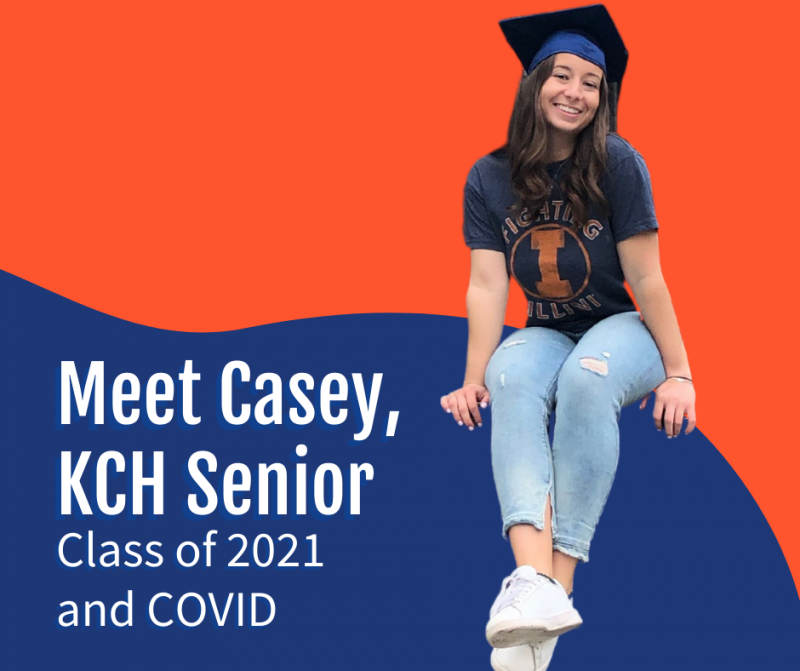
Students are attending college in a unique environment, and that includes students in the College of Applied Health Sciences at the University of Illinois. The AHS communications staff spoke with AHS seniors about online classes, truncated courses and how COVID-19 changed their expectations. Today, we speak with Casey Cushing, who graduated in May with a Bachelor of Science in Kinesiology.
Photo by caption
Q: Why did you pick KCH?
A: I picked KCH because it was a great program at a university that offered me so many benefits compared to other universities. I knew by being in this program that I would gain the basic knowledge to continue on to occupational therapy graduate programs.
Q: Which professors had the most impact on you?
A: There were multiple professors that I really enjoyed having and that made an impact on experience. Dr. (Steve) Petruzzello created such a fun and engaging learning environment and was always willing to help his students so they could be more successful. I worked as an assistant in Dr. (Kevin) Richards’ research lab for the past three years. He helped me grow as a researcher and student, always had so much confidence in me and provided me with opportunities that I could have never imagined! I’m so grateful for them and all the other professors I had along the way.
Q: What course did you most enjoy?
A: My favorite course was KIN340, which Dr. (Petruzzello) taught. I liked the content of the course, as well as the lab. The information we learned in lab was useful and my TA was amazing. I also really enjoyed this class because I was able to develop friendships with my peers.
Q: Did you enter KCH knowing your career path, or did KCH help you decide?
A: I entered KCH planning to go to occupational therapy school. However, KCH reinforced my interest in the field and provided opportunities to get more involved within the OT community.
Q: What do you hope to do after you graduate?
A: I will be attending (Illinois-Chicago) for a Doctorate in Occupational Therapy.
Q: What was your favorite on-campus experience?
A: My favorite on campus experience was being on the quad on a beautiful spring day when it is busy with students. I loved finding a good spot to hammock and relaxing with friends.
Q: What do you miss most because of the pandemic?
A: Because of the pandemic, I really missed in-person classes. I don’t enjoy online classes as much because it is not as easy to foster the relationships with friends, TAs, and professors that I value so much.
Q: What are the biggest changes on campus, pre and during COVID?
A: I am definitely not socializing on campus as much as I did before COVID. I always loved walking around, seeing familiar faces, engaging in campus events, but because of the pandemic I haven’t been doing this stuff as much.
Q: What would you say to recommend KCH to a prospective student?
A: I would 100 percent recommend KCH to a prospective student. Since KCH is within a small college, you feel like you get a personalized education which is very comforting when college can be such a scary change. The professors and other students are great and it will provide you the opportunities you need to succeed in the future!
Students are attending college in a unique environment, and that includes students in the College of Applied Health Sciences at the University of Illinois. The AHS communications staff spoke with AHS seniors about online classes, truncated courses and how COVID-19 changed their expectations. Today, we speak with Emma Boat, who is graduating in May with a Master of Arts in Speech-Language Pathology.
Q: Why did you pick SHS?
A: I chose Speech and Hearing Sciences because I love to use communication to connect with people. I want to help people who struggle to communicate to build their speech and language skills so they too can make connections and express their wants and needs.
Q: Which professors had the most impact on you?
A: Every single one of the SHS professors made an impact on me. I feel like I’ve learned from some of the most knowledgeable, passionate people in the field and I’m so grateful for every class. Jennifer Dahman has made a huge impact on me. She has so much passion and love for the field, and she finds a way to make even the driest topics meaningful. If I ever had a day when I was feeling uninspired, a class or client with Jen would always remind me of why I chose speech pathology.
Q: What course did you most enjoy?
A: My favorite course was probably Cognitive Communication Disorders, taught by Dr. Raksha Mudar. The topics were interesting, the class was discussion-based and engaging, and Dr. Mudar is so intelligent and shared so much valuable knowledge and insight with us.
Q: Did you enter SHS knowing your career path, or did SHS help you decide?
A: I came into SHS knowing I want to be a Speech-Language Pathologist, but my experiences in SHS, both within the classroom and in different clinical settings, exposed me to the diverse settings and roles within the field. All these experiences helped me learn what I’m most passionate about and where I want to take my career.
Q: What do you hope to do after you graduate?
A: I hope to work with kids in a private practice or school setting in Chicago.
Q: What was your favorite on-campus experience?
A: Right before COVID, my roommate and I went to a basketball game against Maryland. It was such a blast feeling the energy and cheering on the Illini, and it really made us feel like a part of the university!
Q: What do you miss most because of the pandemic?
A: The thing I miss most is being in class with my cohort. We are a small cohort of about 30 students, so we all became really close before the pandemic. We all would’ve loved to have one more class together in-person before graduation, but I’m thankful for the time we had before the pandemic.
Q: What are the biggest changes on campus, pre and post-COVID?
A: Before COVID, campus was always lively and energetic. People were always out and the energy was so fun. Immediately after COVID, campus lost that energy and became more isolated. Slowly but surely, campus has returned to its pre-COVID state.
Q: What would you say to recommend SHS to a prospective student?
A: When I entered the SHS department, I was coming from a different school and didn’t know anyone in the department. I immediately felt welcomed by the faculty and my new classmates. After just a few weeks, I felt comfortable and supported. In SHS, we all have different interests and goals, but with a shared love of speech and language. It’s a community of kind, open-minded, passionate people, so it’s been a special experience. I would highly recommend SHS to anyone who’s open-minded, ready to work hard and learn, and is interested in the field.
Students are attending college in a unique environment, and that includes students in the College of Applied Health Sciences at the University of Illinois. The AHS communications staff spoke with AHS seniors about online classes, truncated courses and how COVID-19 changed their expectations. Today, we speak with Sam Tinaglia, a Recreation, Sport and Tourism major with a concentration in sport. Sam will graduate as a Bronze Tablet Scholar this month.
Sam Tinaglia
Q: Why did you pick RST?
A: When I first came to UIUC, I started as a journalism major, but then was recruited to go on Dr. Michael Raycraft’s RST 180 Hall of Fame Class Trip. I enjoyed the trip and meeting other RST students and faculty so much that I eventually transferred into the RST program my sophomore year. I have always loved sports and knew I wanted to work in the sports industry and I felt RST was the major that could help me reach my goals. As I finish my undergraduate degree, I feel I made the right choice as the RST curriculum has thought me many valuable skills for the future.
Q: Which professors had the most impact on you?
A: Dr. Kim Shinew, Dr. Michael Raycraft, Dr. Sharon Zou, Dr. Bill Stewart, Robyn Deterding, and Don Hardin have left a lasting impact on me from my time in RST.
Q: What course did you most enjoy?
A: RST 180 with Dr. Raycraft was my favorite course as that class is one of a kind. As a group of about 20 individuals, we jumped on a big orange Illinois coach bus and traveled to recreation, sports, and tourism destinations in Ohio, New York, Pennsylvania, and Indiana. We saw the Major League Baseball Hall of Fame in Cooperstown, the Lake Placid Olympic facilities, the Woodstock Concert Grounds and Museum, the National Football League Hall of Fame, and the Indianapolis Motor Speedway, which were just a few of our many fantastic stops. This class was like no other I’ve ever taken in my years of schooling and I would take it again in a heartbeat.
Q: Did you enter RST knowing your career path, or did RST help you decide?
A: I entered RST knowing I wanted to work in sports, so I went the sports concentration route. But as I was taking classes in RST, I learned to love the recreation and tourism concentrations too. I think the parts of R, S, and T can be intermixed, and after finishing the course work, I can say I would love to work in any of the RST fields.
Q: What do you hope to do after you graduate?
A: After I graduate I hope to start up my online master’s degree with RST and get more experience in the RST field as I intern with the Niles Park District in Athletics.
Q: What was your favorite on-campus experience?
A: My favorite on-campus experience at Illinois was working with the Fighting Illini Marketing Team within the athletic department. For that opportunity, we handed out promotional materials before athletic events at UIUC and helped with in-game promotions too. Being able to work in person at various Illini sporting events was a fantastic experience and I’ll miss it when I graduate.
Q: What do you miss most because of the pandemic?
A: I have been schooling from home since March of 2020, so ever since the pandemic started. The thing I miss most is going in person to classes and interacting with other students and professors. You don’t realize something was so great until you can’t experience it anymore, and that was me at Illinois. I really enjoyed school and, sadly, it’s (technically) over.
Q: What are the biggest changes on campus, pre- and during COVID?
A: (I) haven’t been back since March 2020, I wouldn’t know.
Q: What would you say to recommend RST to a prospective student?
A: If you love and want to work in recreational activities, sports, and/or the tourism industry, RST is the place for you. Also, if you just want to get a good, well-rounded college experience in a smaller tight-knit college within a large university, RST would be a great home for you.