Applied Health Sciences announces faculty promotions for 2026-27 academic year


Ten faculty at the College of Applied Health Sciences received promotions prior to the 2026-27 Academic Year. Here are their new faculty titles.

Professor

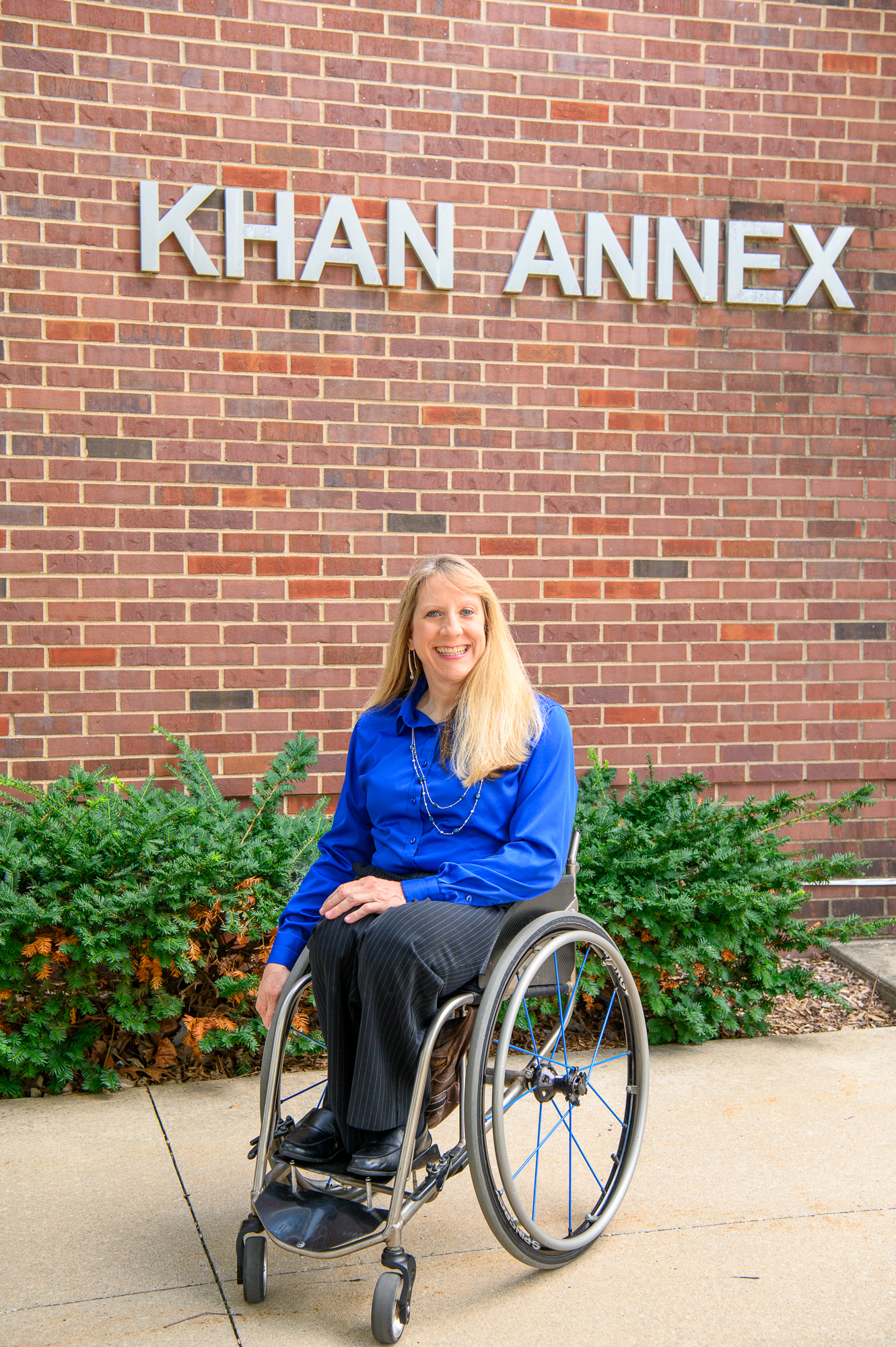
Naiman Khan, health and kinesiology 
Toni Liechty, recreation, sport and tourism
Laura Rice, health and kinesiology

Associate Professor 

Mariela Fernandez, recreation, sport and tourism
Sarah Geiger, health and kinesiology
Hyojung Kang, health and kinesiology
Yannick Kluch, recreation, sport and tourism
Minakshi Raj, health and kinesiology
Wes Wilson, health and kinesiology

Teaching Associate Professor 

Caitlin Clarke, health and kinesiology

Share on social

Related news

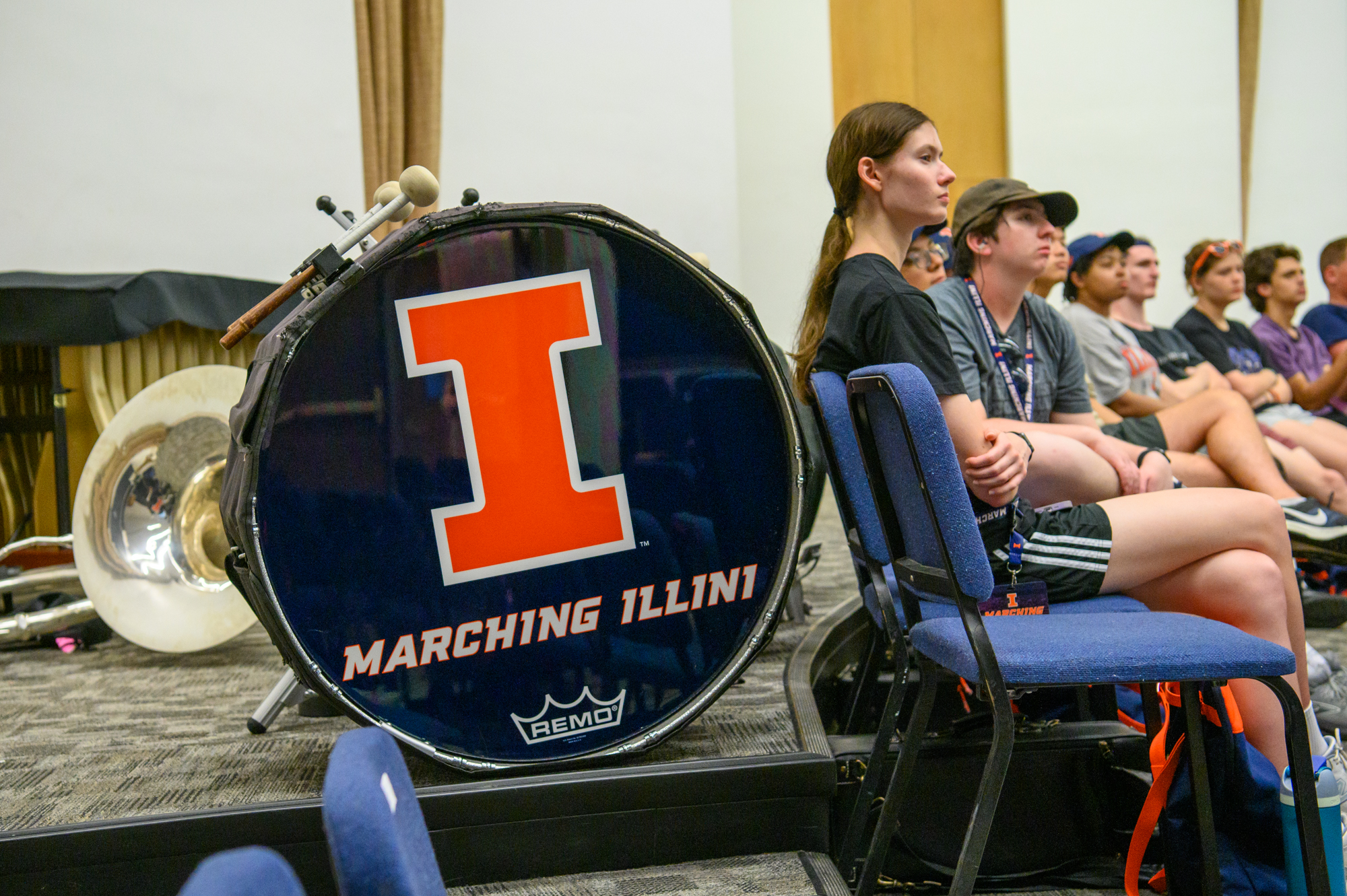
Marching Illini learn from SHS to protect their hearing before taking the field


Before incoming Marching Illini members fill Gies Memorial Stadium with music, faculty members and students from the Department of Speech and Hearing Science delivered a lesson designed to help them keep playing for years to come: loud sounds can cause permanent damage long before musicians notice a problem.

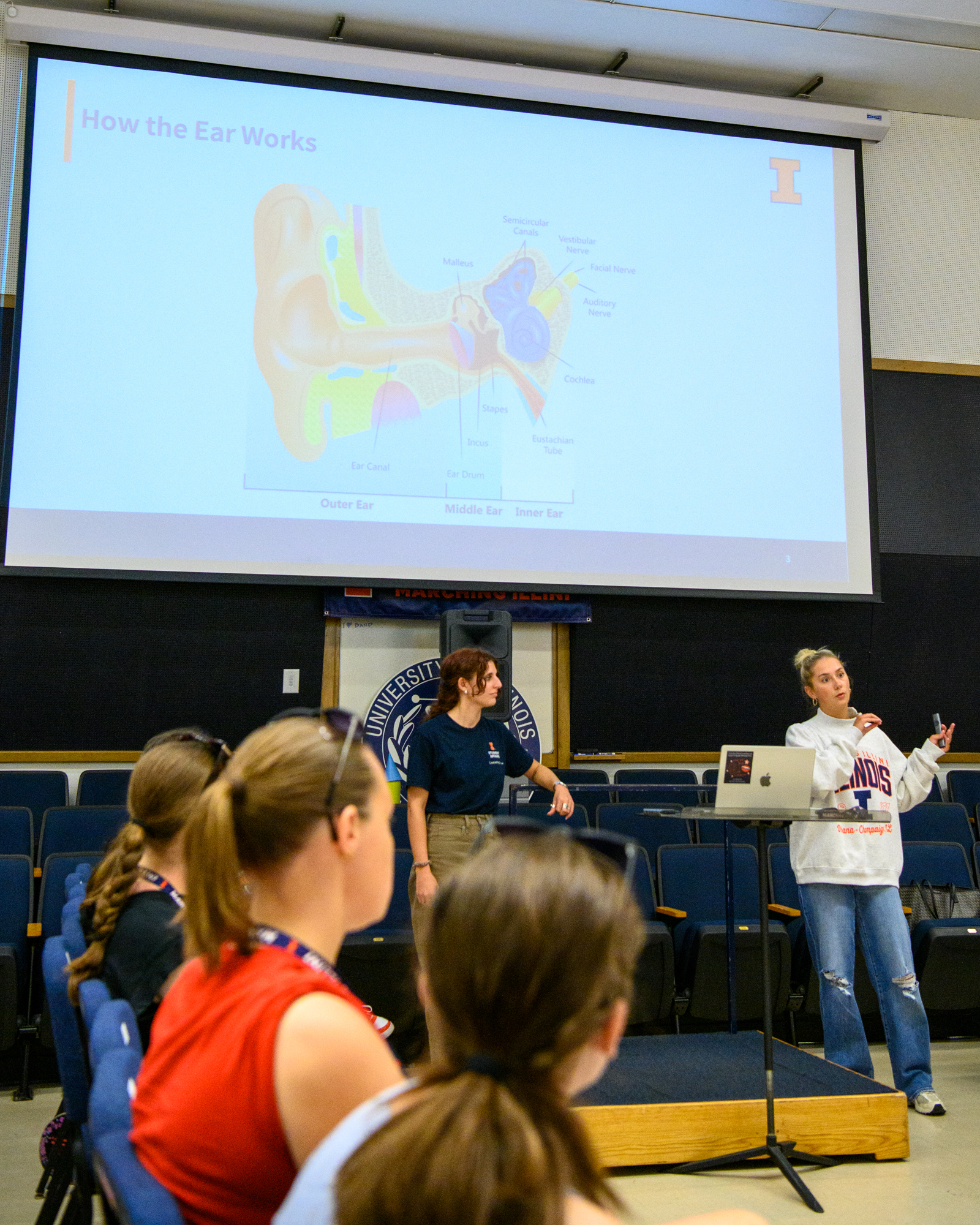
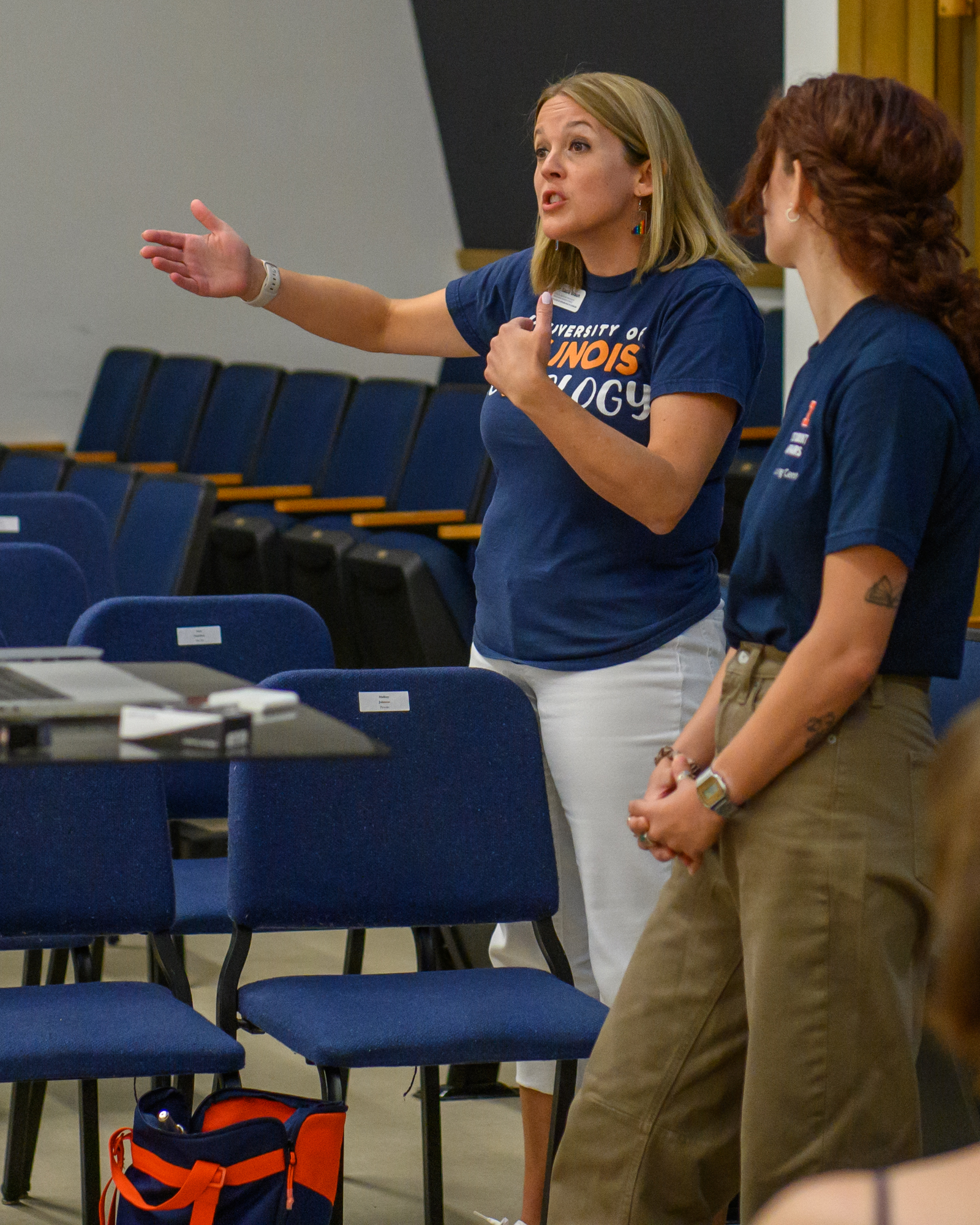
Lauren Stec, left, and Avery Waner talk to members of the Illini Marching Band. (Photo by Ethan Simmons).

SHS Clinical Assistant Professor Sadie Braun, who is an audiologist; and doctoral audiology students Lauren Stec and Avery Waner presented information about noise exposure and hearing protection during the band’s preseason training. The annual session takes on added significance this year as the university completes the largest main video display in college football at Gies Memorial Stadium—another powerful source of sound in an already loud environment.

Braun said one of the presentation’s most memorable images shows healthy sensory hair cells in the inner ear alongside cells damaged by significant noise exposure.

“It’s a pretty shocking picture,” Braun said. “I think just seeing it in such vivid terms like that, it really does catch some of them by surprise.”

Those cells play an essential role in hearing, but damage caused by repeated exposure to excessive noise generally cannot be reversed. A single impact sound, such as a nearby gunshot or firework, can cause a temporary hearing loss that may improve over days or weeks, Braun said. Hearing loss that accumulates gradually is usually permanent.

The effects also may not become apparent immediately.

“They could be exposed right now, thinking this isn’t a problem, I’m hearing just fine,” Braun said. “And then 20, 30, 40 years from now, that noise damage can show up and cause hearing problems.”

That delayed effect can make hearing conservation a difficult concern to communicate to college students. Some musicians understand the risks, particularly if they know someone with hearing loss, Braun said. For others, it is not something they have considered.

“You’re not thinking down the road about the impacts of some of the stuff you’re doing if nobody’s ever talked to you about it before,” she said.

Marching Illini Director Barry Houser said many band members began playing instruments in fifth or sixth grade without receiving hearing-conservation instruction. The topic also is not typically part of the curriculum when students advance to high school marching bands, he said.

20, 30, 40 years from now, that noise damage can show up and cause hearing problems.”

Sadie Braun

Clinical Assistant Professor, Speech and Hearing Science

Braun and SHS Associate Professor Pasquale Bottalico visited sixth grade band students at Franklin STEAM Academy in Champaign to educate them about the effect of noise exposure and also to take noise measurements of their classroom, at the request of Franklin’s band teacher.

At Illinois, the risk is amplified by the size of the ensemble. More than 400 musicians rehearse indoors for four days during preseason training. Even when the band moves outside, instruments remain close to musicians’ ears.

Then comes game day, with instruments, amplified audio and tens of thousands of cheering fans contributing to the sound.

“A lot of people think, well, we’re outside, so it’s not going to impact you to the same extent,” Houser said. “… then you get into the football setting—60,000 people yelling. This Megatron video board, largest in college football, and that volume that’s going to be coming out of that. It all contributes.”

The south end zone video display will measure about 69 feet high and 250 feet wide, covering more than 17,300 square feet. It is part of a 16-display project scheduled for completion before the 2026 football season, according to the University of Illinois Division of Intercollegiate Athletics.

Sadie Braun said hearing loss that accumulates gradually is usually permanent. (Photo by Ethan Simmons)

Within the band, percussionists face some of the greatest exposure. Houser said the 36-member drum line can collectively produce sound approaching the level of a jet engine, depending on a listener’s proximity. Braun said musicians closer to the center of the band also may experience more sound from surrounding instruments than those positioned along its edges.

Risk depends not only on volume but also on duration. A level that might be tolerated briefly can become dangerous during a 30-minute or two-hour rehearsal.

Houser said the band provides hearing protection so cost does not prevent students from taking an initial step. The presentation also introduces them to other options and to hearing services available on campus.

Band members receive hearing protection that reduces sound by an average of about 15 decibels, Braun said. The university’s audiology clinic also offers custom musician earplugs made from impressions of a person’s ears, with a discount available to Marching Illini members.

The partnership between the band and speech and hearing science has existed for years, though it was interrupted at times, including during the COVID-19 pandemic. Braun said the program initially included the entire band but now focuses on incoming members. Houser, who is beginning his 16th year at Illinois, said the sessions have been offered during most of his tenure.

Students do not often approach him with questions afterward, Houser said. Their most common response is simpler: they had no idea.

For musicians, preserving hearing is tied directly to preserving their craft. Players must hear themselves clearly to monitor their sound, maintain pitch and adjust to the ensemble around them, Braun said. That ability is particularly important for students who hope to continue performing after college or pursue careers in music.

Houser said hearing from audiology experts gives band members both practical guidance and the science behind it.

“It’s a game-changer,” he said.

Editor’s note:

To reach Sadie Braun, email svojak@illinois.edu@illinois.edu.
 

Share on social

Related news

Finding the right words at AAC Camp


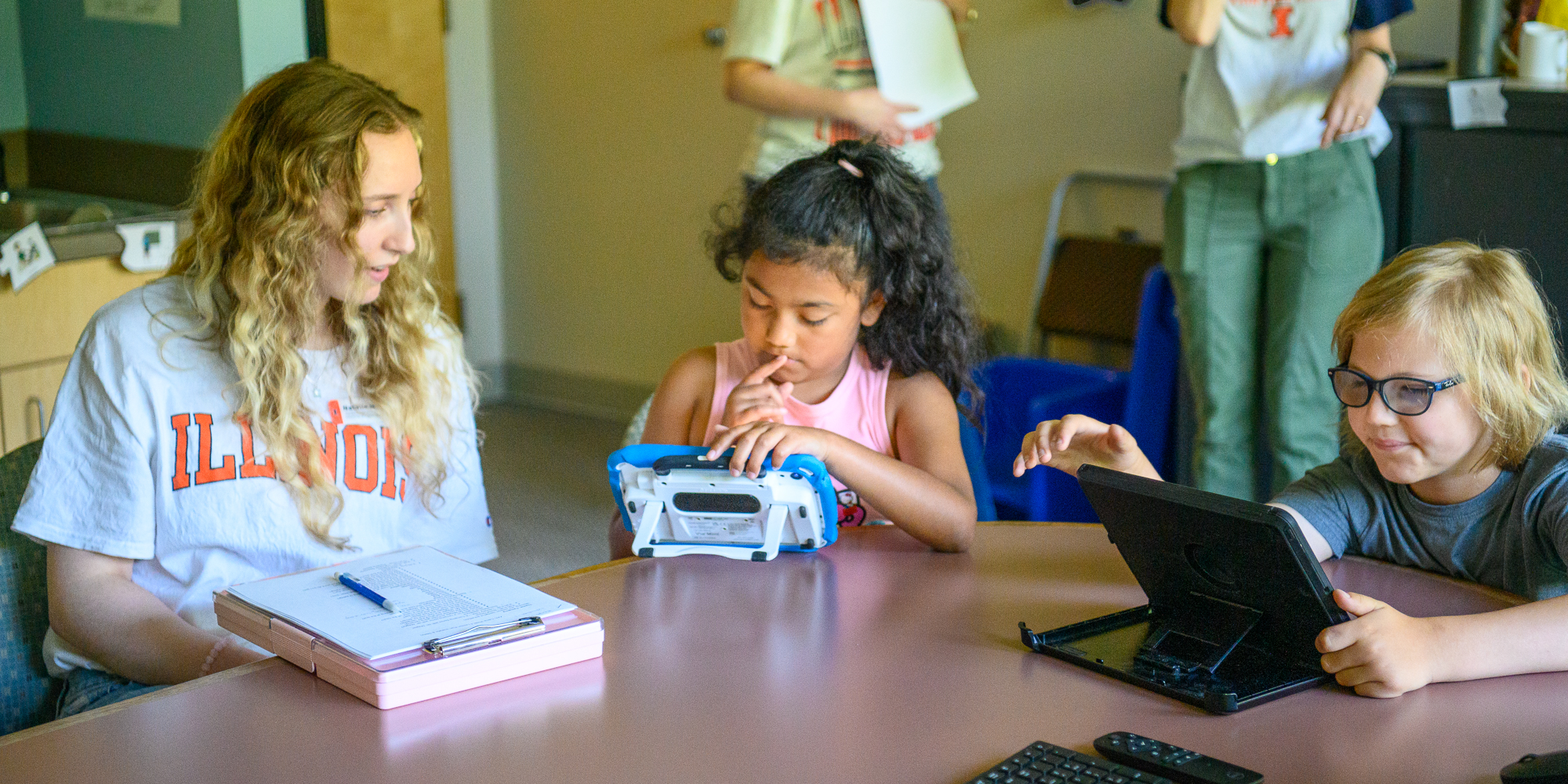
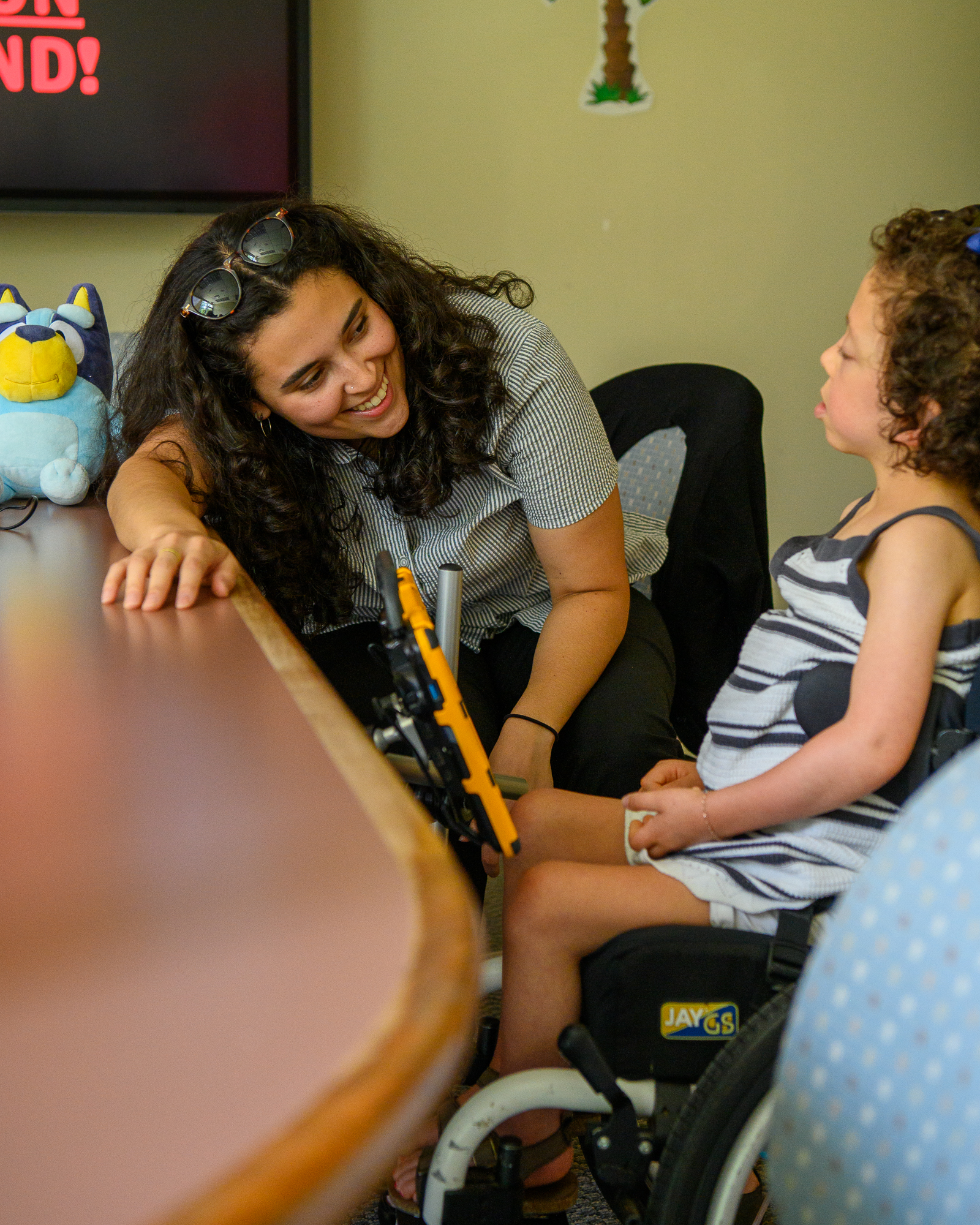
Graduate student speech-language pathologist Natalie Mahalla (left) works with campers in AAC camp, which teaches kids with speech and communication disorders how to use augmentative and alternative communication. (Photos by Ethan Simmons)

Midway through his third session of Augmentative and Alternative Communication Camp at the University of Illinois, one elementary schooler wanted to say “yes” with a little more oomph.

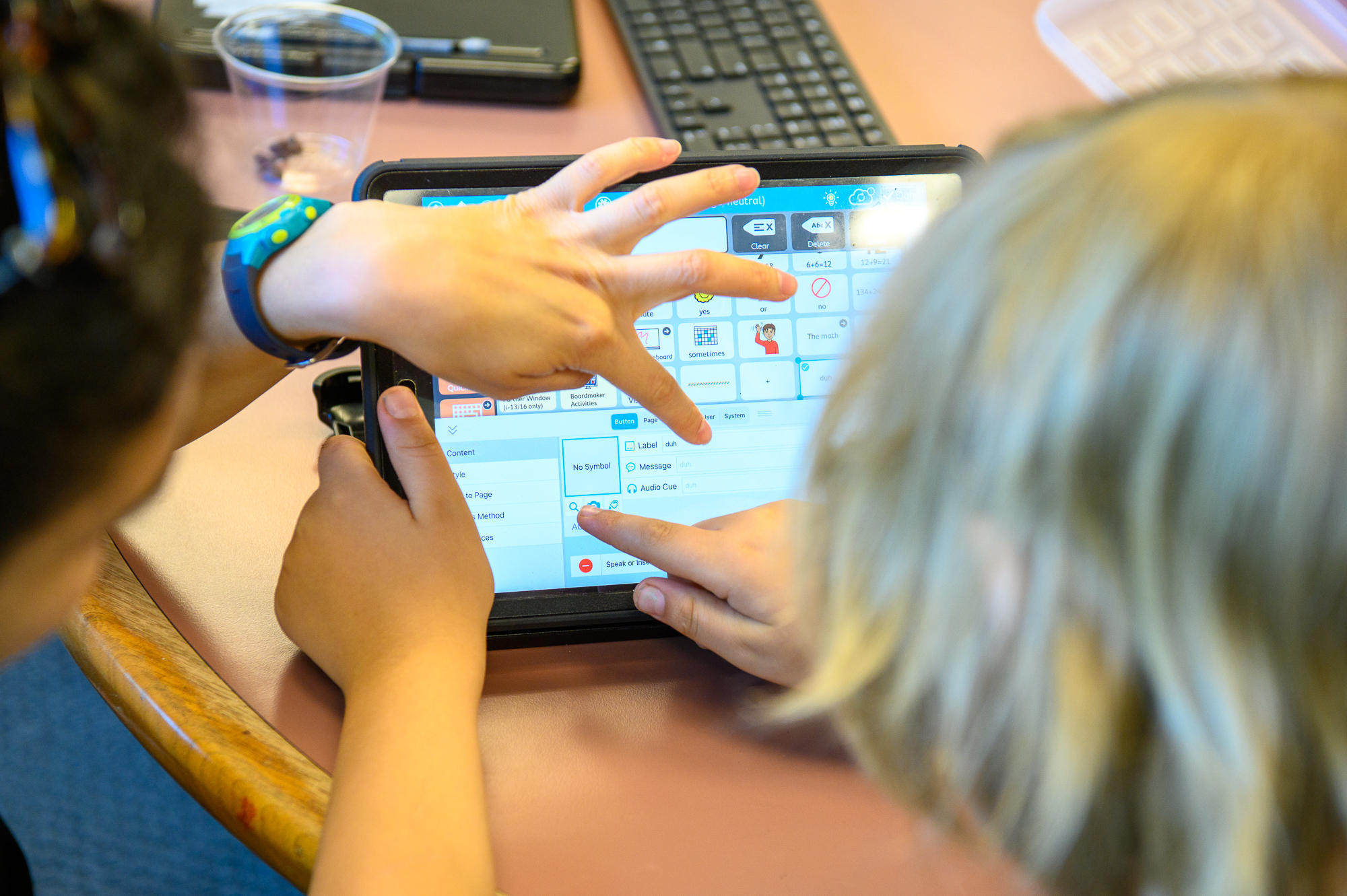
So he grabbed his AAC device—a tablet with an array of common words and phrases that speak when clicked—and typed in a new word of his own: “Duh,” with a rolling-eyes emoji for effect.

“This was an example of how AAC can help a child communicate like any other kid who wants to be silly or tease his friends,” said Stella Shiffrin, a U. of I. graduate student studying to become a speech-language pathologist, who was this camper’s one-on-one clinician. “It was very funny, yet socially relevant and useful.”

For the second year, faculty and graduate students at the Department of Speech and Hearing Science at Illinois hosted a summer camp for local children to practice their skills with AAC devices, and meet other kids with similar communication needs.

Augmentative and alternative communication, or AAC, is an umbrella term for the methods that nonspeaking or minimally speaking people use to communicate.

In practice, AAC can mean techless options, such as sign language and gesturing, or text-to-speech devices, like the kids in camp used this summer.

The camp is designed and run by Speech and Hearing Science Assistant Professor Savanna Brittlebank and Clinical Assistant Professor Andrea Burie, who support AAC implementation among children from academic and clinical perspectives.

A child at the AAC Camp at the University of Illinois Urbana-Champaign clicks a word on their device to speak.

Common users of AAC include individuals with autism, cerebral palsy, and other intellectual and/or physical disabilities who experience difficulty using speech for functional communication. Roughly one-third of children on the autism spectrum are nonspeaking, according to recent estimates. While a spoken conversation can employ anywhere from 150 to 250 words per minute, AAC users might convey eight to 10 words per minute.

“If you’re a child who grows up using AAC, you might be the only one in your class or in your grade or even in your school who uses AAC to communicate,” Brittlebank said.

“Being able to be in a room with other children who use AAC helps normalize it, it helps their social skills just having an example from peers, which helps them build friendships, too. It helps them realize they’re not the only one who communicates in that way.”

A hands-on experience

What was new in the second go-around was a short AAC “boot camp” for the graduate student clinicians, which clearly boosted their confidence working with the campers and the AAC tech that each of them used.

Also, they served more kids this year. Seven campers between the ages of 5 and 10, including a couple of returners, joined the Thursday sessions for six weeks this summer; five campers joined last year. The days were split into two sessions, with one designed for more medically complex children.

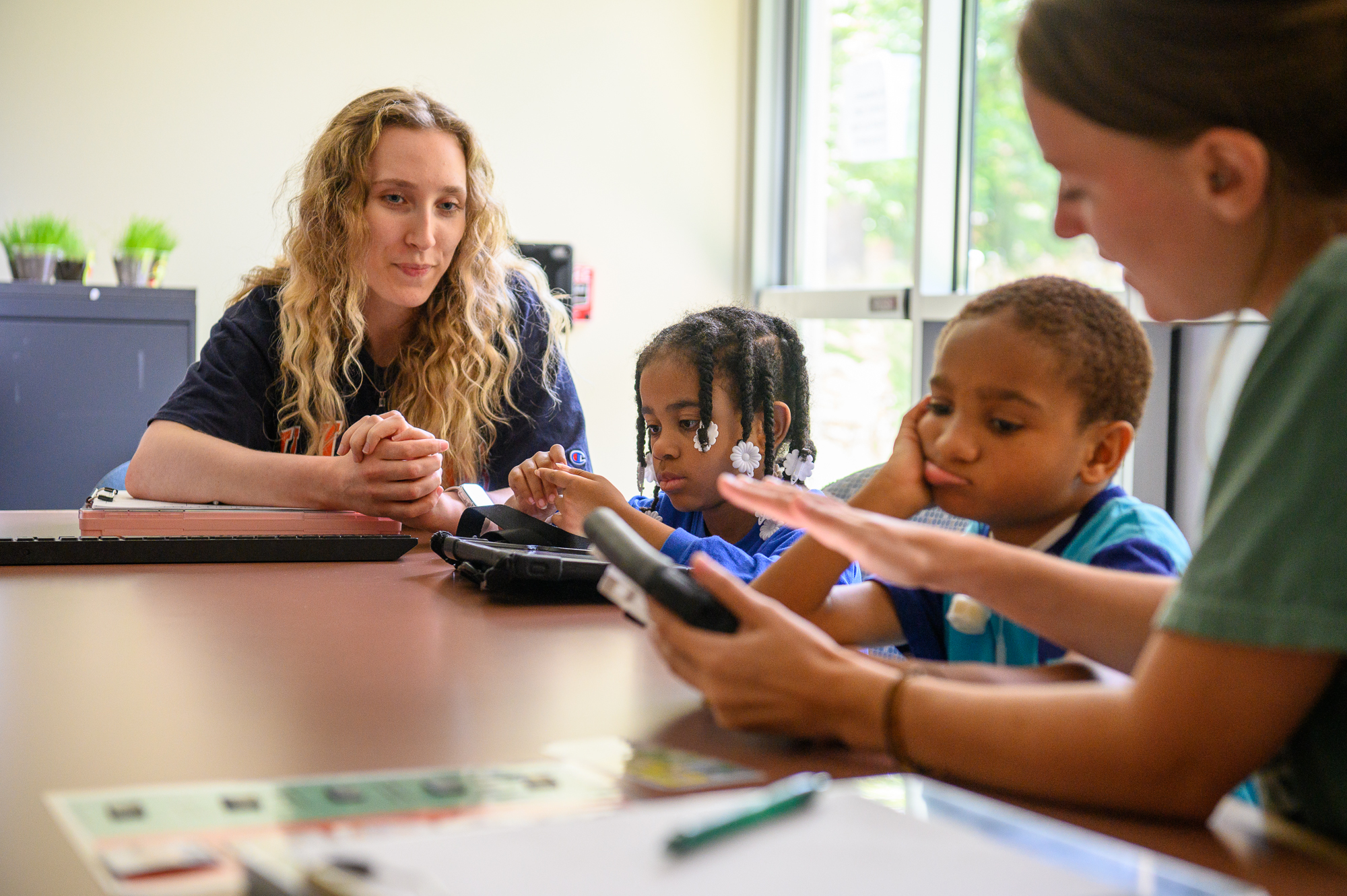
At AAC Camp, facilitators hosted interactive, crafty games each day with the campers, with fun asides and simple conversations to help the kids make meaningful steps toward improving their vocabulary and literacy while adopting the technology. In addition, each kid got one-on-one time with a student clinician, supervised by faculty.

This experience is critical for Speech and Hearing Science students who are training to be speech-language pathologists. Each of them must spend at least 375 hours working directly with patients in a supervised setting before obtaining their degree and licensure.

“They’re able to have a lot of hands-on, in-depth experience with this [AAC] population that is typically underserved in our field,” Burie said. “This is trying to target that gap in speech-language pathology training.”

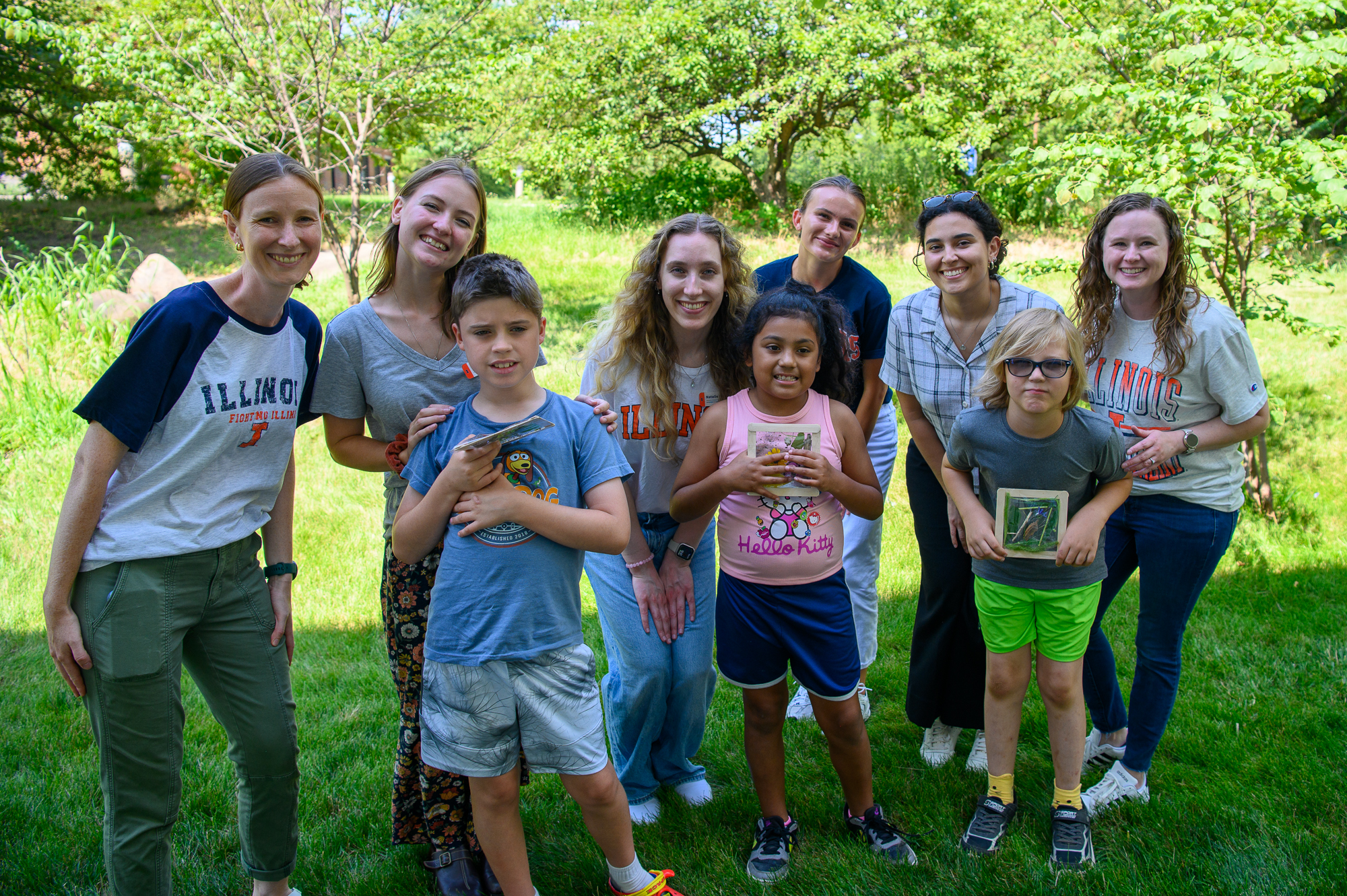
On one humid day, the campers went outside with their clinician partners and went on a nature scavenger hunt, picking up branches, plants and flowers to show at the session, then described what they found using their devices. One camp favorite theme was “Summerween,” where the kids walked around the rooms of the Audiology and Speech-Language-Pathology Clinic for trick-or-treating.

Graduate student speech-language pathologist Stella Shiffrin works with a camper in AAC camp. This summer saw two sessions each week, with one designed for more medically complex children.

“Something that is really fun about the camp setting is that it naturally facilitates social communication between peers,” said Natalie Mahalla, who’s heading into her second year of the speech-language pathology master’s program. “We can model and prompt on the device all we want, but to see the kids use their devices to be able to connect with their peers socially was really fulfilling.”

Camp facilitator Andrea Burie joined the faculty of the Department of Speech and Hearing Science in August 2024, after nine years as a speech-language pathologist in Champaign Unit 4 Schools. Her connection to the district helped her find families that could participate in the AAC camp during its first run in summer 2025.

For Burie, her familiarity with AAC started in the home. Her oldest sister, Alison, was born with a severe physical and cognitive disability, which required the use of AAC support to communicate beyond a few vocalizations. 

Alison used voice-output switches and speech-generating devices throughout her school years, but their family received “very limited” training on how to support AAC use at home, so Alison’s use of the tech tapered off after she left the school system, Burie said. 

“I understand the challenges families can face when trying to incorporate it into everyday life,” Burie said. “Now, as an SLP, it’s been a passion of mine to help families find simple, meaningful ways to support AAC device use in the home.”

Activities also go home with the campers. Families were given an “AAC Bingo,” filled with prompts to help their kids use the AAC devices outside of the camp. One square asks them to go outside and identify three things they see with their device; another asks the user to describe what they liked most about their meal.

“The goal isn’t to add more work to a family’s day but rather to highlight communication opportunities that already exist within everyday routines and moments,” Burie said.

Evidence-based approach

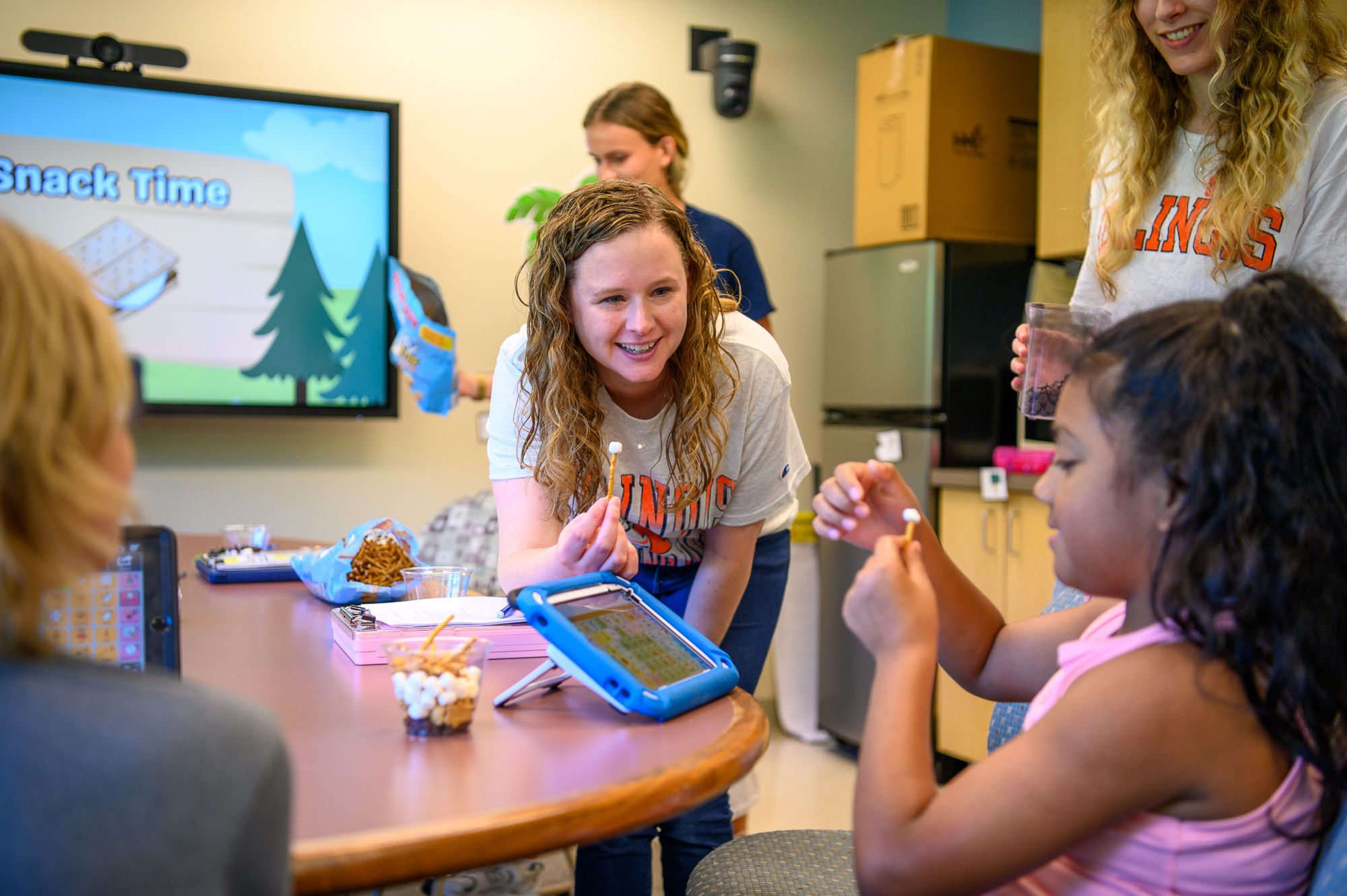
Andrea Burie (center), assistant clinical professor at the Department of Speech and Hearing Science, holds up a snack during AAC Camp.

Through all the fun games and crafts, the summer AAC camp is designed with the latest educational approaches in mind, specifically how kids develop language—and social skills—if they aren’t communicating with speech.

At AAC Camp, the facilitators are keen on getting the kids to ask questions with the help of their devices.

“In typical language development, requesting and social communication actually develop in tandem,” said Brittlebank, who joined the College of Applied Health Sciences in 2024. “But when we provide intervention, sometimes the social piece is overlooked. How do we build that? Taking turns is that underlying piece. And a lot of that is how we ask and answer questions.”

Among augmentative and alternative communication users, literacy needs are critical. An estimated 90 percent of individuals who use AAC graduate high school without functional literacy skills.

Part of this has to do with traditional literacy curricula, which draw heavily from phonics—the sounding out of words—to teach reading. Nonspeaking children have to rely on different approaches.

“There are evidence-based curricula that exist that have non-speech responses, but they’re not very well known or widely implemented, and so we’re drawing on those curricula that exist to support literacy instruction,” Brittlebank said. “Unfortunately, it’s a barrier in practice and the field in general. There is a huge push right now to improve literacy outcomes for individuals who use AAC.”

At AAC Camp, facilitators used visual aids, such as a kid’s photograph from their family’s trip to a baseball game, to spur on the conversation each day.

‘Does it make you happy?’

With many of the campers still learning the ins and outs of their AAC devices, patience was key for the student clinicians working with each child as they formulated their thoughts in new ways.

The AAC camp is a learning experience for the clinicians, too: faculty facilitators model how to intervene with the campers, then slowly go more hands-off as the camp progresses. 

The student clinicians learned to adapt the activities to the child’s unique interests, Shiffrin said: “This makes therapy more meaningful and fun for them.”

Learning AAC can be a tedious process, but parent feedback from the camp has been promising. One parent shared that this was the first summer camp their child had ever attended; others talked about how their child made new friends; or were fascinated to see other kids’ AAC devices for the first time, according to a survey collected by facilitators.

At one session, student clinician Chesney Hassett asked, “Who likes our time together, talking to each other?” The campers raised their hands in agreement.

“Does it make you happy?” she asked. One camper nodded, then clicked the word on his tablet: “Duh.”

Editor’s note:

To reach Savanna Brittlebank, email savannab@illinois.edu
To reach Andrea Burie, email aburie@illinois.edu

(To reach Ethan Simmons, email ecsimmon@illinois.edu)


Share on social

Related news

From RST to Wrigley: Alum finds voice in Major League Baseball


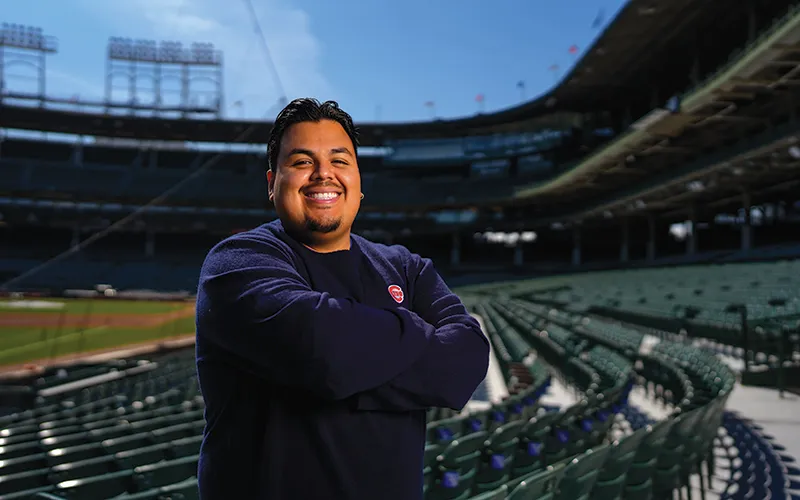
RST alum Fredy Quevedo Jr. enjoying the friendly confines of Wrigley Field. (Photo provided)

As the Spanish-language interpreter for the Chicago Cubs, Fredy Quevedo Jr. steps in front of cameras and reporters, knowing his role is far more than translating words. He’s translating trust. Culture. Confidence. As a media relations specialist, Quevedo helps players share their stories authentically, ensuring language is never a barrier to being heard.

It’s a role that feels tailor-made, even if the path there was anything but linear. 

Born and raised in Elgin, Quevedo grew up deeply connected to his community. Long before he enrolled at Elgin Community College (ECC), he was already familiar with the campus through the Youth Leadership Academy program, attending sessions as early as middle school. “I came here all the time, so I already knew the buildings and the campus.”

After high school, Quevedo’s journey took a few turns. He attended college, took time away to work a variety of jobs, and even headed to Minnesota to briefly pursue college football. But by 2019, he found himself back home — and back at ECC, ready to reset and rebuild his confidence.

“I was everywhere, and then I came back home, which is ironic, but it’s the thing I’m most grateful for. You never know where the journey might take you, but you always come back home.”

At ECC, Quevedo completed his Associate in Arts in just one year, graduating in 2020. His time at ECC had a profound impact, as he found support through TRIO and worked closely with mentors who helped him map out clear, achievable next steps. “Being here helped me get right mentally for when I would transfer,” he said, adding that he initially pursued political science out of high school. “I [now] knew what I wanted to go after.” 

That sense of care and support mattered. As a first-generation college student and the son of immigrants from Mexico, Quevedo had spent much of his life navigating systems that weren’t built with language access in mind. Growing up, he often translated for his mother at appointments, in offices, and in everyday moments. At the time, it was simply what needed to be done. In hindsight, it was the foundation of a future career.

After ECC, Quevedo transferred to the University of Illinois, Urbana-Champaign, where he earned a bachelor’s degree in recreation, sport and tourism with a concentration in sport management. It was there that his vision sharpened: he wanted to work in sports and use his language and culture as strengths — not side notes.

“I grew up watching sports and playing sports, and I didn’t even know jobs like this existed,” he said.

That clarity led him to take a leap and start applying for roles even when he felt underqualified. His first break came with the San Francisco 49ers, where he worked in marketing while finishing his final semester at U of I. When that role ended, he explored his options in the Bay Area. Then came the call from the Cubs in May of 2023, followed by a second move back home.

Today, Quevedo is one of just 30 Spanish interpreters across Major League Baseball — one per team — helping Spanish-speaking players navigate interviews, media obligations, and public life. But to him, the job is about more than words.

“My goal is to help players find their voices so their stories are told, they are heard, and they feel comfortable being themselves,” he said.  

That responsibility feels personal. Quevedo knows how powerful it is to see someone who looks like you, sounds like you, thriving in a visible space. He carries that awareness into every interview and every interaction, hoping young people, especially ECC students, see possibility reflected back at them.

“Don’t ever be afraid to pursue an opportunity. Always be yourself and trust yourself.”

Looking back, Quevedo credits ECC with helping him build that willingness, along with humility, gratitude, and confidence. “ECC showed me the importance of community,” he said. “Of asking for help … of believing that where you start doesn’t limit where you can go.”

From Elgin classrooms to one of baseball’s most iconic ballparks, his journey has come full circle. He’s grounded in home, fueled by purpose, and driven by a belief that language access isn’t just a service. It’s a bridge that breaks down barriers and creates broader connections.

And thanks to Fredy Quevedo Jr., more voices are crossing it every day.

Editor’s Note: Reprinted from Elgin Community College’s website.

Share on social

Related news

New RST faculty member brings a critical eye to sport policy


Anna Posbergh came to the University of Illinois from Florida State University (Photo provided)

When Anna Posbergh studies sport, she isn’t focused on the final score.

She’s interested in something less visible but just as influential: the rules that determine who gets to play, how those rules are written and why decision-makers arrive at the conclusions they do.

This fall, Posbergh joins the Department of Recreation, Sport and Tourism at the University of Illinois Urbana-Champaign as an assistant professor, bringing an interdisciplinary approach to sport policy that blends public health, governance, media studies and critical sport scholarship. Her work examines how evidence is selected, interpreted and translated into policies that shape opportunities for women athletes and the broader sport landscape.

For Posbergh, arriving at Illinois represents more than a new faculty appointment. It’s a return to the kind of academic environment where she believes her work can have the greatest impact.

“I truly feel most at home in a university college that is health science-focused,” she said. During her academic career, she has worked across colleges of education, liberal arts, humanities and public health, experiences that reinforced her belief that understanding sport requires perspectives from multiple disciplines.

That interdisciplinary foundation began during her doctoral studies in kinesiology at the University of Maryland, where she found herself immersed in a public health environment. Rather than viewing sport strictly through competition or performance, she learned to connect it with broader questions about health, community well-being and social systems.

Those ideas continue to shape both her research and teaching.

Before coming to Illinois, Posbergh spent three years as a faculty member at Florida State University. Although she enjoyed her work there, Illinois offered something she found difficult to ignore: a culture known for collaboration.

She was drawn by the university’s research reputation and membership in the Association of American Universities, but she says it was the people who ultimately convinced her.

“The culture in Recreation, Sport and Tourism in particular has a reputation, even outside Illinois, for consisting of brilliant individuals who wholly care about making the world a better place, becoming the best intellectuals and scholars they can be, and building each other up,” she said.

One lesson from her own mentors has stayed with her throughout her career: choose collaboration over competition. She sees that philosophy reflected throughout the College of Applied Health Sciences, where faculty members value interdisciplinary partnerships and practical scholarship.

That emphasis on application also aligns closely with her own goals. Whether communicating with students, policymakers, journalists or sport organizations, Posbergh wants her research to extend beyond academic journals and become useful to the people making decisions that affect athletes and communities.

In broad terms, Posbergh describes her research as examining the governance and representation of women athletes.

More specifically, she studies policymaking in sport, especially policies regulating women’s competition and athlete eligibility, asking which evidence policymakers choose, how they interpret it and why they arrive at particular conclusions.

Those questions have become increasingly relevant as debates surrounding women’s sport, athlete eligibility and transgender participation have moved from academic conferences into legislatures, governing bodies and national headlines.

Although policy remains her primary focus, Posbergh increasingly studies media and public opinion as well.

That’s because policymaking, she argues, isn’t simply a top-down process.

Public narratives, media coverage and societal beliefs often influence how scientific evidence is understood long before a policy is formally adopted. Decision-makers bring their own assumptions and interpretations into the process, making governance as much about people as documents.

She summarizes her work with characteristic humor.

“I read a lot of bylaws, laws and bills,” she said, “especially relating to girls’ and women’s sport and female/transgender eligibility, and I question how and why they arrived at that outcome.”

Posbergh’s path into sport policy began long before graduate school.

As an undergraduate at the University of Minnesota, she interned with the Tucker Center for Research on Girls & Women in Sport. The experience introduced her to research while exposing her to issues surrounding gender equity in athletics.

She describes that opportunity as career-changing. Her academic interests also reflected an unusual combination of disciplines. She studied English, mathematics and kinesiology, an academic mix that later proved invaluable when she encountered scholarship examining testosterone regulations in elite women’s sport.

The topic demanded quantitative reasoning, critical analysis and an understanding of sport, bringing together all three areas of her undergraduate education. She immersed herself in the literature, eventually building her dissertation around what she called “protective policies”—regulations designed to protect women’s sport through rules governing athlete eligibility, health and participation.

Posbergh argues that competing sport policies often claim to be guided by science while relying on different bodies of research or interpreting similar findings in dramatically different ways.

As public attention to these issues expanded dramatically over the following years, her research became increasingly timely.

One of Posbergh’s central research questions asks a deceptively simple question: What counts as evidence?

In her work examining transgender athlete policies, for example, she studies how policymakers select scientific literature to support predetermined policy approaches. Some policies emphasize research they interpret as demonstrating competitive advantages, while others prioritize public health evidence highlighting the benefits of sport participation and the harms associated with exclusion.

Her research has also compared how scientific studies are represented in policies and systematic reviews.

She says her findings raise broader questions about policymaking integrity, particularly when research is cited in ways that do not accurately reflect the original scientific conclusions. Although her work often centers on transgender athlete policies, she believes the implications extend much further.

For Posbergh, ensuring that policies accurately represent evidence matters not only for ethical governance but also for every athlete affected by those decisions.

Illinois offers opportunities to expand that work through collaboration. Given her focus on governance, Posbergh sees natural partnerships with scholars in law, political science and public policy, particularly around questions involving legal precedent, policymaking and regulation.

She also hopes to work closely with Illinois’ Division of Intercollegiate Athletics. Because athletic departments ultimately implement many of the policies she studies, collaborating directly with practitioners can help ensure research remains practical, relevant and accessible to those responsible for putting policy into action.

While her research tackles nationally debated issues, Posbergh says her goals in the classroom are straightforward. She doesn’t want students to memorize her conclusions.

Instead, she wants them to develop the habits of mind necessary to evaluate evidence, understand competing viewpoints and explain why they hold their own beliefs.

“I believe my responsibility is not to tell students what to think,” she said. “It’s my responsibility to help them understand why they believe what they believe.”

She hopes students leave her classes prepared to analyze complex issues thoughtfully, engage respectfully with differing perspectives and become ethical leaders within sport organizations and beyond.

As Posbergh begins her career at Illinois, she’ll continue asking difficult questions about some of sport’s most contested issues. But whether she’s studying policy, mentoring students or collaborating with colleagues across campus, her objective remains consistent: to better understand how evidence becomes action, and how thoughtful scholarship can help build stronger, more equitable systems for sport.

Editor’s note:

To reach Anna Posbergh, email posbergh@illinois.edu.
 

Share on social

Related news

Bronze Tablet, Dean’s List honorees named for spring 2026


The University of Illinois Urbana-Champaign named the student recipients of its highest academic honors for the spring 2026 semester.

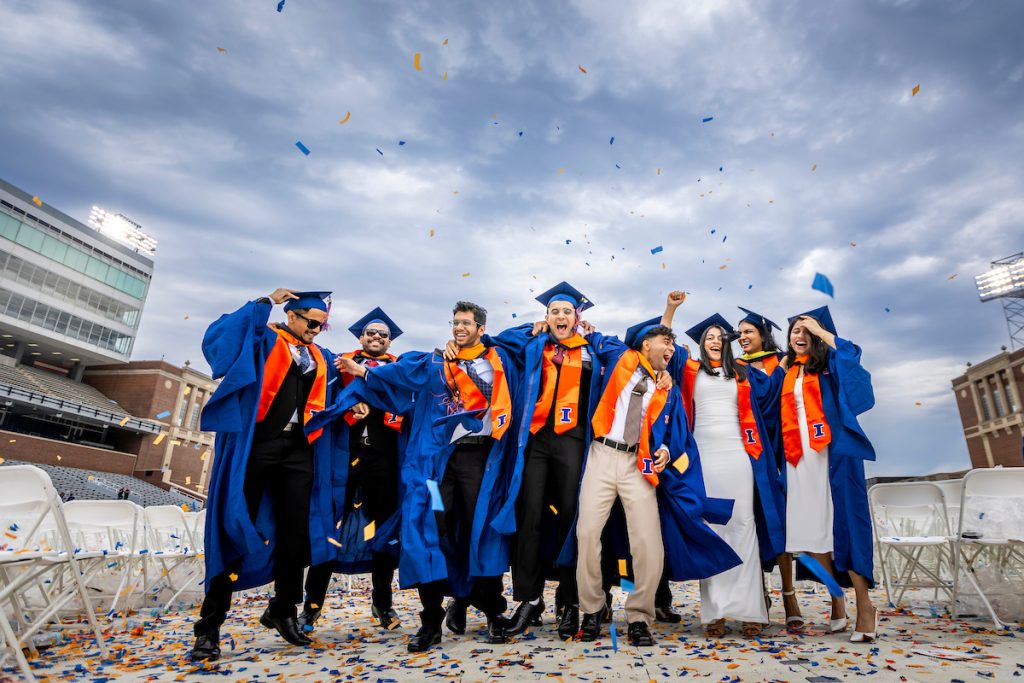
2026 Commencement (Photo by Michelle Hassell)

At the College of Applied Health Sciences at Illinois, 509 students made the Dean’s List, a semesterly honor for students who reach the top 20% grade-point average in their college class or curriculum, with at least 12 academic hours taken for a letter grade.

This year, 17 AHS graduates were recognized as Bronze Tablet honorees. This is the university’s highest honor for graduates, reserved for the top 3% of academic achievers from each college’s graduating class.

Here are the AHS representatives—from all five of our undergraduate degree programs—whose names will be displayed on a bronze tablet in the university’s Main Library:

  • Audrey Arlis, speech and hearing science
  • Christopher Atadero, interdisciplinary health sciences
  • Brian Becker, recreation, sport and tourism
  • Sarah Blyskal, community health
  • Lydia Burger, kinesiology
  • Nicole Dudek, recreation, sport and tourism
  • Collin Janusz, kinesiology
  • Estelle Jones, speech and hearing science
  • Brielle Mapanao, kinesiology
  • Katherine Naveja, kinesiology
  • Dorothy Nguyen, recreation, sport and tourism
  • Stacy Pontikes, speech and hearing scinece
  • Forrest Benjamin Reyes, recreation, sport and tourism
  • Karla Rodriguez, speech and hearing science
  • Farris Sweid, interdisciplinary health sciences
  • Nicole Zagone, community health
  • Ella Zick, interdisciplinary health sciences

Last academic year, 490 graduates obtained a bachelor’s degree from the College of Applied Health Sciences.

In all, Illinois recognized 9,005 Dean’s List students and 387 Bronze Tablet honorees for the spring 2026 semester, and awarded more than 12,174 degrees and certificates. Databases for each honor are available online.

Editor’s note:

To reach Ethan Simmons, email ecsimmon@illinois.edu.
 

Share on social

Related news

College of Applied Health Sciences
110 Huff Hall
1206 South 4th Street
Champaign, IL 61820
(217) 333-2131