New research is testing effective ways to communicate with families about chemical exposures
The IKIDS research team at the Beckman Institute for Advanced Science and Technology at the U. of I. studies maternal and child health outcomes and their relationship to environmental and nutritional exposures. Participant Margo Schiro, age 7, speaks to doctoral student Cai Zhang. (Photo by Fred Zwicky)
Among the last things a mother wants to hear is that chemical compounds found nearly everywhere in the modern environment—our clothing, packaging, plastics and drinking water—could have implications for their child’s development in the womb.
Sarah Geiger, assistant professor of health and kinesiology at the College of Applied Health Sciences at the University of Illinois Urbana-Champaign, has studied the adverse impacts of environmental pollution and chemical exposures on human development for more than 15 years as a researcher.
Now she’s part of emerging research to hone those conversations: how do we communicate these findings without creating undue levels of fear or concern?
“You don’t want them to feel like, ‘Great, now I’ve somehow unknowingly put my developing child at risk,’” Geiger said. “The conversations we try to have with mothers is, ‘Here’s what we know so far and here’s what we’re trying to learn; here’s what could be the case, or not.
“We also equip them with knowledge to empower them to avoid chemical exposure in a way that is tailored to their individual chemical measures, as well as protective behaviors that could help to mitigate any effects of existing chemical exposure.’”
This process, known as ethical report-back of research results (“report-back”) is a science unto itself. With an R01 grant from the National Institutes of Health, Geiger is collaborating with the Silent Spring Institute—a women’s and environmental health research organization—and colleagues at the University of California San Francisco to experiment with the report-back process.
Geiger has teamed up with Silent Spring and UCSF previously to make a tutorial for research participants to understand chemical exposure. In this new study, participants will be tracked on several biomarkers that have not typically been reported back to participants—like telomere length, oxidative stress and inflammation—then informed of the results in separate groups.
“We’re doing a randomized controlled trial, not with vaccines or pharmaceutical products, but with report-back,” Geiger said. “If one study group gets the report-back report, and the other received their results with a feature designed to facilitate them taking action around these results, are there differences in behavior change outcomes?
“The idea is that we want to learn what best helps research participants understand and act on their individual results in a way that has the potential to enhance health.”
The report-back process is important because our polluted environment isn’t going away. Even as larger studies, including a birth cohort study hosted at the University of Illinois, continue to reveal how common chemicals impact children’s development, the United States industrial ecosystem doesn’t seem to be improving, Geiger said.
“Most of the chemicals far and away that I’ve studied are endocrine-disrupting. And the situation is not getting better—it’s getting worse because we’re stripping away environmental regulations in this country,” Geiger said. “Whatever your political persuasion is, the reality is that we don’t abide by the precautionary principle for chemical exposures and chemicals in products to the extent that our counterparts in other developed nations do.”
Understanding ‘forever chemicals’
Among the many compounds Geiger studies as an environmental epidemiologist, so-called “forever chemicals” are recurring characters.
Per- and polyfluoroalkyl substances, or PFAS, are manmade compounds used in water-resistant clothing, stain-resistant food packaging, nonstick cookware materials and countless other consumer products. Also found in drinking water, PFAS earned the moniker of forever chemicals for their durability and tendency to accumulate in human and animal bodies.
PFAS were long considered chemically inert. But a crisis in middle America opened new investigations into their health effects, and Geiger had a front-row seat.
Sarah Geiger (Photo provided)
For decades, chemical producer DuPont knowingly dumped perfluorooctanoic acid, called PFOA or C8, in the Ohio River, which flowed into drinking water for the surrounding communities. DuPont used C8 to produce nonstick Teflon products.
In 1998, more than 70,000 residents of the mid-Ohio River Valley in West Virginia and Ohio reached a $671 million settlement with DuPont. The class action lawsuit also funded a massive cohort study to observe PFOA’s long-term effects on human health.
Geiger obtained her doctorate at West Virginia University School of Medicine, where many researchers were untangling the damage done.
“I was really interested in environment and human health—and pediatrics, too,” Geiger said. “I had a couple kids at that time: I was interested, partially just from being a mom, in child development.”
What they learned: PFAS disrupts human endocrine systems. PFAS chemical structures are similar to the sex hormones estrogen and testosterone. Significant adult exposure is associated with kidney and testicular cancer risk, lowered fertility, and damage to the immune system.
Other common endocrine disruptors include bisphenol A, a chemical used in plastic manufacturing which coats the insides of metallic products like food and beverage cans, and parabens, preservatives commonly found in cosmetic products like shampoos and moisturizers.
Exposure to endocrine disruptors in utero can disrupt and complicate children’s pre-birth sexual development and affect their developmental trajectory years down the line—leading to lower birth rate, decreased bone density and accelerated puberty.
“How can a chemical exposure for a developing fetus in the womb change child behavior at age 5? Physically, chemically, how in the world does that happen? That’s what we’re trying to get to the bottom of,” Geiger said.
Prospective human cohort studies are the gold standard in epidemiology. They enroll participants and follow up with them for years or even decades, collecting relevant health data to find patterns in their development and life outcomes.
In IKIDS, pregnant women are enrolled early in their pregnancy and continue to check in from their child’s birth up to age 8 in many cases. More than 600 mothers, fathers and their children have been enrolled so far, and they’ve secured funding from the National Institutes of Health to continue the study through 2030.
Most of the chemicals far and away that I’ve studied are endocrine-disrupting. And the situation is not getting better—it’s getting worse because we’re stripping away environmental regulations in this country.
Sarah Geiger
HK Assistant Professor
Some participating mothers have been tested on a variety of chemical exposures in their blood during pregnancy. Their kids’ development is tracked for any significant associated outcomes, particularly around neurodevelopment, or the growth of the brain and nervous system.
“We don’t always know exactly what the causal factors are biologically for an outcome we see, but cohort studies allow us to drill down into it in a way that most studies don’t allow you to do,” Geiger said.
Communicating risks
In the large research group at IKIDS, Geiger has led the report-back process for participating families. With grant funding, she helped pilot an app made for the task.
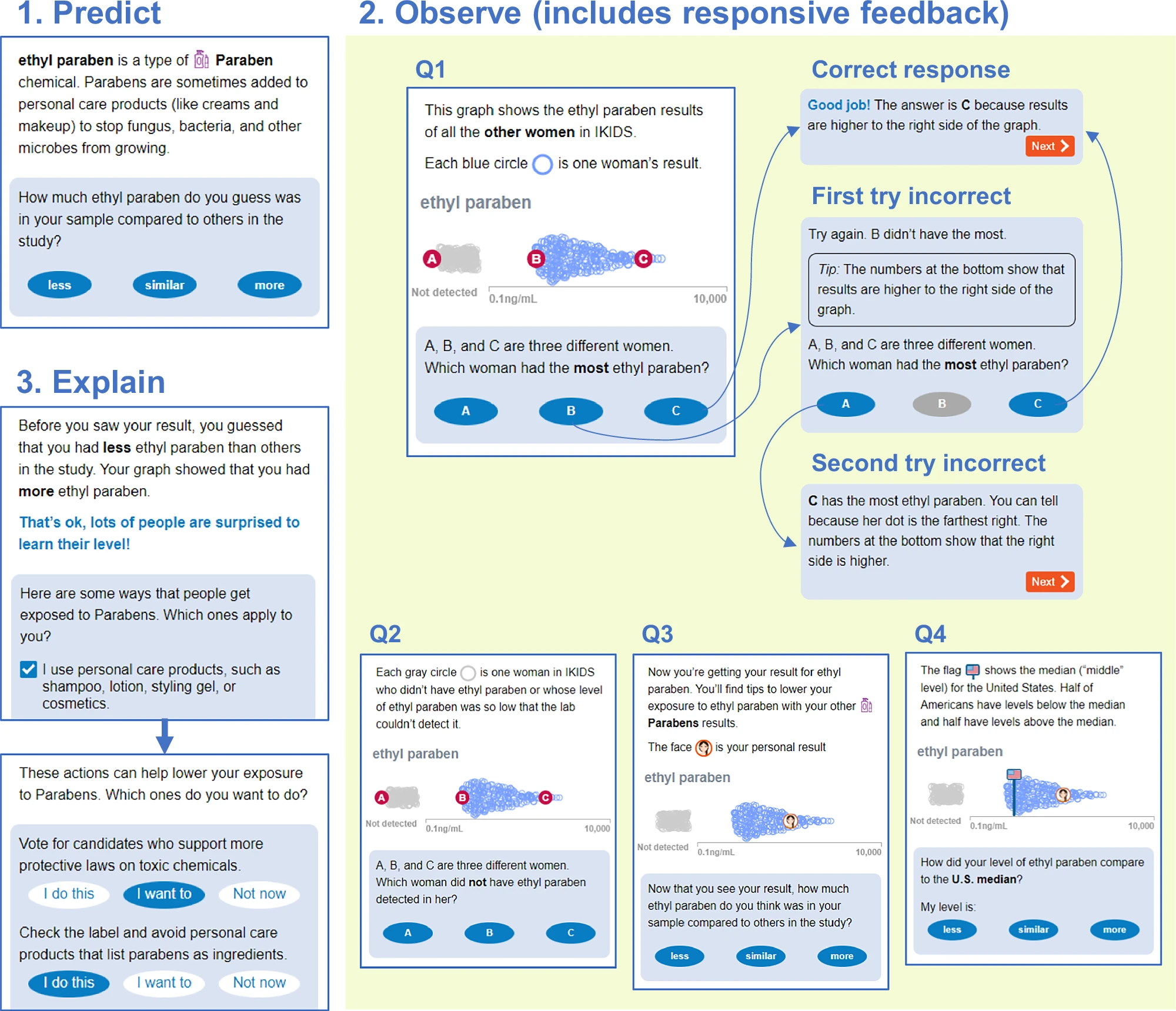
Collaborators at the Silent Spring Institute and UCSF created a smartphone-based tutorial for mothers who participated in two cohort studies, including IKIDS, that walked participants through their chemical exposure results and offered personalized recommendations for reducing contaminants in the future.
According to their study published this February, the tutorial helped study participants understand graphs that detailed their own chemical exposures, aimed at accessibility to participants of all education levels and backgrounds.
The digital interface showed participants how their own chemical exposure levels compared against other mothers collectively in both the study and nationally, then offered pointers to reduce exposure to endocrine-disrupting contaminants.
Some practical recommendations shared in the study: eating more fresh and frozen food, opting for drinks in glass bottles instead of cans, moisturizing with natural oils like shea butter or avoiding household products that are advertised as “antimicrobial.”
The tutorial proved effective at “creating intentions to adopt health-protective behaviors,” the study’s authors wrote, while providing a report-back tool that scaled for participants across different socioeconomic and educational backgrounds.
The tricky part, Geiger said, is framing risks in the proper dose. Since many of these chemicals are still being researched, investigators must give participants their best guidance off of incomplete or evolving information.
“We have to think really hard about how to report these levels back—it’s a little bit of a double-edged sword because we’re getting grants to study these chemicals simultaneously,” Geiger said. “It’s still emerging research with many of these chemicals, so we don’t always have that hard and fast guidance to give back.
“We’re continuing to do this work and hoping that, at the policy level, we become more aware that we may be doing damage to children at these crucial developmental stages, by dosing them with chemicals that are not tested or understood commensurate with the value that our children hold for the future.”
Multiple studies have shown that children who regularly get an adequate amount of sleep have better overall mental and physical health. Not getting enough sleep can lead to high blood pressure, obesity and depression. KCH Assistant Professor Sarah Geiger wants to help mitigate those sleep issues
Multiple studies have shown that children who regularly get an adequate amount of sleep have improved attention, behavior, learning, memory, and overall mental and physical health. Not getting enough sleep can lead to high blood pressure, obesity and depression. An Illinois researcher wants to help mitigate those sleep issues.
Kinesiology and Community Health Assistant Professor Sarah Geiger is planning to assess how the exposure to certain chemicals while in the womb affects child sleep later in life and can lead to poorer health outcomes. Geiger’s study is funded by an R03 grant from the National Institute of Environmental Health Sciences, the National Institutes of Health component dedicated to environmental health research. In the grant application, Geiger writes that “the potential for prenatal exposures to endocrine disrupting chemicals to adversely impact children’s health is a growing public health issue.” As Geiger explains, perfluoroalkyl and polyfluoroalkyl substances are EDCs found in many common household items and found in our blood.
“They’re so pervasive in terms of products,” said Geiger, who investigates environmental pollutants and chronic disease risk factors, including sleep problems, among children. “Studies have shown them to be found in foods (and) they’re notorious for these non-stick surfaces, but that’s really just one of so many types of things they’re in. Plastic water bottles, plastic fast food containers. They’re even in biomedical devices and things like IV bags and makeup, all sorts of cosmetics, nail polish.”
Geiger said her study is looking at the pregnant moms’ concentrations of those chemicals in their blood, and then looking at outcomes in children.
“We’re measuring her levels as a proxy of what they’re being exposed to,” Geiger said. “The idea is that developmental exposure in the womb to those chemicals that their mother has been exposed to is somehow altering their development and manifesting later as sleep problems. What we’re really interested in is looking at the association between the two. Are moms with higher levels of these chemicals in their blood more likely to have children who have poorer sleep quality? And if so, then we can think about maybe what is the mechanism that is causing that to happen?”
Geiger added that the study is not only looking at how chemical exposure in the womb affects child sleep later on, but also how stress and depression and other factors during pregnancy can affect child’s sleep later on. The study is important, Geiger said, because sleep, or the lack of it, is a predictor for health. Lack of sleep for a child can lead them to be unfocused and unproductive. And a lack of sleep in childhood is predictive of sleep issues in adulthood, she said, adding that sleep problems in adulthood cost the U.S. billions of in health care.
Another reason this research is important is how long certain PFAS can stay in a person’s body.
“They are sometimes called forever chemicals; they have an extremely long half-life compared to other types of endocrine-disrupting chemicals,” Geiger said. “The half-life might be like five years. Let’s say you have a certain level of this one chemical in your blood, after five years, half of it would have been metabolized or excreted from your body. To give you a comparison, like BPA (bisphenol A), another common endocrine-disrupting chemical, the half life is more like five hours.”
As important as the research is, Geiger is realistic that studies like hers and others are not likely to force companies to limit their use of PFAS.
“These are extremely powerful market forces … I would like to think that all of the research combined on sleep and other things may apply some pressure, but—and I do think that the end goal is to try to remove or limit these types of chemicals if they are harmful—but that’s much easier said than done. It’s a pretty difficult task.
“There’s this push and pull with just the way the U.S. approaches chemical exposures. We don’t have a very proactive or cautious approach to it. In fact, quite the opposite. And so people in the area that I work in, we’re constantly having to chase down these individual chemicals and show that this is not safe for kids, or for anybody. And then–maybe then it’ll be replaced with, as I said, typically another chemical, and you do the same thing.”
Illinois last funded its own youth tobacco survey in 2015
Eight years have passed since comprehensive data was collected on the tobacco use and smoking habits of Illinois teenagers. But scientific minds are back on the issue once again, with University of Illinois Urbana-Champaign researchers at the helm.
Two Kinesiology and Community Health faculty are set to receive $650,000 to administer and report the Centers for Disease Control’s Illinois Youth Tobacco Survey this academic year, conducting essential research on tobacco use among thousands of Illinois middle and high schoolers.
In partnership with the Interdisciplinary Health Sciences Institute on campus, KCH Assistant Professor Sarah Geiger will lead the survey as principal investigator, along with co-investigator Professor Pedro Hallal, director of the Master of Public Health program at the College of Applied Health Sciences.
“It’s been too long, in our opinion, without telling what’s going on in Illinois with youth smoking, vaping, hookah, all of those things related to tobacco,” Geiger said. “Think about how much has changed in 10 years in terms of youth culture and vaping, and everything tobacco related.”
The CDC runs the National Youth Tobacco Survey on an annual basis, surveying teenagers across the United States on their smoking and tobacco habits. State health departments can conduct their own versions of the survey if funding is available.
Illinois last funded its own youth tobacco survey in 2015, contracting out-of-state to do so, Geiger said. For the first time, the University of Illinois will lead the project, with funding from the Illinois Department of Public Health.
In spring 2024, the research team plans to send out digital surveys to teenagers in 50 middle schools and 75 high schools, randomly selected within Illinois. Their ideal target: 7,500 respondents.
Since 2014, e-cigarettes have been the most commonly used tobacco product among young people, according to the CDC. In 2022, more than 4 in 100 middle schoolers and about 1 in 6 high schoolers reported current use of a tobacco product.
The Illinois survey is being constructed with core items from the national form, along with more state-specific inquiries. The previous Illinois Youth Tobacco Survey found children with asthma had higher rates of tobacco use than those without; this iteration of the survey will contain an “asthma module” to gather more in-depth data.
“The landscape for youth tobacco use has changed. I’m glad we’re implementing questions specifically related to vaping and asthma,” said Max Wallace, program coordinator for IHSI who will serve as the project’s field coordinator. “Asthma is so prevalent among youth in the United States, so I think it’s really important we’re incorporating these questions.”
The hope among investigators is a successful youth tobacco survey will lead to a more regular occurrence in Illinois, with the U. of I. staying in the driver’s seat.
“For us, it’s like a capacity building exercise as well,” Hallal said. “We’ll be able to gain expertise and become the primary option for them to conduct this survey.”
A sizable portion of the project’s budget is set aside for graduate students to assist with the data collection and analysis. More opportunities will come indirectly, Hallal said, from subsequent research analyses of the completed survey data.
“This will generate a lot of fantastic data,” Geiger said. “This is a big ask to put this all together. Having the funding helps, but that’s not the full picture. You have to have the expertise; you have to have the will from different units to be able to put this all together.
“I’m proud of U of I for having the people within the organization who had the wherewithal to go. ‘Let’s figure this out and let’s make it happen to at least to be considered for this opportunity.’”
Endocrine disrupting chemicals are found in many common household items, and our blood
PFAS are found in many common household items and found in our blood.
Multiple studies have shown that children who regularly get an adequate amount of sleep have improved attention, behavior, learning, memory, and overall mental and physical health. Not getting enough sleep can lead to high blood pressure, obesity and depression. An Illinois researcher wants to help mitigate those sleep issues.
Kinesiology and Community Health assistant professor Sarah Geiger is planning to assess how the exposure to certain chemicals while in the womb affects child sleep later in life and can lead to poorer health outcomes. Geiger’s study is funded by an R03 grant from the National Institute of Environmental Health Sciences (NIEHS), the National Institutes of Health (NIH) component dedicated to environmental health research. In the grant application, Geiger writes that “the potential for prenatal exposures to endocrine disrupting chemicals (EDCs) to adversely impact children’s health is a growing public health issue.” As Geiger explains, perfluoroalkyl and polyfluoroalkyl substances (PFAS) are EDCs found in many common household items and found in our blood.
“They’re so pervasive in terms of products,” said Geiger, who investigates environmental pollutants and chronic disease risk factors, including sleep problems, among children. “Studies have shown them to be found in foods (and) they’re notorious for these non-stick surfaces, but that’s really just one of so many types of things they’re in. Plastic water bottles, plastic fast food containers. They’re even in biomedical devices and things like IV bags and makeup, all sorts of cosmetics, nail polish.”
Geiger said her study is looking at the pregnant mom’s concentrations of those chemicals in her blood, and then looking at outcomes in children.
“We’re measuring her levels as a proxy of what they’re being exposed to,” Geiger said. “The idea is that developmental exposure in the womb to those chemicals that their mother has been exposed to is somehow altering their development and manifesting later as sleep problems. What we’re really interested in is looking at the association between the two. Are moms with higher levels of these chemicals in their blood more likely to have children who have poorer sleep quality? And if so, then we can think about maybe what is the mechanism that is causing that to happen?”
Geiger added that the study is not only looking at how chemical exposure in the womb affects child sleep later on, but also how stress and depression and other factors during pregnancy can affect child’s sleep later on. The study is important, Geiger said, because sleep, or the lack of it, is a predictor for health. Lack of sleep for a child can lead them to be unfocused and unproductive. And a lack of sleep in childhood is predictive of sleep issues in adulthood, she said, adding that sleep problems in adulthood cost the U.S. billions of in health care.
Another reason this research is important is how long certain PFAS can stay in a person’s body.
“They are sometimes called forever chemicals; they have an extremely long half-life compared to other types of endocrine-disrupting chemicals,” Geiger said. “The half-life might be like five years. Let’s say you have a certain level of this one chemical in your blood, after five years, half of it would have been metabolized or excreted from your body. To give you a comparison, like BPA (bisphenol A), another common endocrine-disrupting chemical, the half life is more like five hours.”
As important as the research is, Geiger is realistic that studies like hers and others are not likely to force companies to limit their use of PFAS.
“These are extremely powerful market forces … I would like to think that all of the research combined on sleep and other things may apply some pressure, but—and I do think that the end goal is to try to remove or limit these types of chemicals if they are harmful—but that’s much easier said than done. It’s a pretty difficult task.
In some rural counties of Illinois, nearly half of sampled homes with private wells had dangerous lead levels
Nearly half of the sampled homes had measurable lead in their private well water.
When KCH Assistant Professor Sarah Geiger received a grant from the U.S. Department of Housing and Urban Development (HUD) to study private water wells, her primary focus was finding a way to mitigate the amount of lead in drinking water. She might not have expected another outcome.
Geiger, the principal investigator for a study entitled, “Drinking Water Lead Remediation Strategies for Illinois Homes with Domestic Wells,” received a grant of about $1 million from the HUD 2019 Healthy Homes Technical Study Grant Program. As researchers do, she set out to find participants for her study. But to Geiger, the participants weren’t just numbers on a to-do list.
“The rural people who I work with in my private well study have made an impact on me. We have people living in quite impoverished conditions, although they don’t seem to let it affect their self-worth. They are very salt of the earth people and gracious to us when we come to their homes. I would like to be able to tell their stories,” she said.
In the initial stage of Geiger’s project, the Illinois State Water Survey (with collaborators from the University of Illinois at Chicago, and county public health departments) measured lead levels in homes with private wells in rural areas of Peoria, Jackson, and Kane counties, finding that nearly half of the sampled homes had measurable lead.
Lead exposure can cause serious damage to children’s developing brains, so identifying elevated lead concentrations and working with homeowners and public health workers to mitigate sources of lead in water is vital, according to Walt Kelly of the Water Survey, one of Geiger’s collaborators.
For Geiger, part of the issue is a health disparity.
“Clearly not all people who are in municipal systems have clean water. I mean, that’s not even close to being true. But at least there are these mechanisms that are in place in an attempt to keep it free from lead.
Rural people have often lived on their land for generations and have intimate knowledge about its history, including the wells, plumbing, and water issues. But sometimes there is an opportunity for education when we see things that participants may not know are health hazards.”
Sarah Geiger
Assistant Professor of Kinesiology and Community Health
“I work with PFAS. There’s all this (Environmental Protection Agency) PFAS testing going on. It doesn’t test private wells. But there are PFAS in private wells, I can guarantee you. And they’re not going to be picked up, they’re going to be left out of that.”
Geiger’s passion about the subject comes through in the interview as she talks about how generous and kind people are when she and her colleagues visit homes with private wells. Most often, she visits rural, low-income communities across Illinois.
“We’ll go out and meet the well inspector, meet the plumber, meet the county health staff, and the people that will have to be there because they have to let us into their home to do the plumbing assessment. And they’re really gracious, I mean we’re bringing all these people into their home,” she said. “We try to reassure them.”
Still, Geiger said, she has to warn study participants about things the plumber might see, such as mold around plumbing fixtures. It’s not uncommon to see hand-dug basements or basements with dirt floors, Geiger said.
Sarah Geiger
“Rural people have often lived on their land for generations and have intimate knowledge about its history, including the wells, plumbing, and water issues. But sometimes there is an opportunity for education when we see things that participants may not know are health hazards,” she said.
Geiger said she tells the study participants that she and her colleague are not there to identify problems or issue fines.
“They’re receptive to (the inspections) and I think they do care about their water quality. They’re proud of their place,” she said.
What Geiger wants to emphasize is that her study is aimed at helping people remediate their well issues.
“In addition to the water testing, they get this plumbing survey, they get their well inspection. And then they potentially will get, not everybody, but those with the highest levels of lead will get this remediation.”
But in order to implement larger-scale change, especially for private well owners, government regulations need to change, she said.
“We have the Lead and Copper Rule for municipal systems where there has to be this routine testing, and mitigation if there’s an issue. Why are rural people not able to take advantage of the benefits that urban people have in terms of clean water?”
Pre-term birth of a baby puts them at risk for various health problems
Sarah Geiger, an incoming assistant professor in the Department of Kinesiology and Community Health in the College of Applied Health Sciences, has received a $200,000 grant from the National Institutes of Health’s ECHO Opportunities and Infrastructure Fund to study how social vulnerability contributes to pre-term births.
Geiger’s study is entitled, “Oxidative stress and inflammation biomarkers in relation to birth outcomes in four ECHO cohorts. As Geiger explained, babies are born too early for all sorts of reasons, but pre-term birth of a baby puts them at risk for various health problems. Pre-term birth is also really expensive for society, she said. In 2017, for example approximately four million babies were born preterm in the U.S. and preterm birth contributes an estimated $6 billion in health care costs within the first year of life.
“We want to learn more about how social vulnerability—things like being poor, stressed out, living as a racial or ethnic minority, and even being exposed to common environmental chemicals—contribute to pre-term birth,” Geiger said. “To do this, we want to explore what’s going on in women’s bodies when this happens, specifically biological pathways of oxidative stress and inflammation.”
Geiger’s study proposes to characterize biological pathways for preterm birth in four ECHO birth cohorts—including one at Illinois Kids Development Study in Champaign-Urbana—by applying a novel method to quantify the proportion of 8-iso-PGF2α derived from oxidative stress and inflammation mechanisms using the ratio of 8-iso-PGF2α to PGF2α. Previous studies have linked elevated levels of oxidative stress biomarkers to preterm birth, but it is difficult to distinguish between oxidative stress and inflammation, and, Geiger suggests, her study’s approach might address this data gap.
Urine samples will be collected from more than 2,000 women, with about 350 in Champaign-Urbana. The other cohort sites are Chemicals in Our Bodies at the University of California, San Francisco; Puerto Rico Testsite for Exploring Contamination Threats at Northeastern University; and The Infant Development and the Environment Study, at Mount Sinai, University of California, San Francisco, University of Rochester Medical Center, and University of Minnesota.
The study will begin in the fall, and next steps at our site will be preparing urine samples to send to a lab for biomarker measures, Geiger said.