Inside LIFE Home: Five years of innovation for independent living
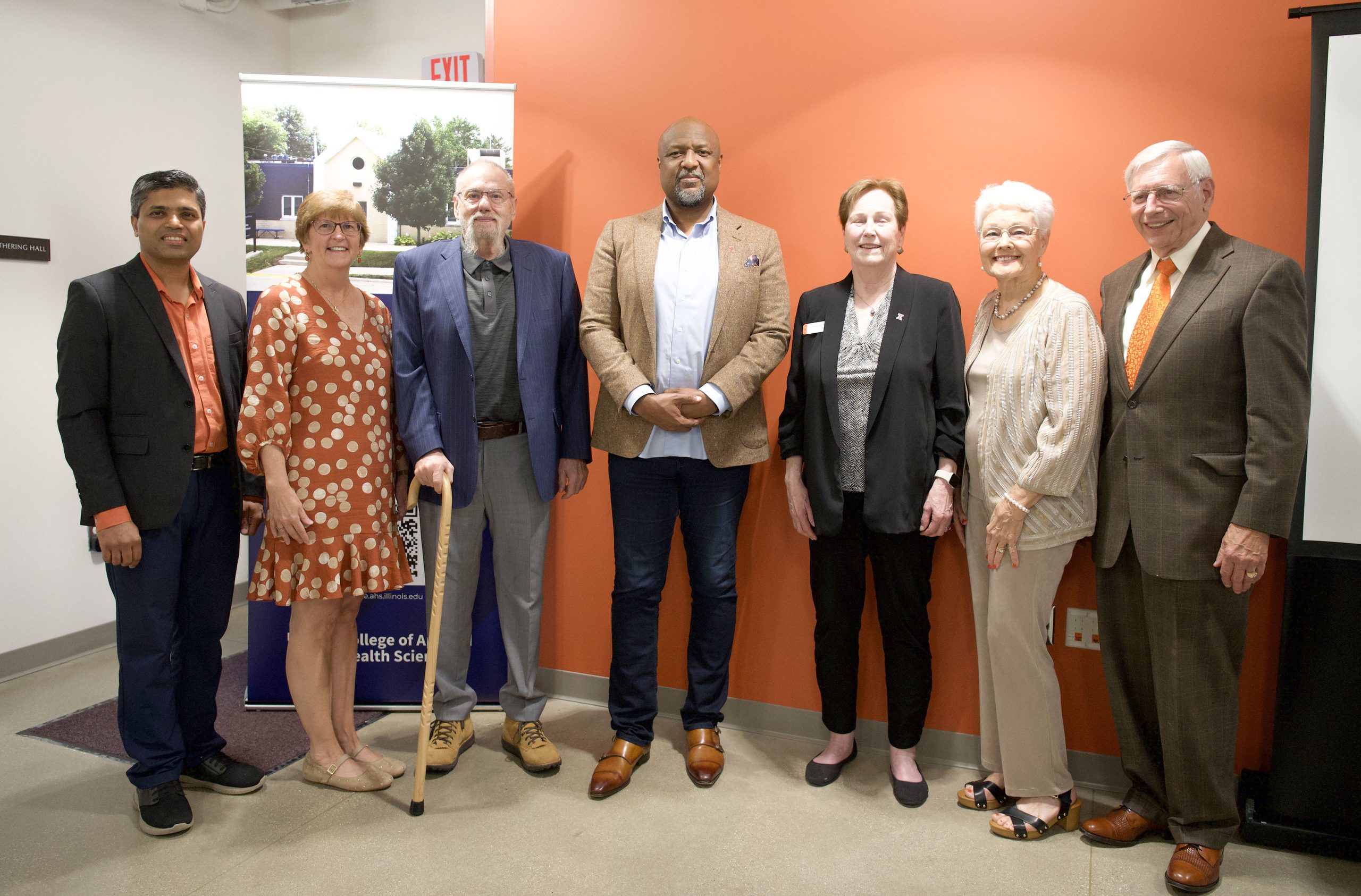
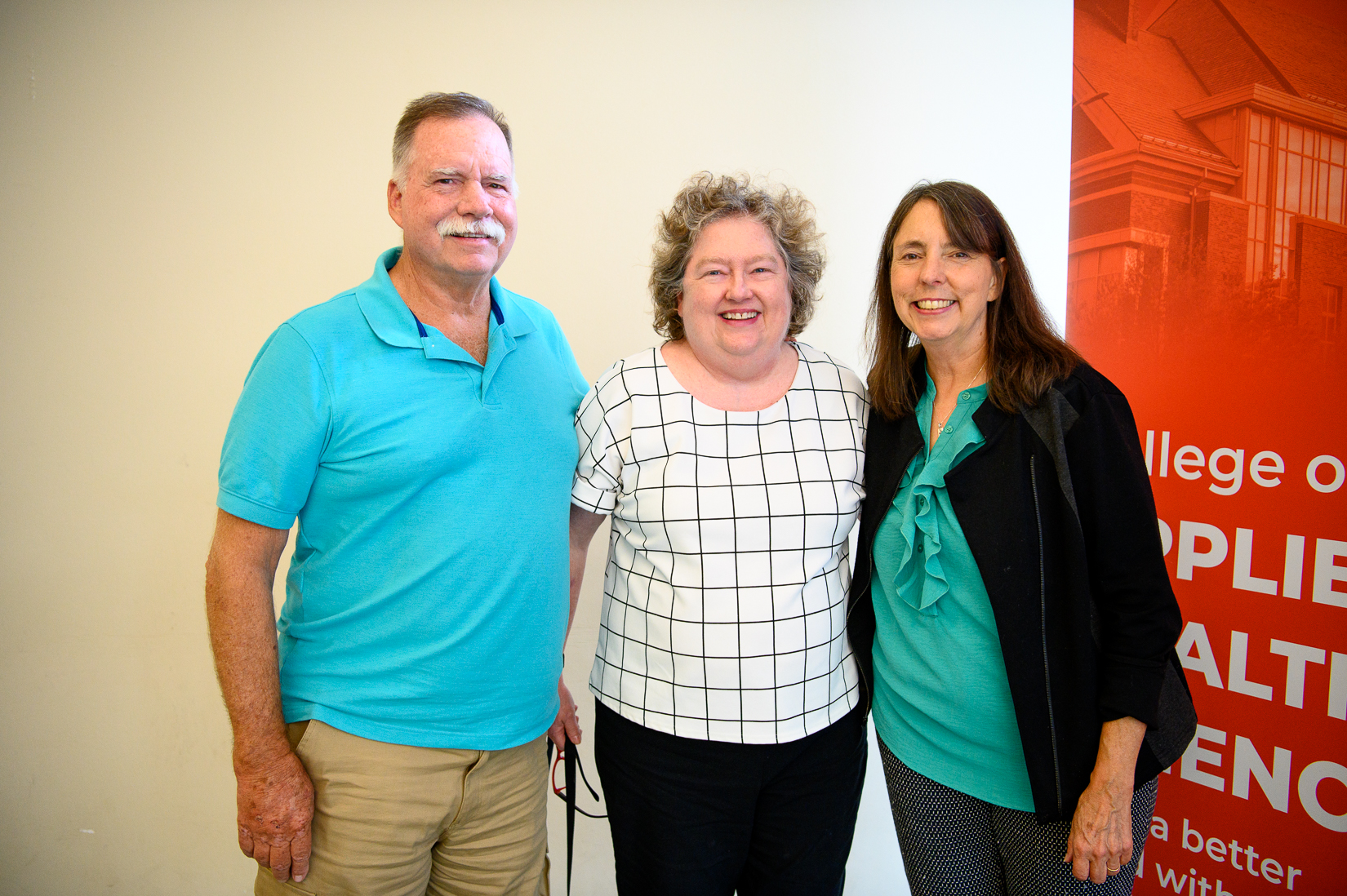
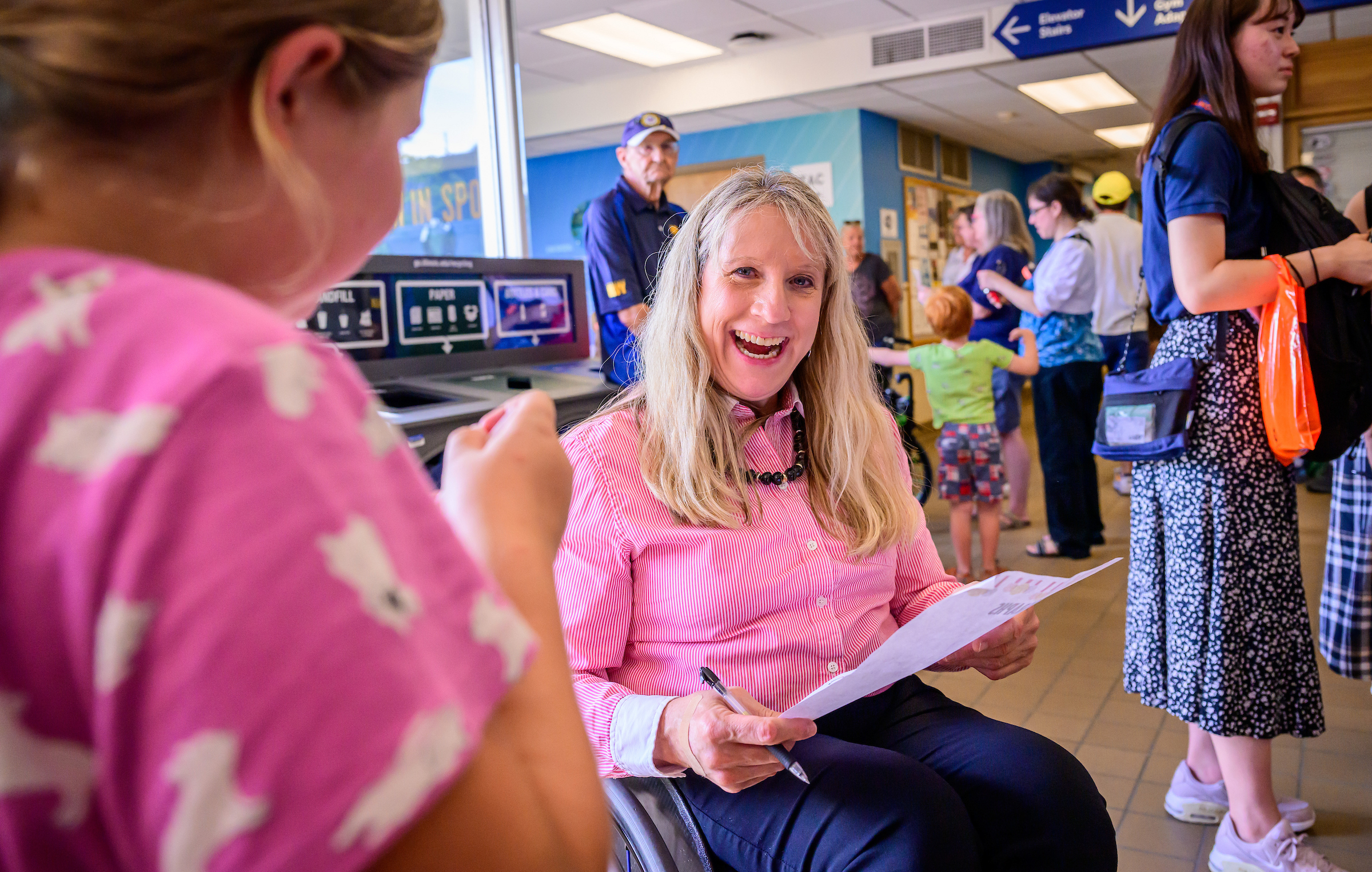
Chancellor Isbell, center, with LIFE Home Director Wendy Rogers, second from left, Dean Cheryl Hanley-Maxwell, right and Karen and Jim McKechnie, lead benefactors of the McKechnie Family LIFE Home (Photo by Bridget Lee-Calfas)
The McKechnie Family LIFE Home at the University of Illinois celebrated its fifth anniversary Oct. 8, marking five years of bringing researchers, students, community members and industry partners together to develop technologies that help people live healthier, more independent lives.
The facility—where LIFE stands for Living in Interactive Future Environments—provides a real-world home environment where research is grounded in everyday experience. By bringing together engineering, health sciences, design and human-centered research, the LIFE Home helps researchers better understand the routines, challenges and aspirations of the people their innovations are intended to serve.
“It is a place where discovery is grounded in everyday experience—where researchers can better understand the routines, challenges and aspirations that shape people’s lives,” said College of Applied Health Sciences Dean Cheryl Hanley-Maxwell during the anniversary celebration.
Over the past five years, the LIFE Home has supported interdisciplinary research in healthy aging, disability, rehabilitation, assistive robotics, smart-home technology and virtual and extended realities. Students learn alongside faculty, community partners and the people whose perspectives help make that research stronger and more relevant.
The work reflects the university’s land-grant mission toward improving lives through research, education and engagement. It also gives students opportunities to see how innovations can address everyday needs and support greater independence, dignity and connection for people of all ages and abilities.
Hanley-Maxwell credited Jim and Karen McKechnie’s generosity and commitment with giving the work a home and creating a lasting foundation for discovery, education and public impact. She also recognized Dan Fisk; Larry Kanfer; other donors and supporters; and Wendy Rogers, Shahid and Ann Carlson Khan Professor of Applied Health Sciences and director of the McKechnie Family LIFE Home, along with the facility’s faculty, staff, students, collaborators and community advisors.
Rogers recalled that the vision for a smart-home research facility began when then-Dean Tanya Gallagher hired her. Hanley-Maxwell later embraced the idea, and the McKechnies’ support enabled the team to expand the original plan.
“This is an amazing facility,” Rogers said. “And it is an amazing community that has contributed to its success.”
Rogers also recognized Fisk for sponsoring a named room and establishing a research fund, Larry and Alaina Kanfer for donating photographs that make the facility feel more like a home, and Walt and Sue Schneider for supporting research on in-home mobility for older adults.
She credited Harshal Mahajan with helping develop the LIFE Home from before the building existed and throughout its first five years. Mahajan prepared a video highlighting the facility’s activities during that period.
Rogers thanked postdoctoral associate Shafiqul Islam, who oversees the facility’s technology and supervises interns,; and operations coordinator Yvona Vlach, who works with clients, campus offices and the public. She also recognized building service worker Leonard Mcfarland for the daily care that keeps the facility ready for research and events.
The anniversary is an opportunity to build on that foundation. Continued philanthropic and institutional support—along with new partnerships—could advance research and strengthen collaboration across the university and broader community. Rogers said the LIFE Home’s mission aligns with the university’s priorities in people-first technological transformation, health and well-being, preparing future leaders and serving the public.
“As proud as we are of these first five years, today is not simply a look back,” Hanley-Maxwell said. “It is an invitation to imagine what comes next: smarter and more accessible homes; more inclusive technologies; stronger community partnerships; and new solutions that help people of all ages and abilities live with greater independence, dignity and connection.”
Rogers agreed, saying, “Together, we will lead the way in improving quality of life and independence for people of all ages and abilities through technology.”
From a small tent to powerful connections fueling opportunity
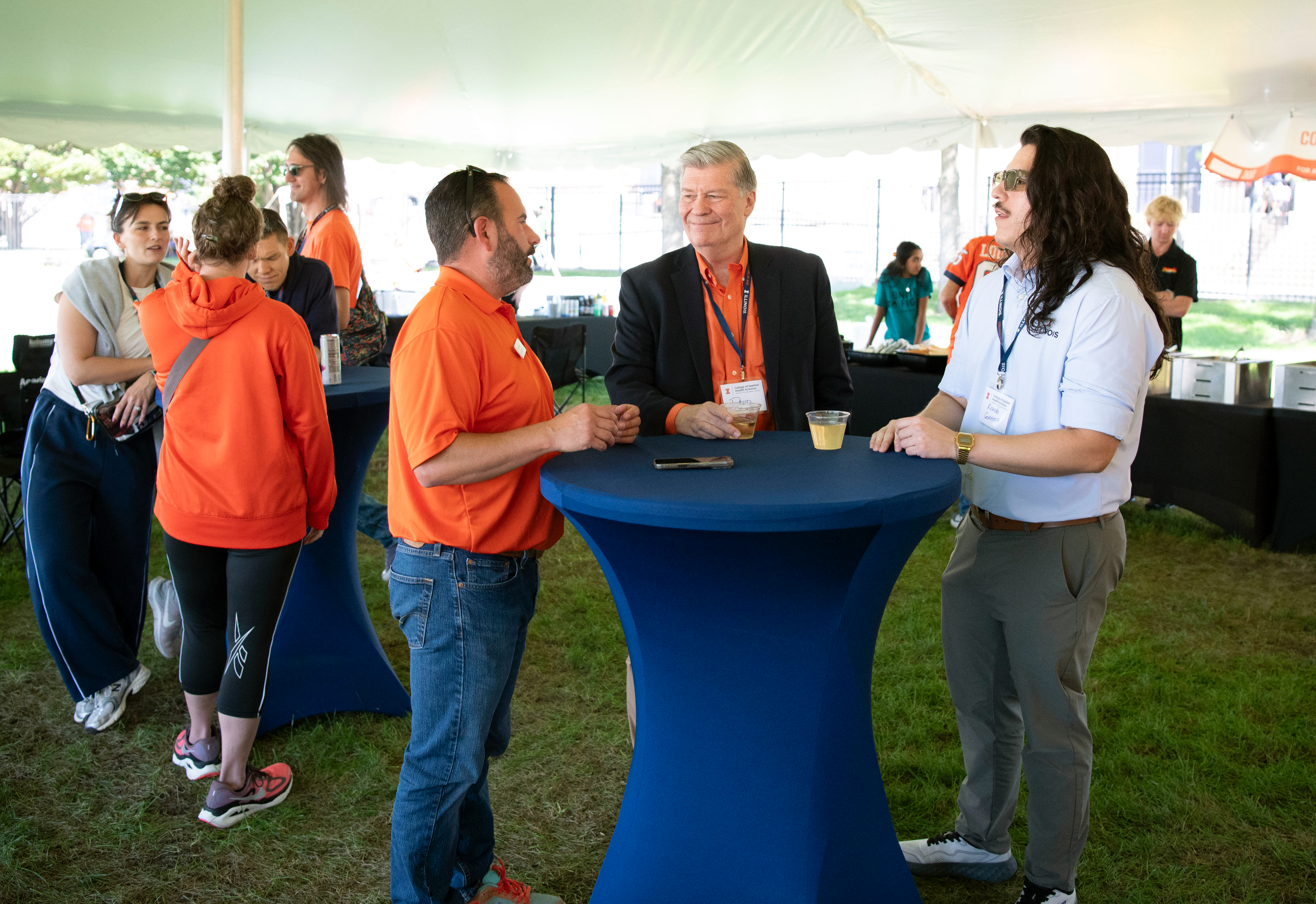
David Shockey, center, with Senior Director of Advancement Matt Smith, left, and Health and Kinesiology Assistant Professor Shaon Lahiri (Photo by Bridget Lee-Calfas)
By Vince Lara-Cinisomo
Sara Kelly once had to make a case for a small tent and a gathering of perhaps 75 people. On Saturday, Oct. 3, 2026, she saw how far that idea had come.
The former Assistant Dean for Advancement for the College of Applied Health Sciences recalled an early tailgate around 2005, tucked away on the other side of what was then Assembly Hall.
At the college’s 2026 tailgate in Grange Grove in front of Gies Memorial Stadium, Kelly saw just how much the gathering has evolved.
“For me to see this today is amazing,” Kelly said.
The event brought together alumni, faculty, staff and donors, giving supporters a place to renew friendships and connect with the people behind the college’s work. For donors, those connections linked the pleasure of returning to campus with the reasons they give: opportunities for Veterans, health equity, community wellness, vital research and a commitment to students.
The gathering gave donors a chance to discuss those shared values and investments with the college community while participating in a beloved annual campus tradition.
Peter Korst, chair of the college’s Board of Visitors, described attending as one way he demonstrates his enduring affinity for Applied Health Sciences.
“I want to show up to support the college in any way,” Korst said.
Korst earned his undergraduate degree in civil engineering at Illinois and a master’s degree in what was then Leisure Studies and is now the Department of Recreation, Sport and Tourism. Both colleges equipped him with valuable skills, he said, but Applied Health Sciences contributed more directly to what became his vocation.
His involvement began on an advisory board for RST before he joined the Board of Visitors. The tailgate gives him another way to maintain those ties, with familiar faces making each return more anticipated than the last.
“It seems like every year it gets more and more comfortable because I see more people that I know,” he said.
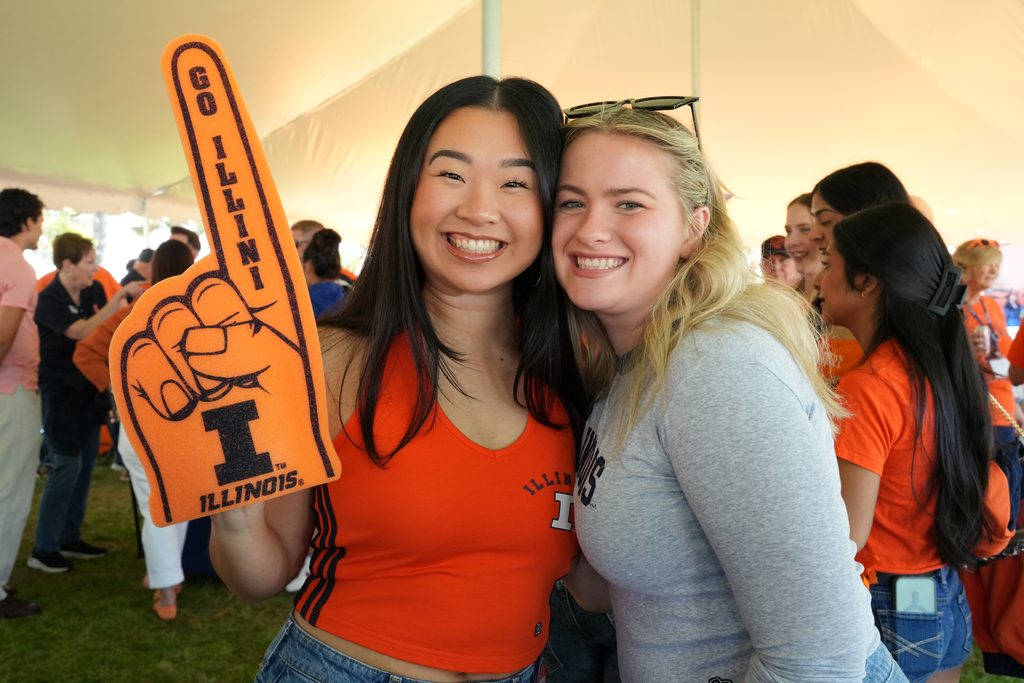
Students as well as faculty, staff and alumni packed the tailgate tent in Grange Grove (Photo by Bridget Lee-Calfas)
That sense of connection also informs his goals for the board. Korst said members want opportunities beyond hearing reports about the college. He is helping identify ways they can engage more directly with students and faculty.
For Denis Lougeay, who runs the San Diego Illini Club, the gathering connected a distant alumni community with people it supports in Urbana-Champaign.
Lougeay said he had returned for homecoming perhaps 30 times or more but first attended the college’s tailgate last year. Valued relationships with people associated with the college help draw him back.
“It’s really great to be here and see all these people,” Lougeay said.
His club sponsors a scholarship for Veterans at the Chez Veterans Center, and he also contributes individually.
“We sponsor a Veteran, essentially, every year,” he said.
Neither Lougeay nor his wife Denruth is a Veteran, he said. But San Diego’s many Navy Veterans and Veterans serving on the club’s board helped make the connection meaningful.
A tour when the Chez Veterans Center opened introduced Lougeay to its facilities and staff, strengthening his confidence in its mission.
“We got a tour right when the Chez Center opened, and it is just an amazing facility,” he said.
For David Shockey, a generous donation to the Rural Health Initiative grew from both personal experience and relationships with people working to extend the university’s reach.
Shockey, a lawyer and two-time University of Illinois graduate from Freeport, Illinois, has a sister with a hearing impairment. He’s also a longtime supporter of University of Illinois Extension and wanted to connect campus expertise with people in Stephenson County who seldom make the trip to Illinois.
He described the developing project as an experiment that would bring together university talent with local enthusiasm and commitment.
“It’s a trial (and) we’re going to see how it goes,” Shockey said.
The proposed approach would use dedicated technology to connect people remotely with campus staff and graduate students for additional evaluation of hearing and speech concerns, he said. Shockey characterized it as a way to seek a second opinion.
The project is not yet underway, he said, but the enthusiasm of Extension contact Margaret Larson encouraged him. Larson is the County Extension director for Jo Daviess, Stephenson and Winnebago counties.
“I’ve never seen her more driven,” Shockey said, who added that AHS Senior Director of Advancement Matt Smith was instrumental in getting him on board.
Shockey’s gift illustrates how the relationships renewed at a tailgate can connect to work far beyond campus. For Lougeay, that work means supporting Veterans. For Korst, it includes finding new ways to serve students and faculty.
Kelly, who helped establish the gathering, also recalled hiring former Assistant Dean of Advancement Jean Driscoll—who recently retired from the university—for her passion for the college’s mission and her experience as an alumna.
“She exemplified what we’re really all about—giving people opportunities to excel,” Kelly said.
In Grange Grove, the people who help make those opportunities possible had a place to come together—and reasons to keep returning.
Patrick Kaler, Vivian Villegas and Susannah Scaroni were honored as the 2026 AHS Alumni Award winners
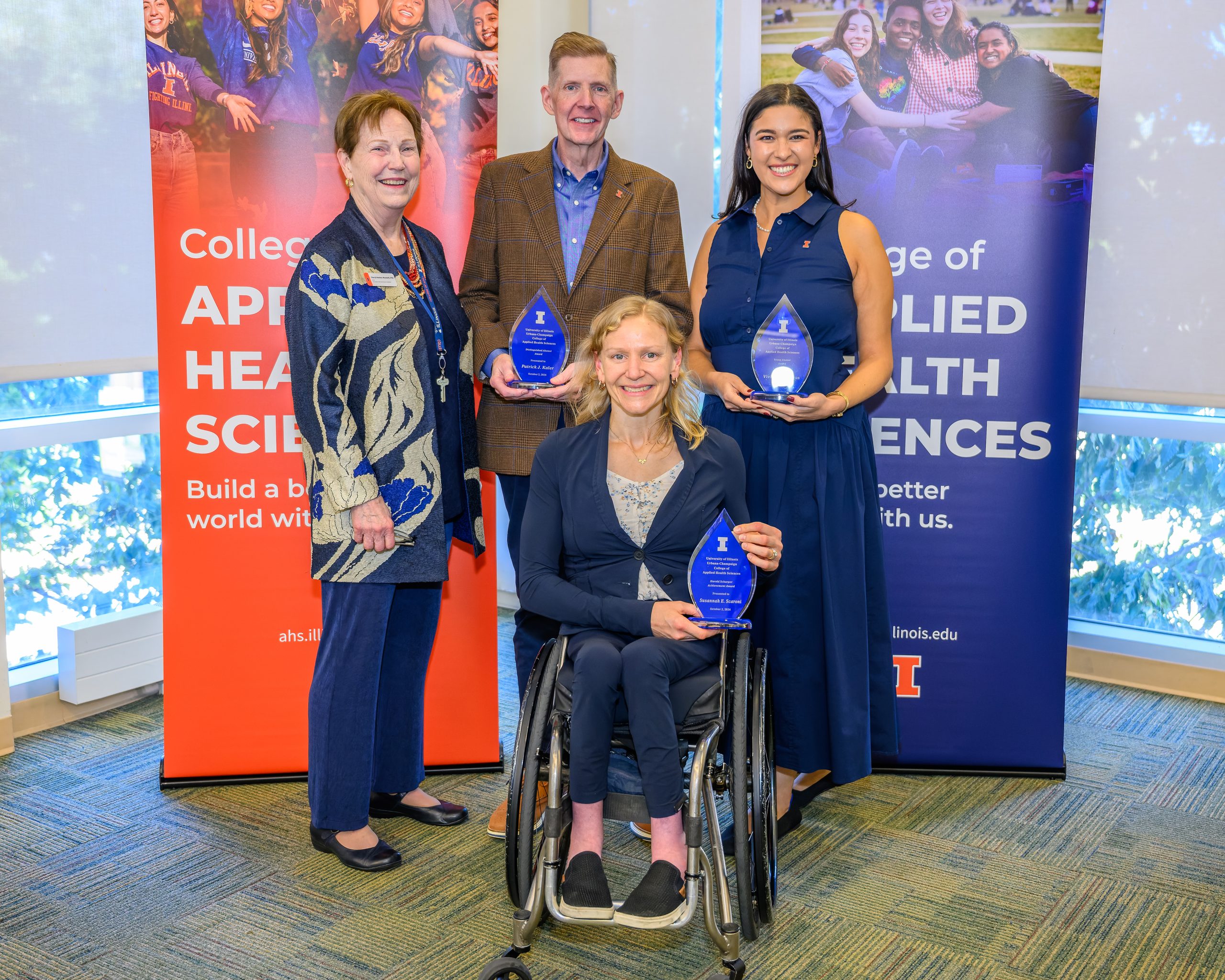
From left to right, Dean Cheryl Hanley-Maxwell, Patrick Kaler, Susannah Scaroni and Vivian Villegas. (Photo by Craig Pessman)
Walking between Huff and Freer halls during her first semester at the University of Illinois Urbana-Champaign, Vivian Villegas encountered something that surprised the friend beside her: an academic advisor who knew her name and remembered her first big test.
Health and Kinesiology advisor Amy O’Neill stopped to ask how it had gone. For Villegas, a freshman from Dixon, Illinois, that small exchange helped make a large university feel manageable.
Years later, the pediatric occupational therapist returned to accept the College of Applied Health Sciences’ 2026 Young Alumni Award, recognizing work that helps children find their own ways to participate and belong.
Villegas joined tourism executive Patrick Kaler and Paralympic wheelchair champion Susannah Scaroni as the college’s 2026 alumni awards recipients. Their careers reach from classrooms to international competition to the communities that welcome travelers, connected by an Illinois education and a commitment to expanding opportunities.
“Although their paths are very different, each has used an Illinois education to open doors for others and strengthen communities,” Dean Cheryl Hanley-Maxwell said.
For Villegas, the recognition brought back another campus memory: watching the same awards ceremony as a student in 2016.
“This really is a full-circle moment and one that I will cherish forever,” she said.
She arrived at Illinois planning to become an occupational therapist and chose kinesiology as her major. Within the college, she found opportunities to work as a research assistant and serve as student council president her senior year.
After earning her bachelor’s degree at Urbana-Champaign, she completed master’s and doctoral degrees in occupational therapy at the University of Illinois Chicago.
Her work now focuses on children, including nonspeaking autistic students, in school and community settings. She helps students who use augmentative and alternative communication and has helped develop an early literacy curriculum for children in kindergarten through second grade.
Her work also extends to research at the Children’s Participation and Environment Research Lab, teaching occupational therapy students an Illinois-Chicago and serving on the Board of Managers at GiGi’s Playhouse Chicago, which supports people with Down syndrome and their families.
Accepting the award, Villegas emphasized the significance of recognition for clinicians whose daily contributions may draw little attention. She described herself as representing alumni “engaging in the meaningful everyday work that often goes unrecognized.”
For Kaler, recipient of the Distinguished Alumni Award, the road back to Illinois began with a decision to step away from an established career.
About a decade into the tourism industry, he returned to school with plans to earn a master’s degree and eventually become a professor. Research papers, seminars and discussions of theory made the transition demanding.
“I won’t pretend that was an easy decision,” he said.
His advisor, former Recreation, Sport and Tourism Department Head Carla Santos, helped him navigate the move from professional life to academia. But graduate school also clarified what Kaler missed.
“I missed the people,” he said. “I missed the problem-solving and creating experiences that can truly change lives.”
After earning his master’s degree in tourism in 2005, he took a job in Lake Tahoe, California, instead of continuing toward a doctorate. For someone who grew up in Rantoul, Illinois, the move stretched his expectations.
“The thought of going to Lake Tahoe was never on my bingo card,” he said.
Kaler’s career subsequently took him to Los Angeles, Northern Virginia and Buffalo, New York. Since 2014, he has led Visit Buffalo Niagara as president and CEO, with responsibilities that also include the Buffalo Convention Center and Buffalo Sports Commission.
Hanley-Maxwell’s remarks placed that work in the context of community development, describing destination leadership as a way to support local businesses and create opportunities throughout a region.
Kaler credited graduate study with strengthening his research and strategic thinking. He also credited colleagues, staff members, industry partners and family for helping make his career possible.
Alongside his industry work, Kaler has shared his experience through teaching, lectures and appearances at national tourism conferences.
Thank you for making this campus my favorite place to come home to.
Vivian Villegas
2026 Young Alumni Award winner
His advice to students left room for uncertainty.
“The field will surprise you,” he said. “It might bring you back to school years later than you planned. It might take you far from where you thought you’d ever end up. Trust it anyway.”
For Scaroni, opportunity is inseparable from access.
The recipient of the Disability Resources and Educational Services’ Harold Scharper Achievement Award came to Illinois from tiny Tekoa, Washington, to study and train with its wheelchair racing program and renowned coach Adam Bleakney. She earned a bachelor’s degree in dietetics and a master’s degree in nutritional sciences and became a registered dietitian.
Her athletic achievements include six medals across four Paralympic Games, with gold in the T54 5,000 meters at the Tokyo Games and four medals at the 2024 Paris Games. She also has won the Boston, Chicago and New York City marathons.
A serious training accident in 2021 interrupted that career. Her return to elite competition added another chapter to a record that Hanley-Maxwell described as extending well beyond results, through mentorship, disability advocacy and work promoting wellness.
In accepting her award, Scaroni focused on the people who helped make an accessible education possible. She credited Scharper and DRES founder Tim Nugent with demonstrating that everyone deserves the freedom education offers.
“As many of us—and I would argue that those of us with disabilities, especially—know, freedom can feel like the absence of a barrier,” Scaroni said.
Dean Cheryl Hanley-Maxwell opened the ceremony with remarks about the winners. (Photo by Craig Pessman)
That freedom, she said, allowed her to pursue goals in athletics, academics and her profession.
“For me, a physical disability has never been a barrier to any of my physical, academic, or professional dreams,” she said.
Together, the honorees offered different measures of achievement: destinations strengthened, students supported and barriers removed. Their remarks also returned repeatedly to the people and experiences that helped them reach those milestones.
For Villegas, that connection still feels personal whenever she returns to campus, whether to watch basketball, walk the Quad or share the university with loved ones.
She closed by thanking the college for the award and, “more importantly, for making this campus my favorite place to come home to.”
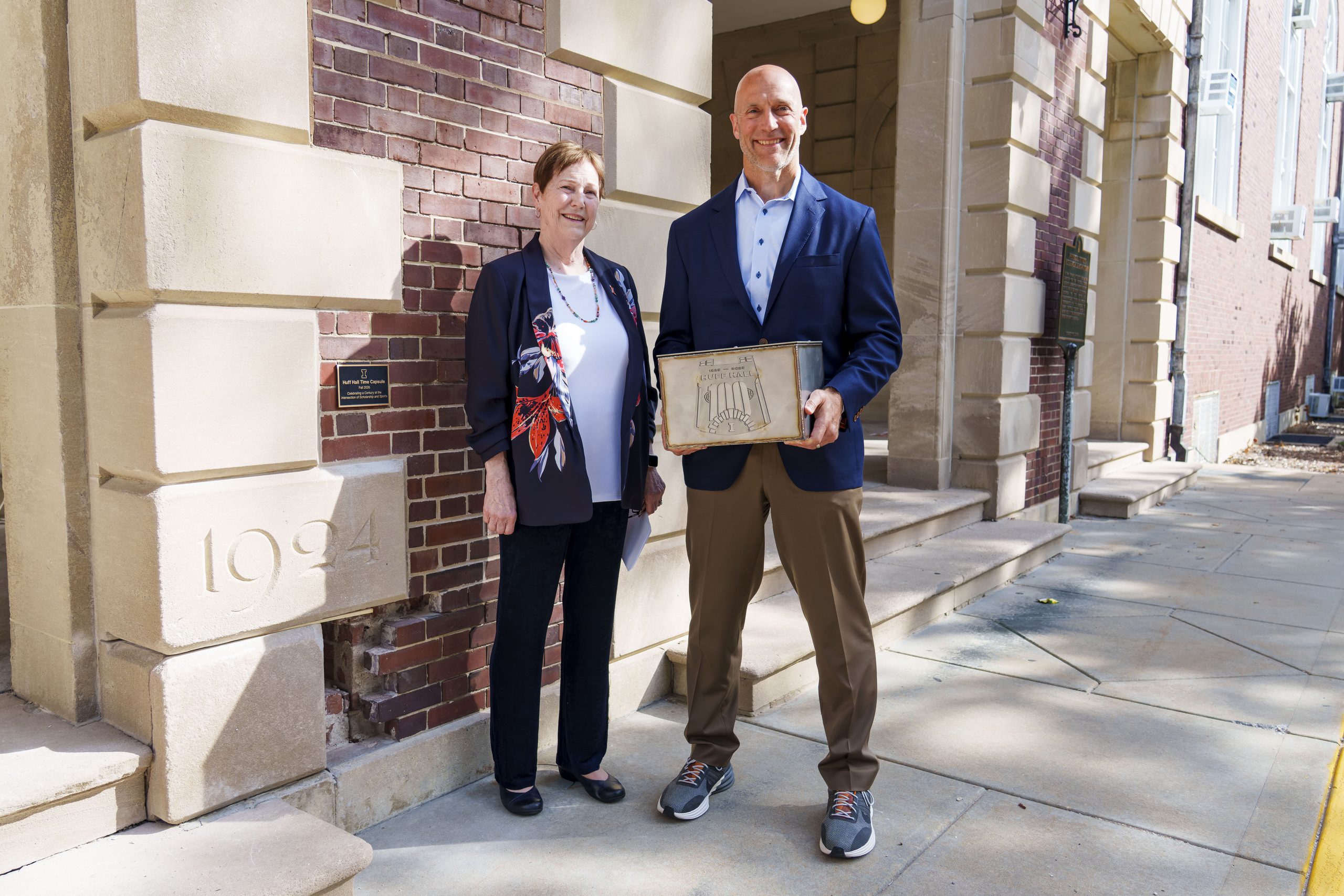
A time capsule to be opened in 2126 was placed inside Huff Hall
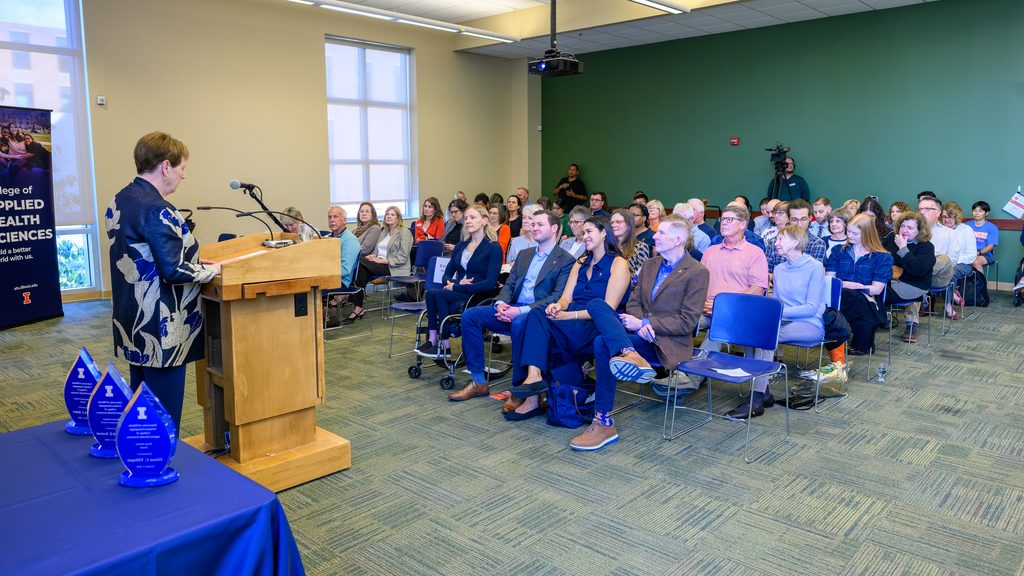
Dean of the College of Applied Health Sciences Cheryl Hanley-Maxwell and Athletic Director Josh Whitman during the Huff Hall time capsule ceremony at Huff Hall. (Photo By Ashley Ray/Fighting Illini)
The people who open Huff Hall’s new time capsule in 2126 may inhabit a world that today’s University of Illinois community members would scarcely recognize. But the people sending messages forward hope some things will feel familiar: teamwork, curiosity and a commitment to helping others.
Those hopes framed the dedication of a new time capsule at Huff Hall, where university leaders looked a century ahead while reflecting on the values they want future generations to inherit.
Kent Brown, Illinois’ retired associate athletics director for media relations who is now serving as the Division of Intercollegiate Athletics’ historian, acted as the emcee of the event. Faculty, staff, alumni and donors from the College of Applied Health Sciences; Illinois Athletic Director Josh Whitman; and students from Brown’s sports public relations class attended.Joe Murphy, George Huff’s great-grandson, also was in attendance and provided an important family connection to the history invoked during the ceremony.
For Cheryl Hanley-Maxwell, dean of the College of Applied Health Sciences, the capsule offered an opportunity to speak directly to current and future students whose lives and circumstances remain beyond prediction.
“As we seal this time capsule, we are doing something both simple and remarkable: sending a message to students we will never meet, in a world we can only imagine,” she said.
When this capsule is opened, I hope inclusion and accessibility are no longer aspirations, but ordinary features of life.
Cheryl Hanley-Maxwell
Dean, College of Applied Health Sciences
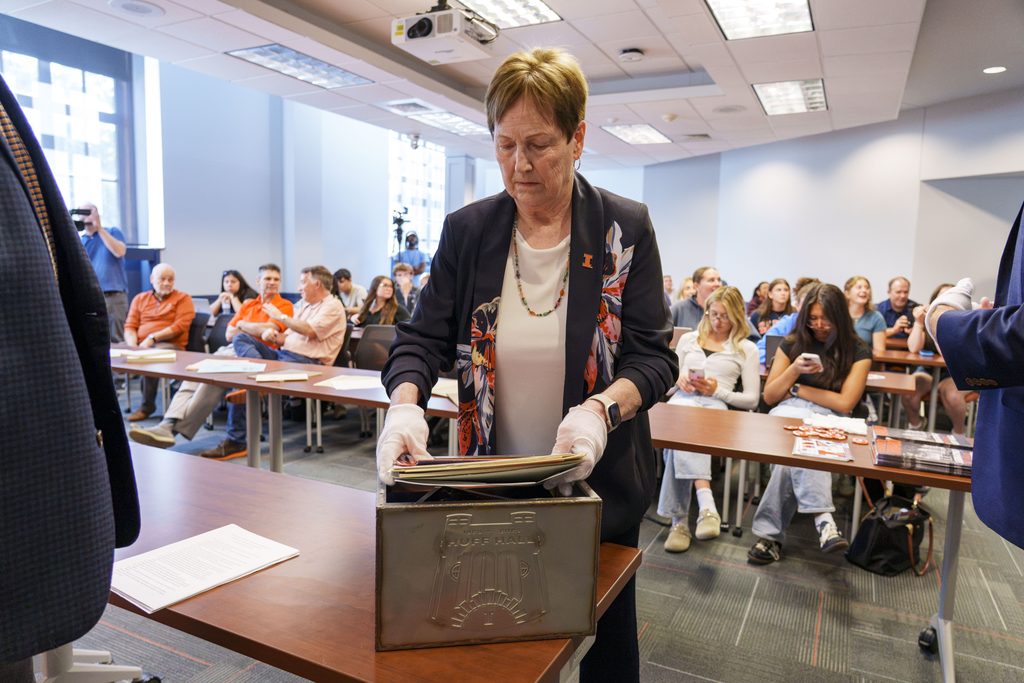
The time capsule box is a 10”x13” container that will be filled with argon gas to preserve the items placed into it, including magazines, newspapers, photos of this and other Huff-related events and people. The box will also contain current high-tech pieces such as a hearing aid and wearable surface electromyography sensor (from the Department of Speech and Hearing Science) and a physical activity monitor from the Department of Health and Kinesiology.
Hanley-Maxwell’s message paired an account of life in 2026 with hopes for a more accessible future. Powerful computers fit into pockets, and communication crosses continents instantly, she noted. Yet health inequities, inadequate support for people with disabilities, loneliness, and barriers to education persist.
The contrast gave the capsule a purpose beyond preserving a record of campus life. Hanley-Maxwell asked its future audience to consider whether the opportunities available to people had expanded along with technological capabilities.
“When this capsule is opened, I hope inclusion and accessibility are no longer aspirations, but ordinary features of life,” she said.
She described a vision of health that extends beyond freedom from illness to encompass dignity, connection, movement and opportunity. Disability, she said, should be fully recognized as part of human diversity.
Cheryl Hanley-Maxwell examines the contents of the time capsule during the event. (Photo By Ashley Ray/Fighting Illini)
That vision also shapes the college’s work today. The students in Applied Health Sciences study subjects ranging from movement and communication to recreation, sport, tourism and disability, as they prepare for careers as clinicians, researchers, educators and advocates, among other roles.
Hanley-Maxwell challenged all to consider learning, “to ask not only, ‘What can we discover?’ but also, ‘Whom can we help?’”
Illinois Athletic Director Josh Whitman approached the century ahead through another question: What role will the university play in helping society solve its problems?
He cautioned against assuming that the challenges of the present are unprecedented. People a century ago faced difficulties of their own, he said, and those opening the capsule will almost certainly confront different ones.
His hope was that the university would continue helping find solutions and that higher education would strengthen its relationship with the public.
“I hope that 100 years from now, we have reclaimed our place and regained the trust of the society that we represent,” Whitman said.
Closer to home, he hoped Huff Hall would still stand and serve its community. Predicting the future of college athletics was another matter. Whitman drew laughter as he suggested it would probably look different, observing how much it had changed in just 10 years.
The qualities cultivated inside the building, however, were ones he wanted preserved: teamwork, self-discipline, hard work, excellence and competition.
“Those are things that have been a part of this building since it was first built,” he said. “And I hope those are in the bricks.”
With Murphy, George Huff’s great-grandson, in the audience, Whitman’s reflections on the legacy of Huff and his family had a living connection. He also recognized the people and programs that have occupied the building and contributed to the university’s story.
Hanley-Maxwell’s remarks further captured the uncertainty of the present, from lessons still emerging from the COVID-19 pandemic to artificial intelligence’s influence on classrooms, research and healthcare. Students, she said, are navigating questions about ethics, sustainability, belonging and responsible technology use.
Alongside those changes, she offered scenes that students in another century might recognize: studying late together, cheering at athletic events, forming friendships and searching for purpose.
Whitman also turned his attention to the students at the ceremony, hoping they would leave with a memory worth keeping and an appreciation for what the occasion might mean long after their time on campus.
In dedicating a commemorative plaque, Hanley-Maxwell linked preservation of the college’s story with its hopes for the future. Together, the messages offered future readers a sense of what university leaders valued and what they hoped would improve.
The capsule’s opening is intended to be a century away, leaving its senders to imagine who will receive it. Hanley-Maxwell addressed those future students as part of an ongoing community of learners and teachers entrusted with carrying the university’s story forward.
“Whatever has changed, I hope the spirit of this university endures: curiosity with humility, innovation with compassion, and knowledge in service to humanity,” she said.
Editor’s note:
You can read the full text of Cheryl Hanley-Maxwell’s remarks here.
As we seal this time capsule, we are doing something both simple and remarkable: sending a message to students we will never meet, in a world we can only imagine.
To the students of 2126: greetings from the year 2026. I am Cheryl Hanley-Maxwell, dean of the College of Applied Health Sciences at the University of Illinois Urbana-Champaign.
Our world today is deeply connected, yet deeply divided. We carry powerful computers in our pockets and communicate instantly across continents. At the same time, we still face health inequities, inadequate support for people with disabilities, mental health struggles, loneliness, climate change, and barriers to education and opportunity.
In Applied Health Sciences, our work begins with a simple belief: every person deserves the opportunity to live a meaningful, healthy, and dignified life. Our students study movement and health, communication, recreation, sport, tourism, and disability. They become researchers, clinicians, educators, advocates, entrepreneurs, and leaders. Most importantly, they learn to ask not only, ‘What can we discover?’ but also, ‘Whom can we help?’
This is a time of tremendous change for universities. We are still learning from the COVID-19 pandemic, which reshaped our understanding of health, science, public trust, and community. Artificial intelligence is transforming classrooms, health care, research, and daily life. Our students learn in person and online, collaborate across the globe, and wrestle with questions of ethics, sustainability, belonging, and the responsible use of technology.
And yet, some things remain timeless. Students still study together late into the night. They cheer at athletic events, form lifelong friendships, and search for purpose. Faculty devote themselves to discovery and mentorship. Universities remain places where people imagine—and begin to build—a better future.
When this capsule is opened, I hope inclusion and accessibility are no longer aspirations, but ordinary features of life. I hope disability is fully recognized as part of human diversity, and that health is understood not simply as the absence of illness, but as the presence of opportunity, connection, movement, dignity, and hope.
Perhaps you will have conquered diseases that challenge us today. Perhaps your technologies will enable forms of communication and mobility we can barely imagine. Whatever has changed, I hope the spirit of this university endures: curiosity with humility, innovation with compassion, and knowledge in service to humanity.
To the students of 2126: thank you for carrying the story forward. You are part of a long continuum of learners, dreamers, teachers, and builders who have passed through this university. We send this capsule—and our hopes for your future—with confidence in what your generation will make possible.
Sally Peterson-Falzone during a mission to China in 2013 (Photo provided)
It is with great sadness that I share the passing of Dr. Sally Peterson Falzone, a distinguished SHS alumna, scholar, clinician, and leader whose contributions to the field of speech-language pathology, particularly in craniofacial disorders and cleft palate, have left an enduring impact on many children and families.
Dr. Falzone earned both her bachelor’s and master’s degrees from the University of Illinois before completing her PhD at the University of Iowa. She was widely respected for her expertise in craniofacial disorders, and her prominent leadership/involvement in several organizations.
Among her many accomplishments, Dr. Falzone served as President of the American Cleft Palate-Craniofacial Association and was deeply involved in the Society for Ear, Nose and Throat Advancements in Children (SENTAC) and numerous other professional organizations. Her influence extended far beyond her clinical and scholarly contributions. She was a dedicated mentor, a trusted colleague, and a passionate advocate whose work helped shape the field and inspired many clinicians.
As Judy Le Duc, who had the privilege of working alongside Sally for many years at the University of Illinois Medical Center, reflected, Sally was “a scholar, academician, and clinician” who devoted herself entirely to serving children with craniofacial conditions. Those who knew her personally speak not only of her professional accomplishments but also of her generosity, compassion, and commitment to others.
Dr. Falzone was also a longtime friend and supporter of our Department and the College of Applied Health Sciences. We are deeply grateful for her many contributions to our profession.
On behalf of the Department of Speech and Hearing Science, I extend our heartfelt condolences to Sally’s family, friends, former colleagues, and all those whose lives she touched.
Her legacy will continue to live on through the many clinicians she mentored, and the countless children and families who benefited from her care and advocacy.
With sympathy and gratitude,
Georgia Malandraki
Shahid and Ann Carlson Khan Professor of Applied Health Sciences Department Head Department of Speech and Hearing Science
Leisure and recreation were ways of life for Payne and led to her passion and career
Laura Payne, right, was joined by brother Tom, left, and her cousin Mary Lynn O’Connor at the McCristal Lecture (Photo by Bridget Lee-Calfas)
For Laura Payne, the study of leisure is anything but idle work. It is a way to understand how people build identity, sustain relationships and protect their health across a lifetime, and how communities can make those benefits available to everyone.
That career-long commitment was celebrated as Payne was honored as the 2026 King James McCristal Distinguished Scholar in the College of Applied Health Sciences at the University of Illinois. The distinction recognizes outstanding scholarships and gives the college community an opportunity to learn from researchers whose work is shaping their fields and improving health and well-being.
Payne, whose scholarship explores how recreation affects quality of life, marked the honor with a lecture titled “Leisure, Health, and Well-Being: Expanding Research Impact Through Public Engagement.”
Her remarks traced the roots of her research from childhood experiences in suburban Chicago to questions about resilience, chronic disease and healthy aging.
“I’m really delighted and greatly appreciate this honor,” Payne said.
Growing up, she found that recreation helped shape her confidence and sense of self. Access to a park district opened a world of activities and eventually led to jobs at a swimming pool, first as a lifeguard and later as a pool manager. She did not realize recreation could become an academic field until she was well into an undergraduate communications degree. After several years at a Chicago management consulting firm, however, she knew she wanted to work with a mission that felt more personal.
Leisure and recreation had mattered deeply to Payne and her family. Over time, that understanding developed into an interest in aging, a subject she describes as inherently personal. One of the most important influences was her older brother, Tom, who was diagnosed in early adulthood with ankylosing spondylitis, a form of inflammatory arthritis. Payne watched him navigate disruptive symptoms, evolving treatments and changing lifestyle demands while remaining committed to the activities he loved.
She was struck by his resilience and by the grit of others who adapted cherished pursuits rather than surrendering them. “Tom, you were a big reason why I pursued this line of research,” she said during her remarks. Her mother’s concise philosophy offered another guide: “Healthy aging is about ‘adapt, adapt, adapt.’”
Those experiences helped Payne frame leisure not as an optional luxury but as an essential part of a good life. To prepare for her talk, she said she asked 25 people about what made a good day. Every participant named two leisure activities. Her research also found that people with broader leisure repertoires reported substantially better physical and mental health than those with fewer activities.
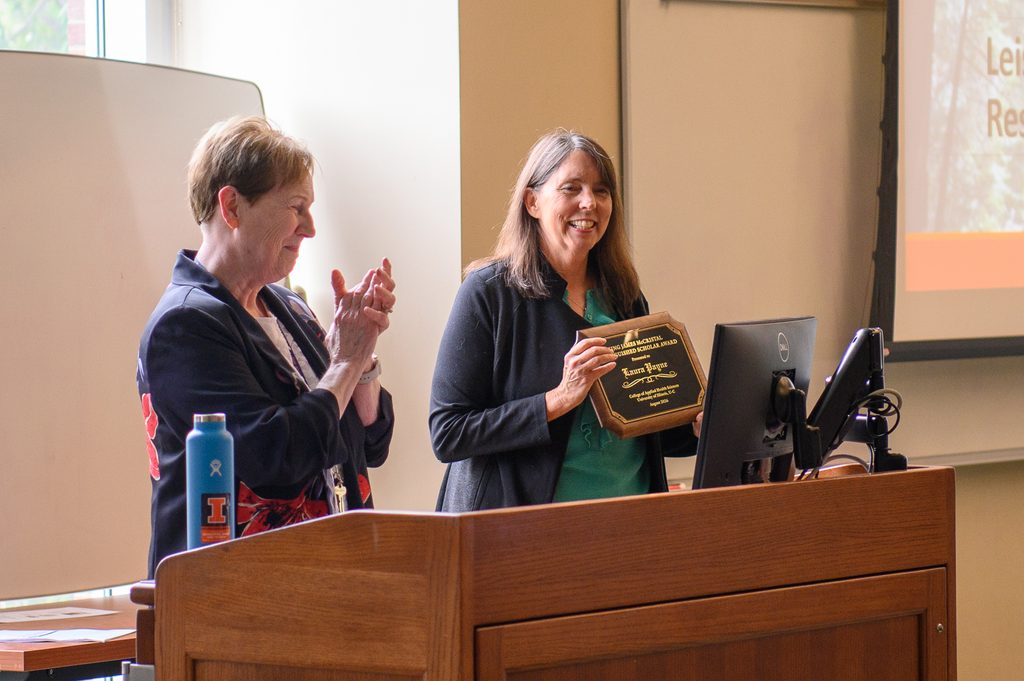
Laura Payne, right, accepts her plaque from Dean Cheryl Hanley-Maxwell (Photo by Bridget Lee-Calfas)
The findings carry increasing urgency as the population ages. Payne noted that people 100 and older are the fastest-growing segment of the older population, with many living more independently. Yet longer lives also bring challenges, including rising risk of developing chronic disease, uneven access to recreation and broader social conditions that affect whether people can pursue and define good health. Personal circumstances matter, too. Understanding healthy aging, in her view, requires attention to all of those forces and to what older adults are already doing well.
Cheryl Hanley-Maxwell, dean of the College of Applied Health Sciences, praised Payne as an accomplished scholar who has advanced understanding of leisure, health and well-being while ensuring that her research makes a difference beyond the university.
“Her work reflects a deep commitment not only to generating knowledge, but also to ensuring that research reaches beyond the university and makes a meaningful difference in the lives of individuals and communities,” Hanley-Maxwell said.
That public-facing commitment is especially visible in Payne’s leadership of the Office of Recreation and Park Resources, which she took over in 2020. Payne refreshed the office’s mission: to collaborate on recreation, sport and tourism initiatives that build healthy communities. Under her leadership, the office responds to community and industry needs, issues and trends while giving undergraduate and graduate students hands-on experience through projects.
Hanley-Maxwell said Payne’s approach demonstrates that research can have greater impact when scholars build relationships with communities, listen to the people their work is meant to serve and translate evidence into practices that are useful and accessible. That approach, the dean added, embodies the values of the McCristal honor.
The King James McCristal Scholar Award was established in 1988 to honor King McCristal, dean of AHS from 1961-1973.
“Dr. Payne’s research reminds us that leisure is far more than how we spend our free time,” Hanley-Maxwell said. “It can be an important contributor to health, quality of life, social connection and well-being, and a powerful avenue through which research can engage communities and create broader societal impact.”
For Payne, the recognition brings a career built around that idea full circle: from a child finding confidence through local recreation, to a scholar asking how leisure can help people adapt, connect and thrive, to a public-engagement leader working alongside communities to put that knowledge into practice.
A new Illinois scholarship recognizes that military service reshapes whole families—and that spouses and partners have ambitions of their own
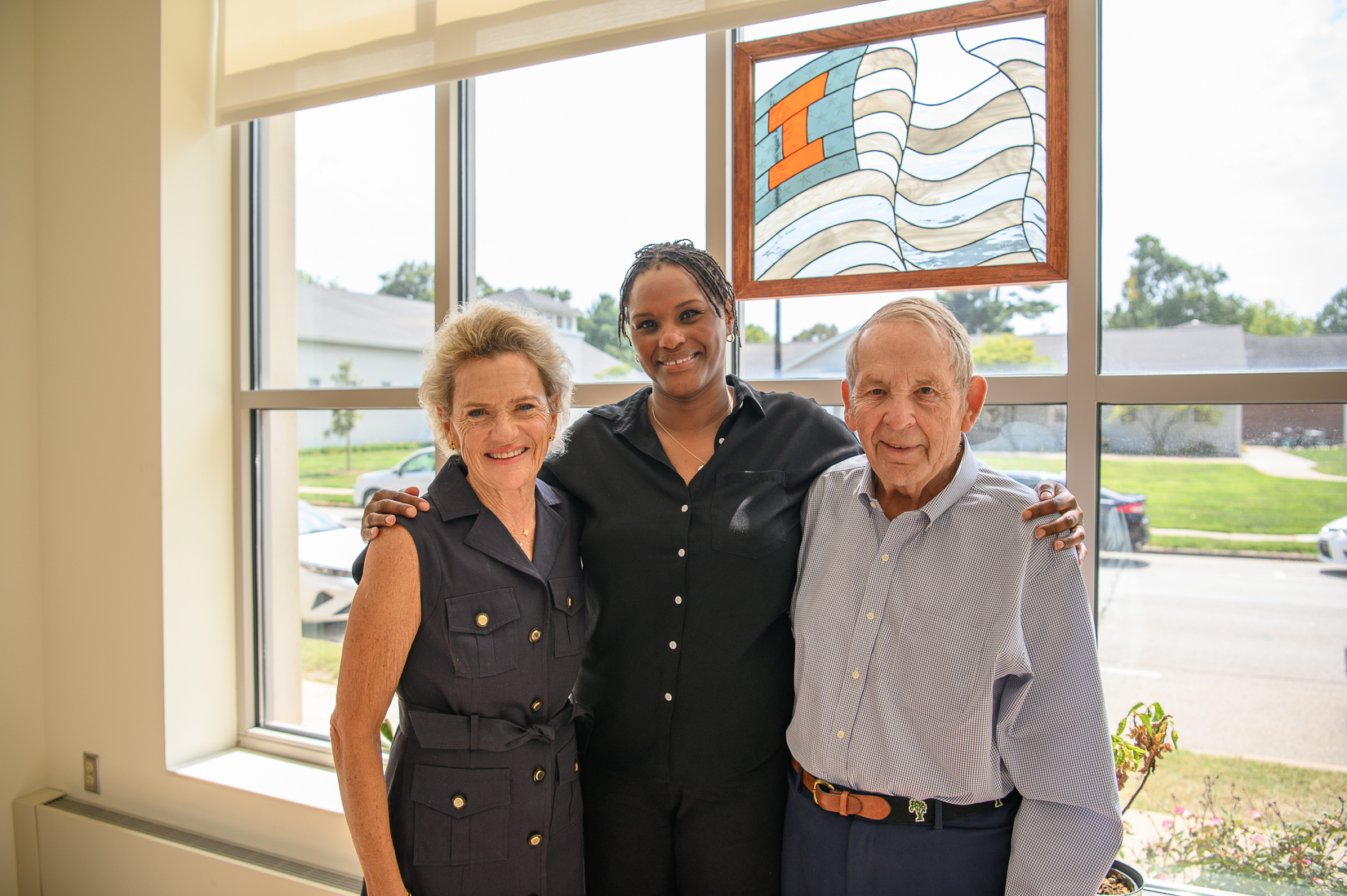
Scholarship recipient Phoebe Mbuvi, flanked by Honey Jacobs Skinner, left, and Sam Skinner (Photo by Ethan Simmons)
Phoebe Mbuvi had already built a career when her husband, John Goeken, arrived at the University of Illinois Urbana-Champaign to begin another one. Mbuvi had worked as a physician assistant for more than a decade. Goeken, a former U.S. Marine, enrolled in an electrical engineering program at the Grainger College of Engineering in his late 30s. His return to school prompted a question that soon became a plan: why shouldn’t she pursue a doctorate, too?
She enrolled in the School of Information Sciences. Together, they balanced two demanding academic lives with work and two very young children. Then, before Goeken could begin his final year, he died in a motorcycle accident in May 2026. He was 39, six weeks shy of his 40th birthday, Mbuvi said. Their children were 2 and 3.
The loss reordered everything. Mbuvi stepped away from employment to care for the family, but she did not want grief and financial pressure to close the door on the doctorate she and Goeken had imagined. The new Skinner Family Foundation Scholarship offers a way to keep that door open.
A family mission
Announced through the Chez Veterans Center, the scholarship is funded by Sam Skinner, a Chicago native who attended the University of Illinois before serving in the U.S. Army and going on to a distinguished career in public service as secretary of transportation and White House chief of staff under President George H.W. Bush. The scholarship supports spouses and domestic partners in military-connected families who are pursuing higher education or career training. Its focus is deliberate: the demands of military service rarely stop with the person in uniform. Careers are interrupted, moves complicate schooling and employment, and childcare can become a daily obstacle.
For Mbuvi, that understanding was central to Goeken’s own life at Illinois. He had joined the Marines in 2004, served in Operation Iraqi Freedom over multiple tours, survived an improvised explosive device blast and received a Purple Heart. After leaving the military, he came to Illinois as a nontraditional student and found a community at Chez.
“He loved the Chez Veterans Center. He spent all his time here,” Mbuvi said. Goeken served on committees and pushed others to see the web of needs surrounding a student Veteran: housing, children, childcare and a spouse’s own goals. “The Veteran can’t be the best student that they can be if they’re not being supported in other ways.”
That conviction now echoes through a scholarship his family can use. The award does more than recognize Mbuvi as someone connected to a Veteran. It recognizes her as a scholar in her own right, one whose education strengthens the family Goeken left behind.
Why spouses
The 88-year-old Skinner arrived at the same idea from another direction. Skinner’s visit to Chez showed him an organization he believed could translate a gift into tangible help.
“You associate yourself with quality people, they bring you up. The same is true with organizations,” Skinner said. At Chez, he saw a center that “got their act together” and was serving Veterans and their families in practical ways.
His concern for military spouses has also been shaped by his involvement with America’s Warrior Partnership, which helps connect Veterans and families with employment and other services. Again and again, he said, spouses absorb the cost of military mobility: a transfer can mean losing a job, surrendering professional momentum or putting education on hold.
He loved the Chez Veterans Center. He spent all his time here.”
Phoebe Mbuvi
Scholarship awardee, wife of John Goeken
“They gave up a lot. A lot of them gave up education to support their spouse,” Skinner said. When a family reaches a university prepared to support them, he added, it may be the right moment for a spouse or partner to begin again. “That’s the way you impact. Little did I know that there was no one more qualified than Phoebe,” he said.
Skinner credited Andy Bender, Chez’ director of operations and services; and Jean Driscoll, the former assistant dean for advancement in the College of Applied Health Sciences, for cementing his agreement to endow the scholarship.
“Jean kept pushing us to get it done right, and I know it took a long time, but we got to the right place,” Skinner said.
The life behind the legacy
Goeken’s path made that kind of second beginning visible. Mbuvi remembers a husband and father first, a Marine second and then an engineering student who was unbothered when classmates mistook him for a professor. His age did not diminish his sense that he belonged in a top program or that he could use what he learned in public service.
He also understood how improbable the journey might have looked to people who knew his difficult early life. After his funeral, Mbuvi said, one of Goeken’s brothers told her that no one would have believed he would one day be married, raising two children and pursuing an engineering degree.
“He leaves behind a big legacy,” she said. “Lots of people have been touched by John.” She wants their children to grow up knowing the shape of that legacy: his patriotism, his belief in democracy, his devotion to family and his refusal to let an unconventional route keep him from the classroom.
Mbuvi is carrying part of that story forward each time she returns to her own studies. The scholarship cannot ease every burden military families carry, and it cannot restore the future her family expected. It can, however, protect one hard-won possibility: that her education continues.
About the scholarship
The Skinner Family Foundation Scholarship recognizes the critical role military spouses and partners play in supporting family well-being, academic persistence and the success of military-connected students. The scholarship is open to spouses of U.S. military Veterans and to spouses or domestic partners of active-duty, Reserve or National Guard service members. Applicants must have a current connection to the University of Illinois Urbana-Champaign and be enrolled in or admitted to an accredited degree-granting, vocational or technical program. Full-time, part-time, online, hybrid and returning students are eligible.
Funds may support education-related expenses, including certification and licensing fees, professional development and other qualifying costs. Recipients also join a small cohort with access to community events, leadership and professional development opportunities and ongoing support from the Chez Veterans Center. For information or to apply, visit the online application form.
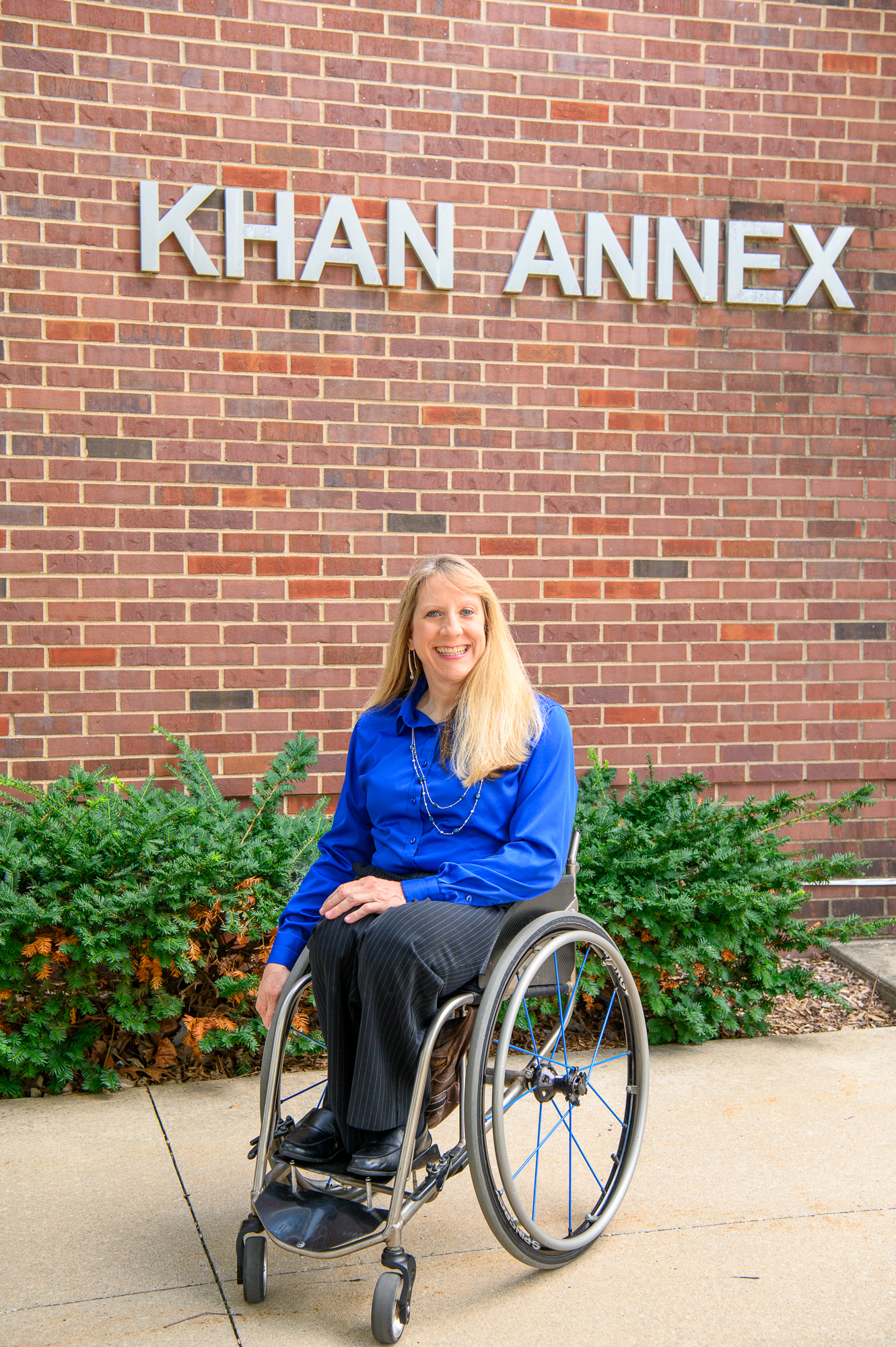
Jean Driscoll outside of Huff Hall on August 4, 2026. Driscoll is retiring from the University of Illinois for a new fundraising role in St. Louis. (Photo by Ethan Simmons)
Jean Driscoll wants you on her team.
Whether you’re a colleague, friend, donor or stranger, sharing a nice dinner or a quick chat inside Huff Hall, Driscoll invites you into her world, mainly to learn more about yours.
After roughly two-and-a-half decades working and learning at the University of Illinois Urbana-Champaign—including two brief exits and returns—Driscoll is retiring from her post as assistant dean for advancement for the College of Applied Health Sciences, a role she’s held since 2020 after coming back a second time.
A new challenge is fast approaching: she’ll be fundraising for the Foundation for Barnes-Jewish Hospital in St. Louis, but colleagues can rest assured that she will be working until the end of her appointment at Illinois on Aug. 31.
Driscoll’s people-first personality has helped secure some of the finest gifts in the College of Applied Health Sciences’ history and woven enduring relationships with alumni who care deeply about the college’s mission.
It’s easy to forget now, but at every phase of her life, Driscoll’s success was anything but guaranteed. The shy younger sister from Milwaukee born with spina bifida, a young athlete with budding talents, a college fundraiser who was “green as green could be.”
“‘Team’ is a theme from my youth onward, where I was the last kid picked on the playground, to now, where I get to choose people for my team,” Driscoll said. “I’m carrying that torch and passing it along—as I transition away from the University of Illinois, I feel like I’m passing it toward each of the staff members here, a little bit to our alumni, donors and friends, and to my closest colleagues.”
What has radiated from Driscoll on the last days of her U. of I. appointment is an appreciation for her place in history, a full respect for the layers of accessibility on this campus that were fought for by trailblazers before her, on the Illinois campus and beyond.
“I try to live in this space of gratitude and try to remember that there are people, my predecessors both professionally and personally, who have laid a foundation so that I can be where I am,” she said.
A reluctant advocate
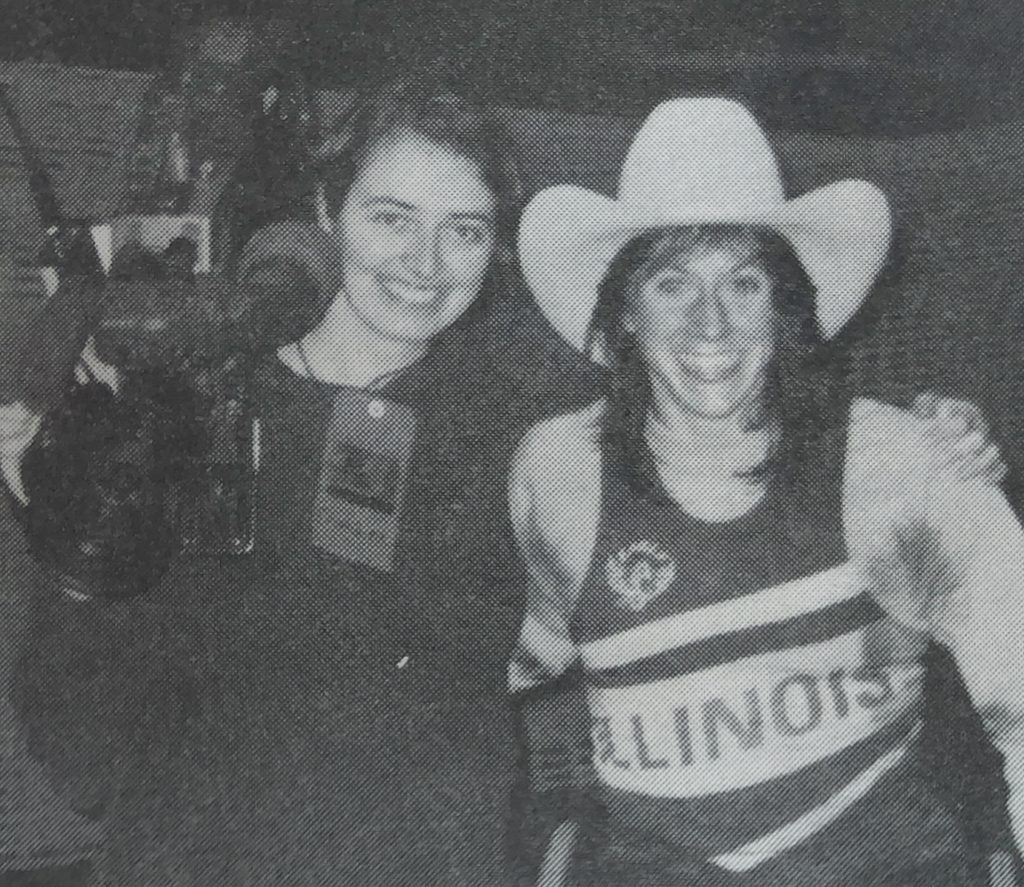
It took two years for Coach Marty Morse to persuade Jean Driscoll—who had become a world-class short-distance wheelchair racer with only a few years of training—to compete in the Boston Marathon. In 1990, she finally caved, “just to get him off my back.”
“I’m sitting on the starting line, not believing I belonged in that race. How did I let Marty talk me into it?”
Then, 26.2 miles later, Driscoll not only won, but broke the wheelchair marathon world record by almost seven minutes, clocking in at 1 hour, 43 minutes, 17 seconds. She thought it was a fluke: her Illinois teammate Ann Cody was supposed to win, she had been “killing” Driscoll in all the workouts.
Imposter syndrome be damned; her life had changed forever.
“All of a sudden, everybody wanted to hear what I had to say,” Driscoll said. “The spotlight was … it felt like a burden to bear in those first few years, because I was so shy.”
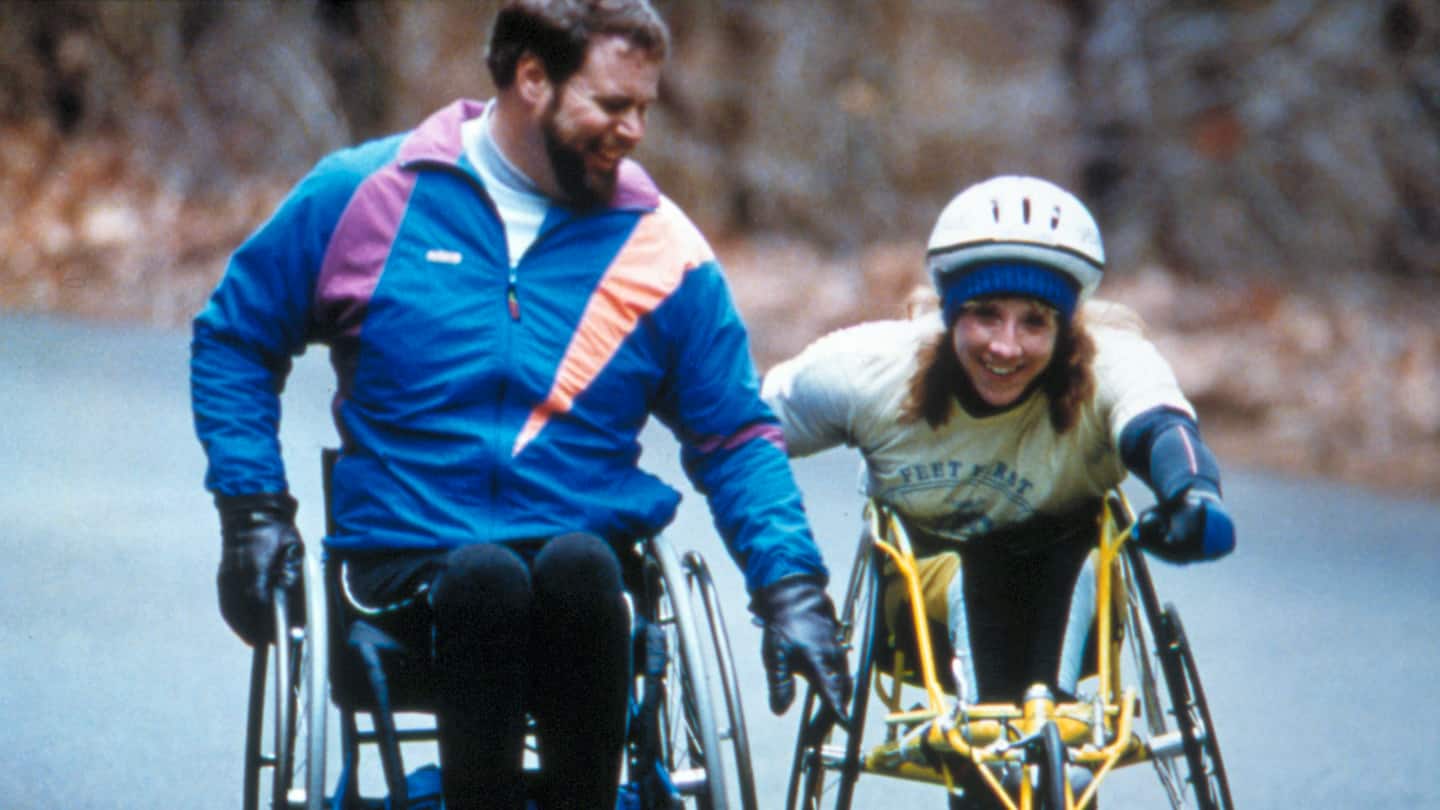
She broke her own world record in the 1991 Boston Marathon on her way to seven straight wins in wheelchair marathoners’ most hallowed race. The spotlight intensified, and slowly, Driscoll’s understanding of her reach and voice began to shift.
“I realized what an opportunity there was to help people understand what disability is and isn’t. It’s a characteristic, like hair color and eye color. It’s not a defining principle.”
She has repeatedly returned to a form of that message, bringing her story back to the universal. Driscoll signs her autographs “Dream BIG and Work Hard!” That same phrase became the title of a children’s book based on her life story.
By the time she retired from racing after the 2000 Sydney Games, she was caught on the opposite end, wondering whether there were enough spokespeople to “carry the message” for the disability community she had been preaching for the last decade. (“That was kind of selfish and self-centered, quite honestly—there have been plenty of people to carry this on,” she said.)
Her retirement from racing allowed her to step into the role of global advocate. In the early 2000s, she traveled back and forth to Ghana several times to host wheelchair racing camps and help develop their para-athletics programs. In 2004, wheelchair racers Raphael Nkegbe and Ajara Busanga became the first Paralympians to represent Ghana in their country’s history, with Driscoll as a key mentor.
Alison Davis got to see Driscoll’s athletic talents and personable nature while filming “Against the Wind,” a documentary on Driscoll’s return to competition. (Provided)
“There are so many places around the world where, if you have a disability, you are considered to have no value, no rights, no education,” Driscoll said. “We have alumni who have done these big things, and every generation has students and alumni and faculty who are making a difference in our country and in the world.”
The subject of Illinois journalism instructor Alison Davis’ first long-form documentary was Driscoll’s return to competition in 1996 after she broke her leg the prior year. Media attention was at its zenith, and Driscoll’s schedule was packed, but she still allowed Davis and her collaborator Tim Hartin to follow along with the camera.
When they first traveled over to Disability Resources and Educational Services (DRES) to pitch the documentary, “I was in awe of her and nervous she would say no,” Davis said. “But we quickly recognized we had the same goal for this project and that was to make a sports documentary. We wanted it to focus on the grit and challenges of training at an elite level and not make it an ‘inspirational story’ of someone who happens to race in a wheelchair.”
Their footage and interviews became “Against the Wind,” an award-winning documentary of what ended up being Driscoll’s seventh consecutive win of the Boston Marathon.
“Jean is a person who truly cares about her community and making others feel seen … She is successful because of her hard work, but also because she is an incredible human, and people admire her for all that she is beyond the athletic achievements,” Davis said.
Prepared for everything
To understand today’s Jean Driscoll, you’ll weave through several storied mentors, generally winding up with two brainy coaches that shaped her years at Illinois: former head of DRES Brad Hedrick, and longtime wheelchair track and field coach Marty Morse, both of whom are “forever on a pedestal.”
“I don’t even want to imagine what life would be like had I not met those men and had they not invested so much of their time and talent and skill in me,” Driscoll said.
Hedrick recruited her in the spring of 1986 after seeing her play wheelchair soccer in Wisconsin, having traveled up to Milwaukee for a wheelchair sports clinic.
Coach Marty Morse trained Jean Driscoll for years of dominance in wheelchair marathons. (Photo by Curt Beamer).
Initially, Driscoll couldn’t be bothered to join the women’s wheelchair basketball team, especially not at regional rival University of Illinois. But Hedrick kept sending letters and kept calling, and Jean joined the team. (Driscoll thinks she has a “weakness” for persistent people.)
Athletically, she was thrown into the fire, facing off against Sharon Hedrick, a star on the basketball court and the track who practically no one beat in a wheelchair race from 1975 until she retired in 1990.
“There was no freshman adjustment year for Jean—she got right to work,” Morse said. “She’s always been meticulous, completely prepared for everything.”
Despite Driscoll’s shyness, once she arrived on campus, Morse saw an absorbent, talented young adult, bent on understanding how everything worked.
This trait reared its head in several wheelchair athletics workshops that Morse hosted through the years, bringing in guest speakers from across the country. As an undergraduate, Driscoll stepped up as Morse’s administrative assistant, running workshops with more than 100 people while competing at the same time, Morse said.
And all the while, she was forming connections across the university. She naturally became acquainted with a wide roster of figures in Illinois athletics and academics: basketball head coaches Kathy Lindsay and Theresa Grentz; pioneering athletics administrator Karol Kahrs; Jayne DeLuce, today’s CEO of Experience Champaign-Urbana who managed the aquatics venues during the 1996 Atlanta Olympics, and countless others.
“Instead of just being friends with somebody, she wanted to know how their job went,” Morse said. “Jean is so well-versed, and she was this way as an undergrad. If she took an interest in something on this campus, it was all in.”
After Morse developed a syrinx—a cyst inside his spinal cord—he underwent four major surgeries from 1997 to 2000, which resulted in a loss of function. Morse and his wife Karen Iehl-Morse, a longtime Illinois athletics trainer and instructor in the program, were taking care of their son, 4-year-old Steven, with another child on the way.
“We were having a lot of problems,” Morse said. “And Jean, who was always one of our go-to babysitters, she [basically] just moved in the house. She was there for us during that really traumatic time. Jean is family to us.”
When Driscoll first left Urbana-Champaign in 2004, Morse was upset. He was losing a great friend, but he also felt the university had “dropped the ball” by not keeping her here.
“Because it was like, boy, this woman, her entire career has been nothing but promotion of Illinois,” Morse said. To see her finally return to the University of Illinois in her development and alumni relations role at the College of Applied Health Sciences in 2006 “was no surprise.”
And her return led to countless more friendships and memories. Longtime U. of I. communications officer Robin Kaler first met her at a local 5K, where she “fan-girled” and asked Driscoll to pose with her baby for a picture.
They became fast friends. Over the years, she “has always been there to build the Illinois brand,” Kaler said, thinking of a half-time commercial where Driscoll sang the Alma Mater song with other famous Illinois alums.
One Halloween, Driscoll and Kaler dressed up as the campus statues Alma Mater and Learning, then went to a restaurant near campus, with plenty of onlookers.
“We laughed the entire time as the other diners stared at us,” Kaler said. “Even though she’s retiring, she will be a pillar of our university community forever.”
Tricks of her trade
After 20 years of working in advancement and development, Driscoll knows that lots of people want to make gifts for higher education. Oftentimes, “they just don’t know what they want to do, or how they want to do it,” Driscoll said.
As she describes it, there’s a creative process of matching the donor’s interests with a college’s needs. A scholarship fund? A named space? A new building?
In any case, the process begins with careful listening. One of her favorite donation stories started with a retraction—a donor had withdrawn their support for a five-figure gift to the college. This donor had a list of grievances about how they were communicated with during the process and how their gift was handled.
Driscoll speaks to former sports psychology faculty from the University of Illinois. (Photo by Ethan Simmons)
So, Driscoll decided to reopen the relationship, working to address each point “one by one,” she said. By the time they were finished, the donor came back with a seven-figure estate gift for the college. The key was leaning into the “crucial conversation,” where a resolution needed to be reached.
“The younger Jean would be surprised, and dare I say impressed, with how I’ve grown into leadership and management,” Driscoll said.
Driscoll’s last month with her advancement team has involved plenty of hand-offs, introducing her staff to key figures and longstanding relationships. And news of her retirement led to some unexpected gray areas, too, like colleagues being unsure of how or when to communicate with her.
What’s never left is Driscoll’s genuine care, and her “unmatched attention to detail, which has consistently elevated the quality of everything our team produces,” said Angela Tammen, director of external engagement for the advancement team. “In every meeting, she brings the conversation back to the people behind our work. She wants us to understand who they are, what matters to them, and why their story is important.”
Driscoll hired Kathy Saathoff in 2013 to support the Applied Health Sciences advancement office. Saathoff’s first impression was how “strong and confident” Driscoll was in her own skin, and her supportive, empathy-driven leadership style.
“I always appreciated her letting us do our jobs, but when we needed support, she was right there to lend it,” Saathoff said.
Advancement officers Matt Smith and Josh Joines have been flying across the country to fill in the web of connections that Driscoll is entrusting with them.
“I want it to be a smooth transition for our alumni and our friends and donors. Because advancement work can be transient, people come and go,” Driscoll said. “I don’t want to start something we can’t finish.”
Another journey
Jean Driscoll accepts a gift from the College of Applied Health Sciences a week before her retirement, at a ceremony held Aug. 25, 2026.
Dean Cheryl Hanley-Maxwell took note of Driscoll making effortless connections at an Illinois event, where she circulated the room and introduced Hanley-Maxwell to influential figures at the college with her genuine curiosity.
“Jean is the ultimate people person,” said Hanley-Maxwell, who became dean of the College of Applied Health Sciences in 2016. “I have watched her build meaningful connections in a matter of minutes, leaving people with the sense that they have known her for years rather than moments.”
That’s part of why, when Driscoll sat down with the dean this spring to let her know she was accepting a new opportunity, she said, “I’m so happy for you.”
“I thought I would have to explain myself, but I didn’t have to,” Driscoll said. “It’s a mark of good leadership.”
At the Foundation for Barnes-Jewish Hospital, she’ll be working as the fundraiser with a fellow Illini: former Assistant Vice Chancellor for Advancement David Bruns, with a new mission at top of mind.
“For years and years, I have wondered what healthcare fundraising might look like—I have relied on healthcare my entire life, from the minute I was born,” Driscoll said. “I will have to prove myself all over again. When you’re outside your comfort zone, that’s where you grow.”
(Photo by Fred Zwicky / University of Illinois Urbana-Champaign)
What motivated her in her early years was a prove-them-wrong mentality. It kept her “punching the wheels” of her racing chairs for 14 years. These days, her drive revolves around showing up for the people she cares about.
Along with her new professional journey, she’ll be spending as much time as she can doing her “favorite thing in the world,” kayaking with her extended family in Wisconsin. She still gets butterflies every time she visits.
For all her Illini faithful, this could be a goodbye, but also a “see you next time.”
“I can’t help but have empathy and appreciate where people have come from and where they are now and where they’re going, because there are experiences that truly shape us,” Driscoll said.
If you can learn anything from Driscoll, “it’s sincerity and honesty,” Morse said. “As long as you are the same with her, you’ll be very glad you met Jean Driscoll.”