Champaign-Urbana celebrates ‘World Voice Day’


Our vocal folds are roughly the length of our thumbnail, and yet they enable us to speak, sing, laugh and share our favorite stories.  

On April 16, the twin cities of Champaign and Urbana—home to the University of Illinois—will recognize World Voice Day, an international celebration of the human voice that shines a spotlight on vocal health. 

Behind the scenes, both proclamations were driven by clinicians and instructors at the Department of Speech and Hearing Science, based in the College of Applied Health Sciences.

“We wanted to bring World Voice Day to both Champaign and Urbana to raise awareness at the community level and emphasize that voice health is relevant to everyone, not just professionals or individuals already seeking care,” said Mariana Mendes Bahia, assistant professor of speech and hearing science. “Voice disorders can affect anyone in our community, and recognizing this day at the city level helps extend awareness beyond the clinic or classroom.” 

Bahia was inspired by the advocacy of Dysphonia International, an association that supports people with voice disorders. Clarion Mendes, clinical associate professor at SHS, encouraged her to get the day recognized locally. The Department of SHS and officials from both cities were fully supportive. 

Champaign city council member Matt Gladney reads the World Voice Day proclamation for the city, with Speech and Hearing Science students and faculty in attendance. (Jeff Hamilton | City of Champaign)
  • On Tuesday, April 14, Champaign city council member Matthew Gladney read the World Voice Day proclamation in the city council chambers, with Speech and Hearing Science faculty and students present. 
  • On Thursday, April 16, at 11:15 a.m., Urbana city council member James Quisenberry will come to the Speech and Hearing Science building to proclaim World Voice Day for Urbana, with the whole department in attendance.

A wide range of professions rely on the voice—not just performers. Actors, singers and broadcasters may come to mind, but retail workers, healthcare providers and teachers also lean on their vocal ability and presence every day at work. 

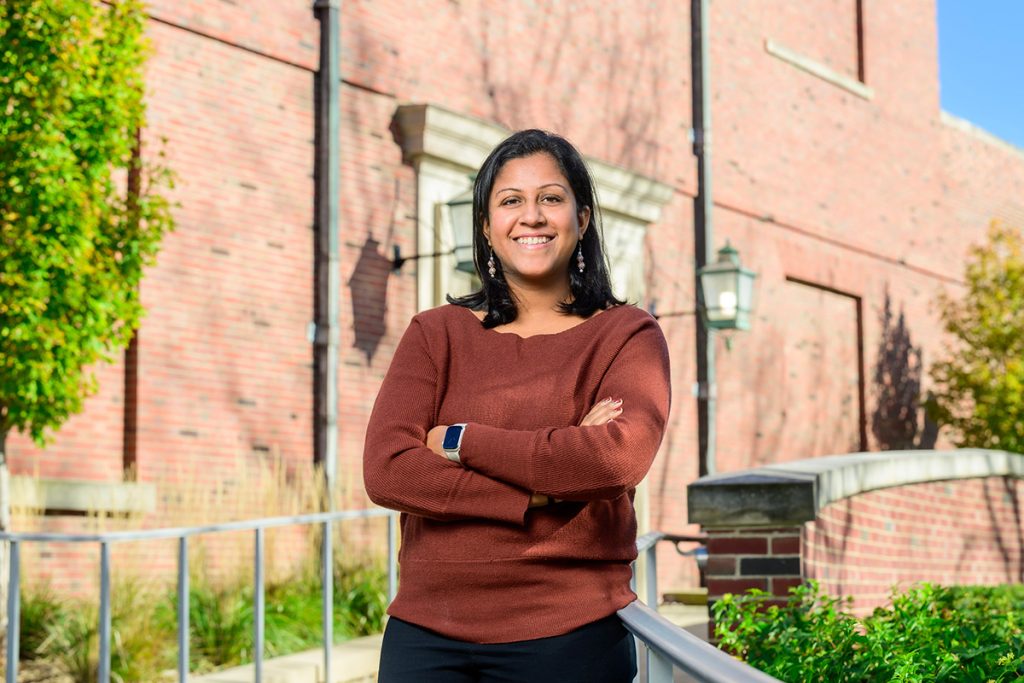
Mariana Mendes Bahia outside the Speech and Hearing Science Building. (Photo by Ethan Simmons | Applied Health Sciences)

And for reasons that aren’t fully understood, the rate of voice disorders appears to be rising in the United States, Mendes said. An estimated 17.9 million adults in the U.S. reportedly experienced a problem with their voice in the last year, according to the National Institute on Deafness and Other Communication Disorders.

“I think of individuals who may not realize the demands they place on their voice, and individuals experiencing voice disorders, for whom communication becomes effortful, limited or even distressing,” said Bahia, who researches swallowing disorders, clinically known as dysphagia.  

To Mendes, World Voice Day is an “extraordinary confluence of art and science,” exciting her students about anatomy and physiology, while showcasing an important part of the speech-language pathology vocation: outreach, education and illness prevention. 

“This day is a reminder that even if we studied and analyzed the voice 24/7, mysteries would still abound, and sometimes we can benefit from taking a pause and simply enjoy the wonder that is the human voice and its capacity for moving us through song or story,” Mendes said. “The Department of Speech and Hearing Science has a legacy of championing the human voice, and it’s incredible to share this with our students and the public.” 

Undergraduate and graduate students in Speech and Hearing Science helped develop educational materials for World Voice Day; explainers on how to protect the voice and when to seek medical attention.

“Our goal is for individuals to better understand how their voice works, recognize early signs of potential problems, and adopt simple habits to protect their voice,” Bahia said. “We also hope these events encourage people to seek care when needed and to view voice health as an important part of overall well-being.”

The Department of Speech and Hearing Science will celebrate “World Voice Day” on Thursday, April 16, at 11:15 a.m. at the Speech and Hearing Science Building.

Editor’s note:

To reach Mariana Mendes Bahia, email mmbahia@illinois.edu.
To reach Clarion Mendes, email cmendes2@illinois.edu.
 

Share on social

Related news

In second year, Illini Physical Activity Symposium widened its reach


The second Physical Activity Symposium at Illinois was hosted by the Department of Health and Kinesiology on April 3, 2026.

The Illini Physical Activity Symposium celebrates the widening research field of physical activity and its connections to public health across the globe. 

The second edition hosted at the University of Illinois Urbana-Champaign added a couple new traditions, including live student presentations and a guest speaker, but things kicked off the same way as last year: with a sunny walk to the Main Quad. 

“We felt very happy with our event and the feedback we received from the students, and we feel motivated to continue with this initiative for next year,” said Health and Kinesiology Assistant Professor Otavio Leão

This year, students and faculty members also celebrated the launch of the concentration in physical activity and health in the Master of Public Health program at Illinois. 

The Illini Physical Activity Symposium is hosted by labs at the Department of Health and Kinesiology in the College of Applied Health Sciences: 

  • The Lifetime Physical Activity Lab run by Assistant Professor Rafael Tassitano and Teaching Assistant Professor Cecília Tenório
  • The Longitudinal Analysis in Physical Activity, Sleep, Sitting, Screen Time, and Accelerometry Lab run by Assistant Professor Leão. (LA-PASSSTA Lab) 
  • The Epidemiology, Physical Activity and International Collaboration Lab of Professor Pedro Hallal. (EPIC Lab) 

University of California San Diego Professor Michael Pratt visited campus to present the research on the potential benefits of vigorous physical activity, and why it may be more important than current physical activity guidelines indicate. 

Afterwards, several graduate and doctoral students presented their findings from physical activity studies, covering topics such as step counts, obesity, screen-time, and childhood development.

Doctoral students Tayo Folorunso and Alisha Chuhdry won the inaugural Bill Kohl Awards for best poster presentation and oral presentation at the event. Folorunso presented her research into physical activity and abdominal obesity among U.S. women, and Chuhdry presented a study on motor competence among preschool children in Brazil. 

“Having doctoral students present their research at the symposium is a valuable experience. It allows them to practice communicating their work to a broader audience, receive feedback, and gain confidence in public speaking,” Tenorio said. “Experiences like this also help young researchers build their professional network and encourage them to continue pursuing a career in research.” 

Editor’s note:

To reach Cecília Tenório, email tenorioc@illinois.edu.
To reach Otavio Leão, email leao@illinois.edu.
 

Share on social

Related news

From Huff Hall to national impact: American Lung Association CEO visits his alma mater


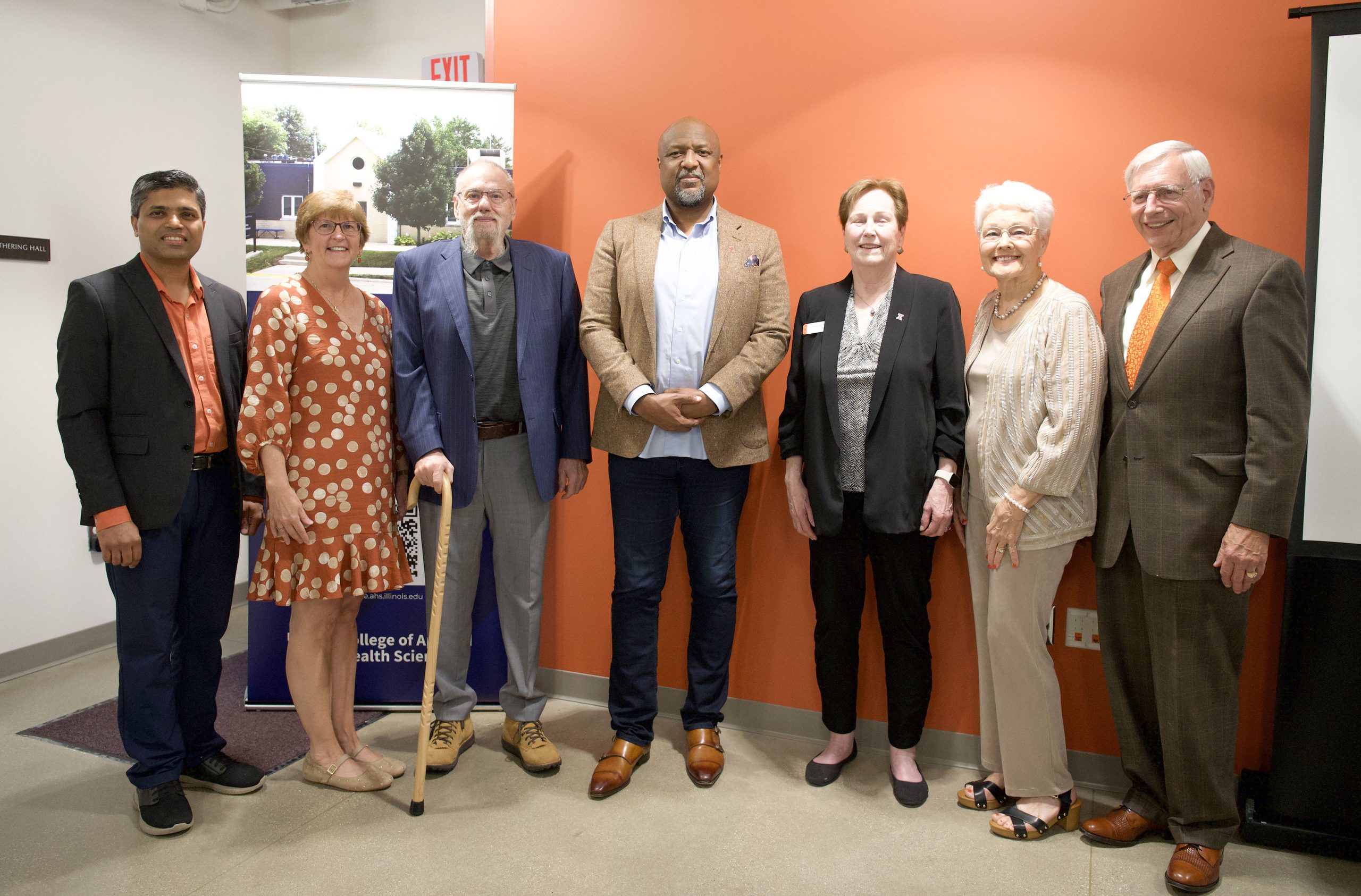
Harold Wimmer, left, with Applied Health Sciences Dean Cheryl Hanley-Maxwell, got his undergrad and master’s degrees in AHS. (Photo by Ethan Simmons)

When Harold Wimmer returned to the College of Applied Health Sciences at the University of Illinois, it wasn’t just a professional visit—it was a homecoming shaped by decades of purpose, mentorship and public health leadership.

Wimmer, president and CEO of the American Lung Association, first walked the halls of what was then the College of Applied Life Studies as a student searching for direction. His visit offered a glimpse into how early moments of uncertainty can evolve into a career leading one of the nation’s most influential health organizations.

“I came into this college because as a freshman, I started in (the College of Liberal Arts & Sciences), more general studies, and I was really trying to find where I would best fit,” said Wimmer, who’s been working with the American Lung Association since 1978, the year he earned his master’s in health administration from the University of Illinois. He also got his undergrad from what is now Applied Health Sciences.

That sense of searching is familiar to many undergraduates. For Wimmer, the turning point came not from a formal advising session, but from a conversation with a roommate. It was a simple nudge—one that ultimately redirected his entire career trajectory.

“And it happened that my roommate was in kinesiology,” he said. “He talked about his experiences and the courses. I certainly had a passion for personal health and community also and working with others, so I came to (AHS) in my sophomore year.” 

The decision to transfer to community health set the foundation for everything that followed.

If Wimmer’s story has a central theme, it is the power of mentorship. During his time at Illinois, he found not only academic rigor but also a network of professors who helped shape his thinking and ambitions.

“I got connected with Tom O’Rourke, Larry Olsen (and) Bill Creswell,” he said, listing faculty members who left a lasting impression. “Those individuals just really impacted me in so many different ways.” 

What stood out wasn’t just their expertise, he said.

“They were also accessible. If you had any issues … their doors were always open. And that’s something that I remember.” 

Wimmer’s academic focus quickly sharpened once he entered the community health curriculum. Courses in epidemiology and population health proved challenging, but transformative.

“I certainly fell in love with the curriculum and the work that’s behind it in terms of community health, public health,” he said. 

What I studied here really aligned with the work of the American Lung Association.

Harold Wimmer

Applied Health Sciences alumnus and CEO, American Lung Association

He credits those classes with giving him a framework that still underpins his work at the national level.

“They were tough courses, but they were ones that have helped me throughout my career in terms of how to really work through public health … using sound data and epidemiology to help track diseases from the earliest points to a way to treat disease also.” 

That emphasis on data-driven decision-making has become even more critical in today’s public health landscape, where emerging diseases, environmental challenges and health disparities require evidence-based responses.

Wimmer’s path to the American Lung Association began in an unexpectedly local way—with a job posting.

“I was fortunate to come across a job posting that the American Lung Association had in the office here at Huff Hall,” he said. 

At the time, he admits, he didn’t know if he was prepared for the setting.

“I wasn’t really sure what I was getting into going into a nonprofit health organization,” he said. 

But the alignment between his education and the organization’s mission quickly became clear.

“What I studied here really aligned with the work of the American Lung Association,” he said. “The mission … is not only about assisting patients with a lung disease, but it’s also working to prevent lung disease.” 

That dual focus—treatment and prevention—is a hallmark of public health and one that reflects the principles taught in AHS.

Harold Wimmer became president and CEO of the American Lung Association in 2013 (Photo by Ethan Simmons).

Wimmer, who became president and CEO in 2013, oversees a nationwide organization tackling issues ranging from air quality to chronic lung disease. Yet when asked what skills matter most, he doesn’t point first to technical expertise.

Instead, he emphasizes communication.

“One thing that I think is really key in community health or public health is to have good communication skills and to be able to interact with individuals … and also groups,” he said. 

For Wimmer, those skills were nurtured during his time at Illinois, through classroom discussions, group work and faculty mentorship.

During his visit, Wimmer—who met with AHS Dean Cheryl Hanley-Maxwell as well as taking visits to Carle Illinois College of Medicine, the Cancer Center at Illinois and the Beckman Institute—also offered practical advice to students eager to make an impact in public health, a field that has gained renewed visibility in recent years.

“I would say really study epidemiology and population data,” he said. “I think [that] is really critical in the field today.” 

But technical knowledge alone isn’t enough. He stressed the importance of understanding diverse communities and advancing health equity.

“Having great communication skills, the ability to communicate with others in really diverse populations … health equity is very important,” he said. 

It’s a message that aligns closely with the college’s current mission—demonstrating how its core values have remained consistent even as the field has evolved.

Like many alumni, Wimmer’s visit also prompted reflection. When asked what advice he would give his younger self, his answer was both practical and revealing.

“I would have probably looked at a minor in finance on the business side,” he said, noting how much of his current role involves budgeting and financial management. 

It’s a reminder that careers in health aren’t confined to science alone—they often require a blend of skills, including leadership, strategy and financial acumen.

He also acknowledged a lingering curiosity about further education.

“I always think I would have liked to continue my education to get a Ph.D.,” he said, before adding with a laugh, “but I think I’m OK where I’m at.” 

Editor’s note:

To reach Vince Lara-Cinisomo, email vinlara@illinois.edu.
 

Share on social

Related news

Illini Success Report: Most new AHS grads find employment or continue education


The majority of 2024-25 University of Illinois graduates have found a next destination post-grad, with most gaining employment or continuing their education. 

The Illini Success initiative surveys recent Illinois graduates on their post-grad destinations, experiential learning participation and salaries, if applicable. The most recent Illini Success Report gathered responses from students who obtained their bachelor’s degree in August 2024, December 2024 or May 2025. 

Sixty-five percent 2024-25 U. of I. graduates disclosed their landing spots. Of those respondents, 58% of Illinois graduates found employment, 34% continued their education and roughly 1% committed to volunteering or service opportunities. 

In all, 392 recent graduates from the College of Applied Health Sciences responded to the Illini Success survey, good for 60% of the 2024-25 graduating class.  

Ninety-six percent of them secured their “first destination,” with 60% opting to continue their education for graduate degrees or other academic programs and 36% of them finding employment straight out of college. Twelve AHS graduates disclosed their first-year salaries, averaging $58,177

In 2024-25, 655 students graduated from the College of Applied Health Sciences at Illinois, up from 616 in 2023-24. 

Of all recent U. of I. graduates who resided in Illinois, 80% of them found employment or continued education in their home state. Overall, 70% of graduates reportedly remained in Illinois post-graduation. 

“Our university is by far the top choice for enrollment in graduate and professional school programs, reflecting that students find meaning and value in continuing their studies at Illinois,” wrote Illinois Chancellor Charles L. Isbell, Jr.

But this class still traveled far after flipping their tassels: surveyed graduates found employment or academic enrollment in 48 U.S. states and 24 foreign countries

For the full Illini Success Report, visit the Illini Success website.

Editor’s note:

To reach Ethan Simmons, email ecsimmon@illinois.edu.
 

Share on social

Related news

Two AHS faculty members recognized for excellence in instruction


SHS Associate Professor Mary Flaherty (left) and HK Adjunct Instructor Christy Bazan were recognized for excellence in instruction.

Every year, the University of Illinois Office of the Provost recognizes faculty members for excellence in instruction, who are nominated by committees of faculty, staff and students at each college.

This year, two Applied Health Sciences faculty members won campus awards for their teaching and mentorship in the classroom: Speech and Hearing Science Associate Professor Mary Flaherty won for Excellence in Undergraduate Teaching, and Health and Kinesiology Adjunct Instructor Christy Bazan won for Excellence in Online Teaching.

Both instructors will be recognized at the university’s Celebration of Academic Excellence on Wednesday, March 25, at the Krannert Center for the Performing Arts.

On top of mentoring student researchers through her Child Speech Research Lab, Flaherty teaches undergraduate- and graduate-level courses in Speech and Hearing Science, such as SHS 358: Understanding Research Methods in Communications Sciences and Disorders and SHS 352: Hearing Health and Society, along with advanced SHS 552: Pediatric Audiology and SHS 570: Evidence-Based Practice for SLPs and AuDs.

Bazan, a licensed environmental health practitioner, teaches several community health-oriented classes in the college and Department of Health and Kinesiology, including AHS 199: Applied Data Solutions in Health Sciences, HK 204: Drug Use and Misuse—a subject she co-authored a book on—HK 207: Introduction to Epidemiology and HK 408: Environmental Health.

The College of Applied Health Sciences asked them about what this recognition means to them, and what they’d like to say to students past and present.

What does this recognition mean to you?

Bazan: I am honored and grateful to receive this online teaching award.  With support from AHS and my colleagues, many doors were opened to me that allowed me to grow in teaching in online environments.  From course redesign, Open Education development, video recoding lectures and developing online content, I have placed emphasis in my courses that shows how important it is to ensure students learn and have experiences just like they might when taking an in-person course.

Flaherty: This recognition means a great deal to me because my undergraduate teaching is centered on helping students learn how to evaluate information responsibly and use evidence thoughtfully in real-world decisions. Many students encounter an overwhelming amount of health and science information online, and a core goal of my teaching is to help them distinguish credible evidence from oversimplified or misleading claims. I aim to make research feel accessible and relevant, while also supporting students as individuals through structure, feedback, and mentorship. Being recognized for this work affirms the importance of teaching students not just what to learn, but how to think, question and apply evidence with care.

Anything you’d like to say to past and current students?

Bazan: My goal as an educator is to cultivate learners who are critical thinkers, empathetic communicators and lifelong learners. I want students to leave my courses not only with knowledge of content but with the confidence and tools to apply that knowledge ethically and creatively in their own lives and in their own communities. Keep learning, learn things in new ways, connect with your professor and your peers in your online classes and engage thoughtfully in an increasingly interconnected world.

Flaherty: This award belongs to my students. I love teaching, and I care deeply about undergraduates and their growth, both inside and outside the classroom. My students show up with curiosity, honesty and a willingness to engage deeply, and they continually remind me why this work matters. Their questions, perspectives and trust shape how I teach, and their commitment to learning pushes me to be a better instructor every year. I am grateful to every student who has shared their time, effort and openness with me. This recognition reflects what we have built together.

Editor’s note:

To reach Mary Flaherty, email maryflah@illinois.edu.
To reach Christy Bazan, email cbazan3@illinois.edu.
 

Share on social

Related news

RST: A history of Black American runners at the Boston Marathon


Ted Corbitt (center) crosses the Boston Marathon finish line in 1956. Thanks in part to his stellar finishes in the Boston Marathon, Corbitt became the first Black American to run the Olympic Marathon in 1952. (Courtesy of Gary Corbitt)

The Boston Marathon’s first known Black finishers. The first Black American to run the marathon in the Olympics. A charismatic road race organizer who ran the Boston Marathon more than 15 times—without a single recorded time. 

Jacob Fredericks, teaching assistant professor in the Department of Recreation, Sport and Tourism at the University of Illinois Urbana-Champaign, researches the history of race and long-distance running. His newest written project covers many of the overlooked accomplishments of Black runners in one of the premiere stages of the sport: the Boston Marathon. 

Fredericks’ essay, “The Colorful Boston Marathon: A History of Race and Long-Distance Running in Boston” will appear as a chapter in “Black Identity and Sport in Boston: New Essays on Racialized Space and Performance,” a book edited by Rob Cvornyek and Doug Stark and expected for release by the University of Tennessee Press later this year. 

Fredericks ties together the accomplishments of a handful of Black long-distance runners who left their mark on the Boston Marathon, visibly and invisibly, alongside the modern-day efforts to organize a more inclusive long-distance competition in the city. 

“Black Americans in this sport are really shaping their own destinies. They have a lot of agency in creating clubs, establishing their own races. And it’s not separate,” Fredericks said. “The things that they’re doing affect the Boston Marathon—they’re still running alongside white runners and international runners. It’s not as segregated as it seems on paper.” 

To uncover the history, he leaned heavily on newspaper clippings from publications in Boston’s Black press, like the Boston Guardian and Boston Chronicle. In the early to mid 20th century, the marathon got scant coverage in the mainstream press like the Boston Globe, rarely going deeper than the winners or the size of the crowd.  “[What] really comes through in the Black press: these runners having this agency at a time when most of America was heavily segregated—if not structurally, then informally. Even in Boston, those issues still remain.”

Early contenders

The first figures he uncovered—Aaron Morris and Clifton Mitchell—were club teammates from New York. In 1919, a full 22 years after the marathon’s founding, Morris became the first known Black American to cross the Boston Marathon finish line, with his sixth place finish of 2 hours and 37 minutes. 

“[Morris] is in the Black press, they’re celebrating him: ‘We have a breakthrough,’” Fredericks said. “And he disappears. Maybe he has an injury, and there’s this hope among sportswriters of ‘He’ll be back,’ but we never see him again in the results.” 

Teaching Assistant Professor Jacob Fredericks.

The very next year, their hopes were renewed with Clifton Mitchell, a fellow member of the New York St. Christopher Club for runners. Mitchell finished eighth in the 1920 Boston Marathon. Almost immediately, writers in the Boston and New York Black press rallied around him as a candidate to represent the U.S. in the summer Olympic marathon.  

Despite their fervent support, he wasn’t selected. 

“In this chapter, I think of the Boston Marathon as a stage where you can display your athletic abilities—it’s very visible, and people are watching you, and it’s being recorded. There are Black people among white people in the 1920s, running together.” 

Nearly 30 years later, another New Yorker—Louis “Lou” White—broke through in the race and the Boston press. He finished third in the 1949 Boston Marathon, seizing the highest placing for an African American runner in the first year the race was televised. 

He soon became a Boston transplant, joining the Boston Athletic Association and putting up several great performances: “Lou White, a Black man—is Boston’s man in the marathon, a symbol of the city on the world stage,” Fredericks said. 

White had a protege of sorts: Ted Corbitt, who in 1952 became the first African American to run the marathon in the Olympic Games. One of the most prolific marathoners in history, he finished the Boston Marathon 22 times. 

“He is a big proponent of running for health, but also integration, and trying to challenge the status quo and build these new structures,” Fredericks said. 

A fixture and “father figure” in the long-distance running community, and a committed member of the integrated track-and-field New York Pioneer Club, Corbitt later helped found the New York City Marathon. 

An invisible organizer and the ‘true’ Boston Marathon

Perhaps the most unique figure in Fredericks’ chapter is O’Neil Shannon, a professional boxer and Bostonian. Shannon ran the Boston Marathon at least 16 times without ever receiving a runner’s bib. 

“His name comes up again and again as this guy who’s training for the Boston Marathon and running the Boston Marathon. And I’m looking at the results, and I just never see his name,” Fredericks said. “I finally found from his own interview that officials told him the first time he stepped up to the line, ‘We know you. You’re that boxer who was at the Garden last night. You can’t run here officially.’”  

So Shannon joined the Boston Marathon’s long tradition of race “bandits,” runners who participate in the 26.2-mile race without registering. At the time, race officials mostly tolerated these bandits, who ran alongside official runners on public roads.

Though he remained invisible in the record books, Shannon continued to build an athletic legacy in Boston. He founded the Blockbuster Athletic Club, where boxers came to both spar and train to run long-distance. 

Reverend O’Neil Shannon (left) shakes the hand of Boston Mayor John F. Collins in August 1965. Though he never recorded an official time, boxer and road race organizer Shannon ran the Boston Marathon at least 16 times. (City of Boston).

Shannon began organizing his own road races, all weaving through Boston proper, and fielded serious competitors—including Ted Corbitt. In the mid-1950s, Carter Playground on the Northeastern University campus became a common site where he’d start and finish his own races.

It’s the same playground where, a decade later, Rev. Martin Luther King Jr. organized a march downtown to advocate for desegregation and equal access to schools and transportation. 

“Shannon becomes this cornerstone of the Boston Black community, where he’s a leader of his own club,” Fredericks said. “He’s hidden in the marathon results. We never see him, but he’s present. You can feel his impact on the sport and the city.” 

Over the decades, qualifying for the Boston Marathon has become increasingly competitive. Just this year, the time requirement to qualify was upped by 5 minutes. 

The race path itself has begun in Hopkinton since 1924, a town 25 miles west of Boston. Local runners have responded by founding a new, unsanctioned marathon, called 26.TRUE, meant to highlight the city’s neighborhoods and celebrate its cultural and ethnic diversity. 

“The Boston Marathon’s earned its prestige over one hundred years; it’s a great course. But the question is: is it really Boston?” Fredericks said. “What kind of Boston is this presenting? And so that’s the 26.TRUE: they organized a marathon, but held it entirely within the city limits, in front of Boston people and to inspire people who live in Boston.”

To Fredericks, the existence of 26.TRUE reminds him of the resolve Black American runners showed to compete and organize in the face of formal and informal barriers 

“They’re choosing to run the Boston Marathon because they want to, and they’re part of these clubs, these networks, because they want to push themselves,” Fredericks said. “They find a lot of meaning. And they brought a lot of pride to the Black community through their participation.” 

Editor’s note

Teaching Assistant Professor Jacob Fredericks teaches management and contemporary issues in Recreation, Sport and Tourism. To reach Fredericks, email jfred@illinois.edu 

“Black Identity and Sport in Boston: New Essays on Racialized Space and Performance,” is expected for release by the University of Tennessee Press later this year.

Share on social

Related news

University of Illinois researchers explore collaboration on innovative skilled nursing model


From left, Wendy Rogers, Raksha Mudar, Elizabeth Hsiao-Wecksler, Lynne Barnes and Cathy Emanuel (Photo by Carrie Wennerdahl)

Researchers from the University of Illinois Urbana-Champaign gathered Thursday to explore a strategic partnership with Advocates for Aging Care (AAC), a local grassroots organization working to bring an innovative skilled nursing facility to Champaign County.

The workshop brought together university faculty, clinicians and leaders to begin shaping how research, education and clinical practice could align to strengthen person-directed aging care.

The guest speaker was Susan Ryan, CEO of Maryland-based AgingIN, whose Green House model is a finalist for the project. 

Building an Innovative Model for Skilled Nursing Care

The overarching goal is to establish The Cottages as a quality, person-directed skilled nursing setting inspired by the Green House model. Through collaboration with the university, project leaders aim to embed research into practice, pilot new technologies and create hands-on educational opportunities for students across disciplines.

The long-term vision is for The Cottages to serve as a flagship model for Illinois and the nation—distinguished not only by its design, but by its integration with a leading research university and its strengths in aging research, technology, design and education.

Turning Shared Interests into Action

The workshop was designed to generate potential models for collaboration based on the mutual needs of university researchers, clinicians, educators and students, as well as residents, families, caregivers and staff at The Cottages. Insights gathered during the session will inform the formation of working groups to advance the partnership.

“AAC is pleased to welcome researchers from the University of Illinois Urbana-Champaign as we identify new ways to advance person-directed skilled nursing care,” said AAC Steering Committee Chair Cathy Emanuel. “This unique Green House model can be strengthened by applying the latest research in aging technology, safety, environmental design, and innovative care practices. By partnering with the university, we aim to create a truly distinctive, high-quality care environment grounded in leading-edge research.”

Broad University Engagement

Interest across campus has been strong.

“We have been impressed by the level of enthusiasm we have seen as we organized this event,” said Wendy Rogers and Elizabeth Hsiao-Wecksler of the University of Illinois Urbana-Champaign. “Nearly 100 have already expressed interest in being engaged with The Cottages. They represent a broad spectrum of areas, including The Grainger College of Engineering, the College of Applied Health Sciences, Carle Illinois College of Medicine, the College of Liberal Arts and Sciences, the School of Social Work, the College of Media, the College of Fine and Applied Arts, the Interdisciplinary Health Sciences Institute, the Beckman Institute, Illinois Extension and UIC Nursing. We expect a long and fruitful relationship with Advocates for Aging Care, AgingIN, and The Cottages.”

Project leaders hope the Champaign County location will become a destination site for organizations seeking to implement innovative skilled nursing models—recognized not only for its Green House–inspired design, but also for its deep integration with university research, education and community engagement.

Additional details about construction timelines and future collaborative initiatives will be shared as planning progresses.

Editor’s note:

To reach Sarah Laufenberg, email info@advocatesforagingcare.org.
 

Share on social

Related news

Wheelchair athletes lead Illinois’ first Adaptive Rec Day, inviting campus to play and pay it forward


Faculty, students and staff engaged in a spirited game of wheelchair football during Adaptive Rec Day (Photo by Ethan Simmons)

It wasn’t even 11 a.m. and Gym 2 at the Activities and Recreation Center on the campus of the University of Illinois Urbana-Champaign was already buzzing.

Illinois’ first annual Adaptive Rec Day had just begun, drawing students, faculty and staff. Inside the gym, sport wheelchairs gleamed beneath the lights. Basketballs and footballs echoed across hardwood.  At center court, members of Illinois’ wheelchair athletics teams smiled, ready to welcome newcomers with open arms.

Illinois’ Campus Recreation held the inaugural Adaptive Rec Day as a way to celebrate the National Intramural-Recreational Sports Association’s (NIRSA) Recreational Sports and Fitness Day.

Developed by Recreation, Sport and Tourism graduate student Noah Eckelberg, students got the opportunity to learn about adaptive sports and recreation while competing alongside Illinois’ wheelchair athletes. Students enrolled in RST courses Community Planning and Engagement and Inclusive by Design also participated in the day’s scrimmages.

Campus Recreation was awarded $16,168 as part of the Christopher & Dana Reeve Foundation National Paralysis Resource Center (NPRC) 2025 Direct Effect 2nd Cycle. The funding was used to put on the event and purchase adaptive recreation equipment, including harnesses for the climbing wall, hand cycles that will be available at the Campus Bike Center and adaptive sleds for use at the Ice Arena, said Alex Williamson, associate director of marketing-programming at Campus Recreation, as well as body-weight straps and a boccia ball set that can be checked out during open recreation.

Martrell Stevens, a Recreation, Sport and Tourism major and captain of the Illini men’s wheelchair basketball team, spun lightly in his chair, greeting a student who had never seen a sport wheelchair up close.

“This is a really, cool experience and an opportunity to just teach other people about adaptive athletics, and not just wheelchair basketball, but all the different sport there is to know,” Stevens said, gesturing toward courts set up for wheelchair basketball, football and volleyball.

“Growing up playing wheelchair basketball has changed my life so much. It’s allowed me to meet the best friends of my life who are going to be in my life for a very long time. It’s allowed me to travel, see the world. It’s allowed me to go to college. If I can teach other people about the sport, and they can teach other people, we can spread awareness and get as many people as possible playing adaptive athletics so they can have the same similar opportunity as me growing up.”

Paralympic medalist Susannah Scaroni nodded vigorously. Scaroni, whose racing career has taken her from campus tracks to the world stage as the defending champ of the Boston, New York and Chicago Marathons, leaned into the question about what an Adaptive Rec Day could teach people.

“Man, I agree with that,” she said with a grin. “And I’d just say we want to change perceptions to be what is right. We just want people to know what recreation sport is, and sport is, and disabled sport—as oxymoronic as that sounds—people learn hands-on.”

And that was exactly what was happening.

Some faculty and staff climbed into a sport chair for the first time, wobbling before finding balance. Students experimented with the wheels, marveling at the speed. Laughter broke out as people discovered just how much upper-body strength the sports demanded.

Mak Nong, a former captain of the Illini wheelchair basketball team and now program manager for Great Lakes Adaptive Sports Association (GLASA) in Lake Forest, Illinois, talked to a crowd gathered after the sport demonstrations were done. His tone carried both urgency and excitement.

Being physically active, moving, it’s what the College of Applied Health Sciences is all about: wellness across the lifespan.”

Jean Driscoll

Paralympic medalist and associate dean of advancement, College of Applied Health Sciences

“I think just for you guys, just really understanding that you’re at a point in time where adaptive sports is in a frying pan right now,” he said. “It can jump off at any second and you guys can trail blaze that. Please use the people that came before you to help you champion that and continue to grow these different opportunities.

“… there’s so many different things that you guys can grow adaptive sports, whether it’s (Name, Image and Likeness) deals for intercollegiate sports, the different equipment that the athletes will eventually use. The sky’s the limit for you guys. And I’m so excited to see what you guys do with this.”

In the gym, Paralympic multi-medalist Jean Driscoll watched as people navigated their chairs, some for the first time, in competition. A legend in wheelchair racing and a longtime advocate for adaptive athletics, Driscoll smiled at the sight of recreation in its purest form.

“Well, I know this is Rec Day,” she said when asked what the event meant to her. “And we all took sport beyond recreation, and we’re elite-level athletes. But I think to Susannah’s point, recreation is the name of the game. Being physically active, moving, it’s what the College of Applied Health Sciences is all about: wellness across the lifespan.”

She gestured toward the swirl of activity.

Women’s wheelchair basketball coach Stephanie Wheeler, left, and Paralympic medalists Jean Driscoll, center, and Susannah Scaroni took part in Adaptive Rec Day (Photo by Ethan Simmons)

“And so being active some way, you don’t have to be a superhero every day. Just do things for yourself, what makes you happy. For us, training makes us happy. But you can do it for fun too. And if you do it for fun, if you’re having fun, you’ll keep doing it. And that’s really what’s important.”

For Illinois women’s wheelchair basketball coach Stephanie Wheeler, the event was also an opportunity to quash some misconceptions about adaptive sports.

“I would say the biggest misconception that we have is it’s not physical or that it’s not real sport,” Wheeler said. “I think that’s what we try to do here at U. of I. is introduce wheelchair basketball, wheelchair racing, whatever sports it might be as a sport. I think that’s the biggest misconception is that it’s not a sport, that it’s not hard, it doesn’t require skill because we are disabled, that anybody can play, and that anybody can be good. I think what that aligns with is the way we think about disability in society.

“It’s not necessarily a positive representation. Whenever we’re encountered with that, we always say come to a game come to a practice because as soon as you see it, you’ll fully understand that skill is required. It’s physical. It’s fast. It’s fun. Just coming to watch it, I think, kind of washes that away pretty quickly.”

Near the end of the event, Nong—who played professional wheelchair basketball in Europe—addressed the crowd, mostly composed of students.

“What I love the most about today is that it has been led by quite a few of our student athletes. And so shout out to all of our student athletes who have played a huge role in making today happen,” he said. “And that’s really important to us because in our program, one of our biggest founding philosophies is that we pay it forward.”

As the final basketballs and footballs were rolled away and chairs lined neatly along the wall, the energy in the ARC felt less like an ending and more like a starting line.

Illinois’ first annual Adaptive Rec Day had been about t-shirts and snacks. But it had also been about perception, possibility and paying it forward.

And if the laughter, shouting and spinning wheels were any indication, this was only the beginning.

Editor’s note:

To reach Vince Lara-Cinisomo, email vinlara@illinois.edu.
 

Share on social

Related news

News Bureau: Seven pain-related risk factors that magnify risk for postpartum depression


Prof. Sandraluz Lara-Cinisomo, center, worked with fellow researchers Melany Romero, left, and Sudhamshi Beeram on a study investigating links between postpartum depression and pain during and after childbirth in racial/ethnic minority women.

(Photo by Fred Zwicky / University of Illinois Urbana-Champaign)

A woman’s risk of developing postpartum depression is influenced by several pain-related factors before and after childbirth, including poor pain management, their prenatal mental health and the quality of patient-provider communication, researchers at the College of Applied Health Sciences at the University of Illinois Urbana-Champaign say.

Health and Kinesiology Associate Professor Sandraluz Lara-Cinisomo and her co-authors, graduate students Sudhamshi Beeram and Melany E. Romero, spoke to the Illinois News Bureau’s Sharita Forrest to share the findings of their analysis of postpartum literature: they identified seven interrelated risk factors of postpartum depression in racial and ethnic minority women.

Read the full story on the News Bureau website.

Editor’s note:

To reach Sandraluz Lara-Cinisomo, email laracini@illinois.edu.
 

Share on social

Related news

WCIA: The link between healthy eating and brain outcomes for toddlers


Thaynã Flores and Pedro Hallal, professors of Health and Kinesiology, joined the University Updates segment of WCIA 3 News this week. (WCIA 3)

It’s no secret that the food you eat every day can impact your body or impact how you feel. Now, researchers at the University of Illinois are learning the link between what toddlers are eating, and how they think years later.

A team of professors from the College of Applied Health Sciences joined WCIA 3’s Amanda Brennan in the studio for Tuesday’s “University Update” to talk all about their new study, that found an association between unhealthy dietary patterns in early childhood and lowered cognitive test scores for kids years later.

“Our take home lesson today is that nutrition earlier in life really matters,” said Thaynã Flores, health and kinesiology assistant professor. “At age two, the brain is still developing fast and what the children eat during this period influences the brain’s outcomes later.”

Pedro Hallal, a professor with the Department of Health and Kinesiology added that it’s “no secret” that what you eat can influence your chronic disease risk or other physical impacts.

“What is new about this study is that what kids eat very early in life, at the age of two, will influence your brain, your cognition ability at age six. The more ultra-processed foods kids eat, the less developed their brains will be at age six. And that’s concerning,” Hallal said.

Watch their full appearance on WCIA 3 News.

Share on social

Related news

College of Applied Health Sciences
110 Huff Hall
1206 South 4th Street
Champaign, IL 61820
(217) 333-2131