Uni High, Health and Kinesiology partnership puts students on both sides of P.E. lessons 


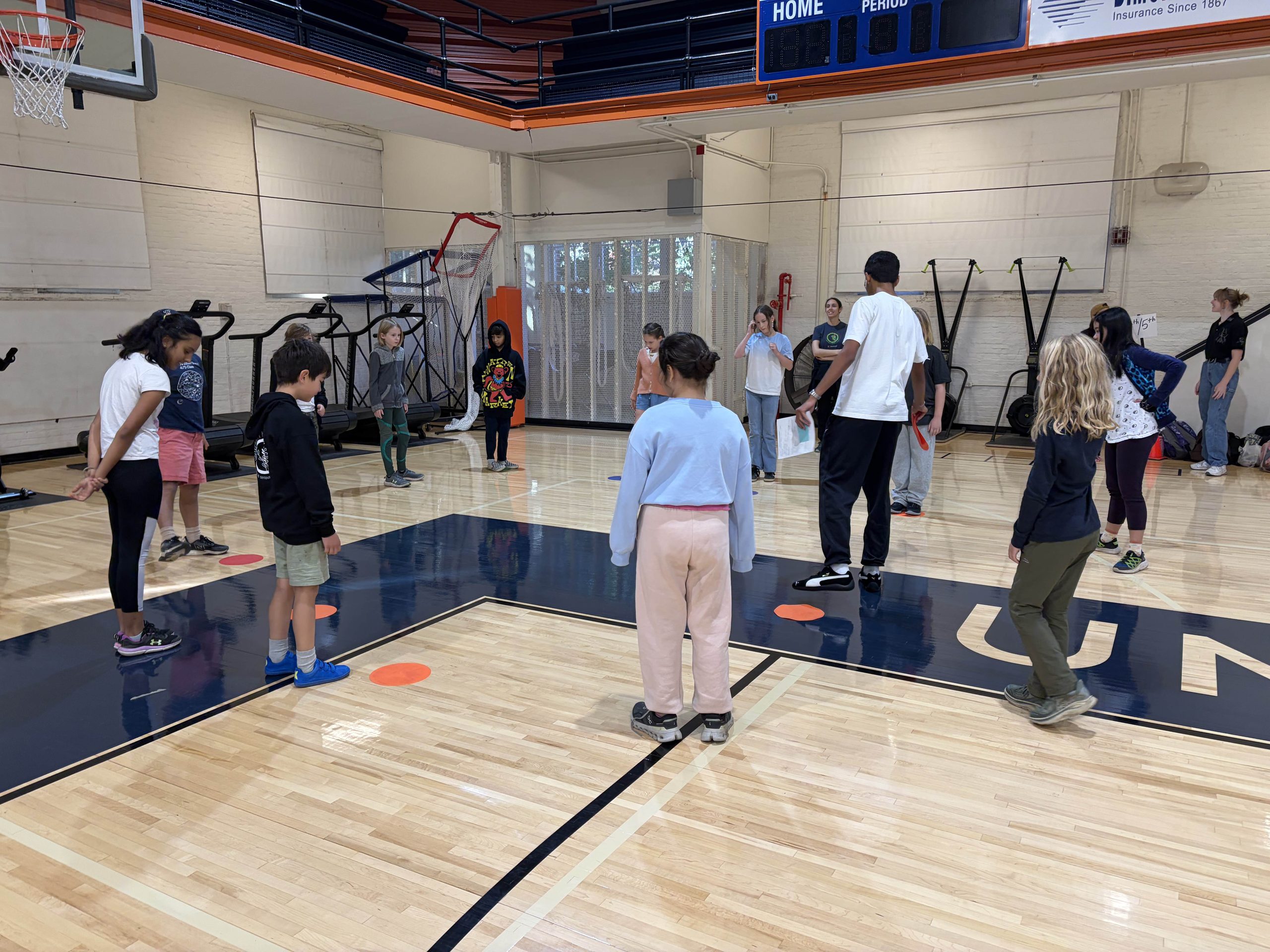
Uni Primary’s three participating classes—kindergarten and first grade, second and third grades, and fourth and fifth grades—were assigned to groups of instructors. (Photo provided)

Before Uni High students could teach younger children how to move, they had to work through a different kind of exercise: figuring out how to teach. 

University of Illinois physical education majors helped them prepare, drawing on lessons they had already taught at University Primary School. Then, when the children arrived, the high school students took the lead, with their college mentors nearby. 

The exchange is at the center of a pilot partnership linking University of Illinois Laboratory High School’s physical education department, Uni Primary and the university’s Department of Health and Kinesiology. It gives students at three educational levels a role in the same lesson, turning movement instruction into an opportunity to practice leadership, develop teaching skills and build connections across campus. 

For Kevin Richards, an associate professor in Health and Kinesiology in the College of Applied Health Sciences, the university students provide a crucial link. 

“Our PETE program is serving to bridge between the two by both teaching the primary school students and preparing the high school students to teach lessons,” Richards said, referring to the Physical Education Teacher Education program. 

The collaboration began when Uni High physical education teachers approached the Pedagogical Kinesiology Laboratory about working together, Richards said. They were interested in bringing their students into contact with Uni Primary children. Conversations with school faculty and administrators helped turn that interest into a teaching partnership. 

The project also gives the P.E. department a way to carry out Uni High’s laboratory mission. The school asks teachers to investigate their practice through experimentation and collaboration, connecting classroom work with the university’s commitments to research, innovation and public service. 

Here, that inquiry takes shape through a practical question: What can students learn when they become responsible for someone else’s learning? 

Kristi Carlson, a teaching assistant professor in Health and Kinesiology and the assistant department head, is guiding the experience through HK 461: Elementary Methods in Physical Education. University students have visited Uni Primary throughout the fall semester, teaching lessons and getting to know the children before helping the high school students prepare. 

Those visits give the P.E. majors more than practice delivering instructions. They learn about children’s skill levels, interests and behaviors: information they can share with students who are preparing to lead a class for the first time. 

The sequence is deliberate. University students teach Uni Primary children two lessons on a particular skill theme. They then help Uni High students plan a lesson addressing that same theme. 

For the first planning session, on Oct. 27, the focus was locomotor skills and movement concepts. Because the university students had already taught that material, they could suggest approaches that might work and identify potential difficulties. 

But the high school students were expected to contribute their own ideas. 

“We want to allow the Uni High students to have autonomy over the lesson, so allow them to brainstorm ideas, and then help them refine the lesson based on the experience and knowledge the U. of I. students have regarding the (University Primary School) students,” Carlson said. 

Planning included demonstrating skills, arranging the space safely and discussing what instructors should watch for as children participated. The university students also helped their younger teaching partners consider feedback and questions they could use to check understanding. 

A planning handout helped organize those decisions. The work required students to think beyond choosing an activity: They had to consider how to explain it, how to monitor it and how to respond when a child needed help. 

We want to allow the Uni High students to have autonomy over the lesson … allow them to brainstorm ideas

Kristi Carlson

Teaching assistant professor, Health and Kinesiology

On Oct. 29, Uni Primary children participated in the first lessons led by Uni High students. The college students arrived early to help their high school partners set up. 

Uni Primary’s three participating classes—kindergarten and first grade, second and third grades, and fourth and fifth grades—were assigned to groups of instructors. The university students worked in groups of five, paired with groups of about eight high school students. 

The lessons lasted 45 minutes and included a variety of activities. Uni High students introduced their lessons and led the children through the plans they had developed with the P.E. majors. 

The college students remained available to clarify instructions, offer feedback and help address behavior challenges. Carlson and schoolteachers moved through the learning area, offering support as needed. 

For the high school instructors, the challenge included recognizing that children close in age may need different kinds of instruction. 

“UPS has their classes arranged so that the students are of a similar age, but that doesn’t necessarily mean they are of similar skill level, so we helped the (Uni High) students think of ways to adapt the activities to meet students at different levels of performance and confidence,” Carlson said. 

Creating a welcoming environment was part of that preparation. So were demonstrating movements clearly, checking understanding and choosing positions that allowed instructors to monitor children throughout the activity area. 

The course’s skill themes include jumping and landing, balancing and weight transfer, and throwing and catching, along with locomotor skills and movement concepts. 

“These are some of the basic building blocks of movement, that can then be applied in more complex situations as students become more proficient in the skills,” Carlson said. 

Learning continued after the children left. University and high school students met in small groups to discuss what had gone well and what they wanted to improve. Then everyone gathered with Carlson and the P.E. teachers for additional feedback. 

That reflection gives the P.E. majors another opportunity to explain their decisions and share what they know about instruction. For Richards, preparing someone else to teach is itself a valuable part of becoming a teacher. 
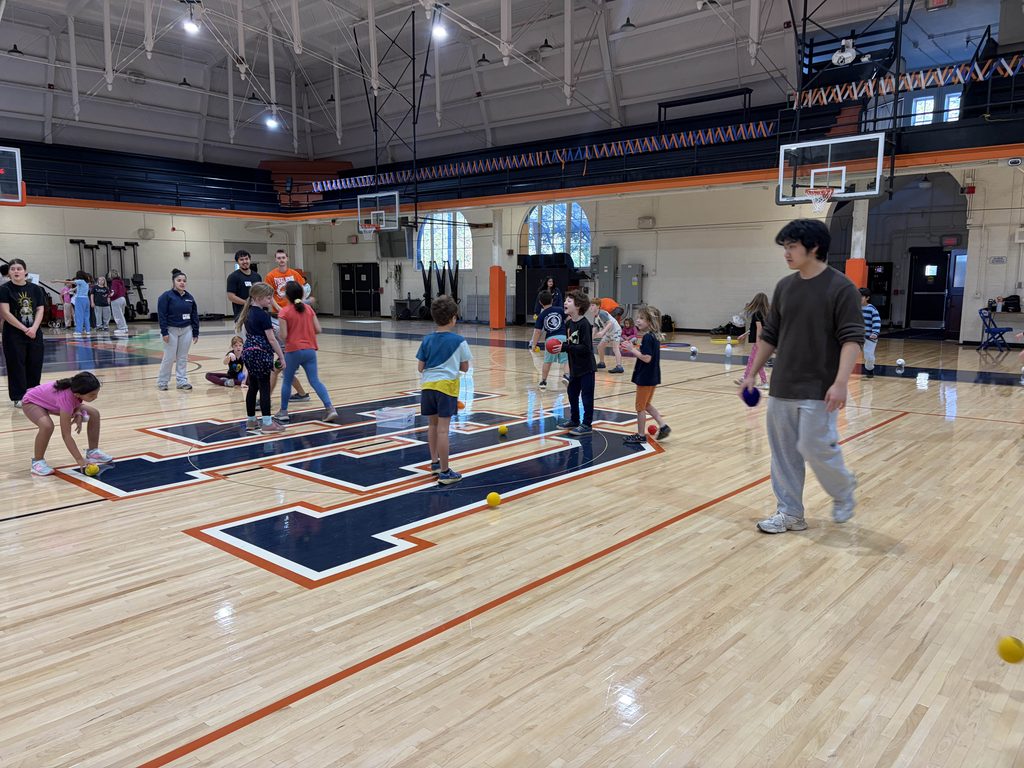
The partnership introduces high school students to physical education as a possible career while giving them immediate responsibility as leaders. (Photo provided)

“This model provides them with the opportunity to teach others what they have learned, which is one of the best ways to deeply learn,” he said. 

The partnership also introduces high school students to physical education as a possible career while giving them immediate responsibility as leaders. 

“It advances the mission by giving our preservice teachers an opportunity to both teach at the primary school and ‘teach the teachers,’” Richards said. 

The Pedagogical Kinesiology Laboratory brings a broader interest in teachers’ and learners’ experiences to the collaboration. Its stated mission includes understanding physical activity settings and addressing inclusion, including the experiences of people with disabilities. Carlson said the lab helped develop the project after discussions with the schools and could become more involved in research as the partnership develops. For now, the lesson planning, supported teaching and discussion afterward give participants a structure for learning directly from one another’s experience. 

The pilot remains an early effort. Carlson said the first lesson appeared to go well, with the children actively engaged for most of the period. Teachers also identified areas for improvement. Richards said more formal research is planned for the second year; the initial goal is for the groups to work well together and have a positive experience. 

Carlson said two additional planning sessions and two more lessons led by high school students were planned for the semester. University students would also continue working with Uni Primary. 

As the partners consider how to sustain the program, Carlson pointed to the relationships within each lesson as the clearest expression of its promise: university students supporting high school students, who in turn support younger children. 

“It’s a pretty great dynamic,” she said. 

Editor’s note:

To reach Vince Lara-Cinisomo, email vinlara@illinois.edu.
 

Share on social

Related news

Support swells for iPALS summer enrichment program


A day in the iPALS program provides academic enrichment, playtime, social-emotional learning and nutritious snacks. (Photo provided)

A group of Illinois physical education alumni are supporting one of the College of Applied Health Sciences’ longest-running youth programs as it returns to Champaign.

Three graduates of the former Department of Physical Education for Women at Illinois—Carolyn Bechly, Jean Snuggs and Lyndell Wilken—have pooled their resources into an endowment to help fund the Illinois Physical Activity and Life Skills program, also known as iPALS. The summer wellness program for local children is also a steppingstone for Illinois student educators to develop their skills.

“We’re hoping iPALS can be part of their practical experience, building on what they’ve learned in a classroom,” said Wilken, who graduated in 1972 and became a coach, physical educator and athletics administrator.

The eight-week iPALS program run by the Department of Health and Kinesiology in Applied Health Sciences brings in local schoolchildren every summer for a full day-camp experience, with structured playtime, academic enrichment, social-emotional learning and nutritious snacks available each day. 

Beyond a summer opportunity for at-risk youth—every child participant qualifies for SNAP benefits or free-and-reduced lunch—the program doubles as a research study, funded by the U.S. Department of Agriculture.

The premise of the study: to see if regular physical activity, summertime enrichment and specialized nutrition can curb “learning loss,” the regular backsliding of academic achievement that occurs over summer break. Enrollment in iPALS is completely free.

The University of Illinois has a long history of youth summer programs. iPALS was originally the “Sport Fitness” program, where physical activity was the focus. With community input from partnering local school districts, faculty leaders have developed a more balanced approach over the years, between academic and social enrichment, exercise and nutrition.

Many of the daily snacks served to iPALS kids contain lutein, a carotenoid common in leafy green vegetables that settles in our eyes and brain, supporting our eyesight and cognitive health. The iPALS participants, ages 6 to 11 years old, take fitness, academic and cognition assessments at the beginning and end of the program to measure its direct impacts.

“Given that physical activity participation is among the most robust behavioral approaches to support both physical and cognitive health, we anticipate that the iPALS program has the potential to have a meaningful impact on children in our community,” said principal investigator Naiman Khan, associate professor in the Department of Health and Kinesiology.

During iPALS days, the kids move from station to station, with each stop run by Illinois graduate students. The researchers purposely use students with diverse backgrounds: nutrition majors running the snack station, education majors running academic enrichment, and physical educators structuring the playtime.

“For me, the most important aspect is that we provide a safe space for eight hours a day where kids are guaranteed meals and snacks, surrounded by adults who care about them, and they’re able to build relationships with peers experiencing similar realities,” said HK Associate Professor Kevin Richards, who researches the teaching of physical education. “That impact is difficult to capture with data, but it is the most meaningful part of the program.”

Interested families can visit the iPALS website and complete the eligibility survey to see if their child qualifies for the program. This year’s iPALS will take place at Booker T. Washington STEM Academy in Champaign on weekdays from June 3 to July 17.

Booker T. Washington STEM Academy in Champaign will be the hosting venue for this year’s iPALS program. (Champaign Unit 4)

A Motivated Donation

Illinois alumnae Carolyn Bechly, Lyndell Wilken and Jean Snuggs on a trip to Alaska. The three graduated from Illinois Department of Physical Education for Women just as Title IX took effect. (Photo provided)

The teaching experience available in the iPALS program mirrors the student teaching opportunities that were available to prior generations of Illinois physical education majors. Months after the passage of landmark Title IX legislation in 1972, the Illinois departments of Physical Education for men and women were fused, just as Bechly, Wilken and Snuggs happened to embark on their careers.

Under Title IX, every education program that received federal funding had to ensure equal access for students regardless of sex. Schools nationwide had an imperative to start girls’ sports teams, and a dire need for coaches. Some states, including Illinois, mandated that coaching slots be filled by women.

Suddenly, these new Illinois physical education graduates had their work cut out for them. 

“It was an amazing time, and busy,” Wilken said. “The opportunities were huge, also the workload you sustained, because you were a full-time teacher and you weren’t given anything extra for coaching—just the love of sport and wanting girls to have opportunities that drove most of us to essentially do it for free.”

The three women quickly discovered the lessons from the Illinois’ physical education program were useful in the field. They had learned under department legends such as professors Phyllis Hill and Beulah Drom, who instilled foundations in childhood motor skills and structuring class-time for physical education. The pedagogy of P.E. was scientific and practical: to help students understand the joy of movement, you’ll have to get them to line up single file as well.

“The science of it was really fascinating … you learned how to learn things, which carried over into how to teach,” Snuggs said. “In retrospect, it was always incredibly teaching-oriented.”

Wilken, Snuggs, Bechly and their cohort have retired, mostly, from long careers in physical education and coaching, spanning secondary schools, colleges and universities. They owe much of their lasting bond with their classmates to the passage of Title IX, and the whirlwind of entering the field together, giving student-athletes—particularly young women—opportunities that didn’t exist for themselves.

“We graduated, Title IX happened, and we fell into wonderland,” Bechly said. “Us starting as brand-new teachers, to be able to coach and experience stuff we didn’t really experience to that level, it was just fabulous.”

Naturally, shared professional experiences led the cohort to stay in touch and collaborate. Wilken made a spirited call to Snuggs back in 1979: Wilken was leaving her post at the American River College in Sacramento after founding its women’s track and field team. The school would need a new athletics administrator, and a new coach.

Inspired by how iPALS mirrors their own student-teaching experiences at Illinois, these physical education alums set up a fund to support the program indefinitely. (Photo provided)

“I had never run a track race in my life, but Lyndell said, ‘Hey, you might like this, why don’t you apply?’” Snuggs said. Snuggs got the job and stayed at American River College for more than 30 years, retiring as its dean of physical education in 2012. Wilken went to work at Lane Community College in Oregon, coaching its cross country and track teams to four conference championships.

Today, more than 53 years after the passage of Title IX, these alums have reconnected with their alma mater. After dialogues with the current faculty of Health and Kinesiology, the iPALS program seemed a good target for their financial support, mirroring their own student-teaching experiences at Illinois.

Their Supervised Teaching of Physical Activity/Nutrition Fund will support iPALS indefinitely. The founders have put out an open call for alums, including fellow physical educators, to donate.

“We’d like the students working there in the summer to be future physical educators, and that they continue being mentored and teaching,” Bechly said.

Families can register their kids for this summer session of iPALS now. In the meantime, the PEW alums hope more supporters help sustain the program.

“Physical education is a wonderful opportunity for kids to make decisions at whatever level, in terms of how they deal with others, how they deal with winning and losing. It’s heavy-duty stuff they can use for the rest of their lives,” Snuggs said.

Editor’s note:

To learn more about iPALS or sign up your child, visit the program’s webpage.

Want to contribute to the Supervised Teaching of Physical Activity/Nutrition Fund (Fund #778014)?  Donate or email our AHS Office of Advancement at advancement@ahs.illinois.edu.

Share on social

Related news

College of Applied Health Sciences
110 Huff Hall
1206 South 4th Street
Champaign, IL 61820
(217) 333-2131