DRES staff, coaches and athletes stress importance of funding, accessibility
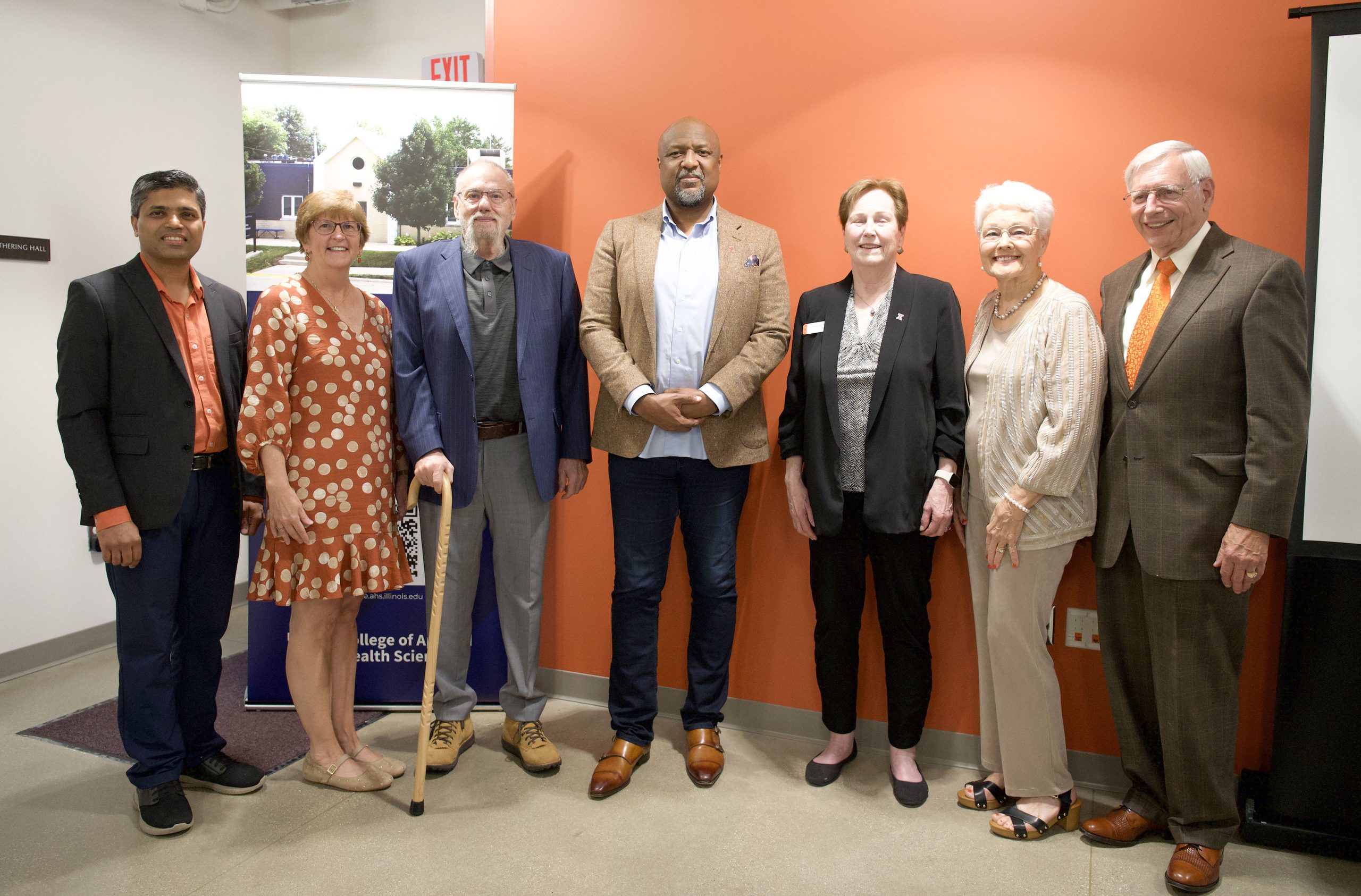
From left, Heather Stout, Brian Siemann, Maureen Gilbert, Jacob Tyree, Matthew Poland, Martrell Stevens, Stephanie Wheeler, U.S. Rep. Nikki Budzinski (D-Illinois) and Adam Bleakney (Photo by Ethan Simmons)
U.S. Rep. Nikki Budzinski (D-Illinois) spent part of her Tuesday on the campus of the University of Illinois Urbana-Champaign, where she toured Disability Resources and Educational Services and met with some of the coaches and athletes behind its nationally recognized adaptive athletics programs.
Budzinski met with a cross-section of DRES leadership, staff and athletes, including Director of Operations and Services Heather Stout; Maureen Gilbert, the coordinator of the office of campus life, wheelchair track coach Adam Bleakney, wheelchair basketball head coaches Stephanie Wheeler and Jacob Tyree and assistant coach Matthew Poland, DRES senior access specialist and Paralympian Brian Siemann and wheelchair basketball player Martrell Stevens.
Together, they highlighted both the day-to-day impact of DRES services and the broader significance of adaptive sports at the collegiate levels.
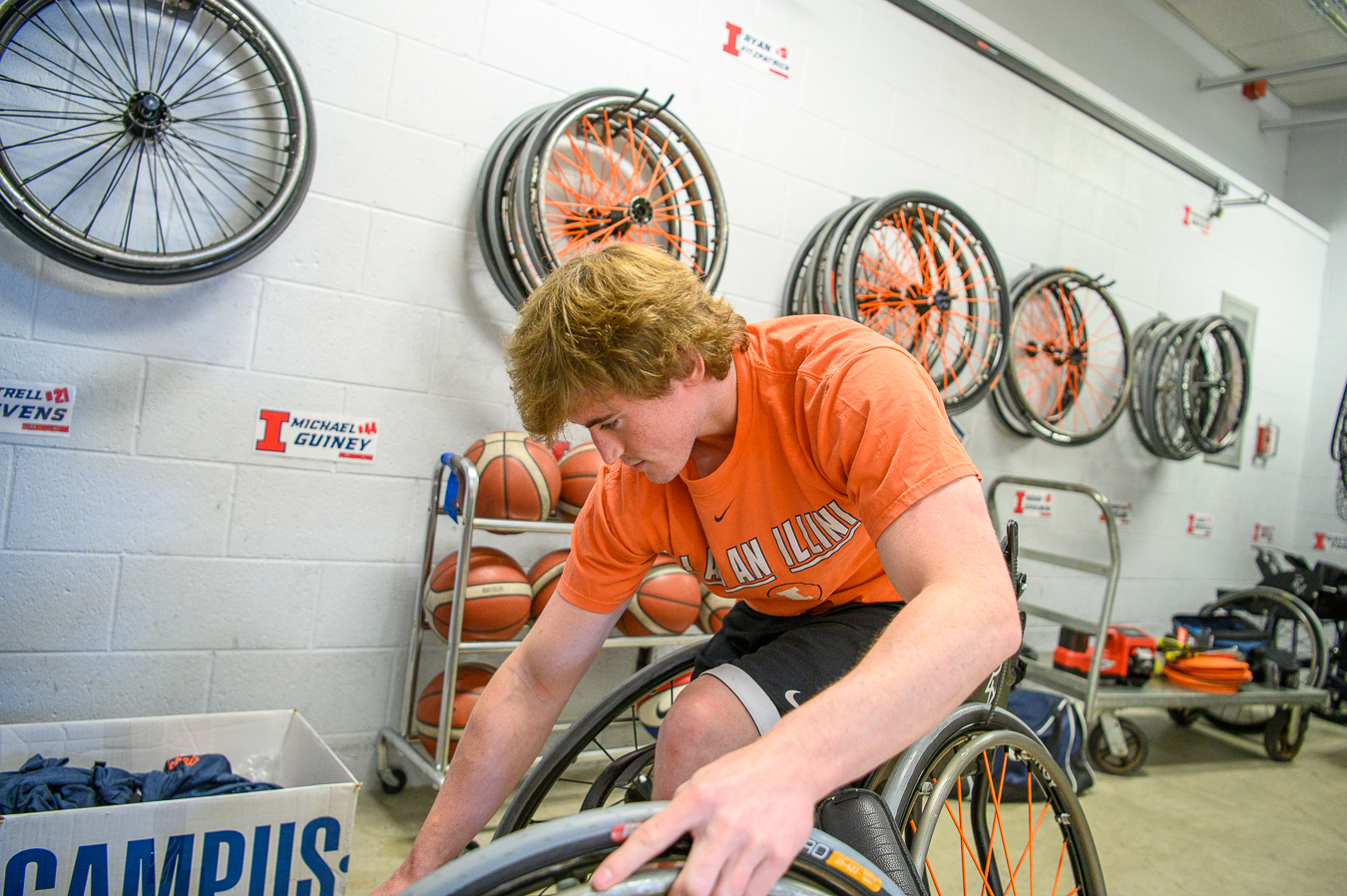
After seeing the main floor, Budzinski’s visit included a stop into DRES’ training facility, which was certified in September 2014 as a U.S. Paralympic Training Center. The basement facility, long regarded as a pipeline for Paralympic talent, served as a backdrop for conversations about access, equity and the future of disability services in education and athletics.
Bleakney showed Budzinski the adjoining Human Performance and Mobility Maker Lab, where he produces 3D-printed wheelchair racing gloves and collaborates on design projects with campus researchers. Siemann, who works with Illinois students with learning disabilities for DRES, showed Budzinski the two bronze medals he won in the 2024 Paris Paralympics as a wheelchair racer for Team USA.
The coaches, athletes, Gilbert and Stout all emphasized to Budzinski the importance of DRES for University of Illinois students, since more than 5,600 students applied for accommodations through DRES in academic year 2025-26. They also made sure Budzinski knew of the trailblazing work of DRES founder Tim Nugent, known as the “father of accessibility.” Nugent, who died in 2015, founded DRES in 1948 to help those returning from World War II.
Nugent advocated on the Urbana campus for wheelchair-accessible buses, curb cuts and other amenities that those with disabilities now take for granted. Many of his ideas have been adopted nationally. Nugent also helped create the National Wheelchair Basketball Association, as well as wheelchair football, track, archery and square dancing.
At the end of the tour, Budzinski was asked about the importance of sustained federal investment in programs like DRES. She underscored how policy decisions in Washington directly shape opportunities on campuses like Illinois.
Coach Adam Bleakney showed Nikki Budzinski the Human Performance and Mobility Maker Lab (Photo by Ethan Simmons)
“I’ve been supportive at the appropriations level of making sure that we’re supporting all of our sports, that we’re supporting the able-bodied and the disabled community to be able to fully participate in all athletics,” Budzinski said. “And you could do that through the appropriations process. I’ve been a big advocate of that for federal funding. I’m one of the bigger champions of Special Olympics as well. I lead our appropriations letters as it relates to that. So, I think just finding more opportunities through our appropriations process to invest in programs like this is so critically important, and we’ve made it a priority in the House.”
Budzinski’s comments connected federal appropriations work with on-the-ground outcomes—something visible in the athletes she met. DRES leaders also spoke about building programs that not only compete at the highest levels but also create pathways for students with disabilities to thrive academically and socially.
Student entrepreneur innovates user-centered assistive tech to empower independence
Carter Schott is the founder of Innovative Independence, a venture dedicated to designing assistive products that center the real, everyday needs of wheelchair users. (Photo by Deana McDonagh)
The College of Applied Health Sciences within the University of Illinois has long been known as spearhead of accessibility, thanks to the trailblazing work of Tim Nugent. Nugent, who died in 2015, was the founder of what is now Disability Resources and Educational Services, a pioneer for disability rights and known as the “father of accessibility.” For student entrepreneur Carter Schott, that environment didn’t just shape his education—it reshaped his understanding of what independence could look like.
Schott, a graduate student in the Master of Science in Management program in the Gies College of Business, is the founder of Innovative Independence, a venture dedicated to designing assistive products that center the real, everyday needs of wheelchair users. His work blends engineering, empathy and lived experience into products that aim not just to function, but to empower.
“DRES taught me that accessibility is not just about compliance; it’s about empowering people,” said Schott, who earned his Bachelor of Science in Mechanical Engineering in The Grainger College of Engineering. “Working in an environment where accessibility is valued helped me see the value of people’s performance when they don’t have barriers in their way. It’s not just about accommodations; it’s about designing for independence.”
That philosophy is the backbone of his work—and it began taking shape early in his time at Illinois. Schott is affected by a disease called spinal muscular atrophy, a form of muscular dystrophy. He has limited mobility and has used a power wheelchair since he was four.
Living in Beckwith Residential Support Services, Schott found himself surrounded by other students with disabilities, each navigating the world in different ways. The experience proved formative.
“Living in Beckwith and being immersed around other students with disabilities was a big deal for me,” he said. “Seeing how people adapted differently and where existing solutions were lacking encouraged me to think like a designer. This encouraged me to think about real-world usability rather than theory, which is something that impacted Sol.”
Sol, his flagship product, is a wheelchair-mounted visibility light designed to increase safety in crowded or low-light environments. At first glance, it’s a simple idea. But like many impactful innovations, it emerged from a gap hiding in plain sight.
“Sol started with a basic but essential problem statement: visibility,” Schott said. “I realized the difficulty that wheelchair-bound people faced in being seen in crowded or poorly lit spaces, such as our campus environment. There was no solution that was both effective and well-designed, so I set out to create one.”
The emphasis on both effectiveness and design is intentional. Schott noticed early on that many assistive technologies met functional needs but fell short in aesthetics, usability or user experience.
“I also saw a disconnect between existing assistive products and the needs that people actually had in their daily lives,” he said. “There was a lot of old or poorly designed technology out there. I wanted to make products that people would be excited to use, that would enhance their lives without making them feel like they were compromising.”
That mindset reflects a broader critique of the assistive technology industry, one Schott believes is long overdue.
“The biggest gap is in user-centered design,” he said. “There are too many products designed without a deep understanding of the people who will be using them. There is a gap in how to make assistive technology look and feel modern and appealing, not just functional.”
At Illinois, Schott found the rare ecosystem capable of addressing that gap. DRES, he explained, isn’t just a support system, it’s a catalyst.
DRES is not just integrated; it’s embedded. It’s not just accessible; it’s empowering.
Carter Schott
Student and entrepreneur
“Illinois is unique in that DRES is not just integrated; it’s embedded,” he said. “It’s not just accessible; it’s empowering. With housing, academic support and innovation spaces like the (dis)Ability Design Studio, students are supported and empowered to create solutions, not just provided solutions.”
Inside the (dis)Ability Design Studio—whose leadership team includes Susann Sears, the assistant director of Academic Services at DRES and Deana McDonagh, professor of Industrial Design in the School of Art + Design—ideas are tested against reality. Students don’t just theorize—they build, iterate and refine alongside the very people their designs aim to serve.
“DRES provides the foundation for innovation by bringing real users and real problems together,” Schott said. “Students have access to real-life experiences and real-life resources, which is not very common. This leads to meaningful innovation.”
That process, he added, is anything but linear.
“It’s taught me that no two users are the same. Creating assistive technology is a constant feedback loop. I’ve learned that simplicity and flexibility are key. In theory, something might work perfectly. But in practice … not so much.”
Collaboration has also played a crucial role in shaping his approach. At Illinois, disciplinary boundaries blur—especially when solving complex human-centered problems.
“Working with individuals from different fields, like engineering, design and healthcare, has been very important,” Schott said. “This ensures not only that the solution you are coming up with is technically viable, but also ‘usable’ and ‘meaningful.’ The (dis)Ability Design Studio really challenges you to think outside your own discipline.”
That cross-functional mindset is embedded in Innovative Independence itself. Schott doesn’t see Sol as a standalone product, but as the first step in a much larger vision.
Sol is a wheelchair-mounted visibility light designed to increase safety in crowded or low-light environments. (Photo provided)
“Yes, definitely. Sol is just the beginning,” he said. “I’d like to continue creating more products that help people be more independent in their daily lives, especially those with limited mobility. There are a lot of needs that are yet to be met, and I see this as a long-term business.”
His ambition reflects both optimism and urgency. While awareness of accessibility has grown in recent years, Schott believes institutions, especially universities, still have untapped potential to drive innovation.
“There are more things universities can do by providing students with opportunities to work directly with users with disabilities,” he said. “Universities can provide access to users, fund prototypes and provide collaboration spaces. When students can test ideas in a real environment, the quality of the ideas improves significantly.”
For Schott, the lesson is clear: meaningful design begins with listening, and meaningful innovation requires proximity—to people, to problems and to lived experience.
At Illinois, he found all three.
And through Innovative Independence, he’s working to ensure that future assistive technology doesn’t just meet standards but raises them.
Masters won a third of Team’s USA total medal count
Oksana Masters won five medals in Milano Cortina ( Photo by Mark Reis/USOPC)
Oksana Masters, who trains at Disability Resources and Educational Services at the University of Illinois, finished with five medals at the Milano Cortina 2026 Paralympic Winter Games, including four golds in biathlon and cross-country skiing events.
Masters, 36, also won a bronze medal in the 20km Para cross-country skiing event, bringing her career Paralympics total to 24 medals. She had a third of Team USA’s 15 total medals at Milano Cortina, extending her legacy as the most decorated Winter Paralympian in U.S. history.
“To look back now and it’s my eighth games and I have 24 medals that I’ve brought home for Team USA … It’s just incredible,” Masters told reporters. “It’s something that I just could not have achieved on my own and I have so many people helping me and I’m so thankful for that.”
Other Team USA Paralympic competitors from the University of Illinois were Aaron Pike, who finished fourth in the men’s 12.5km biathlon, and Travis Dodson, who helped bring home Team USA’s fifth-straight gold in sled hockey.
Oksana Masters has won three gold medals in Milano-Cortina (Photo by Mark Reis, USOPC)
Oksana Masters, who trains at the University of Illinois’ Disability Resources and Educational Services, continued her amazing run at the Milano Cortina 2026 Paralympic Winter Games in Italy.
Masters captured gold in the women’s sitting 10km to secure her third gold medal of these Paralympic Winter Games after completing the four laps and crossing the finish line in a time of 26:31.6. The victory brings Masters’ remarkable Paralympic medal count to 22, including 12 gold medals, continuing to add to one of the most decorated careers in Paralympic sport.
“I don’t even know what to think and I can’t believe it’s actually happening,” Masters told reporters. “I woke up very sore, and I knew it was going to be a really tough race right out of the gates. Our team was incredible, they were screaming and giving me updates out on the course and said, ‘How bad do you want this?’ I wanted it badly. This is an amazing team effort.”
Illinois has three DRES-affiliated Paralympians competing in Italy
Oksana Masters won the women’s sprint sitting event on the first day of competition at Tesero Cross-Country Skiing Stadium. (Photo by Buda Mendes/Getty Images)
Oksana Masters, who trains at the University of Illinois’ Disability Resources and Educational Services, took gold in the women’s biathlon sprint at the Milano Cortina 2026 Paralympic Winter Games on Saturday to earn the 20th Paralympic medal of her career and her 10th gold.
“My emotions are just pure shock—I did not expect a podium finish, to be honest, let alone a gold,” Masters told reporters. “It means the world to me. I feel like now I can kind of relax and enjoy the Games, enjoy the moment. I’m always shooting for gold, but that’s not the ultimate reason and I know it doesn’t define me. To be able to just have that gold knowing that everything went to plan, my team, my ski coach, my strength coach, everyone. I think that’s what means the most.”
Masters finished the course in a time of 21:21.3 and she added to her title as the most decorated U.S. winter Paralympian of all time.
In the men’s sitting class, Illinois alumnus Aaron Pike—who is engaged to Masters—finished sixth.
In Sunday’s competition, Masters placed fourth in the in the women’s sitting individual biathlon, while Pike finished fourth in the men’s sitting class.
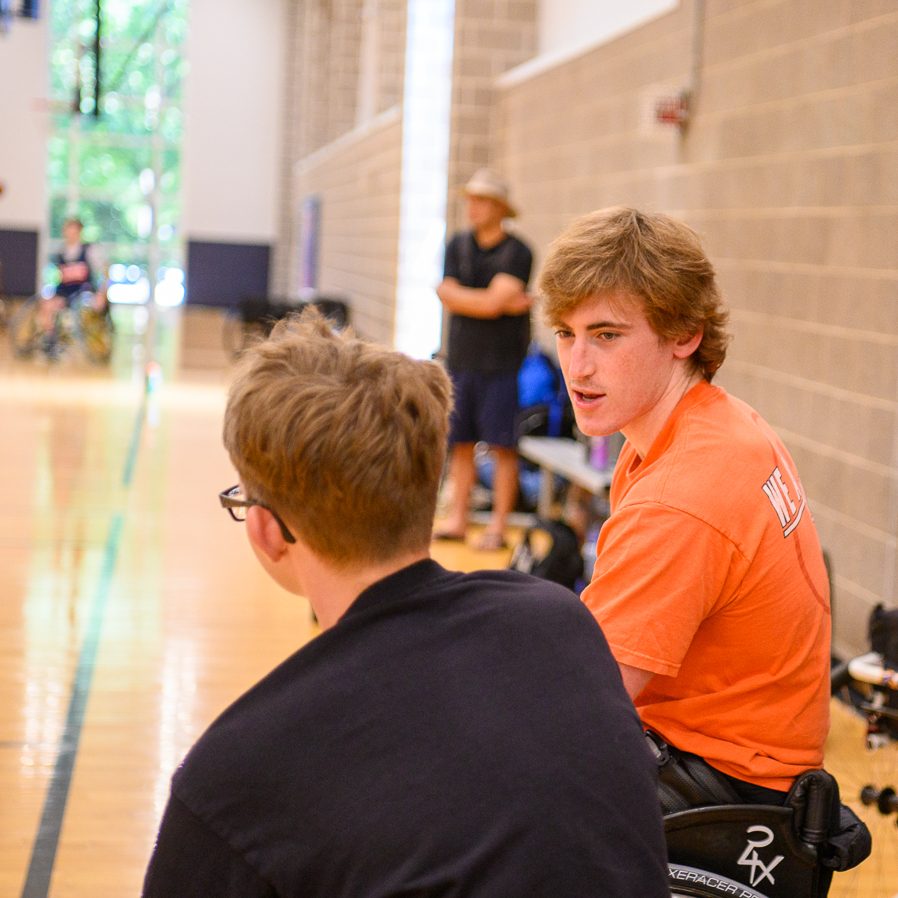
Faculty, students and staff engaged in a spirited game of wheelchair football during Adaptive Rec Day (Photo by Ethan Simmons)
It wasn’t even 11 a.m. and Gym 2 at the Activities and Recreation Center on the campus of the University of Illinois Urbana-Champaign was already buzzing.
Illinois’ first annual Adaptive Rec Day had just begun, drawing students, faculty and staff. Inside the gym, sport wheelchairs gleamed beneath the lights. Basketballs and footballs echoed across hardwood. At center court, members of Illinois’ wheelchair athletics teams smiled, ready to welcome newcomers with open arms.
Illinois’ Campus Recreation held the inaugural Adaptive Rec Day as a way to celebrate the National Intramural-Recreational Sports Association’s (NIRSA) Recreational Sports and Fitness Day.
Developed by Recreation, Sport and Tourism graduate student Noah Eckelberg, students got the opportunity to learn about adaptive sports and recreation while competing alongside Illinois’ wheelchair athletes. Students enrolled in RST courses Community Planning and Engagement and Inclusive by Design also participated in the day’s scrimmages.
Campus Recreation was awarded $16,168 as part of the Christopher & Dana Reeve Foundation National Paralysis Resource Center (NPRC) 2025 Direct Effect 2nd Cycle. The funding was used to put on the event and purchase adaptive recreation equipment, including harnesses for the climbing wall, hand cycles that will be available at the Campus Bike Center and adaptive sleds for use at the Ice Arena, said Alex Williamson, associate director of marketing-programming at Campus Recreation, as well as body-weight straps and a boccia ball set that can be checked out during open recreation.
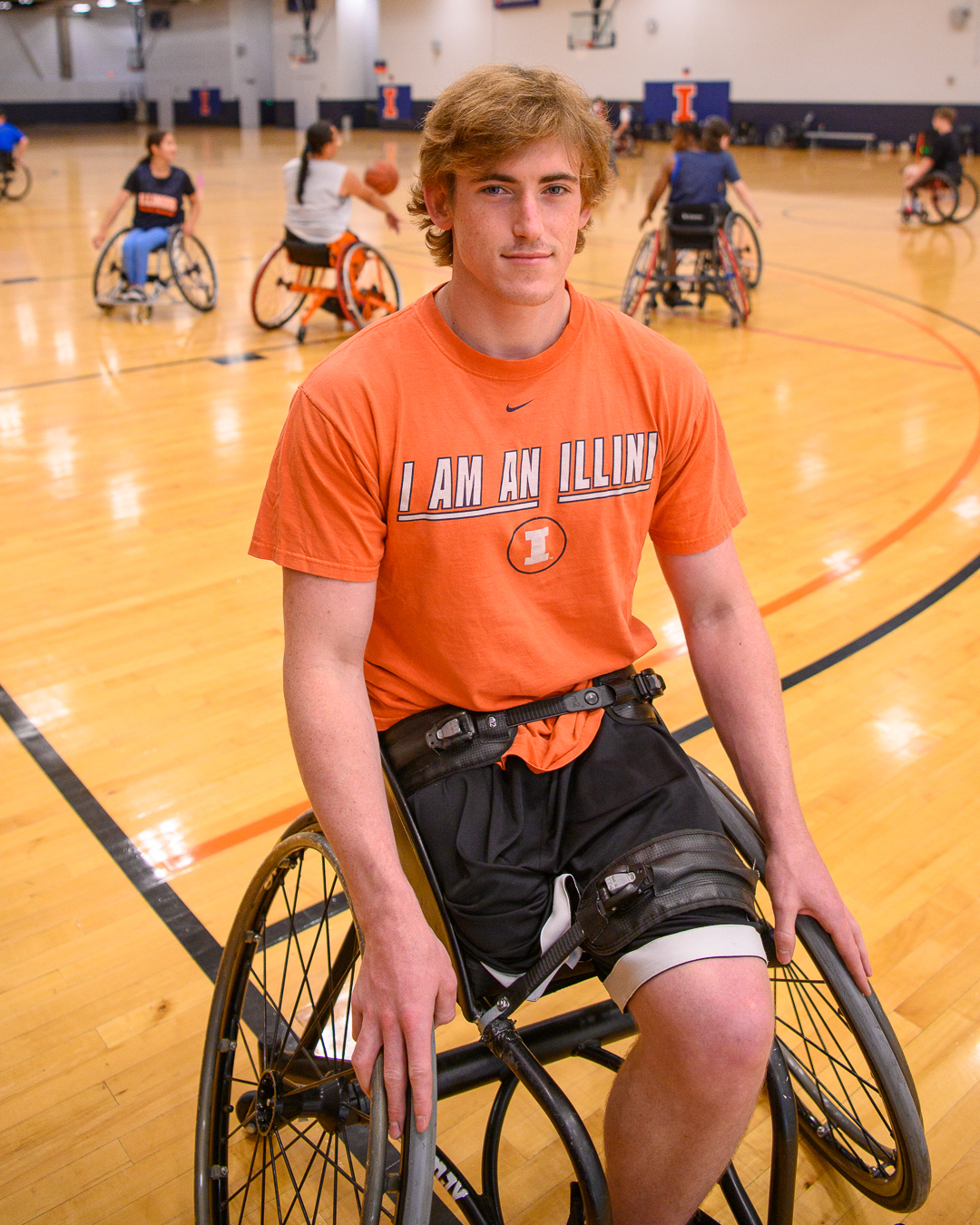
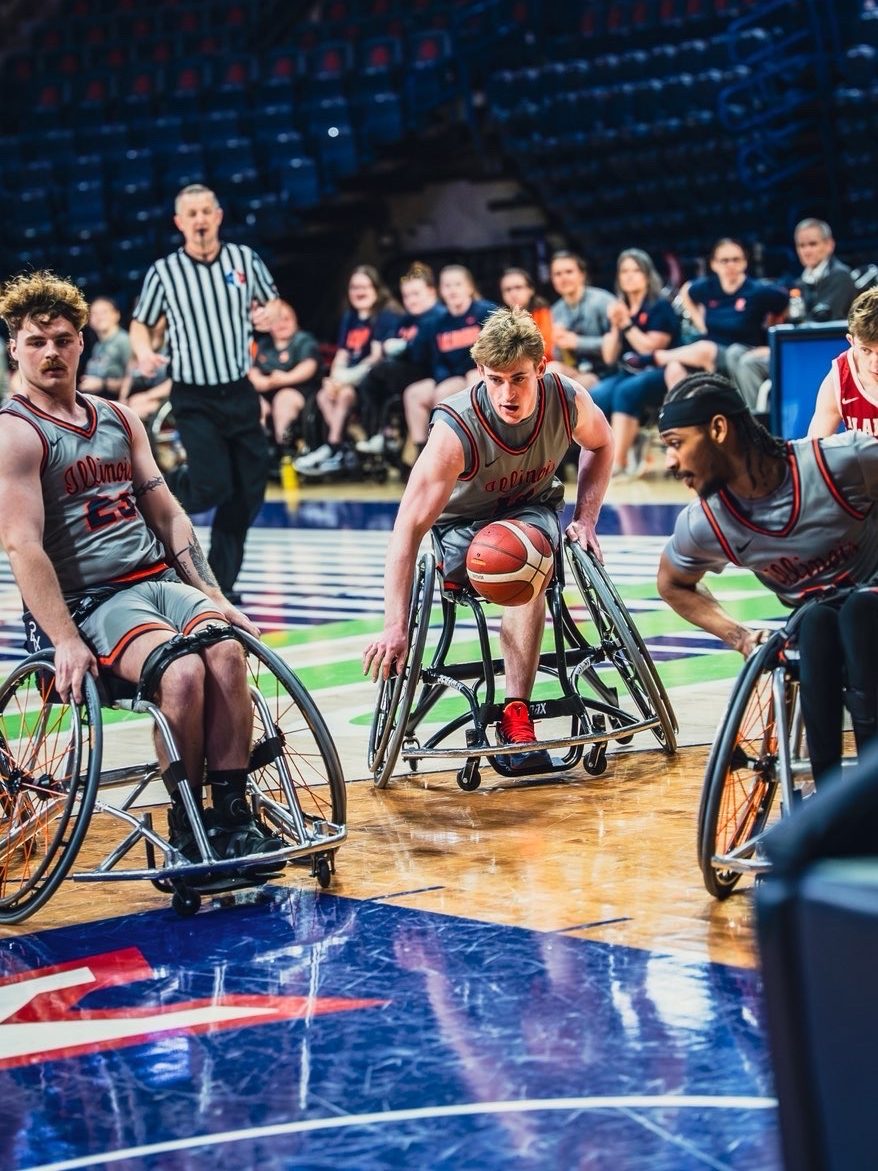
Martrell Stevens, a Recreation, Sport and Tourism major and captain of the Illini men’s wheelchair basketball team, spun lightly in his chair, greeting a student who had never seen a sport wheelchair up close.
“This is a really, cool experience and an opportunity to just teach other people about adaptive athletics, and not just wheelchair basketball, but all the different sport there is to know,” Stevens said, gesturing toward courts set up for wheelchair basketball, football and volleyball.
“Growing up playing wheelchair basketball has changed my life so much. It’s allowed me to meet the best friends of my life who are going to be in my life for a very long time. It’s allowed me to travel, see the world. It’s allowed me to go to college. If I can teach other people about the sport, and they can teach other people, we can spread awareness and get as many people as possible playing adaptive athletics so they can have the same similar opportunity as me growing up.”
Paralympic medalist Susannah Scaroni nodded vigorously. Scaroni, whose racing career has taken her from campus tracks to the world stage as the defending champ of the Boston, New York and Chicago Marathons, leaned into the question about what an Adaptive Rec Day could teach people.
“Man, I agree with that,” she said with a grin. “And I’d just say we want to change perceptions to be what is right. We just want people to know what recreation sport is, and sport is, and disabled sport—as oxymoronic as that sounds—people learn hands-on.”
And that was exactly what was happening.
Some faculty and staff climbed into a sport chair for the first time, wobbling before finding balance. Students experimented with the wheels, marveling at the speed. Laughter broke out as people discovered just how much upper-body strength the sports demanded.
Mak Nong, a former captain of the Illini wheelchair basketball team and now program manager for Great Lakes Adaptive Sports Association (GLASA) in Lake Forest, Illinois, talked to a crowd gathered after the sport demonstrations were done. His tone carried both urgency and excitement.
Being physically active, moving, it’s what the College of Applied Health Sciences is all about: wellness across the lifespan.”
Jean Driscoll
Paralympic medalist and associate dean of advancement, College of Applied Health Sciences
“I think just for you guys, just really understanding that you’re at a point in time where adaptive sports is in a frying pan right now,” he said. “It can jump off at any second and you guys can trail blaze that. Please use the people that came before you to help you champion that and continue to grow these different opportunities.
“… there’s so many different things that you guys can grow adaptive sports, whether it’s (Name, Image and Likeness) deals for intercollegiate sports, the different equipment that the athletes will eventually use. The sky’s the limit for you guys. And I’m so excited to see what you guys do with this.”
In the gym, Paralympic multi-medalist Jean Driscoll watched as people navigated their chairs, some for the first time, in competition. A legend in wheelchair racing and a longtime advocate for adaptive athletics, Driscoll smiled at the sight of recreation in its purest form.
“Well, I know this is Rec Day,” she said when asked what the event meant to her. “And we all took sport beyond recreation, and we’re elite-level athletes. But I think to Susannah’s point, recreation is the name of the game. Being physically active, moving, it’s what the College of Applied Health Sciences is all about: wellness across the lifespan.”
She gestured toward the swirl of activity.
Women’s wheelchair basketball coach Stephanie Wheeler, left, and Paralympic medalists Jean Driscoll, center, and Susannah Scaroni took part in Adaptive Rec Day (Photo by Ethan Simmons)
“And so being active some way, you don’t have to be a superhero every day. Just do things for yourself, what makes you happy. For us, training makes us happy. But you can do it for fun too. And if you do it for fun, if you’re having fun, you’ll keep doing it. And that’s really what’s important.”
For Illinois women’s wheelchair basketball coach Stephanie Wheeler, the event was also an opportunity to quash some misconceptions about adaptive sports.
“I would say the biggest misconception that we have is it’s not physical or that it’s not real sport,” Wheeler said. “I think that’s what we try to do here at U. of I. is introduce wheelchair basketball, wheelchair racing, whatever sports it might be as a sport. I think that’s the biggest misconception is that it’s not a sport, that it’s not hard, it doesn’t require skill because we are disabled, that anybody can play, and that anybody can be good. I think what that aligns with is the way we think about disability in society.
“It’s not necessarily a positive representation. Whenever we’re encountered with that, we always say come to a game come to a practice because as soon as you see it, you’ll fully understand that skill is required. It’s physical. It’s fast. It’s fun. Just coming to watch it, I think, kind of washes that away pretty quickly.”
Near the end of the event, Nong—who played professional wheelchair basketball in Europe—addressed the crowd, mostly composed of students.
“What I love the most about today is that it has been led by quite a few of our student athletes. And so shout out to all of our student athletes who have played a huge role in making today happen,” he said. “And that’s really important to us because in our program, one of our biggest founding philosophies is that we pay it forward.”
As the final basketballs and footballs were rolled away and chairs lined neatly along the wall, the energy in the ARC felt less like an ending and more like a starting line.
Illinois’ first annual Adaptive Rec Day had been about t-shirts and snacks. But it had also been about perception, possibility and paying it forward.
And if the laughter, shouting and spinning wheels were any indication, this was only the beginning.
Honorees embody resilience, leadership, service, and equity
AHS Dean Cheryl Hanley-Maxwell, second from left, poses with AHS alumni award winners Jack Groppel, left, Adrienne Albrecht, right, and Brandon Buchanan, far right. (Photo by Craig Pessman).
The College of Applied Health Sciences at the University of Illinois Urbana-Champaign once again shined a light on extraordinary alumni at its annual Alumni Awards celebration, held during Homecoming weekend. This year’s honorees—Dr. Jack Groppel, Justice Adrienne Albrecht and Brandon Buchanan—embody the college’s enduring mission of advancing health, equity and human potential.
The ceremony, led by Dean Cheryl Hanley-Maxwell, is designed not only to recognize the professional accomplishments of alumni but also to share the personal journeys that shaped their paths. “The individuals who receive these awards never fail to impress and fascinate me,” Hanley-Maxwell said. “As you hear their stories today, I’m sure you’ll find yourself saying, ‘Wow!’ many times, just as I have.”
Distinguished Alumni Award: Dr. Jack Groppel
Few careers demonstrate the power of seizing opportunity quite like that of Jack Groppel, recipient of the 2025 AHS Distinguished Alumni Award. An internationally recognized scholar in the science of human performance, Groppel has been a professor, tennis coach, entrepreneur, author, corporate consultant and motivational speaker.
And yet none of that would have happened without the University of Illinois.
“If the leaders in this college hadn’t given me a shot, I’d be counting wolves in Wyoming,” he said.
Growing up in a small southern Illinois town, Groppel was drawn to sports early, teaching himself to play tennis and eventually becoming one of the top junior players in the St. Louis area. Determined to play for the University of Illinois, he convinced men’s tennis coach Dan Olson to give him a chance—a story that foreshadowed a career marked by persistence and boldness.
His academic path was less direct. Pressured to pursue a “practical” major, Groppel earned a degree in wildlife biology. Yet his passion for athletics led him to graduate study in biomechanics at Illinois, where mentor Dr. Charles Dillman helped redirect his career. Groppel later completed a Ph.D. in exercise physiology at Florida State University before returning to Illinois as a professor and head tennis coach.
“How do you go from crying yourself to sleep at 22 to this?,” Gropple said, referencing his unhappy time seeking a career in the wildlife industry. “I have been truly blessed in my life, thanks to my time at the University of Illinois.”
After a decade, Groppel made another daring move: leaving a tenured faculty position to work in Florida at the Saddlebrook Resort. That leap led him to co-found the Human Performance Institute with Dr. Jim Loehr, a venture later acquired by Johnson & Johnson. Groppel became a pioneer in applying the training principles of elite athletes to business leaders, co-authoring the influential book The Corporate Athlete. He went on to brief Congress on worksite wellness, share stages with global icons like Muhammad Ali and Margaret Thatcher, and earn induction into three tennis halls of fame.
Groppel credits the University of Illinois with giving him the scientific foundation and teaching passion that shaped his career.
One of his mentors was Thomas K. Cureton, considered the father of physical fitness. After a semester working with Cureton and others in the precursor to what is now known as the Department of Health and Kinesiology in AHS, Groppel was hooked.
“AHS molded me into a person who can do quality research,” he said. “It all began with leaders in AHS taking a chance on me. It started in that small town and on those small farms where young Jack dared to dream big.”
Harold Scharper Award: Justice Adrienne Albrecht
If Groppel’s story is about breaking down doors, Adrienne Albrecht’s is about perseverance and the power of access. Recipient of the Harold Scharper Award, presented by the Division of Disability Resources and Educational Services, Albrecht retired in 2024 as a Justice of the Third District Appellate Court of Illinois, capping a distinguished legal career.
Born in Kankakee as the eighth of 10 children, Albrecht was diagnosed with Marfan syndrome, a connective tissue disorder that severely impaired her vision. In the 1960s, long before disability rights laws provided protections, her mother fought to secure accommodations like front-row seating and access to blackboards. “My mother was extraordinary,” Albrecht said. “She understood what I needed and made sure I got it.”
“If the leaders in this college hadn’t given me a shot, I’d be counting wolves in Wyoming.
Jack Groppel
Distinguished Alumni Award winner
DRES founder Tim Nugent also played a vital role. Several of Albrecht’s siblings, who also had Marfan syndrome, attended Illinois with the support of DRES scholarships.
“I can’t tell you what a profound effect the University of Illinois had on my entire family. Imagine this family of 10 children, thinking they could all go to college and have great careers. The University of Illinois was just so crucial to my family,” she said.
Despite limited assistive technology at the time, Albrecht thrived academically, drawn to international relations before pursuing law. A constitutional history course sparked her passion for legal analysis, while her visual impairment forced her to develop a near-photographic memory—an asset in her legal work.
Over a 30-year career, Albrecht became known for her skill, adaptability and dedication to justice. She was among the first attorneys in Kankakee to integrate personal computers into her practice, eventually teaching technology courses for the Illinois State Bar Association. She served on the circuit court bench before her appointment to the appellate court, where she helped interpret Illinois’ landmark cashless bail statute.
Her proudest moments, however, were deeply personal. “People approach me in the grocery store to thank me, to tell me I made a difference in their lives,” she said. “That means more than anything.”
Dean Hanley-Maxwell said Nugent would be proud to see how Albrecht carried forward his legacy of inclusion and access.
“(Nugent) would join all of us in AHS and DRES in saying that you are richly deserving of this award,” Hanley-Maxwell said.
Young Alumni Award: Brandon Buchanan
Brandon Buchanan was honored with the AHS Young Alumni Award for his leadership in health equity and hospital administration. Buchanan is now associate chief operating officer of Orlando Health Dr. P. Phillips Hospital, but his path began in Champaign with a shift in academic focus.
Originally a journalism major, Buchanan found his calling while volunteering at Smile Healthy, a clinic providing dental care to underserved populations. “Community health took a holistic approach to how society looks at health and well-being,” he said. Inspired, he switched majors and pursued graduate training in health administration.
That decision launched a career devoted to improving access to care. Buchanan managed HIV and STI outreach programs at Ohio State, then spent nearly seven years at Endeavor Health in Chicago. There, he built the health equity impact team from a one-person office into a 30-member department that improved mammogram screening rates, reduced hypertension in Black communities, and expanded community education.
Now in Florida, Buchanan serves on the board of the local YMCA and mentors students pursuing careers in healthcare administration. “I’m proud when I see them flourish and shine,” he said.
Hanley-Maxwell praised Buchanan’s blend of leadership and compassion: “You cannot go wrong when you are committed to improving your community through service, fairness and respect.”
John Preston had never been in an integrated environment until he came to the University of Illinois in 1967
John Preston, second from right, navigated an unfamiliar world when he came to Urbana-Champaign (Photo provided)
Arriving at the University of Illinois Urbana-Champaign in the 1970s, John Preston was among the few Black students and people with disabilities on campus. His journey through the university not only challenged him to navigate an unfamiliar world but also taught him the value of embracing life as it comes.
“If you understood what you’re going through, being Black, then what you go through being disabled is just a continuation of having that experience of being different,” Preston said.
In high school, a car accident left Preston paralyzed. The sudden change forced him to navigate a world that wasn’t built for people like him.
Having also grown up in the South, he said he had never been in an integrated environment until he came to U. of I. in 1967 to complete an undergraduate degree in business administration and marketing. It was the only university in the nation at that time that was accessible and accommodating to persons with disabilities.
“When I arrived, I went into my room and I met my roommate. Dwight was from Wisconsin and he was white,” Preston said. “This would be the first time I ever had lived with someone of a different race.”
Preston faced some discrimination in his dorm during the early weeks, but “I was used to it and I soon felt that discrimination melt away when we all got to know each other personally.” For him, the accessibility of the campus and sense of freedom was amazing.
“It was a campus that I could push all over,” Preston said. “I could go from one end to the other, and I could go anywhere in any building. I could get out of my chair and transfer into an accessible shower chair. It was absolutely fantastic.”
He had never lived in a place with accommodations like U. of I. Preston recalled that when he first applied to Illinois, he was missing course requirements like chemistry and algebra. Those classes in his high school were taught upstairs—a place inaccessible to him.
The first thing one has to do is accept, ‘This is who I am’
John Preston
Illinois alumnus
His wife, Lynn Preston, said the integration of people with disabilities isn’t just an opportunity for students with disabilities to have an accessible college program.
“U. of I. offered an opportunity for people who are able-bodied to have a realistic normalized opportunity to integrate with a population that happened to be disabled,” Lynn Preston said. “When we integrate with each other and know each other personally, we don’t see the disability or wheelchair first—we learn to see the person.”
At Illinois, Preston said it was a real treat to be in an environment where he felt comfortable, physically and mentally, as well as educationally.
“I was able to get in touch with a self that I had never been before,” Preston said. “I was able to start thinking about myself as someone who had an opportunity to become different in a world that I hadn’t traversed.”
That physical freedom opened the door to emotional freedom, too—a shift Preston didn’t fully understand until a study abroad trip to France offered and supported by Illinois as part of his master’s program in psychological social work.
A trip to France helped Preston, center, feel more emotional freedom. (Photo provided)
“As far as I can see, people were standing up staring at us—but I didn’t feel bad,” Preson said. “I was trying to figure out, ‘Why don’t I feel bad?’ And I realized that I cannot look inside their heads to see what they were thinking. Whatever negative impressions I was getting was from me—it wasn’t coming from people on the outside.”
It was at that moment, Preston said, that he began to feel OK about himself.
“That was the greatest sense of accomplishment because I came away knowing that my life was about learning how to be OK with me, not about trying to determine whether someone liked me or didn’t like me. It was more about me getting to like me.”
Another experience that defined Preston’s college career was his job as a bouncer at a bar.
“I determined who could come through the door, I was checking IDs at the door,” Preston said. “That was one of the things that really was the normalization process for me. I felt like everybody else because I was doing the same things everyone was doing. I’ll always appreciate the gentleman who gave me the job.”
Shortly after graduating with his B.S., Preston went back to earn his masters in social work. Once it was completed, he packed his car and drove to California, where he landed a job as a licensed psychotherapist for Stanford. His job was to provide sessions to staff and faculty who were having difficulties with their families, the university or any other issues.
“People just feel different sometimes in their environment. We try to get in touch with whom we are within a group of individuals,” Preston said.
He said being in social service helped him understand a lot about individuals and the therapeutic process, and that is intimately tied to my education and experiences at U. of I.
“My success as a psychotherapist was also a result of my coming to terms with myself and the quality of the education that I was getting,” Preston said. “It helped me become a better therapist and gave me the tremendous ability to change my awareness of life to see how I could grow and become the best that I could be.”
Preston said he’s gone on to have a fantastic life, with kids, grandchildren and a great-grandchild with another on the way.
“My life has been more than I could ever have thought it could be,” Preston said.
His philosophy that he has carried throughout his life can resonate with all audiences.
“The first thing one has to do is accept, ‘This is who I am,’” Preston said. “Then, you look at each situation that comes into your life as, ‘How can I be the best me in this situation?’ And you are always looking at life as an ability to grow and become who you are and feel OK about you.”
Paralympic multi-medalist Susan Hagel and the 2004 gold-medal-winning women’s wheelchair basketball team were among those selected for induction this summer into the U.S. Olympic & Paralympic Hall of Fame.
AHS alumna Susan Hagel (No. 31) was among those selected for induction into the USOPC Hall of Fame this summer (Photo courtesy of Susan Hagel and DRES)
The USOPC announced on Tuesday its Class of 2025 that brings together eight individual Olympic and Paralympic athletes, two teams, two legends, one coach and one special contributor.
Beside Hagel, an alumna of the College of Applied Health Sciences at Illinois, and the 2004 women’s team, which includes 10 Illinois alumni, the inductees include Steve Cash (sled hockey), Gabby Douglas (artistic gymnastics), Anita DeFrantz (legend: rowing), Allyson Felix (track and field), Flo Hyman (legend: indoor volleyball), Kerri Walsh Jennings (beach volleyball), Mike Krzyzewski (coach: basketball), Phil Knight (special contributor: Nike founder), Bode Miller (alpine skiing), Marla Runyan (Para track and field), Serena Williams (tennis) and the 2010 Four-man Bobsled Team.
“We’re proud to welcome the Class of 2025 into the U.S. Olympic & Paralympic Hall of Fame and to honor the extraordinary accomplishments they’ve made as representatives of Team USA,” said USOPC CEO Sarah Hirshland. “This induction celebrates not only their remarkable performances and lasting impact but also acknowledges the essential contributions of those who supported their journeys every step of the way. Earning a place in the Hall of Fame is no small feat—especially given the incredible talent across this year’s group of finalists.”
The Class of 2025 has represented the United States at a combined 42 Olympic and Paralympic Games, earning 51 medals, including 35 golds. This year also marks the introduction of three new sports or disciplines to the U.S. Olympic & Paralympic Hall of Fame: Para archery, represented by Hagel; women’s wheelchair basketball, through the 2004 U.S. women’s team; and women’s rowing, with Anita DeFrantz becoming the first female rower inducted.
The distinguished class of 2025 includes:
Susan Hagel (Paralympian: wheelchair basketball, Para archery, Para track and field – 1976, 1980, 1984, 1988, 1992, 1996)
Hagel is a trailblazer in adaptive sport, having competed in six Paralympic Games across three different sports where she earned four gold and two bronze medals. Over the course of her decorated career, she earned numerous honors, including the prestigious International Wheelchair Basketball Federation Triad Award in 1998. A 16-time All-Tournament Team selection, Hagel was a cornerstone of 14 U.S. national teams, representing her country at the Paralympic Games, Pan American Games and Gold Cup competitions. As a member of the NWBA Hall of Fame committee, Hagel continues to champion opportunities in sport for individuals with disabilities. A role model to women and junior girls in the National Wheelchair Basketball Association, she holds the distinction of having the longest playing career of any woman in her division. Hagel’s legacy is defined not only by her athletic achievements but also by her unwavering dedication to the growth and inclusivity of adaptive sport.
2004 Women’s Wheelchair Basketball Team (Paralympians: Susan Katz, Christina Ripp, Renee Tyree, Janna (Crawford) Mizens, Carlee Hoffman-Schwarz, Stephanie Wheeler, Teresa Lannon, Jennifer (Howitt) Browning, Jennifer Warkins, Emily Hoskins, Patty Cisneros Prevo, Jana (Stump) Shelfer)
The U.S. women’s wheelchair basketball team won its first gold medal in 22 years at the Athens 2004 Paralympic Games. Ten of the members (Jennifer Warkins, Janna (Crawford) Mizens, Patty Cisneros Prevo, Susan Katz, Teresa Lannon, Jana (Stump) Shelfer, Stephanie Wheeler, Carlee Hoffman-Schwarz, Emily Hoskins, Christina Ripp) are Illinois alumni. Christina (Ripp) Schwab and Stephanie Wheeler went on to coach future national teams, Wheeler in 2016 and 2020, and Schwab in 2024. Both are members of the National Wheelchair Basketball Association Hall of Fame. Six members of the 2004 team (Emily Hoskins, Patty Cisneros Prevo, Carlee Hoffman-Scwarz, Wheeler, Schwab and Jennifer Warkins) returned to win gold again at the Beijing 2008 Paralympic Games, marking the first back-to-back titles for the program. In 2004, the U.S. defeated five-time defending champion Canada in a tough semifinal and avenged a narrow group-stage loss to Australia with a 56–44 victory in the gold-medal game, setting the stage for continued success in future Paralympic Games.
Mobility disabilities, defined as a “serious difficulty walking or climbing stairs,” affect approximately 21 percent of adults 65 years of age and older
Saul Morse credits assistive technology for helping save his wife’s life (Photo provided)
Saul Morse believes his wife might not have survived a recent health episode without assistive technology.
“Had it not been for our voice-activated digital home assistant, we would not have been able to get my wife the urgent care she needed when she was having a stroke,” said Morse, a College of Applied Health Sciences alumnus and wheelchair user who has post-polio syndrome and is among the growing population of older adults who are aging in place with mobility disabilities.
At the time of his wife’s stroke, Morse—the 2023 Harold Scharper Award recipient—was a participant in a study led by Health and Kinesiology Professor Wendy Rogers, whose research team equipped Morse with the smart home devices that became life-saving tools for him and his wife. Rogers’ study is but one pillar of her storied research career, during which she has worked closely with older adults aging in place to understand their unique challenges and accelerate innovations to improve their quality of life.
Mobility disabilities, defined as a “serious difficulty walking or climbing stairs,” affect approximately 21 percent of adults 65 years of age and older, and this population of older adults only continues to increase, according to a paper from Rogers and her colleagues published in the Gerontechnology journal. Despite the challenges of mobility impairments, a majority of older adults choose to age in place to maintain autonomy and connection to their community. More than 75 percent of Americans 50 years of age and older choose this path.
With the rise in the availability of smart home technology, Rogers identified the potential role of this technology to provide a significant boon to the growing population of older adults with mobility disabilities. Rogers initiated an investigation into smart home technology for older adults in 2019, prior to the COVID-19 pandemic. The pandemic’s stay-at-home orders only further highlighted the critical role that smart home technology can play to boost independence and reduce isolation for many older adults aging in place.
“It is important to offer older adults with long-term mobility disabilities suitable strategies to maintain and postpone significant declines in functional independence,” said Rogers, who, along with Kim Graber, is one of two Shahid and Ann Carlson Khan Professors of Applied Health Sciences.
In this strategic research project, Rogers’ preliminary study, funded in part by the Illinois Department of Aging, investigated ways of reducing feelings of isolation and loneliness and increasing support for older adults. Since then, Rogers has developed a robust portfolio documenting her lab’s study of the role of smart home technology for older adults aging in place.
In January 2020, Rogers and her team published the first paper of this study detailing perceptions of digital assistant devices by early technology adopting older adults. From there, they introduced a group of older adults to two different Amazon digital home assistants, the Echo Show and Echo Speaker, to investigate how older adults interact with those devices and what activities the devices supported. A 2023 paper reported Rogers’ study of specific technology-training needs shared by older adults who do not have experience with such devices.
Those findings informed the next stage of Rogers’ multi-year research project funded by the National Institute on Disability, Independent Living, and Rehabilitation Research: the creation of a technology suite to equip and empower older adults with all the tools necessary to overcome the obstacles to technology adoption and proper usage. To that end, Rogers’ team developed the Digital Assistance in a Box, or DAB, for the study’s 24 participants, who used the at-home technologies for five weeks.
The DAB included an Amazon Echo Show 8, Philips Hue Smart Lightbulb, an Amazon Smart Plug and a custom-designed instructional manual.
It is important to offer older adults with long-term mobility disabilities suitable strategies to maintain and postpone significant declines in functional independence.
Wendy Rogers
HK Professor
“I never intended to use this kind of technology, because I was concerned about what would be recorded on the manufacturer’s servers,” Morse said. “But as a participant in the study, we installed a digital voice assistant and smart bulbs and plugs in my office and in our living room and bedroom. Being in a wheelchair, I saw the utility of these technologies right away. What most impressed me, though, were the custom user manuals—even a technophobe could use and appreciate them.”
Where previous studies looked at the viability of smart home technology for older adults, considering the range of activities they can support and how they might remedy loneliness, Rogers’ latest investigation zeroed in on a deeper exploration of older adults’ attitudes specifically regarding DHAs. Rogers’ team identified a few primary threats that might prevent older adults from adopting DHAs. In addition to the common barrier of learning to use a new technology, only a few older adults reported a lack of trust for manufacturers and a concern for their privacy.
Overall, study participants reported using DHAs for a wide variety of everyday activities and shared that the benefits of DHAs outweigh the risks. Participants reported using DHAs for leisure, hobby, entertainment, and health monitoring and maintenance endeavors. In fact, the results emphasize that DHAs specifically are particularly useful for older adults with mobility disabilities because of the voice-activated nature of such technologies.
“There’s a misperception that older adults don’t want to use technology,” Rogers said. “I’m an advocate for providing them with the support they need to use technology innovations. The benefits of reduced loneliness and isolation are a significant incentive. This latest study suggests that with increased education and training about privacy risks and protective strategies, older adults can experience the benefits of this assistant technology.”
In addition to this study, Rogers is working on multiple projects to benefit older adults aging in place. In partnership with researchers at TechSAge, she is investigating solutions for older adults with long-term vision or hearing impairments. Laura Rice, an associate professor in HK, and director of TechSAge, is leading a project to develop a fall-detection device for those in wheelchairs. At the McKechnie Family LIFE Home, Rogers is working with Girish Krishan, associate professor Industrial & Enterprise Systems Engineering, and Ian Rice, associate professor in HK, to develop a fall-prevention robotic shower. And there’s also a project with Katie Driggs-Campbell in Electrical and Computer Engineering to develop a wayfinding robot for adults with vision disabilities.
“We are studying the actual needs for aging in place for older adults and then coming back to our lab to work with engineers on how we can implement creative solutions that will improve the quality of life for older adults who are aging in place,” Rogers said. “Our study of DHAs, specifically, is a premier example of what makes Applied Health Sciences a special place, as we are doing the systematic interdisciplinary research necessary to produce responsive and supportive innovations to support people in our community.”