DRES staff, coaches and athletes stress importance of funding, accessibility
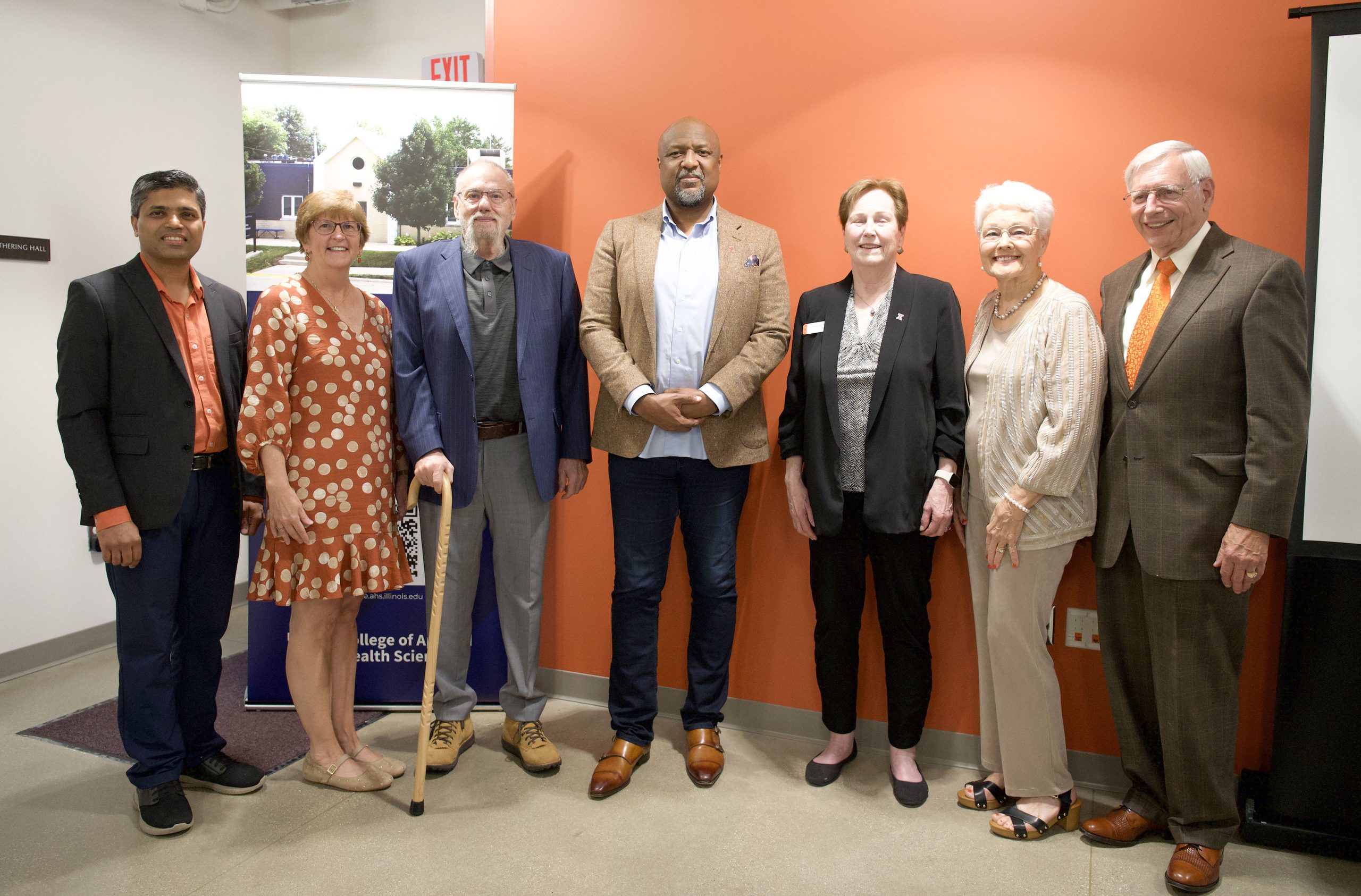
From left, Heather Stout, Brian Siemann, Maureen Gilbert, Jacob Tyree, Matthew Poland, Martrell Stevens, Stephanie Wheeler, U.S. Rep. Nikki Budzinski (D-Illinois) and Adam Bleakney (Photo by Ethan Simmons)
U.S. Rep. Nikki Budzinski (D-Illinois) spent part of her Tuesday on the campus of the University of Illinois Urbana-Champaign, where she toured Disability Resources and Educational Services and met with some of the coaches and athletes behind its nationally recognized adaptive athletics programs.
Budzinski met with a cross-section of DRES leadership, staff and athletes, including Director of Operations and Services Heather Stout; Maureen Gilbert, the coordinator of the office of campus life, wheelchair track coach Adam Bleakney, wheelchair basketball head coaches Stephanie Wheeler and Jacob Tyree and assistant coach Matthew Poland, DRES senior access specialist and Paralympian Brian Siemann and wheelchair basketball player Martrell Stevens.
Together, they highlighted both the day-to-day impact of DRES services and the broader significance of adaptive sports at the collegiate levels.
After seeing the main floor, Budzinski’s visit included a stop into DRES’ training facility, which was certified in September 2014 as a U.S. Paralympic Training Center. The basement facility, long regarded as a pipeline for Paralympic talent, served as a backdrop for conversations about access, equity and the future of disability services in education and athletics.
Bleakney showed Budzinski the adjoining Human Performance and Mobility Maker Lab, where he produces 3D-printed wheelchair racing gloves and collaborates on design projects with campus researchers. Siemann, who works with Illinois students with learning disabilities for DRES, showed Budzinski the two bronze medals he won in the 2024 Paris Paralympics as a wheelchair racer for Team USA.
The coaches, athletes, Gilbert and Stout all emphasized to Budzinski the importance of DRES for University of Illinois students, since more than 5,600 students applied for accommodations through DRES in academic year 2025-26. They also made sure Budzinski knew of the trailblazing work of DRES founder Tim Nugent, known as the “father of accessibility.” Nugent, who died in 2015, founded DRES in 1948 to help those returning from World War II.
Nugent advocated on the Urbana campus for wheelchair-accessible buses, curb cuts and other amenities that those with disabilities now take for granted. Many of his ideas have been adopted nationally. Nugent also helped create the National Wheelchair Basketball Association, as well as wheelchair football, track, archery and square dancing.
At the end of the tour, Budzinski was asked about the importance of sustained federal investment in programs like DRES. She underscored how policy decisions in Washington directly shape opportunities on campuses like Illinois.
Coach Adam Bleakney showed Nikki Budzinski the Human Performance and Mobility Maker Lab (Photo by Ethan Simmons)
“I’ve been supportive at the appropriations level of making sure that we’re supporting all of our sports, that we’re supporting the able-bodied and the disabled community to be able to fully participate in all athletics,” Budzinski said. “And you could do that through the appropriations process. I’ve been a big advocate of that for federal funding. I’m one of the bigger champions of Special Olympics as well. I lead our appropriations letters as it relates to that. So, I think just finding more opportunities through our appropriations process to invest in programs like this is so critically important, and we’ve made it a priority in the House.”
Budzinski’s comments connected federal appropriations work with on-the-ground outcomes—something visible in the athletes she met. DRES leaders also spoke about building programs that not only compete at the highest levels but also create pathways for students with disabilities to thrive academically and socially.
Masters won a third of Team’s USA total medal count
Oksana Masters won five medals in Milano Cortina ( Photo by Mark Reis/USOPC)
Oksana Masters, who trains at Disability Resources and Educational Services at the University of Illinois, finished with five medals at the Milano Cortina 2026 Paralympic Winter Games, including four golds in biathlon and cross-country skiing events.
Masters, 36, also won a bronze medal in the 20km Para cross-country skiing event, bringing her career Paralympics total to 24 medals. She had a third of Team USA’s 15 total medals at Milano Cortina, extending her legacy as the most decorated Winter Paralympian in U.S. history.
“To look back now and it’s my eighth games and I have 24 medals that I’ve brought home for Team USA … It’s just incredible,” Masters told reporters. “It’s something that I just could not have achieved on my own and I have so many people helping me and I’m so thankful for that.”
Other Team USA Paralympic competitors from the University of Illinois were Aaron Pike, who finished fourth in the men’s 12.5km biathlon, and Travis Dodson, who helped bring home Team USA’s fifth-straight gold in sled hockey.
Oksana Masters has won three gold medals in Milano-Cortina (Photo by Mark Reis, USOPC)
Oksana Masters, who trains at the University of Illinois’ Disability Resources and Educational Services, continued her amazing run at the Milano Cortina 2026 Paralympic Winter Games in Italy.
Masters captured gold in the women’s sitting 10km to secure her third gold medal of these Paralympic Winter Games after completing the four laps and crossing the finish line in a time of 26:31.6. The victory brings Masters’ remarkable Paralympic medal count to 22, including 12 gold medals, continuing to add to one of the most decorated careers in Paralympic sport.
“I don’t even know what to think and I can’t believe it’s actually happening,” Masters told reporters. “I woke up very sore, and I knew it was going to be a really tough race right out of the gates. Our team was incredible, they were screaming and giving me updates out on the course and said, ‘How bad do you want this?’ I wanted it badly. This is an amazing team effort.”
Illinois has three DRES-affiliated Paralympians competing in Italy
Oksana Masters won the women’s sprint sitting event on the first day of competition at Tesero Cross-Country Skiing Stadium. (Photo by Buda Mendes/Getty Images)
Oksana Masters, who trains at the University of Illinois’ Disability Resources and Educational Services, took gold in the women’s biathlon sprint at the Milano Cortina 2026 Paralympic Winter Games on Saturday to earn the 20th Paralympic medal of her career and her 10th gold.
“My emotions are just pure shock—I did not expect a podium finish, to be honest, let alone a gold,” Masters told reporters. “It means the world to me. I feel like now I can kind of relax and enjoy the Games, enjoy the moment. I’m always shooting for gold, but that’s not the ultimate reason and I know it doesn’t define me. To be able to just have that gold knowing that everything went to plan, my team, my ski coach, my strength coach, everyone. I think that’s what means the most.”
Masters finished the course in a time of 21:21.3 and she added to her title as the most decorated U.S. winter Paralympian of all time.
In the men’s sitting class, Illinois alumnus Aaron Pike—who is engaged to Masters—finished sixth.
In Sunday’s competition, Masters placed fourth in the in the women’s sitting individual biathlon, while Pike finished fourth in the men’s sitting class.
Faculty, students and staff engaged in a spirited game of wheelchair football during Adaptive Rec Day (Photo by Ethan Simmons)
It wasn’t even 11 a.m. and Gym 2 at the Activities and Recreation Center on the campus of the University of Illinois Urbana-Champaign was already buzzing.
Illinois’ first annual Adaptive Rec Day had just begun, drawing students, faculty and staff. Inside the gym, sport wheelchairs gleamed beneath the lights. Basketballs and footballs echoed across hardwood. At center court, members of Illinois’ wheelchair athletics teams smiled, ready to welcome newcomers with open arms.
Illinois’ Campus Recreation held the inaugural Adaptive Rec Day as a way to celebrate the National Intramural-Recreational Sports Association’s (NIRSA) Recreational Sports and Fitness Day.
Developed by Recreation, Sport and Tourism graduate student Noah Eckelberg, students got the opportunity to learn about adaptive sports and recreation while competing alongside Illinois’ wheelchair athletes. Students enrolled in RST courses Community Planning and Engagement and Inclusive by Design also participated in the day’s scrimmages.
Campus Recreation was awarded $16,168 as part of the Christopher & Dana Reeve Foundation National Paralysis Resource Center (NPRC) 2025 Direct Effect 2nd Cycle. The funding was used to put on the event and purchase adaptive recreation equipment, including harnesses for the climbing wall, hand cycles that will be available at the Campus Bike Center and adaptive sleds for use at the Ice Arena, said Alex Williamson, associate director of marketing-programming at Campus Recreation, as well as body-weight straps and a boccia ball set that can be checked out during open recreation.
Martrell Stevens, a Recreation, Sport and Tourism major and captain of the Illini men’s wheelchair basketball team, spun lightly in his chair, greeting a student who had never seen a sport wheelchair up close.
“This is a really, cool experience and an opportunity to just teach other people about adaptive athletics, and not just wheelchair basketball, but all the different sport there is to know,” Stevens said, gesturing toward courts set up for wheelchair basketball, football and volleyball.
“Growing up playing wheelchair basketball has changed my life so much. It’s allowed me to meet the best friends of my life who are going to be in my life for a very long time. It’s allowed me to travel, see the world. It’s allowed me to go to college. If I can teach other people about the sport, and they can teach other people, we can spread awareness and get as many people as possible playing adaptive athletics so they can have the same similar opportunity as me growing up.”
Paralympic medalist Susannah Scaroni nodded vigorously. Scaroni, whose racing career has taken her from campus tracks to the world stage as the defending champ of the Boston, New York and Chicago Marathons, leaned into the question about what an Adaptive Rec Day could teach people.
“Man, I agree with that,” she said with a grin. “And I’d just say we want to change perceptions to be what is right. We just want people to know what recreation sport is, and sport is, and disabled sport—as oxymoronic as that sounds—people learn hands-on.”
And that was exactly what was happening.
Some faculty and staff climbed into a sport chair for the first time, wobbling before finding balance. Students experimented with the wheels, marveling at the speed. Laughter broke out as people discovered just how much upper-body strength the sports demanded.
Mak Nong, a former captain of the Illini wheelchair basketball team and now program manager for Great Lakes Adaptive Sports Association (GLASA) in Lake Forest, Illinois, talked to a crowd gathered after the sport demonstrations were done. His tone carried both urgency and excitement.
Being physically active, moving, it’s what the College of Applied Health Sciences is all about: wellness across the lifespan.”
Jean Driscoll
Paralympic medalist and associate dean of advancement, College of Applied Health Sciences
“I think just for you guys, just really understanding that you’re at a point in time where adaptive sports is in a frying pan right now,” he said. “It can jump off at any second and you guys can trail blaze that. Please use the people that came before you to help you champion that and continue to grow these different opportunities.
“… there’s so many different things that you guys can grow adaptive sports, whether it’s (Name, Image and Likeness) deals for intercollegiate sports, the different equipment that the athletes will eventually use. The sky’s the limit for you guys. And I’m so excited to see what you guys do with this.”
In the gym, Paralympic multi-medalist Jean Driscoll watched as people navigated their chairs, some for the first time, in competition. A legend in wheelchair racing and a longtime advocate for adaptive athletics, Driscoll smiled at the sight of recreation in its purest form.
“Well, I know this is Rec Day,” she said when asked what the event meant to her. “And we all took sport beyond recreation, and we’re elite-level athletes. But I think to Susannah’s point, recreation is the name of the game. Being physically active, moving, it’s what the College of Applied Health Sciences is all about: wellness across the lifespan.”
She gestured toward the swirl of activity.
Women’s wheelchair basketball coach Stephanie Wheeler, left, and Paralympic medalists Jean Driscoll, center, and Susannah Scaroni took part in Adaptive Rec Day (Photo by Ethan Simmons)
“And so being active some way, you don’t have to be a superhero every day. Just do things for yourself, what makes you happy. For us, training makes us happy. But you can do it for fun too. And if you do it for fun, if you’re having fun, you’ll keep doing it. And that’s really what’s important.”
For Illinois women’s wheelchair basketball coach Stephanie Wheeler, the event was also an opportunity to quash some misconceptions about adaptive sports.
“I would say the biggest misconception that we have is it’s not physical or that it’s not real sport,” Wheeler said. “I think that’s what we try to do here at U. of I. is introduce wheelchair basketball, wheelchair racing, whatever sports it might be as a sport. I think that’s the biggest misconception is that it’s not a sport, that it’s not hard, it doesn’t require skill because we are disabled, that anybody can play, and that anybody can be good. I think what that aligns with is the way we think about disability in society.
“It’s not necessarily a positive representation. Whenever we’re encountered with that, we always say come to a game come to a practice because as soon as you see it, you’ll fully understand that skill is required. It’s physical. It’s fast. It’s fun. Just coming to watch it, I think, kind of washes that away pretty quickly.”
Near the end of the event, Nong—who played professional wheelchair basketball in Europe—addressed the crowd, mostly composed of students.
“What I love the most about today is that it has been led by quite a few of our student athletes. And so shout out to all of our student athletes who have played a huge role in making today happen,” he said. “And that’s really important to us because in our program, one of our biggest founding philosophies is that we pay it forward.”
As the final basketballs and footballs were rolled away and chairs lined neatly along the wall, the energy in the ARC felt less like an ending and more like a starting line.
Illinois’ first annual Adaptive Rec Day had been about t-shirts and snacks. But it had also been about perception, possibility and paying it forward.
And if the laughter, shouting and spinning wheels were any indication, this was only the beginning.
Paralympic multi-medalist Susan Hagel and the 2004 gold-medal-winning women’s wheelchair basketball team were among those selected for induction this summer into the U.S. Olympic & Paralympic Hall of Fame.
AHS alumna Susan Hagel (No. 31) was among those selected for induction into the USOPC Hall of Fame this summer (Photo courtesy of Susan Hagel and DRES)
The USOPC announced on Tuesday its Class of 2025 that brings together eight individual Olympic and Paralympic athletes, two teams, two legends, one coach and one special contributor.
Beside Hagel, an alumna of the College of Applied Health Sciences at Illinois, and the 2004 women’s team, which includes 10 Illinois alumni, the inductees include Steve Cash (sled hockey), Gabby Douglas (artistic gymnastics), Anita DeFrantz (legend: rowing), Allyson Felix (track and field), Flo Hyman (legend: indoor volleyball), Kerri Walsh Jennings (beach volleyball), Mike Krzyzewski (coach: basketball), Phil Knight (special contributor: Nike founder), Bode Miller (alpine skiing), Marla Runyan (Para track and field), Serena Williams (tennis) and the 2010 Four-man Bobsled Team.
“We’re proud to welcome the Class of 2025 into the U.S. Olympic & Paralympic Hall of Fame and to honor the extraordinary accomplishments they’ve made as representatives of Team USA,” said USOPC CEO Sarah Hirshland. “This induction celebrates not only their remarkable performances and lasting impact but also acknowledges the essential contributions of those who supported their journeys every step of the way. Earning a place in the Hall of Fame is no small feat—especially given the incredible talent across this year’s group of finalists.”
The Class of 2025 has represented the United States at a combined 42 Olympic and Paralympic Games, earning 51 medals, including 35 golds. This year also marks the introduction of three new sports or disciplines to the U.S. Olympic & Paralympic Hall of Fame: Para archery, represented by Hagel; women’s wheelchair basketball, through the 2004 U.S. women’s team; and women’s rowing, with Anita DeFrantz becoming the first female rower inducted.
The distinguished class of 2025 includes:
Susan Hagel (Paralympian: wheelchair basketball, Para archery, Para track and field – 1976, 1980, 1984, 1988, 1992, 1996)
Hagel is a trailblazer in adaptive sport, having competed in six Paralympic Games across three different sports where she earned four gold and two bronze medals. Over the course of her decorated career, she earned numerous honors, including the prestigious International Wheelchair Basketball Federation Triad Award in 1998. A 16-time All-Tournament Team selection, Hagel was a cornerstone of 14 U.S. national teams, representing her country at the Paralympic Games, Pan American Games and Gold Cup competitions. As a member of the NWBA Hall of Fame committee, Hagel continues to champion opportunities in sport for individuals with disabilities. A role model to women and junior girls in the National Wheelchair Basketball Association, she holds the distinction of having the longest playing career of any woman in her division. Hagel’s legacy is defined not only by her athletic achievements but also by her unwavering dedication to the growth and inclusivity of adaptive sport.
2004 Women’s Wheelchair Basketball Team (Paralympians: Susan Katz, Christina Ripp, Renee Tyree, Janna (Crawford) Mizens, Carlee Hoffman-Schwarz, Stephanie Wheeler, Teresa Lannon, Jennifer (Howitt) Browning, Jennifer Warkins, Emily Hoskins, Patty Cisneros Prevo, Jana (Stump) Shelfer)
The U.S. women’s wheelchair basketball team won its first gold medal in 22 years at the Athens 2004 Paralympic Games. Ten of the members (Jennifer Warkins, Janna (Crawford) Mizens, Patty Cisneros Prevo, Susan Katz, Teresa Lannon, Jana (Stump) Shelfer, Stephanie Wheeler, Carlee Hoffman-Schwarz, Emily Hoskins, Christina Ripp) are Illinois alumni. Christina (Ripp) Schwab and Stephanie Wheeler went on to coach future national teams, Wheeler in 2016 and 2020, and Schwab in 2024. Both are members of the National Wheelchair Basketball Association Hall of Fame. Six members of the 2004 team (Emily Hoskins, Patty Cisneros Prevo, Carlee Hoffman-Scwarz, Wheeler, Schwab and Jennifer Warkins) returned to win gold again at the Beijing 2008 Paralympic Games, marking the first back-to-back titles for the program. In 2004, the U.S. defeated five-time defending champion Canada in a tough semifinal and avenged a narrow group-stage loss to Australia with a 56–44 victory in the gold-medal game, setting the stage for continued success in future Paralympic Games.
Illinois Paralympians made up a large part of Team USA
Half of the 20 University of Illinois-affiliated Paralympians headed to Tokyo for the 2020 Paralympic Games made an appearance Monday at the Division of Disability Resources & Educational Services for a ceremonial sendoff.
One set of athletes—who were supposed to compete last year before the pandemic changed everyone’s plans—will leave for Japan tomorrow, said Joey Peters, who along with Adam Bleakney coaches the Illini track and field team.
Peters said he, Tatyana McFadden, Daniel Romanchuk, Kelsey LeFevour and Alexa Halko are the ones headed to Tokyo early to get acclimated to the time change and the oppressive heat. “It is supposed to the be (warmest) Olympics and Paralympics ever,” he said.
For McFadden, it will be her sixth Paralympic Games, and in that time, she’s collected 17 medals, including seven gold. This year’s Games will be the second for Romanchuk, who has also won the New York City Marathon as well as Chicago and Boston among his many victories. Romanchuk credited Illini coaches, teammates and family for his success.
“It’s almost impossible to get here without a support system,” he said, adding that the encouragement from friends and fans is “almost indescribable. I would not be here without it.”
The Illini track and field team is represented by Hannah Dederick; Jenna Fesemyer; Halko, Yen Hoang, Eva Houston, Lefevour, Ray Martin, Chelsea McClammer; McFadden, Amanda McCrory, Aaron Pike, Isaiah Rigo, Romanchuk, Susannah Scaroni and Brian Siemann. Men’s basketball includes three Illini: Brian Bell, Ryan Neiswender, and Steve Serio, while the women’s basketball team has Kaitlyn Eaton and Ali Ibanez.