DRES staff, coaches and athletes stress importance of funding, accessibility
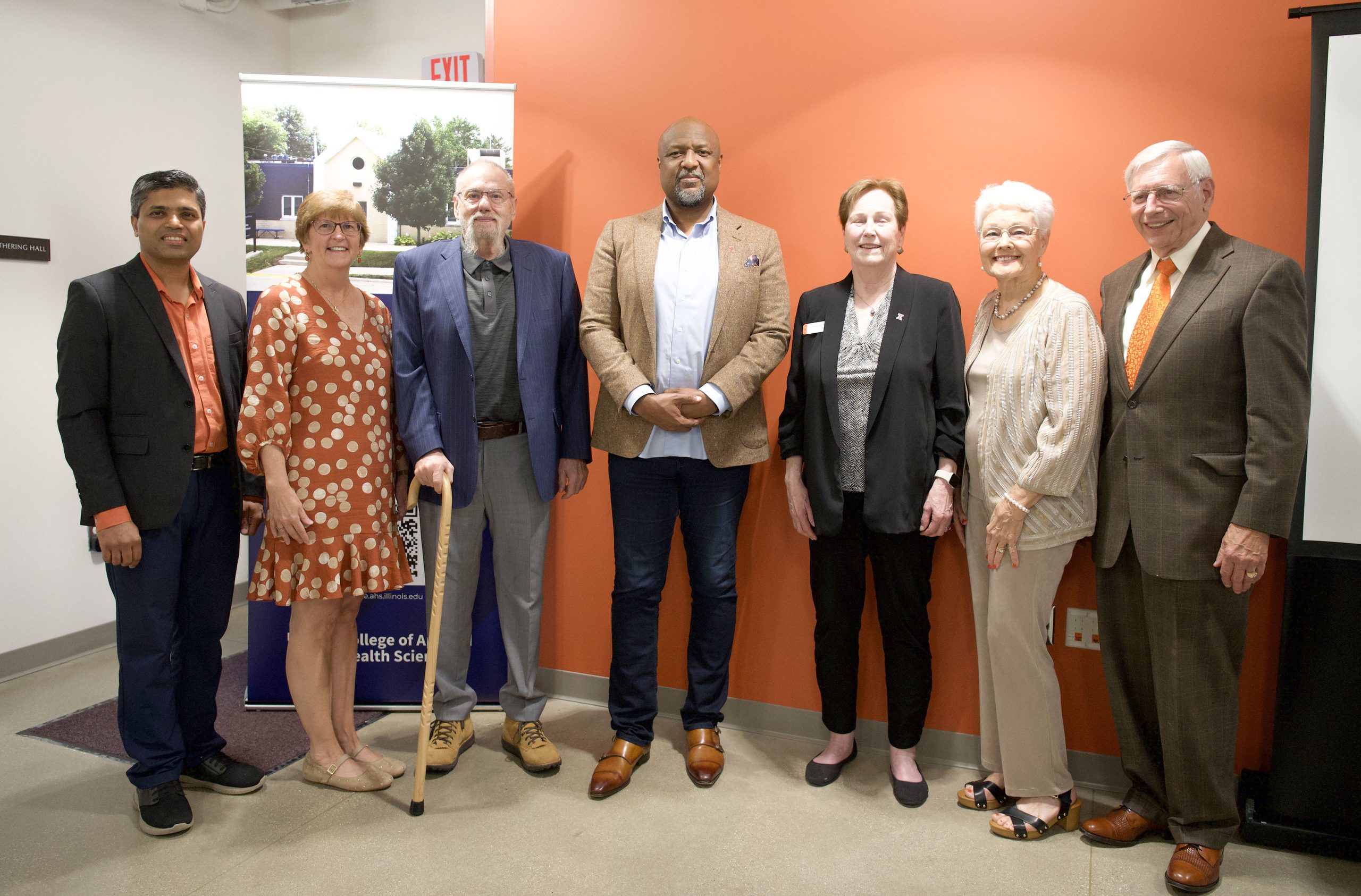
From left, Heather Stout, Brian Siemann, Maureen Gilbert, Jacob Tyree, Matthew Poland, Martrell Stevens, Stephanie Wheeler, U.S. Rep. Nikki Budzinski (D-Illinois) and Adam Bleakney (Photo by Ethan Simmons)
U.S. Rep. Nikki Budzinski (D-Illinois) spent part of her Tuesday on the campus of the University of Illinois Urbana-Champaign, where she toured Disability Resources and Educational Services and met with some of the coaches and athletes behind its nationally recognized adaptive athletics programs.
Budzinski met with a cross-section of DRES leadership, staff and athletes, including Director of Operations and Services Heather Stout; Maureen Gilbert, the coordinator of the office of campus life, wheelchair track coach Adam Bleakney, wheelchair basketball head coaches Stephanie Wheeler and Jacob Tyree and assistant coach Matthew Poland, DRES senior access specialist and Paralympian Brian Siemann and wheelchair basketball player Martrell Stevens.
Together, they highlighted both the day-to-day impact of DRES services and the broader significance of adaptive sports at the collegiate levels.
After seeing the main floor, Budzinski’s visit included a stop into DRES’ training facility, which was certified in September 2014 as a U.S. Paralympic Training Center. The basement facility, long regarded as a pipeline for Paralympic talent, served as a backdrop for conversations about access, equity and the future of disability services in education and athletics.
Bleakney showed Budzinski the adjoining Human Performance and Mobility Maker Lab, where he produces 3D-printed wheelchair racing gloves and collaborates on design projects with campus researchers. Siemann, who works with Illinois students with learning disabilities for DRES, showed Budzinski the two bronze medals he won in the 2024 Paris Paralympics as a wheelchair racer for Team USA.
The coaches, athletes, Gilbert and Stout all emphasized to Budzinski the importance of DRES for University of Illinois students, since more than 5,600 students applied for accommodations through DRES in academic year 2025-26. They also made sure Budzinski knew of the trailblazing work of DRES founder Tim Nugent, known as the “father of accessibility.” Nugent, who died in 2015, founded DRES in 1948 to help those returning from World War II.
Nugent advocated on the Urbana campus for wheelchair-accessible buses, curb cuts and other amenities that those with disabilities now take for granted. Many of his ideas have been adopted nationally. Nugent also helped create the National Wheelchair Basketball Association, as well as wheelchair football, track, archery and square dancing.
At the end of the tour, Budzinski was asked about the importance of sustained federal investment in programs like DRES. She underscored how policy decisions in Washington directly shape opportunities on campuses like Illinois.
Coach Adam Bleakney showed Nikki Budzinski the Human Performance and Mobility Maker Lab (Photo by Ethan Simmons)
“I’ve been supportive at the appropriations level of making sure that we’re supporting all of our sports, that we’re supporting the able-bodied and the disabled community to be able to fully participate in all athletics,” Budzinski said. “And you could do that through the appropriations process. I’ve been a big advocate of that for federal funding. I’m one of the bigger champions of Special Olympics as well. I lead our appropriations letters as it relates to that. So, I think just finding more opportunities through our appropriations process to invest in programs like this is so critically important, and we’ve made it a priority in the House.”
Budzinski’s comments connected federal appropriations work with on-the-ground outcomes—something visible in the athletes she met. DRES leaders also spoke about building programs that not only compete at the highest levels but also create pathways for students with disabilities to thrive academically and socially.
Faculty, students and staff engaged in a spirited game of wheelchair football during Adaptive Rec Day (Photo by Ethan Simmons)
It wasn’t even 11 a.m. and Gym 2 at the Activities and Recreation Center on the campus of the University of Illinois Urbana-Champaign was already buzzing.
Illinois’ first annual Adaptive Rec Day had just begun, drawing students, faculty and staff. Inside the gym, sport wheelchairs gleamed beneath the lights. Basketballs and footballs echoed across hardwood. At center court, members of Illinois’ wheelchair athletics teams smiled, ready to welcome newcomers with open arms.
Illinois’ Campus Recreation held the inaugural Adaptive Rec Day as a way to celebrate the National Intramural-Recreational Sports Association’s (NIRSA) Recreational Sports and Fitness Day.
Developed by Recreation, Sport and Tourism graduate student Noah Eckelberg, students got the opportunity to learn about adaptive sports and recreation while competing alongside Illinois’ wheelchair athletes. Students enrolled in RST courses Community Planning and Engagement and Inclusive by Design also participated in the day’s scrimmages.
Campus Recreation was awarded $16,168 as part of the Christopher & Dana Reeve Foundation National Paralysis Resource Center (NPRC) 2025 Direct Effect 2nd Cycle. The funding was used to put on the event and purchase adaptive recreation equipment, including harnesses for the climbing wall, hand cycles that will be available at the Campus Bike Center and adaptive sleds for use at the Ice Arena, said Alex Williamson, associate director of marketing-programming at Campus Recreation, as well as body-weight straps and a boccia ball set that can be checked out during open recreation.
Martrell Stevens, a Recreation, Sport and Tourism major and captain of the Illini men’s wheelchair basketball team, spun lightly in his chair, greeting a student who had never seen a sport wheelchair up close.
“This is a really, cool experience and an opportunity to just teach other people about adaptive athletics, and not just wheelchair basketball, but all the different sport there is to know,” Stevens said, gesturing toward courts set up for wheelchair basketball, football and volleyball.
“Growing up playing wheelchair basketball has changed my life so much. It’s allowed me to meet the best friends of my life who are going to be in my life for a very long time. It’s allowed me to travel, see the world. It’s allowed me to go to college. If I can teach other people about the sport, and they can teach other people, we can spread awareness and get as many people as possible playing adaptive athletics so they can have the same similar opportunity as me growing up.”
Paralympic medalist Susannah Scaroni nodded vigorously. Scaroni, whose racing career has taken her from campus tracks to the world stage as the defending champ of the Boston, New York and Chicago Marathons, leaned into the question about what an Adaptive Rec Day could teach people.
“Man, I agree with that,” she said with a grin. “And I’d just say we want to change perceptions to be what is right. We just want people to know what recreation sport is, and sport is, and disabled sport—as oxymoronic as that sounds—people learn hands-on.”
And that was exactly what was happening.
Some faculty and staff climbed into a sport chair for the first time, wobbling before finding balance. Students experimented with the wheels, marveling at the speed. Laughter broke out as people discovered just how much upper-body strength the sports demanded.
Mak Nong, a former captain of the Illini wheelchair basketball team and now program manager for Great Lakes Adaptive Sports Association (GLASA) in Lake Forest, Illinois, talked to a crowd gathered after the sport demonstrations were done. His tone carried both urgency and excitement.
Being physically active, moving, it’s what the College of Applied Health Sciences is all about: wellness across the lifespan.”
Jean Driscoll
Paralympic medalist and associate dean of advancement, College of Applied Health Sciences
“I think just for you guys, just really understanding that you’re at a point in time where adaptive sports is in a frying pan right now,” he said. “It can jump off at any second and you guys can trail blaze that. Please use the people that came before you to help you champion that and continue to grow these different opportunities.
“… there’s so many different things that you guys can grow adaptive sports, whether it’s (Name, Image and Likeness) deals for intercollegiate sports, the different equipment that the athletes will eventually use. The sky’s the limit for you guys. And I’m so excited to see what you guys do with this.”
In the gym, Paralympic multi-medalist Jean Driscoll watched as people navigated their chairs, some for the first time, in competition. A legend in wheelchair racing and a longtime advocate for adaptive athletics, Driscoll smiled at the sight of recreation in its purest form.
“Well, I know this is Rec Day,” she said when asked what the event meant to her. “And we all took sport beyond recreation, and we’re elite-level athletes. But I think to Susannah’s point, recreation is the name of the game. Being physically active, moving, it’s what the College of Applied Health Sciences is all about: wellness across the lifespan.”
She gestured toward the swirl of activity.
Women’s wheelchair basketball coach Stephanie Wheeler, left, and Paralympic medalists Jean Driscoll, center, and Susannah Scaroni took part in Adaptive Rec Day (Photo by Ethan Simmons)
“And so being active some way, you don’t have to be a superhero every day. Just do things for yourself, what makes you happy. For us, training makes us happy. But you can do it for fun too. And if you do it for fun, if you’re having fun, you’ll keep doing it. And that’s really what’s important.”
For Illinois women’s wheelchair basketball coach Stephanie Wheeler, the event was also an opportunity to quash some misconceptions about adaptive sports.
“I would say the biggest misconception that we have is it’s not physical or that it’s not real sport,” Wheeler said. “I think that’s what we try to do here at U. of I. is introduce wheelchair basketball, wheelchair racing, whatever sports it might be as a sport. I think that’s the biggest misconception is that it’s not a sport, that it’s not hard, it doesn’t require skill because we are disabled, that anybody can play, and that anybody can be good. I think what that aligns with is the way we think about disability in society.
“It’s not necessarily a positive representation. Whenever we’re encountered with that, we always say come to a game come to a practice because as soon as you see it, you’ll fully understand that skill is required. It’s physical. It’s fast. It’s fun. Just coming to watch it, I think, kind of washes that away pretty quickly.”
Near the end of the event, Nong—who played professional wheelchair basketball in Europe—addressed the crowd, mostly composed of students.
“What I love the most about today is that it has been led by quite a few of our student athletes. And so shout out to all of our student athletes who have played a huge role in making today happen,” he said. “And that’s really important to us because in our program, one of our biggest founding philosophies is that we pay it forward.”
As the final basketballs and footballs were rolled away and chairs lined neatly along the wall, the energy in the ARC felt less like an ending and more like a starting line.
Illinois’ first annual Adaptive Rec Day had been about t-shirts and snacks. But it had also been about perception, possibility and paying it forward.
And if the laughter, shouting and spinning wheels were any indication, this was only the beginning.
Former Illini wheelchair athletes have helped fund scholarship for the next generation of adaptive sports stars
The ‘Band of Brothers’ have come together to support the next generation of Illini wheelchair sport athletes through the establishment of an annual scholarship.
In the heat of an Illinois men’s wheelchair basketball season, intense morning practices roll into sociable team meals and lively late-night gaming sessions. The hours spent between busy student-athlete schedules—on buses and in residence halls—are where teammates became brothers.
For all that the Illinois men’s wheelchair basketball teams of the early 2010s accomplished on the court—a National Wheelchair Basketball Association intercollegiate championship and three second-place finishes under former coaches Mike Frogley and Matt Buchi—they’ve surpassed that off of it, starting careers and raising families.
Now, the alums of this so-called “Band of Brothers” have come together once more to support the next generation of Illini wheelchair sport athletes through the establishment of an annual scholarship.
Their contributions, through The Fighting Illini Wheelchair Basketball Alumni Legacy Scholarship Fund, have been granted to two wheelchair basketball athletes in the past two terms.
“This scholarship is born from people that truly love each other and care about the future of the program at the University of Illinois,” said Mak Nong, former Illinois wheelchair basketball player and founder of the fund. “For us to be able to give back and make things easier for the future generation, that’s our moral obligation: to make this place even better than it was for us.”
Tight bonds
Maureen Gilbert wears many hats as coordinator for the Office of Campus Life at Disability Resources and Educational Services, better known as DRES. To more than 29 classes of Illinois wheelchair student-athletes, she’s “Mo,” director of athletic programs, point-person for travel and eligibility questions and trusted confidante. Some lovingly call her “Mom.”
On bus rides to and from track and field and basketball events, one can usually tell if the team is gelling off the floor, Gilbert said. Team chemistry always takes work to develop, but some teams bond faster than others.
“Once in a while, you get those athletes who seem to click, and they make it happen themselves,” Gilbert said. “Like with Mak’s group.”
Martinez Johnson joined the team in 2013 as a transfer student from Atlanta. It didn’t take long for the memories to start stacking up with his teammates.
“[We’d] just hang out and make sure we were doing our best to balance our social life, school and basketball,” Johnson said. “And we leaned on each other to make sure everyone was doing OK mentally as well.”
Just before the school year, Johnson recalls the team traveling to the 4H campground of Allerton Park for several memorable exercises. In what was a yearly tradition under former Coach Matt Buchi, the players wrote down their individual fears for the season before throwing them into a burning campfire.
“When I came in 10 years ago as a coach, that was one of the first things that I tried to do: have a bonding experience to learn about each other outside of basketball,” said Buchi, who left DRES in November for a job in the Office of the Vice Chancellor for Institutional Advancement. “And that’s what really bonds a lot of these guys for a lifetime, a comfortable place to be vulnerable as young men with our team.
“That bonding took a while to get there, but it just needed activities and locations to blossom.”
Jacob Tyree’s favorite memories with the team tend to revolve around food: morning rushes to Original House of Pancakes or Merry Ann’s Diner after long, physical practices, or cherished visits to Cravings, an Asian cuisine restaurant.
“It could be a really crappy practice, like maybe things just were not clicking on the court—coach is yelling at you for things, your teammates are yelling at you for things—and then you go out afterwards and it’s now a positive bonding experience,” Tyree said.
As the teammates graduated and dispersed across the country and the world, those relationships stayed strong.
A random, gloomy day in the early weeks of the coronavirus pandemic led Nong to check in with many of his old teammates. He’d been pondering ways to give back to the things “he truly cared about,” and Illinois neared the top of Nong’s list.
His calls gave way to proposals: “Would you want to contribute to a scholarship?”
After checking with DRES and the College of Applied Health Sciences advancement team, the groundwork was laid.
“Mak took the lead on all of that,” Gilbert said. “In fact, it was a great gift when they told me what they were doing. It gives a good example to our current students of paying forward and how to support those who come after you.”
The generosity didn’t stop with the scholarship, either. In the spring, program alumni used crowdfunding to finance customized, tailored suit jackets for the graduating seniors on the men’s and women’s wheelchair basketball teams.
“It was a surreal full-circle moment to see my alumni, the guys that I coached, are now taking care of the players that I’m coaching now,” Buchi said before he moved on from DRES.
Life after basketball
After graduating in 2017, Nong played professional wheelchair basketball in Europe for a spell, winning a league championship for LUC Handibasket in Lille, France. What stuck with him was the governance over the sport that was present overseas.
“To them, it was just sport. People without disabilities were playing wheelchair basketball and getting paid to do it,” Nong said. “So, I was thinking, ‘How do I spread this joy to people?’ Recreation is a big opportunity for that.”
How do I spread this joy to people?
Mak Nong
Former Illini wheelchair basketball player
Years after graduating, many members of the wheelchair basketball teams have stayed in the orbit of adaptive sports, committing time and effort to growing the scene in myriad ways.
Nong is a program manager for Great Lakes Adaptive Sports Association (GLASA) in Lake Forest, Ill., overseeing a wide range of sports programs—from football, tennis, track and field, swimming and soccer—suited to disabled athletes of all ages.
His journey truly began as a young boy pushing along his wheelchair in Los Cerritos Mall near Long Beach, Calif. Longtime coach Lisa Hilborn noticed Nong and asked if he’d be interested in trying wheelchair sports.
“I didn’t want to do it at all—I was freaking out—but then I went to a practice and I fell in love with it and kept going back,” Nong said. “I’m trying to spread the love she gave to me to other people.”
By the time he was a senior in high school, Nong was heavily recruited for wheelchair basketball. Coach Frogley’s pitch from the University of Illinois stood out from the pack.
“He stressed the importance of education; he catered to me as not only a person but an athlete as well. Just having that balance and showing that we can use sport as a tool to get to where our success is,” Nong said.
Tyree, too, has found a career in the field as training coordinator for Move United, a nonprofit committed to facilitating adaptive sports opportunities. He returned to his hometown of Roanoke, Va., to found the Roanoke Stars Wheelchair Basketball program.
Like other program alums, he repeatedly credits his coaches’ attention to detail for his professional success.
“We all saw ourselves as having our roles, and thought about how do we support each other to fill in the gaps where this is my weakness, but that’s your strength? When I’m struggling, I can lean on you a little bit more,” Tyree said. “I think that that mindset really fell into creating that excellence and trickled into what we do full time.”
Alums who haven’t found careers in adaptive athletics have stayed around the game in some way, like Derek Hoot and Johnson, who started recording podcasts about it.
In the Push Podcast, the pair of alums discuss the happenings of U.S. wheelchair basketball and bring on established guests.
“Wheelchair basketball has made a big impact on all our lives. Being able to find a sports community as individuals with disabilities is huge,” Johnson said. “I think that’s a big reason we have all stuck around adaptive athletics, is we know the change it made in our lives could be duplicated for the next generation.”
Buchi—who is being replaced as men’s coach by women’s wheelchair basketball coach Stephanie Wheeler—said he was beginning to see talented recruits who’ve been coached by his own wheelchair basketball alums.
“The next step is happening, I have so many of my guys that are actually coaching and are giving back to juniors programs,” Buchi said. “They get to put a little bit of our Illinois stamp on these kids before I even get them.
“Our alumni need to think as soon as they graduate, how do I give back to the guys that are coming up next? Because there’s always going to be that next person that comes up and you want them to have the best experience possible.”
Illini wheelchair basketball teams take on competition at Activities and Recreation Center
Women’s wheelchair basketball player Hailey Smith and men’s player Martrell Stevens pose together in front of this weekend’s game schedule.
For the first and only time this season, the Illinois men’s and women’s wheelchair basketball teams are facing the competition in their home court at this weekend’s Illinois College Tournament.
A total of 22 games will be played at the Activities and Recreation Center (201 E. Peabody Dr., Champaign) from Friday, Feb. 9 to Saturday, Feb. 10, including eight individual contests for the Illini women’s and men’s teams.
For Friday’s 5 p.m. women’s game against The University of Texas at Arlington and the men’s 7 p.m. contest against University of Wisconsin-Whitewater, the teams want fans to fill the stands.
“We want to get as many people in the gym as possible—we’ll have the band and the cheerleaders, we’re trying to make it a loud and fun environment for our student athletes to play in,” said Stephanie Wheeler, head coach of both Illinois wheelchair basketball teams.
Wheeler, head coach of the women’s team since 2010, took over coaching duties for the men’s team after former head coach Matt Buchi moved to a new role at Illinois.
On Saturday, seniors will be recognized between the 3 p.m. men’s game against Mizzou and the 4:45 p.m. women’s game versus the University of Arizona.
“We have veteran guys and ladies who have been in the game, and some who are brand new to college basketball,” said Matt Poland, the assistant coach for both teams. “It’s been fun having that blend, and not only helping the fifth- and sixth-year players finish out stellar careers, but help the next generation come into their own.”
This season, the men’s and women’s teams are playing together more than ever, with coach Wheeler leading joint practices alongside full-time assistant coach Matt Poland and volunteer assistant coach Ranley Clayton, herself an alumna of the program.
The two teams crossed over in practices before this season, often meeting for skill work, but now nearly everything is done together, with the 22 student-athletes mixing or facing off in most scrimmages and drills.
It’s a unique spin for two uniquely structured teams, with sixth-year seniors Gabe DenBraber, Ryan Glatchak, Marlee Wagstaff and Ali Ibanez and seniors Shawn Sloan and Mary Wagstaff shouldering much of their teams’ game experience. This week’s focus: staying disciplined on defense, playing free on offense, Wheeler said.
“Both teams are getting a lot out of training with each other,” she said. “It’s challenging both teams on physical and mental level—it’s been a really positive change and connects the two together.”
Illini wheelchair basketball teams will face their final tests next month at the National Intercollegiate Wheelchair Basketball Tournament College Nationals. The women’s team will head to the University of Alabama (March 6-9); the men’s team will travel to Marshall, Minnesota the following week (March 13-16).
“The message has been each game is a building block on how we want the rest of the season to be going up to the next tournament,” Poland said. “Every single team goes to the last tournament, we have an opportunity to every single game build off of it, and in Nationals is where we need to be our best self.”
Before then, the women’s team will travel to Brookfield, Wisconsin, to play in the Big Cheese Classic (Feb. 16-17); the men’s team will play in the Arizona College Tournament, hosted in Tucson (March 1-2).
Morgan McCammon of the University of Illinois has been selected to participate in the inaugural Team USA vs. College All-Star competition taking place at the NCAA Women’s Final Four, as announced Monday by the United States Olympic & Paralympic Committee and National Wheelchair Basketball Association.
McCammon will compete for the College All-Star team, and the competition is an effort of the USOPC and NCAA Para-College Inclusion Project, which was established to grow awareness around adaptive sport programming at the collegiate level.
“I’m very excited for Morgan to have this opportunity to represent Illinois at the Women’s Final Four,” said Stephanie Wheeler, coach of the women’s wheelchair basketball team at Illinois. “Morgan is so deserving of this honor and her selection is a testament to who she is as a person, student and athlete. She will be an incredible representative of Illinois and the sport of wheelchair basketball!”
The college all-star roster is comprised of one athlete from each of the six women’s wheelchair basketball teams across our country. The College All-Stars are comprised of:
Abby Bauleke (University of Alabama), one-time Paralympian and Paralympic bronze medalist
Crystal Jones (City University of New York)
Grace Wembolua (University of Texas at Arlington), one-time Paralympian
Emilee Gustafson (University of Arizona)
Mada McCabe (University of Wisconsin-Whitewater)
Morgan McCammon (University of Illinois)
Team USA’s roster is comprised of athletes who represented the United States at the Tokyo Paralympic Games. The U.S. roster is comprised of:
Darlene Hunter (Commerce, Mich.), three-time Paralympian and two-time Paralympic medalist
Zoe Voris (Chicago), one-time Paralympian and Paralympic bronze medalist
Courtney Ryan (San Diego), one-time Paralympian and Paralympic bronze medalist
Natalie Schneider (Ord, Neb.), four-time Paralympian and three-time Paralympic medalist
Lindsey Zurbrugg (Portland), one-time Paralympian and Paralympic bronze medalist
Before the Team USA vs. College All-Star competition tips off, athletes from both teams will volunteer their time to host a wheelchair basketball skills clinic for local athletes with disabilitites. The clinic—hosted by the National Wheelchair Basketball Association—is expected to draw dozens of youth from the Dallas metropolitan area.
“I am thrilled to be representing the University of Illinois and the NWBA at the Final Four event as we share our sport with the world!,” McCammon said. “Wheelchair basketball has given me the opportunity to conquer dreams I thought I had lost, and I am beyond excited to share my experiences and knowledge with those who are just learning about the sport and the next generation of NWBA athletes.”
Team USA and the College All-Stars will take the court during halftimes of the NCAA Divisions II and III Women’s Final Four, located at the Kay Bailey Hutchinson Convention Center in Dallas, Texas, on April 1.
For more information about the wheelchair basketball at the University of Illinois, please visit https://dres.illinois.edu/.