DRES staff, coaches and athletes stress importance of funding, accessibility
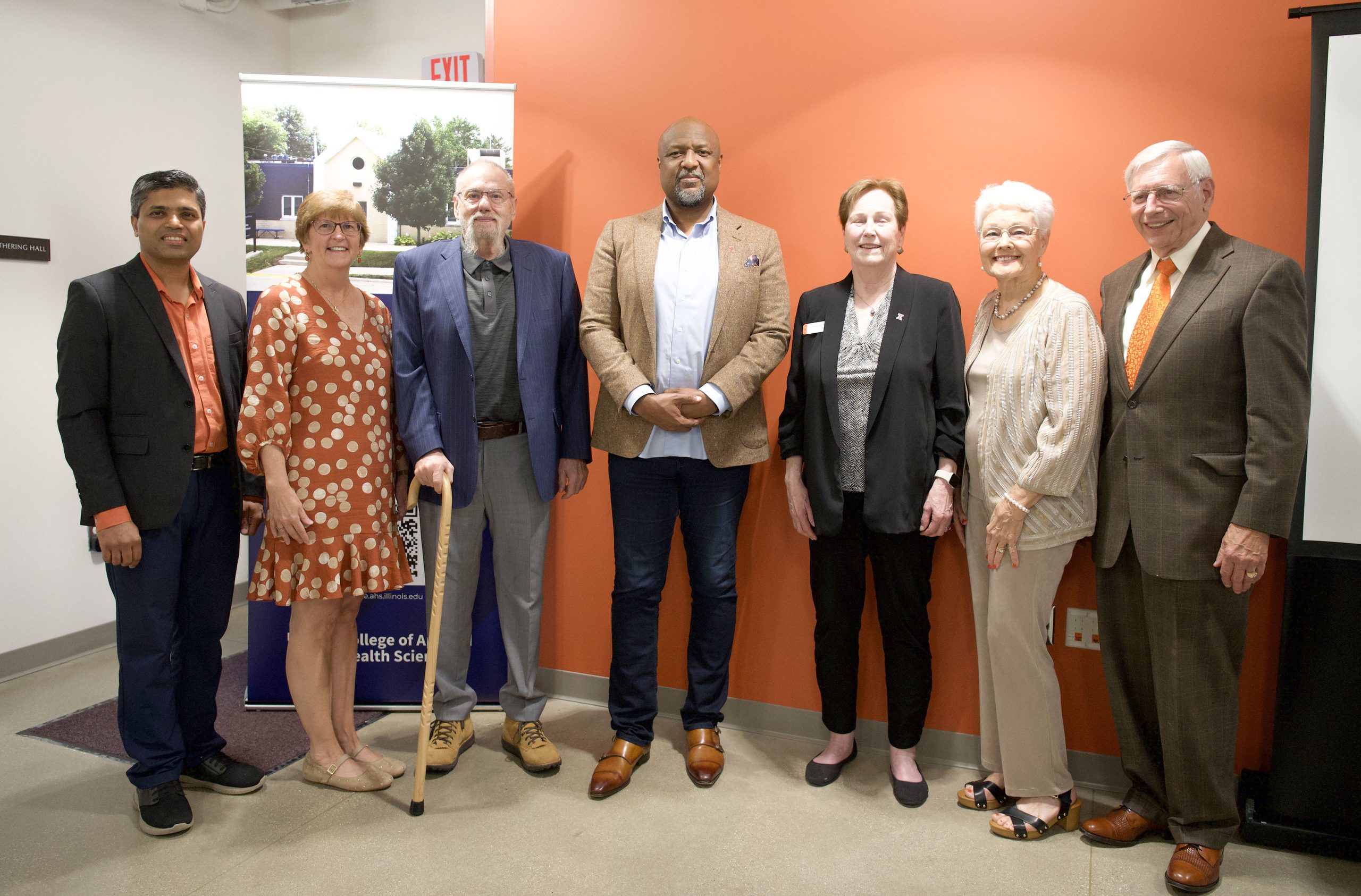
From left, Heather Stout, Brian Siemann, Maureen Gilbert, Jacob Tyree, Matthew Poland, Martrell Stevens, Stephanie Wheeler, U.S. Rep. Nikki Budzinski (D-Illinois) and Adam Bleakney (Photo by Ethan Simmons)
U.S. Rep. Nikki Budzinski (D-Illinois) spent part of her Tuesday on the campus of the University of Illinois Urbana-Champaign, where she toured Disability Resources and Educational Services and met with some of the coaches and athletes behind its nationally recognized adaptive athletics programs.
Budzinski met with a cross-section of DRES leadership, staff and athletes, including Director of Operations and Services Heather Stout; Maureen Gilbert, the coordinator of the office of campus life, wheelchair track coach Adam Bleakney, wheelchair basketball head coaches Stephanie Wheeler and Jacob Tyree and assistant coach Matthew Poland, DRES senior access specialist and Paralympian Brian Siemann and wheelchair basketball player Martrell Stevens.
Together, they highlighted both the day-to-day impact of DRES services and the broader significance of adaptive sports at the collegiate levels.
After seeing the main floor, Budzinski’s visit included a stop into DRES’ training facility, which was certified in September 2014 as a U.S. Paralympic Training Center. The basement facility, long regarded as a pipeline for Paralympic talent, served as a backdrop for conversations about access, equity and the future of disability services in education and athletics.
Bleakney showed Budzinski the adjoining Human Performance and Mobility Maker Lab, where he produces 3D-printed wheelchair racing gloves and collaborates on design projects with campus researchers. Siemann, who works with Illinois students with learning disabilities for DRES, showed Budzinski the two bronze medals he won in the 2024 Paris Paralympics as a wheelchair racer for Team USA.
The coaches, athletes, Gilbert and Stout all emphasized to Budzinski the importance of DRES for University of Illinois students, since more than 5,600 students applied for accommodations through DRES in academic year 2025-26. They also made sure Budzinski knew of the trailblazing work of DRES founder Tim Nugent, known as the “father of accessibility.” Nugent, who died in 2015, founded DRES in 1948 to help those returning from World War II.
Nugent advocated on the Urbana campus for wheelchair-accessible buses, curb cuts and other amenities that those with disabilities now take for granted. Many of his ideas have been adopted nationally. Nugent also helped create the National Wheelchair Basketball Association, as well as wheelchair football, track, archery and square dancing.
At the end of the tour, Budzinski was asked about the importance of sustained federal investment in programs like DRES. She underscored how policy decisions in Washington directly shape opportunities on campuses like Illinois.
Coach Adam Bleakney showed Nikki Budzinski the Human Performance and Mobility Maker Lab (Photo by Ethan Simmons)
“I’ve been supportive at the appropriations level of making sure that we’re supporting all of our sports, that we’re supporting the able-bodied and the disabled community to be able to fully participate in all athletics,” Budzinski said. “And you could do that through the appropriations process. I’ve been a big advocate of that for federal funding. I’m one of the bigger champions of Special Olympics as well. I lead our appropriations letters as it relates to that. So, I think just finding more opportunities through our appropriations process to invest in programs like this is so critically important, and we’ve made it a priority in the House.”
Budzinski’s comments connected federal appropriations work with on-the-ground outcomes—something visible in the athletes she met. DRES leaders also spoke about building programs that not only compete at the highest levels but also create pathways for students with disabilities to thrive academically and socially.
Adam Bleakney and colleagues are pioneering a transformative wheelchair technology designed to increase independence, reduce injury risk, and reframe how society perceives mobility disability.
Illinois’ wheelchair track coach Adam Bleakney leads a cross‑campus team of engineers and designers from AHS and Grainger in testing PURE, the innovative hands‑free robotic wheelchair prototype aimed at “disrupting the wheelchair market” (Photos by Michael Hansen)
As coach of the Illinois wheelchair track team, Adam Bleakney knows about the chronic overuse of shoulders and elbows by his athletes. But as a daily wheelchair user himself, he also knows about the challenges of navigating life.
So Bleakney and his colleagues from Disability Resources and Educational Services, as well as cross-campus collaborators from the Grainger College of Engineering, and the College of Fine + Applied Arts, embarked on a plan to disrupt the wheelchair market.
“We wanted to design something that would break the mode of traditional wheelchairs, which has been essentially a chair supported between two large drive wheels with two casters, and has not changed since the first patents awarded in the 1860s,” said Dr. Elizabeth Hsiao-Wecksler, a professor in the Department of Mechanical Science and Engineering in the Grainger College of Engineering and the principal investigator on a project that recently received a $1.5 million grant from the National Science Foundation under the National Robotics Initiative program to develop a wheelchair that will provide individuals with a physical disability a new and novel mode of mobility.
The project, called PURE (Personalized, Unique Rolling Experience) offers users hands-free movement using an interactive and adaptive robot that is uniquely personalized for each user.
Hsiao-Wecksler said the project was started in 2018 in response to the call for “radical improvements in the mobility and independence of people with lower-limb paralysis through smarter assistive technology” by the Toyota Mobility Unlimited Challenge.
Bleakney had worked with Toyota on a previous project, so he was intrigued by the opportunity, and he spoke with then-DRES director Dr. Pat Malik, whose husband, Ron, is a daily wheelchair user.
“The intent was to achieve an interdisciplinary effort, to combine the tradition and knowledge we have at DRES and AHS as leaders in disability access with the incredible resources that exist across campus,” he said.
“And Pat, Jeannette Elliott, Arielle Rausin, and I each bring a unique and personal disability experience perspective to the project. Pat, who’s married to a daily wheelchair user; Jeanette, who in addition to being the physical therapist at DRES uses a prosthesis and manual wheelchair; and Arielle and me as daily wheelchair users.”
Hsiao-Wecksler was asked to join the team since she had been working on hardware design of devices to assist people with disabilities and also wheelchair technology.
“I have worked on both wheelchair propulsion biomechanics with (KCH faculty) Jake Sosnoff and Ian Rice, and wheelchair wheel development with IntelliWheels, Inc., which was a local start-up that I, Jake Sosnoff, and our graduate students created.”
Three mechanical engineering graduate students—Chenzhang Xiao, Yinan Pei, and Yu Chen—worked on PURE prototypes, and Dr. William (Bob) Norris of Grainger, of Grainger (ISE faculty) who has expertise in control of autonomous vehicles and robots, was brought on as a co-PI. Dr. João Ramos, also of Grainger (MechSE faculty) and with experience with design and control of robotic devices, was added for the NSF proposal.
Illinois’ project reached the top 10 out of 80 applications for the Toyota Challenge. Bleakney and project co-PI Dr. Deana McDonagh of FAA represented the team in London for the competition, but only the top five submissions were funded.
Illinois’ team was unbowed and continued to move ahead, knowing it had a good idea.
“Without question everyone on the team recognized the value of the project and the need to look for funding opportunities to continue working on it,” Bleakney said.
“The traditional manual wheelchair needs to be reimagined,” McDonagh added.
Although Bleakney works with some of the best wheelchair athletes in the country, including multi-marathon winner Daniel Romanchuk, he knows there is a broader application for PURE.
“It’s (for) all daily wheelchair users and other individuals with a lower limb mobility impairment. So we do envision that it would be a mobility device that can be used by both daily wheelchair users and others that don’t necessarily always use a wheelchair but would perhaps use some other some other form of accessible mobility in certain situations.”
The device’s name—PURE—came about as a result of a team meeting, Hsiao-Wecksler said.
“We wanted to express the organic and pure nature of using lean-to-steer technology to propel the device, rather than requiring constant occupation of the hands such as with a manual wheelchair,” she said. “This mobility device will utilize personalized driving calibration to accommodate different trunk function abilities and custom seating of each user. The design is a uniquely different mode of rolling instead of the traditional wheelchair with two drive wheels and castors. And it will be a wonderful mobility experience for the user.”
The traditional manual wheelchair needs to be reimagined.
Deana McDonagh
Professor of Industrial Design in the School of Art + Design
The PURE design plan describes it as “discreet,” which McDonagh said refers to “seeing the person before the chair—which translates to seeing the person before the disability.”
Hsiao-Wecksler added that PURE’s footprint is “smaller than a manual wheelchair’s, being no larger than the user’s body dimensions while seated, providing access to smaller spaces such as inaccessible public restroom stalls.”
Bleakney also stressed PURE’s ability to address long-term health and wellness and safety.
“We look at how can we decrease acute injuries that may occur from falling,” he said.“And we wanted to mitigate that risk, but also mitigate the risk posed to the shoulders from pushing a wheelchair around on a daily basis.”
And McDonagh said, “health is not just the absence of disease. Health is connected with one’s sense of independence, mobility and ability to live the life you need to live. This device will enable the user to traverse a more diverse terrain while holding a coffee in one hand! Or holding the hand of a loved one. We are blending the functional with the emotional needs of real people.”
A prototype of PURE was developed for the Toyota Challenge in 2018, but since it had rather inexpensive components, it could only support a payload of 25 pounds. A second-generation prototype is in the works, one that can support a rider up to 250 pounds and operate on level flooring.
Thanks to the NSF grant, plans are in the works for more development of the second-gen device and then a third-generation chair with more advanced control. Eventually, the researchers see commercial opportunities, and recently submitted an application to the U.S. Patent and Trademark Office.
“We think the value is transformative enough that it can be used by not just daily wheelchair users, but also by a broader audience,” Bleakney said. “Envision being at Disney World. And instead of hundreds of three-wheeled scooters being driven around by folks needing mobility assistance, PURE is being used and providing a much more inclusive and fulfilling experience. So I think it has a fairly broad application to a lot of different individuals who would benefit from it.”