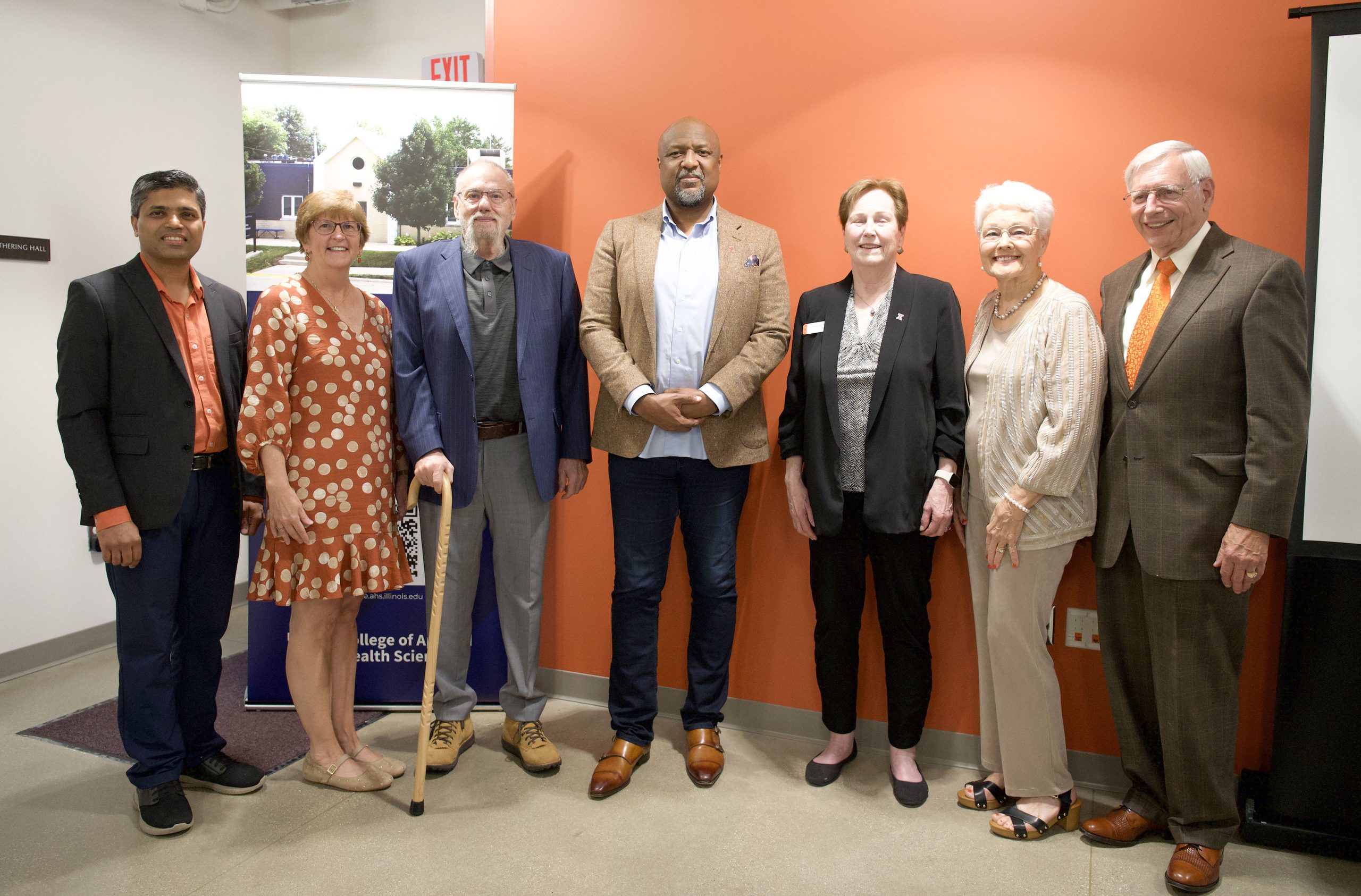
Budzinski visits DRES, comes away with appreciation for adaptive sports


From left, Heather Stout, Brian Siemann, Maureen Gilbert, Jacob Tyree, Matthew Poland, Martrell Stevens, Stephanie Wheeler, U.S. Rep. Nikki Budzinski (D-Illinois) and Adam Bleakney (Photo by Ethan Simmons)

U.S. Rep. Nikki Budzinski (D-Illinois) spent part of her Tuesday on the campus of the University of Illinois Urbana-Champaign, where she toured Disability Resources and Educational Services and met with some of the coaches and athletes behind its nationally recognized adaptive athletics programs.

Budzinski met with a cross-section of DRES leadership, staff and athletes, including Director of Operations and Services Heather Stout; Maureen Gilbert, the coordinator of the office of campus life, wheelchair track coach Adam Bleakney, wheelchair basketball head coaches Stephanie Wheeler and Jacob Tyree and assistant coach Matthew Poland, DRES senior access specialist and Paralympian Brian Siemann and wheelchair basketball player Martrell Stevens.

Together, they highlighted both the day-to-day impact of DRES services and the broader significance of adaptive sports at the collegiate levels.

After seeing the main floor, Budzinski’s visit included a stop into DRES’ training facility, which was certified in September 2014 as a U.S. Paralympic Training Center. The basement facility, long regarded as a pipeline for Paralympic talent, served as a backdrop for conversations about access, equity and the future of disability services in education and athletics.

Bleakney showed Budzinski the adjoining Human Performance and Mobility Maker Lab, where he produces 3D-printed wheelchair racing gloves and collaborates on design projects with campus researchers. Siemann, who works with Illinois students with learning disabilities for DRES, showed Budzinski the two bronze medals he won in the 2024 Paris Paralympics as a wheelchair racer for Team USA.

The coaches, athletes, Gilbert and Stout all emphasized to Budzinski the importance of DRES for University of Illinois students, since more than 5,600 students applied for accommodations through DRES in academic year 2025-26. They also made sure Budzinski knew of the trailblazing work of DRES founder Tim Nugent, known as the “father of accessibility.” Nugent, who died in 2015, founded DRES in 1948 to help those returning from World War II.

Nugent advocated on the Urbana campus for wheelchair-accessible buses, curb cuts and other amenities that those with disabilities now take for granted. Many of his ideas have been adopted nationally. Nugent also helped create the National Wheelchair Basketball Association, as well as wheelchair football, track, archery and square dancing.

At the end of the tour, Budzinski was asked about the importance of sustained federal investment in programs like DRES. She underscored how policy decisions in Washington directly shape opportunities on campuses like Illinois.

Coach Adam Bleakney showed Nikki Budzinski the Human Performance and Mobility Maker Lab (Photo by Ethan Simmons)

“I’ve been supportive at the appropriations level of making sure that we’re supporting all of our sports, that we’re supporting the able-bodied and the disabled community to be able to fully participate in all athletics,” Budzinski said. “And you could do that through the appropriations process. I’ve been a big advocate of that for federal funding. I’m one of the bigger champions of Special Olympics as well. I lead our appropriations letters as it relates to that. So, I think just finding more opportunities through our appropriations process to invest in programs like this is so critically important, and we’ve made it a priority in the House.”

Budzinski’s comments connected federal appropriations work with on-the-ground outcomes—something visible in the athletes she met. DRES leaders also spoke about building programs that not only compete at the highest levels but also create pathways for students with disabilities to thrive academically and socially.

Editor’s note:

To reach Vince Lara-Cinisomo, email vinlara@illinois.edu.
 

Share on social

Related news

Stout Leadership


Heather Stout returned to the University of Illinois from the School of Law at St. Louis University and has roots in Central Illinois (Photo by Ethan Simmons)

When Disability Resources and Educational Services, better known as DRES, began advertising for a permanent director of operations in 2023, it was apparent to current employees who would be a great fit.

“Before there was ever the possibility of Heather [Stout] becoming DRES director of operations, my mentor and the first DRES director I worked for, Dr. Brad Hedrick, mentioned her as one of his respected colleagues working at a peer institution,” said Susann Sears, director of Beckwith Residential Support Services, which is affiliated with DRES and provides care for disabled students.

Stout was hired in June and officially joined DRES in August, succeeding interim Director Kim Collins, who retired at the end of June. Stout returned to DRES with established relationships in hand.

“I worked closely with Susann Sears, because she and I were in similar roles at [the University of Illinois Chicago] and Illinois, respectively,” Stout said. “Paige Lindahl-Lewis [assistant director at Beckwith] and I graduated from AHS together. Paige and I both graduated from rehab programs when I graduated from Illinois.” 

Stout returned to the University of Illinois from the School of Law at St. Louis University and has roots in Central Illinois. She got her bachelor’s degree from Penn State and a master’s in rehab counseling at Illinois, interning at DRES along the way. Stout emphasized the values of continuity.

“It’s important that Illinois has some long-term staff that have historical knowledge and cultural context for DRES and our program,” she said. “In higher ed, there have been a lot of changes across universities, particularly in disability. It’s good that there has been consistency at DRES, along with some of the changes in staffing.”

Maureen Gilbert, DRES’ coordinator for the unit’s Office of Campus Life, agreed that Stout’s understanding of the university was a huge plus.

“Her familiarity with campus and DRES is helpful because she understands the impact and presence DRES has,” Gilbert said. “With Heather’s experience and knowledge base, she can advocate for a strong presence at the table, especially when the discussion involves disability and accommodations across all aspects of the campus community.”

That’s especially important because of the tremendous growth in DRES student enrollment.

Gilbert said that “in four years, our numbers have increased 33 percent. Our access specialists have caseload numbers of 600 to 700 students; we have waitlists for mental health services counseling and neuropsych testing; and our service requests for deaf and hard-of-hearing students and staff are increasing. To continue supporting students and their growing needs, increased financial resources are essential to support current and prospective staff.”

Her familiarity with campus and DRES is helpful because she understands the impact and presence DRES has.

Maureen Gilbert

DRES coordinator, Office of Campus Life

Fulfilling the DRES mission and serving increasing enrollment will require expanded facilities. To that end, Stout said a new facility is necessary. She has seen proposed building designs and said, “It is my hope that in the next five years, we can talk more about that and what we can do to make DRES and each of the departments centrally located. That’s a very thoughtful conversation we’ll need.” 

Stout referenced the Center for Movement and Performance, a proposed state-of-the-art, stand-alone indoor multi-use facility for the wheelchair track and wheelchair basketball programs with enhanced strength and conditioning, equipment, sports medicine, training and meeting areas.

Adam Bleakney, renowned coach of the men’s and women’s wheelchair track and road racing teams, said, “We have a vision for a facility that is built upon the legacy pillars of our program—service, outreach, research, education and innovation—and that will allow us both room for growth and increased interdisciplinary collaboration across campus and the community.”

Although facility upgrades are high on her list of things to do, Stout acknowledged the priority is “serving the entire student.”

“We have a career services area,” she said. “We have mental health resources. One of the things I hope to expand upon is our connections with each academic department. Are we working with and partnering with them so that students are getting the accommodations that they need and each unit can work with us effectively? And are we doing what is best for graduate and professional students, as well as the faculty and administration in those programs?”

Early in her career, Stout worked as an interim coordinator/disability specialist at the University of Illinois Chicago, and worked as director of the Disability Resource Center at Purdue University.

She said Purdue’s approach to disability was “very methodical, very careful” and said Illinois had a similar approach.

“Illinois was the first model for disability resources in higher ed. It includes programs that few universities have,” Stout said. “It also has tremendous support. Being located within an academic college is a crucial connection for faculty and students. Our history is unparalleled in the U.S. and continues to include incredible resources. I hope to build upon that legacy as we look to the future and envision what DRES can be five years and 10 years from now.”

Related news

College of Applied Health Sciences
110 Huff Hall
1206 South 4th Street
Champaign, IL 61820
(217) 333-2131