DRES staff, coaches and athletes stress importance of funding, accessibility
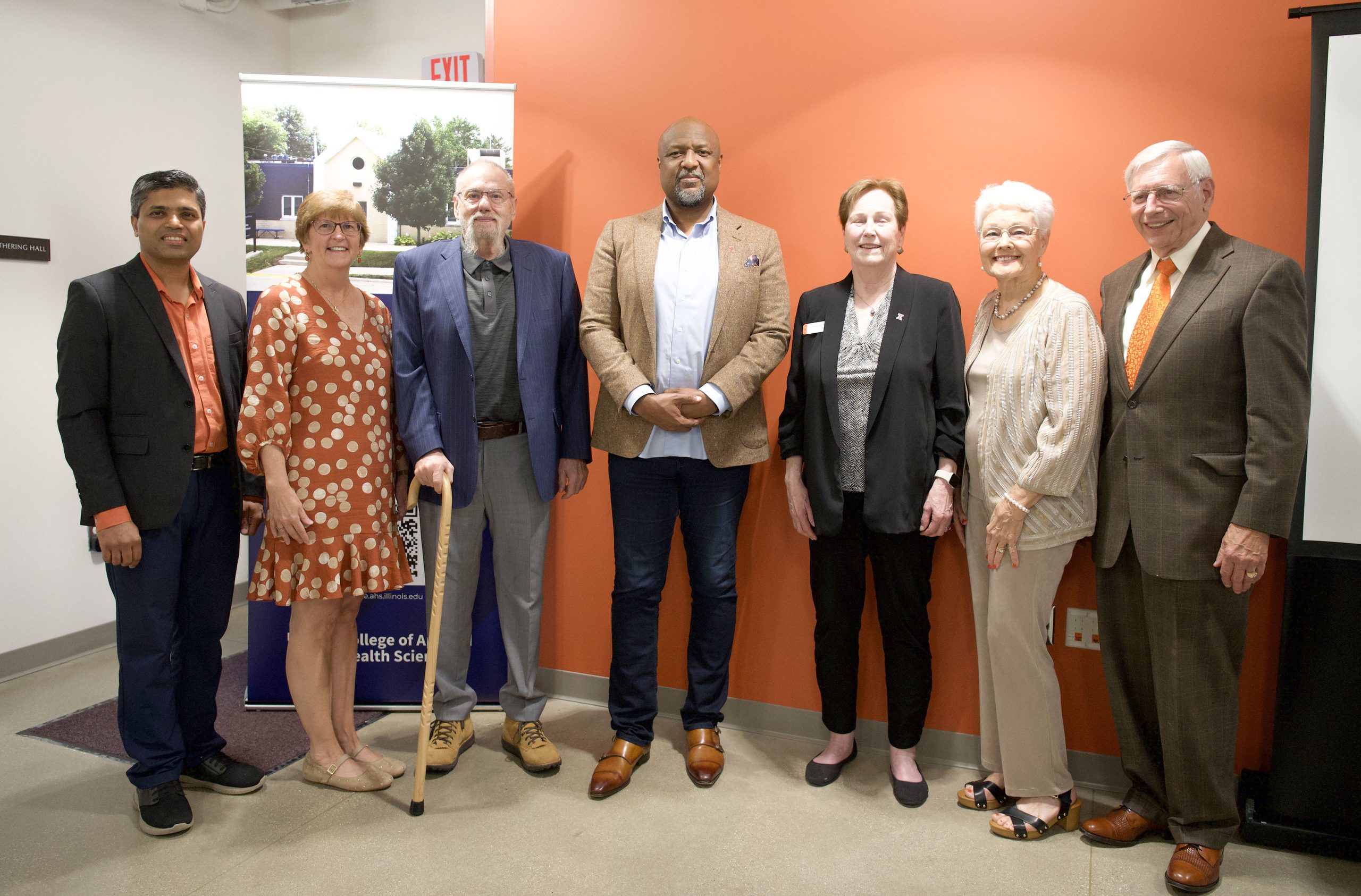
From left, Heather Stout, Brian Siemann, Maureen Gilbert, Jacob Tyree, Matthew Poland, Martrell Stevens, Stephanie Wheeler, U.S. Rep. Nikki Budzinski (D-Illinois) and Adam Bleakney (Photo by Ethan Simmons)
U.S. Rep. Nikki Budzinski (D-Illinois) spent part of her Tuesday on the campus of the University of Illinois Urbana-Champaign, where she toured Disability Resources and Educational Services and met with some of the coaches and athletes behind its nationally recognized adaptive athletics programs.
Budzinski met with a cross-section of DRES leadership, staff and athletes, including Director of Operations and Services Heather Stout; Maureen Gilbert, the coordinator of the office of campus life, wheelchair track coach Adam Bleakney, wheelchair basketball head coaches Stephanie Wheeler and Jacob Tyree and assistant coach Matthew Poland, DRES senior access specialist and Paralympian Brian Siemann and wheelchair basketball player Martrell Stevens.
Together, they highlighted both the day-to-day impact of DRES services and the broader significance of adaptive sports at the collegiate levels.
After seeing the main floor, Budzinski’s visit included a stop into DRES’ training facility, which was certified in September 2014 as a U.S. Paralympic Training Center. The basement facility, long regarded as a pipeline for Paralympic talent, served as a backdrop for conversations about access, equity and the future of disability services in education and athletics.
Bleakney showed Budzinski the adjoining Human Performance and Mobility Maker Lab, where he produces 3D-printed wheelchair racing gloves and collaborates on design projects with campus researchers. Siemann, who works with Illinois students with learning disabilities for DRES, showed Budzinski the two bronze medals he won in the 2024 Paris Paralympics as a wheelchair racer for Team USA.
The coaches, athletes, Gilbert and Stout all emphasized to Budzinski the importance of DRES for University of Illinois students, since more than 5,600 students applied for accommodations through DRES in academic year 2025-26. They also made sure Budzinski knew of the trailblazing work of DRES founder Tim Nugent, known as the “father of accessibility.” Nugent, who died in 2015, founded DRES in 1948 to help those returning from World War II.
Nugent advocated on the Urbana campus for wheelchair-accessible buses, curb cuts and other amenities that those with disabilities now take for granted. Many of his ideas have been adopted nationally. Nugent also helped create the National Wheelchair Basketball Association, as well as wheelchair football, track, archery and square dancing.
At the end of the tour, Budzinski was asked about the importance of sustained federal investment in programs like DRES. She underscored how policy decisions in Washington directly shape opportunities on campuses like Illinois.
Coach Adam Bleakney showed Nikki Budzinski the Human Performance and Mobility Maker Lab (Photo by Ethan Simmons)
“I’ve been supportive at the appropriations level of making sure that we’re supporting all of our sports, that we’re supporting the able-bodied and the disabled community to be able to fully participate in all athletics,” Budzinski said. “And you could do that through the appropriations process. I’ve been a big advocate of that for federal funding. I’m one of the bigger champions of Special Olympics as well. I lead our appropriations letters as it relates to that. So, I think just finding more opportunities through our appropriations process to invest in programs like this is so critically important, and we’ve made it a priority in the House.”
Budzinski’s comments connected federal appropriations work with on-the-ground outcomes—something visible in the athletes she met. DRES leaders also spoke about building programs that not only compete at the highest levels but also create pathways for students with disabilities to thrive academically and socially.
Faculty, students and staff engaged in a spirited game of wheelchair football during Adaptive Rec Day (Photo by Ethan Simmons)
It wasn’t even 11 a.m. and Gym 2 at the Activities and Recreation Center on the campus of the University of Illinois Urbana-Champaign was already buzzing.
Illinois’ first annual Adaptive Rec Day had just begun, drawing students, faculty and staff. Inside the gym, sport wheelchairs gleamed beneath the lights. Basketballs and footballs echoed across hardwood. At center court, members of Illinois’ wheelchair athletics teams smiled, ready to welcome newcomers with open arms.
Illinois’ Campus Recreation held the inaugural Adaptive Rec Day as a way to celebrate the National Intramural-Recreational Sports Association’s (NIRSA) Recreational Sports and Fitness Day.
Developed by Recreation, Sport and Tourism graduate student Noah Eckelberg, students got the opportunity to learn about adaptive sports and recreation while competing alongside Illinois’ wheelchair athletes. Students enrolled in RST courses Community Planning and Engagement and Inclusive by Design also participated in the day’s scrimmages.
Campus Recreation was awarded $16,168 as part of the Christopher & Dana Reeve Foundation National Paralysis Resource Center (NPRC) 2025 Direct Effect 2nd Cycle. The funding was used to put on the event and purchase adaptive recreation equipment, including harnesses for the climbing wall, hand cycles that will be available at the Campus Bike Center and adaptive sleds for use at the Ice Arena, said Alex Williamson, associate director of marketing-programming at Campus Recreation, as well as body-weight straps and a boccia ball set that can be checked out during open recreation.
Martrell Stevens, a Recreation, Sport and Tourism major and captain of the Illini men’s wheelchair basketball team, spun lightly in his chair, greeting a student who had never seen a sport wheelchair up close.
“This is a really, cool experience and an opportunity to just teach other people about adaptive athletics, and not just wheelchair basketball, but all the different sport there is to know,” Stevens said, gesturing toward courts set up for wheelchair basketball, football and volleyball.
“Growing up playing wheelchair basketball has changed my life so much. It’s allowed me to meet the best friends of my life who are going to be in my life for a very long time. It’s allowed me to travel, see the world. It’s allowed me to go to college. If I can teach other people about the sport, and they can teach other people, we can spread awareness and get as many people as possible playing adaptive athletics so they can have the same similar opportunity as me growing up.”
Paralympic medalist Susannah Scaroni nodded vigorously. Scaroni, whose racing career has taken her from campus tracks to the world stage as the defending champ of the Boston, New York and Chicago Marathons, leaned into the question about what an Adaptive Rec Day could teach people.
“Man, I agree with that,” she said with a grin. “And I’d just say we want to change perceptions to be what is right. We just want people to know what recreation sport is, and sport is, and disabled sport—as oxymoronic as that sounds—people learn hands-on.”
And that was exactly what was happening.
Some faculty and staff climbed into a sport chair for the first time, wobbling before finding balance. Students experimented with the wheels, marveling at the speed. Laughter broke out as people discovered just how much upper-body strength the sports demanded.
Mak Nong, a former captain of the Illini wheelchair basketball team and now program manager for Great Lakes Adaptive Sports Association (GLASA) in Lake Forest, Illinois, talked to a crowd gathered after the sport demonstrations were done. His tone carried both urgency and excitement.
Being physically active, moving, it’s what the College of Applied Health Sciences is all about: wellness across the lifespan.”
Jean Driscoll
Paralympic medalist and associate dean of advancement, College of Applied Health Sciences
“I think just for you guys, just really understanding that you’re at a point in time where adaptive sports is in a frying pan right now,” he said. “It can jump off at any second and you guys can trail blaze that. Please use the people that came before you to help you champion that and continue to grow these different opportunities.
“… there’s so many different things that you guys can grow adaptive sports, whether it’s (Name, Image and Likeness) deals for intercollegiate sports, the different equipment that the athletes will eventually use. The sky’s the limit for you guys. And I’m so excited to see what you guys do with this.”
In the gym, Paralympic multi-medalist Jean Driscoll watched as people navigated their chairs, some for the first time, in competition. A legend in wheelchair racing and a longtime advocate for adaptive athletics, Driscoll smiled at the sight of recreation in its purest form.
“Well, I know this is Rec Day,” she said when asked what the event meant to her. “And we all took sport beyond recreation, and we’re elite-level athletes. But I think to Susannah’s point, recreation is the name of the game. Being physically active, moving, it’s what the College of Applied Health Sciences is all about: wellness across the lifespan.”
She gestured toward the swirl of activity.
Women’s wheelchair basketball coach Stephanie Wheeler, left, and Paralympic medalists Jean Driscoll, center, and Susannah Scaroni took part in Adaptive Rec Day (Photo by Ethan Simmons)
“And so being active some way, you don’t have to be a superhero every day. Just do things for yourself, what makes you happy. For us, training makes us happy. But you can do it for fun too. And if you do it for fun, if you’re having fun, you’ll keep doing it. And that’s really what’s important.”
For Illinois women’s wheelchair basketball coach Stephanie Wheeler, the event was also an opportunity to quash some misconceptions about adaptive sports.
“I would say the biggest misconception that we have is it’s not physical or that it’s not real sport,” Wheeler said. “I think that’s what we try to do here at U. of I. is introduce wheelchair basketball, wheelchair racing, whatever sports it might be as a sport. I think that’s the biggest misconception is that it’s not a sport, that it’s not hard, it doesn’t require skill because we are disabled, that anybody can play, and that anybody can be good. I think what that aligns with is the way we think about disability in society.
“It’s not necessarily a positive representation. Whenever we’re encountered with that, we always say come to a game come to a practice because as soon as you see it, you’ll fully understand that skill is required. It’s physical. It’s fast. It’s fun. Just coming to watch it, I think, kind of washes that away pretty quickly.”
Near the end of the event, Nong—who played professional wheelchair basketball in Europe—addressed the crowd, mostly composed of students.
“What I love the most about today is that it has been led by quite a few of our student athletes. And so shout out to all of our student athletes who have played a huge role in making today happen,” he said. “And that’s really important to us because in our program, one of our biggest founding philosophies is that we pay it forward.”
As the final basketballs and footballs were rolled away and chairs lined neatly along the wall, the energy in the ARC felt less like an ending and more like a starting line.
Illinois’ first annual Adaptive Rec Day had been about t-shirts and snacks. But it had also been about perception, possibility and paying it forward.
And if the laughter, shouting and spinning wheels were any indication, this was only the beginning.