Budzinski visits DRES, comes away with appreciation for adaptive sports


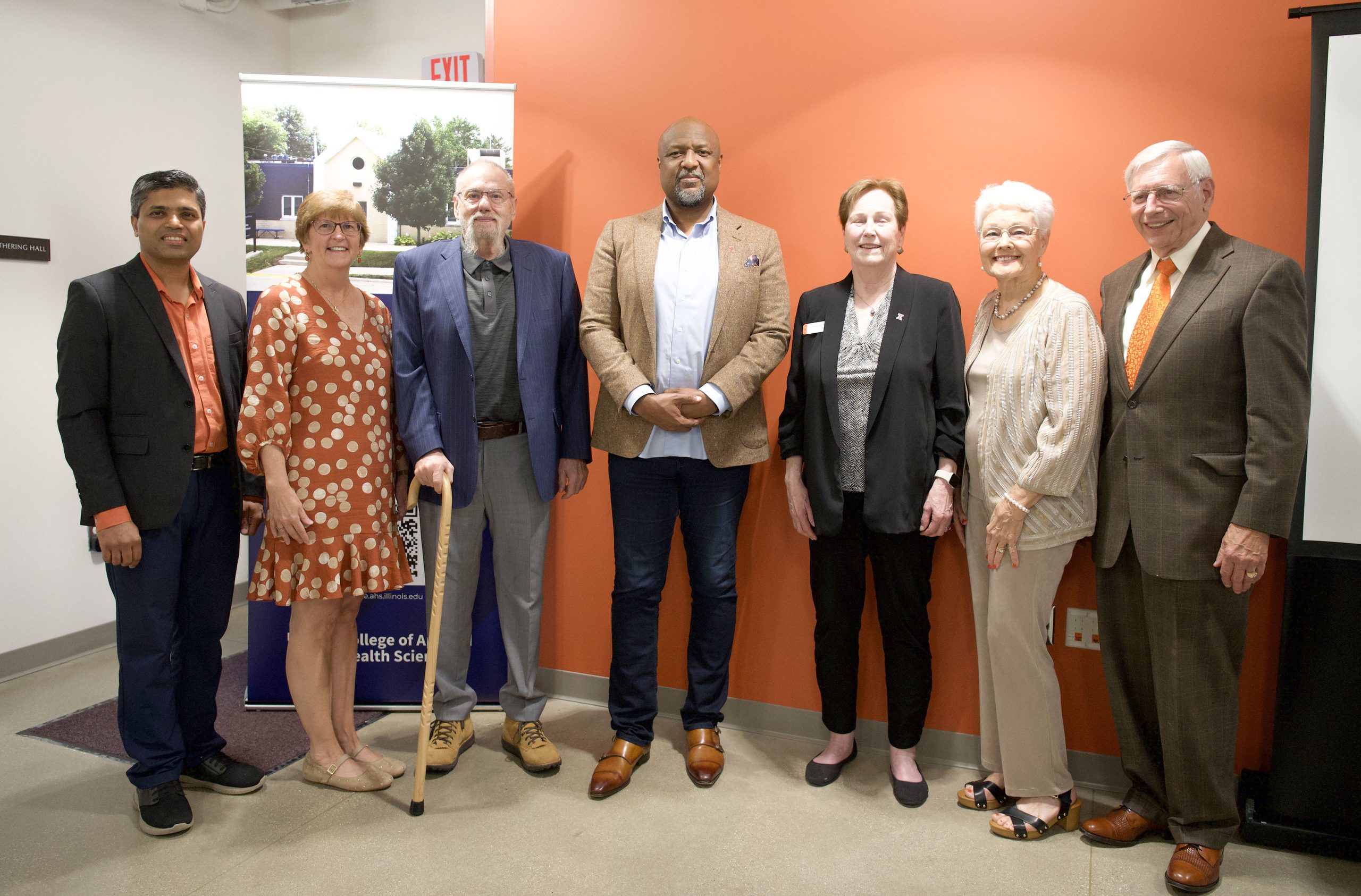
From left, Heather Stout, Brian Siemann, Maureen Gilbert, Jacob Tyree, Matthew Poland, Martrell Stevens, Stephanie Wheeler, U.S. Rep. Nikki Budzinski (D-Illinois) and Adam Bleakney (Photo by Ethan Simmons)

U.S. Rep. Nikki Budzinski (D-Illinois) spent part of her Tuesday on the campus of the University of Illinois Urbana-Champaign, where she toured Disability Resources and Educational Services and met with some of the coaches and athletes behind its nationally recognized adaptive athletics programs.

Budzinski met with a cross-section of DRES leadership, staff and athletes, including Director of Operations and Services Heather Stout; Maureen Gilbert, the coordinator of the office of campus life, wheelchair track coach Adam Bleakney, wheelchair basketball head coaches Stephanie Wheeler and Jacob Tyree and assistant coach Matthew Poland, DRES senior access specialist and Paralympian Brian Siemann and wheelchair basketball player Martrell Stevens.

Together, they highlighted both the day-to-day impact of DRES services and the broader significance of adaptive sports at the collegiate levels.

After seeing the main floor, Budzinski’s visit included a stop into DRES’ training facility, which was certified in September 2014 as a U.S. Paralympic Training Center. The basement facility, long regarded as a pipeline for Paralympic talent, served as a backdrop for conversations about access, equity and the future of disability services in education and athletics.

Bleakney showed Budzinski the adjoining Human Performance and Mobility Maker Lab, where he produces 3D-printed wheelchair racing gloves and collaborates on design projects with campus researchers. Siemann, who works with Illinois students with learning disabilities for DRES, showed Budzinski the two bronze medals he won in the 2024 Paris Paralympics as a wheelchair racer for Team USA.

The coaches, athletes, Gilbert and Stout all emphasized to Budzinski the importance of DRES for University of Illinois students, since more than 5,600 students applied for accommodations through DRES in academic year 2025-26. They also made sure Budzinski knew of the trailblazing work of DRES founder Tim Nugent, known as the “father of accessibility.” Nugent, who died in 2015, founded DRES in 1948 to help those returning from World War II.

Nugent advocated on the Urbana campus for wheelchair-accessible buses, curb cuts and other amenities that those with disabilities now take for granted. Many of his ideas have been adopted nationally. Nugent also helped create the National Wheelchair Basketball Association, as well as wheelchair football, track, archery and square dancing.

At the end of the tour, Budzinski was asked about the importance of sustained federal investment in programs like DRES. She underscored how policy decisions in Washington directly shape opportunities on campuses like Illinois.

Coach Adam Bleakney showed Nikki Budzinski the Human Performance and Mobility Maker Lab (Photo by Ethan Simmons)

“I’ve been supportive at the appropriations level of making sure that we’re supporting all of our sports, that we’re supporting the able-bodied and the disabled community to be able to fully participate in all athletics,” Budzinski said. “And you could do that through the appropriations process. I’ve been a big advocate of that for federal funding. I’m one of the bigger champions of Special Olympics as well. I lead our appropriations letters as it relates to that. So, I think just finding more opportunities through our appropriations process to invest in programs like this is so critically important, and we’ve made it a priority in the House.”

Budzinski’s comments connected federal appropriations work with on-the-ground outcomes—something visible in the athletes she met. DRES leaders also spoke about building programs that not only compete at the highest levels but also create pathways for students with disabilities to thrive academically and socially.

Editor’s note:

To reach Vince Lara-Cinisomo, email vinlara@illinois.edu.
 

Share on social

Related news

Illini athletes lead the way for Team USA


Illini athletes lead the way for Team USA (Getty Images)

In a big night for wheelchair racing and jumps, Americans—led by athletes from the University of Illinois—brought home five medals in front of another electric crowd at the Stáde de France in Paris.

Illini Paralympians Susannah Scaroni, Brian Siemann and Daniel Romanchuk all brought home bronze in their wheelchair racing events.

Siemann, who is competing in his fourth Paralympic Games, earned his first career Paralympic medal in Sunday’s 400-meter T53 race. The 34-year-old won his first world championships medals in 2023 and said that trusting his training is what has helped him to peak at this point in his career.

“I’ve managed to do this with the support of my teammates,” he told reporters in Paris. “I’ve been lucky to train with some really great athletes. Real legends in the sport. I think they’ve always been the force that’s pulling me, sometimes quite literally, across the track to get a little bit better and a little bit faster. That’s what’s gotten me here. Their commitment to making me a better athlete.”

Siemann clocked a personal-best time of 47.84 and said it was an emotional moment.

“I couldn’t stop smiling when I saw my name on the board because I’ve been in that position when I’ve been waiting and I look and I see my name in fourth place by a hair. To finally see it up there and to race as fast and as well as I did is really exciting. There’s still more work to be done.”

Siemann said his training at the University of Illinois led him to reach his potential.

“I went off to Illinois as a student back in 2008 and so it’s like I’ve lived there almost now as long as I’ve lived in New Jersey, and so that really sort of did lay the foundation for my success today,” he said. “You know, it’s been a very long road to get here, but getting the opportunity to train with the best wheelchair athletes in the world on a daily basis has just pushed me to be that much better, not only in terms of my academics when I was a student but now also as an athlete, too.”

“Mo, we did it!,” he added, referencing Maureen Gilbert, coordinator, Office of Campus Life at Disability Resources and Educational Services, who is considered the heart of DRES and its trailblazing Paralympic training facility.

Scaroni took a risk on an inside line in the final 100-meters of the women’s 800-meter T54 and it paid off, resulting in her second medal in as many days. The now five-time Paralympic medalist earned bronze in 1:43.42, eking ahead of teammate and 20-time Paralympic medalist Tatyana McFadden, who clocked a time of 1:43.58 and finished fourth. The third American in the race, two-time Paralympian Hannah Dederick, also from the University of Illinois, kicked off her second Games with a seventh-place finish.

For Scaroni, both Paris medals have come as a result of strategic execution of her race plan. In today’s 800-meter, she sat at the back of the pack until the final 200 meters of the race, where she turned on the power and chose the correct line.

“There’s a lot of strategy, there’s a lot of going as hard as you can while being able to respond what’s going on,” she said. “I’ve realized Tokyo was Tokyo, this is a new Games. It’s been really fun for me to focus on the racing. Tokyo, no one had raced for awhile, and it was going to be kind of mysterious. Here, I know the strengths of this field and I’m just excited to race.”

Scaroni returns to the track for her 1,500-meter competition on Sept. 3, while McFadden and Dederick are set for the 100-meter on Sept. 4.

Scaroni credited the University of Illinois for her training.

“Illinois has prepared me in so many ways,” she said. “Not only am I surrounded by the best environment for a wheelchair racer but I also have an incredible education. They’re really highly ranked in nutrition, and so I was able to couple my nutrition degree with my sport and do a master’s in exercise sociology, and then that obviously has helped as well. So I think that as I’ve become a better athlete, I’ve become a better professional person with a disability by being surrounded by such an inclusive campus, and hopefully a good nutrition educator too.”

Also earning his second medal of the competition was Romanchuk, who found an extra gear at the end of the men’s 400-meter T54 and took bronze, just a day after winning the 5,000-meter event. Romanchuk’s time of 45.11 put him comfortably in third, over half a second ahead of the fourth-place finisher.

Roderick Townsend (gold, men’s high jump T47) and Jaleen Roberts (silver, women’s long jump T37) also won medals for Team USA in their respective sports.

On the basketball court, the U.S. men’s wheelchair basketball team won its third straight game Sunday, rallying past Australia 76-69 behind 18 points from Illinois alum Brian Bell. With a 3-0 finish, the U.S. secured the top spot in Group B, meaning they will face the fourth-place team of group A in the quarterfinals. The Americans return to the court on Tuesday for the quarterfinal round. Its opponent and game time are still to be determined.

Editor’s note:

To reach Vince Lara-Cinisomo, email vinlara@illinois.edu.
 

Related news

College of Applied Health Sciences
110 Huff Hall
1206 South 4th Street
Champaign, IL 61820
(217) 333-2131