DRES alumni unite to help students


The ‘Band of Brothers’ have come together to support the next generation of Illini wheelchair sport athletes through the establishment of an annual scholarship.

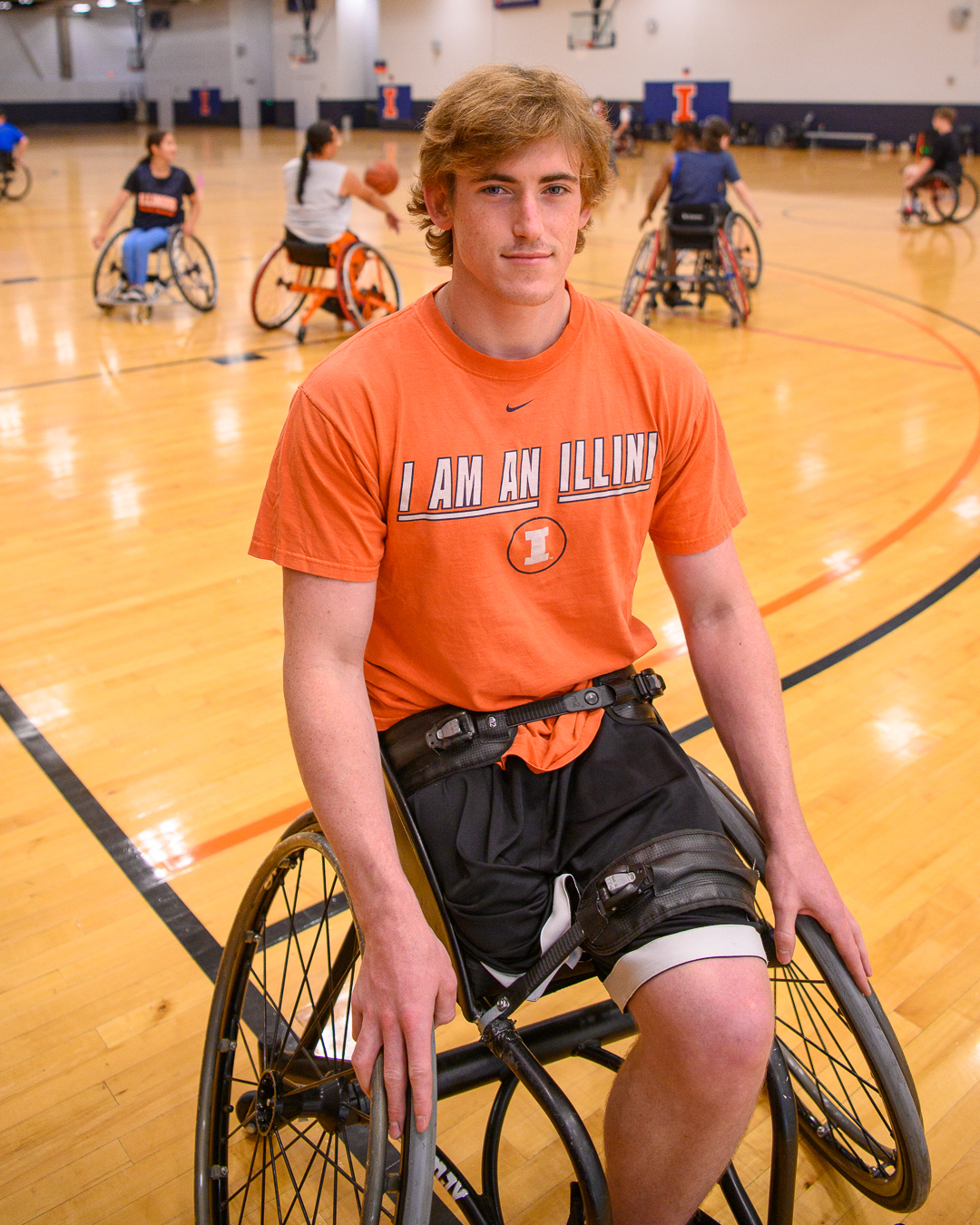
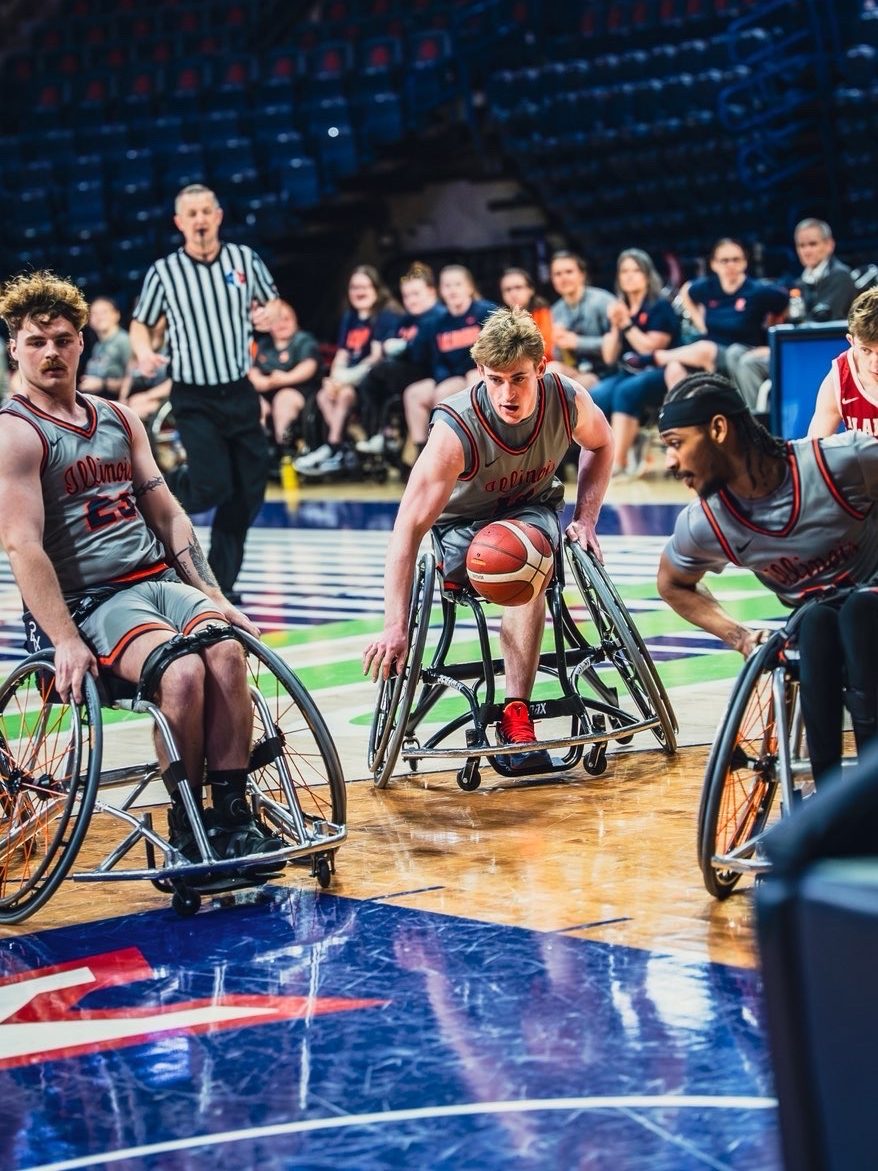
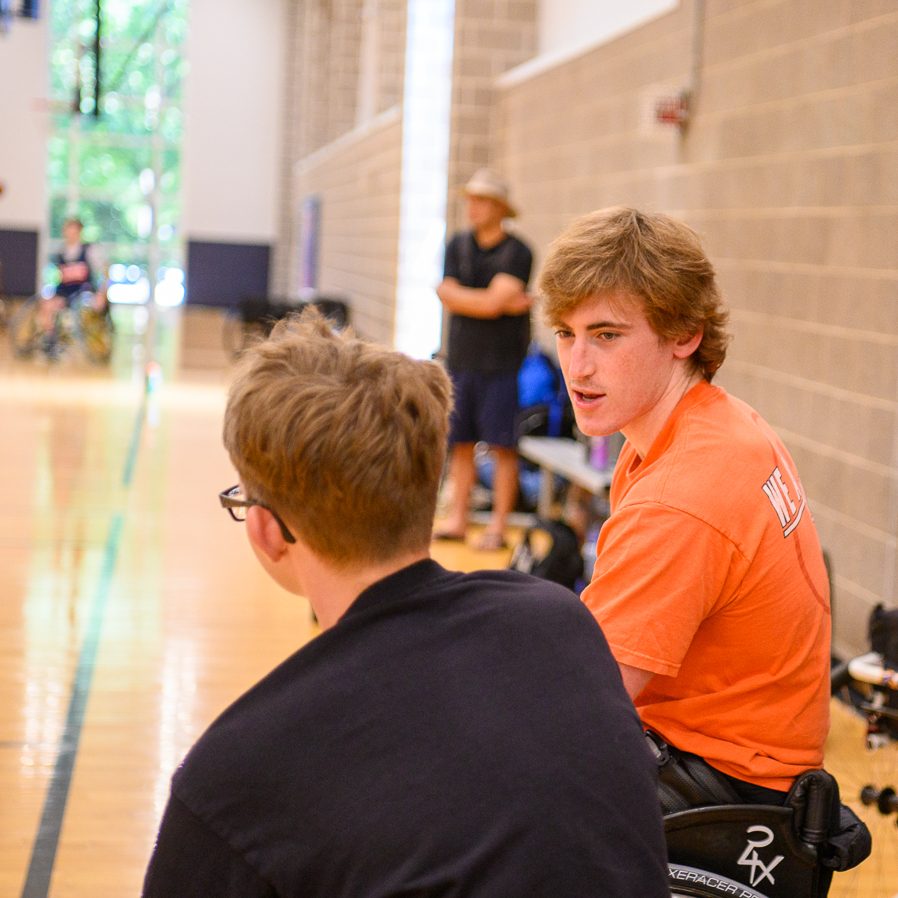
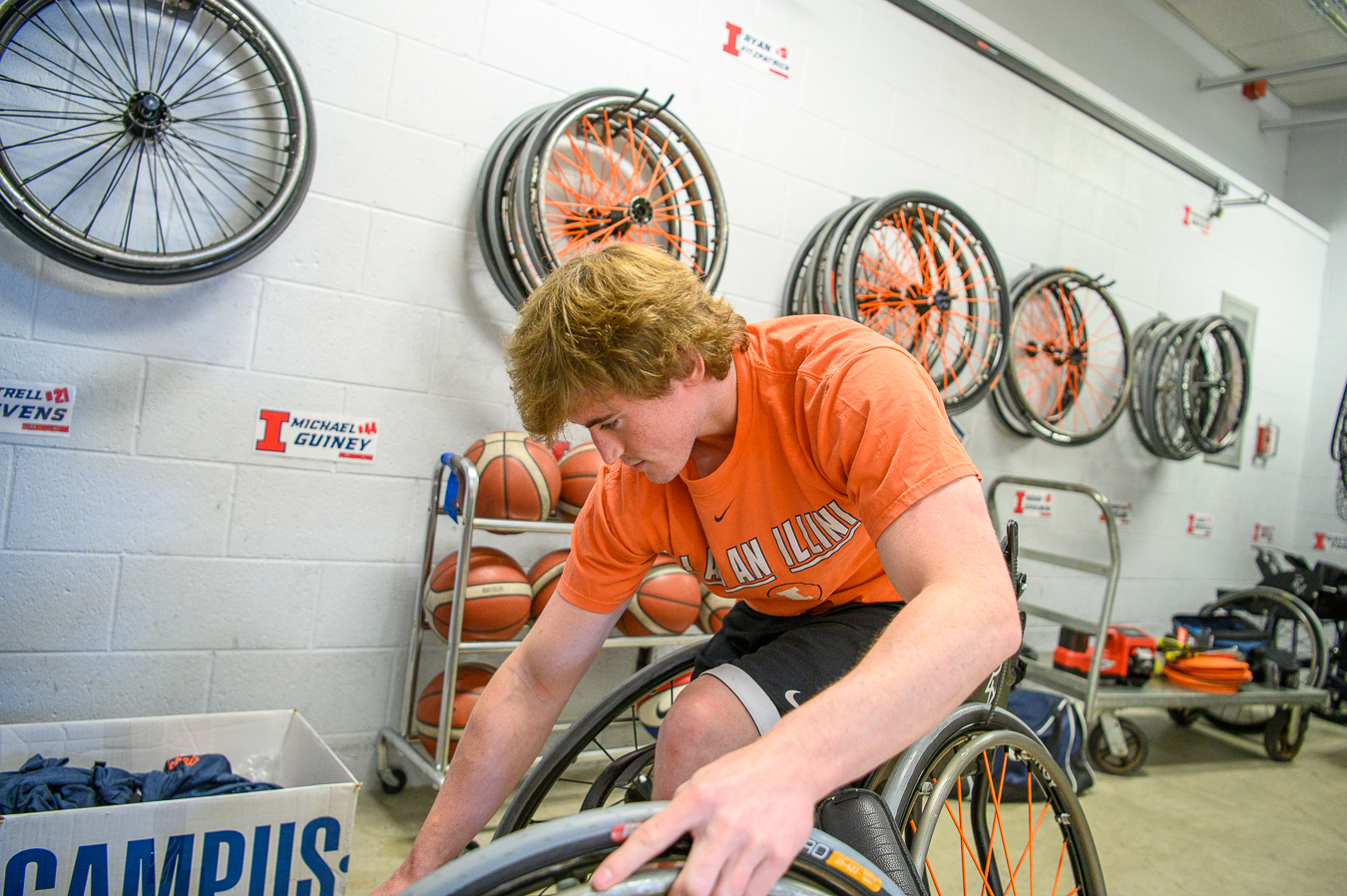
In the heat of an Illinois men’s wheelchair basketball season, intense morning practices roll into sociable team meals and lively late-night gaming sessions. The hours spent between busy student-athlete schedules—on buses and in residence halls—are where teammates became brothers.

For all that the Illinois men’s wheelchair basketball teams of the early 2010s accomplished on the court—a National Wheelchair Basketball Association intercollegiate championship and three second-place finishes under former coaches Mike Frogley and Matt Buchi—they’ve surpassed that off of it, starting careers and raising families.

Now, the alums of this so-called “Band of Brothers” have come together once more to support the next generation of Illini wheelchair sport athletes through the establishment of an annual scholarship.

Their contributions, through The Fighting Illini Wheelchair Basketball Alumni Legacy Scholarship Fund, have been granted to two wheelchair basketball athletes in the past two terms.

“This scholarship is born from people that truly love each other and care about the future of the program at the University of Illinois,” said Mak Nong, former Illinois wheelchair basketball player and founder of the fund. “For us to be able to give back and make things easier for the future generation, that’s our moral obligation: to make this place even better than it was for us.”

Tight bonds

Maureen Gilbert wears many hats as coordinator for the Office of Campus Life at Disability Resources and Educational Services, better known as DRES. To more than 29 classes of Illinois wheelchair student-athletes, she’s “Mo,” director of athletic programs, point-person for travel and eligibility questions and trusted confidante. Some lovingly call her “Mom.”

On bus rides to and from track and field and basketball events, one can usually tell if the team is gelling off the floor, Gilbert said. Team chemistry always takes work to develop, but some teams bond faster than others.

“Once in a while, you get those athletes who seem to click, and they make it happen themselves,” Gilbert said. “Like with Mak’s group.”

Martinez Johnson joined the team in 2013 as a transfer student from Atlanta. It didn’t take long for the memories to start stacking up with his teammates.

“[We’d] just hang out and make sure we were doing our best to balance our social life, school and basketball,” Johnson said. “And we leaned on each other to make sure everyone was doing OK mentally as well.”

Just before the school year, Johnson recalls the team traveling to the 4H campground of Allerton Park for several memorable exercises. In what was a yearly tradition under former Coach Matt Buchi, the players wrote down their individual fears for the season before throwing them into a burning campfire.

“When I came in 10 years ago as a coach, that was one of the first things that I tried to do: have a bonding experience to learn about each other outside of basketball,” said Buchi, who left DRES in November for a job in the Office of the Vice Chancellor for Institutional Advancement. “And that’s what really bonds a lot of these guys for a lifetime, a comfortable place to be vulnerable as young men with our team.

“That bonding took a while to get there, but it just needed activities and locations to blossom.”

Jacob Tyree’s favorite memories with the team tend to revolve around food: morning rushes to Original House of Pancakes or Merry Ann’s Diner after long, physical practices, or cherished visits to Cravings, an Asian cuisine restaurant.

“It could be a really crappy practice, like maybe things just were not clicking on the court—coach is yelling at you for things, your teammates are yelling at you for things—and then you go out afterwards and it’s now a positive bonding experience,” Tyree said.

As the teammates graduated and dispersed across the country and the world, those relationships stayed strong. 

A random, gloomy day in the early weeks of the coronavirus pandemic led Nong to check in with many of his old teammates. He’d been pondering ways to give back to the things “he truly cared about,” and Illinois neared the top of Nong’s list.

His calls gave way to proposals: “Would you want to contribute to a scholarship?”

After checking with DRES and the College of Applied Health Sciences advancement team, the groundwork was laid.

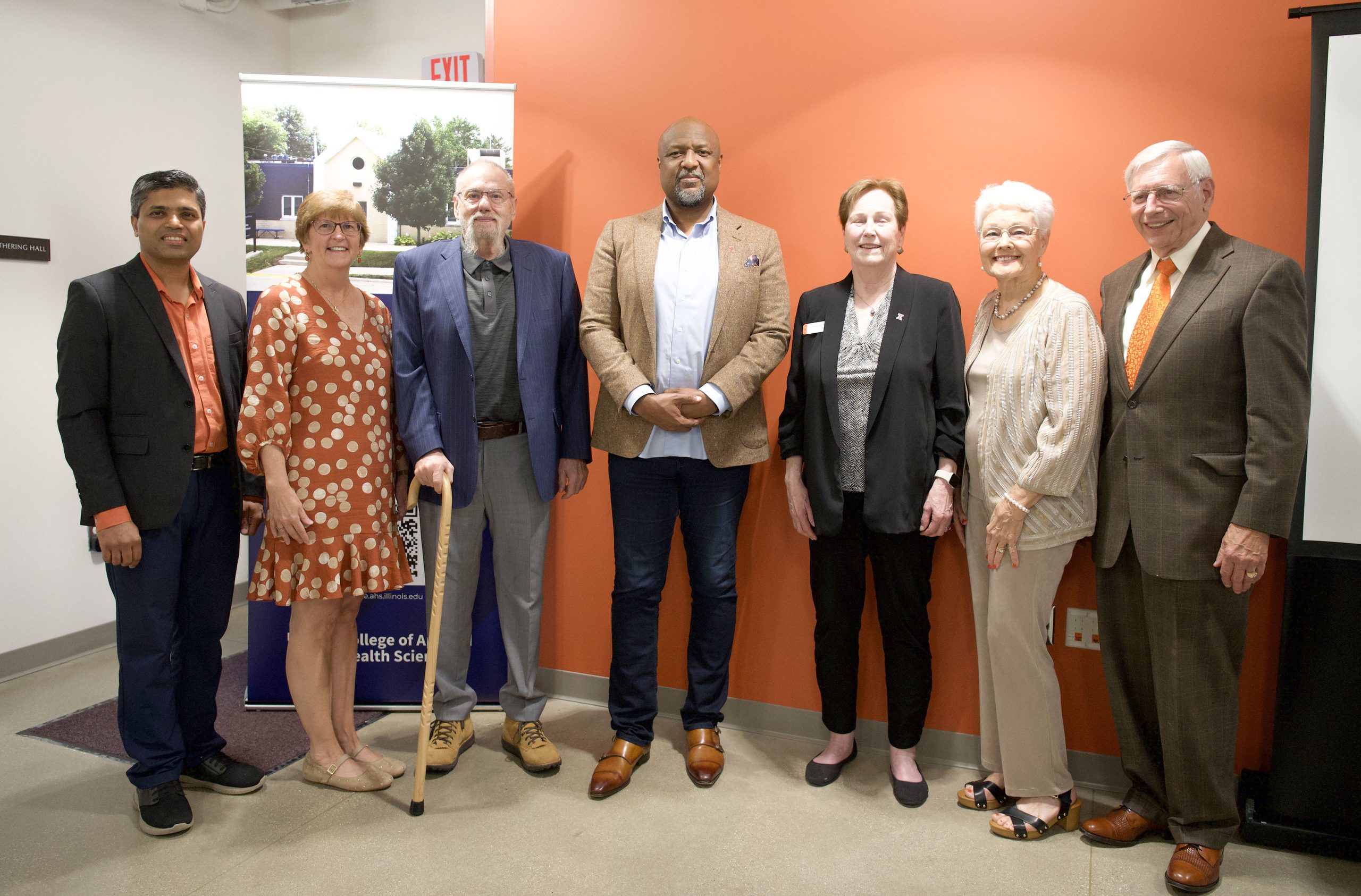
“Mak took the lead on all of that,” Gilbert said. “In fact, it was a great gift when they told me what they were doing. It gives a good example to our current students of paying forward and how to support those who come after you.”

The generosity didn’t stop with the scholarship, either. In the spring, program alumni used crowdfunding to finance customized, tailored suit jackets for the graduating seniors on the men’s and women’s wheelchair basketball teams.

“It was a surreal full-circle moment to see my alumni, the guys that I coached, are now taking care of the players that I’m coaching now,” Buchi said before he moved on from DRES.

Life after basketball

After graduating in 2017, Nong played professional wheelchair basketball in Europe for a spell, winning a league championship for LUC Handibasket in Lille, France. What stuck with him was the governance over the sport that was present overseas.

“To them, it was just sport. People without disabilities were playing wheelchair basketball and getting paid to do it,” Nong said. “So, I was thinking, ‘How do I spread this joy to people?’ Recreation is a big opportunity for that.”

How do I spread this joy to people?

Mak Nong

Former Illini wheelchair basketball player

Years after graduating, many members of the wheelchair basketball teams have stayed in the orbit of adaptive sports, committing time and effort to growing the scene in myriad ways.

Nong is a program manager for Great Lakes Adaptive Sports Association (GLASA) in Lake Forest, Ill., overseeing a wide range of sports programs—from football, tennis, track and field, swimming and soccer—suited to disabled athletes of all ages.

His journey truly began as a young boy pushing along his wheelchair in Los Cerritos Mall near Long Beach, Calif. Longtime coach Lisa Hilborn noticed Nong and asked if he’d be interested in trying wheelchair sports.

“I didn’t want to do it at all—I was freaking out—but then I went to a practice and I fell in love with it and kept going back,” Nong said. “I’m trying to spread the love she gave to me to other people.”

By the time he was a senior in high school, Nong was heavily recruited for wheelchair basketball. Coach Frogley’s pitch from the University of Illinois stood out from the pack.

“He stressed the importance of education; he catered to me as not only a person but an athlete as well. Just having that balance and showing that we can use sport as a tool to get to where our success is,” Nong said.

Tyree, too, has found a career in the field as training coordinator for Move United, a nonprofit committed to facilitating adaptive sports opportunities. He returned to his hometown of Roanoke, Va., to found the Roanoke Stars Wheelchair Basketball program.

Like other program alums, he repeatedly credits his coaches’ attention to detail for his professional success.

“We all saw ourselves as having our roles, and thought about how do we support each other to fill in the gaps where this is my weakness, but that’s your strength? When I’m struggling, I can lean on you a little bit more,” Tyree said. “I think that that mindset really fell into creating that excellence and trickled into what we do full time.”

Alums who haven’t found careers in adaptive athletics have stayed around the game in some way, like Derek Hoot and Johnson, who started recording podcasts about it.

In the Push Podcast, the pair of alums discuss the happenings of U.S. wheelchair basketball and bring on established guests.

“Wheelchair basketball has made a big impact on all our lives. Being able to find a sports community as individuals with disabilities is huge,” Johnson said. “I think that’s a big reason we have all stuck around adaptive athletics, is we know the change it made in our lives could be duplicated for the next generation.”

Buchi­­—who is being replaced as men’s coach by women’s wheelchair basketball coach Stephanie Wheeler—said he was beginning to see talented recruits who’ve been coached by his own wheelchair basketball alums.

“The next step is happening, I have so many of my guys that are actually coaching and are giving back to juniors programs,” Buchi said. “They get to put a little bit of our Illinois stamp on these kids before I even get them.

“Our alumni need to think as soon as they graduate, how do I give back to the guys that are coming up next? Because there’s always going to be that next person that comes up and you want them to have the best experience possible.”

Editor’s note:

To reach Ethan Simmons, email ecsimmon@illinois.edu.
 

Related news

Men’s wheelchair basketball wins opener in Paris Games


Steve Serio takes a shot against Spain during the Paris 2024 Paralympic Games on Aug. 29, 2024 in Paris. (Photo by Joe Kusumoto/Getty Images)

Illinois alum Steve Serio had a triple-double as the U.S. men’s wheelchair basketball team began its pursuit of a third straight Paralympics gold medal with a 66-56 win over Spain on Thursday in Paris.

Serio, who has helped lead Team USA to gold the past two Paralympics, had 12 points, 11 rebounds and 12 assists. Serio, who is a graduate of the Department of Health and Kinesiology in the College of Applied Health Sciences, credited the team’s depth for the win.

“We’re 12-deep. We’re 12 (players) strong, and we’re going to be a tough team to beat moving forward,” Serio told reporters.

The Americans pulled away late in the fourth quarter, highlighted by Serio’s pass to John Boie for a layup.

“JB is a great player for us,” said Serio, the team’s captain. “He’s been a constant for us over the last couple of years. We have the utmost confidence in him not only as a role player but as a scorer as well. When I dumped that ball down to him, I had no doubt that the ball was going to drop.”

The game was close early, as Serio struggled to find his shot. But in the second quarter, Team USA erased a 23-22 Spanish advantage with consecutive buckets from Serio and fellow Illinois alum Brian Bell. Bell had 10 points. Jake Williams had a game-high 22 points for the U.S.

“It’s definitely frustrating when your shot’s not dropping,” Serio said. “The good thing about it is that I found another way to be productive. The best thing about this team is that it’s never one guy, never one player. It’s going to come down to the 12 of us, and we know we got each other’s backs.”

Team USA next faces the Netherlands on Saturday.

Find out more about Steve Serio in this podcast he did with AHS before the Tokyo Paralympics.

The U.S. women’s team also won its opener in Paris, defeating Germany 73-44. Team USA, which won the bronze in Tokyo got strong performances from Courtney Ryan, who scored a team-high 17 points while Rose Hollermann (16) and Ixhelt Gonzalez (15) combined to score 31.

Illinois athletes Ali Ibanez (two rebounds, one block) and Kaitlyn Eaton (plus+2 in four minutes) also contributed to the win.

“Our team was successful because we stuck to the game plan,” said head coach Christina Schwab. “We talked about things that we can control, the distractions that may be there, and just staying present and focused. We were able to play 12 deep and our energy was great.”

Team USA returns to the court on Saturday for a contest against the Netherlands, the defending gold medalists.

Related news

DRES alum’s posthumous gift takes spotlight: ‘I don’t think she ever forgot her debt’


To honor their sister’s time at the University of Illinois, the siblings of Susan Jane Chaplinsky thought a memorial bench in the open-air plaza of Disability Resources and Educational Services would be a fitting tribute. 

The family of Susan J. Chaplinsky sits on her memorial bench in the center of the Disability Resources and Educational Services building. Her siblings Kathy, Amy, Molly and Pete sat with her plaque.

Because the work of DRES was a big part of what propelled Chaplinsky, living with juvenile rheumatoid arthritis, to become an acclaimed business scholar and beloved instructor. She said so herself.  

“[DRES at Illinois] … put me on a path to achieve the professional success I have attained over the course of my life,” Chaplinsky wrote in her will. “It remains a unique institution for students with disabilities to level the inequities caused by life and health and allows them to achieve a measure of success.  I would be proud to have my name associated with an institution with these goals and aspirations.”

Upon her passing in November 2022, Chaplinsky dedicated a substantial portion of her wealth to the DRES: A $3.4 million estate gift which will support two endowment funds for Illinois students with disabilities. 

The family got to witness the memorial for Chaplinsky at the DRES 75th Anniversary Open House on April 19, surrounded by staff, alumni and visitors. College of Applied Health Sciences Dean Cheryl Hanley-Maxwell gave thanks to the family and to Chaplinsky for her generosity. 

”It’s going to change much of what we can do here at DRES, I can’t thank you guys enough for being willing to be here with us today to celebrate Susan’s commitment to us,” Hanley-Maxwell said. “Susan is an example of many students who have graduated from the University of Illinois who look back on DRES and say, ‘If it weren’t for DRES, I don’t know what I would have done.’” 

‘A lifeline’

Chaplinsky graduated from Illinois in 1975 with her bachelor’s in economics. She went a couple hours north to obtain her MBA and a Ph.D. in Economics from the University of Chicago. 

What followed was a stellar academic and teaching career, where Chaplinsky taught finance at the University of Michigan, Northwestern University, and eventually the University of Virginia’s Darden School of Business, where she spent her final 28 years. 

But with her early obstacles, she charted a course her family could’ve never foreseen.  

In sixth grade, Chaplinsky was diagnosed with a severe form of juvenile rheumatoid arthritis. In a matter of months, Chaplinsky went from being an active, able-bodied preteen to needing a wheelchair to get around day to day. 

Growing up in Palatine, Illinois, a village 30 miles northwest of Chicago, Susan’s sister Kathy would bring her lunches during high school, since Susan couldn’t access the cafeteria with her wheelchair. As Chaplinsky confronted her new health challenges, others began to place unfair limits on her abilities. 

“My sister was always very smart, brilliant, but there was no guidance counselor encouraging her to look at colleges,” Kathy Arter said. 

“Then our parents learned about the program at Illinois, and it was just like a lifeline to them. There was a place that not only could accommodate her, but they wanted her there.”

Illinois, with its wheelchair accessible campus and the Division of Rehabilitation Education Services led by director Tim Nugent, was an opportunity to promising to pass up. After being accepted onto campus, Chaplinsky’s life and confidence transformed, her siblings said. 

Every time they’d visit her at Allen Hall, she was surrounded by friends, going out to bars or movie showings on campus, living a regular student’s life.  

But she took her studies seriously, and Nugent played a hand in that. Chaplinsky “talked a lot about Nugent,” Arter said; he was demanding, and held high expectations for the students he worked with. 

“Some of that, with Susan, she left here with that: ‘They expect me to go on and be a success, I won’t disappoint them,’” Arter said. “I don’t think Susan ever forgot her debt to the university, for that opportunity.” 

An outpouring of support flowed from the UVA campus after Chaplinsky’s passing. Her siblings didn’t always get to see the teaching side of Susan; a memorial event they attended allowed them to see a new side of their sister. 

“The great passion of her life was teaching,” said her sister, Amy Meehan. “She was interested in students, she always rooted for the underdog. She just views this gift as an extension of that: ‘I can help for years to come.’” 

Plenty of the traits they knew well—Chaplinsky’s sports fandom and dry humor, for example—also shined through in their remembrances. 

“She’s funny, she’s brilliant,” sister Molly Gillis said. “I think about all the time, her footprint is ginormous when she had so many things that could’ve limited her reach and they didn’t.” 

The siblings and extended family made a big showing at the DRES Open House. They gratefully packed in around their sister’s newly arrived memorial bench and posed for pictures in the cool spring weather. 

“Maybe somebody sees that bench, and it gives them the confidence, the energy to go forward, to dream big, and to do something they didn’t think they could do,” brother Pete Chaplinsky said. 

Related news

Illini athletes lead the way for Team USA


Illini athletes lead the way for Team USA (Getty Images)

In a big night for wheelchair racing and jumps, Americans—led by athletes from the University of Illinois—brought home five medals in front of another electric crowd at the Stáde de France in Paris.

Illini Paralympians Susannah Scaroni, Brian Siemann and Daniel Romanchuk all brought home bronze in their wheelchair racing events.

Siemann, who is competing in his fourth Paralympic Games, earned his first career Paralympic medal in Sunday’s 400-meter T53 race. The 34-year-old won his first world championships medals in 2023 and said that trusting his training is what has helped him to peak at this point in his career.

“I’ve managed to do this with the support of my teammates,” he told reporters in Paris. “I’ve been lucky to train with some really great athletes. Real legends in the sport. I think they’ve always been the force that’s pulling me, sometimes quite literally, across the track to get a little bit better and a little bit faster. That’s what’s gotten me here. Their commitment to making me a better athlete.”

Siemann clocked a personal-best time of 47.84 and said it was an emotional moment.

“I couldn’t stop smiling when I saw my name on the board because I’ve been in that position when I’ve been waiting and I look and I see my name in fourth place by a hair. To finally see it up there and to race as fast and as well as I did is really exciting. There’s still more work to be done.”

Siemann said his training at the University of Illinois led him to reach his potential.

“I went off to Illinois as a student back in 2008 and so it’s like I’ve lived there almost now as long as I’ve lived in New Jersey, and so that really sort of did lay the foundation for my success today,” he said. “You know, it’s been a very long road to get here, but getting the opportunity to train with the best wheelchair athletes in the world on a daily basis has just pushed me to be that much better, not only in terms of my academics when I was a student but now also as an athlete, too.”

“Mo, we did it!,” he added, referencing Maureen Gilbert, coordinator, Office of Campus Life at Disability Resources and Educational Services, who is considered the heart of DRES and its trailblazing Paralympic training facility.

Scaroni took a risk on an inside line in the final 100-meters of the women’s 800-meter T54 and it paid off, resulting in her second medal in as many days. The now five-time Paralympic medalist earned bronze in 1:43.42, eking ahead of teammate and 20-time Paralympic medalist Tatyana McFadden, who clocked a time of 1:43.58 and finished fourth. The third American in the race, two-time Paralympian Hannah Dederick, also from the University of Illinois, kicked off her second Games with a seventh-place finish.

For Scaroni, both Paris medals have come as a result of strategic execution of her race plan. In today’s 800-meter, she sat at the back of the pack until the final 200 meters of the race, where she turned on the power and chose the correct line.

“There’s a lot of strategy, there’s a lot of going as hard as you can while being able to respond what’s going on,” she said. “I’ve realized Tokyo was Tokyo, this is a new Games. It’s been really fun for me to focus on the racing. Tokyo, no one had raced for awhile, and it was going to be kind of mysterious. Here, I know the strengths of this field and I’m just excited to race.”

Scaroni returns to the track for her 1,500-meter competition on Sept. 3, while McFadden and Dederick are set for the 100-meter on Sept. 4.

Scaroni credited the University of Illinois for her training.

“Illinois has prepared me in so many ways,” she said. “Not only am I surrounded by the best environment for a wheelchair racer but I also have an incredible education. They’re really highly ranked in nutrition, and so I was able to couple my nutrition degree with my sport and do a master’s in exercise sociology, and then that obviously has helped as well. So I think that as I’ve become a better athlete, I’ve become a better professional person with a disability by being surrounded by such an inclusive campus, and hopefully a good nutrition educator too.”

Also earning his second medal of the competition was Romanchuk, who found an extra gear at the end of the men’s 400-meter T54 and took bronze, just a day after winning the 5,000-meter event. Romanchuk’s time of 45.11 put him comfortably in third, over half a second ahead of the fourth-place finisher.

Roderick Townsend (gold, men’s high jump T47) and Jaleen Roberts (silver, women’s long jump T37) also won medals for Team USA in their respective sports.

On the basketball court, the U.S. men’s wheelchair basketball team won its third straight game Sunday, rallying past Australia 76-69 behind 18 points from Illinois alum Brian Bell. With a 3-0 finish, the U.S. secured the top spot in Group B, meaning they will face the fourth-place team of group A in the quarterfinals. The Americans return to the court on Tuesday for the quarterfinal round. Its opponent and game time are still to be determined.

Editor’s note:

To reach Vince Lara-Cinisomo, email vinlara@illinois.edu.
 

Related news

Stout Leadership


Heather Stout returned to the University of Illinois from the School of Law at St. Louis University and has roots in Central Illinois (Photo by Ethan Simmons)

When Disability Resources and Educational Services, better known as DRES, began advertising for a permanent director of operations in 2023, it was apparent to current employees who would be a great fit.

“Before there was ever the possibility of Heather [Stout] becoming DRES director of operations, my mentor and the first DRES director I worked for, Dr. Brad Hedrick, mentioned her as one of his respected colleagues working at a peer institution,” said Susann Sears, director of Beckwith Residential Support Services, which is affiliated with DRES and provides care for disabled students.

Stout was hired in June and officially joined DRES in August, succeeding interim Director Kim Collins, who retired at the end of June. Stout returned to DRES with established relationships in hand.

“I worked closely with Susann Sears, because she and I were in similar roles at [the University of Illinois Chicago] and Illinois, respectively,” Stout said. “Paige Lindahl-Lewis [assistant director at Beckwith] and I graduated from AHS together. Paige and I both graduated from rehab programs when I graduated from Illinois.” 

Stout returned to the University of Illinois from the School of Law at St. Louis University and has roots in Central Illinois. She got her bachelor’s degree from Penn State and a master’s in rehab counseling at Illinois, interning at DRES along the way. Stout emphasized the values of continuity.

“It’s important that Illinois has some long-term staff that have historical knowledge and cultural context for DRES and our program,” she said. “In higher ed, there have been a lot of changes across universities, particularly in disability. It’s good that there has been consistency at DRES, along with some of the changes in staffing.”

Maureen Gilbert, DRES’ coordinator for the unit’s Office of Campus Life, agreed that Stout’s understanding of the university was a huge plus.

“Her familiarity with campus and DRES is helpful because she understands the impact and presence DRES has,” Gilbert said. “With Heather’s experience and knowledge base, she can advocate for a strong presence at the table, especially when the discussion involves disability and accommodations across all aspects of the campus community.”

That’s especially important because of the tremendous growth in DRES student enrollment.

Gilbert said that “in four years, our numbers have increased 33 percent. Our access specialists have caseload numbers of 600 to 700 students; we have waitlists for mental health services counseling and neuropsych testing; and our service requests for deaf and hard-of-hearing students and staff are increasing. To continue supporting students and their growing needs, increased financial resources are essential to support current and prospective staff.”

Her familiarity with campus and DRES is helpful because she understands the impact and presence DRES has.

Maureen Gilbert

DRES coordinator, Office of Campus Life

Fulfilling the DRES mission and serving increasing enrollment will require expanded facilities. To that end, Stout said a new facility is necessary. She has seen proposed building designs and said, “It is my hope that in the next five years, we can talk more about that and what we can do to make DRES and each of the departments centrally located. That’s a very thoughtful conversation we’ll need.” 

Stout referenced the Center for Movement and Performance, a proposed state-of-the-art, stand-alone indoor multi-use facility for the wheelchair track and wheelchair basketball programs with enhanced strength and conditioning, equipment, sports medicine, training and meeting areas.

Adam Bleakney, renowned coach of the men’s and women’s wheelchair track and road racing teams, said, “We have a vision for a facility that is built upon the legacy pillars of our program—service, outreach, research, education and innovation—and that will allow us both room for growth and increased interdisciplinary collaboration across campus and the community.”

Although facility upgrades are high on her list of things to do, Stout acknowledged the priority is “serving the entire student.”

“We have a career services area,” she said. “We have mental health resources. One of the things I hope to expand upon is our connections with each academic department. Are we working with and partnering with them so that students are getting the accommodations that they need and each unit can work with us effectively? And are we doing what is best for graduate and professional students, as well as the faculty and administration in those programs?”

Early in her career, Stout worked as an interim coordinator/disability specialist at the University of Illinois Chicago, and worked as director of the Disability Resource Center at Purdue University.

She said Purdue’s approach to disability was “very methodical, very careful” and said Illinois had a similar approach.

“Illinois was the first model for disability resources in higher ed. It includes programs that few universities have,” Stout said. “It also has tremendous support. Being located within an academic college is a crucial connection for faculty and students. Our history is unparalleled in the U.S. and continues to include incredible resources. I hope to build upon that legacy as we look to the future and envision what DRES can be five years and 10 years from now.”

Related news

Expert Q&A: DRES Accessibility IT Group


Online technology is an evolving ecosystem for some disabilities (Stock image)

VINCE LARA: Jon, what does the DRES Accessibility IT Group do?

JON GUNDERSON: Our mission on campus is to help the university understand the accessibility of the online resources that the university creates and uses. Online information technology is still, really, a frontier in terms of digital barriers to people with disabilities. While it’s been an enabling technology for some types of disabilities, it’s still a barrier for other types of disabilities. And the history of UI in breaking barriers on disability is a big part of what motivates our group. Nick, did you want to talk a little bit about that?

NICHOLAS HOYT: Sure. I think another part of what Jon has just said is that we are carrying on the work that the founder of DRES—Tim Nugent—started. He was a pioneer in so many ways and was working in a context—the post-World War II era—helping veterans get access to higher education, and that took the form of a transportation system—the first bus system in this country with wheelchair lifts, and wheelchair access to buildings through ramps, and curb cuts, and things like that.

In the Accessible IT Group, we are carrying on that work, but obviously, things have changed. So much of our lives—our work lives and our personal lives—are now online, and we are trying to deal with this new environment in similar ways to what Dr. Nugent was doing. And with digital information technology—as Jon has mentioned, these barriers weren’t recognized immediately. The Accessible IT Group is trying to increase awareness of IT accessibility requirements and, in so doing, provide means—techniques—for reducing or getting rid of these barriers in information technology.

VINCE LARA: Let me ask you—I know the group is ostensibly housed in DRES. Does it work cross-campus? Do you work with other colleges and units?

JON GUNDERSON: Yes, most of our work is with other campus entities, with other Big Ten Universities and also international through our work with the W3C Web Accessibility Initiative. We are involved with web standards for accessibility—through the Web Accessibility Initiative—for over 20 years. I’ve been a working group member of the Accessible Rich Internet Applications Working Group. And the AInspector WCAG and FAE tools that we’ve built to help people understand accessibility are built on the foundations of the Web Content Accessibility Guidelines and the ARIA standards—ARIA stand for Accessible Rich Internet Application standards—for best practices for accessibility.

And one thing that makes our tools different than tools that you might find from other businesses or organizations, for one, is that they’re entirely open-source. And, more importantly, they’re designed to be educational—helping people understand the accessibility requirements, whereas other accessibility tools tend to be what I call “whack-a-mole” tools. You know, tell me where the problem is, and if I have enough time and resources, I’ll just start fixing things until I run out of time or I get everything fixed.

But unfortunately, being able to point to a particular place in the code or on a web page and fix things only addresses about 30% to 40% of accessibility requirements. So, many people, even though they might get zero errors with an automated tool, and they don’t understand the other requirements, may not have addressed the other 50% to 60% of the requirements related to having an accessible and inclusive website. I mean, we talk about accessibility, but it’s really about inclusiveness, making people with disabilities feel included in the Illinois experience.

When people talk about accessibility, it seems to be something like, oh, yeah, I met that criteria of being accessible. But if you don’t really understand the accessibility principles, like I’m satisfied some tool told me I don’t have any errors—but you still don’t know if you’re being inclusive by making the website usable. And maybe Lori could talk a little bit about some of her work with campus web developers or other campus organizations in terms of helping them understand accessibility. Lori?

LORI LANE: I’m involved with the Canvas Accessibility Working Group on campus. My role in that group is to do evaluation and assessment, look over what Canvas offers, and identify any issues that might come up related to accessibility barriers. I also analyze the accessibility checker they offer to see how it functions and notice any accessibility issues that it flags or doesn’t flag.

It’s a way to help the group make accessibility resources available for instructors who are developing courses and students with disabilities who are taking these courses. We help them improve the accessibility of Canvas within that group. That would be one example of a partnership.

Another example might be that I’m also involved with WebCon, the Web Conference planning committee. I’ve been on that committee for the last two years. And when COVID happened, of course, we were caught off guard and forced to cancel the in-person conference that we had been planning at that point. And we made the pivot, as so many did, to an online platform for our conference. And the committee was discussed different ways to make that change.

And one of the first experiences that we had with an online conference—was CVENT. Our committee was interested in talking about things that they liked about the platform, which they saw that seemed very interesting or flashy. I had to keep reminding the group that we had to consider accessibility. That was crucial for planning a successful conference, not just all the bells and whistles.

And so doing this conference online, and what an online conference platform would mean, is that a wider range of attendees with disabilities who might attend online; would not have been able to come in person. And we had to ensure that the platform we selected for the conference was accessible to all of them. And I took that opportunity to educate the rest of the committee on ways to keep that in mind and evaluate for some of those issues.

We ended up going with CVENT, which is the name of the conference platform that we used. And we worked closely with their developers from the CVENT team in making sure that our conference was as accessible as possible. I help other groups and entities across campus be more aware of their product and help improve the accessibility of what they offer and develop.

VINCE LARA: Excellent. Thank you for that answer. Jon, or anyone who wants to answer this, can you explain, broadly, accessibility and its importance?

NICHOLAS HOYT: Jon and Lori, you may want to weigh in as well—but an analogy came to mind for me this morning, and that’s the analogy of when the printing press was invented. In order to make this new technology (at the time) work, people had to understand certain technical aspects of how to produce a book or other printed material. There was typesetting for example, and it involved the amount of ink needed to print each page. Too much ink, and it’s blurred. Not enough ink—it’s not visible.

But just as there were technical issues people had to understand in that era, there’s a similarity with the era of information technology—of digital technologies for information. There are ways that digital information can be made accessible to people regardless of their abilities. And going back to the printing press analogy—somewhere along the line, someone came up with the idea of using Braille. And Braille allowed people who were blind to be able to read the same texts that were being produced in printed format. Unfortunately, there was about a 400 year gap between the invention of the printing press and the invention of Braille.

Today, digital technology gives us the ability to publish something in a format that includes within it the information that someone—just to take an example, someone who is blind—that will help them be able to not only get to the information but to understand its structure—to be able to navigate around and through that document or that information. So hopefully, that’s a helpful analogy.

VINCE LARA: Absolutely. I love that analogy, actually. It helps me understand the basis—how that even arose. Very interesting, Nick. Thank you for explaining that.

LORI LANE: I was listening to what Nick was saying, and I wanted to add another example that I might use: our users with disabilities aren’t able to use a mouse, for example, and they’re dependent on the keyboard. That’s how they’re navigating the web page they’re on. Most of us have no problem using a mouse to access and navigate the internet.

But for people who depend on keyboard navigation only, when they use the Tab key to navigate to active elements on websites as a way to get where they’re trying to go—to the form controls or the search bar. It helps them navigate across a page or through content.

For example, if there aren’t any visual focus cues—something to show where the visual focus is at that moment or on what element it’s highlighted. We need something that clearly defines a link visually, for example, with an underline. If you use a mouse and hover over the element, you’ll see that underline pop up or something that indicates that this is a link. But for a keyboard-only user who can’t hover over with a mouse, they use the keyboard to navigate through, and they do not see any visual focus cues on the page and get stuck because there are no visual focus cues to lead them. They can’t go anywhere or get to the desired destination.

Web developers can put defined styles into their CSS files, for example, background colors, underlines, borders, and text colors—things that identify as a dynamic element. It’s one little CSS change that they can put in, and it dramatically increases the accessibility for someone who uses a keyboard and needs that visual focus. I hope that explains how to make it more accessible.

VINCE LARA: Oh, tremendously. It makes me understand that we’re not doing enough, clearly, on some of our text-only things. And so, absolutely. Thank you for really planting that seed for me.

JON GUNDERSON: I have a story about a blind student. When I first got started working with Illinois students on IT accessibility in the ’90s, I was helping a law student who was blind use LexisNexis. And the web wasn’t being used at that time, but LexisNexis had their own interface, and you could dial-up and get access to law information—almost any information from print materials on a wide variety of topics. And this student—and I think all law students had free access to LexisNexis, I believe this is true even today.

So working with the blind student to help them—they could access the information pretty well since it was primarily the old style character based interfaces, but it took them two to three times longer to access that same information, and there were still problems. It wasn’t ideal. Sometimes, some things weren’t possible.

But, you know, at that time, it cost $200 to $300 per hour to use LexisNexis. I don’t know if that’s still true or not. And so this student– people with disabilities—are used to having to spend more time—work harder—to get the same level of work done for their classes. But when they graduate, and they go try to get a job, a lot of first-year graduates are going to be doing law research—doing research for partners or other lawyers, in at least in the larger law firms.

And now, if it’s taking this student two to three times longer, they will be costing that law firm two to three times more to use that service. And now the law firm says, well, if I hire you, you’re going to be more expensive than other graduates because of the extra time you will be spending on line to do research—I mean, if you’re the top law student from Illinois that might be fine.

But if you’re not the top law student, or maybe towards the bottom of the class, well, maybe you’re going to be too expensive to hire because you’re taking too much time with Lexus/Nexus searches. Or, you know, after the first year and they see your bill is twice as high as other first-year law schools, or maybe more. That’s an economic disincentive to employ someone with a disability. So these are kind of the hidden costs of inaccessibility, and it affects career opportunities.

And to me, at that time, I said, it doesn’t have to be that way. It’s because we design these systems without thinking about accessibility. And just like curb cuts have helped more than just people who use wheelchairs to get into buildings and ramps and things, when we look at technology for accessibility, we’re helping usability for everybody—to use technology better and more efficiently.

VINCE LARA: Oh, fantastic explanations from everyone. I really appreciate that. Lastly, I wanted to talk to you about—Jon, you had mentioned the software extensions, and I wanted to ask you if you could talk more about those and how they can be utilized.

JON GUNDERSON: Well, I think the latest extension we’ve worked on—maybe Nick could explain—but I think it’s a little bit different direction for us. We’ve been mostly focusing on tools to help people analyze websites for accessibility, but this new tool Nick’s been working on is really an assistive technology. It kind of speaks to what Lori Lane was talking about earlier in terms of providing keyboard navigation. So I’ll let Nick talk a little bit more about that project.

NICHOLAS HOYT: OK. Well, I will just begin by saying that the term “extension” generally refers to a web browser extension—something you can just add into the browser, and then its functionality is just there available to you. And of the tools Jon was referring to that do evaluation, probably the tool that we recommend first is a tool called AInspector WCAG, which is a Firefox browser extension. And that will allow you to evaluate—apply many different accessibility rules to the page, have those rules evaluated, and then get that feedback of—are there any aspects of the page that didn’t meet the requirements?

But since we had experience with creating browser extensions, we saw an opportunity with the latest extension, which is called the SkipTo Landmarks & Headings extension. We saw an opportunity for actually creating something that served a dual purpose. And primarily it allows people to navigate a web page by the headings and the landmarks on that page.

So headings have been around for a long time in the world of web development and HTML web pages. They define different sections of content, and they’re hierarchical—they can be of different levels. For example, a level-2 heading might define a major section of a document, and then there might be several level-3 headings under that that define subsections.

On the other hand, landmarks are relatively new. They’re defined by a more recent standard that Jon mentioned—the ARIA standard. Landmarks define regions on a page, which are common regions that users may want to navigate to or skip over. An example is the header region—oftentimes, the same header is there on page after page within a website, containing the website logo and often a site navigation menu. And people that are just using the Tab key to navigate the page starting from the beginning are going to– if they can’t skip over that header—have to tab through many, many links to get beyond it. The SkipTo extension allows a user to skip over the page header and go directly to some other region on the page.

Another very useful landmark is the main landmark. If you put the main content of the page into that region, the SkipTo extension will allow you to skip directly to it. It’s a replacement for the “skip to main content” link, but does not depend on the page actually containing that link.

In summary, the SkipTo extension give people who are using the keyboard—as I mentioned it’s serving a dual purpose–the ability to navigate the page through landmarks and headings very efficiently. And the other way it can be used—for example, a web developer who just wants to spot-check different pages to see if the heading structure makes sense—it’s useful to them as well. Or to anyone that is looking for information on a fairly complex web page—they can get a list of the headings and scroll directly through them, rather than having to scroll through a very long page with lots of visual distractions.

Editor’s note:

To reach Vince Lara-Cinisomo, email vinlara@illinois.edu.

Related news

Bleakney and collaborators want to disrupt the wheelchair market


Illinois’ wheelchair track coach Adam Bleakney leads a cross‑campus team of engineers and designers from AHS and Grainger in testing PURE, the innovative hands‑free robotic wheelchair prototype aimed at “disrupting the wheelchair market” (Photos by Michael Hansen)

As coach of the Illinois wheelchair track team, Adam Bleakney knows about the chronic overuse of shoulders and elbows by his athletes. But as a daily wheelchair user himself, he also knows about the challenges of navigating life.

So Bleakney and his colleagues from Disability Resources and Educational Services, as well as cross-campus collaborators from the Grainger College of Engineering, and the College of Fine + Applied Arts, embarked on a plan to disrupt the wheelchair market.

“We wanted to design something that would break the mode of traditional wheelchairs, which has been essentially a chair supported between two large drive wheels with two casters, and has not changed since the first patents awarded in the 1860s,” said Dr. Elizabeth Hsiao-Wecksler, a professor in the Department of Mechanical Science and Engineering in the Grainger College of Engineering and the principal investigator on a project that recently received a $1.5 million grant from the National Science Foundation under the National Robotics Initiative program to develop a wheelchair that will provide individuals with a physical disability a new and novel mode of mobility.

The project, called PURE (Personalized, Unique Rolling Experience) offers users hands-free movement using an interactive and adaptive robot that is uniquely personalized for each user.

Hsiao-Wecksler said the project was started in 2018 in response to the call for “radical improvements in the mobility and independence of people with lower-limb paralysis through smarter assistive technology” by the Toyota Mobility Unlimited Challenge.

Bleakney had worked with Toyota on a previous project, so he was intrigued by the opportunity, and he spoke with then-DRES director Dr. Pat Malik, whose husband, Ron, is a daily wheelchair user.

“The intent was to achieve an interdisciplinary effort, to combine the tradition and knowledge we have at DRES and AHS as leaders in disability access with the incredible resources that exist across campus,” he said.

“And Pat, Jeannette Elliott, Arielle Rausin, and I each bring a unique and personal disability experience perspective to the project. Pat, who’s married to a daily wheelchair user; Jeanette, who in addition to being the physical therapist at DRES uses a prosthesis and manual wheelchair; and Arielle and me as daily wheelchair users.”

Hsiao-Wecksler was asked to join the team since she had been working on hardware design of devices to assist people with disabilities and also wheelchair technology.

“I have worked on both wheelchair propulsion biomechanics with (KCH faculty) Jake Sosnoff and Ian Rice, and wheelchair wheel development with IntelliWheels, Inc., which was a local start-up that I, Jake Sosnoff, and our graduate students created.”

Three mechanical engineering graduate students—Chenzhang Xiao, Yinan Pei, and Yu Chen—worked on PURE prototypes, and Dr. William (Bob) Norris of Grainger, of Grainger (ISE faculty) who has expertise in control of autonomous vehicles and robots, was brought on as a co-PI. Dr. João Ramos, also of Grainger (MechSE faculty) and with experience with design and control of robotic devices, was added for the NSF proposal.

Illinois’ project reached the top 10 out of 80 applications for the Toyota Challenge. Bleakney and project co-PI Dr. Deana McDonagh of FAA represented the team in London for the competition, but only the top five submissions were funded.

Illinois’ team was unbowed and continued to move ahead, knowing it had a good idea.

“Without question everyone on the team recognized the value of the project and the need to look for funding opportunities to continue working on it,” Bleakney said.

“The traditional manual wheelchair needs to be reimagined,” McDonagh added.

Although Bleakney works with some of the best wheelchair athletes in the country, including multi-marathon winner Daniel Romanchuk, he knows there is a broader application for PURE.

“It’s (for) all daily wheelchair users and other individuals with a lower limb mobility impairment. So we do envision that it would be a mobility device that can be used by both daily wheelchair users and others that don’t necessarily always use a wheelchair but would perhaps use some other some other form of accessible mobility in certain situations.”

The device’s name—PURE—came about as a result of a team meeting, Hsiao-Wecksler said.

“We wanted to express the organic and pure nature of using lean-to-steer technology to propel the device, rather than requiring constant occupation of the hands such as with a manual wheelchair,” she said. “This mobility device will utilize personalized driving calibration to accommodate different trunk function abilities and custom seating of each user. The design is a uniquely different mode of rolling instead of the traditional wheelchair with two drive wheels and castors. And it will be a wonderful mobility experience for the user.”

The traditional manual wheelchair needs to be reimagined.

Deana McDonagh

Professor of Industrial Design in the School of Art + Design

The PURE design plan describes it as “discreet,” which McDonagh said refers to “seeing the person before the chair—which translates to seeing the person before the disability.”

Hsiao-Wecksler added that PURE’s footprint is “smaller than a manual wheelchair’s, being no larger than the user’s body dimensions while seated, providing access to smaller spaces such as inaccessible public restroom stalls.”

Bleakney also stressed PURE’s ability to address long-term health and wellness and safety.

“We look at how can we decrease acute injuries that may occur from falling,” he said.“And we wanted to mitigate that risk, but also mitigate the risk posed to the shoulders from pushing a wheelchair around on a daily basis.”

And McDonagh said, “health is not just the absence of disease. Health is connected with one’s sense of independence, mobility and ability to live the life you need to live. This device will enable the user to traverse a more diverse terrain while holding a coffee in one hand! Or holding the hand of a loved one. We are blending the functional with the emotional needs of real people.”

A prototype of PURE was developed for the Toyota Challenge in 2018, but since it had rather inexpensive components, it could only support a payload of 25 pounds. A second-generation prototype is in the works, one that can support a rider up to 250 pounds and operate on level flooring.

Thanks to the NSF grant, plans are in the works for more development of the second-gen device and then a third-generation chair with more advanced control. Eventually, the researchers see commercial opportunities, and recently submitted an application to the U.S. Patent and Trademark Office.

“We think the value is transformative enough that it can be used by not just daily wheelchair users, but also by a broader audience,” Bleakney said. “Envision being at Disney World. And instead of hundreds of three-wheeled scooters being driven around by folks needing mobility assistance, PURE is being used and providing a much more inclusive and fulfilling experience. So I think it has a fairly broad application to a lot of different individuals who would benefit from it.”

Editor’s note:

To reach Vince Lara-Cinisomo, email vinlara@illinois.edu.
 

Related news

A Few Minutes With … Alexa Halko


Alexa Halko. (Photo provided)

2016 Paralympian Alexa Halko, training at Illinois for the 2020 Games in Tokyo, speaks with College of Applied Health Sciences media relations specialist Vince Lara-Cinisomo about Illinois’ Paralympic training site, the Disability Resources & Educational Services unit and her future plans.

Transcript

VINCE LARA: Hello, this is Vince Lara in the communications office at the College of Applied Health Sciences at the University of Illinois. Today I spend a few minutes with Alexa Halko, 2016 Paralympian training for the 2020 games here at Illinois.

All right. I’m with Alexa Halko, Paralympian. Alexa, now, you competed in Rio in 2016. You were the youngest US athlete there.

How is it going to be different now that you’re training for 2020? And do you feel like you’re more of a mentor in this role? Is it any different for you at all?

ALEXA HALKO: Yes, I believe it’ll be different, just because I’ve had more experience to get to know the sport a little better. I’ve been in it for– I started Paralympic-wise in 2014. So I’ve really gotten to be around more experienced athletes. And I feel like that will just keep building on itself, obviously, over the years. So I think that’s what will be different in 2020.

VINCE LARA: What did you learn from 2016 that you’re trying to apply to your 2020 training?

ALEXA HALKO: I learned that you’re going to have hard years. After 2016, it was such a frenzy. I was like, well, this is awesome. It’s your first Paralympic Games. You don’t even know what to think after that.

But the year after, in 2018, I didn’t have the best year. And I kind of just went with it and just stayed with it. But it kind of showed me that you’re not going to have the best years every year. You just got to go with it and just keep going, I guess.

VINCE LARA: Now, you loved basketball when you were growing up. So how did you transition into racing? What got you into that?

ALEXA HALKO: Yeah, so I actually played basketball and track at the same time. So it wasn’t really like an, oh, I’m choosing basketball over track. Even though I do love basketball still, track was just my main one, I would say, my main sport, just because I liked the solo part of it. I like a team, and that’s super awesome. But for me, I feel like just going solo and just doing my own thing is what I like.

VINCE LARA: OK. Yeah. Now, you were born in Oklahoma. Your family moved to Virginia. How did you end up here at Illinois?

ALEXA HALKO: Yeah. So I actually have been looking at this program since I started, because it’s commonly known that this is, like, the best program you can be in for the wheelchair track world. And so it’s always been an aspiration for me to come here since I was, like, 14. So I feel like I was just hoping and just keep training so I would come here.

VINCE LARA: Did you have any interaction with Coach Blakeney at all beforehand? Or was that something that was talked about in Paralympic circles, like, oh, Illinois is a great program?

ALEXA HALKO: Well, yeah, it’s always known to be the best program you can go to. So yeah, it is commonly known. And I would always see Coach Adam at competitions.

So I would always see him. And he would always be with the Illinois team. So I would hang out with them and know them. So it’s always been, I see them. And I’ve been aware that they’re around.

VINCE LARA: How much of your deciding to come to Illinois was based on even academics, beyond what DRES has in the wheelchair racing? Did you factor that in as, Illinois is a great school, too?

ALEXA HALKO: Yeah, no, for sure. It’s awesome that I can continue my education, but also be at such a great training program. And that just works, because I don’t want to just drop everything school-wise, but still keep going with my dream of racing and continuing my Paralympic, I guess, career. So I think it’s just the best of both worlds, because what could be better than this setup?

VINCE LARA: Absolutely. What are you studying at Illinois?

ALEXA HALKO: Yeah, so I’m a communications major.

VINCE LARA: OK. So this is perfect.

ALEXA HALKO: Yeah, actually.

VINCE LARA: That’s great. Now, you’re still so young. You’re 20?

ALEXA HALKO: I’m 19.

VINCE LARA: You’re 19.

ALEXA HALKO: Yeah.

VINCE LARA: So what’s next for this? How long do you expect you’ll compete? And then after that, will you coach? Do you see yourself as more of a mentor role?

ALEXA HALKO: I’ve never seen myself as a mentor, to be honest. I think coaches are awesome. I just never have put myself in that position.

I do like outreach and seeing the new kids come up, so maybe possibly in the future. But yeah, we’ll just have to see. I definitely just hope to keep training, keep competing, and just see where it kind of goes from there.

VINCE LARA: Well, how long do you think you’ll compete? Do you see 2024? Do you start to look and say, this is probably the last one I can do?

ALEXA HALKO: Yeah. I feel like if you’re in these cycles, you’re just thinking about, oh, the next games. You get in such a cycle mindset. And so I think I’ll go probably until 2024, maybe later. I’ll be here till 2022. And then whatever I do after that, I’ll probably stay here maybe.

VINCE LARA: Yeah, there’s grad programs.

ALEXA HALKO: Yeah, no, exactly.

VINCE LARA: Got to consider AHS.

ALEXA HALKO: Yep. So yeah, it might just go on from there. But we’ll see.

VINCE LARA: What do you think about beyond sports? What’s the career for you? So you’re studying communications now. Do you hope to break into that field?

ALEXA HALKO: Yeah, I definitely was thinking about something Paralympic-wise in communications. I think that would be really cool, just because I know a lot of the Paralympic track world-wise. And I feel like doing something with that, not just completely blowing it off– doing something with would be really cool, because I’ve been so in this world for a while.

VINCE LARA: With the USOPC or something in that range? OK.

ALEXA HALKO: Yeah, maybe.

VINCE LARA: Mm-hmm. And now that you’re here at Illinois, where do you see your future beyond school and work? Do you feel like you could settle here because of how great the training site is?

ALEXA HALKO: Yeah. I’m not really set on a certain location to live. Just because this program is so awesome, I know so many people who have stayed here just for the program. And that makes me think, hey, maybe that might be a good option, because so many people have succeeded from staying here. So it would be a good option, for sure.

VINCE LARA: What would be your advice to somebody who aspires to reach the Paralympics or even compete? Maybe they don’t make the team, but they’re in the training process for it.

ALEXA HALKO: Yeah, no. Definitely study, not in the school sense, but study your favorite racers. I think that’s kind of something that helped me. I just was observing my favorite racers and just–

VINCE LARA: Who were your favorite racers?

ALEXA HALKO: So I always looked up to Tatyana (McFadden). She’s the best woman–

VINCE LARA: And now you get to train with her.

ALEXA HALKO: Yeah, exactly. And that’s been an aspiration, because this is the program to be in, and then to race against or compete with some great teammates. But yeah, so just observing and just– people say it all the time– but just do it. Just keep going with it.

You’re going to have hard years. And it’s not going to go the way you always want it to go. But it’s just about staying with it, because that’s what’s got me here. So I’m going to keep going.

VINCE LARA: My thanks to Alexa Halko. This has been “A Few Minutes With.”

Related news

A Journey to Empowerment


Harold Scharper Award recipient Kevin Fritz is flanked by Susann Sears, director of Beckwith Residential Support Services, and Pat Malik, former director of Disability Resources and Educational Services.

Kevin Fritz’s disability made his childhood difficult. People noticed his wheelchair before they noticed him. The severity of his disability made it impossible for him to perform the tasks of daily living for himself, and he was often hospitalized with intense illnesses. Despite all of this, he had a strong will to succeed.

So when his health finally stabilized during high school, his thoughts immediately turned to taking advantage of opportunities. It was the first time he felt empowered in his life.

“That was the first time I truly felt authority or power to do something,” he said. “And I did. I immersed myself in academics. I tried to learn things. I tried to become more articulate, sensitive, ambitious.”

In his junior year, he came across an article in New Mobility magazine that listed the top ten universities for people with disabilities. What intrigued him most about the article were the photos of people in wheelchairs.

“They were doing things, going to classes, wearing clothing that wasn’t from a hospital. It was fascinating,” he said.

The University of Illinois was at the top of the list. Although this Pennsylvania resident wasn’t even sure where Illinois was, he called the Division of Disability Resources and Educational Services (DRES) and spoke with Susann Sears, who now directs the Beckwith Residential Support Services program for people with severe physical disabilities who require personal assistants. She recommended a campus visit.

“She said I could take a tour on a special bus that was accessible and see the place where I would live with other students and get care,” he said. “That was the second time in my life that I felt empowered.”

His father drove him 12 hours for the visit. The ride home was quiet, with Kevin feeling “shell-shocked and elated.” His father broke the silence, saying, “Kevin, if you can get in, you can go.”

At Illinois, Kevin learned how to maximize his quality of life. He credits Susann in particular with igniting a fire in him to push back when people said no. “She fought for me to change what is commonplace,” he said. “I have rights. I’m allowed to be here. I deserve to be here.”

He seized opportunity after opportunity, becoming the first student with a known physical disability to be elected to the Illinois Student Senate, which he also chaired, and to serve as director of the Illini Union Board. A student in Community Health, he served as president of Future Health Care Executives, the largest student organization in the College of Applied Health Sciences, and of the rehabilitation service fraternity Delta Sigma Omicron. He landed coveted internships with then-Senator Barack Obama and with Lynne Barnes, vice president of hospital operations at Carle, who encouraged Kevin to apply his analytical mind and passion to law school.

During his studies at Washington University School of Law, he served as the primary editor of the Washington University Journal of Law & Policy, as a board member of Wiley Rutledge Moot Court, and as executive director of advocacy for the National Association of Law Students with Disabilities. He won several mock trials as well as an Excellence in Oral Advocacy Award. As an associate in the firm Seyfarth Shaw LLP, he counsels clients on a wide range of employment issues. His courtroom experience covers the full spectrum of litigation. He co-chairs the firm’s All Abilities Affinity Group, which focuses on inclusion in the workplace, and speaks extensively on disability and diversity issues throughout Chicago.

Looking back on his days at Illinois, Kevin is grateful for the many opportunities that he had through his affiliations with AHS and DRES. He considers the University of Illinois to be a mechanism that allows people to master their lives, adding that he is very honored and proud to have mastered his own.

Share on social

Related news

College of Applied Health Sciences
110 Huff Hall
1206 South 4th Street
Champaign, IL 61820
(217) 333-2131