Nov. 05, 2026 | Ethan Simmons
While faculty life winds down, the former SHS department head’s research stays exciting as ever
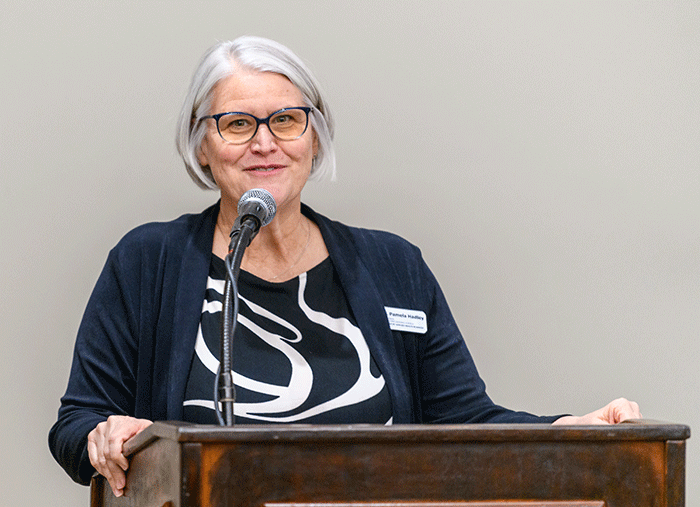
Pamela Hadley’s life as a researcher grew from her fascination with a observations about language development.
The first is the miracle of language development: how most children learn to understand and use grammar largely through exposure without explicit instruction in their first three years.
The second is that roughly 7 to 10 percent of children have persistent difficulty understanding and producing language in a condition known as developmental language disorder, or DLD.
The beauty and complexity of language is Hadley’s academic home base, and her commitment to extending its access to children with DLD continues to drive her work today.
“Sharing the mystery and the miracle of language acquisition, that is the story I tell every undergraduate who comes into my lab,” Hadley said.
After almost 20 years at the University of Illinois Urbana-Champaign, including five years spent as head of the Department of Speech and Hearing Science in the College of Applied Health Sciences, Hadley is retiring from her faculty duties while entering a new stage of her intellectual life.
As an expert on developmental language disorder, Hadley is disseminating the work from two grant-funded research projects, particularly a clinical trial she co-led from 2018 to 2025 with colleagues from Vanderbilt University and Northwestern University.
The trial was built around an 18-month intervention for children at high risk for developing DLD. Via telehealth, caregivers were coached on how to use several strategies to enrich the sentences they spoke around their children.
One strategy incorporated into the trial was Hadley’s “toy talk—teaching caregivers to use more descriptive talk about the objects their kids play with. Overall, the study showed grammatical abilities improved more for the preschoolers in the treatment group than the control group.
“For children with developmental language disorder, the area of weakness that is much more resistant to change is actually the grammar,” Hadley said. “The fact that we were able to slightly modify the language input, and we were able to get these language gains by starting early, is kind of huge.”
With all this information in hand, the concept of “retirement” isn’t at top of mind for Hadley. She’s focused on channeling this new knowledge to the clinicians and families who need it most, with the help of bright scientists she’s mentored and partnered with over the years.
“I’m really in this phase-down where what’s most important is disseminating the work and getting it out in ways that clinicians can better use,” Hadley said. “I’m thinking about how to translate the results of that trial for clinical audiences, doing more professional development conferences and workshops.
“Because research isn’t supposed to sit on a shelf; it’s supposed to transform lives.”
The mystery and miracle
On her first day as a graduate student at the University of Kansas, Hadley watched as Professor Mabel Rice filled her chalkboard with the names of scholars who studied child language development from different perspectives: linguistics, psycholinguistics, cognitive psychology, developmental psychology and more.
“It was all of the different ways in which the miracle of language acquisition was being studied, and that was kind of mind-blowing for me,” Hadley said.
Her time studying under Professor Rice, a renowned scholar in the field of child language development, became the source of key lessons for Hadley’s life as a scholar and mentor.
Research isn’t supposed to sit on a shelf; it’s supposed to transform lives.
Pamela Hadley
Professor, Department of Speech and Hearing ScienceStill early in her career, Rice had created a demonstration project funded by the Department of Education. It was an integrated preschool that included children learning English typically, children learning English as a second language and English-speaking children with specific language impairment, now known as developmental language disorder.
While providing language intervention in that classroom, Hadley said, she learned how effortless language acquisition was for children who were developing typically: those learning English as a second language could match the language proficiency of typically developing children in two years, unlike the children with DLD, who continued to struggle.
For Hadley, it also emphasized the urgency of intervention: in order to maximize the language outcomes for preschoolers with DLD, they typically need two years of intervention before kindergarten entry.
Finding ways to intervene in that window of time “became a huge motivation for me,” Hadley said. What she also took away, long after obtaining her Ph.D. in 1993, was Rice’s approach to mentorship. Rice had high standards, Hadley said, and she drew students to her who authentically shared her passion for child language development.
“Something in the framing of the problems … a certain type of student is attracted to working with me,” Hadley said. “You have to find the fascination in learning grammar. There are so few people who want to study grammar; many people are afraid of it.”
One who felt drawn to the focus of Hadley’s Applied Psycholinguistics Lab was Tracy Preza, who’s now an assistant professor of speech-language pathology at the University of Northern Iowa. She applied to Speech and Hearing Science for graduate school, largely for the potential of working in Hadley’s lab, and joined the lab in her first semester as a master’s student.
“What I find so impressive about Pam is that she cares incredibly deeply about changing clinical practice and improving outcomes for young children with DLD and also maintains such a high degree of rigor as a scientist,” Preza said. “She is passionate about both the science and the population, and I think she instills that in her students across all levels in the lab.”
As a leader, Hadley is known for being generous with her time. Georgia Malandraki leaned on her valuable context and insights while she was getting acclimated to her new department head role with Speech and Hearing Science at Illinois: “I greatly appreciate knowing that I can reach out to her for guidance, and that she will always take the time to listen and offer thoughtful advice,” Malandraki said.
Hadley is the same as a faculty mentor, willing to look at drafts for research posters, papers or personal statements, Preza said.
“I hope to bring the same degree of care and support that Pam had for me to my future students.”
Preza was fortunate enough to join the Applied Psycholinguistics Lab just as Hadley’s recent multisite intervention for DLD was kicking off, providing a new window into how parents’ language input can impact kids’ development of language.
An ambitious trial
Hadley’s idea of toy talk boils down to two simple strategies during play and everyday activities: “Talk about the toys (or objects)” a child is interested in and “give the object its name.”“While you’re playing with objects, we want to talk about how they move, how they change, what they look like. It changes the diversity of sentences kids are hearing.”
Contrasted with other types of language modelingsuch as labeling (“that’s a cup”), self-talk (“I got your cup”) or parallel talk (“you knocked your cup over”), toy talk naturally enriches the diversity and grammatical structure of sentences that children hear. “Your cup fell off,” for instance.
Why use this for kids with DLD? Since children with the disorder struggle more with grammar, like how verbs are marked for tense and agreement, toy talk makes the patterns of language “abnormally easy to detect,” Hadley said.
In the seven-year clinical trial, which enrolled 108 children at risk for developing DLD and their families, caregivers in the treatment group learned to use toy talk during a sentence-focused phase in the middle of the 18-month intervention. At the end of this phase, children in the treatment group had significantly better scores on grammar than children in the control group.
The short-term effects were published in June 2026, showing that changes in caregiver interaction and language input improved children’s grammatical development in particular, which excited Hadley.
“The reason this is so exciting is that usually people say we can’t target the grammar until children get older.” The manuscript reporting on the primary aims of the trial was accepted in September 2026.
“There’s seven years worth of data to get out and share with not just the research community but the clinical communities as well.”
‘This is who Pam is’
As fond as Hadley is about getting back to her researcher roots, experiencing the full-circle moments of former students bringing their work into the real world is always a special experience.
Sometimes students will send notes of appreciation and understanding, such as speech-language pathologist Kayla Jordan (SHS ’14, ’16), who’s helping clinicians in Chicagoland implement toy talk strategies for children with autism as part of a new clinical trial with Northwestern.
Hadley continues to collaborate with the very first student she mentored for a master’s thesis: Windi Krok, who’s now a clinical assistant professor in Purdue University’s Department of Speech, Language, and Hearing Sciences.
With a new perspective and a little encouragement, Hadley helped Krok develop stimuli from her doctoral dissertation into a new assessment tool. The sentence diversity priming task was originally developed to efficiently assess children’s sentence diversity and progress in intervention, Krok is now evaluating it as a measure of children’s responsiveness to instruction and learning potential.”
“Every major career advancement I have made has been because Pam believed in me, even when I didn’t believe in myself,” Krok said. “This is who Pam is. She sees strengths and promise where others might not.”
Hadley’s authentic passion for her research area “pushes those around her to continually strive for excellence,” Krok said. “Her legacy isn’t just the research she has produced, but the students, clinicians and researchers she has supported along the way.”
So, if you’re one of those alumni, don’t hesitate to reach out. Catching up with former students is one of Hadley’s “favorite treats” of faculty life.
“That’s a thrill for me,” Hadley said. “Maintaining contact with alumni who have gone on to use the tools that we taught them while they were here … that communication to us is really meaningful.”
Editor’s note:
To reach Pamela Hadley, email phadley@illinois.edu
Share on social