Hadley’s research transcends retirement


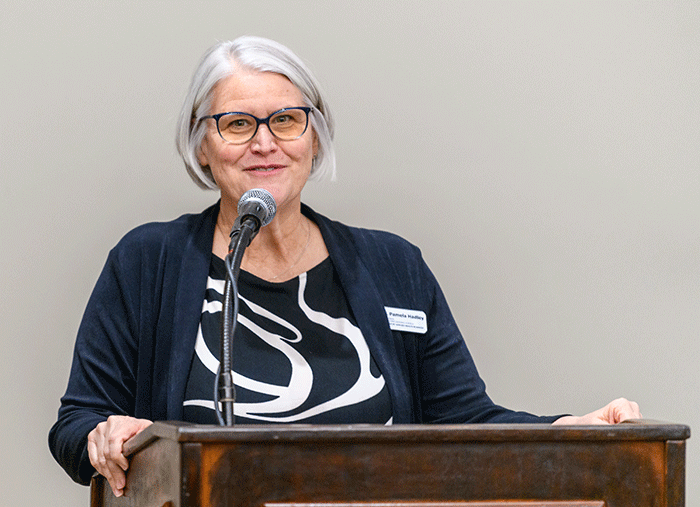
After nearly 20 years at Illinois, Pamela Hadley is retiring from her faculty duties but still engaged in research. (Photo by Ethan Simmons).

Pamela Hadley’s life as a researcher grew from her fascination with a observations about language development. 

The first is the miracle of language development: how most children learn to understand and use grammar largely through exposure without explicit instruction in their first three years.

The second is that roughly 7 to 10 percent of children have persistent difficulty understanding and producing language in a condition known as developmental language disorder, or DLD.

The beauty and complexity of language is Hadley’s academic home base, and her commitment to extending its access to children with DLD continues to drive her work today.

“Sharing the mystery and the miracle of language acquisition, that is the story I tell every undergraduate who comes into my lab,” Hadley said. 

After almost 20 years at the University of Illinois Urbana-Champaign, including five years spent as head of the Department of Speech and Hearing Science in the College of Applied Health Sciences, Hadley is retiring from her faculty duties while entering a new stage of her intellectual life. 

As an expert on developmental language disorder, Hadley is disseminating the work from two grant-funded research projects, particularly a clinical trial she co-led from 2018 to 2025 with colleagues from Vanderbilt University and Northwestern University. 

The trial was built around an 18-month intervention for children at high risk for developing DLD. Via telehealth, caregivers were coached on how to use several strategies to enrich the sentences they spoke around their children. 

One strategy incorporated into the trial was Hadley’s “toy talk—teaching caregivers to use more descriptive talk about the objects their kids play with. Overall, the study showed grammatical abilities improved more for the preschoolers in the treatment group than the control group. 

“For children with developmental language disorder, the area of weakness that is much more resistant to change is actually the grammar,” Hadley said. “The fact that we were able to slightly modify the language input, and we were able to get these language gains by starting early, is kind of huge.” 

With all this information in hand, the concept of “retirement” isn’t at top of mind for Hadley. She’s focused on channeling this new knowledge to the clinicians and families who need it most, with the help of bright scientists she’s mentored and partnered with over the years.   

“I’m really in this phase-down where what’s most important is disseminating the work and getting it out in ways that clinicians can better use,” Hadley said. “I’m thinking about how to translate the results of that trial for clinical audiences, doing more professional development conferences and workshops.

“Because research isn’t supposed to sit on a shelf; it’s supposed to transform lives.”  

The mystery and miracle

On her first day as a graduate student at the University of Kansas, Hadley watched as Professor Mabel Rice filled her chalkboard with the names of scholars who studied child language development from different perspectives: linguistics, psycholinguistics, cognitive psychology, developmental psychology and more. 

“It was all of the different ways in which the miracle of language acquisition was being studied, and that was kind of mind-blowing for me,” Hadley said. 

Her time studying under Professor Rice, a renowned scholar in the field of child language development, became the source of key lessons for Hadley’s life as a scholar and mentor. 

Research isn’t supposed to sit on a shelf; it’s supposed to transform lives.

Pamela Hadley

Professor, Department of Speech and Hearing Science

Still early in her career, Rice had created a demonstration project funded by the Department of Education. It was an integrated preschool that included children learning English typically, children learning English as a second language and English-speaking children with specific language impairment, now known as developmental language disorder. 

While providing language intervention in that classroom, Hadley said, she learned how effortless language acquisition was for children who were developing typically: those learning English as a second language could match the language proficiency of typically developing children in two years, unlike the children with DLD, who continued to struggle. 

For Hadley, it also emphasized the urgency of intervention: in order to maximize the language outcomes for preschoolers with DLD, they typically need two years of intervention before kindergarten entry. 

Finding ways to intervene in that window of time “became a huge motivation for me,” Hadley said. What she also took away, long after obtaining her Ph.D. in 1993, was Rice’s approach to mentorship. Rice had high standards, Hadley said, and she drew students to her who authentically shared her passion for child language development.

“Something in the framing of the problems … a certain type of student is attracted to working with me,” Hadley said. “You have to find the fascination in learning grammar. There are so few people who want to study grammar; many people are afraid of it.” 

One who felt drawn to the focus of Hadley’s Applied Psycholinguistics Lab was Tracy Preza, who’s now an assistant professor of speech-language pathology at the University of Northern Iowa. She applied to Speech and Hearing Science for graduate school, largely for the potential of working in Hadley’s lab, and joined the lab in her first semester as a master’s student. 

“What I find so impressive about Pam is that she cares incredibly deeply about changing clinical practice and improving outcomes for young children with DLD and also maintains such a high degree of rigor as a scientist,” Preza said. “She is passionate about both the science and the population, and I think she instills that in her students across all levels in the lab.” 

As a leader, Hadley is known for being generous with her time. Georgia Malandraki leaned on her valuable context and insights while she was getting acclimated to her new department head role with Speech and Hearing Science at Illinois: “I greatly appreciate knowing that I can reach out to her for guidance, and that she will always take the time to listen and offer thoughtful advice,” Malandraki said.

Hadley is the same as a faculty mentor, willing to look at drafts for research posters, papers or personal statements, Preza said. 

“I hope to bring the same degree of care and support that Pam had for me to my future students.” 

Preza was fortunate enough to join the Applied Psycholinguistics Lab just as Hadley’s recent multisite intervention for DLD was kicking off, providing a new window into how parents’ language input can impact kids’ development of language. 

An ambitious trial 

Hadley’s idea of toy talk boils down to two simple strategies during play and everyday activities: “Talk about the toys (or objects)” a child is interested in and “give the object its name.”“While you’re playing with objects, we want to talk about how they move, how they change, what they look like. It changes the diversity of sentences kids are hearing.”

Contrasted with other types of language modelingsuch as labeling (“that’s a cup”), self-talk (“I got your cup”) or parallel talk (“you knocked your cup over”), toy talk naturally enriches the diversity and grammatical structure of sentences that children hear. “Your cup fell off,” for instance. 

Why use this for kids with DLD? Since children with the disorder struggle more with grammar, like how verbs are marked for tense and agreement, toy talk makes the patterns of language “abnormally easy to detect,” Hadley said. 

In the seven-year clinical trial, which enrolled 108 children at risk for developing DLD and their families, caregivers in the treatment group learned to use toy talk during a sentence-focused phase in the middle of the 18-month intervention. At the end of this phase, children in the treatment group had significantly better scores on grammar than children in the control group.

The short-term effects were published in June 2026, showing that changes in caregiver interaction and language input improved children’s grammatical development in particular, which excited Hadley. 

“The reason this is so exciting is that usually people say we can’t target the grammar until children get older.”  The manuscript reporting on the primary aims of the trial was accepted in September 2026.
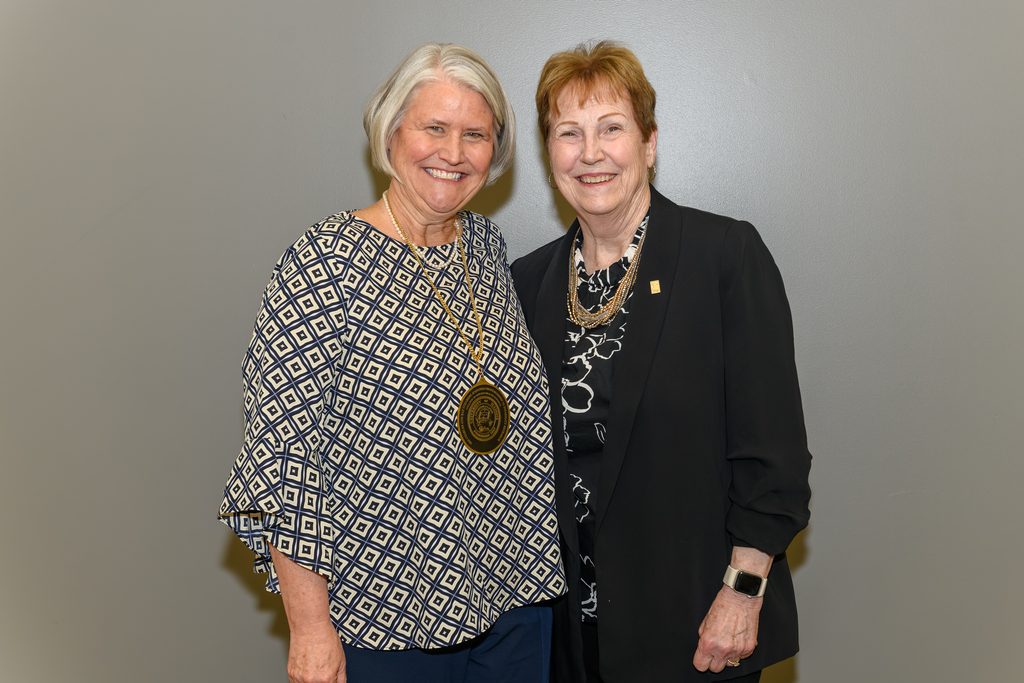
Pamela Hadley with Cheryl Hanley-Maxwell, dean of the College of Applied Health Sciences (Photo by Craig Pessman).

“There’s seven years worth of data to get out and share with not just the research community but the clinical communities as well.” 

‘This is who Pam is’

As fond as Hadley is about getting back to her researcher roots, experiencing the full-circle moments of former students bringing their work into the real world is always a special experience. 

Sometimes students will send notes of appreciation and understanding, such as speech-language pathologist Kayla Jordan (SHS ’14, ’16), who’s helping clinicians in Chicagoland implement toy talk strategies for children with autism as part of a new clinical trial with Northwestern.

Hadley continues to collaborate with the very first student she mentored for a master’s thesis: Windi Krok, who’s now a clinical assistant professor in Purdue University’s Department of Speech, Language, and Hearing Sciences. 

With a new perspective and a little encouragement, Hadley helped Krok develop stimuli from her doctoral dissertation into a new assessment tool. The sentence diversity priming task was originally developed to efficiently assess children’s sentence diversity and progress in intervention, Krok is now evaluating it as a measure of children’s responsiveness to instruction and learning potential.” 

“Every major career advancement I have made has been because Pam believed in me, even when I didn’t believe in myself,” Krok said. “This is who Pam is. She sees strengths and promise where others might not.” 

Hadley’s authentic passion for her research area “pushes those around her to continually strive for excellence,” Krok said. “Her legacy isn’t just the research she has produced, but the students, clinicians and researchers she has supported along the way.”

So, if you’re one of those alumni, don’t hesitate to reach out. Catching up with former students is one of Hadley’s “favorite treats” of faculty life.

“That’s a thrill for me,” Hadley said. “Maintaining contact with alumni who have gone on to use the tools that we taught them while they were here … that communication to us is really meaningful.” 

Editor’s note: 

To reach Pamela Hadley, email phadley@illinois.edu 

Share on social
Related news

Six new grants advance SHS research in health, hearing, language and literacy


Six SHS faculty members secured funding this summer. (Google Images)

Faculty in the Department of Speech and Hearing Science are launching newly funded projects that address how children hear in complex environments, how clinicians deliver swallowing rehabilitation, how early language and literacy interventions can be tailored to families and classrooms, and how educators can put statewide literacy policy into practice. These awards continue the department’s exceptional momentum in research funding, adding to a vibrant portfolio of active externally sponsored projects that advance scientific discovery and improve lives. Together, the awards reflect a shared commitment to translating innovative research into meaningful clinical and developmental outcomes.

Associate Professor Justin Aronoff is a co-investigator on “Functional Spatial Hearing in Reverberation by Pediatrically Implanted Children and Young Adults,” a project led by principal investigator Ellen Peng at Boys Town National Research Hospital. The award totals $3,353,690, with a $202,974 subaward coming to the University of Illinois.

The project focuses on children with severe-to-profound hearing loss who use bilateral cochlear implants. Although the devices partially restore spatial hearing, everyday settings such as noisy, reverberant classrooms can still make it difficult to locate sounds and separate a speaker’s voice from competing noise. Researchers will examine how room reverberation and cochlear implant signal processing work together to shape functional spatial hearing.

Using psychophysical methods and realistic simulations of reverberant spaces, the team will study auditory image perception, spatial acuity and spatial unmasking. It will also consider developmental and hearing-related factors that may influence performance. The findings are expected to clarify gaps between pediatric cochlear implant users and peers with typical hearing and inform future work on personalized bilateral fitting strategies.

Assistant Professor Mariana Mendes Bahia, Julia Carpenter and Kelly Rogers received a $9,994 Shirley Ryan AbilityLab Catalyst Grant for “Practice Patterns in Dysphagia Rehabilitation: From Characterization to Practice Improvement.” Dysphagia, or difficulty swallowing, is common among people with neurological, oncological and other conditions, but research reports and clinical documentation often provide limited detail about what treatment is delivered and how it is implemented. Carpenter and Rogers are from the Shirley Ryan Ability Lab, where Carpenter is a practice leader in SLP and Rogers is a swallowing clinician.

The team will use the Rehabilitation Treatment Specification System, a framework for describing treatment targets, ingredients and mechanisms of action, to analyze dysphagia rehabilitation data. Researchers will characterize practice patterns across care settings and diagnoses, examine connections between rehabilitation practices and patient outcomes, and identify practical opportunities for quality improvement. By making treatment approaches more visible and comparable, the project aims to strengthen both clinical practice and future research.

A third project brings together Charles and Kay Stenberg Endowed Professor in Disability Research Pamela Hadley, the former SHS department head, Emily Harrington, assistant professor in Special Education and an SHS alumna, and Matt Lambert, professor and head of Special Education. Their two-year, $426,559 exploratory/developmental R21 award from the National Institute on Deafness and Other Communication Disorders supports “Leveraging Extant Data to Characterize Language Growth and Optimize Caregiver-Implemented Interventions for Children with Late Language Emergence.” The award runs from Aug. 1, 2026, through July 31, 2028.

Led by principal investigator Harrington, the researchers will analyze existing data from a randomized controlled trial of Enhanced Milieu Teaching-Sentence Focused, a caregiver-implemented intervention. They will trace vocabulary growth from 30 to 39 months and sentence development from 36 to 45 months, while examining how intervention strategies, children’s uptake of those strategies and participant-level factors shaped individual trajectories.

Results will help identify which intervention components work best at different developmental points. That evidence can guide the design and evaluation of brief, targeted approaches capable of reaching more children with late language emergence and their families.

SHS Associate Professor Laura Mattie’s collaborative research proposal with Founder Professor of Computer Science and Industrial and Enterprise Systems Engineering James Rehg, “Using Developmental Machine Learning to Code Eye Gaze in Down Syndrome and Fragile X Syndrome,” was selected for an 18-month, $29,987 grant from the Social & Behavioral Science Institute.

The project will determine AI’s ability to streamline behavioral coding of eye gaze in young children with Down syndrome and fragile X syndrome by leveraging the AnyGaze AI model. Recent advances in the development of AI models for quantifying nonverbal communication, led by Co-I Rehg, have enabled accurate coding of eye gaze in young neurotypical children and those with autism. However, the AnyGaze AI model has not yet been expanded to other neurodevelopmental disabilities. Additionally, the team will train the AnyGaze AI model to single, dual, and triadic gaze shifts, which are important for classifying early communication. With this foundation, the team aims to examine the potential clinical applications of the AnyGaze AI model by speech-language pathologists for assessment and treatment planning.

Assistant Professor Meaghan McKenna is principal investigator for “Writing for Reading: A Technology-Based Approach to Literacy Growth,” a $1,876,852 project funded by the U.S. Department of Education’s Office of Special Education Programs through its Stepping-Up Technology Implementation program. Hope Gerde of Texas A&M University is co-principal investigator; Jack Drobisz of the University of South Florida and Pasquale Bottalico are co-investigators. The award runs from Oct. 1, 2026, through Sept. 30, 2031. You can read more about McKenna’s grant here.

The team will add a kindergarten-first grade writing extension to the Electronic Data Management and Expert Decision Making System. Through iterative development, evaluation, scale-up and dissemination, the project will offer job-embedded professional development designed to help classroom teachers strengthen children’s writing and reading achievement.

McKenna also serves as co-principal investigator on “The Illinois Literacy Plan: Identifying the Supports Needed for Meaningful Policy Implementation and Revision,” led by principal investigator Rachel Schachter of the University of Illinois Chicago. The $15,000 grant from the University of Illinois System Institute of Government and Public Affairs runs from July 1, 2026, through June 30, 2027.

The project will assess how school administrators, teachers and specialists perceive the Illinois State Literacy Plan and what support they need to implement it effectively. Findings will guide policies that better support educators and strengthen partnerships across the state.

Each project also depends on collaboration across disciplines and institutions, extending the faculty’s expertise through partnerships that connect laboratory measures, clinical records, classroom practice, public policy and family-centered intervention data with the practical challenges experienced by patients, practitioners, educators, children and caregivers every day.

Across the six awards, faculty and collaborators are pairing rigorous methods with questions rooted in daily life: hearing in a classroom, documenting swallowing care, supporting a child’s first words and sentences, strengthening early writing and reading, and helping educators implement literacy policy. These new projects continue a period of remarkable research growth within the department, adding to SHS’ mission of advancing both scientific discovery and clinical practice.

Editor’s note:

To reach Vince Lara-Cinisomo, email vinlara@illinois.edu.
 

Share on social

Related news

Our 2026 College of Applied Health Sciences award winners


At the spring college meeting for the College of Applied Health Sciences, our faculty and staff gathered to celebrate this year’s college award winners, and give send-offs to two faculty leaders who are entering retirement: Speech and Hearing Science Professor and former Department Head Pamela Hadley and AHS Professor and Associate Dean for Research Jeff Woods.

(Two of our award winners, Christy Bazan and Mary Flaherty, won equivalent awards from campus as well.)

Here are our AHS college award winners for 2025-26. A recording of the meeting is available on Media Space:

AHS Staff Excellence Award

  • Chez Veterans Center Outreach Coordinator and Veteran Recruiter, Garrett Anderson
  • College of AHS Assistant to the Dean, Robbin King

AHS Excellence in Undergraduate Advising Award

  • Health and Kinesiology Academic Advisor, Patty Hudek

AHS Excellence in Undergraduate Teaching Award – Faculty

  • Speech and Hearing Science Associate Professor, Mary Flaherty

AHS Excellence in Undergraduate Teaching Award – Teaching Assistant

  • Health and Kinesiology Graduate Teaching Assistant, Ashley Morgan

AHS Access, Belonging and Community Awards

  • SHS student Zhitong Zhu
  • RST graduate research assistant Jenna Fesemyer-Ayers
  • RST Assistant Professor Yannick Kluch
  • Chez Veterans Center Research Assistant Professor Michael Lotspeich-Yadao

AHS Excellence in Guiding Undergraduate Research Award

  • Recreation, Sport and Tourism Assistant Professor, Joelle Soulard

AHS Excellence in Graduate and Professional Teaching Award

  • SHS Associate Professor, Dan Fogerty

AHS Excellence in Graduate Student Mentoring Award

  • HK Associate Professor, Laura Rice

AHS Excellence in Online Teaching Award

  • HK Instructor, Christy Bazan

Phyllis J. Hill Faculty Award for Exemplary Mentoring

  • HK Teaching Assistant Professor, Jesse Couture

Share on social

Related news

A message to Speech and Hearing Science, from Department Head Georgia Malandraki


Georgia Malandraki, professor and department head of Speech and Hearing Science, has begun her second month as department head. (Ethan Simmons/College of AHS)

Dear Speech and Hearing Science community,

It is with pride and a deep sense of responsibility that I begin my role as Head of the Department of Speech and Hearing Science. Returning to Illinois, where I completed my Ph.D. and where many of our distinguished faculty shaped my early career, feels like coming home. It is both humbling and exciting to now have the opportunity to give back to the community that supported me from the start.

Over the past several months, I have begun to learn the many stories, strengths, and aspirations that make SHS such a vibrant community. Every conversation with faculty, staff, and students has reminded me of something I have known since I was a student here: SHS is a community where excellence and compassion go hand in hand, and where people genuinely care about making an impact. I am grateful to join you as we continue building on that foundation together.

I am thankful to be joining the department at a time of remarkable momentum, built under the leadership of former Head and Professor Pamela Hadley and Dean Cheryl Hanley Maxwell. The shared governance model, the selfless and dedicated service of faculty, the collective passion for impactful research and clinical training, and the strong commitment to inclusion that I have witnessed during this transition are outstanding.

Equally impressive is the work ethic and dedication of our faculty, staff, and students, clear indicators of the remarkable potential ahead. Importantly, the support and enriching environment provided by the College of Applied Health Sciences and the University as a whole foster collaboration, innovation, and sustained excellence, creating the conditions for SHS to grow and continue its legacy as one of the leading departments in the state and the country.

As we look toward the future, I see a department that not only sustains this legacy but continues to grow its reach locally, nationally, and globally. Together, we will focus on our shared goals:

  • Strengthening our position as a global leader in research and clinical training in communication sciences and disorders
  • Empowering students through exceptional and forward-thinking education
  • Expanding our engagement with communities and partners who rely on our expertise
  • Growing the resources and support needed to enhance discovery, education, and service

These are meaningful goals, and I am confident we can achieve them. The talent, commitment, and heart I see within SHS are truly remarkable.

In the coming months, I look forward to hearing your ideas, learning from your experiences, and working with you to shape the next chapter of SHS. I welcome perspectives from everyone—students, alumni, faculty, staff and friends—because the future we create together will be stronger for it.

Thank you for the very warm welcome. I am inspired by this department, energized by its potential, and honored to walk forward with you.

With warmest regards,
Georgia A. Malandraki, Ph.D., CCC-SLP, BCS-S, ASHA Fellow
Professor and Head

Share on social

Related news

Illinois Speech and Hearing Science at ASHA 2025

Assistant Professor Meaghan McKenna won the 2025 ASHA Early Career Contributions in Research Award. (Provided)

The American Speech-Language Hearing Association (ASHA) held the 2025 ASHA Convention from Nov. 20–22 in Washington, D.C.

Our Department of Speech and Hearing Science at Illinois was well-represented: several SHS faculty and graduate students were in attendance to accept awards and present seminars on their research and teaching contributions.

SHS faculty and students’ ASHA Awards

  • Assistant Professor Meaghan McKenna is being awarded the 2025 ASHA Early Career Contributions in Research Award
  • Ph.D. student Tracy Preza is being awarded an ASHFoundation Student Research Grant in Early Childhood Language Development
  • Ph.D. student Eliza Baby and mentor Professor Raksha Mudar are being awarded a Research Mentoring-Pair Travel Award
  • Ph.D. student Daniela Fanta Alarco is selected for the ASHA Student Leadership Program
  • M.A. student Raina Harpalani is being awarded an ASHFoundation Graduate Scholarship

SHS faculty and students’ talks

Thursday, Nov. 20

12:30 p.m.—Poster: “Examining the Effectiveness and Feasibility of a WebBased First Grade Writing Intervention”
McKenna, M.
Location: CC/Poster (Hall D); Screen #: 134

4:30 p.m.—Poster: “Measuring Functional Communication in Mild Cognitive Impairment”
Lydon, E., Wallace, N., Mudar, R.
Location: CC/Poster (Hall D); Screen #: 134

6 p.m.—One-hour seminar (Invited): “The Speech Accessibility Project: Reflections on Technological Innovation & Visions for Communication Empowerment”
Mendes, C.
Location: CC/151B (Lvl 1)

Friday, Nov. 21

8 a.m.—One-hour seminar: “Building on Legacy, Transforming Practice: Tools to Support SLP Engagement with Multi-Tiered Systems of Support”
Sylvan, L., McKenna, M., Ireland, M.
Location: CC/202A (Lvl 2)

11 a.m.—One-hour seminar: “Imitation and Lexical Overlap in Toddlers with Language Delays: Automated Coding and Sequential Analysis”
Harrington, E., Hadley, P.
Location: Marr/Independence Salon F/G/H (Mtg Lvl 4, LL)

1:30 p.m.—One-hour seminar (Invited): “Research Symposium on Hearing: The Utility of Extended High-Frequency Hearing and Assessment for Speech Communication”
Monson, B., Calandruccio, L.
Location: CC/151B (Lvl 1)

5:30 p.m.—Technical/Research Presentation: “Practice improvement in swallowing management: Using skill-based training in hospitalized post-stroke patients with dysphagia”
Bahia, M.M., Rogers, K., Carpenter, J., Cherney, L.R.
Location: Marr/Liberty Salon K (Mtg Lvl 4, LL)

Speech and Hearing Science faculty and students gathered at this year’s ASHA conference. (Provided)

Saturday, Nov. 22

11 a.m.—One-hour seminar: “Addressing Elementary Writing When Delivering Intervention: Preparing Young Children for Success in School and Life”
McKenna, M.
Location: CC/204B (Lvl 2)
** Designated as a Centennial Session!

Message from Department Head Pamela Hadley


Photo Charles and Kay Stenberg Professor and SHS Department Head Pamela Hadley (Photo by Bradley Leeb)

Dear Students, Faculty, Alumni and Friends of the Department of Speech and Hearing Science,

As we step into the energy of spring 2025, I’m excited to share the latest updates from our department. It’s been a remarkable year, and we have so much to celebrate!

Our commitment to advancing the field of communication sciences and disorders continues to grow. In this edition, we highlight the inspiring achievements of our faculty, students and alumni. We have stories on a newly established aphasia group, multiple grants on understanding and improving hearing in noise, how our research translates to the lives of friends and family and an introduction to one of our new faculty members.

Take a moment to explore the stories in this newsletter and reflect on the incredible work in SHS. Together, we’re pushing boundaries, advancing new approaches to treatment, and improving lives of children and adults.

A heartfelt thank you to our dedicated faculty, staff and students—your passion and perseverance are the heart of our success.

Wishing you a vibrant and inspiring spring season!

Sincerely,
Pamela Hadley, Ph.D.
Charles and Kay Stenberg Professor and Head

Related news

Message from Professor Pamela Hadley, head


Pamela Hadley (Photo by Bradley Leeb)

Dear students, faculty, alumni, and friends of the Department of Speech and Hearing Science,

As we enjoy the spring colors across campus, I welcome you to the latest departmental newsletter. It fills me with great pride to share the progress we’ve made in recent months and provide a glimpse into the prospects on our horizon.

Our dedication to advancing the fields of audiology and speech-language pathology remains steadfast. In this edition, we showcase the stories of faculty, students and alumni making significant contributions across various facets of our field. These narratives underscore the strength of our community and the profound impact we have on enhancing quality of life.

I invite you all to explore the contents of this newsletter, celebrate our successes and envision the limitless possibilities ahead. Together, we will continue to empower individuals facing communication challenges, pioneer groundbreaking research and shape the trajectory of communication sciences and disorders.

Lastly, I extend my heartfelt gratitude to SHS faculty, staff and students for your unwavering dedication. Your tireless efforts are the cornerstone of our achievements, and your enthusiasm propels us forward.

Warm regards for a restful and reinvigorating summer.

Sincerely,

Pamela Hadley, Ph.D.
Professor and Head

Related news

Georgia Malandraki named new head of the Department of Speech and Hearing Science


Georgia Malandraki earned her Ph.D. from the University of Illinois in 2008. (Photo provided)

The College of Applied Health Sciences at the University of Illinois Urbana-Champaign is pleased to announce the appointment of Dr. Georgia A. Malandraki as the new head of the Department of Speech and Hearing Science, effective January 2026. Dr. Malandraki brings with her an exceptional record of scholarly achievement, clinical innovation and academic leadership that will advance the department’s mission in education, research and service.

Dr. Malandraki succeeds Dr. Pamela Hadley as department head, who was appointed department head in 2020. Dr. Hadley will continue serving as the Charles and Kay Stenberg Endowed Professor in Disability Research.

“Since earning my Ph.D. in Speech and Hearing Science from Illinois in 2008, I have been fortunate to have a deeply fulfilling career—one that has been profoundly shaped by the training and mentorship I received during my doctoral years,” Malandraki said. “It is an incredible honor to return to my alma mater to serve as head of SHS. As I step into this role, I am beyond humbled and filled with excitement.

“I follow in the footsteps of professor and current head, Dr. Pamela Hadley, whose compassionate leadership and dedication have strengthened the department through growth and challenges, including during the pandemic. I first met Dr. Hadley during my final year as a doctoral student, and her warmth and generosity have left a lasting impression—one she has carried into her impactful tenure as head. I am deeply grateful for her example and the foundation that she, along with her distinguished predecessors, has built. As I take on this role, I do so with humility, gratitude, and a strong commitment to inclusive excellence, innovation, and collaboration. I look forward to working alongside the exceptional SHS faculty, students, and staff, and under the inspiring leadership of AHS Dean Cheryl Hanley-Maxwell, as we continue to advance impactful research, education, and service in the field of communication sciences and disorders at the University of Illinois Urbana-Champaign. Go Illini!”

Dr. Malandraki joins the University of Illinois from Purdue University, where she served as a professor in the Department of Speech, Language and Hearing Sciences, with a courtesy appointment in the Weldon School of Biomedical Engineering. At Purdue, she directed the I-EaT Swallowing Research Laboratory and Clinic and played a pivotal role in interdisciplinary research and education focused on the neural mechanisms of swallowing function.

Dr. Malandraki earned her Ph.D. at the University of Illinois in 2008 after earning her master’s at Ohio University and her undergraduate degree from the Technological Educational Institute of Patras, Greece.

An internationally recognized expert in dysphagia, Dr. Malandraki is a certified speech-language pathologist, a board-certified specialist in swallowing and swallowing disorders, and a Fellow of the American Speech-Language-Hearing Association (ASHA). Her groundbreaking work has focused on the development of neurophysiologically driven interventions and telehealth solutions to expand access to care for individuals with swallowing disorders, particularly in underserved populations.

Dr. Malandraki is a founding member of the Purdue CEREBBRAL Center and a faculty associate with the Purdue Center for Aging and the Life Course. Her contributions to the field have earned her numerous accolades, including the NIH NIBIB R21 Trailblazer Award in 2019, the Purdue Early Career Research Achievement Award, and the 2021 ASHA Fellowship. Her team also received the 2021 Editor’s Award from the Journal of Speech, Language, and Hearing Research (JSLHR), and she was honored with the 2022 Honors of the Indiana Speech-Language-Hearing Association.

In addition to her research accomplishments, Dr. Malandraki is widely respected for her commitment to excellence in teaching. Since joining Purdue in 2014, she has been recognized with eight departmental teaching awards and received the 2018 Patsy J. Mellott Teaching Innovation Award from Purdue’s College of Health and Human Sciences.

“We are thrilled to welcome Dr. Malandraki to the University of Illinois,” said Cheryl Hanley-Maxwell, dean of the College of Applied Health Sciences. “Her visionary leadership, collaborative spirit and unwavering dedication to advancing the science and practice of communication and swallowing disorders make her an ideal choice to lead our Department of Speech and Hearing Science into its next chapter.”

Editor’s note:

To reach Vince Lara-Cinisomo, email vinlara@illinois.edu.
 

Related news

Q&A: Pamela Hadley, SHS Department Head


‘We have such a great group of remarkable scientists who are really committed to rigor in their research,’ Department Head Pamela Hadley said. (Photo by Ethan Simmons)

Q: This year’s deeper dives into the history of the Department of Speech and Hearing Science at the University of Illinois have been fascinating. Was there anything in any of these explorations that surprised you, even in your role as the department’s head?

A: Oh, absolutely. For example, I didn’t know how instrumental faculty at the University of Illinois had been in the development of the ASHA [American Speech-Language-Hearing Association] journals. The field continues to grapple, even today, with how to disseminate scientific findings. 

There also are many discussions about opening up access to science, especially those things that are federally funded by taxpayer dollars. The internet and social media have fundamentally changed the number of options for sharing scientific findings and clinical resources with the public. That’s something that, looking forward, we will continue to work through. With regard to the SHS at 50 stories, it was really important for me to appreciate the role that Illinois faculty had in the development of those early journals at the very beginning.

Q: What are some topics you would have liked to explore for this series if we’d had more time?

A: Something we talked about early on was exploring paradigm shifts in the field. There are individuals from Illinois who were responsible for changing the way in which our field approached clinical practice. Some of those researchers include Dean Emerita Tanya Gallagher and Carol Prutting, who were mentored by Tom Shriner Jr. in the 1970s. Together they were responsible for bringing the pragmatics revolution into the field of speech-language pathology and establishing the subfield of clinical pragmatics, focused on how language is used in conversational interactions. 

Another example: Elaine Paden and Ph.D. student Barbara Hodson contributed to a paradigm shift in how we treat young children’s speech-sound disorders. They were instrumental in shifting the field toward treating classes of sounds to improve the intelligibility of young children’s speech more efficiently. That was a huge paradigm shift.

Professor Emerita Adrienne Perlman was an advocate for expanding the speech-language pathology scope of practice to include dysphagia, or swallowing disorders. When I was a clinical student, swallowing wasn’t part of our scope of practice yet! Now it’s such a fundamental aspect of medical SLPs’ role in hospitals and skilled nursing facilities in particular.

Finally, it would have been wonderful to highlight major research projects throughout the history of the department, such as the Illinois International Stuttering Research Project that was led by Professor Emeritus Ehud Yairi.

Q: What’s impressed you the most about the department’s growth and development since you joined the faculty?

A: I’m so impressed with my faculty colleagues. We have such a great group of remarkable scientists who are really committed to rigor in their research. They hold themselves and their students to high standards, and at the same time, they’re just truly wonderful people who’ve been so committed to delivering high-quality instruction through some really unprecedented times. I admire their resilience. I enjoy their company. In short, I’m just really proud to lead this department.

Q: What are some new areas in this field that recent graduates, current students, and students who will join you in the next few years have, or will have, the expertise to address as they move into their careers?

A: Telehealth is a professional area that has really expanded rapidly in the last three years. Prior to COVID-19, students weren’t trained to assess or treat via telehealth at all. It was considered to be an advanced clinical skill and not something that students would be expected to learn until they had years of clinical practice under their belt.

During the stay-at-home mandates, telehealth became a lifeline, and it caused our professional bodies to reconsider whether this was an essential skill that all our students in training needed to have. We also had many research projects that were required to pivot to remote data collection. Students today are far more advanced in their knowledge and skills in this area, and they are better prepared to conduct research and deliver clinical services remotely than prior graduates.

Q: Let’s talk a bit more about the department’s Audiology and Speech-Language Pathology Clinic. You’ve referred to it as the “crown jewel” of the department’s community outreach efforts. How would you like to see the clinic evolve?

A: This summer we had a public meeting as part of a follow-up, in-person site visit from our accreditation body, and a number of individuals who received services from our clinic and their family members attended the meeting. They just raved to the site visitors about the services that they were receiving and the impact of those services on their well-being and quality of life. To hear that kind of feedback from the families that we serve just means everything—it’s so essential to what we’re trying to accomplish in terms of our public engagement and outreach, and it’s testimony to how critically important communication skills are to participation in everyday activities. That encapsulates why I’ve referred to the clinic as a “crown jewel.” 

I’d really like to see the clinic expand its sphere of influence beyond the Urbana-Champaign community. My dream for the clinic would be for it to be a center of excellence, particularly for families in rural communities that may not have access to state-of-the-science resources in their local communities. Also, it would be my hope that we could bring individuals here for comprehensive assessments and develop the types of support those families might need for ongoing care, and then maintain that contact through telehealth with educators or health care providers in their local communities. I think that that could be really powerful.

Q: We’ve established through these stories that the SHS faculty at Illinois have been pioneers in the research, and they’ve been leaders in their profession since the beginning. Will these stories serve as inspiration for future activities? Where do you think this department can lead your disciplines in the future?

A: I think these stories helped us bring history alive and explored some topics in a more conversational way than reading a review of the history of the department. What I most hope, though, is that these stories provide our students and faculty with a strong sense of where they come from and, really, a deeper appreciation of the fact they’re standing on the shoulders of giants—pioneers who really established the profession and were influential from the beginning. 

Where do I think SHS will lead the discipline in the future? I envision SHS faculty and students contributing to innovations in health technology, including the use of that technology to improve treatment options, and evaluating how different design features might promote people’s use of those technologies and what new technologies are desired. Those health technologies could include how we are designing and developing hearing aids, which treatments best fit an individual’s cognitive profiles and communication needs, how we interact with augmentative and alternative communication devices, how we use speech recognition devices, or how we use different kinds of technologies to age in place successfully. Technology has moved really quickly just in the last year. So the next 50 years? It’s hard to imagine where we’ll be!

For more on the 50th anniversary of SHS at Illinois, check out our stories at ahs.illinois.edu/shs-50.

Related news

Pamela Hadley honored with Stenberg Endowed professorship


Pamela Hadley, center, with faculty and staff of the Department of Speech and Hearing Science (Photo by Craig Pessman)

The daughter of a farmer in rural Illinois, Pamela Hadley had no “schema” for becoming a university professor. But a high school career filled with self-expression helped guide her toward an illustrious academic career that was culminated with a top honor.

Hadley, the head of the Department of Speech and Hearing Science and a professor, was appointed as the inaugural Charles and Kay Stenberg Endowed Professor in Disability Research in a ceremony on April 30.

The appointment is a testament to Hadley’s decades-long dedication to advancing the science of language development in young children, particularly those with developmental language disorder, said Cheryl Hanley-Maxwell, dean of the College of Applied Health Sciences.  

“Pam Hadley has made significant contributions to language science through highly regarded translational research, mentored numerous students into clinical and academic careers, and benefitted the department, university and profession at large through a variety of service activities,” Hanley-Maxwell said.  

The named professorship “is an honor that is accorded to outstanding scholars who have well-established records of excellence in research, teaching, and public engagement,” Hanley-Maxwell added.

The professorship was made possible by a generous endowment from Charles and Kay Stenberg, both Illinois alumni who experienced firsthand the challenges of navigating life with disabilities in an era before the Americans with Disabilities Act. Though they have passed, their legacy lives on through their commitment to disability research and through the continued support of Kay’s brother, Hugh Wishart. 

“Chuck and Kay were passionate about accessibility and believed deeply in supporting research that improves the lives of people with disabilities,” Hanley-Maxwell said.
Hadley also expressed deep gratitude to the Stenberg family, colleagues, students, and family members who shaped her journey. 

“This is rightfully a shared honor,” she said. “I’m profoundly humbled to be named the Charles and Kay Stenberg Professor. The Stenbergs faced and overcame many barriers, and they endowed this professorship to help others do the same.”

Hadley reflected on a life shaped by both personal experience and professional purpose. Raised in rural Henry County, Illinois, she credited her parents for instilling in her a love for inquiry and compassion. Her father, a farmer, encouraged her to solve story problems at dinner. Her mother, a nurse, brought her along on Saturday visits to residents in a skilled nursing facility. “We’d call that volunteering as a conversational partner today,” she joked, noting it was her first exposure to the impact of communication in caregiving.

Her academic journey took her from Augustana College, where she experienced immersive clinical training, to the University of Kansas, where she joined a research preschool program that would shape her scholarly trajectory. 

“It was in that preschool that I first noticed how children with communication disorders were not socially integrated,” she said. That observation led to a research assistantship, publications, and ultimately a Ph.D. in  child language under the mentorship of Professor Mabel Rice.

Pam Hadley has made significant contributions to language science through highly regarded translational research, mentored numerous students into clinical and academic careers, and benefitted the department, university and profession at large through a variety of service activities.

Cheryl Hanley-Maxwell

Dean, College of Applied Health Sciences

Over her career, Hadley has led pioneering longitudinal studies that have reshaped how clinicians and researchers understand early language development. Her work has focused on early identification and intervention for children with Developmental Language Disorder (DLD)—a condition that affects 7 to 10 percent of school-aged children and often goes undiagnosed until it has already begun to impact learning and social development.

She led a groundbreaking multi-site clinical trial, supported by the National Institute on Deafness and Other Communication Disorders, evaluating a parent-implemented language intervention. 

“I’m thrilled to report that the caregiver-implemented intervention resulted in positive effects on vocabulary and grammar,” she said, noting that the professorship would play a critical role in disseminating these findings to clinicians and families.

As head of the Department of Speech and Hearing Science, Hadley led with empathy and pragmatism during the COVID-19 pandemic. She established virtual check-ins, championed remote accessibility, and helped the department resume clinical services quickly and safely. Her leadership style, she said, is grounded in the deep respect she holds for her colleagues and their shared mission: “to promote improved communication and health for individuals with disabilities across the lifespan.”

Throughout the ceremony, attendees were reminded of Hadley’s enduring commitment to education. Undergraduate and graduate students alike benefit from her guidance, both in the classroom and in the lab. As one of the few national experts on early grammatical assessment and intervention, her work translates directly into tools and strategies used by speech-language pathologists and parents.

In concluding her remarks, Hadley acknowledged her most personal source of support—her family. Her husband, Matt Rispoli, a retired SHS faculty member, and their daughters have shared in the journey. 

“They’ve always graciously shared me with my students and my work,” she said, adding that the family’s shared love of hiking serves as a cherished escape from her many professional responsibilities.

As Dean Hanley-Maxwell presented the medallion that accompanies a named professorship, she emphasized what the moment represented: a celebration of achievement, but also a reaffirmation of the university’s mission to foster research that has real-world impact. 

“Pam, your outstanding work has added to the prestige of this college and university,” she said. “We are grateful for and proud of your commitment to helping children with language disabilities get a better start in life.”

Editor’s note:

To reach Vince Lara-Cinisomo, email vinlara@illinois.edu.
 

Related news

College of Applied Health Sciences
110 Huff Hall
1206 South 4th Street
Champaign, IL 61820
(217) 333-2131