Steve Serio had seven assists to lead Team USA over host France in the 2024 Paralympics in Paris (Photo by Naomi Baker/Getty Images)
The U.S. men’s wheelchair basketball team is a step closer to a record third straight gold medal.
Led by Illini Paralympians Steve Serio and Brian Bell, Team USA routed France 82-47 on Wednesday in Paris.
Serio and Bell each had seven assists as Team USA had 34 assists total and just one turnover.
“They’re not ready for the speed that we can bring,” U.S. coach Robb Taylor told reporters. “It’s probably not something that they can practice. So when they see us coming up in a press Steve, Tre (Jenifer), Jake (Williams), Brian, (John Boie), it’s a formidable five to try to beat.”
From the very start of the game, Team USA was not fazed by the boisterous French crowd. Within the first 70 seconds, the score was 6-0, and France was forced to take a time out.
“Our starting five has been there before,” Taylor said. “A number of them have been around for a couple of Paralympics so they know how to handle crowd size. Those are the guys that we lean on when we need to… and they set the tone for us early.”
The U.S. next faces Canada on Thursday in the semifinals.
Former Illini wheelchair athletes have helped fund scholarship for the next generation of adaptive sports stars
The ‘Band of Brothers’ have come together to support the next generation of Illini wheelchair sport athletes through the establishment of an annual scholarship.
In the heat of an Illinois men’s wheelchair basketball season, intense morning practices roll into sociable team meals and lively late-night gaming sessions. The hours spent between busy student-athlete schedules—on buses and in residence halls—are where teammates became brothers.
For all that the Illinois men’s wheelchair basketball teams of the early 2010s accomplished on the court—a National Wheelchair Basketball Association intercollegiate championship and three second-place finishes under former coaches Mike Frogley and Matt Buchi—they’ve surpassed that off of it, starting careers and raising families.
Now, the alums of this so-called “Band of Brothers” have come together once more to support the next generation of Illini wheelchair sport athletes through the establishment of an annual scholarship.
Their contributions, through The Fighting Illini Wheelchair Basketball Alumni Legacy Scholarship Fund, have been granted to two wheelchair basketball athletes in the past two terms.
“This scholarship is born from people that truly love each other and care about the future of the program at the University of Illinois,” said Mak Nong, former Illinois wheelchair basketball player and founder of the fund. “For us to be able to give back and make things easier for the future generation, that’s our moral obligation: to make this place even better than it was for us.”
Tight bonds
Maureen Gilbert wears many hats as coordinator for the Office of Campus Life at Disability Resources and Educational Services, better known as DRES. To more than 29 classes of Illinois wheelchair student-athletes, she’s “Mo,” director of athletic programs, point-person for travel and eligibility questions and trusted confidante. Some lovingly call her “Mom.”
On bus rides to and from track and field and basketball events, one can usually tell if the team is gelling off the floor, Gilbert said. Team chemistry always takes work to develop, but some teams bond faster than others.
“Once in a while, you get those athletes who seem to click, and they make it happen themselves,” Gilbert said. “Like with Mak’s group.”
Martinez Johnson joined the team in 2013 as a transfer student from Atlanta. It didn’t take long for the memories to start stacking up with his teammates.
“[We’d] just hang out and make sure we were doing our best to balance our social life, school and basketball,” Johnson said. “And we leaned on each other to make sure everyone was doing OK mentally as well.”
Just before the school year, Johnson recalls the team traveling to the 4H campground of Allerton Park for several memorable exercises. In what was a yearly tradition under former Coach Matt Buchi, the players wrote down their individual fears for the season before throwing them into a burning campfire.
“When I came in 10 years ago as a coach, that was one of the first things that I tried to do: have a bonding experience to learn about each other outside of basketball,” said Buchi, who left DRES in November for a job in the Office of the Vice Chancellor for Institutional Advancement. “And that’s what really bonds a lot of these guys for a lifetime, a comfortable place to be vulnerable as young men with our team.
“That bonding took a while to get there, but it just needed activities and locations to blossom.”
Jacob Tyree’s favorite memories with the team tend to revolve around food: morning rushes to Original House of Pancakes or Merry Ann’s Diner after long, physical practices, or cherished visits to Cravings, an Asian cuisine restaurant.
“It could be a really crappy practice, like maybe things just were not clicking on the court—coach is yelling at you for things, your teammates are yelling at you for things—and then you go out afterwards and it’s now a positive bonding experience,” Tyree said.
As the teammates graduated and dispersed across the country and the world, those relationships stayed strong.
A random, gloomy day in the early weeks of the coronavirus pandemic led Nong to check in with many of his old teammates. He’d been pondering ways to give back to the things “he truly cared about,” and Illinois neared the top of Nong’s list.
His calls gave way to proposals: “Would you want to contribute to a scholarship?”
After checking with DRES and the College of Applied Health Sciences advancement team, the groundwork was laid.
“Mak took the lead on all of that,” Gilbert said. “In fact, it was a great gift when they told me what they were doing. It gives a good example to our current students of paying forward and how to support those who come after you.”
The generosity didn’t stop with the scholarship, either. In the spring, program alumni used crowdfunding to finance customized, tailored suit jackets for the graduating seniors on the men’s and women’s wheelchair basketball teams.
“It was a surreal full-circle moment to see my alumni, the guys that I coached, are now taking care of the players that I’m coaching now,” Buchi said before he moved on from DRES.
Life after basketball
After graduating in 2017, Nong played professional wheelchair basketball in Europe for a spell, winning a league championship for LUC Handibasket in Lille, France. What stuck with him was the governance over the sport that was present overseas.
“To them, it was just sport. People without disabilities were playing wheelchair basketball and getting paid to do it,” Nong said. “So, I was thinking, ‘How do I spread this joy to people?’ Recreation is a big opportunity for that.”
How do I spread this joy to people?
Mak Nong
Former Illini wheelchair basketball player
Years after graduating, many members of the wheelchair basketball teams have stayed in the orbit of adaptive sports, committing time and effort to growing the scene in myriad ways.
Nong is a program manager for Great Lakes Adaptive Sports Association (GLASA) in Lake Forest, Ill., overseeing a wide range of sports programs—from football, tennis, track and field, swimming and soccer—suited to disabled athletes of all ages.
His journey truly began as a young boy pushing along his wheelchair in Los Cerritos Mall near Long Beach, Calif. Longtime coach Lisa Hilborn noticed Nong and asked if he’d be interested in trying wheelchair sports.
“I didn’t want to do it at all—I was freaking out—but then I went to a practice and I fell in love with it and kept going back,” Nong said. “I’m trying to spread the love she gave to me to other people.”
By the time he was a senior in high school, Nong was heavily recruited for wheelchair basketball. Coach Frogley’s pitch from the University of Illinois stood out from the pack.
“He stressed the importance of education; he catered to me as not only a person but an athlete as well. Just having that balance and showing that we can use sport as a tool to get to where our success is,” Nong said.
Tyree, too, has found a career in the field as training coordinator for Move United, a nonprofit committed to facilitating adaptive sports opportunities. He returned to his hometown of Roanoke, Va., to found the Roanoke Stars Wheelchair Basketball program.
Like other program alums, he repeatedly credits his coaches’ attention to detail for his professional success.
“We all saw ourselves as having our roles, and thought about how do we support each other to fill in the gaps where this is my weakness, but that’s your strength? When I’m struggling, I can lean on you a little bit more,” Tyree said. “I think that that mindset really fell into creating that excellence and trickled into what we do full time.”
Alums who haven’t found careers in adaptive athletics have stayed around the game in some way, like Derek Hoot and Johnson, who started recording podcasts about it.
In the Push Podcast, the pair of alums discuss the happenings of U.S. wheelchair basketball and bring on established guests.
“Wheelchair basketball has made a big impact on all our lives. Being able to find a sports community as individuals with disabilities is huge,” Johnson said. “I think that’s a big reason we have all stuck around adaptive athletics, is we know the change it made in our lives could be duplicated for the next generation.”
Buchi—who is being replaced as men’s coach by women’s wheelchair basketball coach Stephanie Wheeler—said he was beginning to see talented recruits who’ve been coached by his own wheelchair basketball alums.
“The next step is happening, I have so many of my guys that are actually coaching and are giving back to juniors programs,” Buchi said. “They get to put a little bit of our Illinois stamp on these kids before I even get them.
“Our alumni need to think as soon as they graduate, how do I give back to the guys that are coming up next? Because there’s always going to be that next person that comes up and you want them to have the best experience possible.”
In 2023, the College of Applied Health Sciences chose four AHS graduates to receive alumni awards. These awards serve as a testament to the unwavering dedication and great contributions of our graduates.
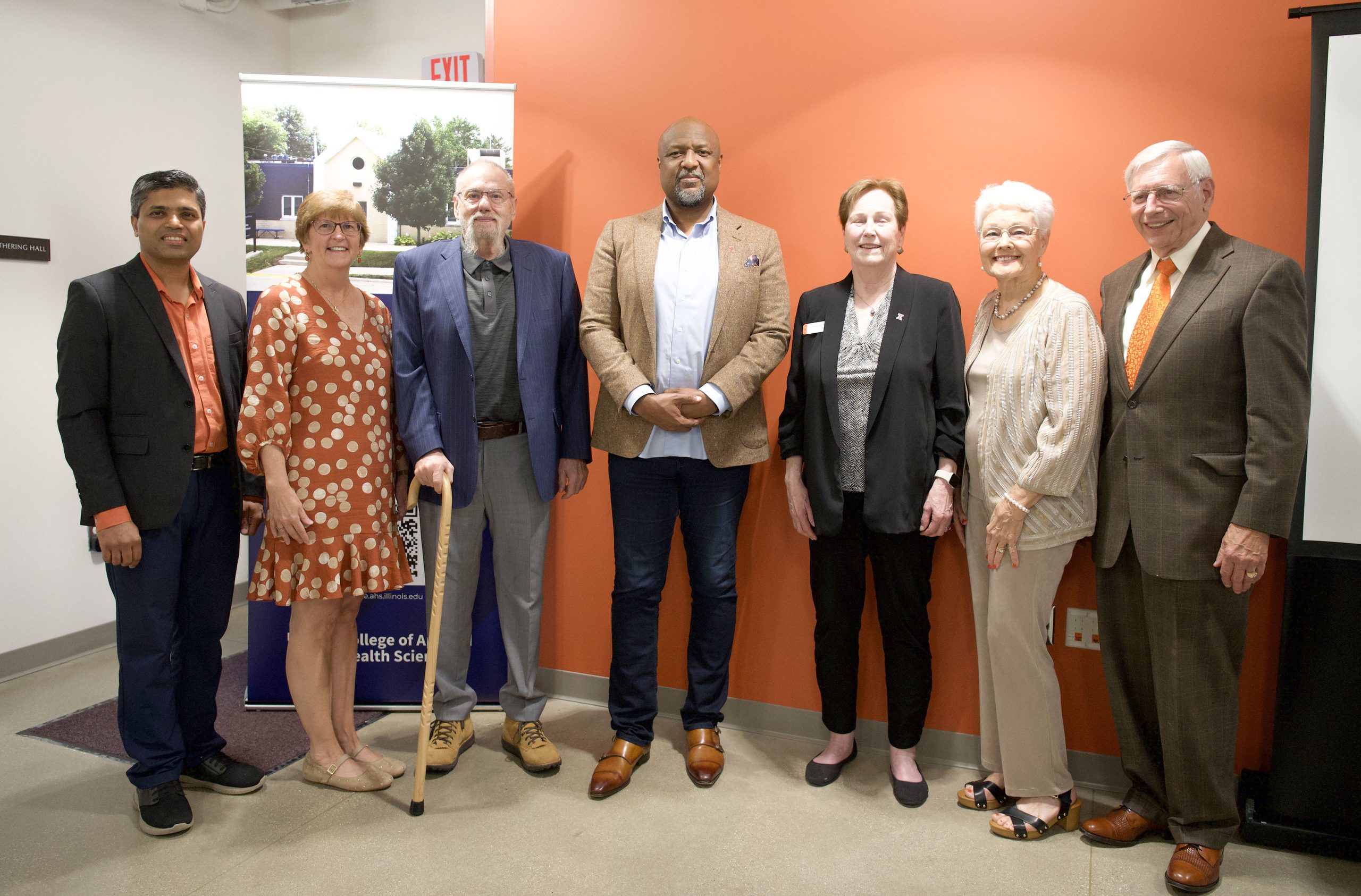
Dean Cheryl Hanley-Maxwell, left, stands with alumni award winners Michael Leach, Saul Morse and Walter Johnson. William Haskell was unable to attend the ceremony. (Photo by Jerry Thompson)
Young Alumni Award Michael Leach Recreation, Sport and Tourism
Michael Leach was appointed as the first-ever chief diversity and inclusion director for the White House in January of 2021. Leach, who earned his bachelor’s degree from RST in 2009, spent more than five years working for the National Football League on the NFL Management Council and later worked for the Chicago Bears and Miami Dolphins.
“I am truly humbled and honored to receive the 2023 Young Alumni Award from the University of Illinois at Urbana-Champaign,” Leach said. “My time in the College of Applied Health Sciences, and the institution more broadly, was nothing short of transformative.”
Harold Scharper Award Saul Morse Disability Resources and Educational Services
Saul Morse earned his bachelor’s degree (1969) and law degree (1972) at the University of Illinois and since has focused his practice on legislative matters, health law, insurance and municipal law. In 2010, with the passage of the Affordable Care Act, Morse was asked by the Illinois Department of Insurance to establish and manage an insurance pool for individuals with pre-existing health conditions.
“The Harold Scharper award is of great importance to me,” Morse said. “I came to the University of Illinois as a 17-year-old freshman. At the time, no other university in this country had a program which fully included students with a disability in all aspects of campus life, from academics to housing to activities. Most of what I have been able to do personally, professionally and within the broader community is due to the DRES program of the college.”
Distinguished Alumni Award William Haskell Kinesiology and Community Health
William Haskell is an internationally renowned researcher and emeritus professor of medicine at Stanford University. Haskell earned his Ph.D. in exercise physiology from the University of Illinois in 1966, and his work and achievements have clearly fulfilled the Illinois mission.
“It is truly an honor to receive the Distinguished Alumni award,” Haskell said. “Attending the University of Illinois at Urbana-Champaign offered me the opportunity to study and work with a large range of outstanding faculty and students, many of whom became exceptional leaders in exercise science research and teaching, as well as lifelong colleagues and friends.”
Walter Johnson Recreation, Sport and Tourism
Walt Johnson was born in Watseka, Ill., and graduated from the University of Illinois in 1958 with an undergraduate degree from the RST program. Later he entered the graduate program in RST and had the privilege of learning from both Professor Charles Brightbill and Dr. Alan Sapora. Upon graduation from the RST master’s program in 1962, Johnson moved immediately into a career in parks and recreation, where he served in a number of key leadership positions.
“The University of Illinois has always been the reason for my success and the lifestyle I live today,” Johnson said. “It gave me knowledge, hope and encouragement. Growing up on a farm and spending hours on a John Deere tractor since age 8, and milking cows, planting, cultivating and raising cattle and pigs, I determined I did not want to be a farmer.”
Hoda Elshorbagy’s journey from rural Egypt to central Illinois was an unlikely story, a path littered with numerous obstacles.
Hoda Elshorbagy aims to develop the sport of wheelchair racing and become Egypt’s first qualified wheelchair racing coach (Photo provided)
By JONATHAN KING
In her home in southern Egypt, Hoda Elshorbagy glanced at the TV, then turned to her father with clear-eyed conviction and said, “One day, I’m going to do that.”
Without missing a beat, he said, “Yes—you need to be one of them.”
Elshorbagy and her father were glued to the 2016 Paralympic Games that day in their rural village when they saw for the first time a sport that would become Hoda’s passion: Wheelchair racing.
Only eight years later, Elshorbagy—now a member of the Illinois wheelchair racing team—finished 10th in the women’s wheelchair division of the 128th Boston Marathon. The timing seemed improbable, but for those who know Elshorbagy and her determination, it was no surprise.
Elshorbagy’s journey from rural Egypt to central Illinois was an unlikely story, a path littered with numerous obstacles.
At eight months old, she was paralyzed due to a medical error. With her parents’ help, she endured 13 surgeries, enabling her a degree of mobility supported by crutches and braces. Elshorbagy then discovered adaptive sports and chose discus throwing and weightlifting. But wheelchair racing? She didn’t own a wheelchair and wheelchair racing was unfathomable in Egypt, where wheelchair accessibility is uncommon.
Without a wheelchair, team or coach, what was she to do?
Elshorbagy traveled to Cairo to meet with adaptive sport leaders but met resistance. Still, she was unbowed.
“When they told me ‘No, no, no,’ I heard ‘Yes, yes, yes,’” she said.
So, she ventured into the unknown and found someone to build a custom wheelchair, and she worked with a friend to fabricate custom gloves. She used YouTube to find videos of the Illinois wheelchair team and Coach Adam Bleakney. To understand Bleakney’s videos, though, she had to learn English. She dreamed that one day she would join the Illinois team to learn from Bleakney face to face. For seven years, she planned, prayed, persevered and practiced.
And then came her break.
She applied for and was awarded a grant by the Challenged Athletes Foundation. Elshorbagy traveled to the U.S. for one week at the invitation of CAF Coach Carlos Moleda. This experience further ignited the fire in her belly. Returning to Egypt, Elshorbagy began to contact anyone she could find on Facebook who might be able to help make a connection that would open a door to the prestigious Illinois wheelchair team.
“How can I get to Illinois and train with Coach Bleakney? That question fueled me,” she said. “Eventually, someone introduced me to Coach Marty Morse (DRES’ first wheelchair track and field coach), and he became my online coach for the next year and a half.”
And then came the news. Coach Morse invited Elshorbagy to come to Illinois in April 2023. What was originally planned as an introductory visit to fit her for a racing chair turned into Bleakney encouraging her to enroll in Parkland College as a precursor to becoming a student at Illinois and then the Illinois wheelchair racing team.
Today, two years later, Elshorbagy is a kinesiology student in the College of Applied Health Sciences and the newest recipient of the Morse-Hedrick Scholarship, created by Illinois alumna and decorated Paralympian Jean Driscoll in honor of her coaches, Morse and Brad Hedrick.
“Hoda had a very difficult time pursuing her athletic goals, but she kept pushing forward, literally and figuratively. She has an incredibly strong spirit and her determination is beyond compare,” Driscoll said. “Hoda aligns with the spirit of this scholarship through her commitment to excellence, doing the work required to get stronger, trusting her coach and the training process, respecting everyone from teammates to race directors and organizers, and having a fire inside that drives her to be the best she can be. She is very deserving of this scholarship. Hoda has a promising future, and a vision that will undoubtedly touch many lives.”
The Morse-Hedrick scholarship provides financial assistance to undergraduate students with disabilities who participate in athletic programs through Disability Resources and Educational Services. The DRES program has been an incubator for the growth and success of students with disabilities since its inception in 1948. Morse and Hedrick, alumni of the College of Applied Health Sciences, are internationally known for their dedication to coaching and mentoring athletes with disabilities, including numerous Paralympic champions.
“Words cannot describe how it feels to have this support,” said a glowing and grateful Elshorbagy. “I’m surrounded by the best athletes and coaches in this sport, and I have a home away from home at Illinois. I’m living a dream.”
In her brief career on the Illinois team, Hoda has finished third in the Illinois Half Marathon, 10th in the Boston Marathon, seventh in the Chicago Marathon, sixth in the New York City Marathon and will compete in her second Boston Marathon later this month.
But Elshorbagy’s dreams don’t stop there.
Upon the completion of a master’s degree in kinesiology, Elshorbagy has a vision to return to Egypt to help others who face similar challenges that have marked her journey. In her home country, the field of kinesiology is not available for those with disabilities. Elshorbagy wants to change that. Equipped with her kinesiology education from Illinois, she wants to educate and train others with disabilities in Egypt. As a wheelchair athlete, Elshorbagy aims to develop the sport of wheelchair racing and become Egypt’s first qualified wheelchair racing coach.
“Hoda will be successful at whatever she does. She is a woman with determination and vision,” Bleakney said. “Our wheelchair community at Illinois serves as an incubator for her continual growth in the sport. If all goes well, I’m confident we are going to be able to get Hoda onto the Egyptian national team for the 2025 or 2027 World Championships.”
For Elshorbagy, who once sat watching the Paralympic wheelchair racers on TV, the dream of being one of those Paralympians is suddenly within reach. The 2028 games in Los Angeles are on the horizon. Twelve years after that memorable day with her father, Elshorbagy is hopeful to be one of those athletes herself. This time, her father will watch, not on TV, but in person, seeing his daughter represent their country and bringing hope to others like her to do what some say was impossible.
Steve Serio takes a shot against Spain during the Paris 2024 Paralympic Games on Aug. 29, 2024 in Paris. (Photo by Joe Kusumoto/Getty Images)
Illinois alum Steve Serio had a triple-double as the U.S. men’s wheelchair basketball team began its pursuit of a third straight Paralympics gold medal with a 66-56 win over Spain on Thursday in Paris.
Serio, who has helped lead Team USA to gold the past two Paralympics, had 12 points, 11 rebounds and 12 assists. Serio, who is a graduate of the Department of Health and Kinesiology in the College of Applied Health Sciences, credited the team’s depth for the win.
“We’re 12-deep. We’re 12 (players) strong, and we’re going to be a tough team to beat moving forward,” Serio told reporters.
The Americans pulled away late in the fourth quarter, highlighted by Serio’s pass to John Boie for a layup.
“JB is a great player for us,” said Serio, the team’s captain. “He’s been a constant for us over the last couple of years. We have the utmost confidence in him not only as a role player but as a scorer as well. When I dumped that ball down to him, I had no doubt that the ball was going to drop.”
The game was close early, as Serio struggled to find his shot. But in the second quarter, Team USA erased a 23-22 Spanish advantage with consecutive buckets from Serio and fellow Illinois alum Brian Bell. Bell had 10 points. Jake Williams had a game-high 22 points for the U.S.
“It’s definitely frustrating when your shot’s not dropping,” Serio said. “The good thing about it is that I found another way to be productive. The best thing about this team is that it’s never one guy, never one player. It’s going to come down to the 12 of us, and we know we got each other’s backs.”
Team USA next faces the Netherlands on Saturday.
Find out more about Steve Serio in this podcast he did with AHS before the Tokyo Paralympics.
The U.S. women’s team also won its opener in Paris, defeating Germany 73-44. Team USA, which won the bronze in Tokyo got strong performances from Courtney Ryan, who scored a team-high 17 points while Rose Hollermann (16) and Ixhelt Gonzalez (15) combined to score 31.
Illinois athletes Ali Ibanez (two rebounds, one block) and Kaitlyn Eaton (plus+2 in four minutes) also contributed to the win.
“Our team was successful because we stuck to the game plan,” said head coach Christina Schwab. “We talked about things that we can control, the distractions that may be there, and just staying present and focused. We were able to play 12 deep and our energy was great.”
Team USA returns to the court on Saturday for a contest against the Netherlands, the defending gold medalists.
To honor their sister’s time at the University of Illinois, the siblings of Susan Jane Chaplinsky thought a memorial bench in the open-air plaza of Disability Resources and Educational Services would be a fitting tribute.
The family of Susan J. Chaplinsky sits on her memorial bench in the center of the Disability Resources and Educational Services building. Her siblings Kathy, Amy, Molly and Pete sat with her plaque.
Because the work of DRES was a big part of what propelled Chaplinsky, living with juvenile rheumatoid arthritis, to become an acclaimed business scholar and beloved instructor. She said so herself.
“[DRES at Illinois] … put me on a path to achieve the professional success I have attained over the course of my life,” Chaplinsky wrote in her will. “It remains a unique institution for students with disabilities to level the inequities caused by life and health and allows them to achieve a measure of success. I would be proud to have my name associated with an institution with these goals and aspirations.”
Upon her passing in November 2022, Chaplinsky dedicated a substantial portion of her wealth to the DRES: A $3.4 million estate gift which will support two endowment funds for Illinois students with disabilities.
The family got to witness the memorial for Chaplinsky at the DRES 75th Anniversary Open House on April 19, surrounded by staff, alumni and visitors. College of Applied Health Sciences Dean Cheryl Hanley-Maxwell gave thanks to the family and to Chaplinsky for her generosity.
”It’s going to change much of what we can do here at DRES, I can’t thank you guys enough for being willing to be here with us today to celebrate Susan’s commitment to us,” Hanley-Maxwell said. “Susan is an example of many students who have graduated from the University of Illinois who look back on DRES and say, ‘If it weren’t for DRES, I don’t know what I would have done.’”
‘A lifeline’
Chaplinsky graduated from Illinois in 1975 with her bachelor’s in economics. She went a couple hours north to obtain her MBA and a Ph.D. in Economics from the University of Chicago.
What followed was a stellar academic and teaching career, where Chaplinsky taught finance at the University of Michigan, Northwestern University, and eventually the University of Virginia’s Darden School of Business, where she spent her final 28 years.
But with her early obstacles, she charted a course her family could’ve never foreseen.
In sixth grade, Chaplinsky was diagnosed with a severe form of juvenile rheumatoid arthritis. In a matter of months, Chaplinsky went from being an active, able-bodied preteen to needing a wheelchair to get around day to day.
Growing up in Palatine, Illinois, a village 30 miles northwest of Chicago, Susan’s sister Kathy would bring her lunches during high school, since Susan couldn’t access the cafeteria with her wheelchair. As Chaplinsky confronted her new health challenges, others began to place unfair limits on her abilities.
“My sister was always very smart, brilliant, but there was no guidance counselor encouraging her to look at colleges,” Kathy Arter said.
“Then our parents learned about the program at Illinois, and it was just like a lifeline to them. There was a place that not only could accommodate her, but they wanted her there.”
Illinois, with its wheelchair accessible campus and the Division of Rehabilitation Education Services led by director Tim Nugent, was an opportunity to promising to pass up. After being accepted onto campus, Chaplinsky’s life and confidence transformed, her siblings said.
Every time they’d visit her at Allen Hall, she was surrounded by friends, going out to bars or movie showings on campus, living a regular student’s life.
But she took her studies seriously, and Nugent played a hand in that. Chaplinsky “talked a lot about Nugent,” Arter said; he was demanding, and held high expectations for the students he worked with.
“Some of that, with Susan, she left here with that: ‘They expect me to go on and be a success, I won’t disappoint them,’” Arter said. “I don’t think Susan ever forgot her debt to the university, for that opportunity.”
An outpouring of support flowed from the UVA campus after Chaplinsky’s passing. Her siblings didn’t always get to see the teaching side of Susan; a memorial event they attended allowed them to see a new side of their sister.
“The great passion of her life was teaching,” said her sister, Amy Meehan. “She was interested in students, she always rooted for the underdog. She just views this gift as an extension of that: ‘I can help for years to come.’”
Plenty of the traits they knew well—Chaplinsky’s sports fandom and dry humor, for example—also shined through in their remembrances.
“She’s funny, she’s brilliant,” sister Molly Gillis said. “I think about all the time, her footprint is ginormous when she had so many things that could’ve limited her reach and they didn’t.”
The siblings and extended family made a big showing at the DRES Open House. They gratefully packed in around their sister’s newly arrived memorial bench and posed for pictures in the cool spring weather.
“Maybe somebody sees that bench, and it gives them the confidence, the energy to go forward, to dream big, and to do something they didn’t think they could do,” brother Pete Chaplinsky said.
This year marked the 76th anniversary of the first NIWBT
The Illini women’s basketball team finished third in the 2025 NIWBT (Photo by Craig Pessman)
The University of Illinois and Illinois Wheelchair Athletics played host last week to the 47th Annual National Intercollegiate Wheelchair Basketball Tournament and even though neither Illini team took home a title, the event at the State Farm Center was still an opportunity to showcase Illinois as a trailblazer for disability resources and adaptive sports.
This year marked the 76th anniversary of the first NIWBT, which was hosted in 1949 at a University of Illinois satellite campus in Galesburg, Illinois. The tournament was organized by Dr. Tim Nugent, the first director of Disability Resources and Educational Services, also known as DRES. In honor of the man known as the “father of accessibility,” the tournament winner is awarded the coveted Timothy J. Nugent Championship Trophy.
This season’s NIWBT featured 11 men’s teams and 6 women’s teams competing in 21 total games across four days, from March 26-29.
In terms of results, the Illini women’s team reached the semifinals after beating City University of New York 72-19, but lost to Texas-Arlington 59-40. The Illini women did defeat Arizona, 62-37, for a third-place finish.
Women’s coach Stephanie Wheeler praised the fans for making their voices heard.
“You could hear their screams, you could hear their I-L-Ls, you could hear them say the names of the players,” Wheeler said. “It’s that kind of energy that translates on court.”
The Illinois men beat Eastern Washington 79-39 in their first-round game, but were defeated by Alabama 65-47 in their second game. The Illini men did cap their play by beating Missouri 51-34 in a consolation game.
In the men’s bracket, top-seed Arizona beat Texas-Arlington 75-65 to win the Nugent trophy. For the women, top-seeded Alabama beat UTA 67-52 to secure the title, its fifth straight title since 2019 (the 2020 tournament was canceled because of the COVID-19 pandemic).
The Illinois men last won an NIWBT title in 2010, while the Illini women have yet to capture the Nugent trophy since women’s play began in 2011. Despite the teams’ current droughts, both programs hold 29 championships between them.
Three members of the men’s team—Ryan Fitzpatrick, Sebastian Milan and Martrell Stevens—left Champaign-Urbana shortly after the tournament to play for Team USA in the IWBF Men’s U23 Americas Championship from April 2-6 in Bogota, Colombia. That tournament features Brazil, Canada, Colombia and Team USA, competing for two qualification spots at the 2025 IWBF Men’s U23 World Championship, taking place in São Paulo, Brazil in June.
Next year’s NIWBT will be played at the University of Arizona.
From as young as seven years old, Kevin Fritz knew something was different. But the alum of the College of Applied Health Sciences never saw different as a negative.
From as young as seven years old, Kevin Fritz knew something was different.
He had spent the past three months in the hospital, but for someone born with muscular dystrophy, that was not unusual. What was unusual was the reception he received.
“I remember, there were three garbage bags of cards from my first-grade teacher’s class and videos of kids wishing I would get better,” Fritz said via Zoom from his home in Miami. “I kept thinking, ‘Why am I sick and other people not sick? I think that was the first recognition of (being different).”
But the alum of the College of Applied Health Sciences never saw different as a negative.
“I think I’ve always just wanted to be included,” said Fritz, who is now employment counsel at Gusto, an human resources management software company. “I think as I’ve gotten older, I’ve realized that fitting in is very overrated.”
Muscular dystrophy (MD) is a genetic neurological disease that causes muscle weakness and decreased mobility, not just of arms and legs, but vital organs as well. With MD, everyday tasks progressively become extremely difficult to manage without assistance. Given the progression of the disease, many people with MD don’t survive into adulthood, which makes Fritz’s life and career that much more inspiring.
MD made Fritz’s childhood a challenge, but when his health stabilized, he started thinking about college. A Pennsylvania native, Fritz wasn’t sure where Illinois was, but he knew it was ranked among the best schools to accommodate students with disabilities.
He called the Division of Disability Resources and Educational Services (DRES) and spoke with Susann Sears, who is now director of the Beckwith Residential Support Services program for people with severe physical disabilities. After a campus visit, Fritz was sold.
A Community Health major, Fritz set out to make an immediate impact, displaying an inner resolve he is proud of.
“I think that I’ve always had a drive to be just as good as the other person,” Fritz said. “When I was much younger, I used to do a lot of theater. I remember, there was a dance audition for a musical. And the director said, ‘Obviously, Kevin, you don’t need to do this.’ I said, ‘You know what? I’m going to do it.’ And I put like a muscle shirt and a headband and really went all out on it.
“It was really embarrassing but also very empowering.”
Armed with that new skill, Fritz became a student senator and acclimated himself with health care issues that were challenging to people with disabilities. One of Fritz’s internships while at Illinois was working with Lynne Barnes, the then-president at Carle Foundation Hospital. Although Fritz enjoyed working in health care, it was Barnes whose advice took him down a different path.
Barnes encouraged him to apply his “analytical mind” and passion to law school, Fritz said. Barnes introduced him to Carle’s vice president of legal affairs and she said that Fritz would make a good lawyer because he’d “like to fight the issues.”
Fritz’s interest in law was also shaped by his time as a student senator, during which he accepted a job in Washington, D.C., interning for then-Sen. Barack Obama where his work was heavily health-policy related. Another chance meeting again diverted Fritz’s path.
Upon meeting Rep. Jim Langevin (D-RI), who also uses a wheelchair, Fritz saw the possibilities for himself.
“When I met him, my whole world changed because there’s a guy like me 20 years later, with an assistant just like me, wearing a suit that’s like perfectly fit to his disabled person, just like I like to do,” Fritz said. “I only met him that one time, but I realized that it can happen. I could run for Congress. I could have a job. I could be successful.”
Pursuing law came with its challenges, Fritz said, but he knew that he wanted to be on the employer’s side of accommodation and representation for disabilities.
He started in employment law and spent nearly 10 years as working to defend Fortune companies against lawsuits. Not only was Fritz the first wheelchair user at his firm but to this day he is one of the only wheelchair users with a “significant disability” at a top-50 law firm in the United States.
Today, Fritz has a significant position in counseling and litigation at Gusto, playing a role in employee relations and policy review. Although Fritz has had his share of challenges living with MD, he continues to view his condition not as something to heal or fix, but something to thrive with.
“I don’t have time to just sit around and pray that everything will be better for me physically. I have to live the life I was given and make the best of it. You should always be yourself, and that’s exactly enough.”
Brian Bell had 31 points for Team USA against Canada (Photo by Tullio M. Puglia/Getty Images for IPC)
Team USA’s wheelchair basketball teams have two shots at gold this weekend.
Illinois alum Brian Bell had 31 points as the Team USA men overcame an early deficit to beat Canada 80-43 Friday to advance to the gold medal game of the Paralympics in Paris.
The American men will seek an unprecedented third straight gold on Saturday against Great Britain.
The women, meanwhile, rallied to beat China—who they lost to in the semifinals in Tokyo three years ago—50-47 and will play for gold on Sunday.
For the men, Canada jumped out to an 8-2 lead and led 16-10 before the U.S. went on a 19-5 run and never looked back. Bell also had 10 rebounds and Jake Williams and Illini alum Steve Serio combined for 20 assists.
Bell credited Williams and Serio for allowing him to get open.
“I know that teams are going to jump Jake,” Bell told reporters. “He’s one of the best shooters in the world. So just to be able to capitalize on that, and then once they jump, being able to attack their two-on-one and utilize the inside presence.”
Canada was held to 38 percent shooting from inside the 3-point line and scored just 11 points in the entire second half as the U.S. cruised to victory.
“Our plan was to push up the tempo a little bit,” Bell said. “So press them a little bit, make their top threats a little tired. We know that that would benefit us as the game goes on because we can rotate some of our guys in and out.”
Serio, 36, who is competing in his fifth and final Paralympics, says that the gold medal match will be a night to remember, no matter the outcome.
“I’m sure there is going to be tons of emotions after the game, but honestly when it comes down to it, it has nothing to do with legacy, it has nothing to do with reflection, but I’m going to do everything I can do to help our team win a basketball game,” Serio said.
Illini athletes lead the way for Team USA (Getty Images)
In a big night for wheelchair racing and jumps, Americans—led by athletes from the University of Illinois—brought home five medals in front of another electric crowd at the Stáde de France in Paris.
Illini Paralympians Susannah Scaroni, Brian Siemann and Daniel Romanchuk all brought home bronze in their wheelchair racing events.
Siemann, who is competing in his fourth Paralympic Games, earned his first career Paralympic medal in Sunday’s 400-meter T53 race. The 34-year-old won his first world championships medals in 2023 and said that trusting his training is what has helped him to peak at this point in his career.
“I’ve managed to do this with the support of my teammates,” he told reporters in Paris. “I’ve been lucky to train with some really great athletes. Real legends in the sport. I think they’ve always been the force that’s pulling me, sometimes quite literally, across the track to get a little bit better and a little bit faster. That’s what’s gotten me here. Their commitment to making me a better athlete.”
Siemann clocked a personal-best time of 47.84 and said it was an emotional moment.
“I couldn’t stop smiling when I saw my name on the board because I’ve been in that position when I’ve been waiting and I look and I see my name in fourth place by a hair. To finally see it up there and to race as fast and as well as I did is really exciting. There’s still more work to be done.”
Siemann said his training at the University of Illinois led him to reach his potential.
“I went off to Illinois as a student back in 2008 and so it’s like I’ve lived there almost now as long as I’ve lived in New Jersey, and so that really sort of did lay the foundation for my success today,” he said. “You know, it’s been a very long road to get here, but getting the opportunity to train with the best wheelchair athletes in the world on a daily basis has just pushed me to be that much better, not only in terms of my academics when I was a student but now also as an athlete, too.”
“Mo, we did it!,” he added, referencing Maureen Gilbert, coordinator, Office of Campus Life at Disability Resources and Educational Services, who is considered the heart of DRES and its trailblazing Paralympic training facility.
Scaroni took a risk on an inside line in the final 100-meters of the women’s 800-meter T54 and it paid off, resulting in her second medal in as many days. The now five-time Paralympic medalist earned bronze in 1:43.42, eking ahead of teammate and 20-time Paralympic medalist Tatyana McFadden, who clocked a time of 1:43.58 and finished fourth. The third American in the race, two-time Paralympian Hannah Dederick, also from the University of Illinois, kicked off her second Games with a seventh-place finish.
For Scaroni, both Paris medals have come as a result of strategic execution of her race plan. In today’s 800-meter, she sat at the back of the pack until the final 200 meters of the race, where she turned on the power and chose the correct line.
“There’s a lot of strategy, there’s a lot of going as hard as you can while being able to respond what’s going on,” she said. “I’ve realized Tokyo was Tokyo, this is a new Games. It’s been really fun for me to focus on the racing. Tokyo, no one had raced for awhile, and it was going to be kind of mysterious. Here, I know the strengths of this field and I’m just excited to race.”
Scaroni returns to the track for her 1,500-meter competition on Sept. 3, while McFadden and Dederick are set for the 100-meter on Sept. 4.
Scaroni credited the University of Illinois for her training.
“Illinois has prepared me in so many ways,” she said. “Not only am I surrounded by the best environment for a wheelchair racer but I also have an incredible education. They’re really highly ranked in nutrition, and so I was able to couple my nutrition degree with my sport and do a master’s in exercise sociology, and then that obviously has helped as well. So I think that as I’ve become a better athlete, I’ve become a better professional person with a disability by being surrounded by such an inclusive campus, and hopefully a good nutrition educator too.”
Also earning his second medal of the competition was Romanchuk, who found an extra gear at the end of the men’s 400-meter T54 and took bronze, just a day after winning the 5,000-meter event. Romanchuk’s time of 45.11 put him comfortably in third, over half a second ahead of the fourth-place finisher.
Roderick Townsend (gold, men’s high jump T47) and Jaleen Roberts (silver, women’s long jump T37) also won medals for Team USA in their respective sports.
On the basketball court, the U.S. men’s wheelchair basketball team won its third straight game Sunday, rallying past Australia 76-69 behind 18 points from Illinois alum Brian Bell. With a 3-0 finish, the U.S. secured the top spot in Group B, meaning they will face the fourth-place team of group A in the quarterfinals. The Americans return to the court on Tuesday for the quarterfinal round. Its opponent and game time are still to be determined.