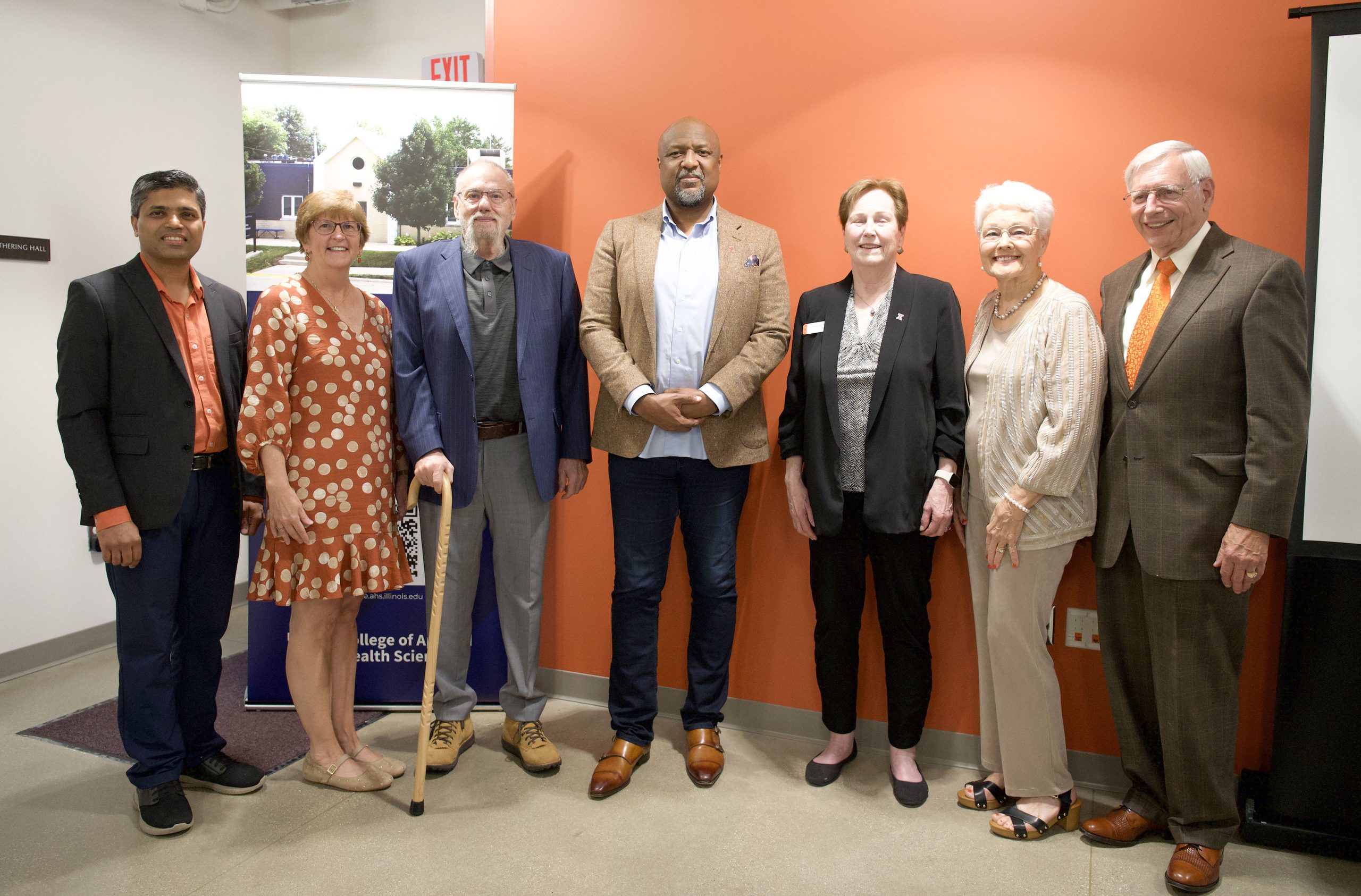
AHS 2023 Convocation


Photo by Fred Zwick

Dean Cheryl Hanley-Maxwell delivered her remarks:

I’m Cheryl Hanley-Maxwell, Dean of the College of Applied Health Sciences and three-time graduate of the University of Illinois Urbana-Champaign.

There are so many great events in the college, but this has to be my favorite. Not only does it make me nostalgic about my own graduations—were they really that long ago? It also fills my heart with joy and pride, and, yes, it makes me a little overcome with emotion to look upon these graduates, knowing that AHS helped them to develop into the outstanding individuals they are today, well-prepared to go out and make a difference in this world. 

I know that wherever your journey takes you from here—to jobs, graduate studies, post-doctoral fellowships, or a time of exploring the possibilities—you take with you a solid foundation on which to continue building. 

You take values that have been reinforced through coursework, research experiences, and community involvement—respect for all peoples and cultures and a commitment to diversity, equity, and inclusion. 

You take a firmly-held belief in the mission of the college: to promote individual and community health throughout the lifespan, to facilitate optimal living with disability, and to foster the development of livable communities in a diverse society.

But let’s be real. You’re not thinking of any of that today. 
•    You’re thinking about all the great friends you’ve made here.
•    You’re looking around the State Farm Center and remembering events you’ve attended here. 
•    You’re thinking about what you’re going to do after the ceremony. 
•    You’re feeling a myriad of emotions, and maybe your head is swimming and you can’t focus on anything!

I recall from my own graduation ceremonies that rush of feelings—excitement, a little nervousness about the next step, pride, a little sadness about moving on, but mostly just gratitude and happiness and thank the stars, I made it!

It’s a bittersweet moment. I think the psychological concept of reframing can come in handy at times like these. 

You’re not losing friends as you all go your separate ways. 
You’re gaining a whole lot of people to visit across the country, possibly around the world, while you’re also making new friends in your new life. 

You’re not leaving a safety net of faculty and staff colleagues and mentors who offered sage advice when you needed it and supported you throughout your studies. 
You’re expanding your professional network of people who will always enjoy hearing from you, finding out what’s new in your life, and, yes, offering sage advice when you need it. 

Being amazed by what you’re learning, from people you respect and admire, doesn’t end here. You have a whole lifetime of being amazed ahead of you. Just be open to it.

Look ahead to a bright future. Take advantage of every opportunity life offers to grow, to learn, to help, and to have fun. Take life seriously, but remember that it’s the only one we have, as far as we know, and time goes by quickly. 

It sounds cliché, but live in the moment, and see even challenging times as chances to learn something new, something valuable. 

Of course, I wish you all the best. Stay in touch and stay involved, if you can. One of the college’s greatest strengths is a strong and active group of alumni. Which you will soon be!

Share on social
Related news

AHS well-represented among Community-Academic Scholars


The Interdisciplinary Health Sciences Institute, in partnership with the Center for Social and Behavioral Science and with support from the Office of the Vice Chancellor for Diversity, Equity, & Inclusion, is proud to introduce our 2023 Community-Academic Scholars! The 18 scholars in this cohort represent 18 majors and six minors in eight colleges and schools, encompassing a diverse array of fields of study, from community health to geography to economics.

Thirteen of the scholars are either majoring in programs within the College of Applied Health Sciences, minoring in those programs or working with AHS faculty members. Learn more about them and their projects below and at this webpage.

Afnaan Afsar Ali (she/her) is a sophomore studying community health with a concentration in health planning and administration, and minoring in business. She’ll be working with KCH Professor Wendy Rogers.

Ryiah Barnes (she/they) is a junior majoring in community health with a concentration in health education and promotion with plans to pursue a career in midwifery or gynecology. 

Brianna Brice (she/her) is a junior on a nursing track minoring in public health with plans to become a nurse-midwife, eventually opening a community birthing center to combat racial disparities in maternal care.

Emma Darbro (she/her) is a sophomore studying brain and cognitive science with a double minor in gender and women’s studies and public health

Stella Emezue (she/her) is a junior majoring in interdisciplinary health sciences with plans to become an OBGYN and open clinics in underserved communities. 

Isabelle Gawedzki (they/them) is a sophomore majoring in integrative biology. They will be working with KCH Assistant Prof. Hyojung Kang.

Norman A. Hernandez II (he/him) is a junior majoring in kinesiology and minoring in public health with plans for a career in public health. He’ll be working with KCH Associate Professor Andiara Schwingel.

Kaylee Janakos (she/her) is a junior majoring in information sciences with a double minor in psychology and health technology.  She’ll be working on the project with Isabelle Gawedzki and Professor Kang.

Alena (Allie) Kormos (she/her) is a senior majoring in community health with a passion to increase equitable health services and educational opportunities for fellow immigrants, children, and low-SES families, as well as improving maternal-infant health outcomes. She’ll be working with KCH Associate Professor Sandraluz Lara-Cinisomo.

Zara Lateef (she/her) is a James Scholar and sophomore majoring in computer science + chemistry with plans to become a doctor advocating for community health and social justice and researching medical advancements. She’ll be working with KCH Associate Professor Laura Rice.

Julian Martinez (he/him) is a sophomore majoring in natural resources and environmental sciences. He’ll be working with RST Assistant Professor Sharon Zou.

Adam Syed (he/him) is a sophomore majoring in food science and human nutrition with a concentration in and minoring in Spanish with a passion for building opportunities and uplifting communities. He’ll be working with KCH Professor Wendy Rogers.

Leyna Tran (she/her) is a sophomore majoring in speech and hearing science with plans for a career in policy analysis or population data. She’ll be working with SHS Associate Professor Raksha Mudar.

Share on social

Related news

Fritz: ‘Fitting In Is Overrated’


From as young as seven years old, Kevin Fritz knew something was different. 

He had spent the past three months in the hospital, but for someone born with muscular dystrophy, that was not unusual. What was unusual was the reception he received.

“I remember, there were three garbage bags of cards from my first-grade teacher’s class and videos of kids wishing I would get better,” Fritz said via Zoom from his home in Miami. “I kept thinking, ‘Why am I sick and other people not sick? I think that was the first recognition of (being different).”

But the alum of the College of Applied Health Sciences never saw different as a negative.

“I think I’ve always just wanted to be included,” said Fritz, who is now employment counsel at Gusto, an human resources management software company. “I think as I’ve gotten older, I’ve realized that fitting in is very overrated.”

Muscular dystrophy (MD) is a genetic neurological disease that causes muscle weakness and decreased mobility, not just of arms and legs, but vital organs as well. With MD, everyday tasks progressively become extremely difficult to manage without assistance. Given the progression of the disease, many people with MD don’t survive into adulthood, which makes Fritz’s life and career that much more inspiring.

MD made Fritz’s childhood a challenge, but when his health stabilized, he started thinking about college. A Pennsylvania native, Fritz wasn’t sure where Illinois was, but he knew it was ranked among the best schools to accommodate students with disabilities.

He called the Division of Disability Resources and Educational Services (DRES) and spoke with Susann Sears, who is now director of the Beckwith Residential Support Services program for people with severe physical disabilities. After a campus visit, Fritz was sold.

A Community Health major, Fritz set out to make an immediate impact, displaying an inner resolve he is proud of.

“I think that I’ve always had a drive to be just as good as the other person,” Fritz said. “When I was much younger, I used to do a lot of theater. I remember, there was a dance audition for a musical. And the director said, ‘Obviously, Kevin, you don’t need to do this.’ I said, ‘You know what? I’m going to do it.’ And I put like a muscle shirt and a headband and really went all out on it.

“It was really embarrassing but also very empowering.”

Armed with that new skill, Fritz became a student senator and acclimated himself with health care issues that were challenging to people with disabilities. One of Fritz’s internships while at Illinois was working with Lynne Barnes, the then-president at Carle Foundation Hospital. Although Fritz enjoyed working in health care, it was Barnes whose advice took him down a different path.

Barnes encouraged him to apply his “analytical mind” and passion to law school, Fritz said. Barnes introduced him to Carle’s vice president of legal affairs and she said that Fritz would make a good lawyer because he’d “like to fight the issues.”

Fritz’s interest in law was also shaped by his time as a student senator, during which he accepted a job in Washington, D.C., interning for then-Sen. Barack Obama where his work was heavily health-policy related. Another chance meeting again diverted Fritz’s path.

Upon meeting Rep. Jim Langevin (D-RI), who also uses a wheelchair, Fritz saw the possibilities for himself.

“When I met him, my whole world changed because there’s a guy like me 20 years later, with an assistant just like me, wearing a suit that’s like perfectly fit to his disabled person, just like I like to do,” Fritz said. “I only met him that one time, but I realized that it can happen. I could run for Congress. I could have a job. I could be successful.”

Pursuing law came with its challenges, Fritz said, but he knew that he wanted to be on the employer’s side of accommodation and representation for disabilities.

He started in employment law and spent nearly 10 years as working to defend Fortune companies against lawsuits. Not only was Fritz the first wheelchair user at his firm but to this day he is one of the only wheelchair users with a “significant disability” at a top-50 law firm in the United States.

Today, Fritz has a significant position in counseling and litigation at Gusto, playing a role in employee relations and policy review. Although Fritz has had his share of challenges living with MD, he continues to view his condition not as something to heal or fix, but something to thrive with.

“I don’t have time to just sit around and pray that everything will be better for me physically. I have to live the life I was given and make the best of it. You should always be yourself, and that’s exactly enough.” 

Share on social

Related news

College of Applied Health Sciences
110 Huff Hall
1206 South 4th Street
Champaign, IL 61820
(217) 333-2131