Can regular exercise reduce the protein needs of adults with type 2 diabetes?
From left: University of Illinois Professor Nick Burd, postdoc Mikaela Kasperek, Ph.D. student Gena Irwin, and Associate Professor Jacob Allen pose inside Freer Hall’s gym, where their labs will train participants in a 12-week exercise program for a clinical trial.
For healthy adults, roughly .8 grams of protein per kilogram of bodyweight per day is enough to maintain muscle mass and support daily function.
But for adults with type 2 diabetes, an estimated 1 in 10 adults in the United States, their protein requirements remain relatively undefined, but are believed to be elevated when compared to their non-diabetic counterparts. Especially as diabetic individuals age, their bodies often become more anabolic resistant: less responsive to the muscle-building effects of exercise and protein intake.
Researchers from the Department of Health and Kinesiology at the University of Illinois Urbana-Champaign are recruiting participants for a human clinical trial to understand the protein needs of older adults with type 2 diabetes, and whether regular exercise can help their bodies use protein more efficiently.
“The problem with current strategies for type 2 diabetes is they largely try to keep throwing protein in people’s diets: eat more, eat more, eat more,” HK Professor Nicholas Burd said.
Piling on the protein could have detrimental effects. There’s evidence that circulating amino acids, including branch chain amino acids that promote muscle mass, are associated with poorer outcomes for people with diabetes, said HK Associate Professor Jacob Allen.
Their upcoming study, “Exercise impact on dietary protein efficiency in older adults with type 2 diabetes,” is funded by a grant from the American Diabetes Association. The principal investigators are Burd, who researches protein metabolism, and Allen, who studies how exercise and nutrition impact the gut microbiome.
Health and Kinesiology professors Jack Senefeld and Steve Petruzzello are co-investigators on the study.
HK Assistant Professor Jack Senefeld and Professor Steve Petruzzello are co-investigators on the study, bringing expertise on training diabetic individuals and psychological well-being during exercise. Ph.D. candidate Gena Irwin and postdoc Mikaela Kasperek will lead the work from the Burd’s Exercise Performance Lab and Allen’s Integrative Microbiota Physiology labs respectively.
Starting this fall, the researchers will recruit 30 older adults to participate in this study—15 individuals living with type 2 diabetes and 15 without—and bring them into Freer Hall’s gym for a 12-week fitness program that mixes weight training with endurance exercise.
The researchers will use sensitive tools in their labs to figure out how efficiently participants’ bodies utilize protein, and whether that efficiency varies for older adults with and without diabetes. After participants wrap the exercise program, the team will test whether resistance training improved their bodies’ usage of protein overall, lessening their daily protein needs.
“To make an older person’s muscles more youthful, you can exercise them,” Burd said. “But we don’t know how the gut’s being impacted, and we don’t know how type 2 diabetes interferes with some of the ‘youthfulness’ effects of exercise.”
Some of our dietary protein ends up in our skeletal muscle, through muscle-protein synthesis, and some of it is used for energy. But there’s a “black box” around where the rest of our protein goes in the body, Allen said.
“We think that the microbes in the gut, the gut microbiome, might be responsible for some of this, but this has never been studied,” Allen said. “We’ve run some pilot work that fueled part of this study, where we can show that indeed, ingested amino acids are converted into these microbial metabolites.”
Why might that matter? Some of these metabolites are important for human health overall, Allen said. For example, short chain fatty acids—the byproducts of dietary fiber being processed in our gut—bring a host of benefits for metabolism and the immune system.
The research teams will host intervention days at the beginning and end of the 12-week exercise program, to see how participants’ bodies are using the protein in their muscle and gut.
Participants will consume amino acids labeled with stable isotope tracers. The labs will collect breath samples to see how much of the labeled amino acid is showing up in the breath—if more of that labeled protein appears in participants’ breath, their bodies aren’t as good at incorporating it into muscle.
Blood samples will help the scientists understand how the gut is taking those amino acids and converting them into potentially beneficial metabolites.
The second intervention day at the end of the trial will determine whether an exercise program changed the way participants’ bodies use protein.
“There are very few labs in the U.S that not only have the expertise, but have the infrastructure to be able to do this kind of work, so we’re very fortunate for Illinois and our department,” Burd said. “Stable isotope tracers require expensive machines to analyze.”
What’s in it for participants? On top of helping the scientists form dietary guidelines for older adults with type 2 diabetes, they’ll receive progressive exercise training from expert students and faculty at the college, that will hopefully serve them well beyond their last visit.
“A big goal is to change behavior, too, to make them healthier,” Allen said. “That’s ultimately what we’re trying to do.”
Editor’s note:
Interested in participating in this study? Take the survey to see if you qualify, or email the organizers at HK-ADA-Study@illinois.edu
Today’s Department of Health and Kinesiology once hosted the nation’s foremost researchers of sport psychology. Nearly 50 years on, these pioneers reunited at Huff Hall for a weekend on campus.
When Rainer Martens arrived at the University of Illinois in the summer of 1966, he stepped out of his blue Mustang and bounded up the steps of George Huff Hall, to see the university’s Sport Psychology Laboratory with his own eyes.
What he found on the third floor of Huff initially disappointed him: old equipment piled up in the corner of a room with just enough space to seat a class. “We thought we’d come to the wrong place,” Martens said.
Turns out, he wasn’t in the wrong place—maybe just a little early.
What followed was the explosive growth of sport psychology research at Illinois. With help from the university’s world-class department of psychology, a group of likeminded doctoral students—including Martens, Glyn Roberts and the late Dan Landers—began building a formal sport psychology graduate program at Illinois, to study the mental aspects of athletic success, motivation and performance.
Dozens of doctoral students went on to matriculate in the program and bring their discoveries to institutions across the globe. By the late 1970s, Illinois had become the torchbearer for modern-day sport psychology in the U.S., with a vibrant group of researchers at the helm.
Five decades later, a group of those same students and faculty returned to campus to catch up with their former colleagues, and take a tour of their old academic home. The guest list left an indelible mark on the field of sport psychology as it stands today.
Even as Illinois’ own sport psychology program has faded, the legacy of its achievements and discoveries endure in the modern day College of Applied Health Sciences. Faculty at AHS, particularly in Health and Kinesiology, continue to study the psychological effects of exercise and physical activity at large, building on more than 100 years of tradition.
“All these former students, they’ve all gone on to distinguished careers. They’ve gone on to become presidents of national sport psychology organizations, and spoken all over the world,” Martens said. “This gathering, it’s a once in a lifetime thing.”
To cap off their walk down memory lane, these legends of sport psychology got to share lunch with current-day faculty and doctoral students in the Department of Health and Kinesiology.
“That was very humbling, we never expected anybody to turn out,” said Glyn Roberts, who worked as a professor of sport psychology at Illinois until 1998. “It was very rewarding that they would do that for us.”
Guests of honor
Rainer Martens, a professor of kinesiology at Illinois until 1984, and co-founder of Human Kinetics, leading publisher of books and journals on physical activity
Julie Martens, PhD in sport psychology and the first employee of Human Kinetics, who retired as executive vice president in 2009
Glyn Roberts, professor emeritus at the Norwegian School of Sport Sciences and former professor of sport psychology at Illinois
Tara Scanlan, professor emerita of psychology at UCLA, and her husband Larry Scanlan
Diane Gill, kinesiology professor emerita at UNC Greensboro
Dan Gould and Marty Ewing, professors emeriti at Michigan State. Both earned a Ph.D. at Illinois, and Gould taught here until 1991
Damon Burton, professor of sport psychology at the University of Idaho
Robin Vealey, professor of kinesiology and health at the University of Miami, Ohio
Linda “Bump” Harrison, a publisher who got her PhD in the program in 1987
Marc Lochbaum, professor of kinesiology at Texas Tech who went to Illinois for undergrad and was mentored by several sport psychology greats
Absent were Joan Duda, professor of sport and exercise psychology at University of Birmingham, and Dan Landers, a professor of sport and exercise psychology and co-founder of the Journal of Sport Psychology, who passed away in 2023
‘We didn’t realize it, but we were pioneers’
Though Illinois experienced fertile growth of sport psychology in the 1970s, the seeds were planted by Coleman Griffith, known as the “father of sport psychology” for his pioneering work into the mental aspects of athletic performance.
Griffith founded and ran Illinois’ Athletic Research Laboratory until 1932, where he studied the links between personality and physiology on athletic success. He wrote two books—“Psychology of Coaching” and “Psychology and Athletics”— but left no proteges for his research. Griffith later became provost of the university.
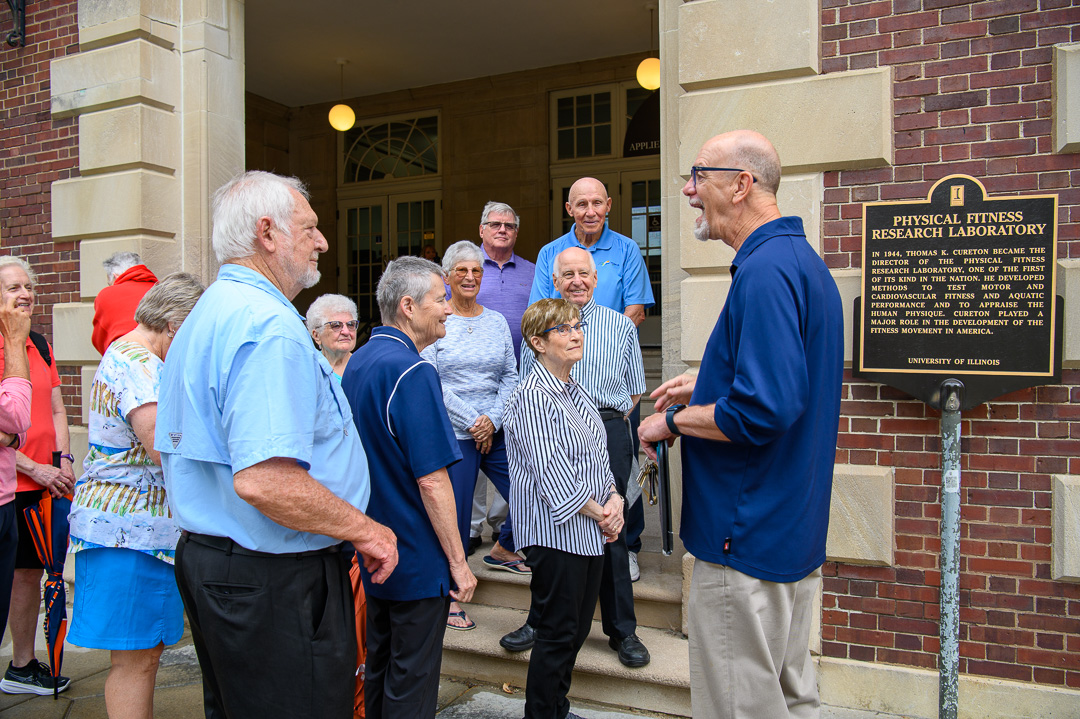
Physical fitness pioneer Thomas “TK” Cureton started his Physical Fitness Research Laboratory in 1944, occasionally collaborating with psychologist Raymond B. Cattell. The two of them examined the relationship between physical activity on personality and several of Cureton’s graduate students examined the anxiety-reducing effects of exercise. In 1951, Professor Alfred “Fritz” Hubbard revived Griffith’s research line with a new Sport Psychology Laboratory, located in a third floor office of Huff Hall, then known as Huff Gymnasium.
Hubbard specialized in motor learning, but saw latent potential in the sport psychology discipline. After a decade of research and recruitment, Hubbard had a prediction: the number of graduate students interested in sport psychology would double or triple by the end of the 1970s. His forecast of growth came true.
Still, those who joined the Illinois sport psychology program in the 1960s found their way to the field before an academic path formally existed. Some started out in coaching or physical education, and were searching for applied knowledge to use in the field.
For Rainer, his experience with intense anxiety before youth wrestling matches inspired him to understand competitive nerves and how to quell them.
After getting degrees from the then-named Department of Physical Education, Landers, Martens and Roberts all eventually joined the Children’s Research Center, a grant-funded research vehicle seeking to explain children’s behavior from multiple academic disciplines.
The recent grads worked in the center’s Motor Performance and Play Research Laboratory, where they used social psychology principles to study children’s play, and explore how their stress levels, personalities and more influenced their motor learning.
The grant-funded lab supercharged their progress.
“A lot of the stuff we did initially was stress related. How do you reduce stress? That was Rainer’s research—what he called competitive anxiety,” said Roberts, who began working at the Children’s Research Center in 1973. “Mine was motivation: how do you make people do what they ought to be doing?”
Full-time research positions to study the field were unusual, and freeing. From 1968 to 1975, Martens stayed on with the Children’s Research Center. Lifted by the university’s resources, namely its enormous library, computing power and collaborators in psychology, the lab produced leading research in sport psychology before peer institutions had caught on to the emerging discipline.
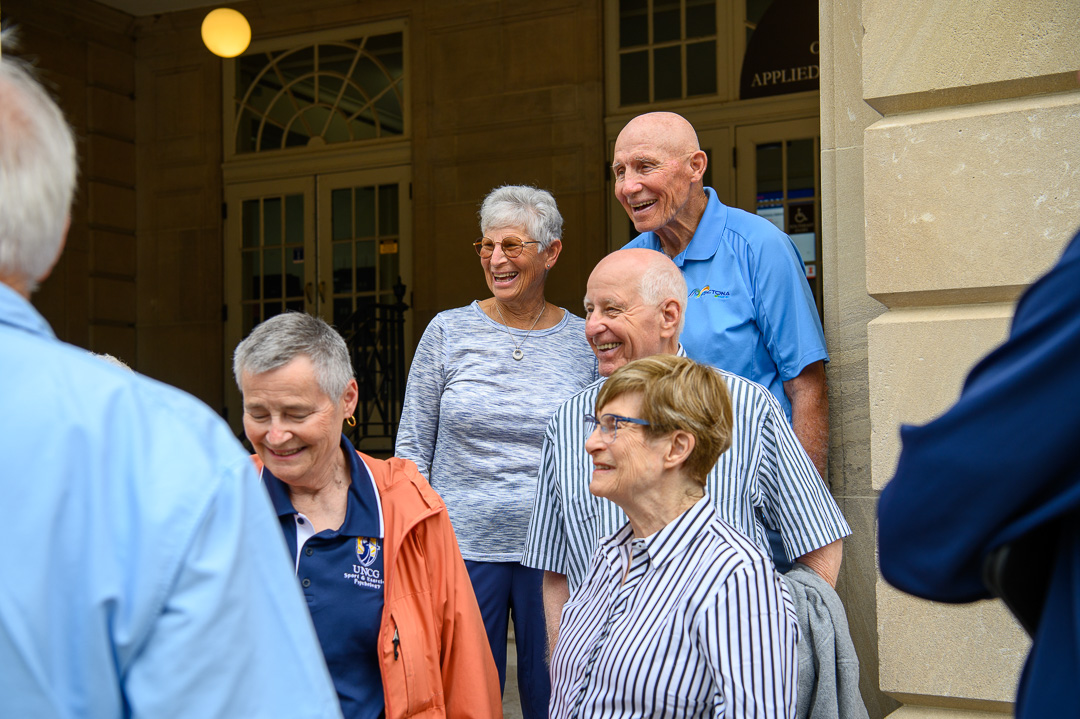
Julie Martens (center left) and Tara Scanlan (second from right) share a laugh in Huff Hall. Both of them obtained their doctoral degrees in sport psychology from the University of Illinois.
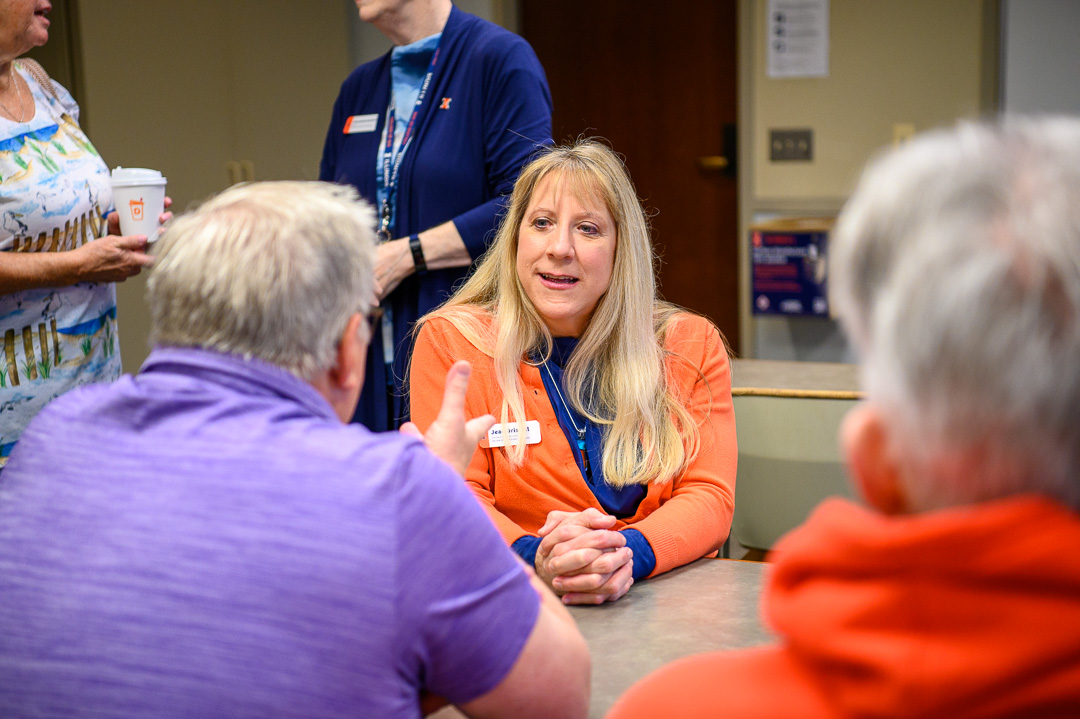
Jean Driscoll (center) chats with Dan Gould and Damon Burton, both graduates of the sport psychology program at Illinois who went on to successful careers in the field.
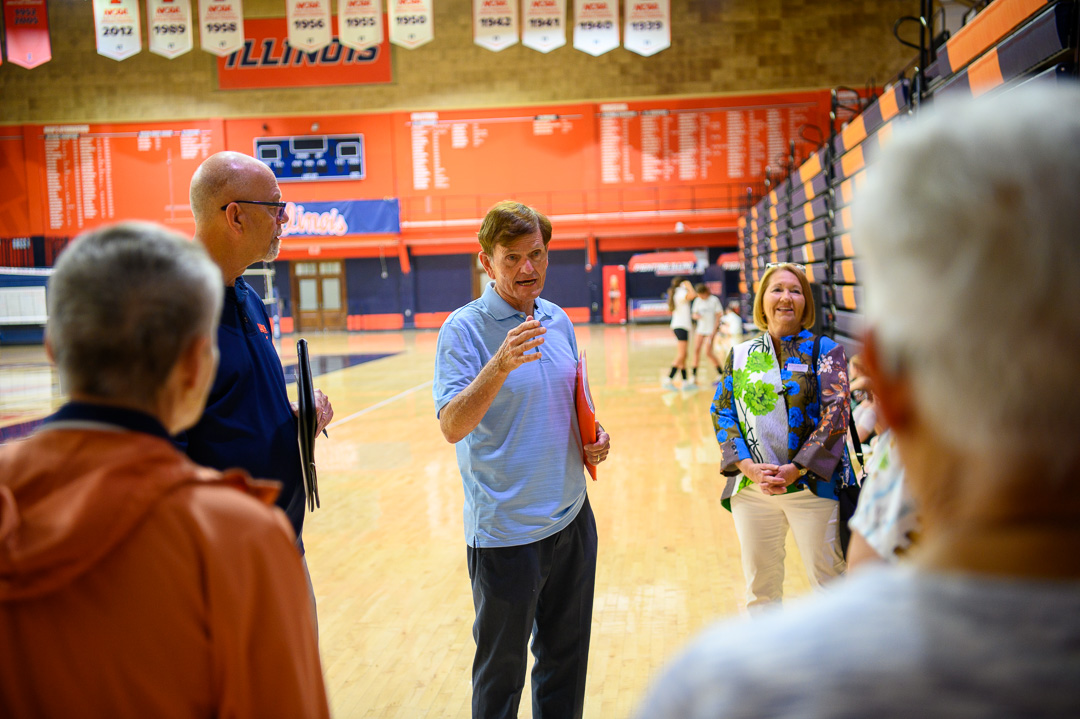
Bill Goodman (center) retired associate dean for administration at the College of AHS, tours former Illinois sport psychology students and faculty around Huff Gym.
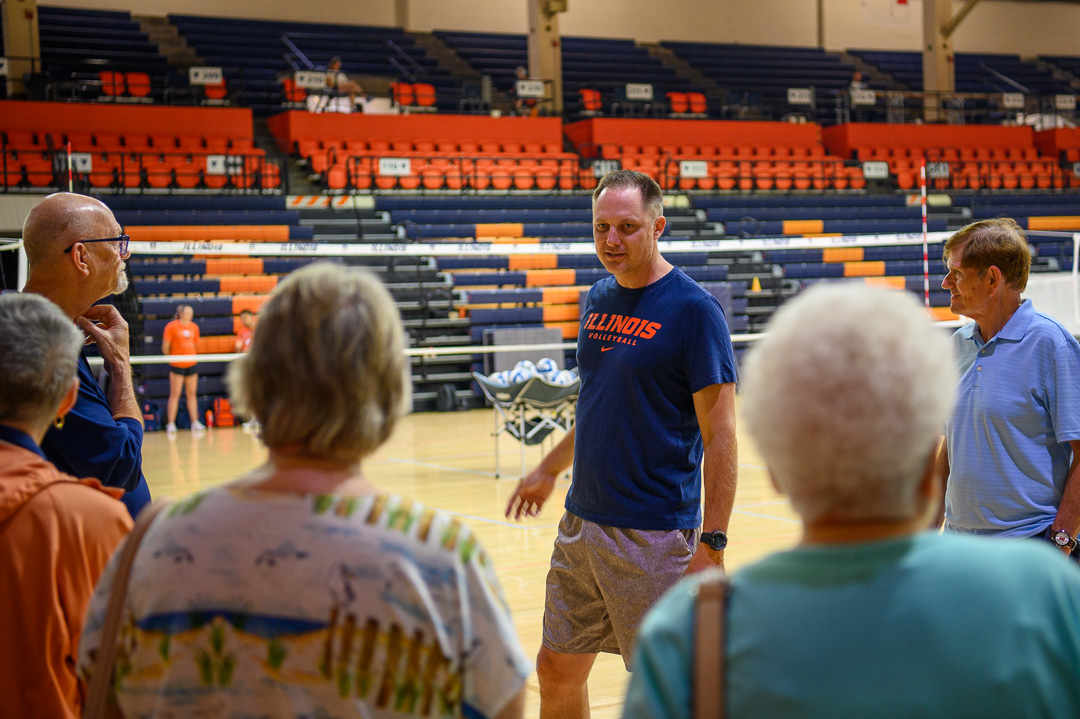
Chris Tamas, the current coach of the Illinois volleyball squad, speaks to former sport psychology students and faculty in Huff Gym.
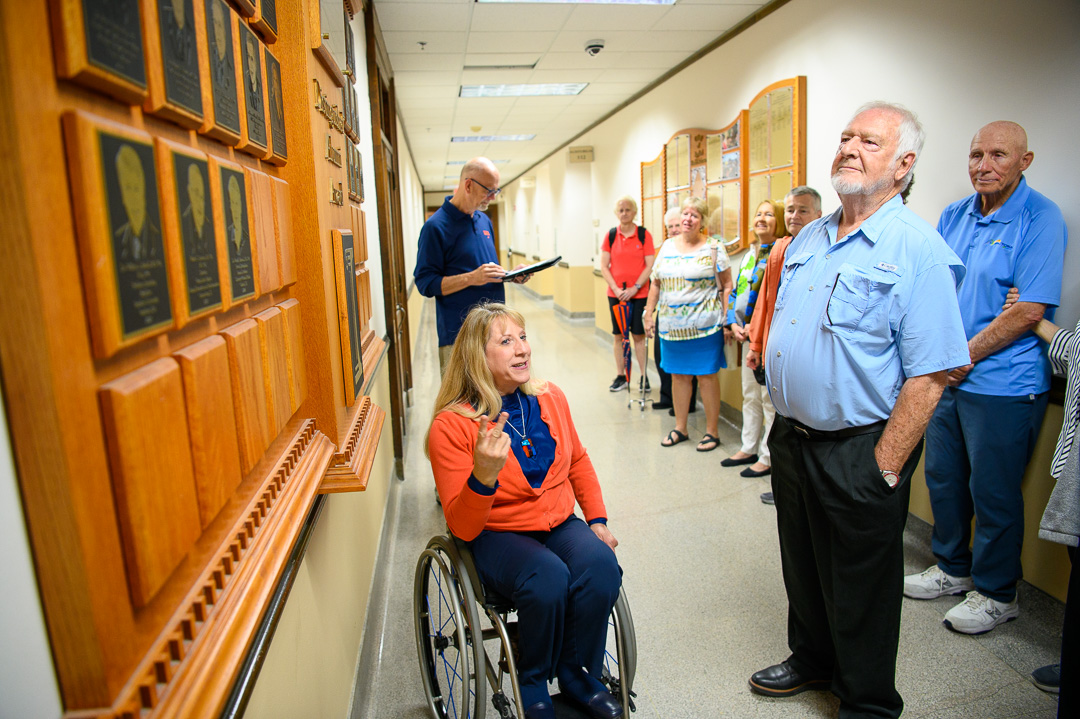
Jean Driscoll shows off the wall of Distinguished Alumni Award winners from the College of Applied Health Sciences.
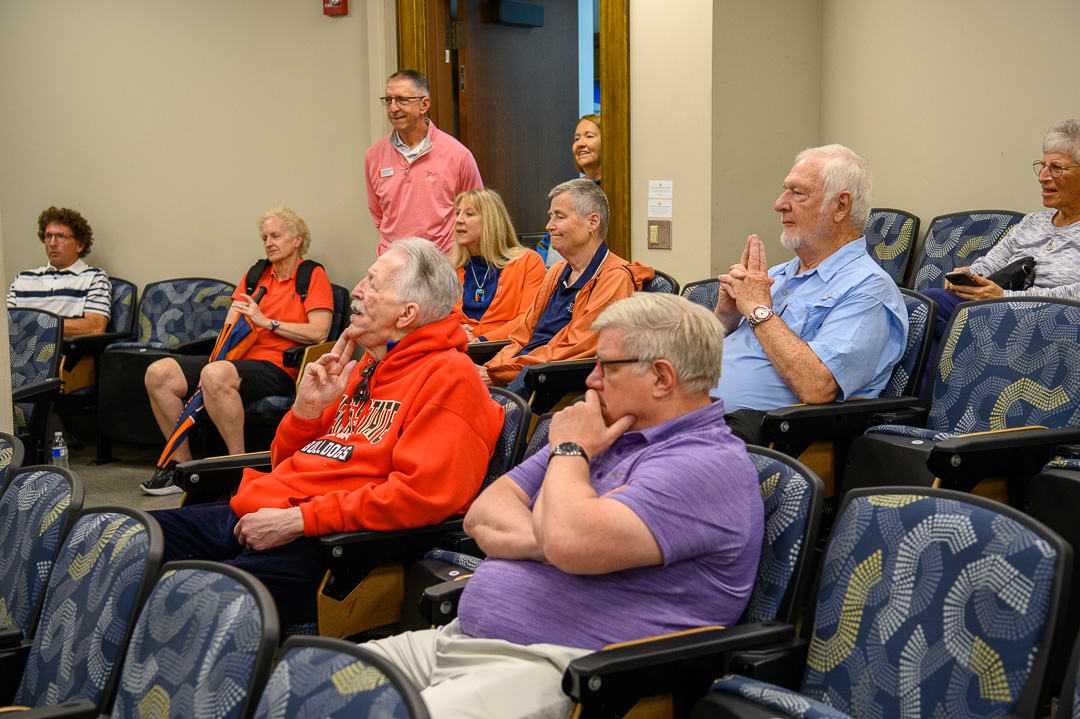
Former Illinois sport psychology students and faculty sit in one of the new Huff Hall classrooms. The space used to be part of the Huff Gym indoor pool.
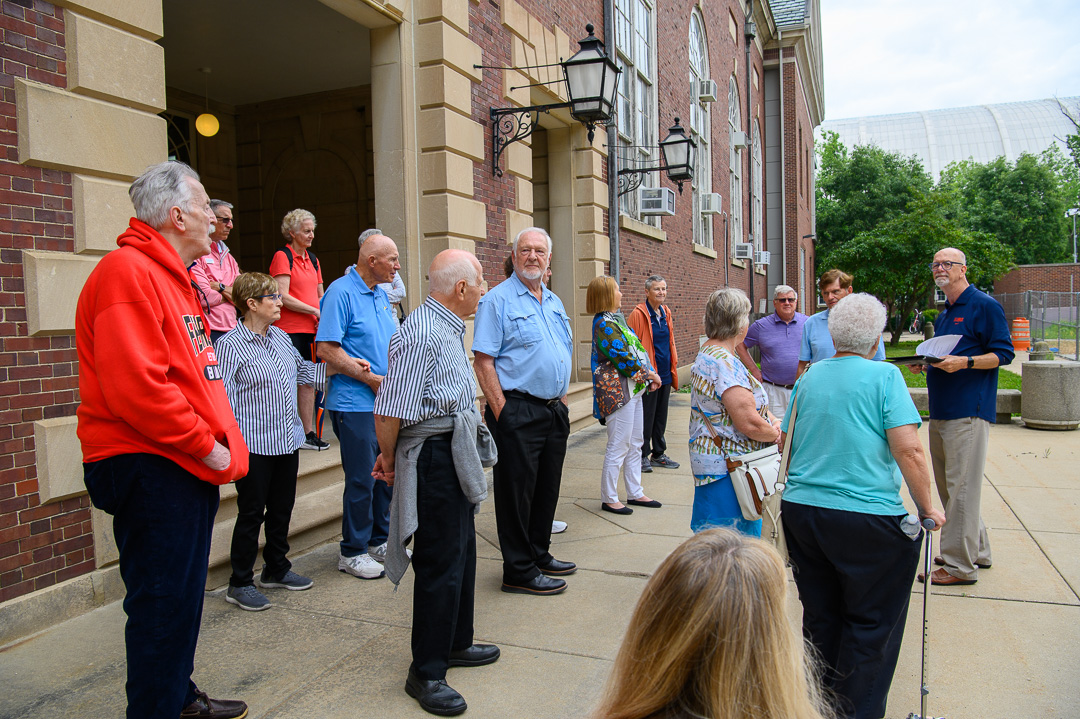
A reunion of sport psychology faculty and students at Illinois brought the guests inside and outside Huff Hall, where much of the early research into their field took place.
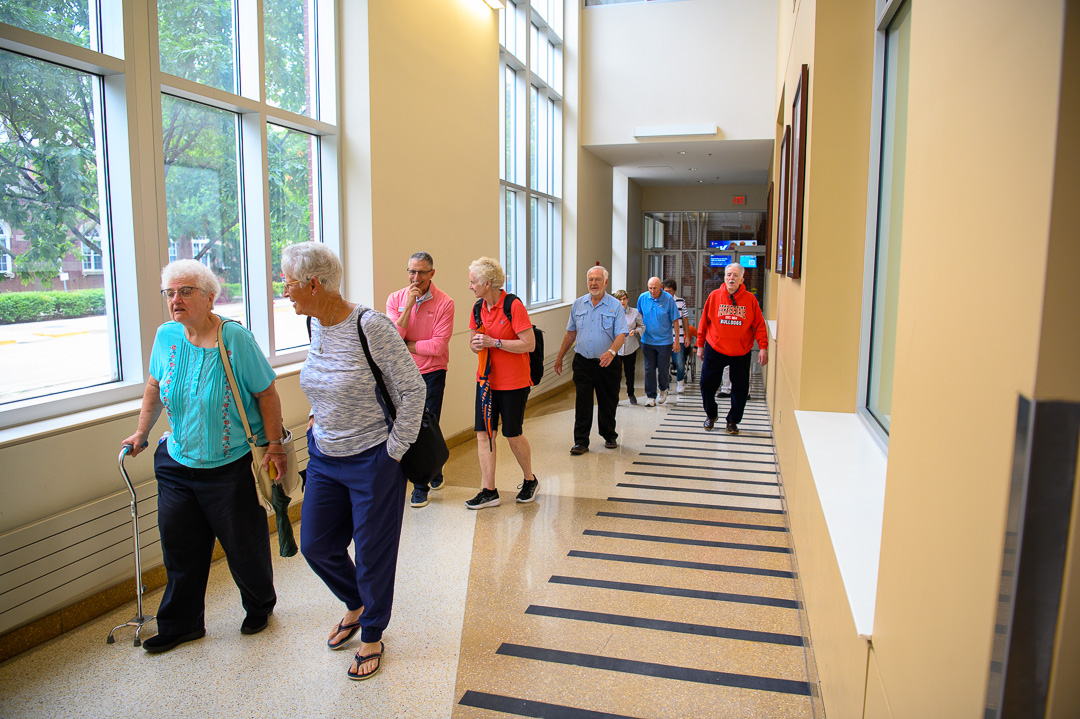
Former Illinois sport psychology faculty and students walk up the ramp of the Khan Annex, an addition to Huff Hall that opened in 2011.
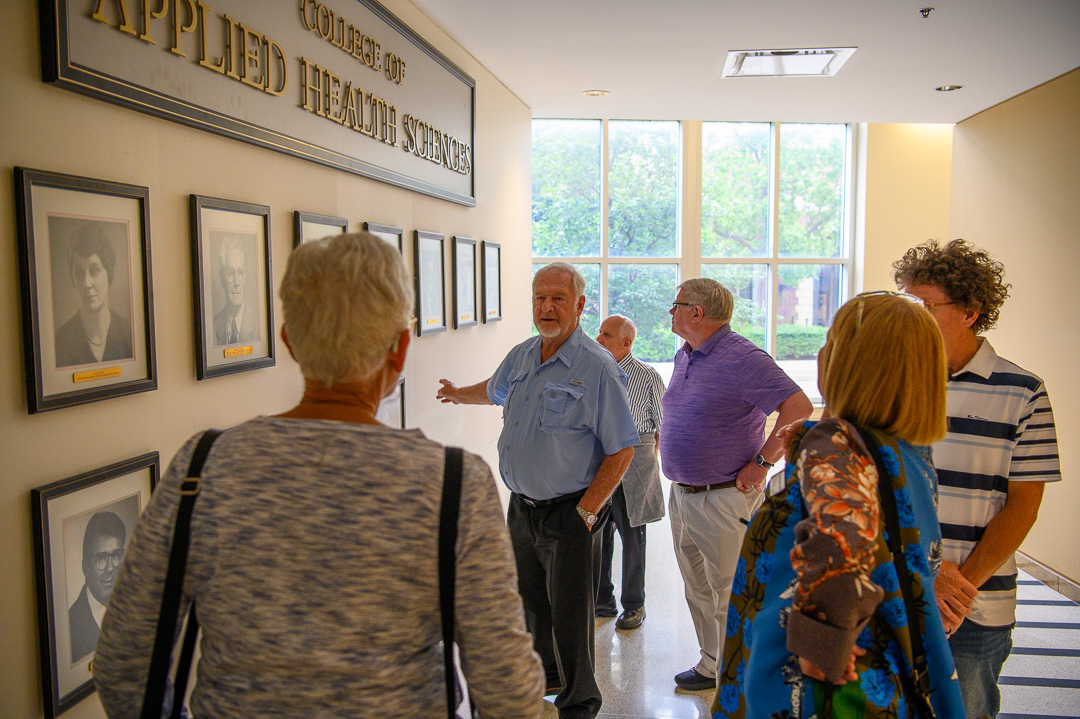
Glyn Roberts (center) points to the wall of deans of the College of Applied Health Sciences.
Don Hardin (right), adjunct instructor at AHS and former women's volleyball head coach, talks about the history of Huff Hall with former sport psychology students and faculty.
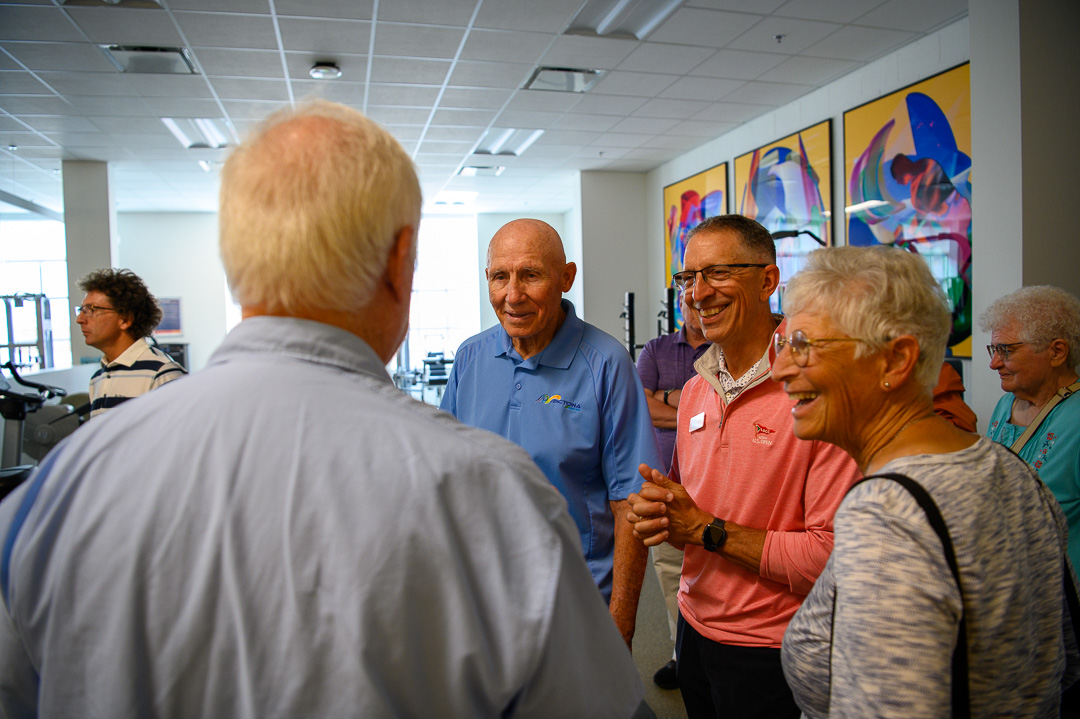
The sport psychology tour stops by the Freer Hall gym, used for research purposes.
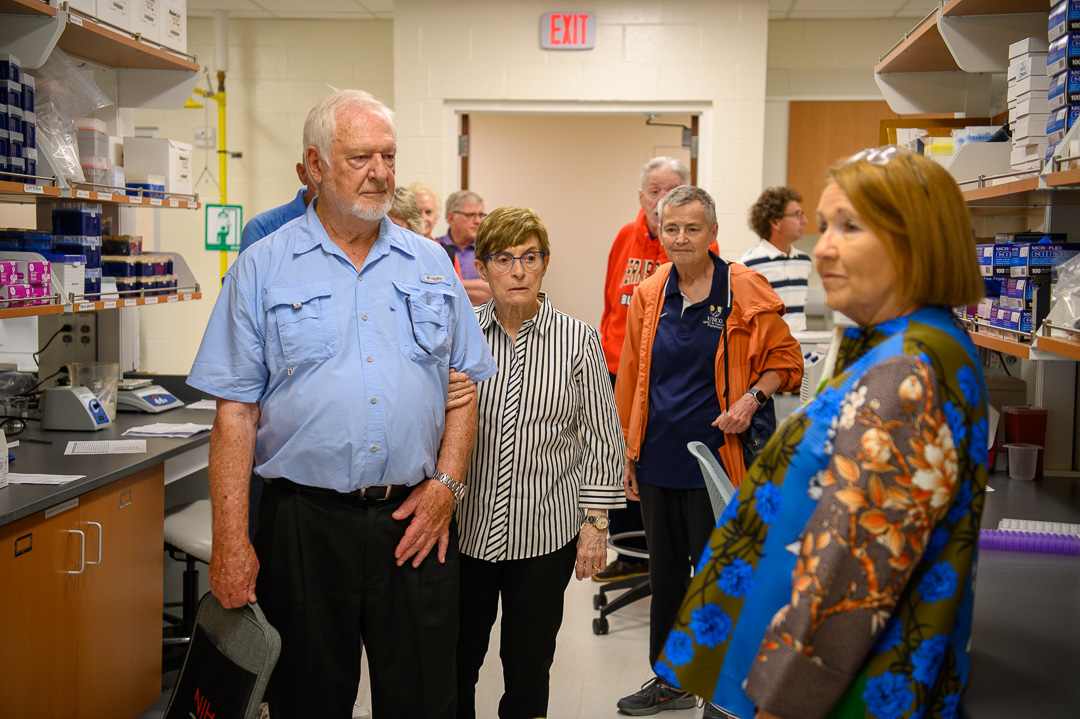
Former sport psychology students and faculty tour the basement labs of Freer Hall.
The enthusiasm of Illinois sport psychologists was clearly infectious. After a couple years teaching physical education, Diane Gill attended a conference at Brockport, New York, where she got to hear both Dan Landers and Rainer Martens speak about their research at Illinois. By her first semester in Urbana-Champaign, Gill was in Martens’ class “Social Psychology and Physical Activity,” where his first doctoral student, Tara Scanlan, was teaching assistant.
“Taking that course, immediately I thought, ‘this is the area I’d like to be in,’” Gill said.
She soon worked with the pair on their competitive anxiety research, and later studied competitiveness and athletes’ “achievement orientation,” or drive to improve and accomplish goals within their sport, along with a host of other topics in the field.
“Illinois was the place to be if you wanted to be in sport psychology,” she said.
Gill is newly retired, having spent more than 30 years as a professor of kinesiology at University of North Carolina, Greensboro after obtaining her master’s and Ph.D. at Illinois.
(“My doctoral students are retiring,” said Martens, now 82. “That makes me really old.”)
Physical activity—whether it’s high-level athletics or recess play—is all one field.
Diane Gill
Professor Emerita of Kinesiology, UNC Greensboro
Julie Martens, née Simon, was accepted into the program in 1973, coming to Illinois specifically to study with Rainer. (They would get married nearly 20 years later).
“[Tara Scanlan and Diane] had an office out at the Children’s Research Center right next to Rainer’s. As I got to know them, we used to be out there every evening. They said, “Come on out, you can study at night with us,’” Julie said. “That’s how I got involved with meeting the other students, then I got an assistantship and got where I wanted to be.”
The scientists would run experiments, hop over to the nearby cafeteria in the Adler Mental Health building for lunch and sketch out ideas for new research designs on napkins. Those early days were “invigorating,” Martens said.
By 1980, U. of I. was the premier place of study for sport psychology, alongside Penn State. They had turned the topic into a formal graduate program, and the field was continuing to blossom. In 1979, Dan Landers and Rainer co-founded the Journal of Sport Psychology, where Landers was the inaugural editor-in-chief.
As the field grew in relevance, new pathways opened up and Illinois sport psychology spread across the country. Sport psychology got a “big break” when the Olympic Training Committee allowed athletes to be advised by professionals who weren’t clinicians or psychiatrists, Roberts said—sport psychologists could now help athletes develop strategies to perform under extreme stressors.
“The U. of I. was very special. And the thing that stuck with me was we attracted such good students. We generated a reputation, and students wanted to come here from all over the world,” Roberts said. “We didn’t realize it, but we were pioneers.”
‘No better program in the world’
Between visits to their old labs and offices, the sport psychology legends visited classrooms in Huff Hall where there used to be a swimming pool, and walked on floors of Freer Hall that were once open air.
“In Freer and Huff, things have changed, which is good in many ways. You wouldn’t want the same stuff you had 50 years ago,” Gill said.
Over the weekend, the sport psychology crew took the 40-minute drive to Allerton Park in Monticello, where they hosted the nation’s first conference in sport psychology: the North American Society for Psychology of Sport and Physical Activity (NASPSPA) in 1973.
Several of them later served as executives and presidents of the society. The first conference also planted the seeds for Human Kinetics, the Champaign-based publisher of sport and exercise science founded by Martens and his first wife, Marilyn.
Though a formal sport psychology program no longer exists at Illinois, the field has expanded and evolved. The Department of Health and Kinesiology continues to study the psychological aspects and benefits of physical activity.
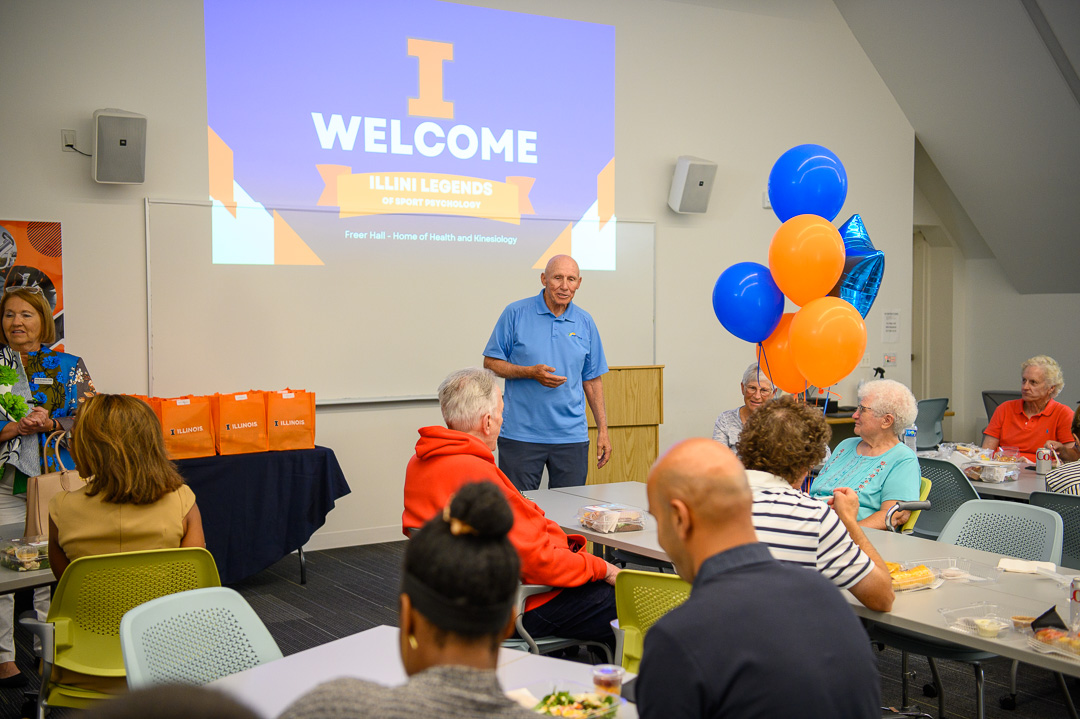
Rainer Martens speaks to his former Sport Psychology colleagues, and the current-day faculty of Health and Kinesiology.
“I think of it as one field. Physical activity—whether it’s high-level athletics or recess play—is all one field,” Gill said.
After walking through their old stomping grounds, the group met with current-day faculty and students of Health and Kinesiology for lunch in Freer Hall.
“This was the group that got sport psychology a foothold in this country,” said HK Professor Steve Petruzzello, who runs the college’s Exercise Psychophysiology Laboratory. “It’s wonderful to see these folks back here, to see their eyes light up as they’re walking around the halls, seeing spaces that look familiar and some that are completely unfamiliar.”
What remains from this era of sport psychology, and even the early days of Athletic Research Laboratory, are questions on the relationship between physical activity and psychology—including personality, stress, cognitive factors and affect, or feeling states.
“Faculty currently study these kinds of topics in older adults and children, in diverse populations, and in more specialized groups like tactical athletes,” Petruzzello said. “So really, the pioneering work of Coleman Griffith at Illinois over 100 years ago has evolved and developed into what it is today.”
Before heading off, the sport psychologists dispensed career advice with some of the rising graduate students and faculty. Linda Harrison obtained her Ph.D. from the program in 1987—she opted to go into the publishing industry instead of academia, but she credits her time at Illinois for developing her abilities to think and ask questions.
“The grad students all benefited from the historic founding fathers of sport psychology and the scholars who picked up the torch to carry the program to the next level,” Harrison said. “I am sure there was no better program in the world than the one offered at U. of I.”
Editor’s note:
To reach Ethan Simmons, email ecsimmon@illinois.edu The College of Applied Health Sciences and Illinois Division of Intercollegiate Athletics are celebrating 100 years of Huff Hallthis fall.
Stephanie Voss’s research at the College of Applied Health Sciences looks at how might yoga be used to manage lasting pain
Stephanie Voss, a kinesiology Ph.D. candidate, is a yogi and occupational therapist. Her research blends the two interests together. (Photo by Ethan Simmons)
To doctoral candidate Stephanie Voss, chronic pain treatment and yoga have more in common than we think.
Voss, now in her third year of a kinesiology Ph.D program at the University of Illinois, first came across the connection while working as an occupational therapist at the Shirley Ryan AbilityLab, a rehabilitation research hospital in Chicago.
While she consulted patients who were dealing with persistent, chronic pain, Voss was training to become a yoga instructor—an out-of-class hobby that helped her overcome her own studying-induced back pain.
“I couldn’t get over how similar the treatment approaches are,” Voss said. “Yoga is very much a holistic practice, and we address chronic pain in very much a similar way—it involves working as part of an interdisciplinary team on strength and muscle conditioning and posture and body mechanics. We also work on the psychological components, the emotional components and how we can integrate pain management strategies into daily life.”
Today, Voss’s research at the College of Applied Health Sciences merges the two: How might yoga be used to manage lasting pain?
This fall, she was named a recipient of the Paul D. Doolen Graduate Scholarship for the Study of Aging, an annual award given to two University of Illinois graduate students whose scholarly work advances research on the human aging process.
With the help of the Doolen scholarship, Voss will develop a yoga protocol that specifically targets interoception, or the ability to perceive and interpret the sensations within one’s own body, an ability which may fade as we age.
The project will explore whether yoga can improve older adults’ abilities detect and interpret feelings of pain and discomfort within their bodies.
“I found [the scholarship] relevant to my research because most of my patients are older adults,” she said. “Chronic pain is immensely prevalent in older adult populations for various reasons but interestingly older adults tend to not be included in pain trials as often.”
What the $4,250 scholarship gives her for now is “breathing room,” Voss said. “Being a grad student isn’t always easy from a financial standpoint, so having a little bit of extra support to free up my time and mental space, it’s one less thing to worry about.”
She’s very smart, and very personable. It’s just refreshing for somebody to have such a good perspective on the science of what she does, but to also be very respectful and willing to take criticism for what it’s worth.
Steve Petruzzello
Health and Kinesiology professor
Voss received her B.S. in Communication Sciences and Disorders from Northwestern University in 2014 and her M.S. in Occupational Therapy from Rush University in 2018.
She began at the University of Illinois in August 2021, working under former Illinois KCH Associate Professor Neha Gothe in Gothe’s Exercise Psychology Lab. Gothe was one of the only academics exploring the connection between yoga and pain management. Voss, then fully working as an occupational therapist, reached out to Gothe over email, expressing her desire to pursue a Ph.D. under her.
Since then, Voss has worked as a research assistant and teaching assistant, having instructed an introductory-level yoga class while periodically working with patients at the AbilityLab in Chicago. She recently taught the yoga intervention for one of Gothe’s research studies working with older adults.
“That got to really challenge my clinical and yoga teaching skills to integrate modifying postures for people who live in different bodies than mine,” Voss said. “It’s so immensely important that my research questions are rooted in the clinical needs of the patients. I want to make sure I’m still in touch with that population.”
When Gothe departed Illinois for Northeastern University in Boston, Voss decided to stay and finish the final stages of her Ph.D. program, with KCH Professor Steve Petruzzello stepping up as her on-site doctoral co-advisor.
“She’s very smart, and very personable,” said Petruzzello, who first met Voss while she made insightful comments in his class, KIN 443: Psychophysiology of Exercise & Sport. “It’s just refreshing for somebody to have such a good perspective on the science of what she does, but to also be very respectful and willing to take criticism for what it’s worth.”
Both her mentors described Voss as a methodical, talented researcher whose clinical experience has given her unique perspective and a deft ability to communicate scientific concepts to different audiences.
“She has an eye for translation and application of the research in clinical as well as real-life settings,” Gothe said. “Her years of yoga training and teaching also give her a unique advantage to work and communicate with her patients and research subjects.”
After her graduation, expected in spring 2025, Voss hopes to work in a hybrid clinical-academic position. In the meantime, Voss has seen great recruitment interest in her dissertation research, examining yoga as a strategy for chronic pain management.
“I do feel like I will be leaving with a degree that gives me a lot of opportunity and flexibility that I can teach in occupational therapy departments. I’ll be fully qualified for that, but I’ll also be fully qualified to teach in more traditional academic university-based settings that are not necessarily a clinical program,” Voss said.
The question that guides her research: How might yoga be used to manage chronic pain?
Stephanie Voss poses outside of Freer Hall.
To doctoral candidate Stephanie Voss, chronic pain treatment and yoga have more in common than we think.
Voss, now in her third year of a kinesiology Ph.D program at the University of Illinois, first came across the connection while working as an occupational therapist at the Shirley Ryan AbilityLab, a rehabilitation research hospital in Chicago.
While she consulted patients who were dealing with persistent, chronic pain, Voss was training to become a yoga instructor—an out-of-class hobby that helped her overcome her own studying-induced back pain.
“I couldn’t get over how similar the treatment approaches are,” Voss said. “Yoga is very much a holistic practice, and we address chronic pain in very much a similar way—it involves working as part of an interdisciplinary team on strength and muscle conditioning and posture and body mechanics. We also work on the psychological components, the emotional components and how we can integrate pain management strategies into daily life.”
Today, Voss’s research at the College of Applied Health Sciences merges the two: How might yoga be used to manage lasting pain?
This fall, she was named a recipient of the Paul D. Doolen Graduate Scholarship for the Study of Aging, an annual award given to two University of Illinois graduate students whose scholarly work advances research on the human aging process.
With the help of the Doolen scholarship, Voss will develop a yoga protocol that specifically targets interoception, or the ability to perceive and interpret the sensations within one’s own body, an ability which may fade as we age.
The project will explore whether yoga can improve older adults’ abilities detect and interpret feelings of pain and discomfort within their bodies.
“I found [the scholarship] relevant to my research because most of my patients are older adults,” she said. “Chronic pain is immensely prevalent in older adult populations for various reasons but interestingly older adults tend to not be included in pain trials as often.”
It’s so immensely important that my research questions are rooted in the clinical needs of the patients.”
Stephanie Voss
Kinesiology Ph.D. candidate
What the $4,250 scholarship gives her for now is “breathing room,” Voss said. “Being a grad student isn’t always easy from a financial standpoint, so having a little bit of extra support to free up my time and mental space, it’s one less thing to worry about.”
Voss received her B.S. in Communication Sciences and Disorders from Northwestern University in 2014 and her M.S. in Occupational Therapy from Rush University in 2018.
She began at the University of Illinois in August 2021, working under former Illinois KCH Associate Professor Neha Gothe in Gothe’s Exercise Psychology Lab. Gothe was one of the only academics exploring the connection between yoga and pain management. Voss, then fully working as an occupational therapist, reached out to Gothe over email, expressing her desire to pursue a Ph.D. under her.
Since then, Voss has worked as a research assistant and teaching assistant, having instructed an introductory-level yoga class while periodically working with patients at the AbilityLab in Chicago. She recently taught the yoga intervention for one of Gothe’s research studies working with older adults.
“That got to really challenge my clinical and yoga teaching skills to integrate modifying postures for people who live in different bodies than mine,” Voss said. “It’s so immensely important that my research questions are rooted in the clinical needs of the patients. I want to make sure I’m still in touch with that population.”
When Gothe departed Illinois for Northeastern University in Boston, Voss decided to stay and finish the final stages of her Ph.D. program, with KCH Professor Steve Petruzzello stepping up as her on-site doctoral co-advisor.
“She’s very smart, and very personable,” said Petruzzello, who first met Voss while she made insightful comments in his class, KIN 443: Psychophysiology of Exercise & Sport. “It’s just refreshing for somebody to have such a good perspective on the science of what she does, but to also be very respectful and willing to take criticism for what it’s worth.”
Both her mentors described Voss as a methodical, talented researcher whose clinical experience has given her unique perspective and a deft ability to communicate scientific concepts to different audiences.
“She has an eye for translation and application of the research in clinical as well as real-life settings,” Gothe said. “Her years of yoga training and teaching also give her a unique advantage to work and communicate with her patients and research subjects.”
After her graduation, expected in spring 2025, Voss hopes to work in a hybrid clinical-academic position. In the meantime, Voss has seen great recruitment interest in her dissertation research, examining yoga as a strategy for chronic pain management.
“I do feel like I will be leaving with a degree that gives me a lot of opportunity and flexibility that I can teach in occupational therapy departments. I’ll be fully qualified for that, but I’ll also be fully qualified to teach in more traditional academic university-based settings that are not necessarily a clinical program,” Voss said.
Editor’s note:
Stephanie Voss completed her Ph.D. at Illinois in May 2025.
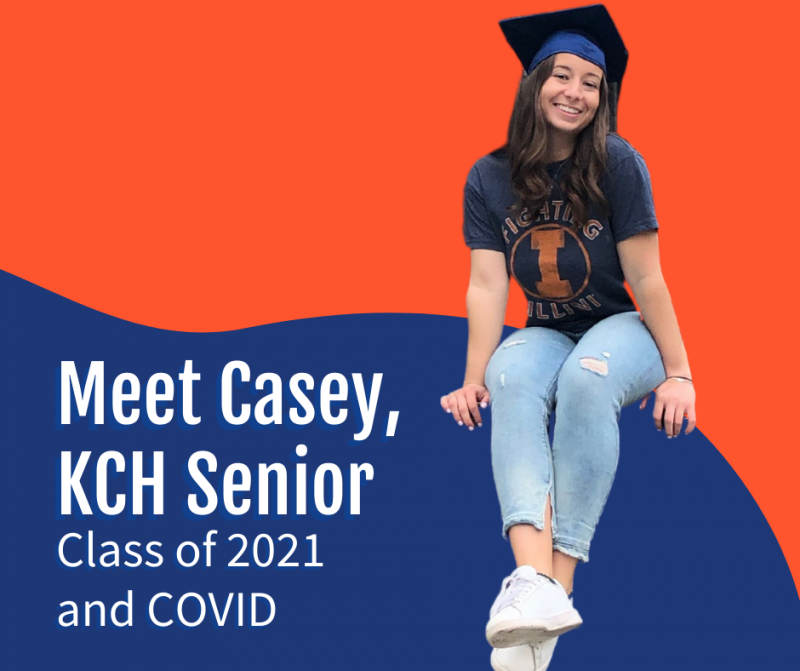
Students are attending college in a unique environment, and that includes students in the College of Applied Health Sciences at the University of Illinois. The AHS communications staff spoke with AHS seniors about online classes, truncated courses and how COVID-19 changed their expectations. Today, we speak with Casey Cushing, who graduated in May with a Bachelor of Science in Kinesiology.
Photo by caption
Q: Why did you pick KCH?
A: I picked KCH because it was a great program at a university that offered me so many benefits compared to other universities. I knew by being in this program that I would gain the basic knowledge to continue on to occupational therapy graduate programs.
Q: Which professors had the most impact on you?
A: There were multiple professors that I really enjoyed having and that made an impact on experience. Dr. (Steve) Petruzzello created such a fun and engaging learning environment and was always willing to help his students so they could be more successful. I worked as an assistant in Dr. (Kevin) Richards’ research lab for the past three years. He helped me grow as a researcher and student, always had so much confidence in me and provided me with opportunities that I could have never imagined! I’m so grateful for them and all the other professors I had along the way.
Q: What course did you most enjoy?
A: My favorite course was KIN340, which Dr. (Petruzzello) taught. I liked the content of the course, as well as the lab. The information we learned in lab was useful and my TA was amazing. I also really enjoyed this class because I was able to develop friendships with my peers.
Q: Did you enter KCH knowing your career path, or did KCH help you decide?
A: I entered KCH planning to go to occupational therapy school. However, KCH reinforced my interest in the field and provided opportunities to get more involved within the OT community.
Q: What do you hope to do after you graduate?
A: I will be attending (Illinois-Chicago) for a Doctorate in Occupational Therapy.
Q: What was your favorite on-campus experience?
A: My favorite on campus experience was being on the quad on a beautiful spring day when it is busy with students. I loved finding a good spot to hammock and relaxing with friends.
Q: What do you miss most because of the pandemic?
A: Because of the pandemic, I really missed in-person classes. I don’t enjoy online classes as much because it is not as easy to foster the relationships with friends, TAs, and professors that I value so much.
Q: What are the biggest changes on campus, pre and during COVID?
A: I am definitely not socializing on campus as much as I did before COVID. I always loved walking around, seeing familiar faces, engaging in campus events, but because of the pandemic I haven’t been doing this stuff as much.
Q: What would you say to recommend KCH to a prospective student?
A: I would 100 percent recommend KCH to a prospective student. Since KCH is within a small college, you feel like you get a personalized education which is very comforting when college can be such a scary change. The professors and other students are great and it will provide you the opportunities you need to succeed in the future!