U. of I. trial will test if exercise can improve protein efficiency for older adults with type 2 diabetes


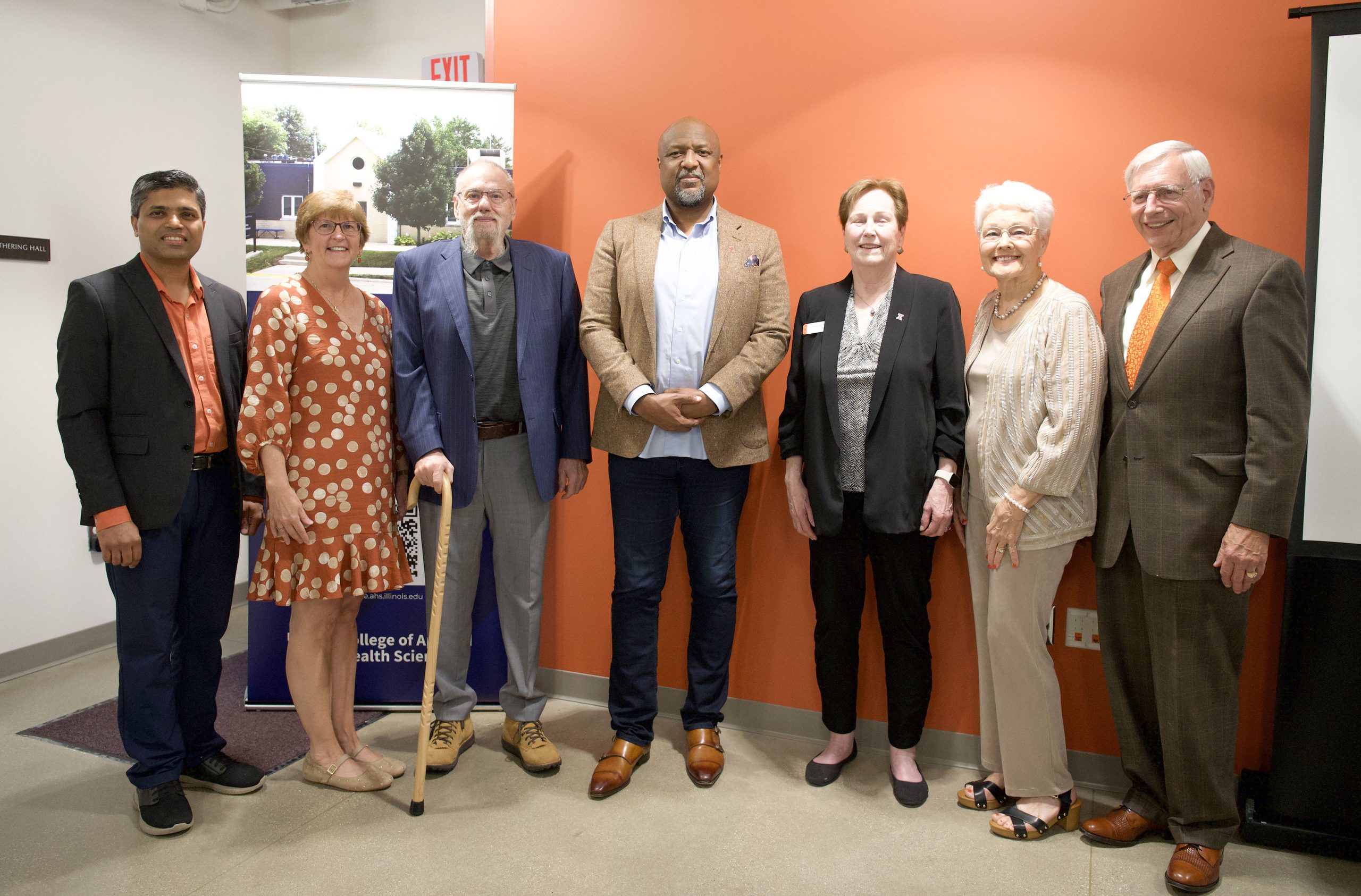
From left: University of Illinois Professor Nick Burd, postdoc Mikaela Kasperek, Ph.D. student Gena Irwin, and Associate Professor Jacob Allen pose inside Freer Hall’s gym, where their labs will train participants in a 12-week exercise program for a clinical trial.

For healthy adults, roughly .8 grams of protein per kilogram of bodyweight per day is enough to maintain muscle mass and support daily function.

But for adults with type 2 diabetes, an estimated 1 in 10 adults in the United States, their protein requirements remain relatively undefined, but are believed to be elevated when compared to their non-diabetic counterparts. Especially as diabetic individuals age, their bodies often become more anabolic resistant: less responsive to the muscle-building effects of exercise and protein intake.

Researchers from the Department of Health and Kinesiology at the University of Illinois Urbana-Champaign are recruiting participants for a human clinical trial to understand the protein needs of older adults with type 2 diabetes, and whether regular exercise can help their bodies use protein more efficiently.

“The problem with current strategies for type 2 diabetes is they largely try to keep throwing protein in people’s diets: eat more, eat more, eat more,” HK Professor Nicholas Burd said.  

Piling on the protein could have detrimental effects. There’s evidence that circulating amino acids, including branch chain amino acids that promote muscle mass, are associated with poorer outcomes for people with diabetes, said HK Associate Professor Jacob Allen.

Their upcoming study, “Exercise impact on dietary protein efficiency in older adults with type 2 diabetes,” is funded by a grant from the American Diabetes Association. The principal investigators are Burd, who researches protein metabolism, and Allen, who studies how exercise and nutrition impact the gut microbiome.

Health and Kinesiology professors Jack Senefeld and Steve Petruzzello are co-investigators on the study.

HK Assistant Professor Jack Senefeld and Professor Steve Petruzzello are co-investigators on the study, bringing expertise on training diabetic individuals and psychological well-being during exercise. Ph.D. candidate Gena Irwin and postdoc Mikaela Kasperek will lead the work from the Burd’s Exercise Performance Lab and Allen’s Integrative Microbiota Physiology labs respectively.

Starting this fall, the researchers will recruit 30 older adults to participate in this study—15 individuals living with type 2 diabetes and 15 without—and bring them into Freer Hall’s gym for a 12-week fitness program that mixes weight training with endurance exercise.

The researchers will use sensitive tools in their labs to figure out how efficiently participants’ bodies utilize protein, and whether that efficiency varies for older adults with and without diabetes. After participants wrap the exercise program, the team will test whether resistance training improved their bodies’ usage of protein overall, lessening their daily protein needs.

“To make an older person’s muscles more youthful, you can exercise them,” Burd said. “But we don’t know how the gut’s being impacted, and we don’t know how type 2 diabetes interferes with some of the ‘youthfulness’ effects of exercise.”

Some of our dietary protein ends up in our skeletal muscle, through muscle-protein synthesis, and some of it is used for energy. But there’s a “black box” around where the rest of our protein goes in the body, Allen said.

“We think that the microbes in the gut, the gut microbiome, might be responsible for some of this, but this has never been studied,” Allen said. “We’ve run some pilot work that fueled part of this study, where we can show that indeed, ingested amino acids are converted into these microbial metabolites.”

Why might that matter? Some of these metabolites are important for human health overall, Allen said. For example, short chain fatty acids—the byproducts of dietary fiber being processed in our gut—bring a host of benefits for metabolism and the immune system.

The research teams will host intervention days at the beginning and end of the 12-week exercise program, to see how participants’ bodies are using the protein in their muscle and gut.

Participants will consume amino acids labeled with stable isotope tracers. The labs will collect breath samples to see how much of the labeled amino acid is showing up in the breath—if more of that labeled protein appears in participants’ breath, their bodies aren’t as good at incorporating it into muscle.

Blood samples will help the scientists understand how the gut is taking those amino acids and converting them into potentially beneficial metabolites.

The second intervention day at the end of the trial will determine whether an exercise program changed the way participants’ bodies use protein.

“There are very few labs in the U.S that not only have the expertise, but have the infrastructure to be able to do this kind of work, so we’re very fortunate for Illinois and our department,” Burd said. “Stable isotope tracers require expensive machines to analyze.”

What’s in it for participants? On top of helping the scientists form dietary guidelines for older adults with type 2 diabetes, they’ll receive progressive exercise training from expert students and faculty at the college, that will hopefully serve them well beyond their last visit.

“A big goal is to change behavior, too, to make them healthier,” Allen said. “That’s ultimately what we’re trying to do.”

Editor’s note:

Interested in participating in this study? Take the survey to see if you qualify, or email the organizers at HK-ADA-Study@illinois.edu

To reach Nick Burd, email naburd@illinois.edu
To reach Jacob Allen, email jmallen5@illinois.edu

Share on social
Related news

Announcing our faculty promotions for 2025-26


Seven faculty at the College of Applied Health Sciences received promotions prior to the 2025-26 Academic Year. Here are their new faculty titles.

Professor

Nicholas Burd, Health and Kinesiology

Andiara Schwingel, Health and Kinesiology

Associate Professor

Susan Aguiñaga, Health and Kinesiology

Jacob Allen, Health and Kinesiology

Mary Flaherty, Speech and Hearing Science

Sharon Zou, Recreation, Sport and Tourism

Teaching Associate Professor

Kristen DiFilippo, Health and Kinesiology

Share on social

Related news

For Health and Kinesiology’s Askow, a heavy lift is no burden


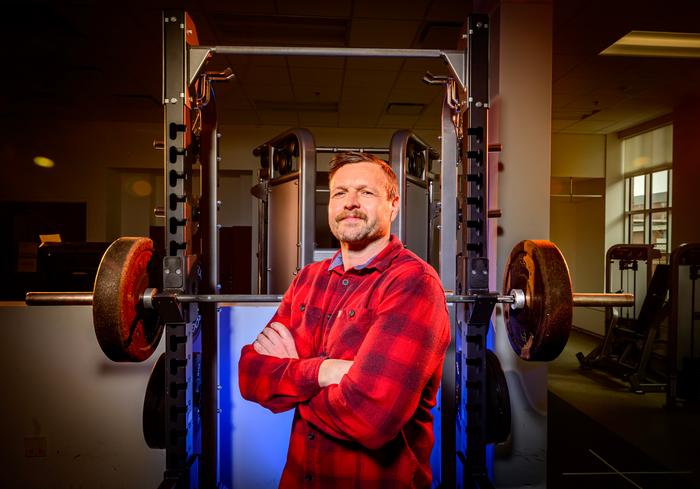
Six-time weightlifing champion Andy Askow is pursuing a Ph.D. at the University of Illinois (Photo provided)

To anyone who knows Andy Askow, the marrying of his personal interests and research interests is no surprise.

The Ph.D. candidate in the Department of Health and Kinesiology is a six-time national powerlifting champion. He’s also planning to defend his dissertation in the fall and graduate from the College of Applied Health Sciences at the University of Illinois Urbana-Champaign in December.

Askow’s dissertation is focused on a randomized controlled trial aiming to understand the role of dietary protein distribution throughout the day and dietary protein source on daily muscle protein synthetic rates throughout a nine-day intervention.

“We can’t look at nutrition without working with the exercise component as well,” said Askow, whose advisor is HK Associate Professor Nick Burd. “Certainly, it cradles a holistic approach to research and setting up to research and setting up the experiments.”

Askow came to Illinois in 2019 after completing his master’s degree in exercise physiology and sport science at Texas Christian University. Before that, he completed his bachelor’s degree in kinesiology and exercise science at University of Wisconsin-La Crosse. 

While at TCU, Askow—a Wisconsin native—came to Illinois for the summer to work as a research associate. During that time, he found he wanted to return to the Midwest for his Ph.D., and found a perfect fit in Burd’s Nutrition and Exercise Performance Group.

“We have an interest in trying to identify innovative approaches to promote muscle health across the lifespan,” Askow said. “And every day is complete chaos. It’s really inconsistent, but it’s a fun inconsistent. It doesn’t get stale, because nothing’s ever the same.”

Burd agreed.

“It’s always exciting,” Burd said. “Andy and I were just sitting here for a few hours this morning, trying to figure out some data sets. And I literally told him, ‘This is where you earned your Ph.D.’ It’s fun, being a critical thinker, and being in the trenches in terms of answering the questions, generating that cutting edge information and then sharing it with other people.”

In addition to carrying his course load and his workouts, Askow has also made time for awards. He’s won four scholarships, most recently the Laura J. Huelster Award in spring 2024.

“Being a Ph.D. student, there aren’t a lot of opportunities for external confirmation that you’re doing things the right way. Winning these awards has been a nice reminder that hard work pays off and that I’m on the right path.” 

As for future plans, Askow has been collaborating with Dr. Andrew Jagim, the director of Sports Medicine Research at the Mayo Clinic in Wisconsin, and hopes to return there after graduation.

As much mentorship as he offers, Burd knows that students, especially doctoral students, have to be self-starters.

“I’m just there to help them stay afloat and steer them in the right direction, but they’re really doing it on their own,” Burd said. “They’re just very self-driven. I’m there to help create a positive learning environment for him and help culture those passions and foster those passions.”

“The people that have been here have been some of my closest friends and collaborators,” Askow said. “I think you can’t get through a Ph.D. without having a good group around you or, it’s certainly not going to be very nice if you try.”

Related news

Boppart research to boost astronaut fitness on NASA’s mission to Mars


From left, chemical and biomolecular engineering professor Hyun Joon Kong, kinesiology and community health professors Nicholas Burd and Marni Boppart, psychology professor Justin Rhodes, and chemistry professor Jonathan Sweedler are gathered at Freer Hall.

Exercise looks a little different en route to the Red Planet, so Professor Marni Boppart got creative.

Boppart and her colleagues at the Beckman Institute for Advanced Science and Technology received $1 million from the Translational Research Institute for Space Health, a NASA-funded institute, to explore the regenerative power of cells in space. Their research will help protect human health aboard Orion, the spacecraft destined to ferry astronauts from the Earth to the moon and Mars.

Because of the Earth’s mass, our daily movement is generally sufficient to keep our muscles in fine working order. Astronauts soaring through space are not afforded the luxury of gravitational pull.

“Astronauts can lose up to 20% of muscle mass after just two weeks, and 1-2% of bone mineral density every month. The longer the space travel, the greater the deterioration of tissues and physiological systems in the human body,” said Boppart, a professor of kinesiology and community health studying the science of exercise at the University of Illinois Urbana-Champaign.

Before joining the university, Boppart specialized in high-altitude health hazards as an officer and aerospace physiologist in the U.S. Air Force. Her current research in the College of Applied Health Sciences focuses on the molecular underpinning of muscle loss and gain. She hopes to develop cell-inspired strategies for recovering strength in circumstances — like spaceflight — when movement and mobility are limited.

When TRISH invited researchers to explore new ways to protect astronaut health and performance by enhancing the human body’s own maintenance and cellular repair abilities, Boppart seized the opportunity. Her project reimagines interstellar fitness with a cellular flair. The institute was scouting for strategies to protect astronaut health during long-duration space exploration missions, including NASA’s ongoing Artemis program, which will set up a sustainable presence on the Moon and prepare for future missions to Mars.

The Artemis program’s chosen vessel is the spacecraft Orion, which launched unmanned from the Kennedy Space Center in November. At the top of the vessel’s formidable to-do list is ferrying the first woman and first person of color from the Earth to the moon, followed closely by establishing humanity’s first long-term lunar presence and eventually trekking to the Red Planet.

Square footage is limited on Orion, which assumes the trifold identities of dormitory, dining hall, and control room all in one. The spacecraft is understandably bereft of the specialized resistance and endurance equipment that astronauts have access to on the International Space Station.

“But even the most intense [exercise] protocols performed in space are not sufficient to overcome the negative impacts of microgravity,” said Boppart. “Alternatives to traditional exercise, ideally based on exercise principles, are required.”

With an approach fit for space travel, Boppart’s proposal turns our traditional understanding of exercise on its head — or rather, inside out. Instead of defining exercise by heavy footfalls or flailing limbs, she’s focusing squarely on the cellular relay underway within our muscles.

Honed by relentless evolution, our cells have yet to catch on to the concept of exercising for fun. When we lift heavy weights or engage in rigorous activities, our cells react with a well-intentioned stress response, deploying a battalion of chemicals into the bloodstream to boost our body’s ability to survive future threats. If a weight that once seemed too heavy becomes manageable with time and training, you have your overprotective, stressed-out cells to thank.

These chemical payloads don’t navigate the bloodstream’s harsh terrain on their own. Some are wrapped in a protective lipid layer called an extracellular vesicle, named for its pickup and delivery routes that transfer restorative chemicals from cell to cell.

Boppart believes that the extracellular vesicles our bodies generate after exercising, and the chemicals they contain, can trigger the restorative effects of exercise — even when no exercise has taken place.

“When we exercise, it’s not only our muscles that benefit, but all tissues, including the brain and skin. Our TRISH-sponsored work will directly test the ability of extracellular vesicles released after exercise to protect human health in space,” Boppart said.

The broad aim of Boppart’s study is to use extracellular vesicles generated naturally by volunteers on Earth, or even artificially, to replicate the restorative effect of exercise in astronauts, essentially enabling their muscles to engage in post-exercise recovery without ever having to lift a space-suited finger.

“Astronauts are the target population for this funded study, but the result could potentially be used to prevent, maintain, or treat a variety of conditions associated with inactivity and disuse, including aging, disability, or even disease, which would be exceptionally fulfilling,” Boppart said.

Her interdisciplinary collaborators at the Beckman Institute include: Justin Rhodes, a professor of psychology; Taher Saif, a professor of mechanical science and engineering; Jonathan Sweedler, a professor of chemistry; and Hyun Joon Kong, a professor of chemical and biomolecular engineering. UIUC professor of kinesiology and community health Nicholas Burd is also a co-investigator.

Research for the project titled “Design of an extracellular vesicle approach to protect human health in space” is expected to begin in October 2023. The $1 million award will be dispersed over two years. This study is funded by the Translational Research Institute for Space Health at Baylor College of Medicine. TRISH is funded by the NASA Human Research Program. The award was administered through the TRISH Biomedical Research Advances for Space Health solicitation.

Related news

Exercise Is Medicine Is Gold For Illinois


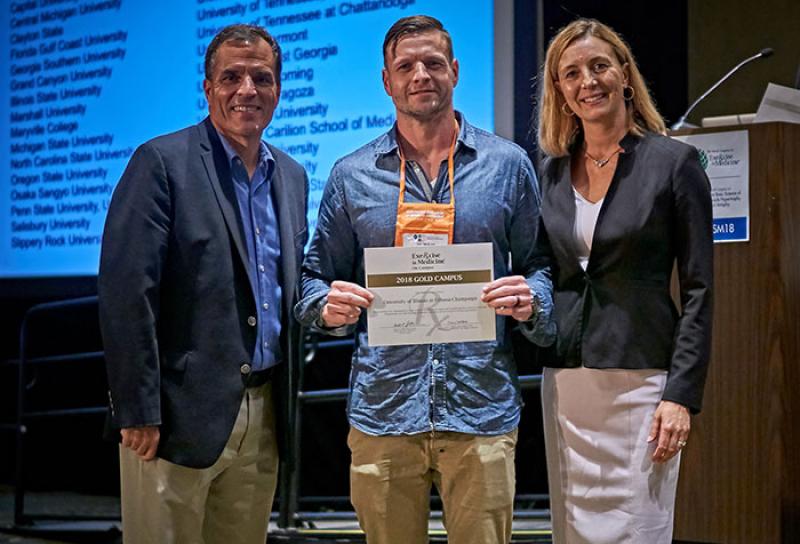
Nick Burd, center, is chair of the Exercise Is Medicine—On Campus committee (Photo provided)

The Illinois Exercise is Medicine—On Campus initiative has been recognized by the American College of Sports Medicine as a gold-level campus. UIUC is being recognized as a healthy academic environment, with physical activity and exercise opportunities and the commitment to create a culture of wellness on campus.

By encouraging faculty, staff and students to engage in regular physical activity and exercise, EIM-OC is positively influencing the overall health of the community. A focus of the initiative is to make movement a part of the daily campus culture, assessing physical activity, and giving students tools to build good physical activity habits, said Alana Harris, Associate Director Assessment, Student Wellness, and Adventure Recreation at Illinois Campus Recreation, who was a member of the founding committee at Illinois in the fall of 2017.

“It is creating a space and a place for students to see all of the different ways they can engage in physical activity and find things they enjoy doing,” she said. “We serve as a hub for all of the things related to physical activity and exercise that are available as resources and services to students on our campus.”

EIM-OC at Illinois has members from across campus and the community, with representation from the following areas: Kinesiology and Community Health, Campus Recreation, Counseling Center, McKinley Health, Christie Clinic and the Kinesiology Students Association. KCH assistant professor Nick Burd is the committee chair, and other members include Harris, Dr. Scott Paluska (Christie Clinic), Felicia Fordyce (McKinley Health), Deidre Weathersby (Counseling Center) and Alexis King, who is serving as the grad student representative.

The program serves multiple objectives: relationship builder, recruiting student participants for other programs, and spreading the word on important topics of wellness. The committee is designed as a mix of professionals and students to engage listeners in different ways, as well as provide experience to student facilitators.

“Everybody was working independently with the same common goal of improving the health and well-being of students and faculty,” Burd said. “And  this was an initiative to integrate us, people who have the same common goals—students and professionals on campus—to work together, to promote all of these great programs that we certainly have on campus. And that, I think, encompasses what EIM is.”

Harris agreed.

“We were doing great things already, but the recognition requirements state that your campus health center must discuss physical activity at health appointments. By simply asking students, during intake, at the McKinley Health Center if they are achieving the recommended 150-minutes of moderate intensity physical activity weekly we are building awareness and potentially giving a cue to action,” she said, “Something simple but potentially very impactful. We have partners at the Counseling Center who are represented on this committee … mental health is another new area of emphasis for this committee. And so we invited colleagues from the Counseling Center last year to assist in having conversations with students about the benefit of regular physical activity on mental health and cognition. Just recognizing that physical activity isn’t just for students who are already in good health, but that it has a positive impact no matter where you are on the health continuum and that your gateway to a more active lifestyle could be through many different doors on this campus.”

One of the main functions of the EIM program is making movement part of campus culture, but Burd and Harris were quick to point out that physical activity and exercise are different.

“Some of our initiatives have been around active transport,” Harris said. “So, building physical activity into your day. There is a deep pool of research supporting the benefits of moderate intensity exercise on health outcomes, but reductions in sedentary time and the accumulation of short bouts of physical activity throughout your day are also shown to have positive health effects. As part of our initiative, we encourage people to walk when they can, to ride their bikes when they can, and to engage structure moderate intensity exercise at the ARC if that’s what they enjoy.”

Harris says that as part of EIM month, in October every year, that the committee and Kinesiolosy students regularly set up activities on the quad.

“As students pass by on their way to class, we engage them. We bring Frisbees, soccer balls, skipping ropes, and footballs, and we had all different ways to ‘play’. We talk to them about opportunities on campus and the benefits of finding activities they enjoy doing to accumulate the recommended physical activity that they should get in a day, and that there are a lot of health benefits to that if that’s what you can fit in.”

But the part that “bumped us up into gold-level status” was the assessment piece, Burd said. “The first step of our assessment piece occurs at McKinley Health, where students provide information related to their physical activity levels, with the ultimate goal of McKinley Health to provide a referral system for students to increase their physical activity.” 

Harris said there is no formal assessment of activity levels, but added, “We’re focusing on awareness building and identifying gaps in opportunities. We’ve put out marketing and promotional materials about wearing activity trackers and set up free physical fitness assessments, again as cues to action. We encourage people to put prompts on their calendars every 60 minutes to get up and move until it becomes habitual.”

Of course, because of COVID-19, keeping people active when just going outside is fraught with issues can be problematic, and the Activities and Recreation Center on campus is closed.

But Harris said “we have really focused on maintaining our community through virtual opportunities. We have Illini Running and Illini Cycling intramural programs, where people are tracking and logging their participation. Our group fitness classes are being offered for free over Zoom, and in the fall we plan to continue virtual offerings via Facebook Live. So we’re looking at connecting people and creating community around physical activity and exercise in a virtual way. Students have been really positive about this and we would not have had this shift in programming without COVID 19. I think that outdoor space may allow us to continue to meet people where they are as well. Connecting exercise with being outside could prove to have positive impacts as well. But I think this next year will focus a lot on engaging people and creating communities virtually.”

Editor’s note:

To reach Vince Lara-Cinisomo, email vinlara@illinois.edu.
 

Related news

Podcast: A Few Minutes With … Nick Burd


Kinesiology and Community Health associate professor Nick Burd speaks with AHS media relations specialist Vince Lara about his research on potatoes as an exercise fuel and that physical activity and nutritional guidelines are inextricably linked.

Transcript

VINCE LARA: This is Vince Lara in the College of Applied Health Sciences at the University of Illinois. Today, I speak with Nick Burd, Associate Professor in the Department of Kinesiology and Community Health, to talk about his research on nutrition and exercise performance. So, Nick, what inspires your research?

NICK BURD: Yeah, sure. I’d say the inspiration comes from answering a lot of real world questions. A lot of our research is aimed at being translational in nature. Most of our work is done in vivo in humans, which obviously is a good model to be able to have translational messages.

VINCE LARA: Mm-hmm. Now why pick Illinois? I notice you went to Ball State, right? So you were in the general region, but why pick here for where you’re teaching?

NICK BURD: Well, I like corn, I like to see it, I like to eat it. No, but in all seriousness, so a lot of my research is tech specialized infrastructure. In particular, it would take this kind of R1 infrastructure, which we have here at the University of Illinois. So coming to a place that could support my research needs, but also had good colleagues in place to create a synergy with my research. And Illinois sort of checked all those boxes, so it just made a lot of sense to come here. And as you sort of alluded to, I was born in Ohio, so it’s sort of home as well in terms of the Midwest.

VINCE LARA: Got you. Now your recent research on the effectiveness of potatoes as exercise fuel got great media attention, so I’m wondering, what led you to study that?

NICK BURD: Yeah, I mean, a lot of my research, I view my research team, we are truly a team. So any project we develop, I sort of develop it in collaboration with my research team. And what I mean by that, my PhD students normally. So that particular idea was sort of derived in collaboration with one of my formal students, Joe Beals. He happened to be a cyclist. Anecdotally, he used potatoes as a fueling source during exercise. Scientifically, it made a lot of sense to test that as a fueling source. I mean, keep in mind, right, sports marketing is– sports nutrition marketing, in particular, they sort of have tuned us to think that we need these specialized sports gels, which they do work, but they can become expensive.

And just trying to find a strategy that’s not too fancy, simple, accessible, cost effective, sort of underpin that sort of idea, potato just happened to be a nutrient dense carbohydrate food source. Students wanted to do it. Scientifically, it made sense, so we went for it. And then sometimes I always say some of the most, I guess the best way to– some of these weird questions always get the most media attention, and that happened to be one of those, right? I think it’s because everybody could kind of relate to it. There’s a lot of runners out there. It was timed well around the marathon, some of the major marathons. So a lot of the news networks just grabbed it and ran.

VINCE LARA: You talked about in your answer here about cost effective means.

NICK BURD: Sure.

VINCE LARA: And so I’ve noticed some of your research really focuses on that, promoting health through diet and exercise changes in a cost effective way.

NICK BURD: Yeah, I’d say that’s fair. I mean, a lot of our work is focused on whole food-based approaches, right? Again, I think we get tuned that sometimes. Certain strategies have to be specially formulated or highly specialized. But a lot of research is aimed at it doesn’t have to be that fancy. And let’s be honest here, a lot of my work is aimed at protein, dietary protein in particular, trying to optimize that within a diet. In terms of that, protein supplements are huge. And once again, they could become expensive.

And we need to be more focused on food first approaches, is what I say. Supplements are fine, but they should be just that, a supplement. But a lot of times, these are the front line strategy for people. But we need to stay focused on the food first approaches. Exercise is a brilliant tool to utilize to support a healthy lifestyle. I mean, it goes back to the old adage, you are what you eat and how you move, right? And that’s what our research shows. It’s aimed at showing that.

VINCE LARA: I know that you hope to look at aging and chronic disease and how exercise and diet can combat those conditions. Talk a little bit more about that, if you would.

NICK BURD: Yeah, I mean, I’m trained as a muscle physiologist, so a lot of times we’re focused on skeletal muscle health. And we do that for a variety of reasons, not to get too reductionist, but muscle has a lot of pertinent roles in a healthy lifestyle, in particular, huge contributor to basal metabolic rate, which for most of us is the biggest contributor to total daily energy expenditure. So we want to make sure we’re protecting muscle for weight maintenance essentially. And certainly, if you were under a period of energy restriction and lose some weight, you don’t want to lose muscle because that’s going to put you at a greater chance for weight regain.

But for metabolic health as well as for performance, we’re focused on muscle. But our experiments, we study obesity, obviously a prevalent disease, especially in Western society, end stage renal disease, aging. These are all areas of emphasis for us because, once again, these are all situations where muscle health is compromised. So we need strategies to sort of help or improve or augment muscle health so hopefully we can ultimately improve overall health.

VINCE LARA: My thanks to Nick Burd. This has been A Few Minutes With.

Related news

College of Applied Health Sciences
110 Huff Hall
1206 South 4th Street
Champaign, IL 61820
(217) 333-2131