Boppart calls investiture a career highlight


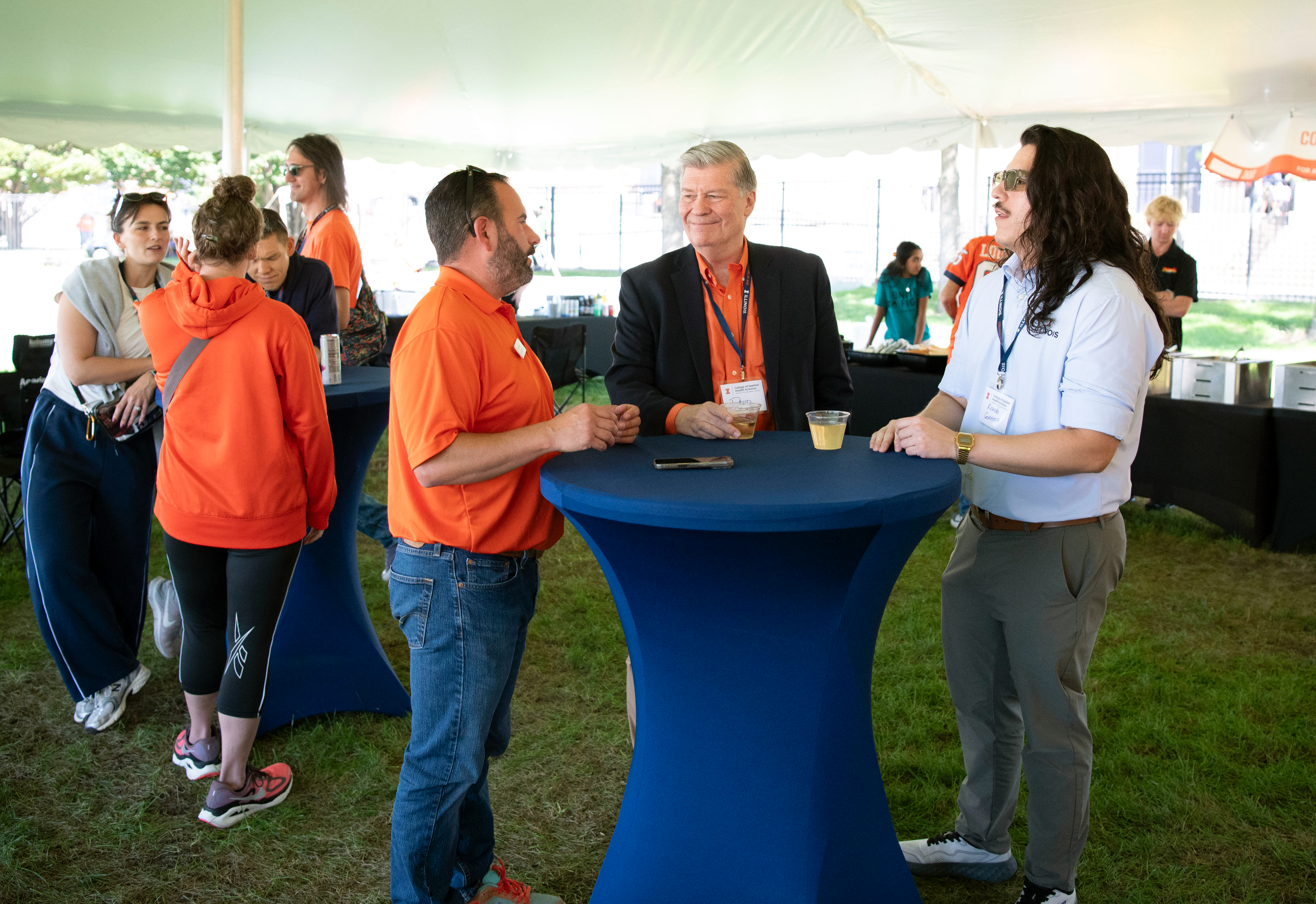
Marni Boppart, second from right, poses with husband Stephen, left, her daughters, and Chancellor Robert Jones, center. (Photo by Darrell Hoemann)

Marni Boppart’s trajectory to named professorship at the University of Illinois Urbana-Champaign began as a kid playing in the Pine Barrens of New Jersey.

Boppart, a professor in the Department of Health and Kinesiology in the College of Applied Health Sciences, was named the Saul J. Morse and Anne B. Morgan Professor at an investiture ceremony on Sept. 6.

But long before her illustrious career studying cellular biomechanics and muscle began, Boppart’s interests were taking roots in the woods.

“I would describe myself as a very active kid growing up,” she said at the investiture. “All our recreational time was spent outdoors playing baseball, basketball, kickball, riding my bike and jumping over ramps and doing crazy things that my mom still doesn’t know about. I grew up in in the Pine Barrens of New Jersey, and the woods were our playground. I mention this because it really influenced my decision to pursue my first degree in biology at the University of New Hampshire. This provided the opportunity to continue to explore the great outdoors, hiking, rock climbing, skiing, and even trying my hand at hang gliding—without hurting myself.”

As a biology major, Boppart was required to take a course in immunology and was assigned to write a paper on the effects of exercise on immune function. 

“I thought, ‘Well, this was a really odd topic. What would exercise have anything to do with immune cells in the body? If you recall, the 80’s were defined by the fitness craze,” she said. “I think I still have my ThighMaster and Jane Fonda tapes sitting in a closet somewhere. The idea that exercise could be beneficial for health and prevent disease was still relatively new. What started as a simple class assignment grew into a life-long obsession with wanting to understand how exercise or the process of muscle contraction could benefit not only muscle, but all organ systems and whole body health.”

Boppart spent time in the Air Force as an aerospace physiologist, then decided to pursue a Ph.D. in Applied Anatomy and Physiology at Boston University. Working with two “powerhouse investigators” in the field of exercise science—Roger Fielding at BU and Laurie Goodyear at Harvard Medical School—the trio was able to document some of the first observations of molecular changes occurring in human muscle as a result of exercise.

“Like most researchers, I had more questions than answers at the end of my doctoral program: How does exercise, or the process of contraction stimulate molecular changes in muscle, what do these changes really mean for structure and function, and going back to my original interest, what is released by muscle into the circulation that might influence whole body health?,” she said.

For Boppart, those question led to what is now a 30-year career studying muscle.

Using transgenic mice, Boppart and her lab partners were able to determine that the integrin complex not only controlled molecular signaling in muscle, but also contributed to skeletal muscle remodeling and growth in response to exercise.

“But then everything changed in 2013,” she said.

That year, Boppart said, she and her lab mates were the first to report that exercise can result in the accumulation of perivascular stem cells in muscle.

“We found that these cells secrete beneficial factors that not only influence muscle remodeling and growth, but structures outside of muscle as well, including vessels and the brain. And so we started to wonder … could these stem cells be used to treat a disease or condition?”

Boppart’s interest in healthy aging led to a study of whether stem cells could be used to address age-related disabilities, particularly slowing the progression of muscle loss. While she found that stem cells were not effective in slowing the progression of muscle loss or regrowing muscle after disuse, she did find if she isolated nanoparticles (or extracellular vesicles or exosomes) from the stem cells first and then injected them into the aged mice, they could successfully recover muscle growth, which is the first step in preventing disability. That discovery led to new sources of funding, including funding from NASA and private foundations such as the Allen Institute.

Cheryl Hanley-Maxwell, dean of the College of Applied Health Sciences, praised Boppart and her work.

“Being named to an endowed position is a singular honor for faculty members,” Hanley-Maxwell said. “Those who hold named professorships are at the top of their fields, and that is certainly true of our honoree today. When I think of Marni, I think of unwavering integrity, deep intellectual curiosity, unconditional dedication to her students, and absolute passion for her work. And humility.”

The named professorship is endowed by Saul Morse and Anne Morgan. Morse earned two degrees at the University of Illinois, including a law degree and is an alumnus of AHS’s Disability Resources and Educational Services. He retired in 2023 after a 50-year career in law. Morgan is a clinical psychologist who retired after more than 30 years of practice in health psychology.

“I would like to thank our donors, Saul and Anne, for their generous contributions to the University of Illinois and the College of Applied Health Sciences,” Boppart said. “I am deeply honored and humbled by this recognition. And I am humbled because, as I look around the room, I see many experts in the fields of health, aging, and disability. To know that several of you nominated me for this award is a bit overwhelming. Thank you for this opportunity. I will remember tonight always.”

Boppart thanked her mentors, HK Department Head Kim Graber and Professor Jeff Woods, as well as her collaborators and colleagues.

Turning toward her future plans, Boppart is energized about what’s next.

“We would like to use our funding and this professorship to translate our EV therapy to humans. I’m confident we can do this,” she said. “Not only because clinical trials with stem cell-derived EVs are already occurring in the U.S. in places like the Mayo Clinic, but also because I have an amazing interdisciplinary research team to help make it possible.”

Editor’s note:

To reach Vince Lara-Cinisomo, email vinlara@illinois.edu.
 

Related news

Boppart research to boost astronaut fitness on NASA’s mission to Mars


From left, chemical and biomolecular engineering professor Hyun Joon Kong, kinesiology and community health professors Nicholas Burd and Marni Boppart, psychology professor Justin Rhodes, and chemistry professor Jonathan Sweedler are gathered at Freer Hall.

Exercise looks a little different en route to the Red Planet, so Professor Marni Boppart got creative.

Boppart and her colleagues at the Beckman Institute for Advanced Science and Technology received $1 million from the Translational Research Institute for Space Health, a NASA-funded institute, to explore the regenerative power of cells in space. Their research will help protect human health aboard Orion, the spacecraft destined to ferry astronauts from the Earth to the moon and Mars.

Because of the Earth’s mass, our daily movement is generally sufficient to keep our muscles in fine working order. Astronauts soaring through space are not afforded the luxury of gravitational pull.

“Astronauts can lose up to 20% of muscle mass after just two weeks, and 1-2% of bone mineral density every month. The longer the space travel, the greater the deterioration of tissues and physiological systems in the human body,” said Boppart, a professor of kinesiology and community health studying the science of exercise at the University of Illinois Urbana-Champaign.

Before joining the university, Boppart specialized in high-altitude health hazards as an officer and aerospace physiologist in the U.S. Air Force. Her current research in the College of Applied Health Sciences focuses on the molecular underpinning of muscle loss and gain. She hopes to develop cell-inspired strategies for recovering strength in circumstances — like spaceflight — when movement and mobility are limited.

When TRISH invited researchers to explore new ways to protect astronaut health and performance by enhancing the human body’s own maintenance and cellular repair abilities, Boppart seized the opportunity. Her project reimagines interstellar fitness with a cellular flair. The institute was scouting for strategies to protect astronaut health during long-duration space exploration missions, including NASA’s ongoing Artemis program, which will set up a sustainable presence on the Moon and prepare for future missions to Mars.

The Artemis program’s chosen vessel is the spacecraft Orion, which launched unmanned from the Kennedy Space Center in November. At the top of the vessel’s formidable to-do list is ferrying the first woman and first person of color from the Earth to the moon, followed closely by establishing humanity’s first long-term lunar presence and eventually trekking to the Red Planet.

Square footage is limited on Orion, which assumes the trifold identities of dormitory, dining hall, and control room all in one. The spacecraft is understandably bereft of the specialized resistance and endurance equipment that astronauts have access to on the International Space Station.

“But even the most intense [exercise] protocols performed in space are not sufficient to overcome the negative impacts of microgravity,” said Boppart. “Alternatives to traditional exercise, ideally based on exercise principles, are required.”

With an approach fit for space travel, Boppart’s proposal turns our traditional understanding of exercise on its head — or rather, inside out. Instead of defining exercise by heavy footfalls or flailing limbs, she’s focusing squarely on the cellular relay underway within our muscles.

Honed by relentless evolution, our cells have yet to catch on to the concept of exercising for fun. When we lift heavy weights or engage in rigorous activities, our cells react with a well-intentioned stress response, deploying a battalion of chemicals into the bloodstream to boost our body’s ability to survive future threats. If a weight that once seemed too heavy becomes manageable with time and training, you have your overprotective, stressed-out cells to thank.

These chemical payloads don’t navigate the bloodstream’s harsh terrain on their own. Some are wrapped in a protective lipid layer called an extracellular vesicle, named for its pickup and delivery routes that transfer restorative chemicals from cell to cell.

Boppart believes that the extracellular vesicles our bodies generate after exercising, and the chemicals they contain, can trigger the restorative effects of exercise — even when no exercise has taken place.

“When we exercise, it’s not only our muscles that benefit, but all tissues, including the brain and skin. Our TRISH-sponsored work will directly test the ability of extracellular vesicles released after exercise to protect human health in space,” Boppart said.

The broad aim of Boppart’s study is to use extracellular vesicles generated naturally by volunteers on Earth, or even artificially, to replicate the restorative effect of exercise in astronauts, essentially enabling their muscles to engage in post-exercise recovery without ever having to lift a space-suited finger.

“Astronauts are the target population for this funded study, but the result could potentially be used to prevent, maintain, or treat a variety of conditions associated with inactivity and disuse, including aging, disability, or even disease, which would be exceptionally fulfilling,” Boppart said.

Her interdisciplinary collaborators at the Beckman Institute include: Justin Rhodes, a professor of psychology; Taher Saif, a professor of mechanical science and engineering; Jonathan Sweedler, a professor of chemistry; and Hyun Joon Kong, a professor of chemical and biomolecular engineering. UIUC professor of kinesiology and community health Nicholas Burd is also a co-investigator.

Research for the project titled “Design of an extracellular vesicle approach to protect human health in space” is expected to begin in October 2023. The $1 million award will be dispersed over two years. This study is funded by the Translational Research Institute for Space Health at Baylor College of Medicine. TRISH is funded by the NASA Human Research Program. The award was administered through the TRISH Biomedical Research Advances for Space Health solicitation.

Related news

Boppart awarded Beckman’s Vision and Spirit Award


The Beckman Institute Vision and Spirit Award.

Marni Boppart, an associate professor of kinesiology and community health, is the 2020 winner of the Beckman Institute Vision and Spirit Award. Boppart is also a faculty member in the Carle Illinois College of Medicine and at the Carle R. Woese Institute for Genomic Biology.

You can read more about the award in the Beckman Institute’s release.


Related news


College of Applied Health Sciences
110 Huff Hall
1206 South 4th Street
Champaign, IL 61820
(217) 333-2131