Our College of Applied Health Sciences college awards.
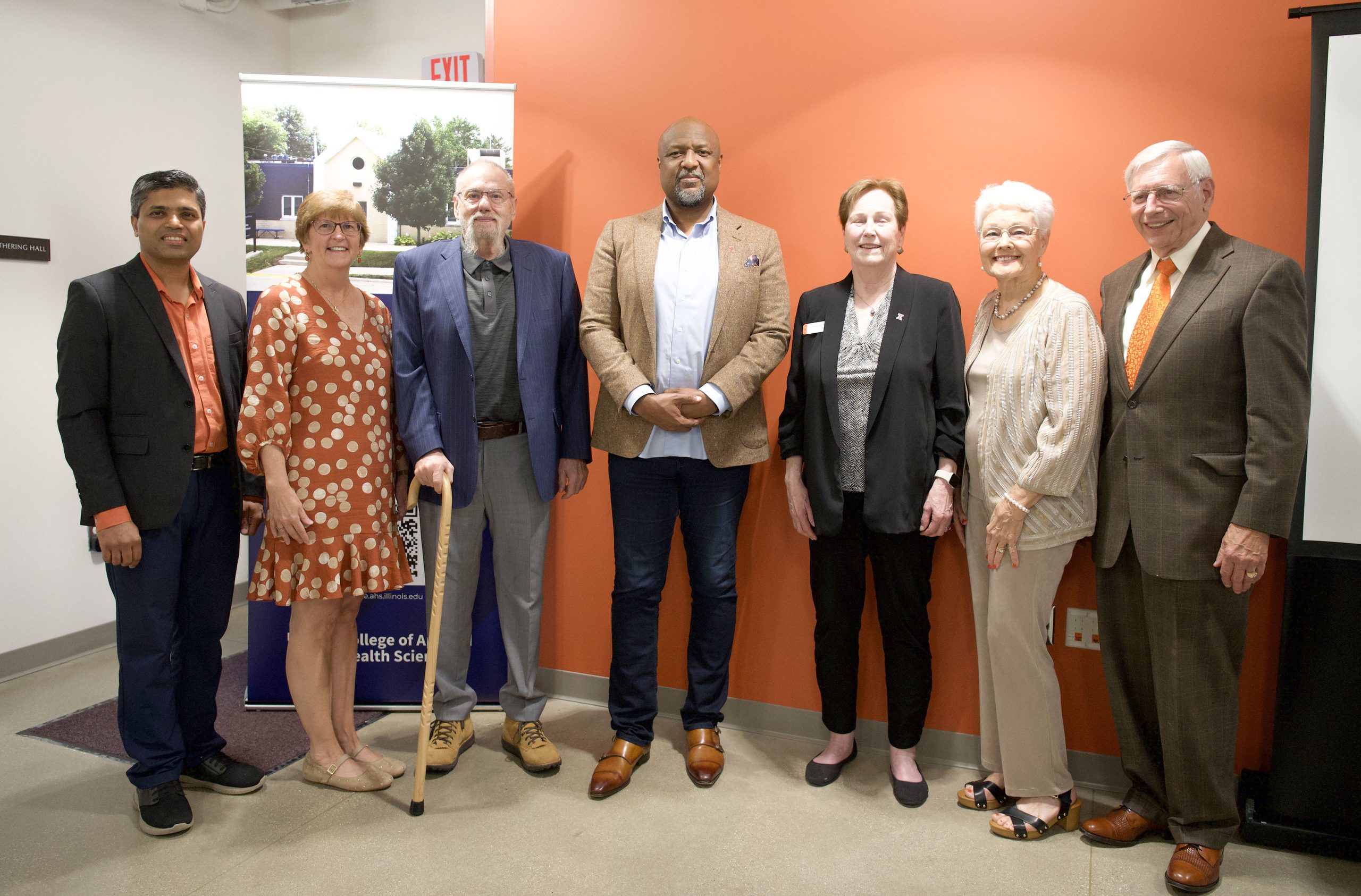
The College of Applied Health Sciences has awarded eleven faculty, staff, and students college awards for excellence. Three individuals received campus-level awards. All recipients will be honored at the Spring College Meeting in May.
AHS Excellence in Undergraduate Teaching Award: Faculty Campus Award for Excellence in Undergraduate Teaching Associate Professor Andiara Schwingel, Department of Kinesiology and Community Health Since joining KCH as a visiting scholar in 2008, Dr. Schwingel has taught more than 40 courses and appears regularly on the List of Teachers Ranked as Excellent. She founded START, Student Aging Researchers in Training, which places undergraduates in labs across the college, and has mentored more than 30 START scholars in the Aging and Diversity Lab. She is the current Associate Head for Undergraduate Studies in Community Health. She also received this award in 2018, and in 2013 was awarded the Phyllis J. Hill Award for Exemplary Mentoring in the Edmund J. James Scholar Program.
AHS Excellence in Undergraduate Teaching Award: Teaching Assistant Allyson Box, Ph.D. student, Department of Kinesiology and Community Health Allyson is a Graduate Research Assistant in Dr. Steve Petruzzello’s Exercise Psychophysiology Lab and a Teaching Assistant for his undergraduate class on the social and psychological aspects of physical activity. She has been named to the List of Teachers Ranked as Excellent every semester since the fall of 2017. Students described Allyson as “approachable,” “passionate,” “an exemplary teacher,” and “an exceptional communicator.” One said, “She encourages us to share our ideas and asks us thought-provoking questions, which has allowed me to gain confidence and develop my critical thinking skills.”
AHS Excellence in Online & Distance Teaching Professor Monika Stodolska, Department of Recreation, Sport and Tourism Dr. Stodolska played an instrumental role in developing and implementing RST’s online master’s program in 2012. She created the first RST course offered online, Theories and Concepts of Leisure, which she recently revised by developing new content and engagement activities that foster meaningful student interaction, and recording more than 40 video lectures. The AHS e-Learning team regularly shares her lectures with other faculty as outstanding examples of online content. She also converted the campus-based undergraduate course on diversity in recreation, sport, and tourism into an online course that enrolled more than 450 students in the fall of 2021.
AHS Excellence in Graduate and Professional Teaching Award Campus Award for Excellence in Graduate and Professional Teaching Associate Professor Toni Liechty, Department of Recreation, Sport and Tourism Dr. Liechty has taught courses for both the on-campus and online master’s degree programs in RST, and developed a course on legal aspects of RST that she has taught in both programs. She also teaches classes for the doctoral program. Dr. Liechty is deeply committed to diversity and takes steps not only to ensure that all students in her classes are able to make meaningful contributions, but also to make all of her students aware of the value of the diversity of perspectives. She often adjusts course syllabi to accommodate students’ various research interests.
AHS Excellence in Graduate Student Mentoring Award Associate Professor Raksha Mudar, Department of Speech and Hearing Science Dr. Mudar has guided the work of three Ph.D. students and several M.A. students in the Aging and Neurocognition Lab. All three Ph.D. students published research papers under her mentorship. Her two current doctoral students have received highly competitive 2021-2022 national scholarships from the American Speech-Language-Hearing Foundation. One also received a prestigious Dissertation Completion Fellowship from the University of Illinois Urbana-Champaign Graduate College. As the Director of Graduate Studies in SHS, Dr. Mudar ensures that more than 100 graduate students meet program milestones and provides support to faculty for graduate mentoring and advising.
Phyllis J. Hill James Scholar Award for Exemplary Mentoring Professor Steven Petruzzello, Department of Kinesiology and Community Health Dr. Petruzzello also received this award in 2018. Since that time, he has mentored almost 40 additional students enrolled in the James Scholar Program. He works with each student to help them identify their area of research interest and how best to pursue it, guides them through relevant literature reviews, and provides them with regular feedback as they complete their projects. Students describe him as enthusiastic, caring, and passionate. He has been called “one of the most impactful faculty members that I have worked with” and students greatly appreciate his commitment to their success and well-being.
Campus Award for Excellence in Undergraduate Advising Amy O’Neill, Department of Kinesiology and Community Health Since joining KCH as an Academic Advisor for kinesiology in 2003, Amy has shepherded thousands of undergraduate students through their studies. In addition to her one-on-one advising duties, she teaches the introductory kinesiology course to new first-year and transfer students. She developed a kinesiology advising website to share important resources with students and sends out a weekly email message to make them aware of opportunities for involvement in the department, college, and campus. She also has played significant roles on departmental, college, and campus committees related to student registration, honors and awards, and scholarships.
AHS Academic Professional Staff Excellence Award Ann Fredricksen, Division of Disability Resources and Educational Services After starting with DRES captioning videos in 2008, Ann has become the Coordinator of DRES’s Accessible Media Services. She oversees the captioning of videos, trains and manages student workers, develops captioning and audio description standards for the campus, and creates and administers educational outreach activities related to captioning and accessibility. Since the COVID pandemic began in late March 2020, she has been responsible for the captioning of more than 1000 hours of video material. She has created Math and Science Captioning Standards and Best Practices for STEM fields and co-developed an online captioning certification course.
AHS Custom Class Staff Excellence Award Heidi Krahling, Center on Health, Aging, and Disability Heidi has been providing outstanding support to faculty, staff, and students before and during the grant submission process as CHAD’s Grant Specialist since 2018. She brings her commitment to the advancement of science, keen eye for detail, and dedication to submitting grants error free and on time to bear on each proposal, and played a critical role in the college’s success in receiving its greatest amount of external research funding ever in 2020, more than $18 million. Grant seekers appreciate that Heidi’s skills enable them to focus on the scientific content of their proposals.
AHS Staff Excellence Awards Sally Marshall, Dean’s Office Sally brings strong organizational, communication, and multitasking skills to her work as the Office Administrator in the AHS Dean’s Office. She has provided support to the Senior Assistant Dean for Undergraduate Recruitment, Advising, and Enrichment, and is the primary support person for the Associate Dean for Academic Affairs. She assists with planning major events such as Ph.D. Recruitment Day and the AHS Distinguished Lecturer Series, serves as the liaison between the Associate Dean and departmental directors of undergraduate and graduate studies, and supports the Associate Dean in his role as Interim Director of the Chez Veterans Center.
Kathy Saathoff, Office of Advancement As the Office Administrator, Kathy supports the Assistant Dean for Advancement, two Major Gift Officers, and the Associate Director for External Engagement. She manages the execution of the critical gift acknowledgement process, handles multiple requests for research and reports, plans donor visits, and helps to complete donor fund agreements. Advancement personnel across campus regard Kathy as a friendly resource with deep institutional knowledge, developed during both her current position and her previous position with the University of Illinois Foundation. Colleagues describe her as “an exceptional teammate” who is always able to see the big picture.
Community Health Workers, or CHWs, are an underrecognized layer of the health care system
For Department of Kinesiology and Community Health researchers Andiara Schwingel and Susan Aguiñaga, the concept of helping place Community Health Workers has a personal meaning.
Schwingel, a KCH associate professor, and Aguiñaga, an assistant professor in KCH, recently received a grant of $100,000 for their project entitled, “Online Certificate Programs for Community Health Workers: From Overlooked and Under‑Researched Employees to Well‑equipped Frontline Agents in the Fight to Reduce Health Disparities in Communities of Color. Drs. Schwingel and Aguiñaga plan to establish a coalition that includes Community Health Workers (CHWs) and other stakeholders to develop, evaluate, and disseminate online learning strategies through certificate programs that will train CHWs to address community health needs.
CHWs are full- or part-time employees of health systems. With at least a high school diploma, CHWs receive on-the-job training and work in multidisciplinary teams focused on primary health care, prevention, and health promotion, the researchers said. Although the CHW model is widely utilized across the globe, the U.S. and Illinois have only recently begun to recognize its importance and develop the infrastructure that supports these grassroots health workers. No online training is currently available in Illinois, a gap that Schwingel and Aguiñaga said they want to fill. Illinois is currently developing recommendations for training and certification programs, and, the researchers said, significant progress has been made in Illinois where House Bill HB5412 passed in February 2021, building momentum for CHWs training and this project.
The researchers sought the grant because they believe CHWs are ideal members of collaborative healthcare and prevention teams working with vulnerable populations and underserved communities as they complement the work of formally trained healthcare professionals.
“As I have lived in many different countries, I am very familiar with universal health care systems that adopt the CHW model,” Schwingel said. “I have seen firsthand the important role they play at community settings as frontline workers visiting homes, being a resource and serving as the go-to people for the community. They also carry the voices and opinions of community members to local healthcare teams. I have seen how effective CHWs are in bringing people to clinics for immunization programs and health promotion events.”
Schwingel said she was motivated to address healthcare systems when she moved to the United States about 12 years ago.
“I found that through my research I could contribute to addressing disparities in health by testing the feasibility of using the CHW model with Hispanic communities in this country.”
Schwingel said her goal is to greatly increase the number of CHWs locally.
“That way, when my research funding ends, the community is left with important human resources to continue the endeavors. Over the years, I have experienced a number of challenges working with volunteer CHWs due to the lack of a state/national reimbursement system for these workers. Nonetheless, my interest has only grown, and I have seen increasing interest in this space by grass roots organizations, healthcare employers, and even state and national agencies.”
One of the vital parts of building a CHW pipeline in Illinois is that the CHWs know well and have easy access to hard-to-reach groups such as historically underrepresented populations of African Americans and Hispanics (which includes undocumented individuals), the researchers said, adding that CHWs are members of the communities that they serve, they share culture, language, income, and life experiences. The CHWs can serve as liaisons between health and social services, especially as the percentage of the underrepresented population rises; in fact, by 2050, that population projects to represent 43 percent of the state and national population by 2050.
The researchers said they will work with partners such as the University of Illinois Extension, the Illinois Community Health Workers Association, a group of CHWs that serve African American and Hispanic communities, and a group of CHW employer organizations.
Schwingel and Aguiñaga also plan to use what they call a “culturally and linguistically sensitive approach.” For two women of color, that is especially important, Schwingel said, calling it a “transformational” process.
“It makes use of a patient’s language and culture as tools to improve outcomes for that individual. By tailoring services to an individual’s culture and language preference, health professionals can help bring about positive health outcomes for diverse populations,” she said.